ONE-BRAND SYSTEMS
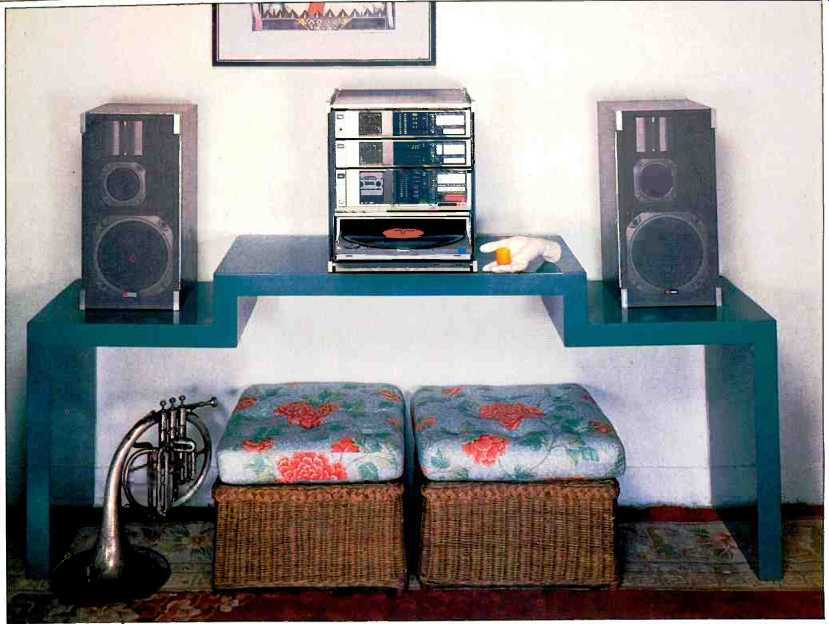
The initials in this system's name stand for "Synchro Performance Audio Network," a unique inter connection method which lets the V 1000G's components act together like a single unit. However, you must use only the components offered, with the possible exception of the turntable and the definite exception of the optional speakers. (In my tests, I did not use Aiwa's speakers and recommend using something larger and of higher quality for best sound.) Interconnection is extremely simple: With the glass rack accompanying the "G" system or the wood rack of the less expensive V-1000X, one just places the components in position and plugs them into prewired connectors in the rack's back plate. Additional cables are supplied for those who do not wish to use a rack.
Even without the rack, however, the lengths of the cables supplied are such that you must stack the components as shown in the owner's manual, unless you buy longer cables with the appropriate DIN plugs (not all identical). Ordinarily, however, the Model LX-100, linear-tracking turntable goes on top; the Model MX-100 amplifier (which also acts as the system's control center) goes just below it. Below that will be the Model TX-100 frequency-synthesized tuner, resting atop the Model FX-100 Dolby B/C-equipped cassette deck. (All components have "footprints" slightly larger than a re cord jacket's, just under 13 inches on each side.) Even the various a.c. power cords must be hooked up a specific way in order for the interactive features of the system to work properly. Once all the connections are made, the only "spare" inputs available are a pair of "AUX" terminals. There is no provision for tape monitoring or the addition of any sort of signal processing equipment (dbx decoder, equalizer, etc.).
Neither is there any circuit interruption point between the preamp-control section of the integrated amplifier and the power amplifier section.
There are, of course, operating ad vantages to this arrangement. The amplifier's program source selectors for "Phono," "AUX," and "Tuner" are paralleled on the cassette deck, so you can select a source for taping without reaching back up to the amp. If you go into "Record" mode when the system is set for "Phono," the tape deck goes into "Record Pause" mode, automatically starting the tape when the tonearm comes to rest on the first groove of the spinning record. These neat tricks, and more, are all made possible by those extra wires inside the supplied interconnecting cables.
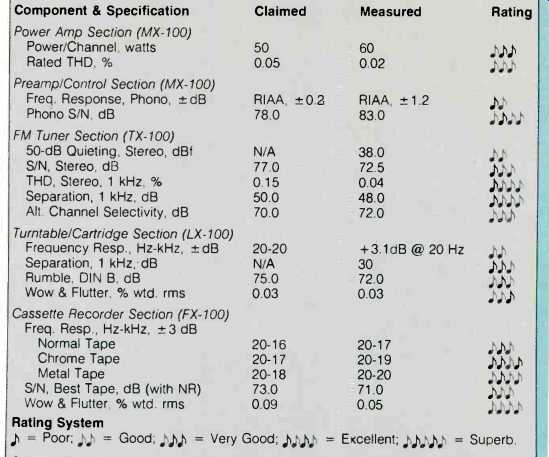
The MX-100 integrated amplifier has an accurate LED power-output indicator referenced to 8-ohm loads. Next to it is a corresponding volume-level indicator which is necessary because volume levels are altered by means of up/ down keypads rather than a rotary level control. Several other indicators in form the user about amplifier status, including a "Tone" indicator, since the bass and treble controls of this unit can be bypassed if desired. A DSL ("Dynamic Super Loudness") switch boosts bass below 100 Hz for rooms or speakers requiring it, but boost diminishes as the level control is advanced for speaker protection. The amplifier is equipped with a microphone input jack and an associated volume control, for mixing live mike sounds with other pro grain sources when listening or re cording. There is also a jack for a re mote control, as yet unavailable. The MX-100 delivered a full 60 watts per channel for its rated distortion, even at the audio frequency extremes of 20 Hz and 20 kHz.
Aside from its excellent frequency synthesized tuning circuitry, the TX 100 tuner features a real-time digital clock display and timer which can be programmed to turn on the tuner and thereby the entire system. It is the tuner's line cord that is connected to a wall socket, with all other line cords connected to its convenience outlets or to convenience outlets on the amplifier. Power will switch off automatically, about 64 minutes after a timed start, or after a front-panel sleep-timer button is pressed. As for its operation as a tuner, sensitivity was just average (an out door antenna is recommended), but distortion was surprisingly low and stereo FM separation was excellent.
There are memory presets for six FM and six AM stations.
============
ONE-BRAND SYSTEM RATINGS
General Comments
Power Amplifier: Sound quality very good, power output conservatively rated. Phono equalization slightly off in bass region. Good switching arrangement between components. Turntable & Cartridge: Properly matched to each other, but cartridge response further accentuates extra bass boost. If replacing, choose a high-output moving-magnet cartridge. Tuner: Well designed and easy to use, with special features not normally found on separate tuner components. Cassette Deck' Exhibited excellent frequency response and good Dolby C tracking. Excellent interface with the amplifier and with the rest of the system.
Overall Comment: While this system makes good use of the fact that it is sold as a complete music system, it also sacrifices some features that are found in separate components, such as a tape monitor loop. On the whole, however, Aiwa manages to cram a great deal of audio performance into a very small space at a very attractive price. A fine system for small apartments, second homes, and the like.
Overall Rating:
============
Perhaps the most outstanding component of this system is the turntable, Model LX-100. Its tangential-tracking tonearm is equipped with an Ortofon VMS-type cartridge of extremely low mass. Thanks to the front-loading system (records are slipped in from the front, after a "Load" button causes a drawer-like ejection of the entire turntable tray mechanism), no clearance for lifting the dust cover is needed. Such operations as lowering or raising the tonearm are controlled from the front panel. Record size is automatically detected by the tonearm. My only criticism of the system had to do with a slight rise in the cartridge's bass response which, combined with an equally small one in the amplifier's response, added up to +3.1 dB. Of course, slight counterclockwise rotation of the bass control easily compensates for this response error. Wow and flutter and distortion were very low, and separation was excellent using this turntable/cartridge combination. I found it easy to cue the tonearm very accurately using the "Backward" and "Forward" tonearm guidance buttons on the front panel. The linear-tracking arm delivered its advantages without imposing any new friction-related problems.
Aiwa very wisely elected not to build a permanent MPX filter into their Model FX-100 cassette deck. As a result, using premium tape, frequency response proved to be better than claimed for all generic types of tape tested. Of course, it's only because Aiwa had control of the design of the matching tuner that they were able to omit this type of filter; the tuner hasn't got enough unwanted subcarrier product output to cause problems here. Wow and flutter was far lower than claimed.
Signal-to-noise fell a bit short of claims, but an actual S/N of 71 dB, using Dolby C (which tracked very well in the record/play cycle on this deck), is nothing to complain about. The deck has a music-sensing feature (to detect silence between taped selections) and a vernier bias adjust which, for some strange reason, is only operative with normal bias tapes. Perhaps this is be cause normal ferric oxide tapes show the greatest variations in bias requirements, but Type II tapes could benefit, too. Here, again, another advantage of one-brand system design is in evidence. You can have this deck record (or play) at a predetermined time, using its "Timer" button and the clock timer on the tuner. This would require an external separate timer in a conventional component system, if it could be done at all.
By keeping the size somewhat larger than that of the "mini" components Aiwa and others promoted some time ago, the price of this system has been kept within bounds. In my opinion, it represents excellent value. For anyone who wants convenience and simplicity of operation, and isn't too worried about later add-ons and embellishments, I wouldn't hesitate to recommend the Aiwa V-1000G.
-Leonard Feldman
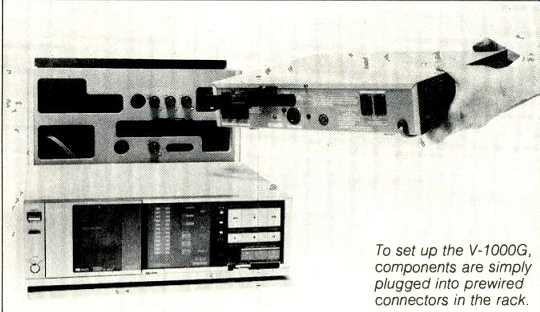
---- To set up the V-1000G, components are simply plugged into prewired
connectors in the rack.
(Audio magazine, Mar. 1983)
Also see:
Aiwa Model AD-6550 Stereo Cassette Deck (Dec. 1978)
= = = =