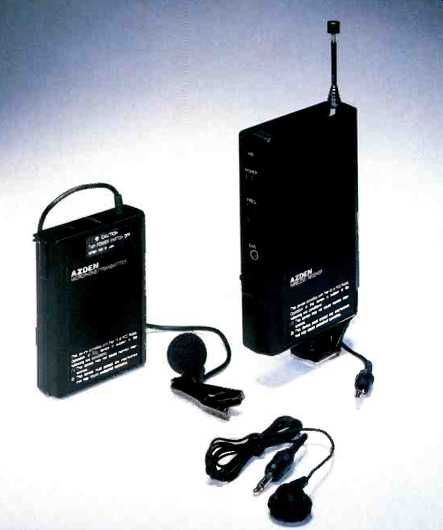
Manufacturer's Specifications:
Transmitter Transmission Frequencies: 49.830 and 49.890 MHz.
Modulation System: FM.
Microphone: Electret condenser, 5 mm diameter.
Maximum Input Level: 94 dB SPL at 3.3 kHz.
Field Strength: 10,000 µV/meter (10 mV/meter) or less, at 3 meters.
Battery: One AA (MN-1500), 1.5 V (not included).
Power Consumption: 27 mA.
Battery Life: Approximately 20 hours.
Dimensions: Microphone, 5/16 in. diameter x 11/16 in. long (8 mm x 17 mm); transmitter, 3 1/4 in. H x 2 1/2 in. W x 7/8 in. D (83 mm x 63 mm x 22 mm); cord, 1/10 in. diameter x 39 3/8 in. long (2.5 mm x 1 meter).
Weight: 3.9 oz., including battery.
Receiver Circuit Type: Double superheterodyne.
Reception Sensitivity: 2 uV/meter
Outputs: Monitor, 0.6 V at 10 ohms, microphone, 3 mV at 300 ohms.
Battery: One 6F22 (MN-1604), 9 V (not included).
Power Consumption: 20 mA.
Battery Life: Approximately 20 hours.
Dimensions: 5 11/16 in. H x 3 in. W x 15/16 in. D (145 mm x 77 mm x 24 mm).
Weight: 6.7 oz., including battery.
General Specifications
Accessories Supplied: Windscreen, earphone, transmitter carrying case.
Price: $150. Company Address: 147 New Hyde Park Rd., Franklin Square, N.Y. 11010.
The Azden WMS-10 wireless microphone system includes the WM-10 transmitter and the WR-10 receiver. Both are battery operated, as their intended use is with a video camera. Other applications may include sound reinforcement, the recording of speakers who move about, and amplification of vocalists in amateur musical shows. Inter views can be amplified or recorded by using two systems set to each of the two selectable radio frequencies. This review concentrates on these purely audio applications. I have excluded amplification of rock-music vocals as a suggested application because of the 94-dB limit on SPL.
However, since audio distortion is tolerated in this art form, an enterprising rock vocalist might still want to try the WMS-10. In addition, the Azden should not be considered a substitute for a costly professional wireless system in critical applications such as professional stage shows, where a 49-MHz system is not proper because of possible interference and noise.
The WMS-10's low power drain means that its batteries will last a very long time. The receiver is designed to mount directly onto a video camera (where lights would otherwise be mounted), so the audio-only user will have to improvise. The camera mount can be detached, and the lightweight unit can easily be affixed to other equipment with tape or with the Velcro panel supplied by the manufacturer. The transmitter easily fits into a pocket or clips to a belt. The lavalier microphone is permanently wired to the transmitter, so there are no connectors to get out of order. The transmitter has a built-in, telescoping antenna. This improves reliability: I find that users of professional body-pack transmitters with wire antennas often curl up the antenna wire, making transmission weak. The mike clips to clothing and has a windscreen for outdoor use. (For those who prefer detachable mikes, Azden now offers the $175 WMS-20, identical to the WMS-10 except that it comes with detach able hand-held and clip-on microphones.)
Measurements
A plot of impedance versus frequency of the receiver's microphone output is shown in Fig. 1. Up to 5 kHz, it is close to the specified nominal value of 300 ohms. The impedance does not change when the transmitter or receiver is turned off, which suggests that the output is terminated with a resistor. The roll-off at high frequencies suggests that the output is also terminated in a shunt capacitor, perhaps serving as an r.f. filter. These impedance characteristics are suited to many recorders and mixers having low-impedance inputs. For connection to three-pin inputs, which may not work with an unbalanced source, I suggest that you purchase a 200:200-ohm microphone isolation transformer from a reliable manufacturer such as Jensen. Mount it in a steel box with a three-pin male output jack and two Ye-inch input jacks. The extra jack could serve as an output to a recorder.
I used an isolation box for my listening tests, but for the lab tests I connected the mike to a preamp with an unbalanced input. Figure 2 shows the frequency response of the system, which, owing to the small microphone, varies little with axial (0°) or side (90°) orientation. The microphone is, of course, omnidirectional. Since in normal use the mike faces upwards to the mouth, the axial response is the appropriate measure. Noting the roll-off above 2 kHz, I removed the windscreen, which is glued to the cap. (Unscrewing this cap exposes a tiny electret cartridge.) I then retested the response and found little change. Inexpensive electret elements of this size have flat response to 8 kHz or higher, so I assume that the smooth-sloped roll-off here results from a flat cartridge plus an RC roll-off in the system. FM modulation and detection has many complications, so this response may be a trade-off Azden made in order to design a simple, low-cost system.
Next, I measured the radio-frequency accuracies of transmitter and receiver. Transmitter frequencies were measured using a 225-MHz Hewlett-Packard counter. Receiver frequencies were measured by monitoring the frequency of an H-P 608 signal generator with the counter, while tuning for minimum receiver noise. (The generator is AM only and was used with no modulation.) For the transmitter, I measured an error of 0.00064% at each of the two transmitting frequencies; for the receiver, I measured errors of 0.00920% at 49.830 MHz and 0.00020% at 49.890 MHz. I usually allow an error of ± 0.01% for equipment that has been in use for a while, to allow for crystal aging. A crystal when new may have a tolerance of 0.005%. The receiver's error at 49.830 MHz is significantly larger than the other errors and attracts attention, but the other errors are very small. This system was used a few times before testing, and the 0.01% rule-of-thumb tolerance, I think, is appropriate.
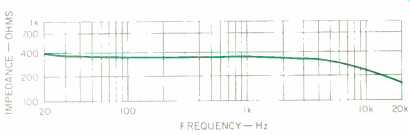
Fig. 1--Receiver output impedance vs. frequency.
Impedance at 1 kHz is 340 ohms, whether receive or transmitter is on or off see text). Impedance scale is logarithmic.
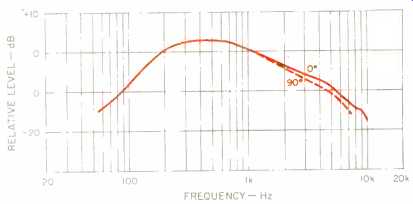
Fig. 2--Frequency response of system (microphone, transmitter, and receiver) at 0° and 90° from microphone axis. Levels shown are dB re:-56 dBV/Pa.
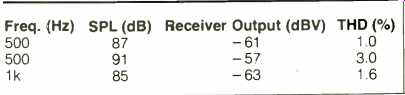
Table 1--Overload thresholds (see text).
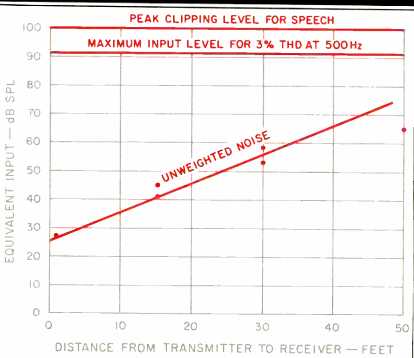
Fig. 3--S/N and dynamic range for a typical range of transmission distances.
Dual data points at 15 and 30 feet indicate signal variations due to room reflections; as a result, the linear noise curve shown here is an approximation (see text).
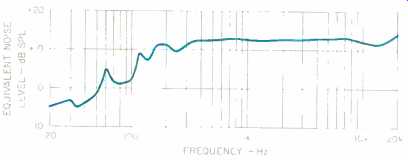
Fig. 4-Noise spectrum (1/3-octave band) of system. The noise curve reaches a peak at 23 kHz (not shown). Peaks at 60, 120, and 180 Hz are probably due to hum pickup in the test system.
Harmonic distortion was measured to establish the over load SPL of the system. I used a 2-inch precision sound source which has low distortion at the frequencies tested.
The results are shown in Table 1. At 500 Hz, the frequency region where the SPL of voices is highest, the maximum input is 91 dB. This represents fairly loud speech at 6 inches, which is the average distance of a lavalier micro phone to a speaker's mouth. It is adequate performance for a consumer-grade system which does not have a gain control on the transmitter or an a.g.c. circuit to level out the peaks from loud talkers. On an oscilloscope, I observed that speech peaks clipped at-4 mV, corresponding to a peak SPL of 100 dB. Thus, I think the system meets its specified 94-dB maximum.
Next, I tried measuring the unweighted receiver noise level with the transmitter at distances from 6 inches to 50 feet, which is possible in my laboratory without any intervening obstacles. This is not a very precise measurement, of course, because of up and downs in the signal due to room reflections, much the same as with sound. At the 49-MHz frequency used by this microphone system, signal nulls within a room tend to be spaced several feet apart. Professional wireless mikes, operating at much higher radio frequencies, suffer from more closely spaced nulls; most professional systems therefore use diversity reception to get around the problem.
Figure 3 shows the results of my noise measurements, with input overload data added to show the available dynamic range. The dual data points show the range of uncertainty caused by signal reflections; the straight line I have fitted to the data points, which rises about 1 dB per foot of increased distance, is therefore just an approximation. Furthermore, Azden says it has improved the transmitter circuit since this sample was made.
The noise level is very low at a few inches; to make that measurement, the transmitter had to be placed in the sound-retardant box I use for microphone noise measurements. The A-weighted noise level with the system closely coupled in this fashion is equivalent to 24.5 dB SPL, similar to that of many professional condenser mikes. The noise of the system, while increasing with distance, is satisfactorily low at distances up to 24 feet, by which point the dynamic range is 50 dB. This, I think, is adequate for a system where the receiver is portable and may be set up close to the transmitter. (The transmitter power is limited so as to meet FCC regulations.) Figure 4 shows the curve of 1/2-octave-band noise levels versus frequency. It is quite uniform, indicating a nearly "pink" noise characteristic. The peaks at 60 Hz and its harmonics are, I think, due to hum pickup in my test leads.
Wind and "pop" noise seem adequately low for most outdoor uses. Magnetically induced hum is virtually nonexistent. Rubbing noise can be a problem with lavaliers, but the Azden had slightly less of this than my RCA BK-12A (see below), and so is satisfactory.
Use and Listening Tests
In all listening tests, the receiver was connected through my isolation box to a sound-reinforcement system in the basement auditorium of my church. I found the WMS-10 to be a very good substitute for a wired lavalier mike in amplifying a lecture series by a college professor who walked about and operated two slide projectors as he spoke. (The wired lavalier was impossible, as the professor tripped over the cable and the mike landed on the floor.) In this room, I was able to put the receiver about 40 feet away, at the sound rack in the rear of the room. By listening to the receiver through the earphone, I was able to reorient its antenna as the professor moved around, thus maintaining the noise level below that which would have been noticeable to the audience. Of course, in sound reinforcement an S/N of 30 to 40 dB is okay.
I noticed a lack of treble response right away, compared to the wired mike, because the latter was an RCA BK-12A dynamic which I designed to have a rising response to compensate for the treble loss encountered in lavalier use.
The BK-12A has a rise of more than 5 dB at 3 to 4 kHz.
However, I found that by turning up the treble control on the old RCA tube amplifier in the system, I was able to attain reasonably natural-sounding speech, and the noise was not noticeably increased.
Later on, I used the WMS-10 at monthly meetings of a seniors' group in the same hall. I started to notice some hiss with maximum treble equalization, so I moved the receiver to the stage, along with the isolation box, and connected its output to a nearby house-mike jack. With the working distance reduced to 15 to 20 feet, there was no audible hiss when the talkers moved about. I thought these meetings were very critical tests because many of the senior listeners no doubt had some hearing loss, and some wore hearing aids (which are difficult to use effectively in auditoriums). I did not have a single complaint. On the contrary, I was asked to set the mike up each month until the summer break provided relief from this unintentionally assumed new duty.
All of this taught me that, in these, lecture applications, a wireless mike with less than ideal frequency response is better than a wired mike with ideal response. (I also learned much about archaeology, sailing, travel, and dishes found on old trains.) Many of the modern electret "mini mikes" are designed with flat rather than peaked response, probably because they are also used for non-lavalier applications.
Many users do not add the needed equalization, so we are getting used to a slightly muffled sound with lavaliers. In contrast, the bail-end, hand-held vocal mikes which are popular today typically have a rising response which would be ideal for lavalier use! I think that the smooth roll-off of the WMS-10 will be easy to equalize with controls found on modern mixers and amplifiers. Those using it with recorders without equalizers will no doubt notice a muffled sound. I hasten to note that the frequency response of the Azden mike is very similar to the optical soundtrack response of a good-quality 16-mm film projector, according to my tests. The Azden, as well as the 16-mm systems, would have increased hiss if the response were made flat.
Last, but far from least, I found that no interference of any kind was heard on the Azden during these many hours of use. This performance was impressive. If any interference had been heard, I don't think I would have been asked for all of those encores. Of course, I do not know what would be encountered in other locations.
The WMS-10 is an extremely handy system, and I highly recommend it for any voice pickup situation where a wired mike is inconvenient, and where economics do not permit an investment of $1,500 to $3,000 for a professional-grade wireless microphone system.
-Jon R. Sank
(Source: Audio magazine, Nov. 1986)
Also see:
B & O MMC 20CL Phono Cartridge (Mar. 1980)
ADC Model LMF-2 Tonearm & ZLM Phono Cartridge (Jan. 1979)
Audio-Technica AT160ML Cartridge (Sept. 1984)
Bang & Olufsen Beogram CD X Compact Disc Player (Mar. 1986)
= = = =