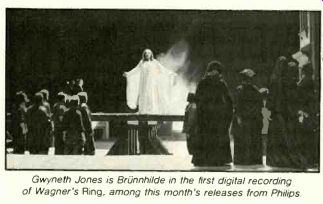
------ Gwyneth Jones is Brunnhilde in the first digital recording of Wagner's
Ring, among this month's releases from Philips.
SINCE sales of digital recordings are about double what could be expected for analog recordings of the same repertoire, record companies label their digital recordings with prominent stickers these days. And the claim "First Digital Recording" is as useful to record companies today as "First Time on LP" and "First Stereo Recording" were in the past.
The first digital recording of Richard Wagner's monumental operatic tetralogy The Ring of the Nibelung has been expected on the Eurodisc label to be imported here by Arista. It was to be a studio recording from East Germany, and the first installment, Des Rheingold, was due for U.S. release in the fall. But Philips is snatching the claim of the first digital Ring away from Eurodisc and plans to release a complete digital re cording of the four-opera cycle in October. It was recorded live at the Bayreuth Festival during performances conducted by Pierre Boulez with such soloists as Peter Hofman, Donald McIntyre, Manfred Jung, Matti Salminen, Siegfried Jerusalem, Jeannine Altmeyer, Gwyneth Jones, and others. The set will be complete on sixteen discs packaged in a carrying case that has a retractable handle for easy portability.
The most recent Bayreuth production of the Ring, the one preserved in audio on the new Philips set, was staged by the French director Patrice Chereau. Using the same artists who are on the records, performances of that Ring production were taped for television last year, and they will be shown on the Public Broadcasting Service in January of 1983 if all goes according to current plans.
----
EXPECTED in stores by October 1 is a five-disc set of the recordings of the American tenor Mario Lanza (1921 1959) reissued by RCA. Born Alfredo Cocozza in Philadelphia, Lanza made his career not in opera houses, but in such Hollywood movies as The Great Caruso, Because You're Mine, and Serenade. Discriminating opera fans generally criticized Lanza's singing. finding it vulgar, but that did not hamper the sale of his recordings, which have continued to find a market. The new set of reissues has been out in Germany for some time, and its success there has been so great that the royalties to Lanza's heirs for only one quarter in 1981 totaled $140,000.
---
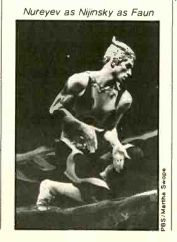
- Nureyev as Nurnsky as Faun
---
AFTER opening its ninth sea son on September 28 with Carlisle Floyd's opera Willie Stark, Exxon's Great Performances on PBS will otter varied musical fare to TV viewers in October. Eugene Ormandy conducts the Philadelphia Orchestra from the Academy of Music on October 5 in a pro gram that includes a suite from Strauss' Der Rosenkavalier and Mussorgsky's Pictures at an Exhibition. On October 19, Mozart's La Clemenza di Tito will be telecast in a performance filmed in Rome. The singers include Carol Neblett, Tatiana Troyanos, Catherine Malfitano, Eric Tappy, and Kurt Rydl, and James Levine conducts the Vienna Philharmonic In a tribute to dancer Vaslav Nijinsky on October 26, Rudolf Nureyev and members of the Joffrey Ballet will re-create three of the ballets most closely associated with Nijinsky: Petrouchka (with a score by Stravinsky), Le Spectre de la Rose (performed to music of Weber), and LA pres-midi d'un Faune (danced to the familiar Debussy prelude). Check local PBS stations for time.
THE musical composition that was heard by the largest audience at its world premiere is too new yet to be included in the Guinness Book of World Records. It is Welsh composer William Mathias' setting of Psalm 67 ("Let the people praise Thee, O God"), com posed for the wedding of the Prince of Wales and Lady Diana Spencer and first performed on that occasion at St. Paul's Cathedral in London on July 29.
The worldwide television audience that watched the wed ding and heard the anthem when it concluded the ceremony has been estimated to exceed one billion people.
The anthem, a work for organ and chorus made up of sopranos, altos, tenors, and basses, lasts just over four minutes. It was published by Oxford University Press the day after the wedding, and the publishers authorized the first performance in the United States at Plymouth Congregational Church in Minneapolis, Minnesota, on September 13. That church won the honor simply because its choir director, Philip Brunelle,
was the first to say "May I?" Single copies of the sheet music, on whose red cover are depicted the plumes of the Prince of Wales and the Spencer coat of arms, are available for $2 postpaid from Oxford University Press, Inc , 200 Madison Avenue, New York, N.Y 10016.
Prince Charles' varied musical activities include playing the cello and singing in a Bach choir, but none of his performances have been recorded At his request New Zealand soprano Kin To Kanawa sang "Let the Bright Seraphim" from Handel's Samson at the wed ding and thereby gained the distinction of being the opera singer heard (with TV assistance) by the largest audience in human history So far as we have been able to ascertain, she has not recorded this aria, but she has many albums for souvenir seekers to choose from, including a new recital of songs by Schubert, Schumann, Faure, and Wolf out in October on CBS Masterworks According to American TV newscasts, bootleg recordings of the wedding ceremony were on the street in London twenty four hours later At press time none of these had reached shops in New York. On hand, though, was Canadian jazz pianist Oscar Peterson's "A Royal Wedding Suite" (Pablo Today 2312 129, distributed by RCA). Containing such compositions as London Gets Ready, Royal Honeymoon, and Lady Di's Waltz, it was recorded in Toronto and London in April Also recorded before the fact were two imports from England "One Thousand English Voices Sing God Bless the Prince of Wales" (Chandos ABRD 1030, $17 98). a program of choral and brass music by massed English male choirs and the Royal Doulton Band recorded digitally in live concert on May 23. 1981, and "Madrigals and Wedding Songs for Diana" (Hyperion A 66019, $15,98), a collection of songs from wedding masques by Thomas Campion and others performed by the Consort of Musicke directed by Anthony Rooley. The two imports are available in shops or by mail from: BriIly Corp , 155 North San Vicente Boulevard, Beverly Hills, Calif 90211
WHEN CBS Masterworks announced in the mid-1970s that it was turning its attention to vocal music, the company planned to avoid duplicating repertoire already available in good recordings and to fill gaps in the catalog of recorded opera. Still living up to that promise, CBS has scheduled three operatic rarities for October release Handel's Xerxes conducted by Jean-Claude
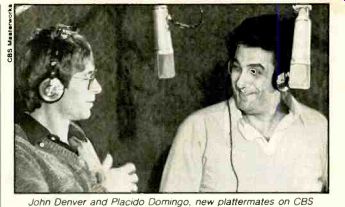
----- John Denver and Placido Domingo, new platter-mates on CBS
Malgoire, Jaromir Weinberger's Schwanda the Bagpiper con ducted by Heinz Wallberg, and Mussorgsky's Salammbo con ducted by Zoltan Pesko Also to be released in October is a digital recording of Wolf-Ferran's ll Segreto di Susanna, with soloists Renata Scott and Renato Bruson. conducted by John Pritchard
CBS Masterworks has also signed an agreement with Italy's FonitCetra to distribute that company's products in the Unit ed States; included in the catalog are some Rossini operas previously unavailable in commercial recordings The two companies will also join in a number of co-productions, mostly of operatic repertoire. Already scheduled are a recital album by Marilyn Horne and a recording of Rossini's II Turco in Italia with Samuel Ramey and Montserrat Caballe conducted by Riccardo Charily A Fonit Cetra album to be re leased here by CBS in October is a recital of early Verdi arias by none other than tenor Lucia no Pavarotti. who has hitherto recorded almost exclusively for London That's not likely to please Pavarotti's chief rival Placido Domingo, who has made no secret of his resentment of the superstar status ac corded to Pavarotti Domingo has lust made his own bid for a share of the mass audience by recording the album "Perhaps Love" with pop star John Denver, released by CBS in September CBS' October release also includes a Christmas al bum by Domingo.
+++++++++++++++++++++++++++
Disc and Tape Reviews
By RICHARD FREED, DAVID HALL, GEORGE JELLINEK, PALL KRESH, STODDARD LINCOLN, ERIC SALZMAN
= stereo cassette
U = digital-master recording
E = quadraphonic disc
e = eight-track stereo cartridge
0 = direct-to –disc
e = monophonic recording
The first listing is the one reviewed; other formats, if available, follow.
C. P. E. BACH: Concerto in A Major for Harpsichord and Strings (Wq. 8); Concerto in D Major for Harpsichord and Strings (Wq. 18). Malcolm Hamilton (harpsichord); Los Angeles Chamber Orchestra, Gerard Schwarz cond. NONESUCH 0 D 79015 $11.98, D1-79015 $11.98.
Performance Strong
Recording Lush
Considering that Carl Phillipp Emanuel Bach composed more keyboard concertos (almost fifty!) than anybody else down to this day, it is surprising that so few are still played, and even those rarely. They are remarkable works: the outer movements are bursting with the energy and emotion of the Sturm and Drang, and the middle movements are filled with the yearning melodies of the German "sentimental" style. The solo writing is virtuosic, the orchestral ritornellos and accompaniments robust. It is to Malcolm Hamilton's credit, then, that he and Gerard Schwarz have added two more of these concertos to the pitifully small re corded repertoire.
Hamilton's playing is straightforward, driving through the fast movements with an unflagging sense of purpose. The orchestra under Schwarz's direction is equally relent less, creating a tense dialogue. Although Hamilton's lyric playing is on the stiff side, the orchestra makes up for it with dynamic shaping of the long phrases.
Balance between a harpsichord and an orchestra is always a problem, and it re mains so here; the harpsichord is heard clearly by itself but gets lost when it is ac companied by the orchestra. The thick sound of the Wittmayer instrument does not cut through; perhaps a more articulated string style would solve the problem. Would it be sacrilegious to suggest that the record ing engineer might have come to the rescue with the twist of a volume knob? Be that as it may the music of old Bach's second son still comes off magnificently, and I wish we had more of it on records. - S.L.
BARTOK: Quintet for Piano and Strings. Sylvia Glickman (piano); Alard Quartet. LEONARDA LPI 108 $8.98.
Performance Committed
Recording Quite good
Bartok was twenty-three when he composed this still virtually unknown quintet, which was not published until 1970. Although I believe there was a recording of it on an import label a few years ago, I had not heard the work until I received this disc for re view, and I doubt that I would have connected the music with Bartok if I hadn't seen his name on the label. The ripe Romanticism, obviously Brahmsian, and the allusions to a Magyarism a bit beyond Brahms' similar flavoring suggest Dohninyi, who was Bartok's piano teacher at the time he began this composition in 1903. But already in the exuberant scherzo there is an earthy, foursquare peasant quality whose nervous impetuosity suggests something new: indeed, the trio seems a deliberate at tempt to calm this irruption with another dose of Brahms, but the second part of the scherzo proper does more than hint at the identity of the composer whose First String Quartet would appear in 1908, to be fol lowed by the Allegro Barbaro three years later. In the long slow movement one finds a sort of groping for the characteristic "night music" that was to pervade so many of Bartok's mature scores-but only a groping, all but submerged in an effusiveness that was not to characterize his style. In the final movement Bartok's own personality, in the voice of the piano, seems almost to be breaking through the Brahms/Dohnanyi sumptuousness sustained by the strings; eventually the strings join in what sounds like a hymnic folk tune, and then, all in their upper register, abandon sumptuous ness for a pre-echo of the real Bartok.
While this may be neither an especially characteristic work nor an especially important one, it does tell us more about Bart6k and his development than, for example, Beethoven's early E-flat Major Piano Concerto and his piano quartets tell us about Beethoven, and it is not without appeal in its own right. The strong, disciplined, communicative performance of Sylvia Glick man and the Alard Quartet bespeaks real commitment, and the sound is quite good.
-R.F.
RECORDING OF SPECIAL MERIT
BARTOK: Suite, Op. 14; Piano Sonata; Improvisations on Hungarian Peasant Songs, Op. 20; Out of Doors. Murray Perahia piano). CBS M 36704, MT 36704, no list price.
Performance Lively
Recording Okay
When I listen to Bartok's Suite, Op. 14, especially in a wonderful performance like this one, a little shiver goes up my spine. I have always liked this piece (I still do)-so much, in fact, that I once wrote a piano suite of my own that I now realize, lo these many years later, sounds an awful lot like the Bartok Suite, Op. 14.
Well, in those days Bartok was modern music and hot stuff. Then he became regular symphonic fare and almost even sym phonic pops. And from there he passed into that special limbo reserved for once-popular contemporary composers. It makes sense for pianists to take him up now. It was mostly (although certainly not exclusively) orchestral and string music that we heard back then. But Bartok was perhaps the most interesting writer of piano music among the modernists of the first half of this century, and his piano works are both original and appealing.
On this disc we get that charmer, Op. 14, and another suite, the colorful, dissonant, but effective Out of Doors. The sonata is a little tougher, more percussive and dissonant but with a lively, engaging finale. And the little Improvisations, Op. 20, entirely neglected until recently, have been included on several recent recordings. It has become fashionable to connect these very folksy studies with Viennese serialism, and I can't for the life of me see why (someone most have written an overly clever essay some where, or perhaps there is a confused re mark in some reference book and everyone copies it). This music is not particularly modernistic or expressionistic or serial- even compared with many other things Bartok himself did before and after. But it is exceedingly strong, well-written, beautiful music that impresses and moves, especially in this performance. Murray Perahia is an excellent Bart6k performer; his playing is clear, lively, full of rhythmic impulse and expressive curve. The piano sound is a bit inconsistent for my taste but, as they say, serviceable. -E S.
BEETHOVEN: Trio in G Major for Piano, Flute, and Bassoon (Wo0 371; Sonata in F Major for Piano and Horn, Op. 17. Daniel Barenboim (piano); Michel Debost (flute); Andre Sennedat (bassoon); Myron Bloom (horn). DEUTSCHE GRAMMOPHON 2531 293 $9.98.
Performance Good Recording Flo* The most attractive part of this album is the delightful Trio in G Major, composed in 1786. Written in the spirit of a divertimento, the music is full of youthful vigor and melodic charm. The better-known Horn Sonata remains a somewhat unwieldy curiosity because of the balance problems, though many of these would be solved if the work were played on the early instruments for which it was intended.
Daniel Barenboim, Michel Debost, and Andre Sennedat, all in fine form, bring lightness and grace to the trio. There are, however, some ensemble problems in the final variations, where the double passage work between the flute and piano is slightly off kilter. The Horn Sonata is less success ful: Myron Bloom's gruff approach and sometimes unfocused tone do not blend with Barenboim's more delicate reading, and a great deal of the musical structure is lost because of constantly fluctuating tempos.
The album is of interest nonetheless, thanks to the relative rarity of these pieces. S.L.
BERNSTEIN: West Side Story, Symphonic Dances (see TCHAIKOVSKY)
BRAHMS: Piano Concerto No. 1, in D Minor, Op. is. Lazar Berman (piano); Chicago Symphony Orchestra, Erich Leinsdorf cond. CBS MASTERSOUND G IM 35850, 0 HMT 35850, no list price.
Performance On the cool side
Recording Very good
BRAHMS: Piano Concerto No. 1, in D Mi nor, Op. 15. Jakob Gimpel (piano); Berlin Philharmonic Orchestra, Rudolf Kempe cond. PELICAN LP 2021 $8.98.
Performance Echt romanlisch
Recording. Vintage stereo
Many of the more striking aspects of the Lazar Berman/Erich Leinsdorf reading of Brahms' First Concerto grow out of the re cording itself: digital mastering and a wide stereo "spread" do much to alleviate the denseness of the opening tutti, and the fuga to episode in the finale has seldom sounded forth with such vitality and clarity. Interpretively, I find this reading something of a puzzler. I sense Leinsdoff's essentially cool treatment of the orchestral part and Berman's free phrasing and lyricism. Only at the deeply moving climax of the slow movement do things really come together, reaching a peak of genuine eloquence. For all its sonic excellence, this performance largely fails to convey the impetuosity of the music.
The Jakob Gimpel recording derives from 1958 sessions with the late Rudolf Kempe that also produced a Beethoven Emperor Concerto reading still available on Genesis 1002. Gimpel, like Berman, offers a freely romantic, poetically ruminative interpretation, but he and his conductor seem decidedly more together than do Berman and Leinsdorf. Whether one agrees with this approach or not (I prefer a more urgent one), Gimpel and Kempe make a very strong case for it, and Gimpel's handling of the solo role is full of felicitous details. The sound itself is clearly of early stereo vintage, with the piano's midrange rather on the steely side. Some judicious playback equalization may help. D.H.
RECORDING OF SPECIAL MERIT
BRAHMS: Sonata for Clarinet and Piano in F Minor, Op. 120, No. I; Sonata for Clarinet and Piano in E-flat Major, Op. 120, No. 2. George Pieterson (clarinet); Hephzibah Menuhin (piano). PHILIPS 9500 784 $9.98, 7300 858 $9.98.
Performance Smooth
Recording. Transparent
George Pieterson's beautiful recording of the Brahms and Beethoven clarinet trios with members of the Beaux Arts Trio (Phil ips 9500 670) has been on my turntable with some frequency since it was assigned to me for review (see the March 1981 is sue), and it gave me the highest expecta tions for this new release. These were raised further by the participation of the late Hephzibah Menuhin, that superb chamber-music player, in what may well have been her last recording and is one of the very few, if not indeed the only one, in which she did not perform together with her celebrated brother. This unexpected partnership is a most successful one. The playing, on both their parts, is extremely smooth but at no point superficial, and Pieterson and Menuhin play into each other's hands with the sort of inspired give-and-take that makes a performance an Event. The recorded sound is transparently realistic. R.F.
BRITTEN: Les Illuminations. SUDER BURG: Concerto (Voyage de Nuit, d'Apres Beudelaire). Elizabeth Suderburg (soprano); Piedmont Chamber Orchestra, Nicholas Harsanyi cond. TURNABOUT TV 34776 $5.98.
Performance Compelling
Recording Boxy
Robert Suderburg has been the dean of the North Carolina School of the Arts-with which the very capable Piedmont Chamber Orchestra is affiliated-since 1974; Elizabeth Suderburg, his wife, is one of the leading singers of new (and sometimes old) mu sic in this country. This very attractive al bum from Turnabout matches Benjamin Britten's settings of Rimbaud's Les Illuminations-a relatively early and dashingly brilliant work-with Robert Suderburg's composition on Baudelaire, written for this singer and this orchestra. The surprise is the unabashedly romantic character of the latter, a "concerto" for voice, solo instruments, and chamber orchestra. Suderburg's work is generally associated with the serious twelve-tone idiom, but here he is writing skillful, expressive tonal music rather than abstract-expressionist atonal music. It's very effective too, especially in this lovely performance. The Britten piece, one of that composer's masterpieces, is also very well sung and played. The recording is some what boxy and doesn't have a lot of presence, but the music and the performances have plenty to spare. E.S.
RECORDING OF SPECIAL MERIT
DEBUSSY: Preludes, Book IL Claudio Arrau (piano).
PHILIPS 9500 747 $9.98, 0 7300 832 $9.98.
Performance: Magical
Recording: Exponent
Last year Philips gave us Claudio Arrau's recording of Book I of the Preludes (9500 676), his first recording of Debussy in more than thirty years and his first phonographic encounter ever with the Preludes. Fortunately, we have not had to wait another thirty years for him to get to Book II, and now that it is here I can only repeat the enthusiastic welcome I gave his Book I (December 1980 issue). Arrau's magnificent way with this music must upset a lot of notions of how it should sound. 1 suggested last year that the pianist's long identification with the music of Liszt may have had something to do with his approach toward Debussy, for "there is nothing reticent in his large-scale, clear-textured approach, none of the veiled or blurred quality so often cultivated in the name of 'Impressionism,' nor is there a trace of the mincing crispness favored by those determined to relate Debussy directly to Rameau. In terms of full bodied color as well as breadth and clarity, these performances are magical." I feel a little self-conscious quoting my self, but Arrau makes the same commanding impression in Book II that he did in Book I, and I am more than doubly grateful to have the series entire. His big and bold approach, as noted before, does not rule out subtlety, tenderness, or wit, and one of the wonders of these performances (as, indeed, of these compositions) is the way a microcosm is revealed in such a piece as Feux d'Artifice, which is of course no mere virtuoso vehicle but a phantasmagoric evocation in which the idea of fireworks is almost incidental. As in the previous set, the heady exoticism of La Puerta del Vino, the humor of "General Lavine" and Hommage d S. Pickwick, and, in fact, the character of each of the twelve pieces are all the more telling for Arrau's insistence on clarity.
Also as before, this is a beautifully life like recording, so much so that there is again audible an occasional gasping or sniffing sound that is hard to pin down as either human or mechanical. On a less meticulous pressing it might have been masked by surface noise; it does not occur frequent ly enough to be a serious irritant, and it in no way minimizes the appeal of this marvelous record. -R.F.
FOSS: Thirteen Ways of Looking at a Blackbird (see MOLLICONE)
FRANCK: Organ Music (see Best of the Month, page 72) GRIEG: Symphony in C Minor. Bergen Symphony Orchestra, Karsten Andersen cond. LONDON 0 LDR 71037 $10.98.
Performance Nicely turned
Recording A-1
We have a double surprise here: this first U.S. release by the Bergen Symphony Orchestra offers a hitherto unknown symphony by that city's most illustrious son, Edvard Grieg, written when he was twenty-one and barely two years out of the Leipzig Conservatory. Grieg had shown some small piano pieces and songs to Denmark's Niels Gade, who proceeded to goad the young man into trying his hand at a symphony.
---------------
The Waltz Family
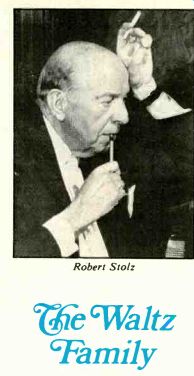
------ Robert Stolz
HERBERT VON KARAJAN is an admirable conductor-that is to say, there is al ways something to admire in any of his performances. There is a lot to admire in his new Deutsche Grammophon collection of music by the Strauss family, which includes ten of the best and best-known waltzes, the two famous overtures, and a good sampling of the polkas, marches, and miscellaneous pieces. The treatment is both straightforward and spirited as well as quite subtle at times. The orchestral execution is neat and precise and, in places, breathtakingly beautiful. The sound of the Berlin strings in such passages as the main theme in Wiener Blut is among the glories of contemporary music making: neither romantically throbbing nor antiseptic but pure, gorgeous silk. The brass too has its high points in this set. Karajan brings a particularly nice feel to the polkas, though the Eljen a Magyar! shows that he is not much of a Hungarian (he is, of course, Austrian).
The digital recording is wonderfully clean and open; one can actually hear the very discreet doubling of the zither melody by the first violins in Tales from the Vienna Woods. The dynamic range is gratefully wide, and, though the percussion is slightly over-favored for my taste, it does add to the excitement and may well be appreciated by many listeners. I find a few slight but disturbing changes of tempo in odd places and a few equally slight changes of ambiance, both indicating to me (perhaps incorrectly) splices that ought not to have been made.
But all in all this is a really excellent set with some glorious high points.
That much said, I confess that I like better a newly imported Eurodisc set con ducted by the late Robert Stolz. Why? Stolz, who died six years ago at the age of ninety-five, was certainly not the orchestral master Karajan is. The Berlin and Vienna Symphonies (no indication is given which orchestra plays which selection) are certainly not in the class of the Berlin Philharmonic. And the undated (but obviously more than six years old) analog recording is not to be compared with DG's digitally mastered one. But Stolz had a foot firmly placed in the older Viennese tradition (he knew Strauss and Brahms, was friends with Lehar), and the idiomatic Viennese acceleration, rubato, and Luftpausen were second nature to him. Not that he pulls these pieces apart-in the older days he was probably looked upon as a fairly strict time keeper but his waltz performances have a lilt, a quality of floating, a freedom, an expression, and a sense of underlying melancholy (the bitter-sweetness of so much of the best so-called "light" music) that Karajan's, for all their beauty of sound, simply do not pos sess. The truth comes out in the several se lections present in both albums, and I would certainly urge those who can afford the luxury to buy and listen to both. Even the sound Stolz coaxes from his orchestras, while it is something less than silk, is some how more evocative, less "internationalized," more Viennese.
There are famous works all through the Stolz album too, but it includes at least one delightful piece I had not heard befor-e-the Heiligenstadter Rendezvous--and a couple of waltzes by Strauss Senior's contemporary, friend, and competitor Josef Lanner. The Eurodisc recording is really quite decent, though hardly up to the best con temporary standards, miked a bit further away than the DG and with correspondingly less detail, more reverberation-in other words, slightly opaque but not unpleasant.
But the absence of any sort of notes at all with a full-price two-record set is not to be condoned.
-James Goodfriend
JOHANN STRAUSS JR.: Kaiser-Walzer, Op. 437; Rosen aus dem Silden, Op. 388;Wein, Weib, und Gesang, Op. 333; G'schichten aus dem Wienerwald, Op. 325; Wiener Blut, Op. 354; An der Schonen, Blauen Donau, Op. 314; Accellerationen, Op. 234; Kilnstlerleben, Op. 316; Tritsch Tratsch-Polka, Op. 214; Annen-Polka, Op. 117; Auf der Jagd, Op. 373; Eljen a Mag yar!, Op. 332; Leichtes Blut, Op. 319; Unter Donner und Blitz, Op. 324; Napoleon Marsch, Op. 156; Persiscber Marscb, Op. 289; Der Ziguenerbaron Overture; Die Fledermaus Overture; Fledermaus Quadrille, Op. 363; Perpetuum Mobile, Op. 257.
JOHANN STRAUSS SR.: Radetzky-Marsch, Op. 228.
JOSEF STRAUSS: Delirien-Walzer, Op. 212; Spharenkl8nge, Op. 235. Berlin Philharmonic, Herbert von Karajan cond. DEUTSCHE GRAMMOPHON 0 2741 003 three discs $32.94, 3382 003 $32.94.
JOHANN STRAUSS JR.: Accellerationen, Op. 234; Rosen aus dem Suden, Op. 388; Wein, Weib, und Gesang, Op. 333; Wo die Citronen Bluh'n, Op. 364; Morgenbutter, Op. 279; Annen-Polka, Op. 117; Heiligen stadter Rendez-vous, Op. 78; Unter Donner und Blitz, Op. 324; Tritsch-Tratsch-Polka, Op. 214; Persischer Marsch, Op. 289; In digo-Marsch, Op. 349; Perpetuum Mobile, Op. 257.
JOHANN AND JOSEF STRAUSS: Pizzicato Polka.
JOHANN STRAUSS SR.: Loreky-Rbein-Klunge, Op. 154; Einzugs-Galopp, Op. 35; Jubel-Qua drille, Op. 130. JOSEF STRAUSS: Frauenherz, Op. 166; Feuerfest, Op. 269.
JOSEF LANNER: Op. 161; Die Schonbrunner, Op. 200. Berlin Symphony Orchestra, Vienna Symphony Orchestra, Robert Stolz cond. EURODISC 87 360 XBU two discs $19.96.
------------------
Karajan: Mahler 'Ninth
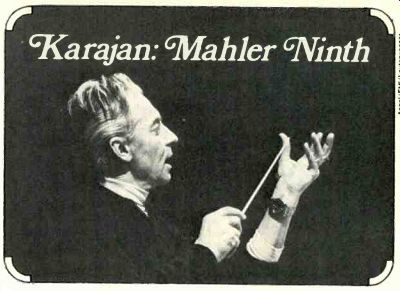
MAHLER'S profoundly affecting Ninth Symphony seems to have elicited more outstanding recorded performances than any of his others, beginning with the historic 1938 reading by the work's first interpreter, Bruno Walter (available currently on Turnabout). The new Deutsche Grammophon recording by Herbert von Karajan is firmly in that tradition, and the conductor brings to the heart-wrenching finale a white-hot intensity that 1 have not heard matched elsewhere on or off records. Klaus Tennstedt's finale (Angel) is probably the most spiritualized, and Carlo Maria Giulini's (DG) the richest in sheer sound, but Karajan probes even more deeply in his special way. His interpretation of the middle movements is on the same remarkable level.
The Landler offers not only flawless pacing but a gauging of coloration and internal balances that is of a wholly exceptional caliber. As for the Rondo Burleske, it would be all but impossible to find a match for this one's savagery and biting sarcasm, or its sense of fancy gone wild in the later pages.
Of course, it is not only Karajan's conductorial prowess and insight that make these achievements possible, but also the nearly superhuman virtuosity of the Berlin Philharmonic players, both individually and in ensemble. Purely in terms of wonderful playing, this is one of the greatest of that orchestra's many great discs, with and with out Karajan. Only the marvelous first movement of the symphony disappoints here, failing to build a full measure of emotional and sonic impact for the great "death knell" climax, and for that I am inclined to blame the recording, which on this twenty nine-minute side sounds a mite thin com pared with the other three. The general effect is of a "coolness" in the reading that does not hold true elsewhere. But if you want to hear stunning orchestral executions of the middle movements and yet another great reading of the last, don't pass up this album.
–David Hall
MAHLER: Symphony No. 9, in D Major.
Berlin Philharmonic Orchestra, Herbert von Karajan cond. DEUTSCHE GRAMMOPHON 2707 125 two discs $19.96, 3370 038 $19.96.
-------------
The last three movements were performed at the Tivoli Gardens in Copenhagen under the baton of Hans Christian Lumbye, and Grieg himself conducted the work twice in Bergen-after which he deposited the score in the Bergen Public Library with the instructions, "Never to be performed." He did, however, later arrange the middle movements for piano four-hands (published as Op. 14). The 1981 Bergen International Music Festival was the occasion of the second "premiere" of the orchestral work as well as the present recording.
To be honest, there are no startling revelations here. Like many "youth" symphonies, the end movements of this one are al most too full of ideas and a bit short on developmental know-how. Grieg's judgment was right in allowing the slow movement and scherzo, the latter having something of a Swedish polska feel to it, to survive as key board pieces. The work as a whole is highly redolent of Schumann (and not of Grieg as we know him), and the finale is rather lengthy for its substance. Karsten Andersen and his players turn out a neat and rhythmically precise performance, and London's digitally mastered recording is absolutely first-rate, but this remains a disc for Grieg buffs and specialists in the Romantic sym phony only.
- D. H .
RECORDING OF SPECIAL MERIT
LISZT: Piano Concerto No. 1, in &fiat Major; Piano Concerto No. 2, in A Major.
Jorge Bolet (piano); Rochester Philharmonic Orchestra, David Zinman cond. Vox CUM LAUDE VCL 9001 $8.98, VCS 9001 $8.98.
Performance. Powerful and poetic
Recording. Bright
Jorge Bolet recorded Liszt's First Concerto about twenty years ago with Robert Irving and the Symphony of the Air for Everest, but that disc has not been available for some time, and he has apparently not re corded the A Major before. It is good to have these omissions corrected at last, for there is no finer performer of Liszt's piano music. Like all of Bolet's Liszt performances, these are exemplary in terms of both power and poetry. The former quality is all the more impressive for his giving the sense of so much more being held in judicious re serve; the latter is similarly refreshing for his avoidance of heaving and churning in favor of delicate but pointed reminders that even in these often derided concertos subtlety can make the difference between a "vehicle" and music of substance. David Zin man's contributions are sensitive and sym pathetic, and his orchestra's winds in particular make a fine showing. The sound is bright and attractive. R.F.
RECORDING OF SPECIAL MERIT
MAHLER: Symphony No. 2, in C Minor ("Resurrection"). Isobel Buchanan (soprano); Mira Zakai (contralto); Chicago Symphony Chorus and Orchestra, Sir Georg Solti cond. LONDON 0 LDR 72006 two discs $21.96.
Performance Intensely dramatic
Recording: Revelatory!
This is the first digitally mastered Mahler Resurrection Symphony, and the combination of Sir Georg Solti and his Chicago forces is a formidable one indeed, backed by a London production crew in top form. Solti is considerably freer in the opening movement here than he was in his 1966 recording with the London Symphony Orchestra. I sense not only a careful restudy of the score, with meticulous attention to Mahler's portamento markings for the violins, but also perhaps an acquaintance with Leonard
Bernstein's wildly visionary 1974 reading at Ely Cathedral (Columbia M2 32681), the film of which was broadcast earlier this year on public television.
The second movement here has just the right Landler lilt and a most effective handling of the contrasting middle section. The pizzicato reprise is utterly breathtaking in digital sonics. In the scherzo the recording is revelatory in fine details of balance and sonority: for once the rustling sound of the Ruthe (birch broom) on bass drum is not lost in background noise. The Urlicht movement is rather lushly sung by Mira Kakai, who is no match for Janet Baker (in Bernstein's Ely recording) in conveying the rapt ecstasy this music demands. The apocalyptic finale is all one could ask for in terms of drama, though it's a bit hectic in the march episode in which the trumpet introduces the "Auferstelr " theme later in toned by a cappella chorus. The Chicago Symphony Chorus does itself proud here, and the "Bereite dich!" outburst by the men will really curl your hair. The truly lovely vocalism of soprano Isobel Buchanan throughout the last pages of the finale also deserves mention.
In short, this is yet another distinguished recorded performance of the Resurrection Symphony. What sets it apart from a half-dozen others-among them those by Bruno Walter, Claudio Abbado, and Zubin Mehta, as well as both of Bernstein's (the dare-all Ely Cathedral reading was preceded by a fine studio recording with the New York Philharmonic)-is that here the performance is supported by just about the most impressive sound this symphonic colossus has yet been accorded.
D H MOLLICONE: The Face on the Barroom Floor. Leanne McGiffin (soprano), Isa belle/Madeline; Barry McCauley (tenor), Larry/Matt; David Holloway (baritone), Tom/John. Alice Lenicheck (flute); George Banks (cello); Henry Mollicone (piano).
FOSS: Thirteen Ways of Looking at a Blackbird. RoseMarie Freni (mezzo-soprano); Robert Dick (flute); Jan Williams (percussion); Ivar Mikhashoff (piano).
COMPOSERS RECORDINGS, INC. SD 442 $7.98.
Performance Very good
Recording Excellent
Henry Mollicone, who used to be an assist ant conductor at the New York City Opera, wrote the original version of his one-act opera The Face on the Barroom Floor for the 1978 hundredth-anniversary celebration of the opera house in Central City, Colorado. The Teller House saloon there is where the famous face was really painted on the floor by a drunken artist in the 1930s. The face in question, of course, is the one in the venerable poem by H. Antoine D'Arcy that used to be part of the repertoire of every parlor elocutionist. It tells the story of Matt, "who comes to the West to find fame and gold" and wants to share it with the beautiful Madeline. He paints her face on the barroom floor and fights over her with her lover, John, who runs the place.
When she hurls herself between them after John pulls a gun, she is shot dead; Matt and John survive.
Mollicone's short opera, with a crisp libretto by John S. Bowman, frames the saga of Madeline, Matt, and John inside a parallel drama involving a contemporary bar tender, a visiting tourist, and his opera-singer girl friend who are fated to re-enact the earlier tragedy. The score is an attractive if somewhat simple-minded one in the Menotti tradition, suffused with a wonderful sense of period atmosphere. The opera actually premiered at the Teller House saloon in stead of the opera house, and it has toured successfully since then. On the recording, Leanne McGiffin (who created the role of Isabelle/Madeline), Barry McCauley, and David Holloway perform impeccably under the composer's direction, and the work makes for fascinating listening.
Lukas Foss' setting of Wallace Stevens' poem Thirteen Ways of Looking at a Blackbird, with its startling still-life imagery that has stimulated a number of com posers, was commissioned in 1978 by Chicago's fine-arts radio station WFMT. For it Foss combined his early tonal style with his later experimental approach to create a score that is both intricate and spectacular.
It is intensely interpreted here by mezzo soprano Rose Marie Freni with the vocal line closely woven into the instrumental texture. I still prefer composer Alan Blank's bleaker treatment of the same text as a series of variations; Foss puts the poet at his service while Blank puts his music at the service of the poem. Yet the Foss work is a distinguished one in its flamboyant way, and it is excitingly performed here. P.K.
MOZART: Flute Concerto No. 1, in G Major (K. 313); Flute Concerto No. 2, in D Major (K. 314); Andante in C Major (K. 315k Rondo in D Major (K. Anh. 184); Concerto in C Major for Flute, Harp, and Orchestra (K. 299). Frans Vester (flute); Edward Witsenburg (harp, in K. 299); Mozart-Ensemble Amsterdam, Frans Bruggen cond. PRO ARTE 2PAL-2004 two discs $19.98, C) 2PAC-2004 $19.98.
Performance Dreary
Recording All right
MOZART: Concerto in C Major for Flute, Harp, and Orchestra (K. 299); Oboe Concerto in C Major (K. 314); Rondo in D Major for Flute and Orchestra (K. Anh. 184).
Jean-Pierre Rampal (flute); Marielle Nordmann (harp); Pierre Pierlot (oboe); English Chamber Orchestra, Jean-Pierre Rampal cond. CBS M 35875, MT 35875, no list price.
Performance inspiriting
Recording. Bright
This Dutch Mozart set, recorded ten years ago, has been around at least once before, and not too long ago, as ABC/Seon 67040.
The new Pro Arte pressings are cleaner but still offer the same dreary performances, not at all what one would expect from the usually enlivening Frans Bruggen and his associates. The "original instruments" offer little enticement here. The acoustic ambiance, too, is rather dead, the labeling is inadequate, and the half-hour K. 299 is gratuitously spread over a side and a half.
With the Jean-Pierre Rampal record we are, not at all unexpectedly, in a different world. Heaven knows how many times Rampal has recorded each of these works (not as conductor heretofore, but as soloist, the Oboe Concerto being identical with the Flute Concerto No. 2), but each time around they come up sounding just as fresh as before. Rampal is an unfailingly inspirit ing musician, and the joy he communicates is in almost cruel contrast with the lifeless ness of the Dutch performances-especially in the D Major Rondo (Franz Anton Hoffmeister's transcription of Mozart's Rondo in C Major for violin and orchestra, K.373), which even Rampal has not brought off with such winning elan before. In con ducting for his longtime associate Pierre Pierlot and in his dual partnership with the presumably young and demonstrably gifted Marielle Nordmann, Rampal's delighted response to the stimulus of good company as well as good music is unmistakable and irresistible. There are other attractive recordings of both concertos, by Rampal and others, but if this combination of titles appeals to you, you can't go wrong with this pack age. Bright, airy sound too, from an Erato original. R.F.
MUSSORGSKY: Night on Bald Mountain; Khmanschina, Prelude and Entr'acte; Scherzo in B-flat Major; Triumphal March; Joshua; Three Choruses (see Best of the Month)
RECORDING OF SPECIAL MERIT
PROKOFIEV: Alexander Nevsky. Larissa Avdeyeva (mezzo-soprano); Republican Russian Chorus; USSR Academy Sympho ny Orchestra, Yevgeni Svetlanov cond. War
and Peace (Highlights). Galina Vishnev skaya (soprano), Natasha; Valentina Kle patskaya (mezzo-soprano), Sonya; Yevgeny Kibkalo (baritone), Bolkonsky; Aleksei Krivchenya (bass), Kutuzov; Boris Shapen ko (tenor), Denisov; Leonid Ktitorov (bass), Tikhon; others. Chorus and Orchestra of the Bolshoi Theater, Alexander Melik-Pa shayev cond.
MUSICAL HERITAGE SOCIETY MHS 824351 two discs $15.50 (plus $1.60 postage and handling charge from the Mu sical Heritage Society, 14 Park Road, Tin ton Falls, N.J. 07724).
Performance. Vital and Idiomatic
Recording Very good
These two major works of Sergei Prokofiev have a great deal in common. Aside from their historical material, which provides a natural link, political events played a cru cial part in their musical creation. The triumphant film score to Alexander Nevsky (1938), which is the source of this cantata, was written under the threatening shadow of World War II: the implications of this reminder of past Russian glory in repelling the "Teuton" invaders could hardly be lost on the public. The composition of War and Peace was begun three years later, when the German invasion of Russia made the Napo leonic horrors related in Tolstoy's epic novel terrifyingly contemporary. The opera's martial episodes echo similar portions in Nevsky, and it is not difficult to find coun terparts to the cantata's occasional lyric portions in the vast panorama of the opera.
Both of these recordings were previously available as Melodiya/Angel 40011 and 40053, originally released around 1968.
Several versions of Alexander Nevsky have been recorded since then, and they may surpass this one in sonic terms, but I find this Russian performance excellent. The colors and clangors of Prokofiev's music are captured with vivid sharpness, with nicely de tailed choral and orchestral sonorities.
Moreover, Yevgeny Svetlanov's identification with the music appears to be total. His sensible tempos, generally on the lively side, move it briskly forward and keep the sentimental episodes from turning lugubrious.
Mezzo Larissa Avdeyeva intones her Lament movingly, with deep-felt but not excessive emotion.
War and Peace is a more complicated matter. The opera itself is an uneven work, more convincing in the intimate confrontations than in the massed and exhortatory scenes Prokofiev was urged to expand for patriotic purposes. To take a realistic view, just as the opera cannot be a true representation of Tolstoy's vast epic, so highlights cannot do justice to the opera. (The complete War and Peace is available on a four-disc CBS set, M4 33111.) However, these highlights offer a great deal of worthy music, very well performed.
Galina Vishnevskaya's impressive theatrical gifts are matched by pleasing vocal strengths to create a sympathetic Natasha.
Yevgeny Kibkalo, a fine lyric baritone, is very touching in the strange but effective music Prokofiev contrived for Bolkonsky's death scene. The music of the heroic Field Marshal Kutuzov is more functional than memorable; Aleksei Krivchenya delivers it in a lusty, powerful, and unsubtle fashion.
The crucial roles of Helene and Pierre Bezukhov have been squeezed out of these "highlights," but in the brief episode of the burning of Moscow (side four, band two) you can briefly hear two exceptional singers: baritone Pavel Lisitsian (Napoleon) and bass Artur Eizen (Rambal). The musical leadership and the choral work are both exemplary. In all, then, these are very praiseworthy recordings, and the set is en hanced by Peter J. Rabinowitz's informative annotations. G.J.
RECORDING OF SPECIAL MERIT
PROKOFIEV: The Love of Three Oranges, Symphonic Suite, Op. 33bis; Lieutenant KO, Op. 60; Symphony No. 1, in D Major, Op. 25 ("Classical"). London Symphony Orchestra, Neville Marriner cond. PHILIPS 9500 903 $9.98, CI 7300 903 $9.98.
Performance Lively
Recording Excellent
Prokofiev was, in the great tradition of Rimsky and early Stravinsky, a composer who could evoke magic and fantasy. Almost alone among modern operas, his The Love of Three Oranges has fantasy without breast-beating or pies in the face. Kije, al though the subject is satirical rather than fantastical, has some of the same qualities, and so, in fact, does the Classical Symphony. Russian composers are supposed to be tormented souls, but there seems to have been hardly a shred of self-pity in Prokofiev or his music, and, unlike the urban, acerbic aesthete Stravinsky, he wore his neo-Classicism with charm and good spirit.
These new recorded performances help a lot. The Classical Symphony here is quite different from what we are used to hearing;
instead of the hard edge, brilliant sound, and bite that nearly everyone prefers nowadays, it is an almost pastoral reading charming, elegant, laid-back, full of happy detail. The two suites are also simple, a bit livelier, and completely ingratiating. The recording sounds good too. Enjoy. E.S.
PUNTO: Horn Concertos: No. 5, in F Major; No. 6, in &fiat Major; No. 10, in F Major; No. 11, in E Major. Barry Tuckwell (French horn); Academy of St. Martin-in-the-Fields, Neville Marriner cond. ANGEL SZ-37781 $9.98.
Performance Pleasing Recording Excellent The young Beethoven wrote his Horn Sonata. Op. 17, for the great virtuoso Giovanni Punto. This prompted a Budapest critic to write, "Who is this Beethoven [sic'? His name is not known in musical circles. Of course Punto is very well known." Punto was a Bohemian (that is, a Czech) whose real name was Jan Vidal/ Stich.
Like many of the great virtuosos of another day, he wrote fancy concertos to show off his own abilities-supposedly more than a dozen concertos all told, although some of the scores are now lost, defective, or misattributed. They are difficult; they belong to the developed high Classical style, and,
though no one would claim they are immortal works of genius, they still have the power to please. Especially in the hands-and lips-of Barry Tuckwell, a worthy successor to the great Punto/Stich. And it certainly does no harm that this is another chapter in Tuckwell's collaboration with Neville Marriner and the Academy of St. Martin-in-the-Fields. Angel's attractive sound completes the charming picture. E.S.
SALZMAN/SAHL: Civilization and Its Discontents. Karl Patrick Krause (tenor), Carlos Arachnid; Candice Early (soprano), Jill Goodheart; William Parry (baritone), Derek Dude; Paul Binotto (tenor), Jeremy Jive; Michael Sahl (piano, organ); Cleve Pozar (drums, percussion). NONESUCH N 78009 $8.98, N1-78009 $8.98.
Performance Excellent Recording Very good My good colleague Eric Salzman, who started his composing career with a string quartet and a flute sonata, has so whole heartedly embraced avant-garde techniques and so dealt with the challenges of mixed media (his studies with Otto Luening, Vladimir Ussachevsky, Milton Babbitt, and Roger Sessions were bound to rub off eventually) that each new piece from him has caused something of a sensation: Feedback and The Nude Paper Sermon in 1968; the spectacle Noah ten years later; the aleatory pieces called The Electric Ear introduced at the Electric Circus in Greenwich Village.
Civilization and its Discontents, a collaborative effort with Michael Sahl, won the RAI Music Prize of the Prix Italia. Subtitled "a music theater comedy," it was writ ten and composed in 1977 and first presented in that year at the American Musical and Dramatic Academy in New York.
The performance heard on this record is based on a 1978 production for National Public Radio.
Despite Salzman and Sahl's comments in their liner notes about traditional European "operatic opera" as a fossilized, elitist form, I think an opera is what they have written here, unconventional as their approach may be. The title, blithely borrowed from the work by Freud, is certainly appropriate.
The action takes us first to the Club Bide-
a-Wee where a group of painfully recognizable types at play are spouting the pseudo-
psychiatric clichés of the moment against a jazzy background. Here, on her twenty ninth birthday, we meet heroine Jill Good-
heart, who encounters a young agent named Jeremy Jive and takes him home-where he waits while, in a Menotti-like recitative, she reads a letter from her mother, answers in numerable phone calls (which drive him to destroy the instrument), and finally welcomes, to Jeremy's further frustration, her friend the producer Derek Dude. The arrival of a third male, Carlos Arachnid, fur ther complicates matters and leads to a perfectly smashing vocal quartet in a modern yet melodious idiom. Things wind up back at the Bide-a-Wee, I forget exactly why or to what end, with Jill appearing as "The Singing Chicken," clucking that she has been "born again," with everything culmi nating in the liberating message, "If it feels good, do it." The characters in Civilization and its Discontents are all colorfully neurotic, and in the course of portraying them and their curious evening together the performers get to do some excellent acting as well as singing. Soprano Candice Early is in every way equal to the part of Jill, a role that in less canny hands might have bogged down in bathos-especially when she announces "My life is over" and tries to end it with a knife. The shenanigans of Jill and her pals unfold against a luminous, always idiomatic instrumental background that is never less than appropriate and that sometimes, as in a kind of jazz fugue toward the end, achieves real distinction. Following the ac tion would be a bit easier if Nonesuch had provided a libretto, but the singers' enuncia tion is very clear and I think you'll enjoy the record anyway. P.K.
RECORDING OF SPECIAL MERIT
SCHUMANN: Frauenliebe und Leben, Op. 42; Lied der Suleika; Weit! Weit!; Liebes lied; Schmetterling; Hinaus ins Freie; Der Sandmann; Kinderwacht; Die Blume der Ergebung; Singet Nicht in Trauertonen; Mond, Meiner Seele Liebling; Reich Mir die Hand;
Die Letzten Blumen; Frohlingslust. Edith Mathis (soprano); Christoph Eschenbach (piano). DEUTSCHE GRAMMOPHON 2531 323 $9.98, 3301 323 $9.98.
Performance Outstanding partnership
Recording. Excellent
Record companies have been rather over generous with their releases of Schumann's Frauenliebe und Leben lately, but a performance on the level of excellence of the one here leaves no room for complaint.
Edith Mathis sings with involvement but without undue exaggeration and communicates the highly sentimental Chamisso lyrics with clarity, sensitivity, and-apart from a few spots where the tessitura is a bit low-a lovely rounded tone.
To balance this much-recorded cycle, Miss Mathis offers on the reverse side thirteen Schumann songs that are quite unfamiliar. Ranging in date from 1840, the famous "song year," to 1851, the sequence is of variable significance. Four of the best songs of Op. 79 (Album fair die Jugend) are here, all poetic trifles but enriched by delightful musical ideas (the excellent Christoph Eschenbach is particularly sparkling in these songs). The later songs (1850 1851) show a decline of musical inspiration, but singer and accompanist make a strong case for every single item in this imagina tive release. G.J.
SIBELIUS: Symphony No. 4, in A Minor, Op. 63; Luonnotar, Op. 70; Finlandia, Op. 26, No. 7 (see Best of the Month, page 72)
R. STRAUSS: Songs. Heimliche Aufforder ung; Befreit; Freundliche Vision; Drei Lieder der Ophelia aus "Hamlet"; Schlechtes Wetter; Breit' fiber Mein Haupt; Standchen; Ich Schwebe; Nichts; Wiegenlied; Die Zeitlose; Wozu noch Mildchen; Am Ufer;
Wie Sollten Wir Geheim. Helen-Kay Eberley (soprano); Donald lsaak (piano). EB SKO ES-1005 $8.98.
Performance Very good
Recording- Very good
There are several unfamiliar Strauss songs here, including the three songs of Ophelia set to a German translation of Shakespeare's text in 1919. They are brief and not particularly interesting, but Helen-Kay Eberley lavishes on them the same care and tonal refinement with which she endows the better-known Heimliche Aufforderung, Standchen, Freundliche Vision, Befreit, and the rest. She is a well-trained singer with a voice of natural loveliness and an ex tension that enables her to handle high tessituras without effort and without compromising the limpid quality of her singing. I would have welcomed a more varied pro gram from such a fine interpreter. But she does offer a feast for the Strauss aficionado with her loving treatment of sixteen songs, never falling into the temptation of excessive sentimentality posed by some of Strauss' favored lyricists. The accompaniments are excellent. G.J.
SUDERBURG: Concerto- Voyage de \Mt. d'Apres Baudelaire Isee BRITTEN)
RECORDINGS OF SPECIAL MERIT
TCHAIKOVSK V: Romeo and Juliet.
BERNSTEIN: West Side Story: Symphonic Dances. Atlanta Symphony Orchestra, Robert Shaw cond. Vox CUM LAUDE VCL 9002 $8.98, VCS 9002 $8.98.
Performance Galvanic
Recording Excellent
TCHAIKOVSKY: Romeo and Juliet; Fran cesca the Rimini. Concertgebouw Orchestra, Amsterdam, Edo de Waart cond. PHILIPS 0 9500 745 $10.98, 7300 830 $10.98.
Performance Splendid Francesca Recording Excellent As if he weren't unhappy enough already, Tchaikovsky was also unfortunate in his critics. When Mahler conducted the Romeo and Juliet Fantasy-Overture in Hamburg in 1893, one critic declared it "devoid of melodic invention." Today the work is played so often, and has been recorded so many times, that it takes an exceptional rendition indeed to bring its passionate pages to life again for jaded ears. Of these two latest attempts, both impressive in terms of recorded sound, Robert Shaw's is the more dashing. It was, moreover, a happy idea to couple the piece with the suite of dances from Bernstein's score for West Side Story, in which essentially the same star crossed lovers are reincarnated in the streets of Manhattan. Here also Shaw de livers a high-energy performance, quite matching the composer's own in intensity and more advanced sonically.
The Concertgebouw Orchestra, however, is a more remarkable ensemble than the Atlanta Symphony, and Edo de Waart's less turbulent but expansively lyrical treatment of Romeo and Juliet is also well worth hearing. It is backed by a contrastingly fiery version of another love story, Francesca da Rimini-which is set in the second circle of Dante's hell. As the winds whirl and rage about the shrieking, tormented sinners, the full richness of Tchaikovsky's exciting orchestration comes through. Thanks to the digital mastering, the brasses sound especially brilliant, and the string tone is supple and silken. There are numerous Francescas for sale at more modest prices-notably Giulini's, a bargain on Seraphim-but none quite as hair-raising as this one by De Waart.
P.K.
RECORDING OF SPECIAL MERIT
TELEMANN: Concerto in E Minor for Recorder, Flute, and Strings; Concerto in A Major for Oboe d'Amore and Strings; Concerto in &fiat Major for Oboe and Strings;
Concerto in B-Nat Major for Two Flutes, Two Oboes, and Strings. Michael Copley (recorder); Aurele and Christiane Nicolet (flutes); Heinz Holliger (oboe d'amore, oboe); Louise Pellerin (oboe); Camerata Bern, Thomas Furi cond. Archiv 2533 454 $9.98, 3310 454 $9.98.
Performance. Suave
Recording Beautiful
When it comes to wind concertos, especially for multiple instruments, Georg Philipp Telemann must be awarded top rank. The subtle interplay of flute and recorder in the E Minor Concerto and the intriguing contrast between a pair of pithy oboes and a pair of silken flutes in the B-flat Major Concerto demonstrate his understanding of the instruments and his mastery of sonority.
Although the timbres of early instruments would provide more striking contrasts than does the more homogenized blend of modern instruments used for this recording, Telemann's sound images are well served by an admirable delicacy of balance between the soloists and strings of the Camerata Bern. Like all the other musicians involved here, Heinz Holliger uses the seamless legato of the twentieth-century performer rather than the articulation so favored during Telemann's time. His ability to make an oboe d'amore sound musically like a modern oboe is amazing, if not authentic, but in the long run it is of course his superb musicianship that counts most, not his stylistic preferences.
Except for the somewhat routine E-flat Major Oboe Concerto, the concertos in this album are all strong pieces. Indeed, they provide new ammunition for those who believe in Telemann's genius to shoot down his numerous detractors.
- S.L.
COLLECTIONS
FREDERIC HANDEL: Baroque and on the Street. Vivaldi/J. S. Bach: Harpsichord Concerto in D Major. First Movement. Vivaldi: Concerto in C Major for Mandolin.
Strings, and Continuo. First and Third Movements; Sonata in G Minor for Lute and Continuo. Larghetto; Concerto in D Major for Lute, Strings, and Continuo; Concerto in A Major for Guitar, Strings, and Continuo; Il Pastor Fido, Gigue. Purcell: The Gordian Knot Untied. Rondeau Minuet. Frederic Hand (guitar); Eric Weissberg (banjo); Andy Statmand (mandolin); Bloom (soprano saxophone); Paul Dunkel (flutes); Keith Underwood (sopranino recorder); Joe Passaro (temple blocks, cymbal). CBS FM 36687, FMT 36687, no list price.
Performance Charming
Recording Excellent
The instrumentation of his own work by Antonio Vivaldi has always been good enough for me, although it is true that he was rather flexible on this point and was known to switch arrangements from one instrument to another on short notice. What guitarist Frederic Hand (he was seen for seven seconds as the street musician in the movie Kramer vs. Kramer) has done here is to arrange a lot of Vivaldi, plus part of a suite by Purcell, for himself and other "street musicians." Guitar, banjo, harp, harmonica, recorder, and flute are freely-and imaginatively and effectively-substituted for what is indicated in the original scores. The music itself is all so charming that I imagine it could bemuse the ear if played on a kazoo. Especially attractive is 11 Pastor Fido, for which Hand adds temple blocks for percussive effects. The record ends with a coda of traffic noises, scattered applause, and a "thank you" with which this listener concurred. P.K.
RENATA SCOTTO: Opera Arias and Duets. Verdi: Nabucco: Anch'io dischiu so . .Salgo gia del trono. Puccini: Ma dama Butterfly: Love Duet, Act 1,- Un be! dl; Cononor muore. La Boheme: SI. Michiamano Mimi; O soave fanciulla; Donde lieta uscl. Turandot: Signore, ascoltal; Tu the di gel sei cinta. Leoncavallo: Pagliacci: Qua! fiamma avea nel guardo. Renata Scotto (soprano); Robert Lloyd (bass); Car lo Bergonzi, Alfredo Kraus (tenors); various orchestras, Riccardo Muti, Sir John Barbirolli, Francesco Molinari-Pradelli, and James Levine cond. ANGEL SZ-37819 $9.98, 4XS-37819 $9.98.
Performance Illuminating
Recording Good to very good
These excerpts, all taken from complete opera sets, yield an interesting view of Renata Scotto's artistry over a period of several years, from Turandot (1965) to La Bo heme (1980). Vocally, she is in top form in Lui's two arias and in the three Butterfly scenes. In the latter, her character projection too is immensely affecting, and it is all achieved through subtle vocal means. Al though stemming from a later production, the Pagliacci aria discloses similar winning values. In the excerpts from La Boheme, however, Scotto's vocal resources are no longer what they were. There is considerable stridency in high passages and some ton al unsteadiness, both at times skillfully mitigated by the artist's interpretive skill. The Nabucco scene is a bit of characteristic Scotto: she dauntlessly attacks music not really designed for her type of lyric voice and, being a resourceful and intense artist, brings it off creditably nonetheless. Even when she is vocally less than pleasing, Miss Scotto Is an imaginative, illuminating singer whose work commands attention.
In the Butterfly Love Duet, she is partnered by the impeccable Carlo Bergonzi, in La Boheme by the tasteful but tonally undernourished Alfredo Kraus. As for the conductors, between the precise but hectic Muti ('Vabucco) and the indulgent Levine (La Boheme), the routine competence of Molinari-Pradelli (Turandot) is soothing and the richly nuanced, marvelously expressive and compassionate leadership of Sir John Barbirolli (Madama Butterfly) is a cause for joy. The Boheme scenes are oddly balanced sonically; otherwise the sound is consistently impressive. Texts and translations are supplied.
---------------------
The Art of the English Song
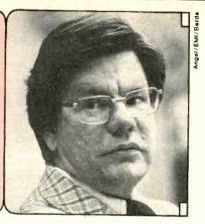
IAN PARTRIDGE . One of the best English tenors around
As one of the happy few who really like to listen to English art songs, I have long since resigned myself to the fact that most people don't. What I have never really re signed myself to is that recorded versions of the songs come only in dribs and drabs over the years, rarely by major artists, all too frequently by inferior ones or by those who have seen, or have yet to see, a better day.
Why don't they get somebody good, I've of ten thought, and make a nice two-record set of a whole pack of songs. Well, "they" did (nice to give some credit to "they" once in a while rather than just blame them for everything that goes wrong).
Peters International has released an Ox ford University Press recording of Ian Partridge singing thirty-nine "English" songs, dating from 1889 to 1929, by four composers. The quotation marks around "English" are there because of five of the Delius songs which, while invariably sung in English, were originally composed to texts in Norwegian. Partridge is one of the best English tenors around today; his voice, while not of the sort raved about in operatic circles, is capable of producing beautiful and affecting tones, his phrasing is musicianly, his diction excellent and not overdone. His major drawback is that he is not a particularly imaginative or daring singer, and his accompanist here, Jennifer Partridge, is also rather soberly musical. But it is a very well performed album.
I doubt, though, that it will do much to ward making English art song more than a minority taste. You simply can't play these four sides through at a single sitting; there's too much sameness of sound. To an extent the music is responsible, but it would have been a far more listenable program if shared with a woman's voice, perhaps with a couple of duets.
As a compendium from which to select, however, the set makes perfect sense. War lock's modern reincarnation of the Elizabethan song is represented by some of his best pieces (they are mostly the ones that have been recorded before). Sleep, with its wonderful modulation to nowhere at the end, is a splendid example and quite a little masterpiece. Most of the Delius songs are less familiar, and they show the composer, interestingly, struggling against the limitations of the medium, yearning for orchestral sonorities, and generally trying to write "big." The songs are successful in varying degrees, but the best of them, Twilight Fancies, is certainly a great one. The Vaughan Williams songs show the greatest stylistic range, despite the fact that all but one were composed within a three-year span. The New Ghost and The Water Mill are both masterly, but as different from one another as day and night. Ivor Gurney is the least familiar name here, and his songs are even more rarely heard in the U.S. than the others. He was a highly sensitive man, no doubt, and there are some very beautiful and effective passages in his songs, but his pacing is generally so slow that the songs lose overall impact. His Down by the Salley Gardens, though, with a tune utterly unlike the famous one, is a gem.
THERE is little point in comparing, for ex ample, Partridge's performance of Yarmouth Fair with Alexander Young's or his The New Ghost with Jennifer Vyvyan's, for both of those earlier versions, and others too, are long since gone from the catalog.
Devotees of English song will want this al bum in addition to whatever older ones they possess, and those coming new to the field had best avail themselves of the current opportunity before this set too passes into the limbo of unavailability. The recording is excellent, and complete texts are provided.
-James Goodfriend
IAN PARTRIDGE: English Songs. War lock: Passing By; Pretty Ring Time; Sweet-and-Twenty,. Rest, Sweet Nymphs; Sleep; Away to Twiver; The Frostbound Wood; Yarmouth Fair; Balulalow; Jillian of Berry; After Two Years; My Own Country. Delius: Hidden Love; The Birds' Story; The Nightingale; The Homeward Way; Young Venevil; Twilight Fancies. Gurney: The Fields Are Full; Severn Meadows; Desire in Spring; The Singer; An Epitaph; The Folly of Being Comforted; Bread and Cherries; All Night Under the Moon; Down by the Salley Gardens; Snow; The Cloths of Heaven; Brown Is My Love. Vaughan Williams: The Twilight People; How Can the Tree but Wither?: Four Nights; Nocturne; A Clear Midnight; Joy, Shipmate, Joy!; The New Ghost; Motion and Stillness; The Water Mill. Ian Partridge (tenor); Jennifer Partridge (piano).
PETERS INTERNATIONAL PLE 136/7 two discs $17.96.
-------------------------
Rzewski Piano Music
As have said, lo these many years, the real split in contemporary music, of whatever genre, is between the minimalists and the maximalists. And having said so, I feel compelled to add that I hate people who talk and write like that. But the division is real nonetheless.
The composers and critics who support minimalism are legion, and the phenomenon is well understood. Awash as we all are in the informational overload of the past few decades, it is perhaps not surprising that so many have fled into simpler creative worlds where the eternal verities-some eternal verities, any eternal verities-still reign. More complex and ultimately more interesting are those artists of maximalism who try to confront, use, or sort out the manifold inputs that bombard us. I'll admit right off that this approach catches my sympathy more than its opposite, in part be cause I have tried to do the same thing my self in various ways since the early Sixties (sometimes in concert pieces, but mostly in a series of music-theater pieces written with Michael Sahl).
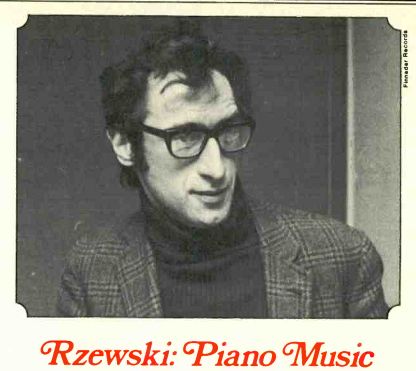
Composer-pianist Frederic Rzewski has impeccable avant-garde credentials; he is also a musician interested in social issues.
In his recent work he has tried to integrate the European classical tradition, the American popular/folk tradition, and the avant garde. In his case, the re-creation of traditional elements is not, I think, in any way a return or a looking backward (as it may be with certain other contemporary composers) but a genuine attempt to achieve a higher synthesis. Rzewski's best-known work in this vein is the big piano piece The People United Will Never Be Defeated on Vanguard 71248, and now the same label has brought us a record full of smaller pieces for the instrument, played by the composer, that are even more ingratiating, tighter, perhaps in a way more "complete" in themselves.
The 1977 Four Pieces (really a piano sonata without benefit of clergy) are colorful, insistent, multifaceted works. This is playing music-a kind of contemporary Gebrauchsmusik but without Hindemith's neo-Baroque pedantry. Unlike a lot of the best new music, these pieces belong to the central concert tradition, but in its widest, least snobbish form. As such, they ought to be played in concert halls, and played quite a lot.
The Ballad No. 3, called Which Side Are You On?, is a bit more like the earlier The People United. This is the third of four bal lads based on North American folk and pro test songs that Rzewski wrote for pianist Paul Jacobs (who recorded them for None such). The basis for this one is a protest song on a traditional tune written by Florence Reese in 1931 about the coal-miners' strike in Harlan County, Kentucky. The traditional tune turns up in its original form only after its elaborate balladic interpretation. Rzewski's version here differs considerably from Jacobs', not least in its inclusion of an extensive improvisational section that is as long as the written-out part of the work. Rzewski has been doing quite a bit of exploring in the area of improvisation, and some of the best fruits of his exploration are to be found in both the improvised and the written-out portions of this music.
Rzewski's virtuosic performances-reminiscent of the composer-pianists of the past-are excellent, and the digital recording is good. A most worthwhile release.
-Eric Salzman
RZEWSK1: Four Pieces; Ballad No. 3, Which Side Are You On? Frederic Rzewski (piano). VANGUARD CVA-25001 $12.98, CVA-2500 I $12.98.
---------------
Also see:
NEW AUDIO PRODUCTS AT CES '81, PART 2: A report on accessories and audio/video developments.
THE CASE FOR MINIMAL MIKING: The "back to realism" movement is invading the nation's recording studios.
Source: Stereo Review (USA magazine)