British-made Goldring phono cartridges, which in the past have had limited distribution in this country, are now being imported by AudioSource of Foster City, California.
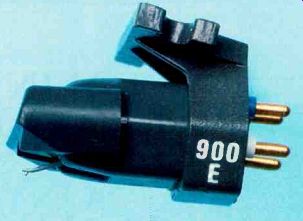
The Goldring G900 series of moving-magnet cartridges share a common body, differing only in their stylus assemblies (which are easily replaceable and can be changed to upgrade one cartridge model to another). The cartridge was designed to be as light as possible, to which end the number of its fixed coils was reduced from the usual four to two, which were wound with out forms to further reduce weight. The mu-metal hum shield is also smaller and lighter than usual. All these measures result in a cartridge with a total weight of only 4 grams, about 40 percent lighter than most magnetic cartridges.
The stylus moving system is mechanically damped by a butyl-polymer damper in the G900E (the model we tested), and the moderate inductance of its fixed coils (570 millihenries) helps to make the cartridge response relatively insensitive to capacitive-loading effects. The G900E, being intended for use in a wide variety of tone arms, has a more rugged cantilever than the more ex pensive models, and its more powerful mag net gives it a rated output of 6.5 millivolts ±2 dB for a lateral stylus velocity of 5 cm/ sec. The 0.3 x 0.7-mil elliptical diamond stylus is bonded to the aluminum cantilever tube.
The performance specifications of the Goldring G900E include a frequency response of 20 to 20,000 Hz ±3 dB (test record not specified) when loaded by 47,000 ohms in parallel with a capacitance of 200 to 400 picofarads. The range of usable tracking forces is 1 to 3 grams, with 1.75 grams being the recommended value. The vertical stylus angle is 24 degrees. Price: $70.
Laboratory Measurements.
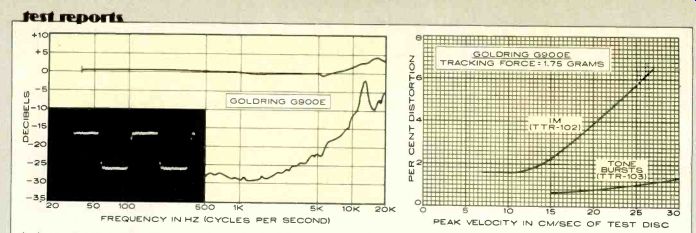
---------- In the graph at left, the upper curve represents the frequency
response of the cartridge. The distance (measured in decibels) be tween it
and the lower curve represents the separation between the two channels (anything
above 15 dB is adequate). The inset oscilloscope photo shows the cartridge's
response to a recorded 1,000-Hz square wave, which indicates resonances and
overall frequency response (see text). At right is the cartridge's response
to the intermodulation-distortion (IM) and 10.8-kHz tone-burst test bands
of the TTR-102 and TTR-103 test records. These high velocities provide a
severe test of a phono cartridge's performance. The intermodulation-distortion
(IM) readings for any given cartridge can vary widely, depending on the particular
IM test record used. The actual distortion figure measured is not as important
as the maxi mum recorded-signal groove velocity that the phono cartridge
is able to track before a sudden and radical increase in distortion takes
place. There are very few commercial phonograph discs that embody musical
audio signals whose average recorded groove velocities are much higher than
about 15 centimeters per second. ----
We tested the Goldring G900E in the tone arm of an Onkyo CP-1130F record player for a total effective mass, including the cartridge, of 15 grams. The vertical force was 1.75 grams, although tracking tests were made over the range of forces for which the cartridge is rated. The cartridge load was 47,000 ohms and 185 picofarads (pF), and the frequency response was also measured with higher values of capacitance.
The frequency response with a CBS STR 100 test record was flat up to 6,000 Hz, rising gently at higher frequencies to a maxi mum of +4.5 dB from 16,000 to 17,000 Hz. The overall response was within ± 2.5 dB from 40 to 20,000 Hz, comfortably meeting the manufacturer's specifications.
Increasing the load capacitance to 420 pF shifted the high-frequency resonance peak to 11,000 Hz, which had the effect of in creasing the output between 4,000 and 13,000 Hz by about 2 dB and causing it to drop off faster at higher frequencies com pared to the performance with the lower capacitance value. The overall variation was still only ±2 dB throughout the audio range with the higher capacitance.
The channel separation was 25 to 28 dB in the midrange, 12 to 13 dB at 10,000 Hz, and about 6 dB at 20,000 Hz. The response and crosstalk characteristics of the two channels were both very closely matched over the frequency range, and the two out puts were also almost identical at 4.7 milli volts, their mismatch being less than 0.1 dB.
The low-frequency resonance in the Onkyo arm was at about 10 Hz, an ideal frequency. The vertical stylus angle was 28 degrees, slightly higher than the rated 24 degrees. At its minimum rated force of 1 gram, the cartridge was able to track our high-level low- and middle-frequency test records successfully. Only the 40-micrometer level of the German Hi Fi No. 2 test record was playable at 1 gram, but tracking improved to a very good 80 micrometers at 1.75 grams and to 90 micrometers at 3 grams.
The response to the 1,000-Hz square wave on the CBS STR 112 record was very good, with a single 20 percent overshoot fully damped in only one cycle of the high-frequency stylus resonance (about 20,000 Hz). Other than this, the square wave was reproduced about as accurately as we have ever seen from this record.
Tracking distortions were measured with the Shure TTR-102 and TTR-I03 test records. The TTR- 102 is an intermodulation distortion (IM) test record with mixed 400-and 4,000-Hz tones recorded at a number of levels. The G900E's IM was low (about 1.6 percent) at low to average velocities up to about 12 cm/sec, increasing smoothly to 6.5 percent at 27 cm/sec. There was no sign of actual mistracking even at this very high level. The TTR-103 has shaped I0.8-kHz tone bursts with a 270-Hz repetition rate at four levels from 15 to 30 cm/sec. Any high-frequency tracking nonlinearity causes the 270-Hz frequency to appear in the cartridge output after the 10.8-kHz burst has been filtered out. Here too, there was no obvious mistracking visible on the waveform, and the distortion (at the 270-Hz level com pared to the 10.8-kHz level) rose smoothly from 0.7 percent at 15 and 19 cm/sec to 1.4 percent at 30 cm/sec.
Comment.
Our initial listening to the Goldring G900E (before any measurements were made) left us with the impression that it was a very clean, smooth, and easy sounding cartridge. Nothing in the tests conflicted with that judgment. For example, the subjective tracking tests with the Shure ERA III and ERA IV "Audio Obstacle Course" records confirmed the excellent tracking qualities of the G900E. It played everything on the ERA III record without strain. With the more demanding ERA IV disc, there was a sense of strain only on the highest level (5) of the flute and combined harp/flute sections. As we had observed in the distortion measurements, the cartridge "overloads" very gracefully, never becoming harsh or unlistenable, merely sounding somewhat strained when the tracking demands become too severe.
To put this into perspective, one must bear in mind that the G900E has a list price of only $70, ranking it among the least ex pensive cartridges that can claim true high fidelity performance. In spite of its low price, the sound and measured performance of the G900E are not strikingly different from those of some highly regarded cartridges that sell for several times its price.
Furthermore, it has a high output, good hum shielding, and the ability to operate with full effectiveness into almost any load likely to be encountered in a home music system. These are impressive qualities, especially in a bargain-price cartridge, and combined with what we heard from it they leave us with an overwhelmingly positive impression of the Goldring G900E (and considerable curiosity about its senior relative, the G900IGC, which is fitted with the radically shaped van den Hul stylus and sells for four times the price of the G900E).
---------------
Also see:
Source: Stereo Review (USA magazine)