POPULAR MUSIC: Arlo Guthrie: "Power of Love" Janis Ian: "Restless Eyes" Stevie Nicks: "Bella Donna" Cabaret: Bobby Troup and Meredith; The Swinging Madison ... Jimmy Witherspoon: " Olympia Concert"; Smithsonian Collection: C-&-W Classics
Pop Music Briefs ...
THE cover of the MCA album "Bill Monroe: Master of Bluegrass" (MCA-5214) shows a mandolin and a white hat, two well-known trademarks of an artist who is often referred to as the Father of Bluegrass.
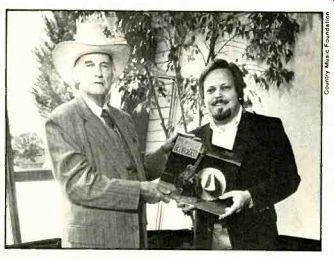
Monroe began his musical career in Kentucky in his early teens playing with one of his uncles, whom he subsequently immortalized in his most famous song, Uncle Pen In 1938 Mon roe joined the Grand Old Opry in Nashville, where his first number was Mule Skinner Blues He signed with MCA in 1950 and has recorded for that label ever since Monroe was elected to the Country Music Hall of Fame in 1970, and when "Master of Bluegrass" was released this year, he donated to the museum connected with the Hall of Fame one of his favorite mandolins and a white beaver cow boy hat given to him by the late Lester Flatt, with whom, as all old radio fans will remember, he played in the early Opry days At the presentation ceremony Danny Hatcher, deputy director of the Country Music Foundation, also accepted a copy of the album for the foundation's library and media center.
WE don't know what cult favorite Alex Chilton is up to these days, so for the time being we'll have to make do with "Bach's Bottom" (Line LLP 5081), a German release of some mid-Seventies sessions Chilton did in Memphis while his left hand was in a cast. Chilton, the boy genius responsible for the great Box Tops hits in the Sixties as well as two lovely power-pop albums as a member of Big Star a few years later, has been relatively inactive recently The new album, produced by critic Jon Tiven, includes a few cuts previously available as singles on the New York indie label Ork and shows Chilton working in a raw style that eerily presages elements of the New Wave. A fascinating curio, particularly relevant in light of the Searchers' recent (and splendid) cover of Chilton's September Gurls. Avail able from JEM Records. 3619 Kennedy Road, South Plainfield, N.J. 07080
-S S.
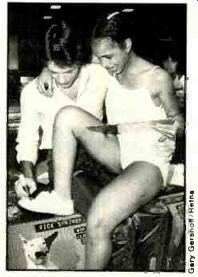
“You’re nowhere without that tube," Lou Rawls once observed. and here's a picture that proves him right.
That's rocker Rick Springfield autographing a shoe for one of the thousands (I) of fans who turned up recently to see him at a Manhattan record store Rick is currently enjoying his first hit single (Jessie's Girl) and album ("Working Class Dog") after almost a decade of knocking around the music business, but that's not why the crowd showed up in case you hadn't heard, Rick's also a heart-throb on the popular daytime TV drama (soap opera to the rest of us) known as General Hospital, in which he plays Dr Noah Drake. Could be the beginning of a trend.
TRADITIONAL wisdom has had it, until recently, that books on rock-and-roll don't sell But ever since biographies of Bruce Springsteen and Jim Morrison started generating what music-biz types refer to as "elephant dollars" there has been a spate of rock books attempting to duplicate their success. Comes now Bruce Pollock's When Rock Was Young (Holt, Rinehart, and Winston, $6 95), which will most likely reinforce traditional wisdom Billed as "A Nostalgic Review of the Top 40 Era," the book is mainly made up of interviews with various hit-makers of the period ( 1955 1964) ranging from off-the-wall (Jo-Ann Campbell) to historically interesting (Hank Ballard) to pointless (Dave Guard of the Kingston Trio, whose connection with rock is, shall we say, tenuous) It's breezy and light on scholarship, but it does give you something of the feel of the time, and Pollock has a nice postscript about a minor Play mates single that haunted his youth.
Considerably more impressive is David Bowie: An Illustrated Record, by Roy Carr and Charles Shaar Murray (Avon, $9 95)
This is an absolute must for Bowie fanciers, for it has it all a lively critical overview of his entire career, endless historical minutiae, and incredible graphics (if the authors have missed an extant Bowie photo or Japanese single sleeve, it's not for lack of trying) For non believers like myself the book is problematic Carr and Murray make a case for Bowie as the most important rock artist of the decade, but while I'm willing to admit that, for better or worse, he's been profoundly influential, his appropriation of other people's ideas, his dilettantism, and his casual exploitation of an unsophisticated audience (all of which Carr and Murray admit) are still troubling Then again, Bowie's biggest impact has been in England, so perhaps the authors can be excused as being too close to the subject to maintain a proper objectivity In any case, as with Carr's earlier, similar books on the Beatles and the Stones, a fascinating package.
-S S
COLLECTORS ALERT: CBS has a new Springsteen album out, but, sad to say, as of now it's available only to radio stations and the press. Called "Bruce Springsteen as Requested Around the World," it's a sort of eccentric greatest-hits package Side one is made up of stuff from "The River." and side two has concert favorites from the earlier albums (nothing from the first one, oddly enough) Boss fans who have to have everything shouldn't despair, however if history is any guide, bootleg copies should be appearing, at exorbitant prices, in specialty stores by the time you read this.
------------
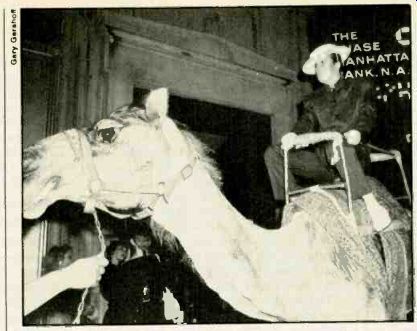
GIGGLING INTO THE CHANNEL DEPARTMENT: Polydor Records, apparently laboring under the misapprehension that the average Midwest rock fan will relate to a troupe of painted hussars in gaucho outfits, is engineering a massive promo push for Visage, a band in the vanguard of the so-called "New Romantic ' movement currently the rage in Britain Pictured here is Steve Strange, the band's conceptual honcho and fashion plate, arriving at a Manhattan punk club a /a Peter O'Toole And you were wondering why records list for $9 98-S S
GRACENOTES: Terry Sylvester has defected from veteran English hit-makers The HOLLIES; the band is currently in Los Angeles recording with founding member Graham Nash (late of Crosby, Stills, and There will be no mention of Adam and the Ants this month No comment a BBC reporter working the Royal Wedding with Tom Brokaw opined (on the a r) that the only other event he could recall combining such massive spectacle with a feeling of intimacy was "a Rod Stewart concert I saw once " Cover versions of songs by cult favorite Richard Thompson are popping up suddenly in unlikely places, a trend we heartily endorse Hot on the heels of Arlo Guthrie's version of When I Get to the Border (on "Power of Love." reviewed elsewhere) comes a remake of Dimming of the Day by Elvis Costello-sound-a-likes Any Trouble ("Wheels in Motion," Stiff / America) Mean while, Thompson's record la bel, Chrysalis, has not yet re leased "Sunnyvista," his 1980 English album, in this country, and a collaboration with Gerry Rafferty (of Baker Street fame) has been languishing in the can for over a year Yes, there will Women's Wear Daily lust called Adam and the Ants "a stupid rock band whose only claim to fame is beating Macy's to the Pirate Look by six months " You mean to tell me there was a contest?
++++++++++++++++++
Disc and Tape Reviews
By CHRIS ALBERTSON; NOEL COPPAGE; PHYL GARLAND; PAUL KRESH; MARK PEEL; PETER REILLY; STEVE SIMELS; JOEL VANCE
= stereo cassette
= digital-master recording
= quadraphonic disc
= eight-track stereo cartridge
= direct-to-disc
= monophonic recording
The first listing is the one reviewed; other formats, if available, follow.
--------
AIR SUPPLY: The One That You Love. Air Supply (vocals and instrumentals). Don't Turn Me Away; Here I Am; Keeping the Love Alive; This Heart Belongs to Me; and six others. ARISTA AL 9551 $8.98, ACT 9551 $8.98, OO A8T 9551 $8.98.
Performance Nice but numbing
Recording Excellent
Air Supply's are drivel and their tunes aren't likely to set the world singing, so what keeps the customers lining up to plunk down their money for their albums? The first album released in America by these seven Australian singers and instrumentalists, who dress neatly and can play and sing quietly when they choose, was called "Lost in Love." From the sound of things here, they still are. Maybe that's their secret. They project a kind of naive vulnerability. You don't want any of these fellows to be hurt, that's all, and you hope all those "friends" they sing about will be there when they wake up tomorrow. P.K.
MARTY BALIN: Balin. Marty Balin (vocals, guitar): instrumental accompaniment. Hearts; You Left Your Mark on Me; Lydia!; Atlanta Lady: Spotlight; and four others. EMI/AMERICA SO-17054 $7.98, CI 4X0-17054 $7.98, 8X0-17054 $7.98.
Performance: Another producer's trip
Recording: Very good
If you're old enough to remember when John Chancellor could pronounce his own name, you'll recall that Marty Balin and the early Jefferson Airplane let the market react to them rather than the other way around. I guess times and people do change.
From the Richard Avedon jacket photos to the last strains of Music Is the Light, this album seems custom-tailored to today's radio needs-although I have to say it isn't as dumb as the Peter Frampton album that ushered in this era. The trouble is that Balin has a stylized, one-of-a-kind voice that besides not going with this silk shirt production-loses credence once you realize he doesn't really feel passionate all the way down to his toes about what he's singing.
Only the opening cut, Hearts, written by Jesse Barish, manages to accommodate both tie production-fiber-alles ideal and Balin's idiosyncrasies. As for the rest .. well, somebody ought to rewrite / Believe in Music to put it in touch with the Eighties: / Believe in Production.
N.C.
RECORDING OF SPECIAL MERIT
BOBBY BARE: As Is. Bobby Bare (vocals, guitar); instrumental accompaniment. Dollar Pool Fool; Learning to Live Again: Call Me the Breeze; Take Me As I Am (Or Let Me Goi; Let Him Roll; New Cut Road; and four others. COLUMBIA FC 37157, FCT 37157, FCA 37157, no list price.
Performance Writers' showcase
Recording Very good
Turning abruptly away from the approach he used for his last two good, rowdy live albums, Bobby Bare got Rodney Crowell to produce this one and used Crowell's band, the Cherry Bombs, for most of the back-up.
There isn't a Crowell-written song in it, probably because Crowell had to think about getting his own album out, but several of Bare's favorite songwriters-Bob McDill, Townes Van Zandt, Guy Clark are represented, along with J. J. Cale, the Bryants, and, in the maybe-not-yet-finished She Is Gone, Willie Nelson (Bare found the tune on an old demo tape Nelson had left behind). The songs are not always those writers' best, but they do grow on you and they indicate that Bare's ear is still good.
Bare's singing continues to be, in my opinion, among the best you can get, just about totally honest and unforced in a baritone that seems to get richer all the time.
The instrumentation is the usual Crowell synthesis of the best that's going on in Nashville, Austin, and L.A., but it is not radically different from the ways Bare has been backed in the recent past. Most of the time it is straightforward and economical, like Bare's style. It's country, but it didn't just fall off a cucumber truck. There's a worldliness about how both Crowell and Bare do things, but it hasn't worn all the romance off of them. - N.C.
KURTIS BLOW: Deuce. Kurtis Blow (vocals); vocal and instrumental accompaniment. The Deuce; It's Gettin' Hot; Get away; Starlife; and three others. MERCURY SR M-1-4020 $7.98, MCR4-1-4020. $7.98,MC8-1-4020 $7.98.
Performance: Breezy rapping
Recording: Good
Though rap records had long been a main stay among black urban youngsters, who take pride in their ability to memorize and rattle off long stretches of apparently nonsensical material with rapid-fire ease, it was Kurtis Blow who, with a little help from clever producers and benevolent winds in the recording industry, managed to popularize the form among the over-eighteen crowd. But in transforming rapping into adult entertainment, Blow has altered its basic style, especially here on his second LP. Whereas earlier rap records by groups like the Sugar Hill Gang were all patter with little music except for a simple rhythm background, "Deuce" features smooth, fully fleshed-out instrumentals and even back up vocals, with the rap itself handled in an almost melodic manner. And in contrast to the all-but-endless raps of yesteryear, these tracks run from three to six minutes long, just like pop songs. They are tightly constructed numbers featuring a clear statement of the theme of each mini-story before it unfolds in rhyme and is carried to a conclusion. The most engaging tracks are The Deuce, a swaggering, slice-of-life excursion down New York's seamy West Forty-Second Street, and Starlife, a tongue-in-cheek poke at the extravagant lifestyle of today's superstars.
It is all highly listenable and danceable, but there is something just a little too prime-time slick about Blow's raps. His material is too often antiseptically safe, with little of the gritty reality of contemporary black urban life, the seed ground for rap.
On the other hand, this record is not in tended for kids trapped in the ghetto but for those who have escaped to the downtown discos. That's entertainment! P.C.
THE CARPENTERS: Made in America. Karen Carpenter (vocals); Richard Carpenter (vocals, keyboards); vocal and instrumental accompaniment. Those Good Old Dreams; Strength of a Woman; Back in My Life Again; When You've Got What It Takes; Because We Are in Love; and five others. A&M SP-3723 $8.98, CS-3723 $8.98, 8T-3723 $8.98.
Performance. Cheery
Recording Very good
Karen and Richard Carpenter, the brother-and-sister act from New Haven, are still singing songs as innocent and innocuous as their pleasant, pretty faces. Actually, Karen does most of the singing, with her brother and sometimes the "Carpettes" or "O.K.
Chorale" providing vocal accompaniment.
To tell the truth, a few of their songs are beginning to sound a more sour note, as in Strength of a Woman, whose heroine promises, like the .doormat she must be, to wait for her lover until his other affair is over and he comes back to her. That's how it is with the Carpenters' songs: liars are forgiven (Someone's Been Lyin'), prayers are answered (Those Good Old Dreams), hearts beat together (Touch Me When We're Dancing). And even when disillusionment sets in, the style is so bland and cheery that you just know everything will come out all right-the errant lover will return, the sad ness will end, the morning will "come through" and there will be "no dark horizons, only blue." I guess that's their appeal in these hard times. P.K.
JOHNNY CASH: The Baron. Johnny Cash (vocals); instrumental accompaniment. The Baron; Mobile Bay; The Hard Way; Hey, Hey Train; Thanks to You; The Greatest Love Affair; and four others. COLUMBIA FC 37179, FCT 37179, FCA 37179, no list price.
Performance. Pliant Recording. Very good "The Baron" is a bit of a letdown after "Rockabilly Blues," but, as Bobby Bare said, "If they figure out what you're going to do next, they'll file you away in a category." This is characterized mainly by the most ... well, the most production on a Johnny Cash album since his TV-show days, some of it unreconstructed Nashville Sound, also known as mainstream Billy Sherrill. At the same time, much of it is aimed at those grandpa's-generation red necks in Big John's audience who love his recitations of stories with O'Henry endings.
It's getting so you can anticipate the twists to come in The Baron, A Ceiling. Four Walls and a Floor (which, being by Tom T.
Hall, still tells a pretty good-and tough story in a touching way), Chattanooga City Limit Sign, and even The Greatest Love Affair, which is a schmaltzy love song to Amurrica (need I say more?).
For all that, Cash does continue to show a good ear for a song, and his singing now is the most accurate it's ever been. And once in a while Sherrill lets the boys play. You can have some moments with this, but the moments with the "real" Johnny Cash in "Rockabilly Blues" are more numerous and better. N.C.
GLORIA GAYNOR: I Kinda Like Me. Gloria Gaynor (vocals); vocal and instrumental accompaniment. I Kinda Like Me; Fingers in the Fire; Let's Mend What's Been Bro ken; Yesterday We Were Like Buddies; I Can Stand the Pain; and four others. POLYDOR PD-1-6324 $8.98, CT-1-6324 $8.98, 0 8T-I-6324 $8.98.
Performance Polished singing
Recording. Good
I recall hearing Gloria Gaynor years ago on what appeared at the time to be a most curious record. Though many of the songs, such as Never Can Say Good-bye, were quite familiar, the rhythms were not. The pace was off-beat and hectic, and the whole disc seemed to be galloping around my turntable. That was probably the first disco record I heard, and its appeal was immediate. As the disco wave reached its crest and rolled on for what seemed an interminable time before finally subsiding, Gaynor was eclipsed as a disco star by Donna Summer and others. But even in this post-disco era she remains an exceptionally fine singer and also a talented lyricist, sharing credit for half the numbers on "I Kinda Like Me." Most of the arrangements on this new al bum are uncluttered. Back-up singers are used sparingly, and Gaynor's rich, fluid voice is kept out front. The mood varies from that of the up-tempo I Can Take the Pain to the pensive I Love You Cause, which demonstrates that Gaynor has a mean way with a ballad. Although I can't call this an outstanding album-the songs don't reach out and grab you-it is certainly a pleasantly listenable one. P.C.
GEORGE HARRISON: Somewhere in Eng land. George Harrison (vocals, guitars, key boards); Paul and Linda McCartney, Denny Laine (vocals); Ringo Starr (drums); other musicians. Blood from a Clone; Un consciousness Rules; Life Itself; All Those Years Ago; Baltimore Oriole; Teardrops; and four others.
DARK HORSE DHK 3492 $8.98, M5 3492 $8.98, M8 3492 $8.98.
Performance: Surprisingly good
Recording: Good It took George Harrison almost two years, off and on, to make this album, and, though it isn't a knockout, it's by far the most note worthy one he's released in a long, long time. The hit single is All Those Years Ago, a tribute to John Lennon that features Rin go Starr on drums and the McCartneys singing back-up vocals. It wasn't originally intended as a eulogy, but after Lennon was killed Harrison rewrote the lyrics and taped a new lead vocal. The two most interesting and unusual selections are Hong Kong Blues and Baltimore Oriole, both tunes by Hoagy Carmichael but with classy lyrics by Paul Francis Webster for Oriole. I don't know where Harrison heard these songs or why he chose them for this album, but I'm glad he did. As a performer, he isn't really up to the demands of Hong Kong Blues--he doesn't have the right sense of humor but Oriole elicits his best vocal here.
Blood from a Clone, in a reggae rhythm, and Save the World, almost a vaudeville number, both have some very funny lines.
Unconsciousness Rules and Teardrops are oddly up-tempo numbers about lost souls that might sound livelier in other hands.
They have serviceable melodies and careful production, though, and the same can be said of the three songs here that make a pitch for the comforts of religion (Life It self, That Which I Have Lost, and Writing's on the Wall). I gave up expecting much from George Harrison quite some time ago, but I have to admit that this one is not bad, not bad at all. J V.
RICK JAMES: Street Songs. Rick James (vocals, guitar, bass, percussion); the Stone City Band (vocals and instrumentals); other musicians. Give It to Me Baby; Ghetto Life; Mr. Policeman; Super Freak; Fire and Desire; and three others.
GORDY G8-1002M1 $8.98, G75-1002-H $8.98, 0 G8-1002 H $8.98.
Performance Punk funk
Recording Good
I'll give Rick James credit for being one of the few newfangled r-&-b folks who is trying to say something in his music. As a purveyor of "punk funk," as he calls it, he blends freakishness, funk, and social protest with the usual love themes, pounding it all out to brazen, beat-heavy music. In this case, the message is better than the music, which tends to merge into one big thumping blur. Perhaps the blur is caused by the enormous cast employed here. I counted about fifty names in the credits, including such fascinating ones as the Temptations, Teena Marie, and Stevie Wonder--who offers a spicy harmonica solo on Mr. Policeman a protest against police brutality.
Since this is partially a concept album, a good many of the selections deal with stereotypical features of ghetto life such as growing up hanging out on street corners passing joints. Somehow I find it difficult to reconcile James' picture on the cover elaborately coiffed, expensively clad, wearing thigh-high red leather boots-with the realities of poverty, but at least he is ad dressing a serious subject in music that is energetic if not always imaginative. P.G.
ELTON JOHN: The Fox. Elton John (vocals, piano); vocal and instrumental accompaniment. Breaking Down Barriers; Carla Etude; Fanfare; Chloe; Fascist Faces; and six others. GEFFEN GHS 2002 $8.98, W5 2002 58.98, CI W8 2002 $8.98.
Performance A bit weary
Recording Good
"Yes I am the fox, a fascinating cross/Of sharp as a whip and tough as an ox/Yes I am the fox." Oh, come off it, Elton! You're a marmalade cat with a vast talent to amuse-or at least you used to be. Another couple of albums like "The Fox" and you'll become as ponderous, sententious, and solipsistic as your more "serious" colleagues.
The danger signs here include a barrel-of-fun political item called Fascist Faces and two more adolescently mopey statements about bisexuality, Breaking Down the Barriers and Elton's Song. While Chloe and Heels of the Wind are closer to Elton's familiar effervescent style, even they are marked by a certain weariness in the performance. A lot of Elton's initial outrageousness has been diluted by the shock tactics of the punk movement, but that isn't enough to explain the general air of depression that hangs over this album. P.R.
KID CREOLE AND THE COCONUTS:
Fresh Fruit in Foreign Places (see Best of the Month, page 77)
STACY LATTISAW, Stacy Lattisaw (vocals); instrumental accompaniment. With You; Young Girl; Spotlight; Screamin'; It Was So Easy; and four others.
COTILLION FD 16049 $8.98, CS 16049 58.98, 0 TP 16049 $8.98.
Performance. That certain Angie
Recording Good
On most of the tracks here Stacy Lattisaw projects a certain zingle (that is, a musical zing combined with a sexual tingle) that lifts her head and décolletage above the average disco singer. Of course, even the really good tracks, such as Feel My Love To night, go on much too long, but Lattisaw's fervor never diminishes for an instant. Absolutely no substance here, but a lot of drive and excitement. P.R.
----------------
Interview
Rosemary Clooney
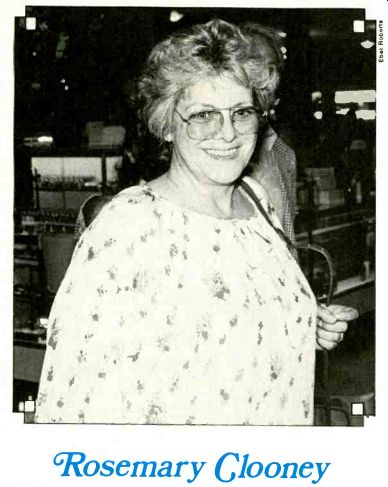
"You've got to learn to take care of yourself”
LEGEND tells us that once upon a time-- just about thirty years ago, actually--there was a cozy, comfy Dream America presided over by an endlessly smiling, endlessly benign father figure named Ike and his cute little wife Mamie. In those days, before Elvis and the musical Visigoths who followed him shook things up, we all happily listened to Nice Music performed by Nice People.
"The Fifties were apple pie, the American flag, motherhood, and The Ed Sullivan Show. You didn't ask questions. Even if you were married to a man, you didn't ask for explanations of his behavior. It was always,
'I'm the wife and you're the husband.' I listened recently to a duet I did at Paramount called Man and Woman, and it gave me the strangest feeling. It was completely manipulative on the woman's part and very condescending on the man's part. But I thought it was just fine-then." That's Rosemary Clooney, one of the nicest of the nice performing stars of the time, speaking about being drawn into the prevailing cant. She may have been even more deeply indoctrinated than the average per son, since the Hollywood-instructed American mass audience has always demanded of its pop stars that they reflect back glorified images of itself.
Clooney's first hit was in 1951, and she was a major star in the movies, on TV, and on records by the time Elvis arrived in 1956.
Thirty years later she's in New York to pro mote her wonderful new Concord Jazz al bum "With Love." She's still radiant, still genuinely a nice person, still a star, but to day it's on her own terms. It was very different when she started out.
"It was a time of band singers becoming individual personalities. It really was a singer's time. Mitch Miller, who had so much to do with my early success, was autonomous within his record company [ Columbia]. He could call up the sales department and say.
'We're going to ship 300,000 on consignment.' He had total control; he coordinated everything. Sure, it was all very paternalistic. I never saw an arrangement until I got to the studio; I was handed the material with the implication, do it or else. But, truthfully, all I ever wanted in those days was a hit. I wanted terribly to be a success, and I never felt manipulated because I didn't know there was any other way. We all seemed anxious to accept our limits in those days." The quick and lasting success of rock and-roll took Clooney and other "nice" per formers by surprise. "Mitch told me that it was only going to last about six months and then it would be all over. I think he was the most surprised man in the world when the whole business changed around. I got to wondering about it a little because I heard rock on the radio all the time, and then I saw what was happening to my record sales and to those of some other singers. I don't think that the first rock-and-roll records were very well recorded, whereas we were kind of prideful that we were making strides in recording techniques. We were using bigger control boards and better microphones and having a lot of new equipment brought in. But all of the rock stuff that I heard in the beginning sounded as if it had been re corded in a toilet somewhere, and the music was something I couldn't seem to relate to at all. 1 could always relate to jazz, but even that took a dip."
THE four top-selling female singers of the Fifties were Rosemary Clooney, Doris Day, Patti Page, and Kay Starr. I asked Clooney why she thought she was the only one of them still performing, still recording, still a star. She hesitated for a moment and then said quietly: "Probably because of the time I spent in the hospital after my nervous breakdown. The eight years of analysis, the starting from scratch again, getting my priorities straight about what's important and what isn't.
"I think that today I have a better approach to everything, that I can deal with the feelings I have now instead of any of the residual feelings from back then. All that garbage has been cleaned out. When I find a piece of material that's new to me now, such as Billy Joel's Just the Way You Are or Paul Anka's Alone at Last on the new album, I can meet it and sing it on its own terms. There's no more of that wistfulness I used to have no matter what song I was doing, which came from my wondering, 'God, am I ever going to get out from underneath all this?' There's no feeling any more that I have to fit the song to that 'thing,' that per former named Rosemary Clooney, which I had created and which wasn't me at all.
"ER me the most important thing now is the holes in my calendar, when I can look at my schedule and see that I've got a couple of days off here, a week there. Advisors have to be told, managers and publicity people have to be told that there are times you have to have for yourself, time that no one can infringe on. But you've got to learn to take care of yourself, because in the final analysis that's all you're left with-just yourself. That's where Elvis ended up, even with all of the pills and all of the people, alone in that mansion.
"The odds seem to be against the solo performer today," Clooney observes. "Even Debby Boone, who is married to my son Gabriel and who I think is just wonderful, hasn't been able to build on the success of You Light Lip My Life. It hasn't built for her in the way that it built for her father, who doesn't have her talent, or the way it built for me. She's going to country-and western, but I think she's limiting herself tremendously. Not that I have anything against country-and-western. I admire someone like Dolly Parton a lot. I love the way she writes and the way she sings and that public personality of hers. Nine to Five, for instance, is a positive, sensitive song." Clooney has some good words to say about others of today's songwriters, especially James Taylor: "He's my favorite.
He's somethin'! People are faced with so much more up close today than they were back in the days when I was singing Come On 'a My House, and writers like Taylor are saying some really positive things, al though it may not sound that way on the surface. For instance, all of the things he says about being crazy, and then not being crazy any more, about being scared and not being scared. If I were ever to write I'd like to be able to reflect my feelings as honestly as he obviously does.
"I only met James Taylor once. I was working at the Huntington Hartford and he was at the Pantages in Hollywood. I ran over in my costume, saw the last half of the concert, and went backstage. He entered this room filled with every big movie star in the world, came directly over to me, and said, 'I'm glad you're here.' I said, 'Thank you. I'm a tremendous fan of yours'-and I was truly shy about telling him that. Then he looked at me and said, 'Are those really your nails or are they false?' I told him they were mine, and he said, 'They look very strong. Guitar players always look at people's nails.'
“THE five Concord Jazz albums that Rosemary Clooney has recorded over the past few years display a singer at the height of her creative powers. The familiar Clooney warmth and humor and, yes, radiance are all still there, but there is also a whole new person and artist. If you want to hear what a lovely difference twenty-five years or so of living a life can make, simply compare her famous Fifties record of Tenderly with her new version on "With Love." Enough said.
If you're any kind of connoisseur of singing, you should certainly get the new album and the four that preceded it. And there will be others after this one. As the lady herself says, "I intend to go on singing and recording as long as there is anyone left to listen to me." That's the best news I've heard in a long time.-Peter Reilly
ROSEMARY CLOONEY: With Lore. Rosemary Clooney (vocals); Scott Hamilton (tenor saxophone); Warren Vache (cornet, flugelhorn); Cal Collins (guitar); Nat Pierce (piano); Cal Tjader (vibes); Bob Maize (bass); Jake Hanna (drums). Just the Way You Are; The Way We Were; Alone at Last; Come In from the Rain; Meditation; Hello Young Lovers; Just in Time; Tenderly; Will You Still Be Mine.
CONCORD JAZZ CJ-144 $8.98, CJ-144
--------------------------
Arlo Guthrie
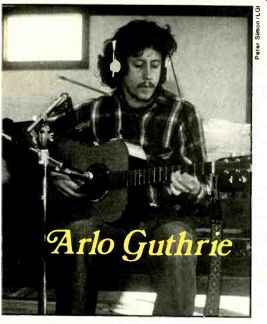
THE piece of work that comes after your best piece of work is a problem, especially if you work in public. Music-business executives used to try to force performers to follow hit singles with tunes that sounded as much like them as possible. It almost al ways turned out to be a mistake. Today's album orientation makes the next-record problem even knottier.
In the case of Arlo Guthrie, it is a further complication that his last and best album, "Outlasting the Blues," was a sort of summary statement about his life up to then, and its starting words, "In the event of my demise," put chilling thoughts in the heads of those who knew something of the Guthrie family history. According to Joe Klein's Woody Guthrie: A Life, Woody had eight children and half of them died tragically, either from accidents or of Huntington's disease, which Woody inherited from his mother and passed along. Arlo's songs didn't mention this directly, of course, but there's a fifty-fifty chance that he inherited it too, and Arlo has four children. How does one follow a piece of work that deals, how ever obliquely, with something like that and is a critical high-water mark to boot? Arlo has elected, after a two-year hiatus, to do something more or less completely different. His new "Power of Love" is more elaborately produced than we expected, has very little autobiography in it, doesn't even remind us of folk music, is apolitical, and has almost none of the whimsey and humor we expect of Arlo Guthrie. It is a potpourri.
Three songs-including a Jamaica Fare well without vibes, if you can believe it have island imagery and rhythms, but the album doesn't have a single unifying flavor, let alone a theme. There's a nice Jimmy Webb song, Oklahoma Nights, with strings; a no-frills (and no-folk) rock thing, Give It All You Got, which gives the impression of being recorded louder than any thing else; a duet with Leah Kunkel on If I Could Only Touch Your Life, by Aaron Schroeder and David Grover, one of those ultraromantic songs in the vein of You Light Up My Life that's given over almost entirely to the dramatic buildup; David Mallett's Garden Song, a piece for children in which Arlo is backed vocally by his own and the sidemen's kids; and so forth and so on-in short, a bunch of seemingly unrelated selections.
The album is, I suppose, an attempt to attract a broader, more pop-conscious audience. If you take the songs one at a time, they stand up pretty well-with a couple of exceptions. I'm not sure we needed Jamaica Farewell again, even with Ricky Lee Jones' baby-voiced harmony added, and Give It All You Got is simply not very interesting.
Arlo wrote only two songs here, and one of those, Living Like a Legend, retells the by-now threadbare story of a musician's life on the road. I like Jim Horn's recorders imbedded in the opaque arrangement of the title song (written by Bob Dylan's pal T-Bone Burnett), but it wasn't until the fourth se lection, Waimanalo Blues, that I found one that I didn't think was at least somewhat overproduced.
But Leah Kunkel is terrific, the album is tuneful, most of the lyrics are interesting if not exactly riveting, the arrangements are mostly pretty good in spite of their being crowded, and Arlo still sounds like his old nice, affable self. I don't know whether the pop masses will glom onto this or not. With all my expectations and long history of liking Arlo the folkie, I can't imagine what kind of impression it might make on kids who come upon it cold. The thinking nowadays seems to be that the pop masses want music that is bland, escapist, without tension. Not much of "Power of Love" fits that bill, and Arlo doesn't fit the mold of a purveyor of that kind of pop. Even in the thick of this expensive production, he doesn't come across as market-oriented or other-directed. The album may be easy to listen to, and it may be full of "new" elements stylistically, but nothing in it really contradicts what we have come to believe are Arlo's values or his vision.
IN any case, the album follows up "Out lasting the Blues" in a way that tilts the ma chine and ends the game, in the way apples follow oranges, thwarting comparisons left and right. Does it mean a New Direction for Arlo? Probably not, but it might open up some elbow room for him. If many people think they know what a performer's going to do next, the performer is in trouble, and if he repeatedly proves them right, he's in worse trouble.
-Noel Coppage
ARLO GUTHRIE: Power of Love. Arlo Guthrie (vocals, guitar, piano); Leah Kunkel (vocal); Russ Kunkel (drums); Bob Glaub (bass); Jai Winding (keyboards); Hadley Hockensmith (guitar); other musicians. Power of Love; Oklahoma Nights; If I Could Only Touch Your Life; Waimanalo Blues; Living Like a Legend; Give It All You Got; When I Get to the Border; Jamaica Farewell; Slow Boat; Garden Song. WARNER BROS. BSK 3558 $7.98, M5 3558 $7.98.
----------------
ROSE MADDOX: This Is Rose Maddox.
Rose Maddox (vocals); vocal and instrumental accompaniment. Philadelphia Lawyer; Let Those Brown Eyes Smile at Me; Single Girl; Dark as a Dungeon; This Old House; Sally Let Your Bangs Hang Down; and eight others.
ARHOOLIE 5024 $7.98.
Performance Bright
Recording Very good
Rose Maddox has been around almost as long as country music. She started singing the stuff over station KTRB in Modesto, California, back in 1937 and has been re cording it since 1946. Now, in 1981, this daughter of a sharecropper family in Boaz, Alabama, is white of hair but as good a singer as she ever was. The band of brothers she used to sing with broke up in 1956, but on this new record she's ably backed by a live bluegrass outfit called the Vern Williams Band.
When Rose turns on the full force of her personality she's hard to resist, whether she's singing about dangerous days in the mines (Dark as a Dungeon), reciting a bal lad about a crime passionelle in Pennsylvania (Philadelphia Lawyer), or delivering down-home humor (Rusty Old Halo). She's at her very best in a bluegrass ballad about a "happy-go-lucky-girl from Kentucky," Sally Let Your Bangs Hang Down, but there are very few duds in this collection.
Country music never had it better than it does right now with Rose Maddox. P.K.
THE MANHATTAN TRANSFER: Mecca for Moderns. The Manhattan Transfer (vocals); instrumental accompaniment. On the Boulevard; Boy from New York City; Spies in the Night; Smile Again; Kafka; and four others. ATLANTIC SD 16036 58.98, CS 16036 $8.98, 0 TP 16036 58.98.
Performance Boring Recording Elaborate This is yet another overproduced, gimmicky, leadenly cute album by this tiresome group. The two men and two women of the Manhattan Transfer spend an inordinate amount of time wending their way in and out of convoluted, pretentious arrangements that all seem to run on several minutes after the last idea has been used up.
The nadir here is the last track, A Nightingale Sang in Berkeley Square. Gene Puerling's arrangement and the Manhattan Transfer's performance combine to reduce that stately old bit of romantic whimsey to chittering nonsense. And they have the cheek to proclaim, in a prim little note on the inner sleeve, "We dedicate the harmony in our music to the quest for harmony in the world"! P.R.
JOHNNY MATHIS: The First 25 Years The Silver Anniversary Album (see Best of the Month, page 70) HILLY MICHAELS: Lumia. Hilly Michaels (vocals, drums, guitar, keyboards); instrumental accompaniment. Look at That Face; Our Love Will Last Forever; I've Got No Right to Love You; In the City; I Still Think About You; One; and four others. WARNER BROS. BSK 3566 $8.98, 0 M5 3566 ¶8.98.
Performance Polished
Recording Very good
Hilly Michaels' first album, "Calling All Girls," was a triumph of one-dimensional pop virtuosity: upbeat, clever, totally dance able, light as a feather. For this second al bum, Michaels has broadened his sights, exploring a range of pop styles with mixed success. "Lumia" reveals him to be a facile songwriter and a polished, versatile per former. He's also a shrewd casting director.
The album's credits drop a few of the more durable studio names: Dan Hartman, Elliot Randall, Rick Derringer, Ian Hunter, Mick Ronson, and Rupert Holmes. Such aristocratic support contributes to an album of clean, precision-crafted, energized music that struggles to be more than just pop. If too many of the songs fail to transcend their formulas, that may be because Michaels hasn't given his talents enough focus. "Lumia" doesn't seem like the creation of a coherent musical personality, but rather an attempt to show mastery of a whole range of styles.
There are some great moments, particularly Reach for the Vitamins, an act of desperation by a man who's met his match in bed, and the eminently danceable Look at That Face and Assembly Line. These three good-naturedly zero in on a whole slew of Eighties affectations. Most of the others are formula pieces that don't hit any mark at all. M.P.
RECORDING OF SPECIAL MERIT
STEPHANIE MILLS: Stephanie. Stephanie Mills (vocals); vocal and instrumental accompaniment. Winner; Two Hearts; I Believe in Love Songs; Night Games; and four others. 20TH CENTURY-FOX T-700 $8.98, C-700 $8.98, 8-700 $8.98.
Performance Compelling
Recording Very good
It has taken years for Stephanie Mills to shake her image as Little Dorothy in The Wiz, but her new status as a Grammy Award-winning popular singer should en able her to desert the Yellow Brick Road for a path of gold, or so the quality of her recent output suggests. Like Chaka Khan, her main competitor for the title of Soul Princess (Aretha Franklin will reign as Soul Queen into her dotage), Mills has a voice of exceptional power, with a piercing quality and thrust that enable her to inject excitement into everything she sings. But her voice and her ability to handle it are only the beginning of her gifts. She also has a solid sense of phrasing and really digs into the lyrics, however simple, so as to make her post-adolescent love entreaties utterly convincing and compelling.
For this album, producers James Mtume and Reggie Lucas have supplied Mills with songs that sound fresher than they are, thanks mainly to her wonderful way of working them over, wringing every ounce of meaning out of them. Winner and My Love's Been Good to You shimmer with intensity, and her duet with Teddy Pender grass on Two Hearts proves that she can work with another powerful musical personality and not be overwhelmed. "Stephanie" is at least as good as "Sweet Sensation," Mills' excellent previous set, and maybe just a bit better. P.C.
THE MOODY BLUES: Long Distance Voyager. The Moody Blues (vocals and instrumentals). The Voice; Talking Out of Turn; Gemini Dream; In My World; Mean while; 22,000 Days; and four others.
THRESHOLD TRL-1-2901 $8.98, TCR4 1-2901 $8.98, 0 TC8- I-2901 $8.98.
Performance. Up to standard
Recording: Very good
----------------
Janis Ian--Short stories
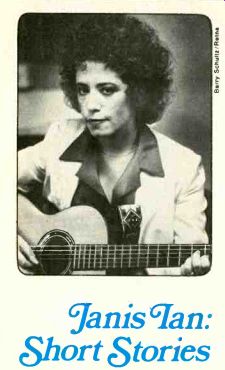
THE advance word within the industry was that Under the Covers, the first track of Janis Ian's new album, "Restless Eyes," would be another mass-audience hit on the order of her smash At Seventeen. If that happens, it will have to be without the benefit of much airplay, since the powers that be have decided that the lyrics are too lewd for our ears (compared with the aver age pre-teen conversation these days, it's about as lewd as To a Skylark). Under the Covers, a reverie on the quality and style of Latin men as lovers, is a typically fine piece of writing and performing by Ian. Like all her work, it's distinguished by an earthy but romantic sensibility that expresses itself fearlessly regardless of the social climate.
THE whole album, in fact, is like a collection of short stories by a writer of the caliber of Katherine Mansfield or Anna Kavan.
Some of Ian's tales are unqualified successes: Restless Eyes, about two people who "settled" for each other and are sadly Ln easy about it; I Believe I'm Myself Again, about the guilt-free pleasures of being out of love; and Dear Billy, a stinging piece about the rage and confusion of a young wife deserted by her husband. Others are merely brief, perceptive vignettes (Passion Play, Sugar Mountain). But everything here, whether dark or light, angry or giddy, is suffused with mood, intelligence, and the authority that comes from writing about what one knows firsthand.
-Peter Reilly
JANIS IAN: Restless Eyes. Janis Ian (vocals, guitar); instrumental accompaniment. Under the Covers; I Remember Yesterday; Passion Play; Dear Billy; Sugar Mountain; I Believe I'm Myself Again; Restless Eyes; Get Ready to Roll; Down and Away; Bigger Than Real. COLUMBIA FC 37360, FCT 37360, CO FCA 37360, no list price
---------------------
Stevie Nicks Solos
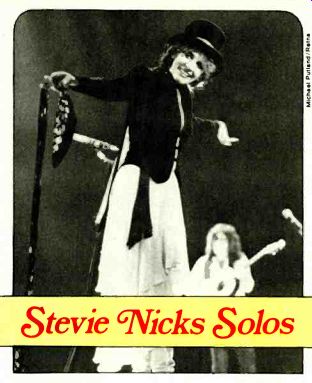
STEVIE NICKS may have a voice uncannily reminiscent of a no-nonsense c-&-w belter like Brenda Lee, but she has the soul of a girl who writes "How true!" in the mar gins of Kahlil Gibran books. She's a moon calf who has consciously fashioned her image after the kind of heroine who used to dwell in Donovan songs, long-haired child sirens who, when not pining for faithless lovers, sit strumming sad songs by the sea in the misty, moisty morning. You get the feeling she thinks La Belle Dame sans Merci is a beautiful woman who never says thank you.
In the context of Fleetwood Mac, Nicks' doe-eyed Lady of the Canyon amateurism nevertheless resulted in a lot of genuinely appealing music. Propped up by colleagues whose roots are considerably earthier (the blues, that is) and whose creative command of the recording medium is as accomplished and imaginative as that of any rock band since the Beatles, her wistful little songs seemed not so much silly as touching in their naïveté, sonic wallpaper (Sara, on "Tusk," for example) that you could get lost in as long as you didn't think about it too much. In short, she's the Ringo of Fleet wood Mac, although she's certainly cuter than Ringo and she can carry a tune.
In the context of "Bella Donna," however, her new Jimmy lovine-produced solo al bum, Nicks is about as much fun as a dramatic reading from the latest Harlequin romance. !ovine has surrounded Nicks with the usual L.A. spare parts-refugees from Linda Ronstadt and Elton John sessions who provide the usual L.A. licks. The results are as parched as you might imagine, high-gloss and completely without character or spontaneity. Without the Macs' quirky underpinnings to bolster them, Nicks' songs are revealed for the undergraduate mewlings they really are, wispy banalities about the vagaries of Love in the Fast Lane set to tunes as flimsy as tissue paper. After the Glitter Fades has an uncharacteristic directness and honesty about it, but it's hard to be astonished by its one Big Insight, that its protagonist carries on the way she does because it's the only life she's ever known. Even the songs she does with Tom Petty and the Heartbreakers provide little relief. Petty's own Stop Draggin' My Heart Around is a minor effort, sounding like the stuff he wisely left out of his great Refugee, while Nicks' Outside the Rain has a profile so low that it's invisible. As a capper, ner voice is recorded in such an unflattering way as to kill what little charm remains.
The lame little conceit of the title tune is of course the album's giveaway. Doubtless intended to ring with romantic greeting-card associations, it also has the advantage of Another Level: foreign-language stuff is always good when you want to wrap your self in poetic profundity (just ask Patti Smith). But I wish somebody had given Nicks a copy of Ambrose Bierce's The Devil's Dictionary before she committed this nonsense to vinyl. Says Bierce, "Bella donna-In Italian a beautiful lady, in English a deadly poison, thus proving the similarity between the two languages." Now that's profundity!-Steve Simels
STEVIE NICKS: Bella Donna. Stevie Nicks (vocals); Tom Petty and the Heartbreakers (vocals and instrumentals); other musicians. Bella Donna; Kind of Woman: Stop Draggin' My Heart Around; After the Glitter Fades; Edge of Seventeen; How Still My Love; Leather and Lace; Outside the Rain; The Highwayman. MODERN MR 38 139 $8.98, CS 38-139 $8.98, TP 38 139 $8.98.
----------------
The title notwithstanding, this comeback album never strays very far from the Moody Blues' familiar mannered style. Re cording together for the first time after three years of mostly forgettable solo projects, the Moodies have come up with one of their best albums: effectively paced, impeccably arranged, convincingly performed.
Some of the credit has to go to new member Patrick Moraz, former synthesizer wizard of Yes. He didn't write any of the music on "Long Distance Voyager," but he contributed plenty of technique (and will doubtless save the band thousands in full-orchestra recording-session costs over the next few years).
But for all its merits, the new album also stumbles into the characteristic Moody Blues pitfalls that have long made them a favorite target of critics. The songs are stilted and full of self-important, patrician-style rocking, and too many follow the same maddening formula of vaporous ideas in grand, expansive settings. And so the Moodies once again blaze off into the sunset and hurtle through trackless voids, mixing metaphors and dipping again and again into the well of dreams, deepest night, and perfect love. "Voyager" sparkles with lyric rhinestones, but I think my favorite is Graeme Edge's 22,000 Days, a figure sup posed to be the length of the average human life span. Unwittingly amusing imagery coupled with melodramatic, self-conscious intensity makes it impossible to take seriously even such otherwise promising pieces as Ray Thomas' three-song study of the rock star as jester in Painted Smile, Reflective Smile, and Veteran Cosmic Rocker.
Still, the new material all sounds as good as or better than the Moodies' output in the band's heyday, and fans will welcome their capable, assured return. M.P.
RECORDING OF SPECIAL MERIT
NEW ENGLAND: Walking Wild. New England (vocals and instrumentals). Walking Wild; Holdin' Out on Me; Don't Ever Let Me Go: Love's Up in the Air; DDT; and five others. ELEKTR A 6E-346 $8.98, TC5-346 $8.98, ET8-346 $8.98.
Performance Fresh and feisty
Recording Excellent
The four men in this group expend so much energy that I sometimes expect them to burn themselves out before their latest record is over. They never do, though, and on "Walking Wild" they have again come through with a fresh and sassy concert that does them proud. The songs are shorter than they have been in the past, which al lows for ten numbers, most of them by leader John Fannon, without a lemon in the lot.
I particularly enjoyed the bold and bawdy DDT (which stands for "Dirty Dream To night") and L-5, which manages to sound spacy and futuristic without either taking itself too seriously or going on forever. In Don't Ever Let Me Go, the group demonstrates that they can pound out rock rhythms as relentlessly as anybody in the business, and Holdin' Out on Me shows they can scream as frantically as their rivals; the difference is, even the screams are fun. When New England takes you for a ride on their double-entendre Elevator, the special effects really work because these boys know what they're doing. P.K.
RECORDING OF SPECIAL MERIT
ODYSSEY: I Got the Melody. Odyssey (vocals); instrumental accompaniment. I Got the Melody: Roots Suite: I Can't Keep Holding Back My Love: Baby That's All I Want: and three others. RCA AFLI-3910 $8.98, AFKI-3910 $8.98, AFSI-3910 $8.98.
Performance: Classy
Recording: Very good
Every now and then the trio called Odyssey pops out of the woodwork to produce a sonically spectacular album full of some of the best singing around. Here at last is an r-&-b record with arrangements that don't sound like a mixture of all the rhythm, horn, and string clichés that long ago wore out their welcome in my house. The crackling brightness of the instrumentals is a major ingredient, along with the energy-charged vocals, in the success of Roots Suite, a medley of compositions by Al Gorgoni and Lamont Dozier. Odyssey sings like a roll of controlled thunder, setting the pace with the opener, a rousing rendition of Patti Austin's / Got the Melody. This album never flags for thirty-six delicious minutes. A knockout. P.G.
MIKE OLDFIELD: QE2. Mike Oldfield (mandolin, synthesizers, percussion, guitars, keyboards); vocal and instrumental accompaniment. Taurus I; Sheba; Conflict; Arrival; Wonderful Land; and four others. Virgin/Epic FE 37358, FET 37358, no list price.
Performance Engaging
Recording. Good
It's been eight years since the occult, tongue-in-cheek masterpiece "Tubular Bells" launched Virgin Records, the film of The Exorcist, and Mike Oldfield's career.
That Oldfield never again scaled the pinnacle he reached in 1973 owes as much to a field crowded with earnest mystics as to the quality of his subsequent work.
"QE2," his seventh album, finds Oldfield still at work in the field he helped open up.
It is like most of its predecessors in that nothing much happens in it, but it passes time pleasantly. Depending largely on a theme-and-variations scheme for a loose, incantatory structure, the pieces tumble down upon one another with a pulsing, fugue-like momentum. There are all the fa miliar Oldfield devices: plinking acoustic themes that erupt into cascading electronic variations, quotations from the classics and traditional melodies, chants, vocalize, and the usual assortment of exotic instruments.
But nothing leads anywhere, and by the end of the album you've forgotten it all. That may not matter, however; "QE2" lacks some of the good-natured, self-effacing charm of Oldfield's best work, but it is still full of relaxing, atmospheric music without an ounce of pretension. M.P.
YOKO ONO: Season of Glass. Yoko Ono (vocals); instrumental accompaniment.
Goodbye Sadness; Mindweaver; Dogtown; Silver Horse; Extension 33; No, No, No; and six others. GEFFEN GHS 2004 $8.98, M5 2004 $8.98.
Performance. Surprisingly melodic
Recording. Very good
Yoko Ono says in the sleeve notes here that she seriously considered quitting this project "because, as some people had advised me, 'It was not the time.' But the question was, when would it be the time?" At certain times work is good for you, and this did at least turn out to be an interesting record you won't confuse it with the stuff on the radio. For me, as much as I hate to criticize widows, a little of Yoko's singing goes a long way. It's not that she's out of tune all that much, although she is quite a bit of the time; it's her constant threatening to go out of tune that wears me down. I find her lyrics arresting only now and then, but I'm interested in the viewpoint behind them more of ten than that. What stands out here are the melodies and the instrumentation. The tunes are mostly wide-eyed, childlike, un fettered-and yet somewhat grandiose. The instruments don't do anything outlandish, but they somehow convey both freshness and spectacle, like a big Kurosawa-directed scene. All of it except Yoko's voice seems larger than life. I don't think the album's great, but it makes a nice change of pace from a lot of other things. N.C.
POINTER SISTERS: Black & White.
Pointer Sisters (vocals); instrumental accompaniment. Slow Hand; We're Gonna Make It; Fall in Love Again; Should I Do It; and five others. PLANET P-18 $8.98, PC-18 $8.98, PT-18 $8.98.
Performance. Routine
Recording. Good
The Pointer Sisters are off their nostalgia kick but unfortunately not on to much of anything else. No matter how good they are as singers and performers-and they are good-they can't operate in a vacuum. This Richard Perry production provides what seems a random selection of indifferent material, all of which the Pointers sing in a thoroughly professional but basically aim less way. The sole exception is Slow Hand, a very good song which they perform with great warmth and style. P.R.
THE REDDINGS: Class. The Reddings (vocals and instrumentals); instrumental accompaniment. Class; Seriously; Main Nerve; and five others. BELIEVE IN A DREAM FZ 37175, FZT 37175, no list price.
Performance Good
Recording. Good
The Reddings' second album is a lot tighter than their first. The songs here are better than average, given the rather flaccid requirements of r-&-b these days, and there is a very happy and scrappy horn section blowing some delightful riffs. The group's vocal style has settled somewhere between that of the contemporary Commodores and the restoration royalty of the Isley Brothers.
Seriously is a good soul ballad, and the instrumental Main Nerve features some pretty and graceful piano by William Joyner.
The Reddings are learning fast. J.V.
RECORDING OF SPECIAL MERIT
THE STAPLE SINGERS: This Time Around. The Staple Singers (vocals); instrumental accompaniment. Live in Love; A Child's Life; I Got to Be Myself; and five others. STAX MPS-8511 $7.98.
Performance Nostalgic soul-folk Recording Satisfactory Here's an album to stir pangs of nostalgia in the hearts of those who recall when the STAPLE Singers carried the lusty force of their Mississippi gospel and folk roots into the mainstream of soul music in the early Seventies. Though previously unreleased, this material was originally recorded at the old Stax Studios in Memphis when the firm was second only to Elvis Presley as a source of civic pride. Several of the songs were written by Betty Crutcher, one of the many talented composers in the Stax stable at the time, and they seem direct, earnest, and un contrived compared with today's souped-up multilayered hits. The three Staples sisters, supported by Pop Staples' unpretentious but tasteful guitar, simply sing from their hearts.
This set features lead singer Mavis Staples far more prominently than in most of the group's other albums from the same period. Her earthy voice with its distinctive hoarse edge soars and dips in the hypnotic cadences of a country preacher. Scant liner information is provided, but a fine mix of horns, rhythm, and an occasional touch of organ capture the flavor of the old Memphis sound. Years in the vault have only served to mellow this music. P.G.
PETER TOSH: Wanted Dread and Alire.
Peter Tosh (vocals, guitar, keyboard, percussion); vocal and instrumental accompaniment. Coming In Hot; Nothing but Love; Reggae-Mylitis; The Poor Man Feel It; Cold Blood; and four others. ROLLING STONES/EMI AMERICA SO-17055 $8.98, CS-17055 $8.98, TP-17055 $8.98.
Performance. Cool
Recording. Good
If Bob Marley was the silver-tongued prophet of Rastafarianism, then Peter Tosh is the street-corner evangelist who can't hold the crowd. The message of Rastafari is naïvely simple: good vs. evil, rich vs. poor, clean vs. unclean. To make it compelling, it must be delivered with fire. Tosh's song-writing is prosaic at best, and he delivers his songs with cool detachment, never exhorting, never threatening. "Wanted Dread and Alive" does move the way reggae is sup posed to move-like a streetwalker in the grip of Satan-but it fails to do the one thing that distinguishes great reggae from the routine: it fails to terrify. M.P.
THE TUBES: The Completion Backward Principle. The Tubes (vocals and instrumentals). Sushi Girl; Don't Want to Wait Anymore; Think About Me; Attack of the Fifty Foot Woman; Power Tools; and four others. CAPITOL S00-12151 $8.98, 4X00-12151 $8.98, ID 8X00-12151; $8.98.

Performance. Good
Recording: Good
-----------------------
There's nothing like an economic crunch to bring people to their senses. Record labels have had to cut back their largesse, and some of the more extravagant acts, such as the Tubes, have been forced to get down to business. I must say that the Tubes-whose new album photos show them in suits and ties, looking for all the world like a bunch of conservative account executives-sound all the better for it. Some of the kinky flim-flam remains in the lyrics of the "shocker" songs here, but in general the Tubes seem to be going for the dear old despised bourgeois audience along the hallowed pop-rock route. Most of the time "The Completion Backward Principle" sounds like a cross be tween Chicago and Steely Dan, and it's not unpleasant at all.
Attack of the Fifty Foot Woman, based on a cheesy Fifties drive-in movie, is funny enough and should help satisfy the Tubes' original audience of goofies. But Don't Want to Wait Anymore is not only the standout cut-a glorious pop single if there ever was one-but the one to which the band clearly gives the most attention. Kinky bands need hits too. J.V.
JOE VITALE: Plantation Harbor. Joe Vi tale (vocals, drums, keyboards); Joe Walsh (guitar); Timothy Schmit (vocals); Don Felder (guitar); other musicians. Plantation Harbor; Never Gonna Leave You Alone; Theme from Cabin Weirdos; Lady on the Rock; Bamboo Jungle; and four others.
ASYLUM 5E-529 $9.98, 5C5-529 $9.98, 5T8-529 $9.98.
Performance Goofing off
Recording Good
The Eagles are on sabbatical until the end of this year, possibly recovering from the uncongenial response to their last group al bum. Joe Vitale's solo flight, though lavishly produced, is a time-marking effort, obviously a vacation enterprise. Eagles Joe Walsh, Timothy Schmit, and Don Felder are present in various supporting roles, but none of them works too hard, and guest appearances by Stephen Stills and Graham Nash don't add much either. There is a tele phone conversation between Vitale and Walsh (it leads into Bamboo Jungle) that seems meant to reassure Eagles fans-and, perhaps, the Eagles themselves-that it's a sabbatical, not The End. We'll see. J.V.
FRANK ZAPPA: Tinsel Town Rebellion.
Frank Zappa (vocals, guitar); vocal and instrumental accompaniment. Love of My Life; I Ain't Got No Heart; Panty Rap; Tell Me You Love Me; Fine Girl; Easy Meat;
For the Young Sophisticate; Dance Con test; and seven others. BARKING PUMPKIN PW2 37336 two discs, WAX 37336, WTX 37336, no list price.
Performance. Chilling
Recording. Excellent
I began listening to Frank Zappa and the Mothers of Invention in high school, more than thirteen years ago, and for years after ward I devoured each new release of his with unseemly passion. Among the things of lasting value Zappa introduced me to were contemporary jazz, twentieth-century classical composers, and healthy skepticism.
About five years ago, however, Zappa's devastating satire seemed to collapse into a weary and wearying cynicism. On "Over night Sensation" and "A-pos-tro-phe" his strange inventiveness, a product equally of his eagerness to experiment and his disdain for popularity, was abandoned for a bitter mixture of "fusion" music and Caesar's Palace put-downs. The new live set, "Tinsel Town Rebellion," is a sixty-two-minute harangue. It seems there's nothing Zappa doesn't dislike, and his targets here are as banal as the worn-out stage act he's been dragging around for years: Mexican tarts, Brut cologne, Cosmo, the record biz, fast food. He makes these cheap shots with such condescension he must think he's the only one left who isn't sick, stupid, or crooked.
Zappa's music, too, seems to have reached a dead end. There are a few ingenious instrumental passages or choice solos, but for the most part he fills out the concert with mock-Las Vegas formula stuff. The abundant synthesizer sounds are the kind of thing he would once have parodied, not duplicated. As with other recent live packages, the old material stands out: the highlights here are Peaches III, a reworking of Peaches en Regalia, and Brown Shoes Don't Make It, a song whose mordant wit makes the tawdriness of Zappa's new tinsel all the more apparent.
As dispiriting as Zappa's creative decline is his evident growing contempt for women and for his audiences in general. His fans deserve better than a hypocritical dedication of the album to "all our friends who have attended our concerts year after year, all over the world, without whose support these performances would not have been possible." Zappa's real feelings for those "friends" are shown by Dance Contest, in which several members of the audience are egged on to participate in a grotesque, humiliating game. Zappa's antics aren't funny any more, let alone liberating-just irritating and nasty. M.P.
(Continued overleaf)
--------------
THEATER--FILMS
AMERICAN POP. Original-soundtrack recording.
Pat Benatar: Hell Is for Children.
Big Brother and the Holding Company: Summertime. The Mamas and the Papas: California Dreamin'. Peter, Paul, and Mary: This Train. The Dave Brubeck Quartet: Take Five. The Doors: People Are Strange. And four others. MC, MCA-5201 $8.98, MCAC-5201 $8.98.
Performance. As they were
Recording. Good
Ralph Bakshi's film American Pop has as its subject the last couple of decades of American popular music and performers.
This album drawn from the soundtrack includes recordings by a wide variety of per formers, from Dave Brubeck to Jimi Hendrix to the more commercial Mamas and Papas to the real-life pop cartoon known as Fabian. It is an interesting anthology, but there's nothing here that particularly makes me want to see the movie. P.R.
THE GREAT MUPPET CAPER (Joe Raposol. Original-soundtrack recording. Jim Henson, Frank Oz, Dave Goela, Jerry Nelson, Richard Hunt, Steve Whitmire, Louise Gold, Kathryn Mullet, Charles Grodin, Diana Rigg (vocals); instrumental accompaniment. ATLANTIC SD 16047 $8.98, CS 16047 $8.98, OO TP 16047 $8.98.
Performance. Very good
Recording. Excellent
The Great Muppet Caper takes the Muppets noisily to London, where Kermit the Frog and Fozzie the Bear attempt to mend their reputation as a competent reporter-photographer team after they are fired from a New York newspaper. A far more stimulating entertainment than its predecessor, The Muppet Movie, the Caper threatens the soignée Miss Piggy's wholesome relationship with Kermit as the wicked Nick Holiday (Charles Grodin) tries to steal her favors along with the fabulous jewels of his cousin Lady Holiday (Diana Rigg). Miss Piggy's right to stardom has never been less in doubt as she and her friends delightfully spoof movie history. Joe Raposo's songs, however, with their Silly Symphony melodies and lyrics tied closely to the action, are less than delightful heard on their own.
Still, the album has its moments: the mu sic for Miss Piggy's underwater fantasy is a marvelous parody of the kind Esther Williams used to swim to, and the song accompanying the action in the unspeakably seedy Happiness Hotel is splendidly grubby. On the whole, though, this is more a souvenir of the film than an independent piece of musical entertainment. P.K.
------------------
Smithsonian Collection: C & W Classics
Bill Monroe and the Bluegrass Boys a category unto themselves.
IF you were born during or after World War II and in the country instead of a city or suburb, you may feel today-1 know firsthand-a little like an immigrant. Starting about then, rural America moved to town with the gusto of a hound dog tailing a coon, and it's hard now to realize, looking around at all the concrete and neon and hustling trend merchants, that this country was mostly rural for most of its existence.
But music has powers. Before me is a giant-size, sixteen-side, 143-song record al bum that brings (down) home our rural roots and our corn-dodger heritage. "The Smithsonian Collection of Classic Country Music" was Bill C. Malone's project. Ma lone, a teacher at Tulane University and au thor of several books, is probably the most respected country-music historian we have, and he and our most respected conservatory institution have put together an anthology that not only charts this nation's "progress" from the cornfields and red-clay hillsides to barstools in honky-tonks and urban-cowboy hangouts but, since it contains the music that was played at the time, gives you the very feel of it.
Starting with a 1922 recording of Eck Robertson's unaccompanied fiddling on Sally Gooden and ending with Willie Nel son's 1975 version of Blue Eyes Cryin' in the Rain, the collection reflects just about everything important that happened during that fifty-odd-year span in America except its black experience. Add to it a parallel project covering ragtime, blues, and jazz, and you'd have the best American history course ever put together. As it is, the country collection covers everything from the soap-making and hog-killing period of the folk heritage to the wartime migration to the cities, the postwar boom, and beyond.
It works so well as a painless history les son because country music has always talked about what real people were doing and thinking and feeling. For instance, America's seemingly built-in yen to be on the move resulted in an early fascination with trains, among other things, and this restlessness is evoked here in a classic Jimmie Rodgers recording, Waiting for a Train, as well as in Vernon Dalhart's Wreck of the Old 97, one of the first hillbilly hits.
All the selections are arranged chronologically except for the two bluegrass sides.
Bluegrass, producer Malone writes, is "the sole recognizable style or subgenre of country music that has developed and preserved a life of its own." The engineers got an un usual amount of music on each side, nine cuts on most, possibly by remastering them at a relatively low level. The older recordings are in mono, of course, but the sound is surprisingly good throughout. You just have to crank up your volume knob a bit.
I would have liked to see Waylon Jennings and Emmylou Harris included, but outside of that it's difficult to quarrel with the selections. Oh, there are a few small things: Patsy Cline singing Faded Love in stead of the Bob Wills band playing it, and then no Patsy singing Crazy or I Fall to Pieces. And they left out Okie from Muskogee. But it's hard to complain much. For those oddballs among us who were born in the country, the memories evoked by such things as the remarkable tenor voice of Cowboy Copas singing Filipino Baby more than make up for small oversights, and hearing Hank Williams sing Lovesick Blues again is what we former hicks call a pure dee blessing.
WE'RE here on earth to learn, I have concluded (possibly because it's clear that II'm never going to make any real money), and this collection has provided the pleasantest learning experience I've had in years. The booklet Malone wrote to accompany it, with notes on each selection, is almost as valu able as the records. Reading it, I notice that whereas the state of Kentucky produced a number of repositories of the folk tradition-Bradley Kinkaid, Buell Kazee, Cliff Carlisle, Molly O'Day, Grandpa Jones North Carolina tended to turn out hot instrumentalists such as Chet Atkins, Doc Watson, and J. E. Mainer and His Mountaineers, and the Southwest gave us more varied, "modern" jazz- and blues- and pop-influenced musicians. Even better is the esoterica: Frank Sinatra, during his Lucky Strike Hit Parade days, had to sing, week after week, Al Dexter's Pistol Packin' Mama. Picture that. Or how about the full name of Harty of the team of Karl and Harty: Hartford Connecticut Taylor! Ah, they don't name 'em like that any more, now that we've all gotten so citified. You can return in memory to those rural days of yesteryear, though, with this collection, which is the next best thing to reliving them.
-Noel Coppage
THE SMITHSONIAN COLLECTION OF CLASSIC COUNTRY MUSIC. Selected and annotated by Bill C. Malone. 1920s.
Eck Robertson: Sally Gooden. Fiddlin' John Carson: The Little Old Log Cabin in the Lane. Grayson and Whitter: Going Down the Lee Highway. Uncle Dave Ma con: Jordan Is a Hard Road to Travel. Ver non Dalhart: The Prisoner's Song; Wreck of the Old 97. Charlie Poole: Goodbye Sweet Liza Jane. Gid Tanner and His Skillet Lickers: Soldier's Joy. Smith's Sacred Singers: Where We'll Never Grow Old. East Texas Serenaders: Shannon Waltz. Darby and Tarlton: Birmingham Jail. Buell Kazee: Lady Gay. Bradley Kinkaid: The Fatal Wedding. Carl Sprague: When the Work's All Done This Fall. Pop Stoneman: The Titanic. Carter Family: Wildwood Flower;
Can the Circle Be Unbroken?
Jimmie Rodgers: Daddy and Home; Waiting for a Train. 1930s Southeast. Arthur Smith:
Mocking Bird. Riley Puckett: Ragged but Right. Cliff Carlisle: Black Jack David.
Coon Creek Girls: Pretty Polly. Mac and Bob: Twenty-One Years. Callahan Brothers: She's My Curley Headed Baby. Blue Sky Boys: East Bound Train. Delmore Brothers: Brown's Ferry Blues. Monroe Brothers: What Would You Give? Rouse Brothers: Orange Blossom Special. Red Foley: Old Shep. Karl and Harty: I'm Here to Get My Baby Out of Jail. Lulu Belle and Scotty: Remember Me. J. E. Mainer's Mountaineers: Maple on the Hill. Rex Griffin: The Last Letter. Roy Acuff: The Great Speckled Bird; The Precious Jewel.
1930s Southwest. Gene Autry and Jimmy Long: Silver Haired Daddy of Mine. Sons of the Pioneers: Tumbling Tumbleweeds;
Cool Water. Patsy Montana: I Want to Be a Cowboy's Sweetheart. Montana Slim: My Swiss Moonlight Lullaby. Stuart Hamblen: Texas Plains. W. Lee O'Daniel and His Light Crust Doughboys: My Mary. Shelton Brothers: Deep Elem Blues. Jimmie Davis: Nobody's Darlin' but Mine. Bill Boyd: Un der the Double Eagle. Milton Brown and His Brownies: St. Louis Blues. Bob Wills and His Texas Playboys: Steel Guitar Rag; New San Antonio Rose. Leo Soileau: Le Valse de Geydon. Woody Guthrie: Do Re Mi. Chuck Wagon Gang: Jesus Hold My Hand. Cliff Bruner's Texas Wanderers: It Makes No Difference Now. Gene Autry:
You Are My Sunshine. 1941-1953. Ernest Tubb: Walking the Floor Over You. Wiley Walker and Gene Sullivan: When My Blue Moon Turns to Gold Again. Ted Daffan's Texans: Born to Lose. Elton Britt: There's a Star-Spangled Banner Waving Somewhere.
Al Dexter: Pistol Packin' Mama. Tex Ritter: Have I Stayed Away Too Long; Rye Whiskey. Molly O'Day: Teardrops Falling in the Snow; The Tramp on the Street. Jack Guthrie: Oklahoma Hills. Bailes Brothers: Dust on the Bible. Roy Acuff: Wabash Cannon Ball. Merle Travis: I Am a Pilgrim. Eddy Arnold: Cattle Call. Tex Williams: Smoke, Smoke, Smoke. Johnny and Jack: What About You? Jimmie Dickens: Take an Old Cold Tater. Maddox Brothers and Rose: Philadelphia Lawyer. Red Foley: Peace in the Valley. Grandpa Jones: Eight More Miles to Louisville. Cowboy Copas: Filipino Baby. Blue Sky Boys: Kentucky. Moon Mullican: New Joie Blon. Slim Whitman: Bandera Waltz. Hank Snow: Movin' On. Leon Payne: I Love You Be cause. Pee Wee King: Tennessee Waltz.
Martha Carson: Satisfied. Floyd Tillman: Slippin' Around. Lefty Frizzell: I Love You a Thousand Ways. Carl Smith: Darlin' Am I the One? Hank Thompson: The Wild Side of Life. Kitty Wells: It Wasn't God Who Made Honky Tonk Angels. Wilma Lee and Stoney Cooper: Thirty Pieces of Silver.
Hank Williams: I'm So Lonesome I Could Cry; Lovesick Blues. 1953-1963. Webb Pierce: There Stands the Glass. Johnny Cash: I Walk the Line. Tennessee Ernie Ford: Sixteen Tons. Everly Brothers: Down in the Willow Garden. Chet Atkins: Country Gentleman. Jim Reeves: He'll Have to Go. Ray Price: City Lights; Crazy Arms.
Bobby Helms: Fraulein. Louvin Brothers: When I Stop Dreaming; Knoxville Girl.
Johnny Horton: Battle of New Orleans.
Lefty Frizzell: Long Black Veil. Marty Robbins: El Paso. Rusty and Doug: Louisiana Man. Patsy Cline: Faded Love. Buck Owens: Excuse Me. George Jones and Melba Montgomery: We Must Have Been Out of Our Minds. Bluegrass. Bill Monroe and His Blue Grass Boys: Muleskinner Blues;
It's Mighty Dark to Travel. Flatt and Scruggs: Earl's Breakdown. Stanley Brothers: The Lonesome River. Mac Wiseman: Dreaming of a Little Cabin. Jim and Jesse:
Are You Missing Me. Osborne Brothers:
Rocky Top. Bill Clifton: Mary Dear. Reno and Smiley: /'m Using My Bible for a Roadmap. Lilly Brothers: John Henry.
Hylo Brown: I'll Be All Smiles Tonight.
Jimmy Martin: Sunny Side of the Mountain. Kenny Baker: Jerusalem Ridge. Doc Watson: Black Mountain Rag. Charlie Moore: Legend of the Rebel Soldier. Cliff Waldron and the New Shades of Grass: Four Strong Winds. Country Gentlemen: Two Little Boys. Seldom Scene: Bottom of the Glass. 1963-1975. Dave Dudley: Six Days on the Road. Bobby Bare: Detroit City. Porter Wagoner: Green Grass of Home. Roger Miller: King of the Road.
Charley Pride: Is Anybody Going to San Antone? Tom T. Hall: Homecoming. Dolly Parton: Coat of Many Colors. Merle Haggard: Hungry Eyes; Mama Tried. Ernest Tubb: Waltz Across Texas. Loretta Lynn: Coal Miner's Daughter. Tammy Wynette: D-I-V-O-R-C-E. George Jones: The Grand Tour. Moe Bandy: It Was Always So Easy.
Flying Burrito Brothers: Sin City. Willie Nelson: Funny How Time Slips Away; Blue Eyes Crying in the Rain.
SMITHSONIAN COLLECTION
R 025 eight discs $54.95 (plus 52.75 shipping and handling from Smithsonian Recordings, P.O. Box 10230, Des Moines, Iowa 50336).
-----------------
----------------
Also see:
Source: Stereo Review (USA magazine)