by Larry Klein
Power Indicators
In My receiver is equipped with fluorescent power indicators that are marked "referred to an 8-ohm speaker load.- However, they read the same whether the speakers are connected or disconnected and whether or not my headphones are plugged in. Since each of these conditions causes such different load impedances and power demands, why do the indicators always read the same?
ERIC DEVIRGILIS; Waverly, Pa.
A. Almost all modern amplifiers operate as "constant-voltage" sources within their ratings. As an explanatory example, let us say that a 1-volt input signal produces a 20-volt output at the speaker terminals; this is the equivalent of 50 watts across an 8-ohm load. Now let's say we substitute a 4-ohm load. The same 1-volt input will produce the same 20-volt output, but Ohm's Law tells us that halving the resistance doubles the power. So we now have 100 watts output, assuming that the amplifier is capable of supplying double the current into the load. A 16-ohm load would draw 25 watts of power.
What it all comes down to is that your amplifier is behaving normally. Its fluorescent display is responding only to the volt age level at the output terminals, not to the current supplied, which varies with the load. Therefore, within reason, the output display will always read the same level of output for a given level of input, but the calibration markings will be "accurate" only when the load is a reasonable approximation of 8 ohms.
Car-stereo Distortion
Q. I recently bought a new stereo system for my car, installed it myself, and ran into a strange problem. The radio cassette unit that I put in didn't seem to be able to play loud enough, it had audible distortion at normal levels, and it oscillated when pushed hard. I took the unit back to my dealer, who claimed he checked it out and found nothing wrong. I insisted that he give me a new unit, and guess what?-it works no better than the first one. Do you have any idea what's wrong?
MARVIN KALISH; Mt. Vernon, N.Y.
A. This is an easy one to diagnose, if only because I went through much the same sequence of events myself recently.
Almost certainly your problem is not caused by a defective car-stereo receiver; the fault is most likely somewhere in the wiring of your speakers. At some point there is a contact between an uninsulated part of the speaker wiring and the grounded car chassis, and that is having an unhappy effect on the amplifier section of your receiver.
To locate the problem, first disconnect all the speaker leads from your car-stereo receiver. Then, if you have an ohmmeter, measure the resistance between each pair of speaker leads and the car chassis. A correct reading would be 5 ohms or so across each pair of speaker leads and no reading at all (infinite resistance) between either lead and the car chassis. If you read 5 ohms or so between a speaker lead and the car chassis, that means that the other lead of the pair is grounded. If you read 0 ohms between a lead and the car chassis, that means that you've found the grounded lead.
If you lack an ohmmeter, a flashlight battery (a D cell) can serve as well (see illustration). Touch a pair of speaker wires (A and B) across the battery's terminals.
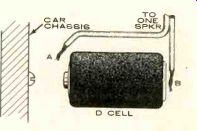
The speaker at the other end of the wire will produce a small "thump" at the moment of contact. Now, hold wire B to the bottom of the battery and touch the positive tip of the battery to a chassis ground. If the speaker is silent, try it with wire A held to the battery.
A speaker that remains silent with either wire held to the bottom of the battery is free of chassis-ground shorts; one that makes a noise with one or the other wire is shorted to ground. When you've determined which speaker is shorted, all you need do is find out where. Likely trouble spots are the speaker terminals (which should be insulated with plastic electrical tape) and any parts of the wire that could have been pinched during speaker installation.
Individual Hearing
If the ability to hear specific frequencies varies significantly from one person to another, what is the point of room and speaker equalization to some theoretically flat frequency response? Would not a more subjective process (akin to an eyeglass examination) prove more satisfactory?
ROY E. SANDSTROM; Cedar Falls, Iowa
A. This question keeps reappearing in my mailbox under several different guises, usually with reference to the problem of selecting loudspeakers, since "every one's taste differs." Live music usually sounds "right" assuming a reasonable listening environment-no matter what the frequency-response vagaries of our particular set of ears, and live sound as we hear it becomes the standard. If by some magic we were given "ear glasses" that would correct our ears' specific frequency-response aberrations and provide "flat response," the subjective result would probably seem unnaturally shrill or peaky. This is because each of us has established an individual set of "reference standards" based on what reaches the hearing centers of our own brain. Thus, although room/speaker equalization can help restore "reality" to reproduced sound by removing some of the gross aberrations in the room or speakers, it cannot be used to "correct" our ears' performance.
Equalizer Overload
Q. You've said that every 3 dB of boost by an equalizer doubles the power demand on the amplifier. I have a 35-watt-per-channel amplifier and a five-band equalizer capable of a 15-dB boost in each band. Is there any danger 1 could overload my amplifier with that much boost?
A. H. JOHNSON; Spokane, Wash.
A. It's true that every 3 dB of boost demands twice the power from an amplifier. But if your amplifier is putting out an average of, say, 2 watts in a certain frequency range, then a 3-dB boost in that range will demand only 4 watts from the amplifier, and a 10-dB boost will demand 20 watts-still well within your amplifier's rating. However, a full 15-dB boost will demand more than 60 watts, and this would drive your amplifier into overload clipping.
In other words, it isn't simply the amount of boost indicated by the equalizer control settings that's important; you must also consider the signal level in the frequency area that's being boosted.
Also see:
TECHNICAL TALK: What Price Distortion?
TAPE TALK: Pitch Problems; Tape Contact; What, No Bias?
Source: Stereo Review (USA magazine)