AMPLIFIER POWER--HOW MUCH DO YOU NEED? The answer depends on your taste in music and how loud you play it, your listening room, and your speakers.
HOW MUCH POWER DO YOU NEED?
THE KIND Of SPEAKERS YOU HAVE, THE SIZE OF YOUR LISTENING ROOM, YOUR TASTE IN MUSIC, AND HOW LOUD YOU PLAY IT ALL INFLUENCE YOUR POWER REQUIREMENTS.
BY E. BRAD MEYER
Hi-FI experts, like psychiatrists, have the annoying habit of answering questions with other questions. Take, for example, the query, "How much power do I need?" When the psychiatrist hears this, he responds by saying something like, "How much power do you want?" The audio ex pert is worse. He replies with a whole series of questions: What kind of music do you listen to? How loud do you like to play it? What kind of speakers do you have? How big is your listening room? How is it furnished and decorated? The hi-fi expert needs all this in formation not just to fine-tune his reply but to give any sort of meaningful answer at all. Variations in the desired loudness level, in the choice of speakers, or in the nature of the room and its furnishings can change the system's power requirements to a vast degree.
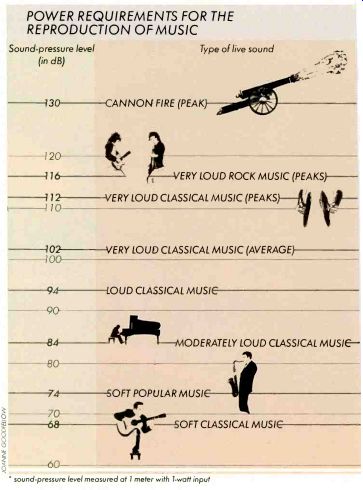
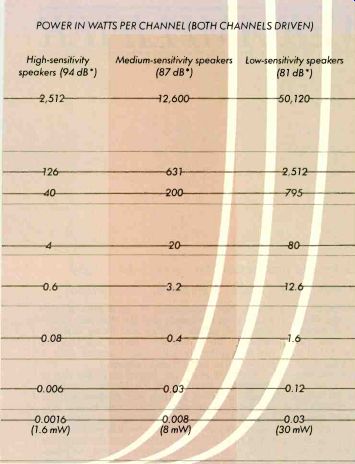
An audiophile of my acquaintance-who is also, coincidentally, a psychiatrist-reports that some one once said to him, "What do I need a bigger amplifier for? Mine already plays loud enough to hurt my ears!" His reply, of course, was that a powerful enough amplifier will play loudly without hurting your ears. But how do you find out how much power is enough? The accompanying table will give you an idea of the nature of the problem. It shows the amplifier power required to achieve a play back sound-pressure level (SPL) equivalent to various kinds of live music. The conversions from electrical to acoustic energy were made with the aid of formulas and tables from Chapter 10 of Leo Beranek's classic book Acoustics; the sound levels come from my own live-music measurements. The power figures, expressed in watts per channel, are based on the assumption that there are two channels playing.
THE MUSIC The most important characteristic shown by the table is the rapidity with which the power requirements increase as the sound-pressure level rises. (The three curves overlaid on...
--------------
THE LARGER THE ROOM, THE MORE POWER IT TAKES TO FILL IT WITH SOUND, AND THE FURNISHINGS COUNT TOO.
--------------
...the table at right give some idea of the rapidity of that increase.) This reflects the logarithmic nature of human hearing, the principal reason that the question of power requirements is so tricky. An increase in sound level of 10 dB, which most listeners would rate subjectively as "twice as loud," requires a tenfold increase in amplifier power. Conversely, if you are willing to play music at a level that is subjectively only half of what you would en counter in a concert hall (which still sounds loud to many people), your power requirements decrease by a factor of ten.
What does this mean when you're choosing an amplifier? First of all, amplifiers differ less than you might think. Going from a 50-watt-per-channel (W/ch) amp to a 100-W/ch one will increase the maximum available output by only 3 dB, which is noticeable, but just barely.
Second, for someone who never listens above moderate levels, 20 watts per channel is enough for any speakers, even those with the lowest sensitivity. ("Efficiency" is often used, incorrectly, as a synonym for speaker sensitivity. The familiar "x dB SPL at 1 meter with a 1-watt in put" is a sensitivity specification.) Third, the average power required by most speaker systems, even playing loud classical music at concert-hall levels, is very low. It is reproducing the momentary peaks that requires a powerful amplifier. The difference between average and peak levels on classical program material ranges from 8 to 12 dB. Al though a well-designed amplifier can occasionally "clip" a peak with only a mild effect on the sound quality, one with generous "headroom" -- the ability to put out more than its rated power for short periods--has a real advantage over an other one with the same continuous power but less headroom.
Rock music presents a somewhat different case. The 116-dB SPL given in the table as the maximum peak level represents what you'll en counter at an actual concert. But in most rock music the peak and aver age levels are very close, so the corresponding average level would be around 110 dB. Most people can't play their systems at these levels be cause neither their neighbors nor their loudspeakers can stand it for very long. If you must have such levels despite the inevitable hearing damage they will cause, you can achieve them with special speakers instead of a bigger amplifier.
THE SPEAKERS
The differences between the three right-hand columns in the table show that your choice of loudspeaker can change your power requirements by a factor of at least twenty: a speaker that puts out 94 dB at 1 meter with 1 watt of input will play as loud with a 10-watt amplifier as
------------------46
-- sound-pressure level measured at 1 meter with 1-watt input
----------------------
... an 81-dB/W/m speaker with a 200-watt amp. If you must hear music at live levels, it's pretty obvious that, depending on the amplifier power available, speaker sensitivity can spell the difference between success and failure. Particularly demanding of power are the new small, full-range speakers, many of which have relatively low sensitivity.
Although our examples were chosen to cover the range of sensitivities of commonly available loudspeakers, there are exceptions.
Some large horn-loaded speaker systems are almost 10 dB more sensitive than the "high-sensitivity" figure in the table.
Since this represents an easing of the power requirements by nearly a factor of ten, such speakers can produce extremely high sound levels with a modest amplifier.
THE ROOM
While the table shows the effects of two of the three principal factors in determining power requirements speaker sensitivity and desired sound level-it makes no mention of the listening room. The larger the room, the more power it takes to fill it with sound, and the furnishings can make even more difference than the size. The calculations in the table are based on a room with a volume of just over 3,600 cubic feet (17 feet wide, 25 feet long, and 8 1/2 feet high) that is fairly "dead" acoustically. containing an area rug, heavy curtains, and several pieces of heavy upholstered furniture. This is somewhat larger than an average listening room. If yours is only half the volume, your power requirements will be less by about one third.
Increasing or decreasing the amount and type of furnishings will have a stronger effect, changing the power requirements over a range of about three to one. Our assumed listening room is fairly absorptive, which means that reflected sound is soaked up before it has a chance to contribute to the overall acoustic energy. A more "live" room-one with more reflective surfaces and less padded furniture-makes the amplifier's job easier.
THE DIGITAL FACTOR
It is often said that digital Compact Discs demand more of our amplifiers than analog LP's ever did. This is true, but it does not affect your use of the figures in the table. Since the table gives the actual sound-pressure levels of acoustic events, an uncompressed CD that was digitally recorded with a minimal microphone setup will behave according to the numbers you see here.
Analog tapes, discs, and FM broad casts--and, for that matter, CD recordings on which accent mikes or compressors have been used--will have less dynamic range and thus be less demanding of amplifier power than the table predicts.
The level labeled "Cannon fire (peak)" is approximately correct for a 105-mm howitzer firing blanks at a distance of about 100 yards, as called for in the score of a well known Tchaikovsky overture.
A HIDDEN VARIABLE Until now we have been operating on the assumption that amplifier power ratings can be taken at face value. Unfortunately, not all amplifiers will deliver their rated power into a real loudspeaker. The figure on a manufacturer's amplifier spec sheet is measured with a pair of 8-ohm test resistors connected to the amplifier in place of speakers. But most "8-ohm" speaker system, have an impedance that falls to 5 ohms or less at some frequencies, causing them to draw more current than the resistor would.
In addition, a loudspeaker presents a reactive load to the amplifier, which may under certain signal conditions increase the current demand still further, to as much as several times that demanded by a simple resistor. Since it is the cur rent, not the voltage, that actually moves the speaker cone, output cur rent capability is what limits most amplifiers' outputs. Check the manufacturer's spec sheet for how an amplifier behaves with 4- and 2-ohm loads. Ideally, its output with lower impedances should be substantially higher than with an 8-ohm load. Then test the amplifier with your speakers before buying.
MORE IS BETTER
It may actually be riskier to use an underpowered amplifier or receiver than an overpowered one. Some amplifier protection circuits can, when tripped, produce ultrasonic oscillation at full power for long enough to burn out a tweeter.
Don't be afraid of buying a more powerful amplifier if you can afford it, especially if you like the features that come with the extra power.
That power will be used primarily on very brief musical peaks, and even a modest speaker system can absorb several hundred watts for a few milliseconds with no damage.
In any case, be sure you have enough power that the sound won't hurt your ears!
----------------
Also see:
THE MARK LEVINSON ML-3 AMPLIFIER---Julian Hirsch discovers "gold-plated" sound in a special lab test on a high-end power amplifier.