TESTED:
Pioneer CT-A9 cassette deck, Dual CS 515 turntable, Ohm Walsh 4 speaker system
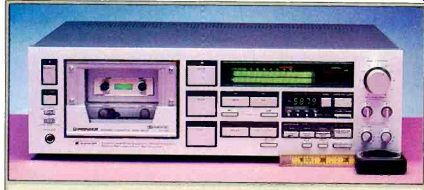
PIONEER CT-A 9 CASSETTE DECK
THREE heads, dual capstans, sophisticated microprocessor-controlled tape optimization, and a high performance level characterize Pioneer's new top-of-the-line CT-A9 cassette deck. The CT-A9 has Dolby B and Dolby C noise-reduction systems, an unusually informative recording-level display, a real time-indicating counter, and automatic tape loading.
The deck uses a dual-capstan drive to minimize wow and flutter.
The main capstan is direct-driven by a d.c. servomotor that is in a phase-locked loop (PLL) with a stable, quartz-crystal oscillator. The two capstans are textured to provide a better grip on the tape. They have slightly different diameters to ensure proper tape tension across the heads and to avoid a common rotational frequency, which might actually increase rather than lower tape flutter. Light-touch pushbuttons, logic-controlled to prevent tape tangles, switch between transport modes.
When a cassette, tape openings downward, is dropped into the slides on the rear of the transparent cassette-well door, a sensor detects its presence. The door then closes automatically, seating the cassette, and any tape slack is taken up. The label is completely visible, and rear illumination helps the user see how much tape remains on each spool.
To optimize performance with a given tape type, the user presses one of three pushbuttons (with illuminators):
UNDER BIAS, PEAK BIAS, Or OVER BIAS.
Features mom, 0 Four-digit tape counter switchable to indicate remaining time in minutes and seconds (four pushbuttons calibrate the microprocessor for different tope lengths and hub sizes)
Selectors for Dolby B, Dolby C, or no noise reduction
Memory rewind (to 0) and music search
Automatic switching (with manual and tope monitoring
Separate playback controls for the front-panel headphone and rear-panel line-output lacks
Separate Ribbon Sendust record and playback heads, easily accessible for cleaning and demagnetizing
Automatic tape-type sensing
Master record-level knob with adjustable stop plus separate record-balance control for each channel
Record mute
Switchable FM multiplex filter timer or playback operation
The four-bit microprocessor inside the CT-A9 adjusts the bias, tape sensitivity level, and recording equalization for the tape. These set tings are stored in the deck's memory and remain in effect until the power is turned off, the program is reinitiated, or the BLE CLEAR button is pressed. The program takes only a little over 10 seconds, and at its end the tape is rewound to the point where it began, so the test signals are automatically erased when re cording begins. For most music, the PEAK BIAS setting is recommended.
In the OVER BIAS mode some very high treble response is sacrificed to prevent distortion of very loud transients, and in the UN DER BIAS mode treble sensitivity is increased at the expense of some what increased distortion.
The greatest problem with the peak-reading fluorescent or LED record-level displays used on most cassette decks today is poor resolution. The CT-A9's displays have no fewer than thirty five illuminated elements per channel, covering the range from-40 to + 14 dB overall, with 1-dB increments for all levels above -20 dB. This ...
----------------
HIRSCH-HOUCK LAB MEASUREMENTS
Fast-forward time (C-60): 78 seconds
Rewind time (C-60): 76 seconds
Speed error: +0.3 percent
Dolby tracking error: ±-0.75 dB
Wow-and-flutter: 0.016 percent wrms, 0.024 percent
DIN peak-weighted Line input for indicated 0 dB: 0.96 volt
Meter indication at IEC-standard 0 dB: +4 dB
Tape Used: Maxell XLI-S (Type I, Ferric) IEC 0-dB distortion: 0.52 percent
Meter indication at 3 percent THD: +8.8 dB
Signal-to-noise ratios (in decibels):
CCIR/ ARM Unwtd. A-wtd.
Tape Used: TDK SA-X (Type II, chrome-equivalent) IEC 0-dB distortion: 2.4 percent Meter indication at 3 percent THD: +5 dB Signal-to-noise ratios (in decibels):
CCIR/ ARM 56.0 66.1 74.2 NR off
Dolby B Dolby C u'nwtd. A- wid.
Tape used: TDK MA (Type IV, metal) IEC 0-dB distortion: 0.98 percent Meter indication at 3 percent THD: +8.6 dB Signal-to-noise ratios (in decibels):
-------------
...provides a degree of resolution comparable to that of an analog meter. In addition, a series of orange dots-beginning at +5 dB for ferric and chrome-type tapes and at + 7 dB for metal-shows the level above which excessive distortion is likely to be encountered. The 0-dB point on the scale corresponds to the 160-nanoWeber/meter reference still used by most Japanese manufacturers. The Dolby reference level is marked at +3 dB.
The CT-A9 measures 165/8 inches wide, 5 inches high, and 14 inches deep. It weighs 22 pounds.
Price: $800. Pioneer Electronics ( USA) Inc., Dept. SR, P.O. Box 1720, Long Beach, Calif. 90801.
MEASUREMENTS
The playback frequency response of the Pioneer CT-A9 was extremely smooth and flat. Using either our CrO2/metal (70-microsecond) or ferric (120-microsecond) IEC-standard BASF test tapes, the variation was less than + 2,- 1 dB throughout the entire 31.5-Hz to 18-kHz measurement range.
Overall record-playback frequency response was equally impressive.
Pioneer suggested using either Maxell or TDK blank tapes, and we obtained our best results with Maxell XLI-S (ferric), TDK SA-X (chrome equivalent), and TDK MA (metal), though we obtained essentially similar graphs with several of today's premium formulations. Especially noteworthy is what happened when we recorded at the IEC 0-dB level and used Dolby C, which reduces pre-emphasis somewhat at the very highest frequencies: the response with TDK MA was down only 0.5 dB at 20 kHz! The CT-A9's A-weighted signal to-noise ratios were excellent. The level meters' orange warning lights were usefully placed, as shown by the meter indications when 3 percent distortion was reached with each type. The wow/flutter measurements for the CT-A9 were the best we have yet made with our usual Teac MTT-111 test tape. The figures were so low that we cross checked them with a special Nakamichi wow/flutter measurement tape, but the results were even lower: 0.013 percent wrms and 0.02 percent DIN weighted. This is simply superb performance.
COMMENTS
In terms of its sonic performance, we found the Pioneer CT-A9 as capable as any cassette deck we have tested. If there was an audible difference between its playback or record-playback performance and that of our reference deck, we certainly could not readily detect it. There was none of the grainy quality on piano tones that wow-and-flutter of ten contributes to cassette sound.
Of course, when recording and playing back a pure sine wave, we could clearly hear the modulation noise behind the signal, but this is a test no analog recorder (including open-reel mastering decks) can pass.
Both Dolby B and Dolby C reduced noise without introducing either frequency-response or level changes.
Dolby C eliminated any audible tape hiss from all but specially selected passages of very wide dynamic range on Compact Discs played at very high volume levels.
We also give the CT-A9 high marks for its human engineering.
While many high-end machines provide memory options that permit the user to program a large number of selections to be played, we have always found these more complicated to use than they are worth. The CT-A9's approach was refreshingly straightforward. One button rewinds you to 0000, wherever you choose to set that. Another pair of buttons advances the tape to the next music selection or replays the present one from its start. All transport buttons worked positively and quietly.
In only one respect could we fault the design of the CT-A9, and that was its microprocessor-controlled tape-optimization program. We found that the standard settings for the different tape types gave extremely flat response to 20 kHz, but when the AUTO BLE feature was used in any of its three modes (OVER, UN DER, or PEAK BIAS), the high-end response suffered slightly in range above 15 kHz. We would naturally expect this with OVER BIAS but not with the other two. While it is highly doubtful that the rolloff would be audible, the standard settings are superior in addition to being easier to use.
This minor feature aside, however, the Pioneer CT-A9 checked out as a superlative unit that we can recommend in the highest terms.
-Craig Stark
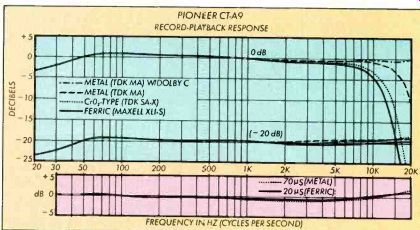
The upper curves indicate overall record-playback response at the manufacturer's indicated 0-dB recording level using the tapes designated on the graph. In the center are the same measurements recorded at-20 dB relative to the upper curves, a level used for frequency-response measurements. Bottom curves show playback response with calibrated test tapes and indicate performance with prerecorded tapes.
DUAL CS 515 TURNTABLE
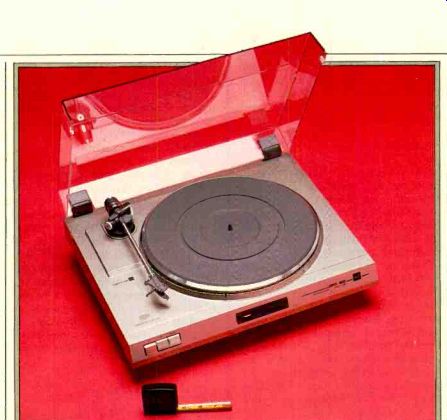
ALTHOUGH it is the lowest-priced model in Dual's new turntable line, the semi-automatic CS 515 offers several of the same features as higher-priced units, and its performance meets true high-fidelity standards. The two-speed, belt-drive turntable has a new isolating suspension system together with the pioneering and much-imitated Dual/Ortofon Ultra Low Mass (ULM) tone-arm/cartridge system, which is said to enable the combined mass of the tone arm and cartridge to be less than half that of conventional designs.
The suspension system uses four independent shock absorbers to isolate the tone arm, platter, and drive system from the turntable's base.
According to Dual, the damping factors of the shock absorbers were selected with the help of a computer in order to optimize protection under all the operating conditions likely to be encountered in home use.
The arm and platter are mounted as a unit on a separate plate that is elastically isolated from the silver gray, molded-plastic base on which the motor is mounted.
While the entire record player is not decoupled from the supporting surface, the CS 515's floating arm/ platter system provides some isolation from acoustic feedback and base-conducted vibration. When extraneous vibrations do reach the tone arm, especially from warped records, the ULM system enables the stylus to react faster and thus avoid mis tracking or skipping.
The Dual CS 515 is available either with or without the Ortofon ULM65 cartridge, a lightweight (2.5-gram), elliptical-stylus model that tracks at 1.5 grams. The tonearm's ...
----------
Features:
Belt drive
Electronically servo-controlled motor
33 1/3- and 45-rpm speeds with vernier control to vary speed over o nominal ± 6 percent range (plus or minus one semitone)
Illuminated strobe to set 33 1/3-rpm speed exactly
Front-mounted controls accessible with the dust cover down
Aluminum-alloy platter, weight 2 1/4 pounds including ribbed rubber mat
Straight tubular tone arm
Antiskating compensation calibrated from 0.5 to 2.5 grams in 0.5-gram intervals
Accepts cartridges weighing from 2.5 to 8 grams with standard 1/2-inch mounting centers
Vertical tracking force adjustable from 0 to 3 grams in 0.1-gram intervals
------------
... removable headshell can accept any cartridge with standard 1/2-inch mounting centers.
The turntable measures 17 1/2 inches wide, 4 1/2 inches high, and 14 1/2 inches deep with the dust cover down. It weighs 10 pounds. Price: $194.95 with cartridge. $139.95 without. Dual turn tables are distributed in the U.S. by Adcom, Dept. SR, 11 Elkins Road, East Brunswick, N.J. 08816.
----------------
LAB MEASUREMENTS
Flutter: 0.08 percent
JIS-weighted rms: ± 0.1 percent
DIN peak Rumble:-36 dB un-weighted,-58 dB ARLL-weighted
Tracking-angle error (for radii be tween 2 and 6 inches): less than 0.33 degree
Effective mass of tone arm with Ortofon ULM65 cartridge: 11 grams
Resonant frequency of tine arm with ULM65 cartridge: 11 Hr.
Frequency response of ULM65 cartridge: 40 to 20,000 hz + 3.5,-1.5 dB
Channel separation of ULM65 cartridge: better than 20 dB up to approximately 17,000 Hz
Output of ULM65 cartridge: abort 4.3 millivolts
-----------
MEASUREMENTS
Our test sample of the Dual CS 515 was furnished with an Ortofon ULM65 phono cartridge, which we used for our tests. Although the cartridge's performance was not fully evaluated for this re port, we made enough measurements to establish that it was first rate. It was able to track all our high-level test records at its rated 1.5 grams, including the 90-micrometer level of the German HiFi #2 record (in which respect it surpassed most higher-priced cartridges we have tested). Its tracking distortion, measured with the Shure TTR-102 and TTR-103 test records, was slightly higher than that of several other recently tested cartridges but still quite acceptable. It tracked all of the Shure ERA IV record except Level 4 of the flute section, and with the ERA V it mistracked only on the maximum level (Level 6).
After the tone arm of the CS 515 had been balanced, the tracking force dial calibrations were almost exactly correct. The antiskating compensation was optimum when its dial was set about 1 gram higher than the tracking force. The arm lift and descent worked smoothly, al though the arm drifted outward slightly during its descent, repeating about 2 to 3 seconds of the record each time it was lowered.
The turntable speed could be varied about ± 10 percent from its nominal 33 1/3-rpm speed. When that speed was set exactly, the 45-rpm operating speed was 0.3 percent slow, but it could be varied in a range from +8 to-7 percent relative to the correct speed. Flutter components fell mostly below 5 Hz, though there was a discrete component at about 10 Hz. Rumble energy was principally concentrated between 5 and 15 Hz.
The base isolation of the Dual CS 515 was fair, but it did not quite match that of many direct-drive turntables, to say nothing of belt driven turntables having more com pliant suspensions. Its principal transmission range was from 18 to 28 Hz, with other responses at 45 and 110 Hz as well as between 4 and 10 Hz. There were also several prominent transmission modes in the range of several hundred hertz, which appeared to be resonances in the dust cover or the hollow plastic base. They resulted in little electrical output from the cartridge, however.
COMMENTS
Considering the low price of the Dual CS 515, it is a remarkably good turntable, and in view of the excellent performance of the Ortofon ULM65 cartridge, the combination surely ranks as one of today's best record-player values. It is so light that it may seem like a feather-weight compared with some other turntables, but its essential performance has not been sacrificed in the weight-reduction process.
Although the platter and arm of the CS 515 are suspended as a unit from the base, the mountings are rather stiff and afford little isolation at subaudible frequencies. On the other hand, because the entire base rests quite solidly on the supporting surface, the front-panel controls are easy to operate without jarring the pickup.
We would have liked to see a front-panel reject or off button, since the only way to terminate playing before the record is finished is to lift up the tone arm and move it to its rest by hand. On the plus side, the CS 515 (like the other Dual ULM models) is absolutely out standing at playing warped records.
Our entire collection of "un-playably warped" discs was not only tracked by the Dual arm, but in most cases there was not even an audible hint of a warp. Perhaps you are fortunate enough not to have any warped discs in your collection. If so, congratulations! But the other 99 percent or so of the record-playing public may be glad to learn that a record player as inexpensive as this one will not only play warped records as though they were perfectly flat but, in doing so, will also deliver the sound quality typical of a far costlier turntable. Julian Hirsch
OHM WALSH 4 SPEAKER SYSTEM
THE Ohm Walsh 4 is based on an unusual speaker designed by the late Lincoln Walsh. Unlike most hi fi speakers, the Walsh speaker is essentially a "one-way" system. It has a single full-range conical driver facing down into a large enclosure. The voice coil is at the top (small end) of the cone, and the sound propagates down the outside surface of the cone. The driver consequently produces a phase-coherent, cylindrical wave front.
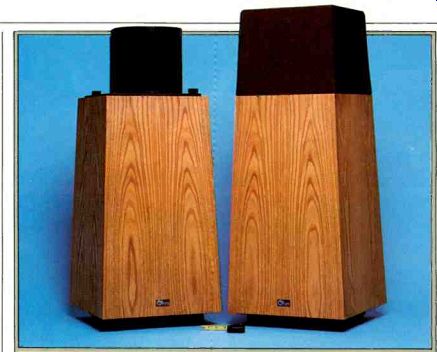
In its purest form, the Walsh speaker (as used in the Ohm F, for example), is omnidirectional in the horizontal plane and quite dependent on placement for best results. It is also a low-sensitivity speaker.
For the Ohm Walsh 4, which has a recommended amplifier power range of 50 to 500 watts, the Ohm engineers modified the Walsh de sign by placing a sound-absorbing material called Tuffiex around the top rear of the main cone.
This serves to attenuate the middle-and high-frequency rear-wall reflections, which improves imaging and allows for less critical placement. In addition, the highest frequencies are augmented by the direct radiation of a small auxiliary supertweeter above the main cone, which is aimed 45 degrees inward from the system's front axis in order to provide the de sired room coverage. The lowest bass frequencies radiate from the port in the bottom of the enclosure and through the slot between the speaker, which is raised on casters, and the floor.
The Ohm Walsh 4 is 40 inches tall, 12 1/2 inches square at the It weighs 63 pounds.
Price: $1,895 per pair. Ohm Acoustics Corp., Dept. SR, 241 Taafe Place, Brooklyn, N.Y. 11205.
---
Features
Sub-Bass Activator (a passive equalizer to augment low-bass output, attenuate infrasonic frequencies, and adjust mid-boss sensitivity for proper balance)
Frequency-balance adjustments for HIGH (increase, average, decrease), Low (increase, overage, decrease), and PERSPECTIVE (front, middle, rear)
Thermal-cutoff devices to protect against overload; driver voice coil cooled by ferrofluid
Entire driver assembly enclosed in perforated metal cover for protection
Novel spring-loaded connectors accept either bare wires or single or dual banana plugs
Tapered pyramidal wooden cabinet mounted on casters; removable brown top grille cloth; genuine oak or walnut veneer finish; rosewood veneer or black or white lacquer finishes available on special order for a higher price top, and 15 1/2 inches square at the bottom.
----
-----
MEASUREMENTS

The unusual design of the Ohm Walsh 4 presented some problems in measuring its acoustic performance. For example, the response on the forward axis of the system was appreciably different from that measured at 45 degrees off-axis, in line with the supertweeter. The overall response in the room was a composite of the speaker's output in all directions, making it difficult to characterize it by an FFT measurement on any one axis. While this is true of any speaker, a further complication in this case was that the measured response, even with close microphone spacing, depended on whether the microphone was near the bottom, middle, or top of the main cone radiator. In addition, the output measured at the port (under the cabinet) was not the same as that measured in the narrow slot between the cabinet edges and the floor.
With all the frequency-balance switches at their center settings, the averaged room response was smooth and flat, within ±4 dB from 500 to 20,000 Hz.
The bass response, measured as close to the bottom of the speaker cone as the protective cage allowed us to get, was flat within ± 2 dB from 60 to 500 Hz, and it could be spliced un ambiguously to the room curve.
-------------
HIRSCH-HOUCK LAB MEASUREMENTS
Composite frequency response: 40 to 20,000 Hz ±4 dB
Sensitivity: 83 dB SPL at 1 meter with 2.83 volts (1 watt) input
Impedance range: 6.5 to 16 ohms
Phase coherence: group-delay variation from 500 to 20,000 Hz less than ±0.2 millisecond
Bass distortion (measured at input level needed for 90-dB SPL output at 1,000 Hz): 1 percent from 100 to 70 Hz; 3.7 percent at 50 Hz; 5.25 percent at 40 Hz; 9.5 percent at 35 Hz
--------------
The port output was at its maxi mum at 30 Hz and was within ± 2 dB from below 20 to about 60 Hz.
We could not establish the proper relative contributions of the cone and port in the lowest range, but the composite response of better than ± 4 dB from under 40 up to 20,000 Hz was consistent both with what we heard and with Ohm's rating of 32 to 17,000 Hz ±4 dB.
Our lab measurements showed an omnidirectional response below 1,000 Hz, with the rear radiation being suppressed by 20 dB or more above 2,000 Hz. With the two speakers placed a couple of feet from rear or side walls, the imaging was exceptionally good and al most independent of the listening position. Like the original Ohm F, the Walsh 4 had excellent phase coherence, with a group delay variation that certainly seems to confirm Ohm's claims for the Walsh driver.
The frequency-balance adjustments produced definite, but not excessive, changes in the speaker's sound quality. We found the center settings to be perfectly satisfactory in our room, but that is a matter of individual taste. The low-frequency switch changes the output by about ± 5 to 7 dB between approximately 60 and 300 Hz. The high-frequency switch range is ± 5 dB from about 2,000 to 13,000 Hz.
The Perspective control's range is also about ± 5 or 6 dB from 250 to 1,300 Hz, and it can impart either a "forward" or "distant" quality to the sound of the speakers.
Ohm rates the Walsh 4's system sensitivity as an 87-dB sound-pressure level (SPL) at 1 meter with 2.83 volts input and all controls at maxi mum. In our case, with the controls centered (thereby reducing the sensitivity), we measured an 83-dB SPL under those conditions. The sensitivity of the Walsh 4 is slightly lower than average for a speaker of its size, but it should present no problems when used with amplifiers in the recommended output range of 50 to 500 watts per channel. Al though Ohm rates the Walsh 4 as a 4-ohm speaker, the lowest impedance value we measured was 6.5 ohms. By traditional criteria, this should be considered a 7-ohm speaker, and it can be expected, therefore, to present an easy load to any amplifier.
We measured the bass distortion at the bottom of the cone with the same close microphone placement we had used for the low-frequency response measurement. The results were excellent and fully consistent with what we heard. The relative contribution of the port output, which is probably effective in the lowest part of the bass range, could not be assessed.
COMMENTS
The Ohm Walsh 4 is as smooth and natural sounding as its excellent frequency-response measurement suggests. It provides a full stereo stage of sound at almost any position in the room, including a distinct quality of depth resulting (presumably) from sound reflections off the rear and side walls.
Ohm claims that the Walsh driver does not operate as a piston-the usual design goal for a conventional speaker-but rather as a transmission line that progressively delays the propagation of different frequencies so that a coherent cylindrical sound field is radiated. Some years ago, when we tested the original Ohm F speakers, we were able to verify that claim to our satisfaction.
Although the Walsh 4 is a modified form of that system, it retains many of its qualities, with the added ad vantages of a reasonably high sensitivity, noncritical room placement, and a much lower price.
The heavy-duty, high-temperature voice coil of the Walsh driver makes it virtually impossible to overdrive the Ohm Walsh 4 with any home amplifier. We were able to drive a 200-watt-per-channel amplifier to its clipping point with Compact Disc program sources without straining the speakers, which sounded fine at that level.
Ohm makes much of the imaging qualities of this speaker, and it certainly lives up to those claims. A demo record produced by Ohm pro vides convincing evidence that the Walsh 4, playing a variety of commercial music recordings, is capable of generating distinct spatial images that are apparent from almost any position in the room. For example, Leroy Anderson's musical typewriter moves with impressive smooth ness between the speakers, with not a trace of the vague, uncertain, or erratic position shifts that we ob served with some other speakers.
In case I have not made the point sufficiently clear, this is a superb-sounding speaker--not inexpensive by any means, but worth every cent of its price.
Julian Hirsch
[Equipment Test Reports Hirsch-Houck Laboratories: Julian D. Hirsch and Craig Stark]
----------------
Also see:
Turntables: How to Evaluate the Specs
Bang & Olufsen MMC 2 Phono Cartridge
Acoustic Research (ad)