| Home | Audio mag. | Stereo
Review mag. | High
Fidelity mag. |
AE/AA mag.
|
|
The Deprogramming and Reformation of Bob Carver (Exact Text of the 1983 Preprint) The article that follows was standing in type in January 1983, along with other parts of an almost complete issue, when the Carver Corporation asked for, and was granted, permission to preprint it and circulate it. The issue itself, which was to reach its readers almost simultaneously, never made it to the printing press. In the same spirit as a man might marry a mistress of long standing "to make an honest woman of her" (an old-fashioned notion, admittedly), we are making an honest article of this widely discussed, some would say notorious, piece by officially publishing it here and now. All editorial comment about the ravages visited upon the belief system of the high-end community by the Carver preprint will be found in the Follow-up article that appears immediately after this one. --------- By Peter Aczel Editor and Publisher The amazing story of how Bob Carver, a uniquely gifted inventor who had somehow become indoctrinated with mid-fi notions and practices, divested himself of all bad influences under our watchful eye and modified his super-powered magnetic field amplifier in our laboratory to make it sound exactly (and we mean exactly) like the Mark Levinson ML-2. Bob Carver, who is not yet 40, may well be the oldest continuing paradox on the audio scene. For as many years as most of us can remember, he has been the most original and innovative audio designer of them all. Every piece of equipment the man has come up with, from the earliest version of the Phase Linear 700 power amplifier to the late-1982 Carver TX-11 tuner, can be legitimately and literally called a new idea, something that had not even occurred to his peers. It could be plausibly argued that, for sheer invention and creativity, there has been no one else in home entertainment electronics who could be compared to him since the days of Edwin Armstrong. On top of it, he is a perfectionist, so obviously dedicated to the do-it-right philosophy that he made the cover of the December 29, 1980 issue of Fortune magazine as a prime exhibit for a feature article on "Things Made Well." And yet, here is the major paradox: the Carver name has so far acquired no status among upper-echelon audio purists, golden ears and high-tech fanatics. Popular as he is with the editors of the big, commercial hi-fi slicks, Bob has failed to impress the underground audiophile journalists and their disciples; in fact, on the extreme tweako/weirdo fringe of the "alternative" audio press he has recently come under spiteful, repeated and childishly unfair attack. One could easily attribute this to the particular image he projects: he talks like a physicist rather than a cultist or mystic; all of his products have made money; the mainstream business community has made him one of its minor celebrities; he comes on like an apple-pie American optimist; he is a heterosexual-you get the picture. But that still does not resolve the contradiction inherent in extraordinary engineering renown without some sort of elitist support. Only the Carver product itself can provide the explanation. That product, in our opinion, has consistently offered unexpected and highly convincing user benefits as well as solid value for the money, quite aside from uniqueness of concept and unusual engineering elegance. The sound, how ever, when judged by the purist on a black-box basis and without regard for the price, has always left something to be desired. The ultimate transparency, openness, neutrality and detail have not been Carver hallmarks. Even if the Mark Levinson or Audio Research level of sonic performance were absolutely unachievable within the price structure set by a company like Carver (an article of faith we never quite shared with the high-end religionists), there are at least half a dozen small manufacturers who have tried and occasionally succeeded to obtain a good approximation of the high-end type of sound in a moderately priced component. Past issues of The Audio Critic provide some outstanding examples. The Carver sound, on the other hand, has not even nudged this select category until now. How we got involved. Ever since we had the pleasure of meeting Bob Carver a number of years ago and having extensive discussions with him on a variety of audio subjects, this paradox has been bothering us a great deal. It was clear almost from the start that this boyish, apple-cheeked technologist knew a great deal more about the physics, mathematics, psychoacoustics, and just plain nuts and bolts of audio design than nearly all of the various practitioners who were producing better sound! Something was decidedly askew somewhere. It took us a while to sort out the probable causes of this baffling and obviously unnecessary situation, but after several highly interesting dialogues with Bob we had a pretty good list of tentative conclusions. Namely: (1) he did not listen quite as critically as the fussiest audiophiles and his expectations were ultimately not as high; he used unnecessarily large amounts of negative feedback in his amplifier circuits for purely cosmetic reasons, to make his distortion figures come out low enough to be "competitive" with all comers; (3) he specified output filters for his power amplifiers, mainly in apprehension of weird speaker loads that might conceivably destabilize the high-feedback circuitry, but also to reduce THD readings even further; (4) he tacitly accepted the cynical old engineering maxim that a resistor is a resistor and a capacitor is a capacitor, so that he tended to turn his back on premium-quality parts that in some cases would have cost only pennies more. All in all, it appeared to be the case of an inherently puristic and uncompromising mind that had been gradually programmed, under the pres sure of its commercial environment, to tolerate certain insidious mid-fi compromises. To save that mind for the immaculate audiophile cause, it was clearly necessary to expose Bob Carver to some new influences. We decided it would be worthwhile to keep bugging him about these matters with some regularity. And we did, as attested by monstrous phone bills, New York to Seattle. Our efforts were eventually successful beyond our wildest dreams, otherwise this article would not have been written and published here. But it happened in stages, not all at once. The first concrete result after innumerable long distance calls and one brief visit by Bob to New York in March 1981 was the unannounced modification of the M-400 magnetic field amplifier, also known as the Carver Cube, which had been already reviewed in The Audio Critic. At some point in mid-1981, the amplifier began to come off the production line with the M-400a designation silk screened on its front panel and substantial circuit changes inside. These included considerably reduced negative feed back, more nearly class A operation of the linear amplifier section, different input impedance characteristics, and a milder filter at the output. The sonic improvement over the original M-400 was immediately noticeable; the M-400a came almost within striking distance of the kind of amplifier sound expected by the audio purist. In our opinion there was still something lacking in the rendition of the sound stage and the refinement of inner detail, but a number of high-end oriented audio professionals commented favorably on a special version without output filters that we played for them in our laboratory. The next positive development was an entirely new Carver magnetic field power amplifier, launched early in 1982 and designated as the Model M-1.5. It was an incredible souped-up version of the cube, rated at 350 watts per channel into 8 ohms and capable of brief 600-watt bursts, but no longer in the cubic format. Instead, it was packaged in the shape of a conventional low-silhouette preamplifier or tuner with standard 19-inch rack panel, weighing about one-and-a-half times as much as the cube at 16 pounds. Some shoehorning job-75 watts into every pound! The M-1.5 made obeisance to most of the high-end design trends: fully complementary topology from input to output, the latest and fastest transistors, almost pure class A biasing of the basic linear amplifier, relatively little (though still too much) negative feedback, relatively little (though still too much) filtering at the output-all this, of course, within the framework established by the utterly original Carver high-output amplifier circuitry. The sound was definitely a step up from that of the M-400a, very respectable even by fairly critical standards (especially at the eminently reasonable price of $799) but still not quite in the same category with the most exalted high-end brands. Conceptually the amplifier was so brilliant, so right, that anything short of the ultimate sonic performance affected us as a letdown, regardless of price, and we made no bones about our frustration to Bob Carver, although we had to admit he was moving in an audiophile direction. It was at this point that he reiterated in greater depth a challenge he had made to us several times before: "Give me an amplifier, any amplifier at any price," he said, "and I'll make my amplifier sound exactly like it by duplicating its transfer function." Now, depending on how you interpret it, this is either the most daring or the most simplistic and redundant statement an amplifier designer can make. The transfer function of an amplifier is the exact mathematical relationship of its output to its input. In the most elementary terms it is the output divided by the input, so that the transfer function of a totally perfect amplifier would be 1 X gain (i.e., the theoretical "straight wire with gain"); in practice, however, it is the approximation of an immensely complex expression that would implicitly specify each and every separately measurable deviation from linearity, such as amplitude changes, phase shift, THD, IM, clipping, ringing and all the rest. It is entirely possible for two "black boxes" of different internal design to have exactly the same transfer function, in which case they would have to sound absolutely alike by definition, since a given input would undergo exactly the equivalent processing inside each box by the time it reaches the output. If Bob meant that he would strip his amplifier down to the chassis and then build something inside that would duplicate the transfer function of any other amplifier, his statement was nothing more than a tautology. That, of course, was not what he meant. He had sufficient faith in the basic quality of his signal path and his unique power supply to feel that he could implement his challenge with relatively minor modifications, without changing the circuit board or redesigning any part of his amplifier from scratch. That being the case, the challenge was both meaningful and irresistible. "Okay," we said, "make the M-1.5 sound exactly like a Mark Levinson ML-2 with more power." We could have said Octave Research or Krell or Futterman (by New York Audio Laboratories) or Electrocompaniet or Bedini, but we were convinced that theML-2 was the right choice. Not be cause it was clearly "better" than the top-of-the-line models of the other brands (in fact, the Octave Research was our reference) but because it represented the worldwide gold standard in high-end transistor amplifiers and had undergone constant refinement by a solidly established company over a period of more than five years. We had a chance to test the latest version in August 1982 (just before the Carver challenge) and found it utterly clean and musical, both measurably and audibly the equal of any power amplifier known to us and our staff, although not necessarily "the winner by unanimous decision." Bob immediately agreed to let his challenge stand against the ML-2 and also to complete the necessary work in the laboratory of The Audio Critic, so we could observe exactly what he was doing and act as his technical assistant as well as occasional devil's advocate. At this point we still suspected him of believing that he could turn the trick with minor changes in bandwidth and amplitude response; if we were right, we never found out just where in the process he abandoned that pious mid-fi tenet, since he certainly knew better by the time we were through. A word about the Carver power supply. We would not have gotten so deeply involved in this rather unorthodox project if it had not been for our convictions about the Carver magnetic-field power supply. Regardless of the sonic limitations of the M-400, the M-400a and the original M-1.5, their power supply (as distinct from their audio signal path) represented by far the most advanced and most successful design approach in our judgment, at least for the amplification of music. Contrary to untutored opinions expressed by audio-store cowboys, jealous manufacturers and/or tweaky reviewers, the Carver power supply does not constitute a compromise. It does not give up any thing in exchange for its astonishingly small size, light weight and cool operation. Whatever the largest convention al power supplies in the costliest and most venerated high end amplifiers can do, thanks to their two-ton transformers and beer-keg-sized capacitors, the little Carver power supply does just as well. It is not "slower," nor does it cause "less bass impact"-such perceptions, if at all valid, relate to the behavior of the rest of the amplifier. Even the various highly laudatory write-ups of the Carver power supply design in the large-circulation audio magazines missed the essential principle, the basic insight embodied in the circuit. Energy storage in the magnetic field coil is not it, although important to the total process. The breakthrough idea was the demand utilization, as dictated by the audio signal, of nearly the entire sine-wave cycle of the 60-Hz power line, as distinct from the wasteful operation of conventional power supplies that store the energy from the 120 peaks per second and in effect throw away the rest of the cycle. The so-called Triac conduction switch and the magnetic field coil work in conjunction to accomplish this, enabling a quantum jump in size and weight reduction. The Carver power supply is one of the very few genuine inventions in the history of electronic amplification, and a number or people whose job it is to recognize such things have missed that point entirely. The juxtaposition of the Carver M-1.5 and the Mark Levinson ML-2 presented a dramatic contrast in power sup plies. The latter has a magnificent power supply of the old school, large enough to provide the required current for pure class A operation into very low-impedance loads. The ML-2, as most of our readers know, is a mono amplifier; a stereo pair costs $6300, even though the maximum continuous power output into 8 ohms is only 35 watts (it used to be 25). The current reserves are sufficient, however, for twice that power into 4 ohms and proportionate increases into even lower impedances. The M-1.5 looked very puny by comparison, although in other respects it exhibited some coincidental similarities in design, including a relatively modest amount of negative feedback and an almost-class-A 35-watt amplifier at the core of the 350-watt-plus demand modulated configuration. Perhaps these and other marginal similarities made it easier to duplicate the transfer function of the ML-2; a tube amplifier like the Futterman or a totally different solid-state amplifier like the Octave Research might have proved to be a harder nut to crack, although the basic principle of duplication would have remained the same. ----------- 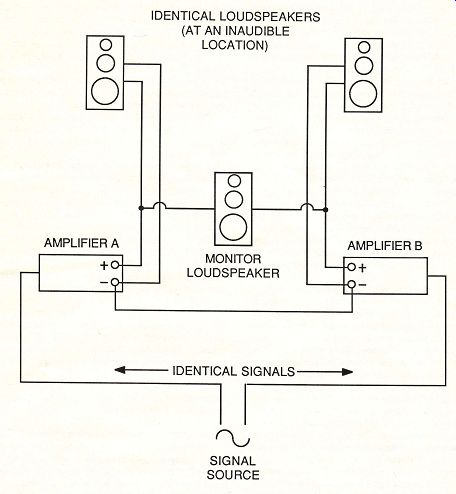 Figure 1: Block diagram of the Carver null test. If the monitor loudspeaker remains silent on all program material, then A-B = 0, and A = B. ----------- The Carver null test: absolute proof. The utter confidence Bob Carver appeared to have in his ability to turn the M-1.5 into a sonically identical twin of the ML-2 was based on a very powerful laboratory tool, a test that could prove beyond argument the similarity or dissimilarity of the transfer functions of two amplifiers. He had discussed the test with us before, but even he himself had not been able to implement it to quite the same degree of perfection as he subsequently achieved in our laboratory. He calls it the null test; bridging test would perhaps be a more revealing name. The two amplifiers, A and B, are simultaneously driven in an externally bridged hookup as shown in Figure 1. In the case of stereo amplifiers, one channel of each is used at a time; the other channel remains idle and is tested on the next go-around. Here are the rules of the game. The two amplifiers must drive absolutely identical loads, preferably two carefully matched loudspeaker systems or possibly a pair of sufficiently complex dummy loads, simulating both the resistive and reactive components of real-world loudspeakers. For maximum reliability, the test should be repeated with a variety of loads. If actual loudspeakers are used, they should be in another room, at the end of long leads and well isolated from the laboratory, since they must not be audible. The inputs of the two amplifiers are fed exactly the same signal, which can be music from a phono or tape source, white or pink noise from a generator, or any other signal that the tester fancies and considers representative of real-world conditions. A large variety of music undoubtedly provides the most thorough test, and the signal levels should also be varied, almost up to the clipping point of the less powerful amplifier. Now, the plus (red) output terminal of amplifier A is bridged to the plus (red) output terminal of amplifier B through a third loudspeaker, which is the monitor speaker to be listened to. It does not matter which of the two input terminals of the speaker goes to A and which to B; it is a completely balanced configuration. For a visual reading, an oscilloscope or voltmeter can be connected across the monitor speaker. It should be quite obvious that if at any given instant the two amplifiers are not processing the signal in an absolutely identical manner (i.e., if their transfer functions are not exactly the same), the two red terminals will not be at the same potential and therefore current will flow through the monitor speaker. The resulting sound will rep resent the net difference signal between A and B, and so will the oscilloscope display or voltmeter reading. If the difference between A and B is very small, the sound will be barely audible; if the test signal is music and the difference signal sounds undistorted and musical, both amplifiers are at least reasonably linear though different. If the difference signal sounds ugly and garbled, like a mistuned FM station, then at least one but possibly both of the amplifiers must have a nonlinear transfer function. The test is extremely sensitive. Here comes the most beautiful part: if the monitor speaker indicates a null by remaining silent as the test is repeated with a variety of amplifier loads and inputs, amplifiers A and B are proven beyond a shadow of a doubt to have identical transfer functions, at least above normal thresholds of audibility. They must therefore sound identical in any rigorous listening test, since with the same input their outputs are totally identical in waveform and totally in synchronism. We beg you not to misinterpret this as a claim that subjective listening quality is now precisely measurable in the laboratory; on the contrary, the Carver null test bypasses all qualitative or value judgments, focus ing strictly on proof of difference or sameness. In fact, two identically terrible amplifiers, with identically nonlinear transfer functions, would null perfectly against each other and, of necessity, would sound exactly the same, namely equally and indistinguishably terrible. The test is absolute precisely because it lumps together all differences and similarities, desirable or undesirable, and concerns itself merely with their existence. In his measurements of the transfer functions of amplifiers, Bob Carver also uses another nulling test, not quite as indisputably conclusive but more qualitative in thrust and already referred to in previous issues of The Audio Critic. In this test the input and output of a single amplifier channel are nulled against each other to establish the resemblance of the output to the input and thus the linearity of the transfer function. The amplifier is loaded and driven in much the same way as in the bridged A/B null test. The hookup is shown in Figure 2. We were never completely sold on this test, since the time delay of the signal as it passes through the amplifier cannot be washed out of the input/output comparison and therefore a perfect null is unobtainable regardless of the linearity of the amplifier. A number of reputable testers have tried to compensate externally for the delay; Bob Carver believes that this contaminates the results and prefers to try for the best possible null without any extra processing of the signal, allowing the delay to remain a known limitation of the test. The latest and best of today's amplifiers have relatively little front-to-back delay in any event. Duplicating the transfer function of the ML-2. Before Bob even looked at the Mark Levinson amplifier, it was agreed upon our recommendation that the stock Carver M-1.5 would first be cleaned up and modified to agree more closely with the best current high-end practices. The output filter was excised. The negative feedback was reduced to approximately 15 dB. All capacitors in the actual signal path were replaced with a very high-quality German brand of metallized self-healing polypropylene film capacitor. The one 470-microfarad electrolytic for which there existed no film capacitor substitute was replaced with a much higher-grade electrolytic and then bypassed with a small polypropylene. With just these quickie mods, the M-1.5 immediately began to sound like a genuine blue-blooded high-end amplifier. Perhaps a wee bit zippier than the ML-2 or the Octave Research and not quite as fine-grained, airy and transparent, but in the same general class and not far
behind them. Even without the considerable improvements that were to come, an amplifier with this kind of sound and the M-1.5s virtually unlimited power would have been an outrageous success among serious audiophiles, especially at $799. We had finally made our point to Bob; he was now 100% in our camp. Next, the Carver null test was set up to see how close we were, for openers, to the transfer function of the latest Mark Levinson ML-2. Big disappointment. The difference signal was not only fairly loud but quite distorted. The improved M-1.5 obviously needed a lot more improvement before it would track with the ML-2. This is where Bob began his measurements of the ML-2 and the procedure of copying its transfer function into the M-1.5. The Mark Levinson amplifier was analyzed strictly on a black-box basis; its cover was never taken off. The technique of characterizing and duplicating an amplifier's transfer function is something that Bob has been working on and perfecting for more than two years; it involves literally hundreds of measurements and requires fairly sophisticated instrumentation, which we were fortunately able to provide. The difficult part is not the precise definition and quantification of the differences between the two amplifiers but knowing step by step what to do next to cut down and finally eliminate those differences. It requires very clear thinking, lots of experience and quite a bit of patience. We played Igor to Bob's Frankenstein at the laboratory bench for 48 hours, with very little time off for eating and sleeping, before the two amplifiers tracked each other perfectly. In the process, the open loop of the M-1.5 was retailored, the negative feedback was readjusted several times, various transistors were re-biased, the input impedance characteristics were changed, lower-resistance wiring was substituted in crucial places, but no active devices were replaced and no changes in basic topology made. The German polypropylene capacitor was used wherever new values had to be inserted. When it was all done, the monitor speaker remained dead silent on the null test (except for minuscule ground-loop hum) and the instruments indicated a -74 dB null! Yes, two amplifiers of totally different electronic design and physical construction now had exactly the same transfer characteristics from input to output. The listening tests. To anyone who understands the basic principle of the null test, the amazing thing would be if two amplifiers with identical transfer functions did not sound alike, since there is no mechanism or process whereby they could sound different. Let no one make the mistake of confusing this truism with the old pop-tech fallacy that all amplifiers having the same frequency response, equal gain and adequately low distortion sound alike. The transfer function of an amplifier incorporates all of its parameters, known and unknown. The entire matter reduces to the simple assertion that if A - B = 0 then A = B. Thus, when we started our A/B listening comparison of the modified Carver M-1.5 and a pair of Mark Levinson ML-2's, we were not at all surprised that they appeared to be sonically indistinguishable, as long as we did not exceed the ML-2's dynamic headroom. For the listening tests we used the Fourier 1 three-way dynamic speaker system, which had been developed in the laboratory of The Audio Critic for precisely such applications (see follow-up article in this issue). It is the only single-box, single-amped speaker known to us that (1) goes down to an honest 32 Hz, (2) is efficient enough to be used successfully with low-powered amplifiers and at the same time capable of handling the power of a blockbuster amplifier like the M 1.5 without distress, (3) has the required accuracy in both the frequency domain and the time domain for critical listening evaluations, and (4) presents a simple, un-temperamental load to the amplifier at all frequencies. Both amplifiers sounded equally clean and open through the Fourier 1, leaving little or nothing to be desired in spatial information, clarity of detail and sheer musicality; our overriding concern, however, was whether we could hear even the slightest difference between the two. We decided it was too easy to fall into the audiophile trap of hearing nonexistent differences simply because we were challenged to do so and knew, after all, that we were dealing with two very different amplifiers. So, on Bob's recommendation, we set up a relatively foolproof blind A/B test for a small panel of experienced listeners, including your Editor but excluding Bob, who could not be considered unbiased under the circumstances (and besides was needed to operate the equipment). A randomized A/B switching sequence, unknown to the panelists, was established by 15 tosses of a coin, heads corresponding to one amplifier and tails to the other. Before the blind test began, the panelists were given unlimited time to familiarize themselves with the sound of A and B. They had every opportunity to identify and memorize any differences that may have existed. Then they were asked to leave the room, allow Bob to connect A or B, come back and mark their scorecards while listening. Before every switch they had to leave the room to avoid any possibility of latching on to nonmusical cues, body language or whatever. When the test was completed, the scorecards proved conclusively that the panelists had absolutely no idea which amplifier was the Carver and which the Mark Levinson, even though in the course of listening some of them had claimed to have zeroed in on the difference. In fact, the overall scores were worse than what would have resulted on a statistical probability basis from pure guessing. The theoretical sonic prediction of the null test was therefore experimentally verified. The "Levinsonized" Carver M-1.5 was then subjected to the input/output null test, in order to make sure that between 35 watts and 350 watts its transfer function remained as linear as it was within the dynamic range of the ML-2. This investigation resulted in one more small modification of the Carver, a slight downward extension of the open-loop bandwidth, which eliminated a tiny phase shift at 20 Hz copied from the Levinson. The two amplifiers still nulled perfectly on musical program material, but the input/output null of the modified M-1.5 was reduced to -64 dB, an amazing figure considering that there was no compensation for the time delay between input and output. This was the final version that Bob duplicated for us a little more neatly, starting with a fresh sample of the stock amplifier (yes, the copy nulled perfectly against the prototype), and the one that came to be called the t-mod of the M-1.5 (t for transfer function) or more formally the Carver Model M-1.5t. We now have it almost permanently connected to our laboratory Fourier 1's and consider it to be the equal of any power amplifier in transparency, focus and smoothness, and of course far ahead of any other we have tested in sheer gut-shaking power and dynamic range. We especially enjoy hearing spatial detail, instrumental definition and completely natural dynamics on familiar records to a degree we did not know was extractable from the grooves when we listened through lesser amplifiers. At this level of sonic performance, the astoundingly small size, light weight and cool operation of the M-1.5t become the icing on the cake, rather than the main attraction. What the future holds. Bob Carver informs us that the t-mod has replaced the original M-1.5 in current production, so that the M-1.5t should be in the stores by the time you read this. The price remains $799, despite the somewhat higher cost of parts. According to Bob, the production version is identical to the prototype he took back to Seattle from our laboratory and nulls perfectly against it in the bridging test. He has also acquired a pair of the latest Mark Levinson ML-2's and is using them as his quality-control standards against which every M-1.5t is nulled. That means you can now buy the ML-2 kind of sound at less than one-eighth the price and with ten times the power. Mind you, we are in no way suggesting that the ML-2 has ceased to have a reason for its existence. It is incomparably more beautiful than the Carver M-1.5t, more solidly constructed, more likely to provide decades of uninterrupted service, much more of a jewel for an oil sheik's equipment rack. On the other hand, the Carver M-1.5t symbolizes with great poignancy the end of the high-end boom of the 1970's, the era in which only the Mark Levinson or Audio Research type of manufacturer understood what the audio purist really wanted. (See also the reviews of the New York Audio Laboratories NCP-1 and the Pheenix Systems P-10 in this issue, not to mention the Fourier 1.) We are also aware that this article will create tremendous antagonism in certain high-end audio circles, wherever there is a financially or emotionally vested interest in very high-priced equipment in general and Mark Levinson components in particular. That cannot be helped; we are merely reporting certain irreversible facts of life. But for heaven's sake, let no one make an ass of himself by indignantly declaring that the ML-2 does so sound better than the M-1.5t. The two have been proved sonically equal with the same rigor as two triangles are proved congruent in plane geometry. What has not been rigorously proved is that either one of them is "better" than other amplifiers. So if you hate both of them, you still retain some credibility. Or you can love both of them, as we do. Bob is also working on a t-mod of the Carver Cube and claims that he will eventually be able to make it null against the M-1.5t and the ML-2. It may require a new complement of transistors and some changes in topology, however, to get to that point. It should be added in conclusion that Bob is a changed man as a result of the t-mod project. His reformation is so complete that he simply cannot understand why he had not come to the same conclusions years ago and acted accordingly. It takes courage, of course, to admit past mistakes and omissions freely, without excuses, and to allow one's present work to stand as the severest critic of previous efforts. For this, as much as for the quality of his engineering mind, Bob Carver has earned our sincerest admiration. Truth is a river that is always splitting up into arms that reunite. Islanded between the arms, the inhabitants argue for a lifetime as to which is the main river. - CYRIL CONNOLLY ------- [adapted from TAC, Issue No. 10] --------- Also see: The Carver Amplifier Controversy Four and a Half Years Later (Will They Never Learn?) Various audio and high-fidelity magazines Top of page |
|
| Home | Audio Magazine | Stereo Review magazine | AE/AA mag. |