
| Home | Audio mag. | Stereo
Review mag. | High
Fidelity mag. |
AE/AA mag.
|
A Challenge to All Critics of The Audio CriticAny audio journalist, equipment designer, manufacturer or other audio practitioner who delights in bad-mouthing us, or maybe just automatically contradicts us at every turn, is hereby given the chance to destroy our credibility in front of all our readers. Or forever hold his peace. We continue, for indexing purposes, to number our editorial topics sequentially, picking up where we left off in the previous issue; this is not to be construed as any suggestion of a serial story. What follows is complete and independent of prior index numbers. Uninhibited criticism of other people's 28 professional efforts, no matter how scrupulous the critic, is bound to be met with hostility in certain quarters. There are always those whom the truth hurts for one reason or another; some devious minds don't even understand the elementary mechanics of truthfulness and will never believe that the child wasn't bribed to call the emperor naked. We now realize that we should have discounted such hostility and suspicion from the very beginning, as soon as we published the first issue of The Audio Critic, instead of responding to every irresponsible attack with indignation and factual arguments, as our charter subscribers will remember. Harry S. Truman, in his admiring reminiscences of General Marshall, observed that the latter had never bothered to answer his detractors. “He wouldn't take the time.” We're just beginning to appreciate the full wisdom and integrity of that stance, even if we can't exactly equate ourselves to George C. Marshall in importance. But then our bad-mouthers aren't senators, either, so the ratio remains about the same. The fact is, in any event, that our ill wishers have been quite ineffective; our subscriptions show a healthy growth pattern, and the best brains of the audio world appear to be solidly in our camp, as witnessed among others by the distinguished roster of participants in our State of the Art seminar. Every indication is that the teeny-weeny minority of audio hysterics who have inside information about our venality or know a hitherto unsuspected law of physics with which to refute us should from here on be editorially ignored, instead of being elevated from the obscurity they so richly deserve. That will indeed be our basic policy in the future, but from the point of view of our average subscriber there remains a general credibility issue that needs to be addressed. Suppose we report that preamp A is 29 vastly superior to preamp B or assert, say, that a certain nonnegotiable mathematical truth governs the limitations of subwoofer C. And suppose, no matter how carefully we qualify and document our statements, an underground reviewer or an audio store owner or a manufacturer's chief engineer then declares to all comers that we are 100% wrong, that in fact we are a certain sphincter-bound bodily orifice. How is a busy music-loving doc tor or stockbroker to determine at that point who is right? Well, of course, he can't-not without soliciting third and fourth opinions of the highest quality. But we have devised at least a first step toward clearing the air in such cases. We hereby offer all these critics of The Audio Critic the privilege of a tape-recorded debate with the Editor, the uncut transcript of which will be published in our pages. That should separate the mindlessly hostile know nothings from the responsible objectors, since we don't expect the former to want their lack of substantive arguments documented and publicized. It should also create some lively reading for our subscribers, of possibly even broader credibility than our editorial correspondence (“Box 392”), from which our detractors have been known to cop out because “you can't win when the Editor has the last word.” Well, in these transcribed debates anybody can have the last word. All he needs is the courage of his convictions. Here are the rules we propose. The 30 debate must be restricted in subject matter to assertions already made in The Audio Critic. The “challenger” must be an active and recognized practitioner of some sort in the field of audio, a person who has something to lose if it turns out he doesn't know what he is talking about; in other words, not a college sophomore majoring in literature and looking for a lark. The debate can take place in person, at a mutually convenient location, or by telephone. It will be tape-recorded from beginning to end. Either side is allowed to bring consultants, expert witnesses or any other outside support, as long as their number is mutually agreed on in advance. (One or two should be sufficient.) If necessary, a conference call will be arranged. The debate will be limited to 30 minutes, with an overrun of another 15 minutes if absolutely unavoidable. No more than that; we can't allow this feature to take over our entire publication. The exact transcript of the tape will be printed uncut and unedited, in 9-point type. Once the debate has begun, neither side can withdraw; the transcript will be printed no matter what. The whole idea is to drive the snipers out of their blinds and into the open. Other than this standing offer, we propose to take no further notice of potshots taken at us by anyone, anywhere. (Of course, we shall continue to comment on published letters to the Editor, if comments are called for.) So there's the challenge, fellas. If you're so sure you're right and we're wrong, you can now have a field day showing us up before the very eyes of our readers. It's the chance you've been waiting for. Put up or shut up. Other Misc StuffPublisher's Note Here we go again. We're late. Not as late as we were with Volume 1, Number 6, but late enough to get some of our subscribers upset all over again. We're well aware of it. In fact, we have a feeling as we bring you this unprecedentedly fat 80-page issue that these subscribers might have been happier if we had split it into two 40-page issues published twice as fast-in which case they would have been paying twice as much for the same amount of information but would have blissfully cycled through two surges of mailbox anticipation and gratification instead of one. And, of course, we would have been fulfilling two issues' worth of subscription fees with just about the same effort and investment. Pretty stupid of us not to give people what they want, especially when it would save us work and money. What do you think? Well, the way it happens is a vicious circle. It gets to be a little late; meanwhile more and more interesting new information piles up; then we just can't stand not publishing all we've found out, since the following issue is too far away. So, when we finally go to press, the new issue reflects our most up-to-date point of view, but our publishing schedule is shot to hell and we're giving away much too much for one sixth of a subscription. We now realize that we can't go on like this issue after issue and that we must sooner or later restructure our entire format and subscription package. One possible solution would be to separate the theoretical material from the equipment ratings, publishing the latter with much greater frequency, and the theory in larger chunks and greater depth, but separately and less often. We're in no position, however, to make any such conversion in the near future; it will take place, if at all, sometime in 1980. You'll be notified in plenty of time to think about it, and the conversion formula will be such that you'll end up with more information than you originally paid for, but we won't end up being the bad guys who deliver too much too late. Until then we want to reiterate our belief that, whether The Audio Critic comes out bimonthly, quarterly or (God forbid) semiannually, anyone who reads and assimilates every word in every issue possesses a devastating superiority-both in real world, no-bull audio knowledge and in protective consumer reflexes-to anyone who reads only the hi-fi slicks and/or the undergrounds with equal diligence. If we didn't believe that, we wouldn't even bother to publish the next issue. You should be aware that individual copies of The Audio Critic are now being sold over the counter in a small number of selected audio stores. We feel this will give us needed exposure and an expansion of our marketing base; at the same time our first obligation is still to our subscribers. Therefore the over-the-counter price has been set 20% higher than the subscription price, and subscriber copies will always be mailed first when a new issue is published. Subscribers will also have special advantages and privileges if and when we convert to a new format as mentioned above. Again we must remind you that where-the-hell-is-my-latest-issue letters, if no such issue is off the press yet, will be answered only when accompanied by a stamped and self-addressed envelope. We don't have fifteen cents to spend on explaining to someone that an unpublished issue is very difficult to mail. --------------- In Your Ear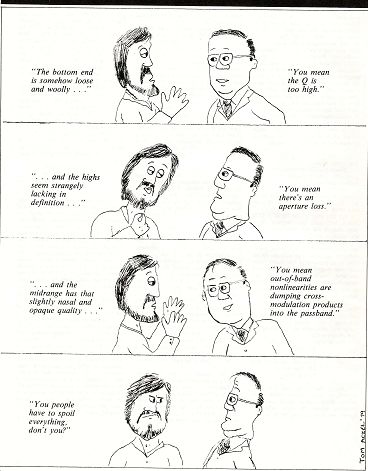 “The bottom end “You mean is somehow loose the Qo is and woolly . . .” too high. . and the highs seem strangely “You mean lacking in there's an definition . . .” aperture loss.” j Bn “You mean out-of-band . and the nonlinearities are midrange has that slightly nasal and opaque quality . ..” dumping cross modulation products into the passband.” “You people have to spoil everything, don't you?”
--------------- A Brief Note on Absolute Phase
When a trumpeter at a recording session blows into his mouthpiece, the first transient wave front emerging from the bell of his instrument, the initial attack, pushes the microphone diaphragm in. It's a positive-going signal and should be reproduced by a loud speaker diaphragm moving toward the listener--a push. Similarly, a singer taking a sharp breath initially sucks the microphone diaphragm out and creates a negative-going transient signal that should be reproduced by a pull of the speaker diaphragm. If these signals are reversed in polarity, making the speaker push when it should pull and vice versa, the perceived sound won't be exactly the same. There will be a subtle loss of realism. The audibility of “absolute phase” in music (not to be confused with stereo channel phasing!) has been known for a long time to sophisticated audio practitioners, in fact in the early vacuum-tube days it was an ironclad rule in the recording studio that there must be no phase inverting stages anywhere in the recording and playback chain. This traditional piece of studio wisdom is now being rediscovered with wide eyed wonder by assorted new audio gurus and cultists, who hail it as the invention of the wheel. With the widespread use of multimike, multichannel, op-amp-console, mixed-down re cording, the absolute-phase criterion has become meaningless. Not even the cleverest recording engineer knows what happens to a positive-going pulse through that maze of signal paths; even if he did, he might end up mixing his signal with inverted versions of itself on the same track. With exceedingly simple recording techniques, however, such as are used by Mark Levinson, Proprius, the “new” Max Wilcox and a few others, there remains the possibility that the positive or negative-going character of a signal will be preserved intact. In that case an extra touch of realism can be added to the reproduction by experimenting with the plus-minus polarity of each channel, either by quickly reversing the speaker leads on each side by hand or having some kind of two position switch in each channel. (Needless to say, it won't work with speaker systems that have the woofer pulling when the tweeter is pushing-or have any other driver out of phase.) Try it. You'll hear it. The better-sounding of the two possible connections will be the one with absolute phase. ------------- Classified Advertising Rates: For 25 cents per word, you reach everybody who is crazy enough (about accurate sound reproduction) to subscribe to The Audio Critic. Abbreviations, prices, phone numbers, etc., count as one word. Zip codes are free (just to make sure you won't omit yours to save a quarter). Only subscribers may advertise, and no ad for a commercially sold product or service will be accepted. For Sale THRESHOLD 800A Class A Amplifier. Latest updates and tweaked by Nelson Pass in 7/78. $1700. Central NY area. George. (315) 437-3357 weekdays. INFINITY QLS-1's Aquaplast woofers, mint condition, #7001034-35, $1400. Two Threshold 400A amplifiers, pristine, 6 months old, #7809771 and #7805486, $950 each. ARC SP-5, mint, #27304054, $525. Yamaha CT 7000 tuner with walnut sleeve, #02866, $925 firm. Akai GX-630D, 3-xtal ferrite heads, 3 motor, 1/2 track, 7.5 /3-3/4, excellent condition, $500. New Revox B-77,1/2 track, 7 1/2/ 3 3/4, factory sealed with warranty cards, $1350. (317) 283-1361, ask for Dave. DAYTON WRIGHT XG-8 Mk 2 loudspeakers, excel lent condition, $2000. Nakamichi 550, brand new, $500. Ask for George Gilbert. (212) 484-6961, Monday-Friday, 10-6. Or call (914) 725-3085 after 7 PM. FIDELITY RESEARCH FR-64s tone arm, unused, in box, $450. R. Lerner, 4126 NW Douglas, Corvallis, OR 97330. HARMAN/KARDON CITATION 17 preamplifier, $300. (212) 989-8001, ext. 36. BEST OFFER. (MOSTLY) NEW: AEA-520, ARC SP 4 and D-100, DB-1, DQ-10, IMF pro MK IV, Micro Seiki DQX-500 with MA-707 arm, Teac TN-400 (rare magnetic float D-D) with Grace 704, Teac A-3300SX, Sony C-37p mic, Technics 9070, 9060 and 9030, Norman Lab switcher. Allen (607) 272-8941. ABSOLUTELY MINT: Professional Systems Engineering Studios I and II, Technics ST-9030, Tangent RS2's, Denon DP-755 with Audiocraft AC-300 II, and unopened Denon 103/T (103C plus matched transformer). Best offer over $2100. Eric (805) 682-2754. --------- Our Big and Our Little Reference Systems, Updated Reference A, our experimental and not exactly practical five figure super system, has changed only slightly. Our best-sound per-dollar Reference B, however, is totally different, thanks to exciting new developments in medium-priced components. For the detailed rationales behind these two different reference systems, please go back to the original article in the last issue. Here we merely wish to reiterate a very basic point of view we've been expounding since the earliest days of The Audio Critic, namely that only two choices of equipment are of genuine interest to the serious audiophile: (A) the best in sonic performance, regardless of price or other considerations, and (B) something reasonably close to the best, at a much, much lower price-if such a thing exists. Thus, the world's third-best preamplifier over $1000, or the fourth-best un der $500, is an absolute bore even if it happens to be a respectable engineering achievement and the designer's mother is proud of it. The fact is that only Reference A and Reference B, conceptually speaking, are worth considering at any given time in any given component category, unless some very specific reason exists for a substitution. That doesn't mean, of course, that if you own our last issue's Reference B power amplifier, for example, you should now throw it away as a piece of junk. It's still every bit as good as it was when we recommended it. But time marches on, and the Empire State Building isn't the tallest in the world anymore. If you feel that your present equipment is no longer enjoyable because it hasn't been blessed in The Audio Critic's latest updates, you've got a problem. We must add that the extensive changes in Reference B are quite unusual and unexpected. We really don't believe that the same thing will recur in the next issue. It's just that progress occasionally comes in quantum jumps. The gradual evolution of Reference A is much more typical. Reference A We must repeat once more that this is not for the well-heeled amateur without test equipment and a complete understanding of what's going on inside each component. Don't blame us if you rush out to buy all this stuff and then end up with problems. It's infinitely safer, and in most cases considerably more rewarding, to put all the responsibility squarely in Mark Levinson's or Harold Beveridge's lap, especially for the “back end” of your super system. Let them worry about your needs and holler at them if you aren't satisfied. Reference A is simply our way of saying: this is what's possible today with ready-made components and this is what we're currently using in our listening evaluations. It's a tool rather than a take-home package for the consumer. Okay? Speaker System Two out of three components remain un changed here, and even the third one is still the same brand, though not the same model. The tweeter is the Pyramid Model T-1 ribbon as before, but in the improved version (see follow-up review in this issue). The price has gone up to $1175 the pair. The midrange speaker is now the Koss Model One/A electrostatic, which has considerably more headroom than the Model Two and, unlike the latter, doesn't have any panels driven out of phase. The price is $3000 the pair, alas. The woofer remains the Janis W-1, at $1350 the pair. The tweeter and midrange must be geometrically aligned for pulse coherence and the rearward radiation of the Koss must be blocked with sound-absorbent material, such as Tuflex. Power Amps and Crossovers The Pyramid T-1 is driven by a separate Rappaport AMP-1 ($1800) this time, with the tweeter's built-in high-pass filter/attenuator acting as a 2.5 kHz crossover. The Koss One/A is driven by another Rappaport AMP-1 ($1800); we're currently working on an internal modification of the Koss to make it roll off by itself approximately where the Pyramid cuts in, but meanwhile we're feeding the power amp from the low-pass out put of a Symmetry ACS-1 active crossover (8650), set for 2.5 kHz. The high-pass output of the ACS-1 isn't used. The Janis woofer is still driven by the Janis Interphase 1 bass amplifier ($495 each, two needed for a pair of woofers). The built-in 100 Hz electronic crossover of the Interphase takes care of the bass/midrange split. Preamplifier and Interfaces We're quite decisively sold at this point on the Cotter front-end modules, despite the shocking price increases. (See Cotter preamp review in this issue.) The PW-2 power supply (8250) provides four identical power sockets for our four separate modules: the PSC-2 phono stage ($475), the CU-2 high-level stage with controls (so far available only in custom-built “engineering models” but soon to be in production at around $1350), and two NFB-2 noise filter /buffers ($425 each). We use one NFB-2 at the input of the Janis Interphase 1 and the other at the input of the tweeter amplifier, which is driven full range; the midrange amplifier doesn't need one since its passband in this system is only 100 Hz to 2.5 kHz. There can be no doubt that the non fatiguing, “zingless” sound of Reference A is at least partly due to this time-domain corrected filtering; out-of-band garbage is dumped over board without altering the in-band information. Removing the Cotter filter/buffers makes the system sound just a little more like hi-fi and a little less like music. Phono Cartridge and Transformer This is a different combination than before; we're now using the Koetsu moving-coil cartridge (approx. $1000) with the Cotter transformer especially made for it, the MK-2L ($650). The resulting sonic improvement is instantly audible even if it isn't dramatic. (See review in this issue.) Tone Arm We still haven't found anything we prefer to the Fidelity Research FR-66s twelve-inch arm ($1250), although we do wish its VTA adjustment facility during play covered a spread of more than just 2° or so. Let's be thankful for small favors, though; a 2° range allows us to play most of the recent LP's correctly, without fiddling with the fixed arm pillar adjustment. Turntable We've settled down to the Technics SP-10 Mk II in the Cotter B-1 base (approx. $2100 assembled) as our reference standard until further notice. (See the turntable reviews in this issue.) k The total retail price of this revised Reference A comes to between $18,000 and $19,000, depending on the inclusion of the Symmetry crossover, small price breaks you can get on a few items, small extra charges here and there, etc. And that doesn't include an FM tuner or any kind of tape deck. But the sound is definitely better than before. As a matter of fact, it's very, very good. Reference B We really prefer to talk about this system because it's something you can go out and buy without a flirtation with insanity, whether fiscal or technophiliac, and enjoy immediately out of the cartons, like takeout fried chicken. The sound isn't in the same class with that of Reference A, but it's better than a lot of people have ever heard, especially now that we have new and improved component selections in nearly every category. These are all reviewed elsewhere in this issue. Speaker System Despite its undeniable shortcomings, the Vandersteen Model II ($880 in our area) is the best speaker system known to us anywhere near the price. The upgrade from the DCM Time Window is clearly audible and worth the $200 plus difference in our opinion. The money will be recouped in some of the other categories below. Power Amplifier The sensational Hafler DH-200 ($399.95 wired, $299.95 in kit form) is the hands-down choice here. And it's quite a bit less costly than the Audionics CC-2, our previous and still far from unimpressive nominee. Can't ask for much more, right? Preamplifier We offer you two options. Get the improved Hegeman HPR /CU ($720), which is in many ways the second best preamp we've found at any price, or get-nothing. The latter option, predicated on the use of the Win Laboratories strain-gauge phono transducer (see below), is unlikely to appeal to those who want a conventional panel-ful of controls, so we won't push for it too vigorously, although the sonic results are quite possibly superior. But you can't go wrong with the Hegeman, either. Phono Cartridge and Step-Up Device If you go the Hegeman route, we recommend the Fidelity Research FR-1 Mk 3F moving-coil cartridge ($230) as before, but this time with a Marcof PPA-1 pre-preamp ($119.95). The Cotter transformer, which we recommended at a time when we weren't aware of any respectable low-cost alternative, has meanwhile priced itself completely out of the Reference B category. The Marcof isn't quite as perfect sonically, but it's truly excellent and in conjunction with the Hegeman yields better results overall than the previous lopsidedly priced preamp/step-up combination. If you're willing to do without a preamp, get the Win Laboratories SDT-10 Type IIC phono transducer system with the SPG-10 passive volume control module ($550 plus $150). This will save you $370 and even provide you with one switchable “aux” input for a tuner or whatever. We'll vouch for the sound but not for the convenience. Tone Arm You may decide to go with an integrated turntable/arm unit (see below), but if you end up with a separate tone arm, we still don't know of a better one at a moderate price than the Series 20 Model PA-1000 ($150). Turntable We regret that we can't give you a definitive recommendation in this category as of press time. The Kenwood KD-500 direct drive turntable, which was our previous choice, is no longer made; several successor models look promising, but we haven't tested them yet. Sony and Yamaha have also come out with some interesting new medium-priced turntables with arms; what's more, adjustable VTA during play is becoming a standard feature on the new Japanese integrated models and may turn out to be the decisive factor in our final recommendation. Dual and Thorens are also in the running with interesting new integrated units. If you've read and assimilated everything we've said on the subject so far, you're in a pretty good position to make your own selection. Look for a base that sounds as dead as possible when you tap it or scrape it; stay away from un its that have absolutely no give when you jounce them. The Cotter B-2 isolation platform ($150) is still highly recommended where mechanically transmitted feedback is a threat. In the next update of Reference B, we expect to have the full benefit of our extensive new turntable tests; we promise to be more specific then. No matter how we combine and add up the above recommendations, the highest figure we can get is about $2900; the lowest is well below $2500. We think that's good news considering the greatly improved sound of Reference B. ----------- In the next issue: We conclude the seminar on the State of the Art with Part II of the transcript. Whew! We report our long-delayed comparative tests of mechanical resonances and acoustical breakthrough in turntables and tone arms. The factual and mythological aspects of speaker wires and audio cables are examined in detail. Our “benign neglect” of FM tuners comes to a reluctant end, one issue later than promised. We take our first critical look at tape recording and tape decks. Also, other equipment reviews in all categories, as well as the usual features and columns. --------- [adapted from TAC] --------- Also see: Symmetry ACS-1 -- John Curl's Perfectly Coherent Electronic Crossover Various audio and high-fidelity magazines Top of page |
|
| Home | Audio Magazine | Stereo Review magazine | AE/AA mag. |