| Home | Audio mag. | Stereo
Review mag. | High
Fidelity mag. |
AE/AA mag.
|
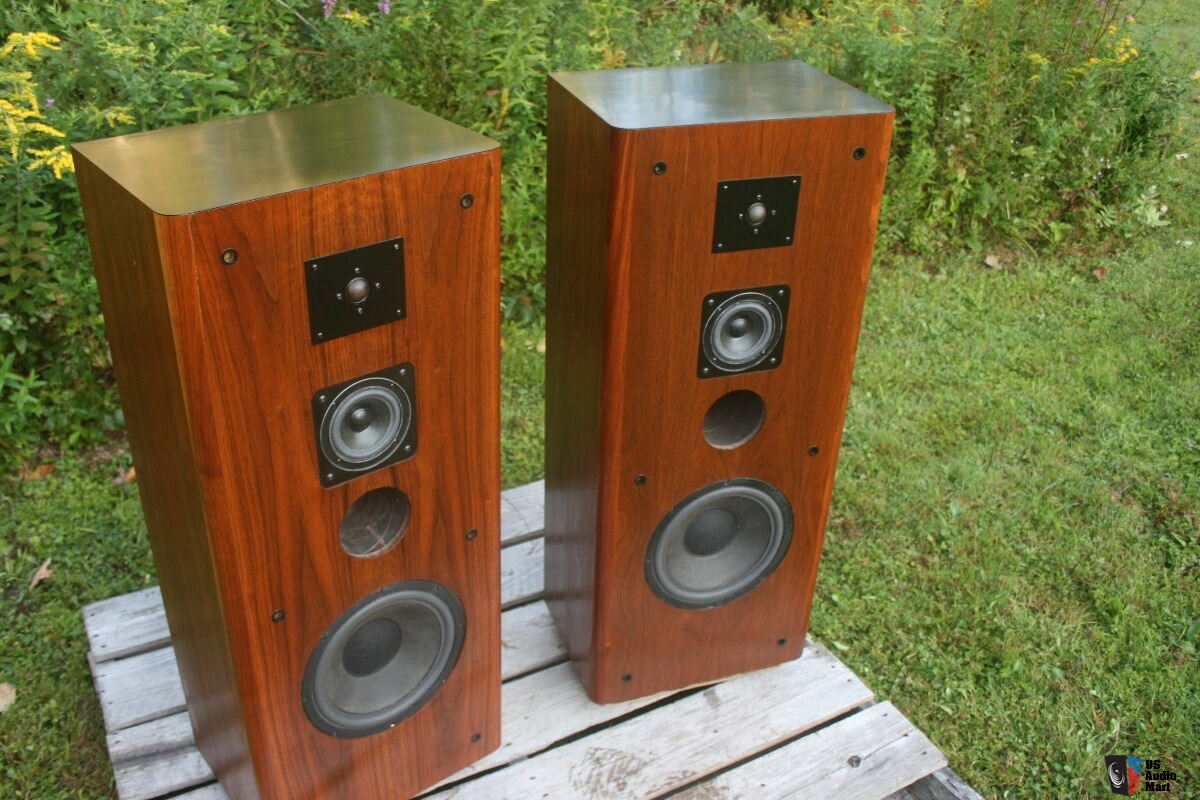
Introducing the First Speaker Designed to the Specifications of The Audio Critic --Fourier 1It should have happened long ago but never did: a simple, straightforward 3-way dynamic system without any highfalutin engineering shenanigans but also without the usual vulgar errors in design.This is the speaker we've been hinting at in our ads announcing this issue. It's called the Fourier 1 and is the first product of Fourier Systems, Inc., a recently formed New York company named after the French mathematician of the Napoleonic era who developed the integral transform that establishes (among other things) the relationship between the frequency domain and the time domain. The speaker started out as an intramural laboratory project to satisfy the curiosity and vindicate one of the pet peeves of your Editor and was never meant to be a consumer product; when its unexpectedly wide margin of superiority to other dynamic speakers resulted in a reversal of that decision, it was our impression that a few stores would definitely have it in stock by the time you read this.
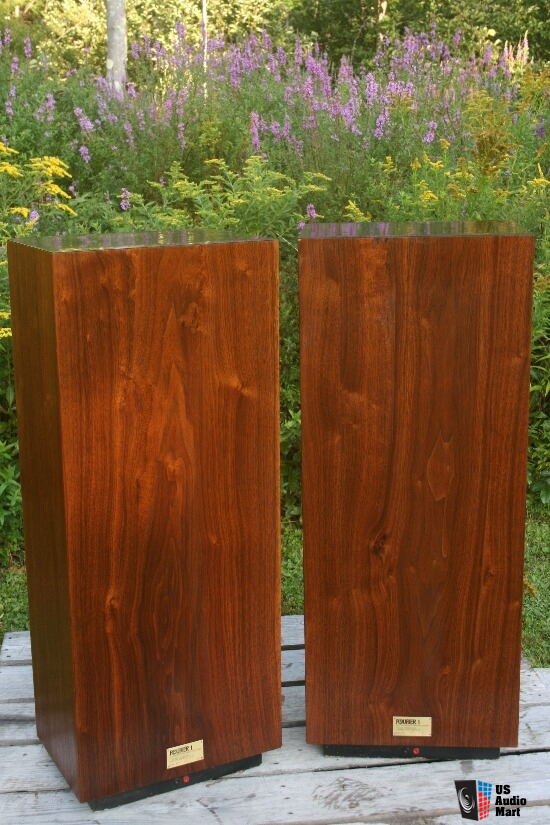
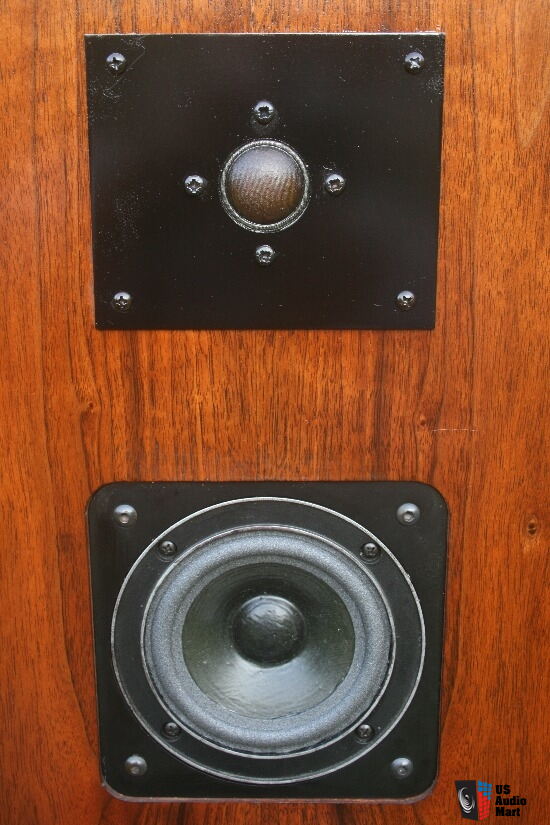
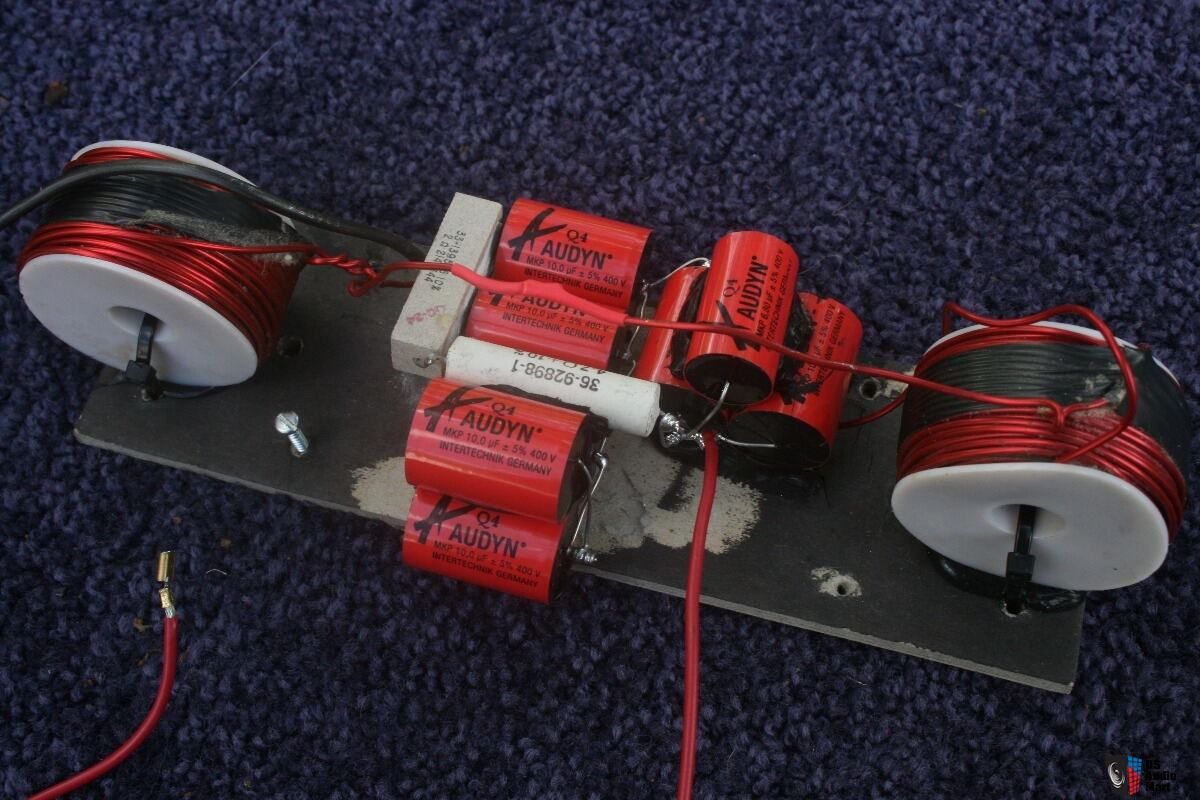
As we go to press, that projection appears to have been just a little on the optimistic side; the earliest dealer shipments of the Fourier 1 are now expected to start around March 1, 1981, we're told. If our ads caused you to defer the purchase of speakers for a longer time than you intended, we're truly sorry for our faulty timing; on the other hand, would you have preferred to remain totally ignorant of what was coming? Although we can't take credit for the actual nuts and-bolts engineering and execution of the Fourier 1, the speaker would never have happened without our initiative and our conviction that it was feasible; therefore, since The Audio Critic is in the business of making impartial and commercially disinterested evaluations of audio equipment (including other 3-way dynamic floor-standing speakers on occasion), we want to disclose here the full background of the project so you can judge for yourself the exact degree of our involvement and our consequent partiality, if any. A laboratory exercise in credibility. It all started with subscriber response to our insistent assertions, repeated in issue after issue, that manufacturers of conventional dynamic speakers weren't doing their home work, since their designs were almost invariably riddled with primitive engineering errors that could have been avoided at little or no extra cost, with only a modicum of extra knowledge. 'Come on,' these subscribers would say, ''do you mean to tell us that Acoustic Research, James B. Lansing, KLH, Cerwin-Vega and all those other highly successful speaker companies don't know what they're doing?' It be came a full-fledged credibility problem, compounded by the fact that not even the smaller audiophile-oriented ' 'boutique' manufacturers (whose products were quite a bit superior because at least they listened to them) had ever made a simple dynamic speaker we could point to as being entirely free from important goofs, in order to prove our point. Slowly it began to look as if there were something wrong with our attitude and criteria, not with the speakers we were putting down. After all, thousands of audiophiles liked those speakers. We decided we had to come up with more than just academic arguments if we wanted to settle the matter once and for all. We had to come up with a speaker. What we had in mind was a single pair of speakers, constructed strictly as a laboratory exercise, incorporating all the specific design points we had been clamoring about and found lacking in others. We began by establishing some very strict rules for the exercise to make the demonstration of our thesis as convincing and comprehensive as possible. First we ruled out exotic or excessively costly technologies that might not be available to all speaker companies. No ionized-air (plasma) drivers, not even electrostatics, nor even super special dynamic drivers that a speaker manufacturer might have to custom build for his system. Nothing but plain vanilla dynamic drivers of good quality, available to anyone from the standard trade sources. We also ruled out giant enclosures that could be expected to elicit an ' 'over my dead body'' reaction from wives defending the hearth from unreasonable encroachment. It had to be a practical, widely usable but still full-range speaker. The crossover had to be passive, electronic crossovers being beyond the manufacturing capability of the typical small speaker firm. These requirements automatically kept the hypothetical price of such a speaker to a reasonable figure. So much for the anyone-could-have made-it-if-he-knew-how criterion. We then set down what we thought were stringent but achievable specifications for such a speaker. It had to be much more efficient than typical audiophile speakers, approaching rock speakers like the Cerwin-Vegain efficiency without any of the sonic colorations of the latter. Also (a seemingly conflicting but not unrealistic requirement), it had to have deep bass, flat down to 30 Hz or so, and not just on a small-signal basis. Really loud and clean in the bottom octave, without going to pieces on organ music with powerful pedal passages, and with impact and proper damping on bass drums. In other words, the subwoofer sound without a subwoofer. At the other end of the spectrum, it had to be much faster than typical dynamic speakers using 1" dome tweeters, with better power handling on cymbal crashes and such. Needless to say, all drivers had to be in phase, producing a multiple wave launch with at least a half-decent chance of coalescing into a coherent wave front and yielding a reason- able facsimile of a square pulse. Ringing in response to tone-bursts of any frequency and pulse stretching of any significant magnitude were not to be tolerated. Implicit in these requirements was the need for a crossover network free from all the usual time-domain disturbances, yet with steep enough slopes to restrict each driver to its most comfortable band of frequencies. A tall order, that one, but not beyond the powers of educated and experienced engineering minds. It happens to be one of our professional assets to know just where to look for such minds, and the team of consultants that succeeded in designing precisely such a speaker to our specifications eventually ended up as the founders of Fourier Systems. Because once a pair of the finished speakers was put together and listened to, it became quite obvious that we couldn't just publish an article saying *'see, we told you so'" and let it go at that. The how-can-I-get-just-one-pair-for-myself letters would have inundated our office to waist level. The speaker audibly demanded to become a purchasable product. And that's how the Fourier 1 was born. The design and what went into it. It was decided very early in the course of the project that the speaker would have to be a 3-way system. A convention al, straightforward 2-way system can't be made to reach down into the subwoofer range and at the same time be fast on top. A 4-way system, on the other hand, requires an elaborate and costly crossover network if it is to work properly and thus begins to approach the exotic category we wished to avoid. Once the 3-way format was agreed on, it became fairly obvious that the woofer would have to be a 10" unit. The mass-reactance roll-off of a 12" woofer dictates a midrange crossover generally too low in frequency for the best dynamic midrange drivers, which can be expected to be almost invariably on the small side. Our requirements in efficiency, maximum tolerable size and large-signal bass response then suggested very strongly the use of a vented enclosure, specifically of 4th-order Butterworth tuning, with an internal volume somewhere in the neighborhood of 3 cubic feet (85 liters). Since multiple drivers in clusters or pseudo-line source configurations had been ruled out from the start on account of their miserable wave-launch characteristics, the driver complement was thus established as one 10" woofer with a Q of approximately 0.4 (for B, alignment), one mid range driver and one tweeter. As our readers know, one of our most insistent objections to typical dynamic drivers has been their excessive energy storage. They ring; many of them ring vigorously and long. To find one with reasonably flat response in its operating range is easy; even good dispersion can be had without too much difficulty; but only a very few drivers will shut up after the input signal has been cut off. When we launched this laboratory project, we had already been testing commercially available drivers for a good many months to help us with our regular speaker evaluations, and we immediately turned all the accumulated data over to our consultants. Among the raw tweeters we had looked at, our favorite was a Japanese flat-diaphragm design with etched voice coil (the kind that's usually promoted as a ribbon but isn't really); this particular one measured and sounded amazingly like the Pyramid T-1, at a tiny fraction of the cost. The vertical dispersion of this unit is far from sensational, and it also exhibits a slight peculiarity (shared by the T-1) in its differentiation of a square pulse, but it's dead flat on axis to 43 kHz, very efficient and free from appreciable ringing at all frequencies. It's faster, louder and just plain better than 1" domes. Our favorite midrange driver, on the other hand, out of a very limited group worthy of consideration, happened to be a large soft-dome unit made in Europe. (We're not mentioning any brands and models lest some home constructor should attempt a half-baked version of the Fourier I that would only parody the design.) For the woofer we had no suitable candidate. As most makers of vented-box speakers have found out, it's well-nigh impossible to find an off-the-shelf woofer whose free-air resonant frequency and Q fit right in with the preconceived parameters and performance specifications of a new design. The way around that problem is to tell the raw-speaker supplier exactly what parts to put together: what kind of magnet, pole piece, front plate, back plate, voice coil, cone, surround, spider, basket, etc. If the parts specified are avail able from stock, the supplier will accommodate you, even if he doesn't understand your exact rationale for the recipe. That's how our consultants obtained the unique 10" woofer of the Fourier 1 (it has a 54-0z. ceramic magnet, an exceptionally dissipative cone and a suspension that's almost impossible to bottom), and since the same route is open to even the smallest speaker manufacturer if he knows what he is doing, our ground rules weren't violated. The biggest difference between competently and in competently designed speaker systems, however, is usually in the crossover network. Here again our consultants came up with a relatively simple solution, an elegant little constant voltage network that any C + student in a graduate course on filter theory would consider a piece of cake but one that would never enter the mind of the typical self-taught designer found in most small speaker companies. The network allows the drivers to play very loud without unduly exciting them outside their optimum passband, and on the lab bench as well as on the Hewlett Packard HP-85A computer both the amplitude and phase response of the network look virtually textbook-perfect. Enough said. Fourier 1 Fourier Systems, Inc., One North Broadway, Suite 620, White Plains, NY 10601. Fourier I floor-standing 3-way dynamic speaker system, $1190 the pair. Three-year warranty. The finished product in its veneered cabinet stands just a few inches over 3 feet tall and takes up just a little more than one square foot of floor space. It has no controls and no fuses in the back because it doesn't need any. Its price is based on its physical contents and should not be interpreted as an indication of the category it aims to compete in. In view of our role as godfather to the Fourier 1, even though we didn't actually design it, we've decided not to review it here in the subjective sense. The objectively verifiable design data presented above should be sufficient. Its large-signal bass response alone, not mention its time-domain characteristics, make the usual comparisons unnecessary. 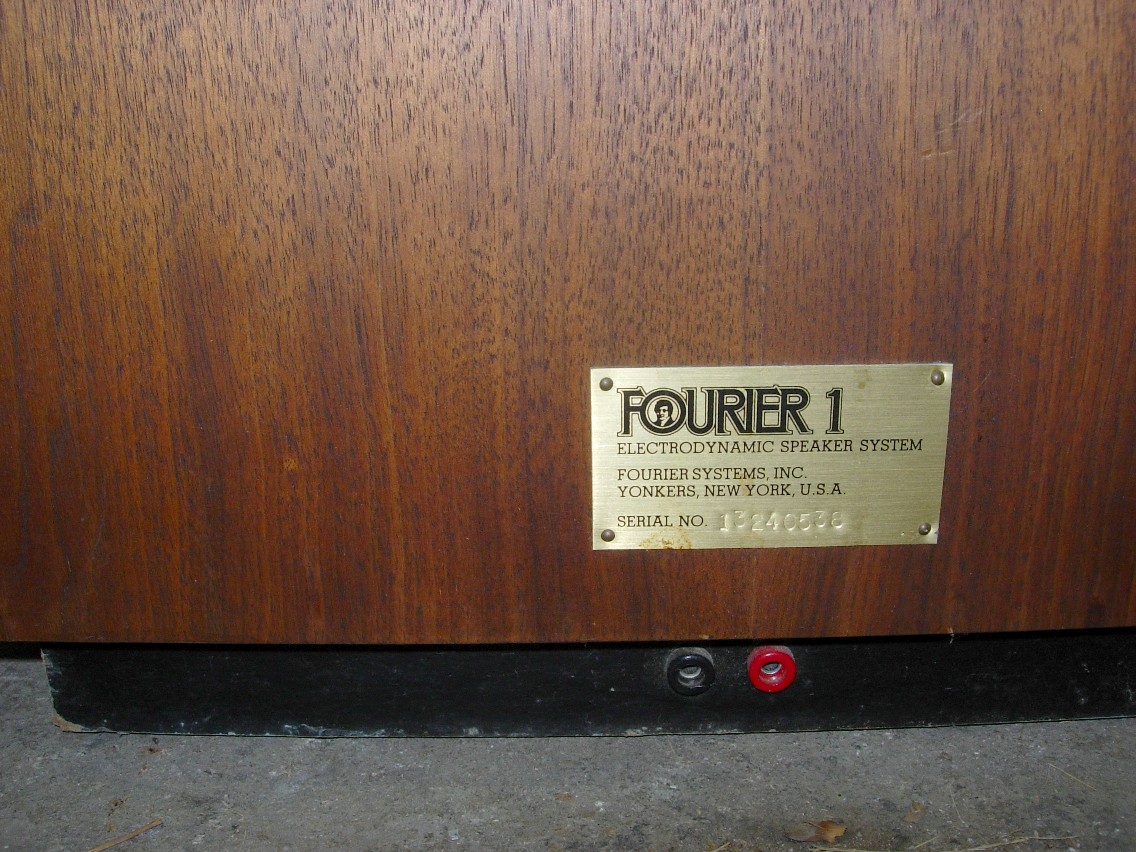 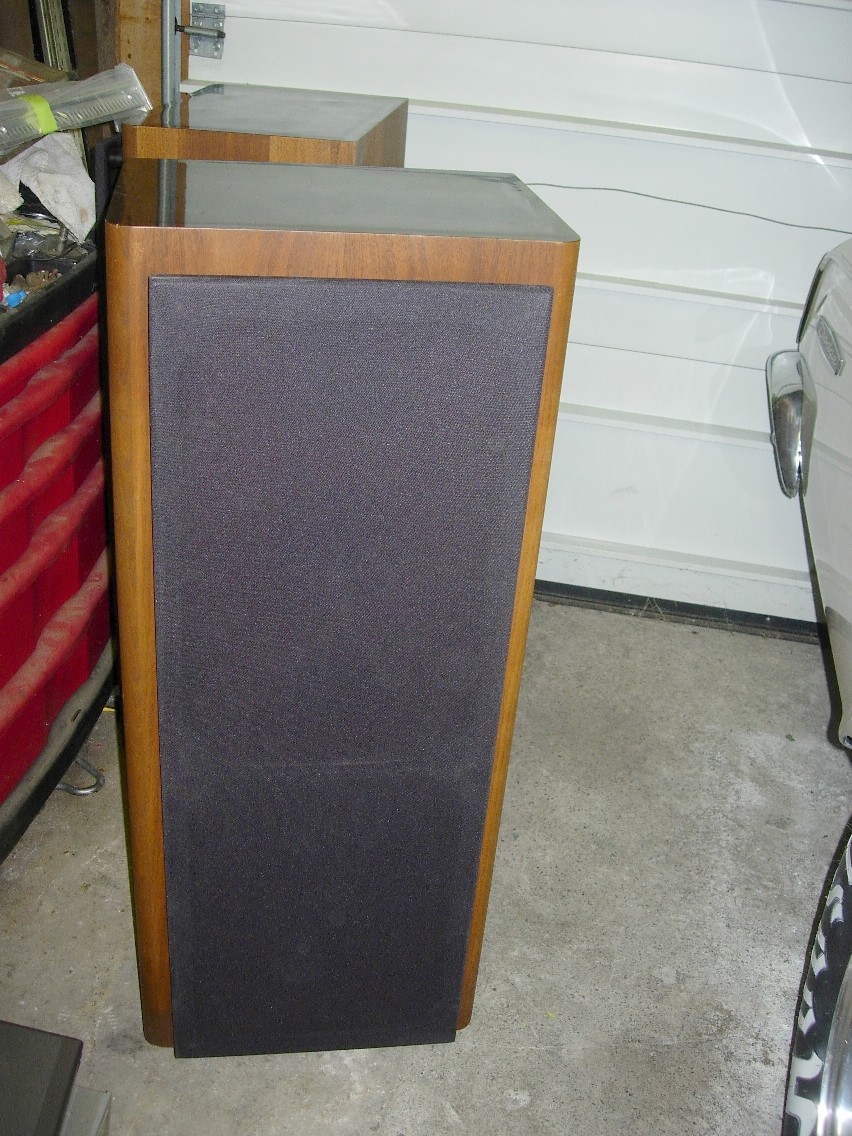 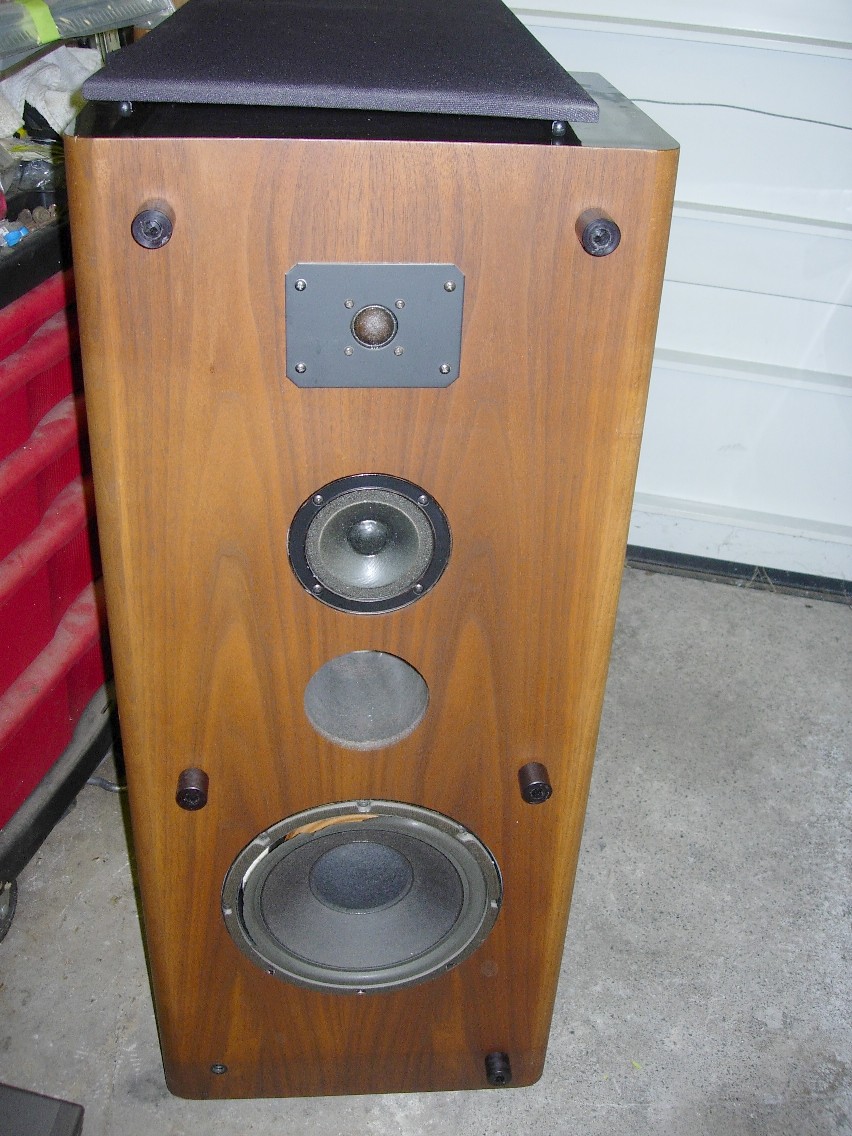 We're currently using it as one of our top reference speakers, alternating with the Quad and the Quad/Janis W-1 combination to double-check our perceptions and evaluations. That should tell you where we stand; the rest you'll be able to hear for yourself very soon when the speaker begins to arrive in showrooms. --------- [adapted from TAC, Vol.2, No.3 ] --------- Also see: Sophisticated Speaker Systems, Large and Small: Continuing Our Survey --- Beveridge 'System 2SW' (follow-up) ; Canton HC 100 ; Dayton Wright XG-8 Mk 3 ; DCM 'Time Window' (Improved) ; Hartley 24' Subwoofer ; Innotech D24 ; Spendor BC1 ; Tangent RS2 ; Ultraphase 2501 More Speakers, Ordinary and Extraordinary Various audio and high-fidelity magazines Top of page |
|
| Home | Audio Magazine | Stereo Review magazine | AE/AA mag. |