MANUFACTURER'S SPECIFICATIONS
"Hiss" Reduction: Up to 30 dB above 5 kHz, 5 to 14 dB total above 400 Hz, depending upon program material and control settings.
Frequency Response: Minimum bandwidth, -3 dB @ 500 Hz, -10 dB @ 1 kHz, -20 dB @ 2.5 kHz; Maximum Bandwidth, ±0.5 dB, 10 Hz to 20 kHz.
Input Level: 0.77 V (0 VU), adjustable to 10 dB lower level.
Maximum Input: 6 V @ 0.1 dB gain.
Rated Output: 2.5 V (+10 dB). Clipping Level: 6 V. Output Impedance: 50 ohms, d.c. coupled.
Gain at 1 kHz: 0 dB adjustable to +10 d B. THD (Sensitivity at Maximum): 0.2 percent at any frequency from 20 Hz to 10 kHz.
IM Distortion: 0.05 percent.
Internal Noise: 100 µV rms. 20 Hz to 20 kHz.
General Specifications:
Dimensions: 17 1/2 in. (44.5 cm) W x 2 1/2, in. (7.3 cm) H x 8% in. (21 cm) D.
Weight: 8 lbs. (3.6 kg).
Power Requirements: 105-125 V, 50/60 Hz, 8 W (210-250 V model optionally available).
Price: $379.00.
The Burwen Research DNF-1201A is a much improved and totally restyled and re-engineered version of Dick Burwen's earlier Model 1201 which we had an opportunity to examine some years ago. The Burwen operation is now headquartered at the same location as KLH, in Cambridge, Mass., both companies being part of EAD Industries. Evidently, with Mr.
Burwen now able to devote all his efforts to engineering (instead of trying to run his small, independent company and worry about new products all at the same time), he has come up with a truly effective dynamic noise filter.
A dynamic noise filter, unlike the more familiar "high cut" passive filters found on most preamplifiers, amplifiers, and even receivers, may be thought of as a filter whose cut-off points and degree of attenuation are constantly changing, depending upon the musical content of the program source.
In other words, if a moment of music comes along which contains no high frequencies, the filter cuts down overall system response (it is usually inserted in the signal path via the tape out/tape in jacks available on most amplifiers and receivers), and high frequency "hiss" or noise is sharply diminished. At the instant when a high frequency musical signal comes along, the filter "opens up" and lets the music come through untenanted. Sounds simple, but execution of an unobtrusive dynamic filter is not that easy. As for what happens to hiss when the filters are wide open and highs are contained in the music, a well known characteristic of human hearing known as the "masking effect" takes care of that very nicely.
During such time periods, the high frequency musical content tends to mask the lower intensity high-frequency noise so that even though it is very much there, our ears simply do not respond to it.
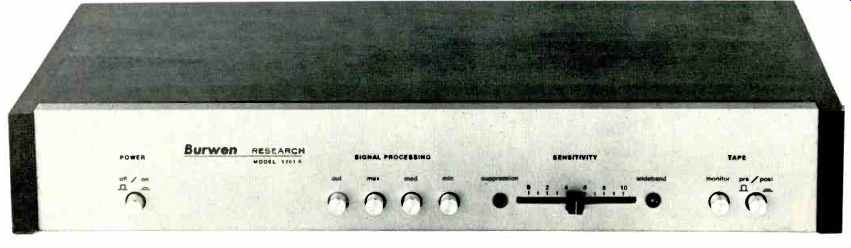
The front panel of the 1201A is gold anodized and has a low-profile design. The power On/Off pushbutton is located at the lower left. Four interlocking pushbuttons determine the level of signal processing which is to occur. The first button (bypasses the filter entirely, while the next three switches are labeled MAX (for maximum processing of poor quality program material where high levels of hiss are present), MED Untended for signal processing of average quality tapes, records, or broadcasts), and MIN (for signal processing of very high quality, low-noise programs of all types). A sensitivity control, in the form of a continuous slide lever, is flanked by red and green LED indicators and allows the user to "fine tune" the filters once the appropriate signal processing switch has been selected. Optimum performance occurs when the LEDs flash on and off alternately. In actual use, if this condition cannot be obtained for any setting of the sensitivity control, the user is advised to use an alternate signal-processing button and try again.
The rear panel of the 1201A contains a pair of tape-out and tape-in jacks, in addition to the input and output pair of jacks. These replace the ones used up on your amplifier or receiver in connecting the 1201 A, and the user can select tape monitoring by means of the tape monitor button on the front panel. The button at the extreme lower right of the panel permits the user to interpose the filter ahead of the connected tape recorder's inputs or after the tape deck's line outputs, thereby enabling pre- or post-recording filtering.
Flow It Operates
The Model 1201A uses a bandwidth control circuit which includes a complex multistage nonlinear filter. The band width controller measures the high frequency content of the sum of the bandwidth in accordance with both level and frequency. Dynamic filtering is achieved as the bandwidth controller generates a d.c. control voltage that constantly regulates the cutoff frequency of a voltage variable low-pass filter. Bandwidth changes occur gradually at low levels but rapidly enough to track the signal. According to Burwen, sharp transients can extend the bandwidth to full response in as short a time as 600 microseconds attack time. Reduction of bandwidth, or decay time, is adapted to the incoming signal and varies in the range from 50 milliseconds to 1.5 seconds.
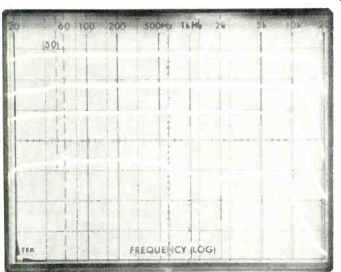
Fig. 1-With the "MIN" button depressed the DNF-1201A provides mild bandwidth suppression which increases at low noise levels. Here the Sensitivity control was set to mid-position. Each vertical division equals 10 dB.
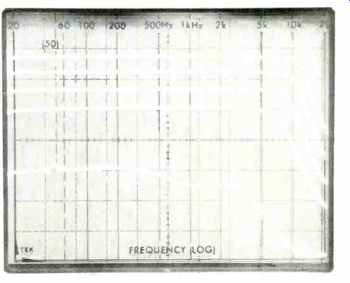
Fig. 2-Greater bandwidth contraction occurs when the "MAX" button is depressed. Each vertical division equals 10 dB.
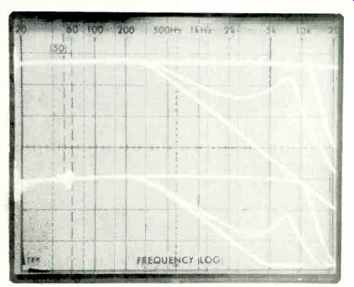
Fig. 3-Varying sensitivity control of the 1201A with the high level sweep frequencies applied resulted in the upper group of response curves. With the low level sweep, lower response curves were obtained with the "Min" button depressed.
Fig. 4--Procedure was the same as used in Fig. 3 curves, except that this time the "MAX" signal processing button was depressed.
Laboratory Measurements
From the foregoing description, it should be obvious that a dynamic filter such as the Burwen DNF-1201A does not lend itself too well to "static" or constant-signal bench testing.
When measuring frequency response, for example, results can be confusing because the bandwidth of the device changes with incoming frequency and levels. Nevertheless, we looked about for a way to illustrate graphically what is happening in the filter under different signal level conditions and came up with a series of scope traces which helps to clarify the action, we feel. Figure 1 is a 'scope photo of frequency sweeps (from 20 Hz to 20 kHz) taken with the signal processing set to minimum and the sensitivity lever set to its mid-position. At high level input (top trace), response is almost out to 20 kHz, as it should be, since high frequencies at this level cannot be anything but "music." The lowest trace (some 40 dB lower) exhibits a cut-off at around 7 or 8 kHz. In other words, the filter has "closed down" somewhat, perceiving this low level sweep (or its high frequency content) as being "noise." Note that each of the response sweeps is the result of an instantaneous change of a shift in the instantaneous output/frequency response with input frequency and amplitude.
In Fig. 2, the MAX signal processing button was pushed and successive sweeps were repeated as in Fig. 1. Note that this time, cut-off occurs at approximately 10 kHz, even for high level signals, while at lowest sweep level, cut-off moves down even further in frequency, as it should be expected to do.
Figures 1 and 2 represent a series of frequency response curves all taken with the slide sensitivity control in a set (mid) position. To get some idea of the action of this control, we recorded additional sweeps in Figs. 3 and 4. This time, for Fig. 3, we used the MIN signal-processing button and applied high-level and low-level sweep signals. For each level, we varied the setting of the sensitivity control and obtained a series of response curves for each of the constant input sweep levels (low and high). These experiments were repeated using the MAX signal processing setting, again using low- and high-level input frequency sweeps and varying the sensitivity control from one extreme to the other. By examining the results obtained in Figs. 3 and 4 and correlating them with earlier Figs. 1 and 2, readers should be able to get a pretty good idea of how the filter expands and contracts bandwidth, depending upon the input level and frequency content.
Accurate static measurements can be made only with the OUT button depressed and, under those conditions, response measured flat within 0.5 dB from 10 Hz to 20 kHz, as claimed.
We were able to drive the output to a level slightly greater than 6.0 volts before noticeable clipping occurred. With the sensitivity control set to maximum (worst case), total harmonic distortion at 1 kHz was just under 0.1 percent. IM distortion measured 0.03 percent. Signal-to-noise ratio of the unit itself (with the OUT button depressed) measured a very acceptable 88 dB below rated output.
Listening and Use Tests
The only proper way to evaluate a device such as the 1201A is to listen to it while playing a variety of program material having varying degrees of poise content. We did just that, using everything from some antique 78 rpm discs (there is nothing noisier), to weak-signal stereo FM programs and moderately noisy LP discs. With a bit of experimenting for each of these program sources we were finally able to adjust the controls and choose the right buttons so as to achieve really significant noise reduction with barely a trace of musical loss. If you have a chance to experiment with 1201A, don't be fooled by a phenomenon which first tricked us .. we are all so accustomed to have high frequency hiss accompany treble tones that when the hiss disappears, we tend to think that we have lost treble response (for the music) as well. It takes a bit of careful listening and A-Bing to realize that this is not the case. The OUT button on the 1201A makes it very easy to conduct such comparison tests.
Since the Burwen is a "one-sided" noise reduction system, it can be applied to any program source and does not require "processed" or "encoded" program sources (such as Dolby, dbx, or other "two-sided" signal processing systems). As such, it will prove useful to anyone who has records or tapes (or listens to FM programs) that are anything less than totally noise free. Of course, at $379.00, owners of mid-priced hi-fi systems will have to think twice before spending very nearly as much as they may have spent for all their other components, but for the purist, who has unlimited funds and also owns records or tapes that have become overly noisy and are irreplaceable, the Burwen DNF1201A may prove to be one of the most worthwhile investments you can make.
Leonard Feldman
(Audio magazine )
Also see:
Connoisseur Model BD2A Turntable (Equip. Profile, Jul. 1980)
= = = =