by EDWARD TATNALL CANBY
Happily Ever After?
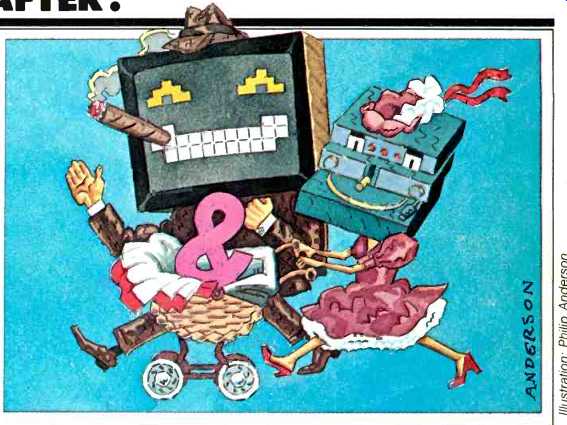
Everybody 'round here knows about the big wedding of technologies and equipment going on today. That huge, blowsy, successful achiever, "King TV with the cracked voice," better known as Video, is tying the knot-until death do us part-with a dainty, refined little thing called Hi-Fi.
She's older but she speaks pretty.
That's us! And just as a married man imposes his name on his spouse, as though she were only an ampersand (&), so video is now busy innovating in its own name all sorts of big ideas borrowed straight from the blushing bride.
COMPONENTS!
Where have I heard that before? The idea is not TV's, but ours, and already 40-odd years old, though you'd hardly guess it from the video ads. STEREO! Coming, coming, but is it an innovation? It was, a quarter-century ago in audio. And DISCS! Now you can build a whole library of Great Works to play right in your own living room. Zowie, what an idea! It dates from slightly before 1900, at which time it was indeed innovative.
Never imagined before. Brand-new. In these areas, present-day video is just borrowing, adapting, not innovating.
Maybe we're going to have to do the innovating, we who now are in audio.
Can you really imagine the first-time thrill of hearing a real, intelligible voice coming out of a machine, actually making sense and offering entertainment? That's what the phonograph did for people in the 1890s and on into the first age of recorded opera. This was real innovation, living up to the potential of a wholly new array of equipment.
Can you remember, as I do, some 30 years ago, the slow realization that stereo, the spread of sound to right and left-much distrusted at first-was really going to work? We could not possibly have imagined the effect in earlier mono days. I lived as long with mono as I have since lived with stereo; I should know.
And high fidelity. That hi-fi componentry, too, was a genuine new thing which those of us who had simply owned radio-phonographs of various kinds could not have envisioned beforehand. Hi-fi, the very idea of a play of quality between a recording and its reproduction, was certainly new for the intelligent consumer and it hit me like a thunderbolt. It still retains that vitality because it is still real.
These were some of the genuine shock treatments that audio, minus pictures, has been able to give to the public. It's a good record, you'll admit.
The days of TV's shock treatments are mostly over. The business got bigger faster than it moved forward; its innovations have been slow and pretty safe. Too big! The genius of TV is ever so clearly in its engineering. Its weakness is in its software, the whole enormous, expensive, commercialized, rigidly mediocre day-to-day mass of it.
There are miracles of TV programming, here and there, superb documentaries, great dramas, acres of news, Emmy awards, sports. None of these can make up for the dead weight of the rest. It won't go away. It can't. The air, the cables, must be kept full.
Is this for us, for our hi-fi business, to join? Are we to be dragged down into mediocrity? The video genius is in its incredibly capable machinery, the ever-blossoming hardware and the possibilities that it opens up for real innovation. In pure engineering, video is supreme and the video engineers are already into a New Age as anybody can see. Just wait until the ancient tube at last shrinks to zero size and gives way to compact image processing, tubeless, for fewer demands on space and, in the end, what with the usual inflow of integrated circuits and microprocessors on chips, also micro in cost for the viewer. If we are given half a chance-by politics, economics, war-without question we will soon have a TV, a video, that is so much more versatile than ours today that you wouldn't believe it-now, that is. (You'll take it for granted then.) But what's going to be done with all this marvelous stuff? Who's going to do it? It's likely we'll have to. Those of us who have come up through audio, through the sound media minus pictures. Our program people, our recording people, pop and classical alike.
Television won't help! It's muscle-bound. It's bogged down in weight lifting. It's the Mr. America of entertainment. In comparison, we in hi-fi are flyweights and maybe the better for it.
In current TV, as is, I note only two areas of video programming where things are being done that really are new, unimaginable before. I'll risk the brickbats and describe them. One, without the slightest doubt, is current TV sports. That area is alive and moving! Sports-casting on TV is genuinely out of nothing that has come before, unless with a mild bow to old-time radio. And like all real innovation, the stuff is incredibly effective, so much so (as we all know) that by comparison the "original," the living sport itself on the spot, is already an inferior message, often bewildering-especially to the uninitiated. On TV, all is clear! Unheard-of techniques do the trick-the instant slow-motion replay, for instance, or the marvelous use of the zoom, so that the viewer is, you might say, weightless and disembodied, all over the field, seeing everything. Can you imagine describing this to a baseball fan of 1899? Here we can admire the mesh of technology and its actual dramatic use, perfectly at one. That's real. It's innovative. But (sigh) is audio of any importance? Will even our best hi-fi make any vital difference? Nope. It's all video.
The other really innovative TV area, shared with the movies (more and more these work cheek to jowl together) is the incredible, often foolish but absolutely unheard-of art of computer animation, combined of course with assorted space wars, which was recently brought to a focus in the Disney Tron. Say no more! This is a thing that video can do and superbly, in all its entertainment forms, in games, arcades and computers, via broadcast and cable and cassette and, maybe, even disc. And do it as never before imagined. I won't say much about artistic values at this point, but basic innovations like these tend to grow fast on their own enormous potential. Compare the earliest motion-picture dramas with the profound works of art that came later, even before sound was added to a silent medium.
But what part can state-of-the-art audio play in this area? Sigh again. A lot of beeps, blips and electronic howls? It's video stuff, through and through.
Oh, so you think there are other areas of present TV that are truly innovative? Well, go a bit further. There's plenty of fine entertainment, of course.
But is it really new, alive for the future, or just borrowed from the past? I love good films but they aren't as good on TV as on the screen, though much more convenient. I am always impressed by TV news coverage-it's amazing. But I do not think that a picture of an anchorperson reading news across a big desk is exactly a profound innovation, compared with radio news. (They had to put the person somewhere in the picture.) Again, the news is all engineering, that instant assembling of info and pictures from everywhere, the ubiquitous satellite. That, decidedly, is real and new in our time.
The news does project a few mild "firsts," like those windows at the back through which newscasters in distant places seem to talk to us. That's clever and useful engineering, not to be imagined in TV's earlier days. So with other news tricks, but mildly.
What's so innovative about the talk show? Maybe its length-not much else. If they moved the guests from the left couch to the right, I suppose that would be innovation. I did a talk-show (dead-center mono) in 1943.
So is hi-fi going to get very far in the video news and the talk shows? Well, we can always install stereo.
We have to be careful about this business of mediocrity in programming and lo-fi standards on the technical side. They are often rigidly unamenable to change and for good reason--simply because they work as is.
In audio we have never felt that the sound of TV even rates the term "audio." Pretty sad. Still mono. If it is audio, then it ranks with the feeblest, including ancient P.A. systems in churches, ball parks and maybe the New York subway. Most audio professionals will agree and many are all hepped up and missionary about it--we'll fix things up for good TV sound! I take a different tack. I've always felt that present TV sound is exactly right for its purpose. Otherwise why does it satisfy the millions? No, it's not because we have no choice! No, not because people are clods with tin ears.
They are right because 98% of the present TV message gets through quite adequately via the present sound system. That's why. We can use better fi (at reasonable cost) but we do not really need it.
The TV message, as is, consists almost entirely of the speaking voice. It is no accident that nature shaped our hearing to maximize the understanding of speech, and vice versa: The telephone has grown up on this principle.
Hi-fi on the phone would do no harm but we don't need it either. No bass required. We supply it within the ear.
Just enough midrange to distinguish the sibilant S from the fricative F, though we did fine without even that for many years.
People will indeed accept improvements of this sort if they are handed to them on a platter. But they really aren't much interested, and they are right.
The messages get through as is! That's what really matters.
Same for color. Color is lovely but people still don't much object to purple or green faces on the tube. Just look around you. Too much effort to get up and fuss with the controls-not worth the effort because the TV message gets through anyway.
You don't argue about these things.
You can't. No matter how high your standards. Stereo, for instance. For TV speech, for most video fare now, it would be a very marginal improvement and sometimes a liability. (The canny Japanese use it largely for two-language channels.) [But also for stereo-even baseball games.-I.B.] Who cares about directionality and ambience via the little TV box, or even the smallish projection screen? Too much separation and you confuse. (And bollix up the mono reception.) As of the whole of TV-why bother? TV is not organized for little minorities who like classical concerts and such. And after all, do you ever notice that the TV sound in your favorite bar comes from the other side of the room, or behind you, far from the picture? Who cares? Doesn't bother the message a bit.
On the other hand, certain forms of distortion are immediately serious. Audio noise, static, garbled voices, signal interference (that's why we have FM). Video snow, ghosts, rollings and shearings. These hit people right in the plexus, because they do interfere with the message in a big way.
Finally, music. Music is still the mainstay of hi-fi. There's music on video too, but it is characterized in four very unpalatable ways. First, it is still mono, as of audio around 1957, but the sound is good 1932. Can we go for that? Second, music is statistically unimportant; speech is the overwhelming audio message on TV. In our hi-fi, speech is almost nonexistent. Third, video music is by its very nature inherently background. The picture always hits harder. Even the most urgent efforts in high-minded classical music still leave the picture very much ahead, the music secondary.
And fourth, in contrast to the enormous diversity of available sound in our hi-fi, present video music is irrevocably limited to strict big-time stuff. It has to be. Can't be helped. Inherent in the present TV setup, except for a bit of PBS now and then.
Yes, it's a dismal picture-for us.
Where can we fit in? It's going to be a very incompatible marriage, right down the line point by point. Unless we join the video engineers (the innovators) and get away from this monster, TV, to create some genuinely new entertainments that combine sound and sight. Like nothing ever before. This, or we die.
==============
Vintage magazine ADs
What Your Ears Need Is A Brain.

-----This tiny microprocessor is the latest innovation in Pioneer's best components. It can improve the way you listen to your music. And it can also improve your music.
Not that there's anything wrong with the one you've got.
We just had something a little smaller in mind. More like the one you see here.
Technically, it's called a microprocessor or computer chip.
But we like to think of it as a little brain.
Because when it's built into our Pioneer receivers, tape decks and turntables, they become more.
They become smart.
And when it comes to getting the most music out of your music, smart components have a lot of advantages over dumb ones.
How smart is smart?
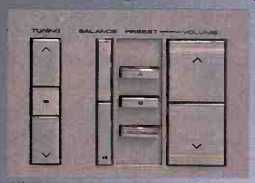
------All-electronic receiver operation does away with knobs and dials. Volume, station a id bass and treble levels can be easily monitored thanks to L.E.D. readouts.
For starters, the brain inside the SX-8 allows us to use push button controls, eliminating noise and distortion caused by mechanical dials.
So all you hear is crisp, clean music.
Just the way it was recorded. The brain also willingly takes over the chores you used to do yourself.
Just push a button to raise or lower volume or tone, change stations, even check the time. Push the Scan-Tuning button and the receiver automatically scans every station, playing five seconds of each one.
Then, simply touch the Memory button. Your station, volume, and tone settings will e instantly stored in the memory. Ready to be recalled just as fast.
THE CT-9R TAPE DECK: SMART ENOUGH TO FIND NOTHING.
If you've ever done even a small amount of cassette recording, you've gone through the not-so-convenient fast forward/stop/play/reverse/stop/play procedure of trying to find the blank area where your last recording left off and the next one can begin.
The CT-9R, on the other hand, as a button marked Blank Search. Give it a push and it will find the area that's long enough to tape on, back up to the last recorded piece, leave a four second space and stop, ready to record.
Automatically.
--------The real-time counter reads out the amount of tape left in meaningful minutes and seconds instead of meaningless inches.
And, as if that weren’t enough, the CT-9R also has one of the world's fastest Automatic Bias Level Equalization systems.
In plain English, that means that it takes just eight seconds for Auto B.L.E. to analyze the tape being used (no easy task with over 200 different tapes on the market) and then adjust the deck for optimum performance with that tape. Improving the quality of your recordings faster than you can say "wow and flutter."
THE PL-88F TURNTABLE: IT WON'T PLAY WHAT YOU DON'T LIKE.
In the history of recorded music, there has probably been one, maybe two people who like every cut on a record. If you're not one of them, you'll take an immediate liking to the new PL-88E It's front loading, stackable and, best of all, it's fully programmable.
Punch in up to eight cuts per side in any order that makes your ears happy.
The turntable will automatically skip the ones that don't.
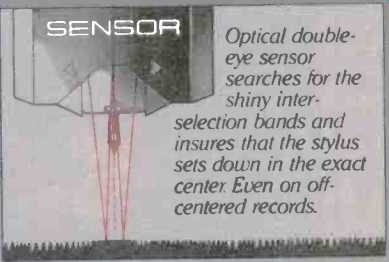
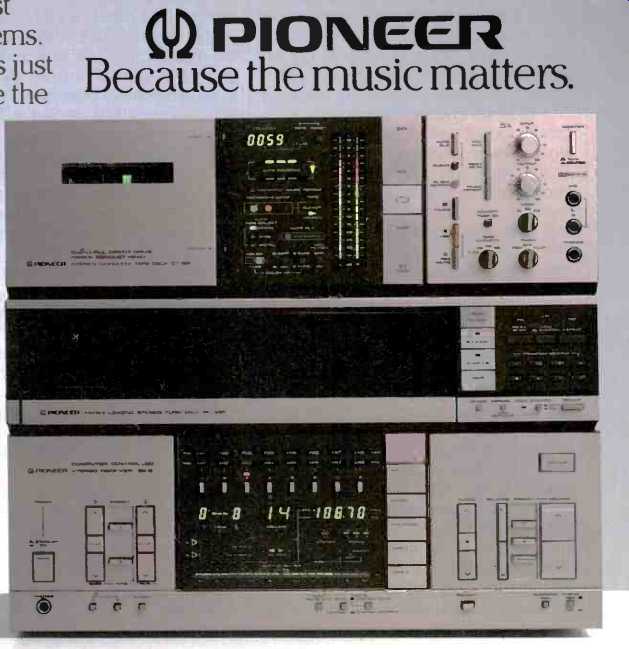
---------Optical double-eye sensor searches for the shiny inter-selection bands and insures that the stylus sets down in the exact center. Even on off-centered records.

And when you're recording from records to cassettes you'll appreciate the tape deck synchro that automatically places any Pioneer Auto Reverse tape deck into the pause mode when the turntable tone arm lifts off the record.
Leaving you free for more important things.
Like listening to music.
The Pioneer CT-9R tape deck, SX 8 receiver and PL-88F turntable. Proof that to get the quality of music you buy quality components for, you don't need a lot of knowledge.
You just need a little brain.
PIONEER
Because the music matters.
------------------
Dynavector's Moving Coil is Now Affordable.

You can now experience the superb musicality of Dynavector's moving coil cartridge at a reasonable price and without the additional expense of a step-up device.
The DV10X3 is a high output cartridge (no step-up device required) that embodies all the design advantages of Dynavector's moving coil technology, including low mass for wider dynamic range, precision wound silver coils for lower distortion and powerful Samarium cobalt magnets for increased product life.
With our DV10X3, you can hear the improvement--honest music reproduction without coloration.
The big surprise is that this new DV10X3 retails for only $150.
We know that once you listen to the DV10X3, you'll be sold on Dynavector. Write or call for information or visit your audio specialist.
Dynavector World leader in moving-coil cartridges Dynavector Systems USA 1721 Newport Circle Santa Ana, CA 92705 (714) 549-7204 Dynavector 1982

------------------
Onkyo
The song you're recording is building to a big finish.
Unfortunately, your tape may finish before the band does.
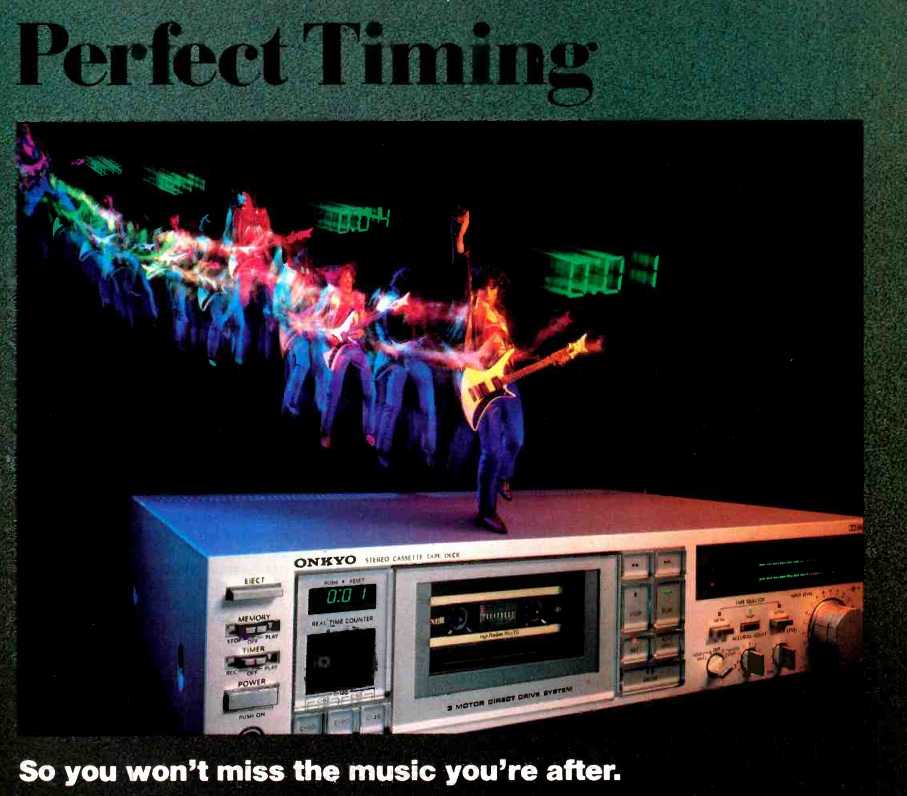
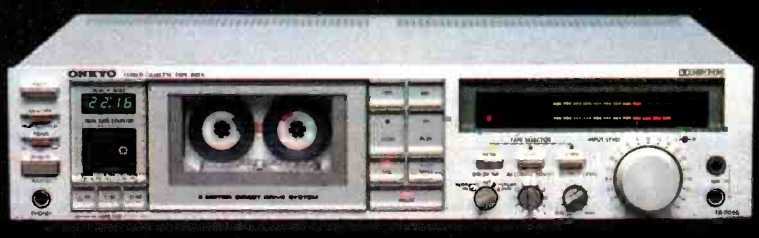

The Onkyo TA-2055 takes the guesswork out of making perfect cassette recordings. It features a Real Time Counter that displays the consumed or remaining time on the tape, so you can plan your music selections down to the second. Creating your own tapes takes a lot of effort, and the TA-2055 insures that time is on your side.
There are more outstanding recording benefits to this remarkable deck. Jarring, abrupt song transitions are prevented by our Auto Space control that automatically inserts five seconds of blank space between cuts. Onkyo's patented Accubias lets you fine tune to the correct recording bias of the tape. The result is professional recording quality with the flattest frequency response a tape can produce. Dolby B & C Noise Reduction systems are standard, and a microcomputer controlled direct-drive 3-motor transport guarantees smoothness and reliability, in recording or playback.
The TA-2055 takes its place with our other cassette decks as a superb example of Onkyo technology and value for the dollar.
Our perfect timing will make for perfect listening.
Dolby B & C are trademarks of Dolby Labs 200 Williams Drive. Ramsey. NJ 07446
---------------
Linn
Single Speaker Demonstration
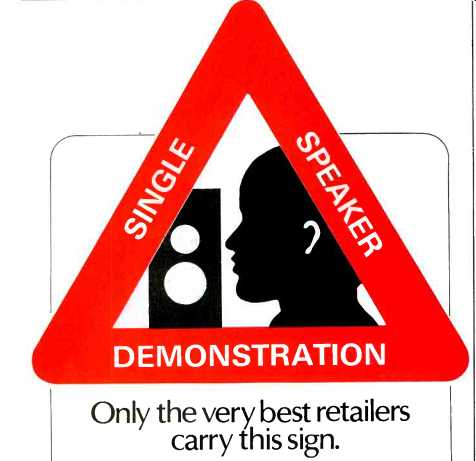

Only the very best retailers carry this sign.
The only valid and fair method of evaluating audio components involves assessing their performance in circumstances which approach a domestic environment. This implies that only one pair of loudspeakers can be in the room at any time.
The presence of any other transducer, no matter how small, will significantly degrade the performance of any audio system.
The best retailers realize that modern equipment demands higher standards of demonstration than the familiar wall of speakers on wobbly stands.
The best retailers employ only single-speaker dem-rooms.
LINN PRODUCTS
For further information contact:
AUDIOPHILE SYSTEMS LTD., 6842 HAWTHORN PARK DR., INDIANAPOLIS, INDIANA USA 46220. ALDBURN ELECTRONICS LTD., 50 ROLARK DR., SCARBOROUGH, ONTARIO, CANADA M1R 4G2
--------------
==============
(adapted from Audio magazine, 1983; EDWARD TATNALL CANBY)
= = = =