by CHRISTOPHER GREENLEAF
A recent five-week visit to Japan and Hong Kong revealed a number of small but, one would venture, important new wrinkles in the Digital Audio Tape scene. Any big breakthroughs? No, and none anticipated as this issue goes to press. Nevertheless, there are enough cracks in the DAT dam to send those standing on top of it scurrying for solid ground once the extent of the format's actual appeal to the public becomes more apparent.
In East Asia-the enlightened term most people now prefer to the old term, the Far East-sales of DAT hardware and software are soft. Real soft.
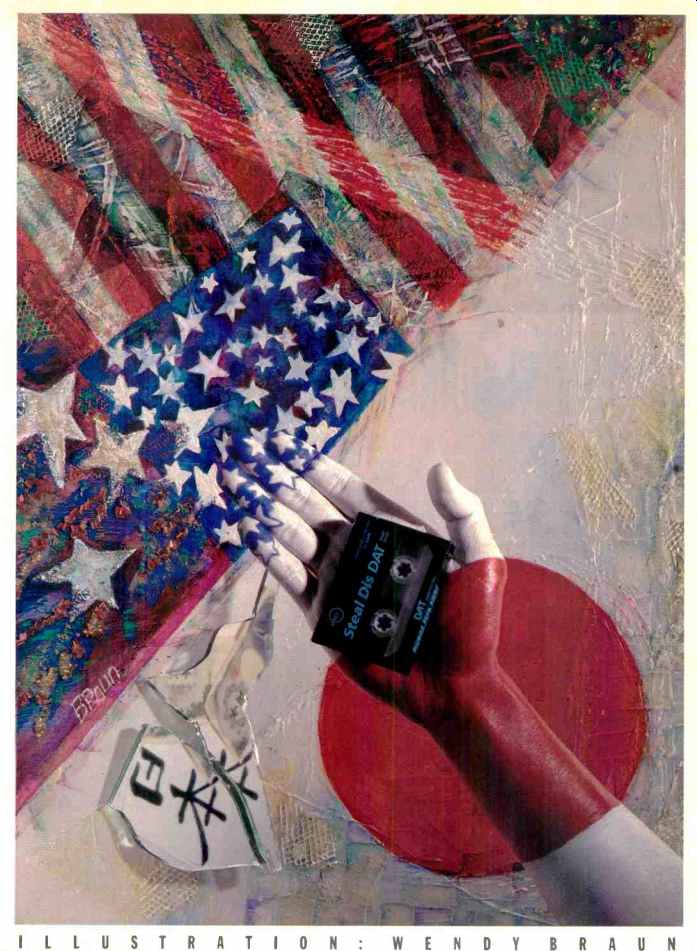
East Asian manufacturers are waiting for the North American market to bring prices down and make Digital Audio Tape a global format. It looks as if their wait-and the world's-will continue, but not indefinitely. Repeated trips to Tokyo's audio ghetto, Akihabara, turned up initial discounts on list prices for recorders that were a little encouraging but not as attractive as they might have been. Keen haggling and some shuttling back and forth between Akihabara and Shinjuku, across town on the other side of the Yamanote National Railway circle, eventually turned up some very good deals. The big, famous stores-LAOX, Yamagiwa, Ishimaru, and others--quoted Sony's second-generation consumer deck, the DTC-500ES, at the official list price of 160,000 yen (about $1,230 or so then) and gave "between you and me" discounts of 130,000 to 140,000 yen. A lot of legwork knocked the price (and the salesmen's good humor) down even further. Finally, I walked out of Yodobashi Camera, in Shinjuku, with my Sony DTC-500ES for 123,000 yen. Similar shoe-leather wear got the first mini portable recorder, the Casio DA-1 (148,000 yen, list) down to 108,000 yen and into my heavy luggage bound for Narita airport. In Hong Kong, bargaining was almost nonexistent in the stores. Their stated price for the DTC-500ES was their final price. With the exchange rate at that time, 7,500 Hong Kong dollars was about $962.
The brands of home and portable recorders on view in Japan included four Sonys, two Kenwoods, Victor (JVC here), Aurex, Pioneer, Aiwa/Excelia, A&D, two Technics/Matsushitas, Alpine/Luxman, Casio, Sharp, and one or two others that were obviously re-labeled versions of the above. A closer look revealed that some of the companies had their own faceplates on innards supplied by a few of the bigger names.
Who was buying? Gaijin, like you and me-especially Germans and Dutch, but also well-heeled Japanese consumers.
Tape made by Maxell, TDK, Sony, Fuji (Axia). That's, DIC (U.S.), Just, BASF, Agfa, 3M (U.S.), Technics, Denon (Nippon Columbia), Audia, JVC, and one Korean maker (whose name eludes me) were around, but Sony, Maxell, and That's had the most visibility on store shelves. I saw DAT blanks (D-46 up to D-120) in many more stores on my October '88 trip than during the preceding winter and spring, and the stock was moving, if slowly.
===============
HOW'S DAT DOING HERE?
Although DAT recorders are neither illegal nor unavailable in the U.S., they aren't on the shelves of most neighborhood audio stores yet. So far, no DAT deck maker has begun imparting recorders for home use, but a few manufacturers do sell their decks (often including home models)
through dealers of professional equipment.
A few enterprising retailers have begun importing machines and tapes directly from Japan, advertising them in Audio and other national magazines. We asked three such dealers (Brian Bielski of Audio Gallery and Jesse Jacobson of The DAT Store, both in Santa Monica, California, and Bob Grindlay, a salesman at American International Audio/Video, in East Windsor, New Jersey) what today's DAT market is like. All three companies sell mostly by mail or phone order, though American International also does direct sales to pros.
The recording industry has been fighting tooth and nail against the introduction of home DAT recorders, but all three dealers agree that recording industry professionals have accounted for most DAT sales. Since the Los Angeles area is full of recording studios, it's no surprise that both Santa Monica dealers told us that the pros make up 90% to 95% of their market.
In Southern New Jersey, where studios are comparatively rare, the market isn't quite the same. "We're seeing a lot of music professionals, both studios and musicians," says Bob Grindlay of American International, "but we're seeing a lot of professionals in general--lawyers, doctors--too. And most particularly, Grateful Dead fans." The hot-selling items vary a bit from store to store. At Audio Gallery, "the Sony DTC-1000ES is moving. Studios prefer them. Also the Technics and Sony portables and Sony's PCM2500 pro unit. There's also a new Technics 18-bit machine," says Brian Bielski. Down the street at The DAT Store, the best-sellers are the Sony DTC-500ES and the new Technics SVD-1100, "because it's an 18-bit machine and definitely sounds better than any previous DAT I've heard," says Jacobson. "One of our partners just got back from the show in Japan, and says companies are coming out with 18-bit machines which will be out in early '89. But until then, the Technics is the state-of-the-art machine." At American International, there are two distinct markets, according to Grindlay. One is the portable market, where "there's no clear favorite between the Sony D-10, the Technics D1, and the Panasonic SZ-250. The Panasonic is a pro unit with XLR inputs. It's a newcomer on the scene, but people are starting to look for it.
The Technics and Panasonic portables have MASH 64-times oversampling input filters and multi-stage noise shaping, so you lose zero cross distortion. They sound warmer," Grindlay explains.
"In home decks, far and away our best-seller is the Sony DTC-500ES," continues Grindlay. "But the 18-bit machines-the Technics SVD-1100 and Panasonic SV-3500-are both starting to pick up more sales now, particularly to professional music people." The dealers disagree as to the state of the car-player market. Brian Bielski says, "I understand car players aren't selling well. Probably when there's more software and prices come down, they'll do better." But Bob Grindlay reports, "We're getting second-generation calls, people who bought machines as long as 14 to 16 months ago and are now calling back to buy car units." Sales of blank tapes are booming at all three stores. That's only logical, since most sales are to pros, who use a lot of tape, and tapes can't be purchased in many other places. American International generally sells anywhere from 10 to 50 blank tapes with each machine, then gets reorders for anywhere from 20 to 100 pieces.
The folks at Audio Gallery say they're not selling many prerecorded tapes but are selling a lot of blank tapes.
The DAT Store's sales figures for blank tapes are just about identical to American International's but their experience with prerecorded tapes is far different from that of their neighbor, Audio Gallery.
"This is a DAT-only store, and we sell a lot of units, blank tapes, fiber-optic cables, test DATs, and all the pre-recordeds we can find. We're on the prowl for prerecorded tape, but as you know, there's a short supply," says Jacobson. "The Enigma releases are selling well--there are so few rock titles available." Jacobson is hoping to get more prerecorded tape from abroad, soon: "I'm sure we'll get a lot of orders when it gets here." Meanwhile, Jacobson reports that The DAT Store is selling "a lot of the more esoteric things, like the Japan Audio Society's Stakkato DAT [actually a reissue of a CD produced by the German magazine Audio] and their Audio Check DAT. They also have some Mozart piano music, recorded at [a sampling rate of] 48 kHz. A lot of the prerecorded tapes are at 44.1 kHz, which to me defeats the purpose. They sound great at 44.1, but they sound better at 48.
"I'm surprised," adds Jacobson, that companies who record New Age and classical music haven't jumped on DAT, considering their demographics. Of the home buyers we have, the titles that lean in those directions are the hottest sellers. Both appeal to a slightly older audience, slightly wealthier. These are people who were brought up buying a lot of records. Now they want something to buy, because they have the money--but not New Wave or heavy metal."
-Ivan Berger
================


Who has the machines? Every studio seems to own several. Even the major labels in the U.S., in some cases, are now using DAT tests of their masters rather than the considerably more costly test runs of CDs. It is a pro tool of enormous convenience and relatively affordable cost, especially now that prices of the pro decks (available everywhere in the world, including the U.S., during most of 1988) are reflecting the effects of competition and volume sales. Sony, for instance, had just dropped the price of their PCM-2500, the double-decker professional DAT recorder, from about
$5,000 to $3,200 as this issue was going to press. (Editor's Note: Look for a review soon, maybe next month.) Audio/ Design, in the U.K., offers modified consumer decks from Sony--the $3,500 Model Pro-DAT-1 and $5,000 Model Pro-DAT-2. Both of these decks record at the pro sampling rate of 44.1 kHz as well as at the con sumer format rate of 48 kHz (which is also the sampling frequency of the Mitsubishi recording/ editing system). The more expensive of the two British pro decks is compatible with the Sony 1630 editing system, thus eliminating the incredibly slow and rather bulky Sony U-Matic from at least some steps in editing and transferring for CD-or for prerecorded DAT. The pros are sufficiently impressed by the better consumer table-tops and portables to put home units from Luxman, Sony, Matsushita, and some other makers into their racks. In a lot of studio and location sessions, PCM-F1NCR systems have quietly ceded their place as "safety" systems to DAT recorders. This makes playback for artists a lot easier: You just tap out the track number you want (if you've re membered to punch address codes into the deck and note them in your session log), and zot, you have the desired take.
One of the signs that home units are now reaching studios in the U.S. as well as overseas is that Allied Broadcast Equipment, in Richmond, Indiana, now offers a Harris DAT recorder (actually an Aiwa consumer unit) together with a popular Otari open-reel studio analog recorder as a $4,349 package. The Harris recorder costs some $2,400, has digital inputs and outputs, and records only at the 48-kHz sampling rate.
But what about prerecorded DAT? It is selling, not just slowly but abominably, in many of the world markets it has entered. The prices for DAT cassettes dubbed in real time are astronomical--in the $28 (if you're lucky) to $35 range here, and from 4,000 to 5,500 yen in Japan. The labels are making quite slim profits, the duplicators are taking a good slice but doing relatively low production runs, and the retailers are nailing down very high per-unit commissions. This is certainly not a good short-term outlook by any means.
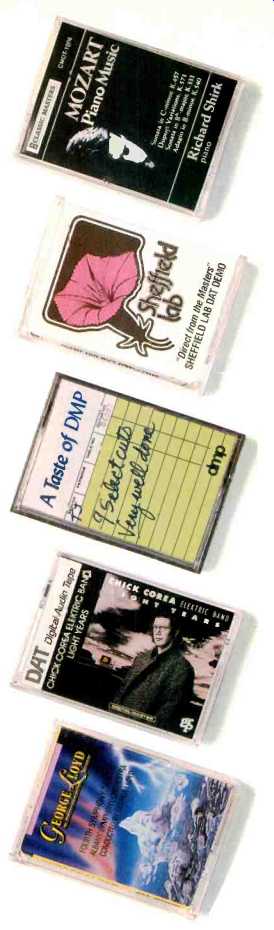
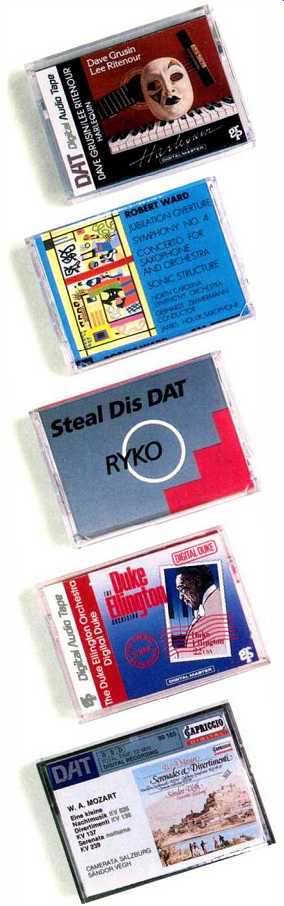
But, and there is a but, an increasing number of labels are announcing the release of DAT albums. Not to bang my own drum, but my label, Classic Masters, sold 500 copies of our first DAT release, a Mozart piano album, to the Japan Audio Society for sale at the Japan Audio Fair (early October) and expanded our release plans from four to seven more albums. Capriccio/Delta, despite soft sales, is beefing up their 50 title catalog with additional releases.
New guys on the scene are Dorian (six titles, all classical), Albany Records (two initial releases of contemporary orchestral music), Rykodisc USA (Steal Dis DAT, a $19.95 sampler that's probably the lowest priced prerecorded DAT cassette available), Sheffield Lab (Direct from the Masters demo), GRP (seven jazz/cinema titles), dmp (a respectable, small, all-digital jazz catalog), JCI (three pop albums from California), Sea Breeze (three band albums), Direct-to Tape (a sizable catalog of classical titles), Simax of Norway (Bach gamba sonatas), Sonata of West Germany (five titles, from Bach organ to Chick Corea), and a few English pop/rock companies.
Ford Motor Co., after making their landmark decision to market DAT players (by Sony) in their Lincoln Continental last June, has gone on to help their customers find software by providing a catalog of what's available. Ford also includes, with each player, DAT samplers from Capriccio, dmp, and Soundwings (a jazz/pop label). The real news in prerecorded DAT, though. is Chandos' release of 50 classical titles in October and November.
Drawn from the most popular of their 400 stunningly recorded albums. these tapes are on sale in the U.K. for 20 pounds and are also moving in the Japanese market. Chandos dupes them in real time on their own DAT or 1630-driven Sony machines. All "pops"? No way. Virtually all of this music is either serious orchestral repertoire, explorative early 20th-century material, or good baroque/classical.
This looks like quite a challenge to Capriccio. and to the rest of the industry.
The tapes available so far are made by real-time duplication, which is expensive but of very high quality-and the only way to make DAT albums at the moment. The high-speed systems from Sony (at least one has been shipped), BASF, 3M, one rumored to be on the drawing boards of a certain large Netherlands conglomerate, and others have not yet been seen to be enough of a presence to change the present staggering retail prices of the albums. Also, the computer industry is consuming just about every ounce of barium ferrite, the magnetic medium used in high-speed DAT duping. Until that demand eases or production of the expensive substance swells, bulk high-speed tape could be too costly or too rare for the marketplace.
The high cost of duplication isn't the only problem. Most of the few stores willing to carry DAT cassettes have been unwilling to sell them without a huge markup. The DADO/Sony plant in Indiana is offering duplication now but saying nothing about the mother company's high-speed duper. The most informative and active of all the duplicators has been Loran, in Warren. Pennsylvania. They have kept abreast of the world DAT situation and been quite generous with information contacts, and materials for professionals and writers in the field. They did the Ford tapes and have associations with many of the labels listed above, but acknowledge the present stillness in the marketplace. Kate Campana of Loran was quietly optimistic about the 1989 albums the company is lining up with their clients.
So whither DAT in the short term? As even Billboard, the vocal, visible weekly of the U.S. record and video industry, has predicted-and, in the case of a few guest editorials, urged-the DAT logjam may be handled best by a marketplace trial of the new format. Since the ignominious death of CBS Copy-Code (it did not perform as claimed), conflicting copy-guarding systems proposed else where have found only confused resonance in the industry. Further, the U.K.'s Parliament rather tidily trounced a royalty which was to have been collected from blank-tape taxes. So the situation remains frustratingly at an impasse. The rest of the world can buy and record DAT. It is not illegal here-and everyone's finally admitting that the format itself not only poses no danger to the CD format but probably is a supportive complement-but the stalling goes on.
The big labels will eventually have to coexist with a consumer digital recording system, whether it be DAT, bubble memory, or optical disc. So why not embrace the inevitable and reap the benefits now? The hardware manufacturers. mostly in Japan. will not bring in recorders (playback car decks are around, of course) until the RIAA's threat of a lawsuit over copyright infringement is somehow removed or resolved worldwide. There we languish, for now.
But. one is tempted to dream: What if someone does say the hell with it and introduce recorders in the U.S.? No one in Japan appears to have the bravado to test the legal and marketing waters at this point. What if some bold, perhaps brash, board in a company based in that waking electronics giant, Korea, were to beat everybody to the punch and challenge the stalemate head on? Well, I'm not making any predictions. because there's too little to go on. and the latest rounds of talks between the two industries remain secret.
But even if DAT is a tempest in a teapot, when viewed in dollar potent al and compared with the CD or video markets, it is highly visible. The company that successfully negotiates safe passage round and through the complex issues surrounding DAT will get a lot of attention. Do you wonder who it will be? We all do.
===============
PRERECORDED DAT LABELS
Albany Records Classical Music, Inc.
P.O. Box 355
Albany, N.Y. 12201
Capriccio/Delta Music
2008 Cotner Ave., Suite 2
Los Angeles, Cal. 90025
Chandos Records Koch Import Service
111 Hicks St., 25-C
Brooklyn, N.Y. 11201
Classic Masters
41 Fourth Place
Brooklyn, N.Y. 11231
Direct-to-Tape
14 Station Ave.
Haddon Heights, N.J. 08035
dmp (digital music products)
Box 15835, Park Square Station
Stamford, Conn. 06901
Dorian Recordings
17 State St., Suite 2E
Troy, N.Y. 12180
Enigma Records 11264 Playa Court
Culver City, Cal. 90231
GRP Records 555 West 57th St.
New York, N.Y. 10019
JCI Records 5308 Derry Ave., Suite P
Agoura Hills, Cal. 91301
Rykodisc USA
Pickering Wharf Building C-3G
Salem, Mass. 01970
Sea Breeze
P.O. Box 11267
Glendale, Cal. 91206
Sheffield Lab
P.O. Box 5332
Santa Barbara, Cal. 93150
Simax Qualiton Imports
24-02 40th Ave.
Long Island City, N.Y. 11101
Sonata Music Distributor
Rahlau 4-6 2000 Hamburg 70
West Germany
===============
(adapted from Audio magazine, Jan. 1989)
Also see:
The March of Technology: Analog Tape Home Recording (May 1997)
Celebration of Audio's Earliest Years
Hi-Fi Sound on Hi-Fi VCRs (Sept 1988)
Enduring Instruments--Treasures from The Yale Collection (Feb. 1989)
= = = =