REFINED
RECORDER
Vivaldi Recorder Concertos. Peter Holtslag; The Parley of Instruments.
Hyperion CDA 66328, CD; 59:59.
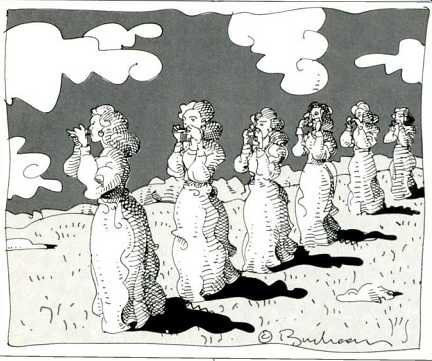
Vivaldi is still everywhere these days, though his aristocratic nose is mildly bent by that later rival, Mozart. If you are still with Vivaldi, here is a fine chance to get closer to his enormous output of practical music, largely composed to show off the extraordinary prowess of the female orphans he taught at the Pieta, a remarkable place where these ladies were trained for life in the highest circles.
You must understand that the baroque-period concerto was first of all a contrast between a solo virtuoso, or solo group, and something larger-often hardly any larger at all. There is no "orchestra" here, just individual instruments, but you will be aware of the familiar concerto sound, soloistic passages set off by intervening "tutti"even without an orchestra. Via recording, you can make the music as loud as you wish, and these performances are satisfyingly full bodied.
Three of the works are for sopranino recorder, an astonishing tiny instrument. Two dogs' ages ago, I bought one for myself to supplement a much bigger alto instrument. It was slightly larger than a fat pencil; my fingers were too wide to fit over the tiny finger holes, so I could barely play the simplest tunes. One day it flew out of my shirt pocket, it was so portable, and that was that. If I were not familiar with this music, I would gasp at these sopranino concerti. Remember the piccolo in Sousa marches? It's that kind of music but nonstop, the most astonishing virtuoso stuff you'll ever hear. Yet obviously it was played in Vivaldi's time; it is played again now, better and better, on exactly the same little instrument, so many holes in a piece of wood. Unbelievable.
The other concertos feature a larger recorder, the treble, which is better known in the U.S. as the soprano in C. Lovely stuff, this too, the recorder matched to two violins, pleasantly steely in sound (are they the older baroque configuration?) and a varied continuo, organ or harpsichord, properly subdued in the background. One concerto in particular, the next to last on the disc, is suddenly more powerful, definitely beyond the others and evidence of Vivaldi's reserve power-it may remind you of the pastoral music in Beethoven's Sixth Symphony in the same key of F. Good recording! Edward Tatnall Canby Penderecki: Symphony No. 2; Bruzdowicz: Concerto for Double Bass and Concerto for Violin. Polish Radio National Symphony Orchestra, Jacek Kasprzyk. Arthur Rubinstein State Philharmonic Orchestra of Lodz, Andrzej Markowski; Fernando Grillo, double bass; and Krzysztof Jakowicz, violin. Olympia OCD-329, CD; 67:19.
This is a bit of a grab bag. Krzysztof Penderecki's Second Symphony, called the "Christmas" Symphony, was commissioned by Zubin Mehta for the New York Philharmonic and composed during 1979 and 1980. The reference to Christmas is occasioned by quotations of "Silent Night," but the general texture is quite un-Christmasy, being dense and even rather morose, with heavy reliance on oppressive brass harmonies.
The program notes refer to it as a one-movement work to which the composer has said he plans to add. The recording, made in Katowice in 1981 (that is, only about a year after the first New York performance), is divided into two movements with a more than minimal pause between them. I'm at a loss to explain the disparity.
The scoring is vivid, as you can expect from Penderecki. The orchestra, which is efficient and altogether professional, has no special luster to bring to the score, however. The recording itself is similarly no more than competent. All in all, it is an effort that is worth acquiring for Penderecki's sake, though it will win no orchestral or recording awards.
The two concertos of Joanna Bruzdowicz, recorded in 1984 and presumably in Lodz, are an entirely different matter. A Pole who studied in France and married a Belgian, she founded and directs the Frederic Chopin and Karol Szymanowski Society in Belgium (which, perhaps not coincidentally, also happens to be home for Pavane Records, co-producer of this release). Her music demonstrates the influence of her teacher, Nadia Boulanger, but it is sufficiently witty and creative to avoid any suggestion of being derivative.
The beautifully recorded Concerto for Double Bass (1982) is quite exciting, in fact. Granted, a solo double bass generally sounds like a dancing elephant-particularly when it tries not to do so. That is, the daintier it attempts to sound, the more preposterous it becomes. But Bruzdowicz revels in its very bulk and ungainliness; in consequence, the piece works. The very close miking of the solo instrument, picking up every nuance of the articulation, adds to the sonic intensity.
The Violin Concerto, written six years earlier, is more rhapsodic and, partly because the solo instrument is more conventional, less striking. The solo instrument is perhaps too closely miked in this case; it sounds rather oversize and slightly harsh. But the writing is no less intense than that of the other concerto, and both are rewarding.
-Robert Long

Duo Vivo. Works by Rodney Rogers, William Bolcom, Paul Cooper, Arthur Gottschalk, and Steven Galante. Laura Hunter, alto sax; Brian Connelly, Yamaha Pf/DX7 synthesizer. Crystal CD-651, CD; 67:29.
I got to listen to about half of this lively duo's offerings, enough to find that Laura Hunter is a splendid artist on her unexpected ("classical") instrument, and Brian Connelly a closely sympathetic accompanist. Unfortunately, when number 8, the second of four impromptus by Paul Cooper, flashed up on my player's display, things began to go awry-Cooper for a moment seemed terribly repetitive, as I listened some distance from the player. He was indeed-the same spiral of pits, over and over, while the numbers jumped crazily. I tried all the usual remedies, taking the disc out and replacing it carefully and with a half turn, all to no avail. My player would go no further. It happens-this machine is informative if only because, being a few years old, it perhaps is more sensitive to disc faults than some newer players.
Useful for a reviewer! So I heard the Rodney Rogers "Nature of the Working Wheel" and William Bolcom's "Lilith," in five short movements. The Yamaha DX7 synthesizer. alas, remained silent, in the unplayable port on.
Crystal Records' Peter Christ (rhymes with gist) is well known for excellent programming, in the choice of instruments and artists, and especial y in the actual performance order that we hear. This is an interesting close-up view of the familiar sax in its not-so-well-known classical and contemporary vein. Quite something! This is a very versatile instrument, in case you think its Hain personality is 1930 big-band sound. Never forget that the saxophone was invented strictly for "classical" purposes. Monsieur Jesús López-Cobos Adolphe Sax was the Frenchman responsible, quite some years before big band and jazz! Is it wise to begin with a less-than-exciting work? Maybe, if you are going to include it in your program. The piece about the wheel is full of symbolism, but the music, 16 minutes or so, is one of those all-too-derivative works, skillfully written, covering an old-fashioned idiom with splashes of dissonance, suggesting now this earlier composer, now another, and always (to my ear) with the thought that the original was a lot more persuasive. The novelty of the sax was very present, to carry forward your interest. William Bolcom, an older contemporary and somewhat of a curmudgeon, was more fun. He is on the acid side and not lovely, but your attention is immediately grabbed. A good man, if cantankerous.
That's as far as I got. I regret Mr. Cooper's repetitious grooves, and Messrs. Gottschalk and Galante remained mum. Maybe it was just my individual pressing.
-Edward Tatnall Canby
Bruckner: Symphony No. 7. Cincinnati Symphony Orchestra, Jesús López-Cobos. Telarc CD-80188, CD; DDD; 66:40.
At first glance, this recording may seem somewhat incongruous-the new conductor of the Cincinnati Symphony Orchestra, Spanish-born Jesús López-Cobos, performing the music of Bruckner. One expects a conductor with a Spanish background to be especially empathic to the music of countrymen Falla and Albéniz, and indeed, Telarc has recorded López-Cobos in a splendid performance of Falla's ballet The Three-Cornered Hat. However, it turns out that López-Cobos has made a specialty of the music of Bruckner.
In this recording of the composer's Seventh Symphony, he provides a performance in the best grand Mittel European tradition. Against such Bruckner stalwarts as the late Herbert von Karajan, López-Cobos makes a profound musical statement. His performance has nobility and majesty, as exemplified in the great second movement.
The scherzo is dynamic and propulsive. The finale is at a tempo consistent with Bruckner's admonition, "doch nicht schnell" (not too fast), and the music progresses to grandiose climaxes with massive brass chords.
No question, this is a most compelling read, but it also has the considerable advantage of some of Telarc's most resplendent sonics. The disc was recorded in Cincinnati's Music Hall, and its sound combines tremendous weight and thrust with great clarity and detail, as well as very wide, expressive dynamics. One can hear, especially in the scherzo, great outpourings from the trumpets, trombones, and tuba on the right; the same phrase is then answered by huge French horn chords on the left. A moment later, there are timpani figures played at barely audible pianissimo levels, with the timbre of the drum heads still perceptible. All in all, this Bruckner Seventh Symphony is a triumph-glorious sound and an uplifting musical experience.
-Bert Whyte
Debussy: La Boite a Joujoux; Ravel: Ma Mere l'Oye. Ulster Orchestra, Yan Pascal Tortelier. Chandos 8711, CD; DDD; 57:09.
Both the rarely played "Toybox" of Debussy and the more familiar "Mother Goose" ballet of Ravel are prime examples of extravagant orchestral color.
The string writing, exotic percussion, and above all, the intricate interplay of the woodwinds and variations in dynamic expression require playing of very high order. Any recording of this music must provide a very clean, open, and highly detailed sound.
The Ulster Orchestra, now under the baton of Yan Tortelier, exceeds the demands of the music, and Chandos has produced a superbly balanced recording in the richly resonant acoustics of Ulster Hall in Belfast.
There are quite a few CD recordings of the "Mother Goose" ballet with prestigious orchestras and conductors, but Tortelier wins the day with his light, deft touch and exemplary execution from his players. This Chandos recording is a model of high orchestral definition coupled with transparency and acoustic warmth.
-Bert Whyte
Carl Philipp Emanuel Bach: Musikbeispiele. Assorted German performing groups. Capriccio 10-999, CD sampler; DOD; 25:00.
Longtime record collectors remember the LP sampler, a sales device that became possible when the LP first appeared-the 78 being much too short, in itself no more than a sample. With CD, the breed is returning in improved form. This one is astonishing, simply in that it samples a series which contains an enormous batch of CDs covering a considerable part of the even more enormous output of this middle Bach son, the most gifted and learned next to the old man himself. A generation ago, C. P. E. Bach was mostly a name in the history books, though he was a profound influence in his time and later. A few pieces in student books, a movement or two, and that was it.
Yet now comes this series of 14 well filled CDs, every last note by C. P. E. Bach. Judging by the samples here, every CD is worthy of your attention, if you enjoy a kind of introspective cross between "old Bach" (the Bach) and Mozart, who learned much from Carl Philipp Emanuel and his younger brother in London, Johann Christian.
You'll hear the "Mozart" all right--though that genius was a child when much of this music was composed.
You'll also hear gratifying echoes of the baroque and the earlier Bach, the son after the father.
This sampler gives one complete movement-unaltered-from each of eight items: Concerti, symphonies, choral music, a flute sonata. And there's plenty more where this came from; the volumes are all available separately.
-Edward Tatnall Canby
(Audio magazine, Jul. 1990)
More music articles and reviews from AUDIO magazine.
Also see:
= = = =