MANUFACTURER'S SPECIFICATIONS:
CK 1 Microphone Capsule Type: Pressure Gradient.
Frequency Range: 20-20,000 Hz.
Directional Characteristic: Frequency-independent cardioid.
Sensitivity at 1000 Hz: 0.95 mV per microbar; 0.95 mV/Pa;-41 dBV/Pa;-38 dBm.
Unweighted Noise Level: 3.6 microvolts eff.,-107 dBm.
Weighted Noise Level: 2.2 microvolts eff.,-111 dBm, filter CCITT-c/DIN 45405.
Equivalent Noise Level: 21 dB. Capsule Capacity: 27 pF. Weight: 20g; gross weight, 60g.
Temperature Range: -20°C (-4°F) to +60°C (140° F). Humidity: 99 percent at 20°C (68° F), 95 percent at 60°C (140°F).
Dimensions: 18mm diameter x 26.3 mm long.
The above measured with an AKG standard measuring preamplifier with following data: no-load amplification, 0.47; input capacitance, 12 pF; polarization voltage, 62 V. C451E Preamplifier Type: FET preamplifier.
Frequency Range: 5-30,000 Hz.
No-load Amplification: 0.47 ±0.5 dB. Source Impedance (20-20,000 Hz): <_ 200 ohms.
Supply Voltage: 9 to 52 d.c. Sensitivity is proportionally reduced from 7.5 to 9 V.
Noise Level: see CK1 data.
Current Consumption: < 5.5 mA (DIN 45-596).
Sensitivity to Magnetic Stray Field: At 50 Hz, 5 microvolts/50 milligauss (-138 dBm, 1 milligauss); at 100 Hz, 8 microvolts/50 milligauss; at 1000 Hz, 80 microvolts/50 milligauss.
Load Impedance:-500 ohms.
Harmonic Distortion at 1000 Hz (UE= 200 mV): 0.5 percent.
Weight: 74g, Gross Weight, 370g.
Temperature Range:-20°C to +60°C (-4°to 140°F).
Humidity: 99 percent at 20°C (68° F), 95 percent at 60°C (140°F).
Dimensions: 18 mm diameter x 120 mm long.
Connector: XLR-3 pin male.
(dBm) values computed for 150 ohm impedance.
Prices: C451E combination, $229.00; complete with CK1 microphone capsule, C451E preamplifier, W3 foam windscreen, and SA15/1 stand adapter.
Optional Accessories
B46E battery supply unit (9V), $75.00; MCH-20 extension cable, XLR plugs, $13.00; H60 elastic suspension, $18.00, and H15 elastic suspension, $37.00.
-- --- ---
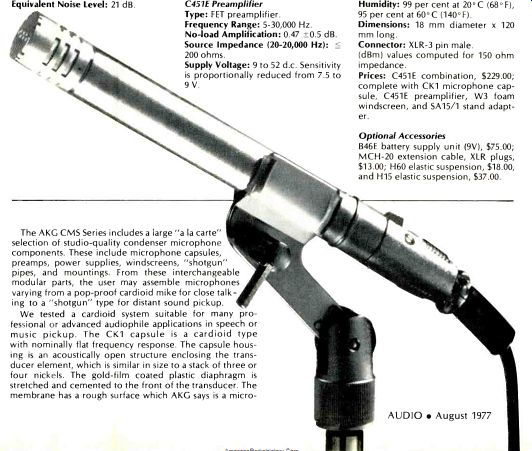
The AKG CMS Series includes a large "a la carte" selection of studio-quality condenser microphone components. These include microphone capsules, preamps, power supplies, windscreens, "shotgun" pipes, and mountings. From these interchangeable modular parts, the user may assemble microphones varying from a pop-proof cardioid mike for close talking to a "shotgun" type for distant sound pickup.
We tested a cardioid system suitable for many professional or advanced audiophile applications in speech or music pickup. The CK1 capsule is a cardioid type with nominally flat frequency response. The capsule housing is an acoustically open structure enclosing the transducer element, which is similar in size to a stack of three or four nickels. The gold-film coated plastic diaphragm is stretched and cemented to the front of the transducer. The membrane has a rough surface which AKG says is a microembossed pattern which controls tension. Apparently this is similar to the embossed corrugations in a ribbon which serve to increase compliance and stabilize the tuning. The exterior of the transducer is coated with an organic finish which probably keeps out moisture. The rear sound port is a sintered metal disc about 1/4-inch in diameter. This disc is made to pass sound and barometric pressure, but retard moisture.
The CK-1 is advertised as stable with temperature and humidity, and we can believe this after examining the transducer. We are not equally well impressed with the electrical contact arrangement, which reminds us of a carbon microphone. The "hot" center contact is via a gold-plated spring which may have a resonance at some audible frequency.
This spring also presses the gold-coated diaphragm against the case, forming the ground connection.
The C451E preamplifier is a FET-input discrete component circuit. A balanced low impedance output is provided by a transformer. The C451E "handle" also includes an integral 62-volt power supply for polarizing the capsule. A standard two-wire shielded microphone cable carries audio away from, and brings d.c. power to, the preamp. A so-called "phantom" power circuit is used. The audio signal is balanced to ground, but the d.c. is an unbalanced "common mode signal." D.C. power, for our test, was obtained from the B46E battery supply. This contains an audio transformer with the primary center tap connected to the positive terminal of the 9-volt battery. The user may be able to provide power from the recorder or mixer and save on the cost of this accessory.
The "phantom" power arrangement is obviously compatible with either dynamic or ribbon microphones. In other words, the "common-mode" d.c. will have no effect if an electrodynamic mike is plugged into the condenser input.
However, if you make a wiring error, the ribbon or voice coil could be destroyed. The output of the B46E is a balanced, low impedance line with no d.c. on it.
The application of the other accessories is obvious, but the cable deserves mention. AKG has engineered their own high quality microphone cable with long flex-life conductors and an especially tough plastic jacket. These cables are available in four colors which is a boon to multi-mike setups.
Packaged along with the microphone capsule was a frequency response graph, which showed the CK1 capsule to be +3-6 dB from 40 Hz to 15 kHz. Enclosed with the hardware was a data sheet on the preamp alone and a two-page pictorial showing the CMS line. We received separately a batch of microphone applications information intended for audiophiles and musicians, emphasizing the AKG dynamics, but not describing how the CMS studio condensers might be used in these applications. We were not supplied the usual explicit instructions (connect jack "A" and socket "B") which accompany most domestic microphones. (Editor's Note: We understand that AKG has a new owner's manual in progress, but was not able to complete it in time to supply one for the review.)
Laboratory Tests
The impedance curve (Fig. 1) shows that the impedance is not 200 ohms or less from 20 to 20,000 Hz, as specified, though it is within spec from 25 Hz to 8 kHz. We suspect that the transformer in the battery pack may be responsible, but AKG does not specify what effect this transformer may have.
The rise at 20,000 Hz is due to the leakage inductance of pre amp and battery pack transformers. It had no effect on frequency response when the mike was tested with a broadcast preamp. We recommend a load of not less than 1000 ohms, corresponding to a high-quality 150-ohm "unloaded" input.
The rise at 20 Hz is caused by the output coupling condenser in the preamp. This may indicate an undersized capacitor which could cause some loss in low frequency response if load impedance is not high enough.
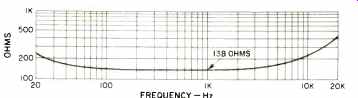
Fig. 1-Impedance of the AKG C-451E microphone.
The frequency response (Fig. 2) shows a smooth and slightly rising response. From 500 to 20,000 Hz, the AKG is somewhat flatter and smoother than our RCA BK-5B reference microphone. Above 500 Hz, our curve agrees precisely with the calibration curve supplied with the microphone.
Below 500 Hz, it is flat at 12 inches, but with a pronounced rolloff for plane waves or sources greater than 3 feet away.
The AKG may be preferred for high fidelity reproduction of treble instruments, voice, or the close miking of bass instruments, but it's my opinion that it will not be as good as the BK-5B ribbon mike for distant miking of symphony orchestras, as mentioned later. The AKG curve shows the response of the capsule only, which is down 6 dB at 50 Hz. Apparently, the preamp and battery box account for an additional 2 dB loss at 50 Hz, which might be reduced with alternative powering arrangements. (Editor's Note: AKG confirms that statement.)
The low frequency response of the AKG is similar to the V1 (voice) response of the BK-5B. This is an excellent characteristic for distant speech pickup as it suppresses low frequency room noise. The AKG should be good for pickup of stage plays or opera.
The sensitivity of the AKG is more than 10 dB higher than the BK-5B or other electrodynamic microphones. For most applications, we recommend a 10-dB attenuator at the input of the mixer or recorder. AKG sells attenuators for use between capsule and preamp for use with high sound levels, though with normal sound levels these will degrade signal-to-noise ratio. We found the CK1/C451E will not clip on peaks up to 130 dB, so there is little need for the capsule attenuators-unless you are recording jet aircraft. In-line attenuators are available for low impedance microphones from several manufacturers. Take care that an attenuator does not interfere with d.c. powering.
The directional characteristics (Fig. 3) show a cardioid unidirectional pattern that is extremely uniform with frequency. It is superior in this respect to almost any mike we've tested. This means that undesired sounds of all frequencies will be uniformly rejected, and the sound of distant sources in reverberant rooms will be most accurately reproduced.
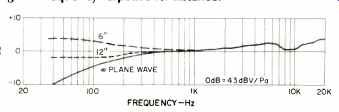
Fig. 2-Frequency response vs. distance.
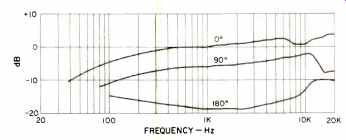
Fig. 3-Frequency response vs. angle.
While tapping the AKG microphone, we noticed a bell like ringing sound that decayed slowly. We made a one-third-octave band spectrum analysis of the vibration noise of the AKG compared to the BK-5B (Fig. 5). Some of the higher noise of the AKG can be attributed to the higher mass of the condenser diaphragm as compared to the ribbon. The 630-Hz resonance is far more annoying than it seems on the graph, and we suspect it may be related to the contact spring. The 630-Hz resonance could also be related to the acoustical resonance of the preamp case's air space.
The vibration sensitivity of the AKG is not significantly reduced by the H60 shock-mount. We did not try the H15 mount which looks like a better design. If you have a vibration problem that the H15 doesn't solve, try adding some mass to the microphone.
The H60 shock-mount which we tested is a small shock-mount, intended for use with a floor or desk stand. It is very compliant in a direction parallel to the microphone axis, but very stiff in the perpendicular direction. The H15 mount is a larger one which could be used on a mike boom or stand, and it will probably have reasonably equal compliance in all directions. As with all low-mass mikes, the AKG is difficult to isolate and a very compliant mount is required.
Another indispensable item is the windscreen, which is supplied as part of the C451E "combo" package. The wind and "pop" sensitivity of the CK1 is very high. The integral capsule grille is formed by one piece of wire mesh which is both too open and too close to the diaphragm to offer much protection. We found that the foam windscreen offers excellent protection, virtually eliminating wind and "pop" noise. It would be a good idea to use this screen for all applications, but what effect does this use have on performance? We tested frequency response for each cardinal direction: 0°, 90°, 180°, both with and without the screen. The effect of the screen was minor, but easily measured with this high quality microphone. Only the 0° response (Fig. 4) is shown, for clarity. Significant but not objectionable changes were noted in the 90° and 180° responses. High frequency response is slightly reduced because the screen acts as a resistance in series with the acoustically capacitive diaphragm. If this were a pressure (omnidirectional) microphone, no change in low frequency response would be observed. The bass response of the AKG is improved because the screen covers the side sound entrances. You may imagine that less sound reaches the rear of the diaphragm, and since it responds to the pressure gradient (difference between front and rear pressure), the net pressure acting on the diaphragm increases. The screen has a net flattening effect on response, and we recommend it be used at all times. AKG offers an attractive metal screen with foam lining that is more durable. The frequency response must suffer a little from acoustic reflections off the metal screen, so the plain foam screen performs best.
The phasing test with the EMT Polarity Tester revealed that the red wire of the output cable from the battery box is positive with positive sound pressure. Before you conclude that this fully agrees with EIA standards, read RS-221 paragraph 3.3 again: "...in phase terminal shall be the red (or other than black) conductor, the out-of-phase terminal shall be the black conductor." Since the cable does not contain a black conductor, the AKG system does not conform to standards. We recommend that AKG follow EIA RS-215 which calls for red and black conductors in broadcast microphone cables. (Editor's Note: The B-46E power supply is now being supplied, says AKG, complete with a standard XLR-type connector mounted on the output cable. Both the microphone and the power supply are phased [poled] "pin 2 high," i.e. positive acoustic pressure on the microphone's diaphragm will result in a positive voltage on pin 2 with reference to pin 3. This follows IEC standard 268-12 and IEC 268-4.) We found the MCH-20 extension cables to be of excellent quality. The Swiss-made three-pin connectors are inferior to either the Cannon XLR or Switchcraft A3 type connectors.
The strain reliefs are a positive sort, in that they continue to tighten as force is applied. The ones on the set supplies needed additional tightening, as they were a bit loose when received, and the cable could be twisted inside the relief.
The female connector did not mate easily with the plug on the microphone. (Editor's Note: These connectors were from the initial production run, and several design changes will be implemented in the final product available by the end of this year. AKG says that their original design intent was to provide a connector with a compliant insert which would be compressed during mating to prevent rattling during use.)
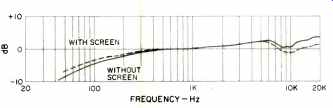
Fig. 4--Effect of foam windscreen on the AKG C-451E Microphone.
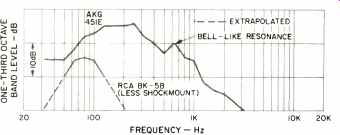
Fig. 5-Analysis of tapping noise (see they are now changing the adapters to a less rigid material text for discussion).
Subjective and Listening Tests
We recall from the classic theoretical studies that a condenser microphone with less than approximately 150 volts, polarization could be too noisy. The AKG uses 62 volts, but was quiet enough that we could not measure the noise without replacing the microphone with a capacitor. Subjectively, it seems quiet enough for most applications, but if you intend to use it for extremely low sound levels, we suggest you check the noise level first.
As previously indicated, the preamp has quite a high output capability and did not clip or distort with any sound we could generate, up to about 130 dB. The very low magnetic hum sensitivity rating was difficult to believe, what with the unshielded transformer in the preamplifier. We found the hum to be less than our BK-5B reference microphone so we believe the specification is correct. The CK1/C45IE is extremely impervious to magnetic fields. AKG transformers utilize D-U laminations and two separate coils, which is a hum-bucking design.
The mid range and high frequency sound is extremely clear and transparent, and perhaps just a little cleaner than our BK-5B. The bass response sounds a little thin compared to the BK-5B for sound sources such as a bass viol in an orchestra where just two microphones are used at a great distance. For close miking and most "pop" music, the AKG is just about the best microphone we've heard. But for classical recordings, the BK-5B or 77-DX ribbon microphones remain our favorites, as the small orchestras we record are always weak on bass.
The quality and durability of the AKG products is excellent. Most parts are abrasive blasted and nickel plated, o resulting in a very tough finish. Biomechanics are good, save for the stand adapter. It is very difficult to slide the microphone into the plastic clamp because neither microphone 20 nor clamp have chamfered edges. These remarks apply to the clamps on the SA15/1 and H60. (Editor's Note: AKG says it isfor an easier fit.)
Our conclusions from the tests: As an ex-designer of ribbons, I have to admit a built-in bias against batteries and power supplies and-in fairness-point out that this system would normally be phantom powered in the studio, though again this is another subsystem which at least potentially can break down. Be that as it may, for the devotees of "condenser sound," we can state that the AKG CK1/C451E is one of the best condensers we have tested and certainly not the most expensive. We can enthusiastically recommend the AKG to anyone wanting a condenser microphone.
-Jon Sank
(Source: Audio magazine)
Also see:
Beyerdynamic Model M500N (C) Microphone (Feb. 1978)
Audio-Technica AT813 Microphone (Sept. 1982)
Brüel & Kjaer Type 4003 and Type 4007 Studio Condenser Microphones (Nov. 1984)
Brüel & Kjaer 4011 Studio Microphone (Jan. 1990)
Crown PZM-180 Pressure Zone Microphone (March 1985)
Crown PZM-30GP Pressure Zone Microphone (March 1983)
Nakamichi Model CM-700 Electret Condenser Microphone Systems (Sept. 1978)
Neumann Models 83, 84, & 85 fet-80 Series Microphone System (Jan. 1978)
Realistic 33-1080 Back-Electret Condenser Microphone (July 1983)
Sennheiser MKH 40 Microphone (Jan. 1988)
Shure Model 516EQ Microphone (Apr. 1977)
Shure SM-81 Unidirectional Condenser Microphone (Aug. 1980)
Shure SM85 Unidirectional Condenser Microphone (May 1982)
Shure SM91 Microphone (Jun. 1986)
Sony Model ECM-56F Electret Condenser Microphone (Jan. 1979)
Speiden SF-12 Stereo Microphone (Mar. 1987)
Microphones Vital Link in the Recording Chain--Part 2 (Jul. 1974)
A Microphone Primer: Basic Construction, Performance, and Applications (Dec. 1972)
A Microphone Primer: Conclusion (Feb. 1973)
Mike Technique and Sound Effects (Dec. 1974)
Recording in 2 and 4 Channels (Dec. 1973)
Electro-Voice microphones (Jan. 1973)
AKG K340 Earphones (Nov. 1992)
= = = =