Manufacturer's Specifications:
S/N Ratio: Greater than 100 dB. Input Impedance: 100 kilohms, constant.
Damping Factor: Greater than 800, 20 Hz to 20 kHz.
IM Distortion: Less than 0.1%.
THD: Less than 0.1%.
TIM Distortion: Unmeasurable below clipping.
Power Output: 120 watts/channel into 8 ohms, 200 watts/channel into 4 ohms.
Load Impedance: 2.0 ohms to infinity with music signal.
Signal Phase: Non -inverting.
Peak Output Current: 50 amperes.
Rise Time: 2.5 µS. Fall Time: 2.5 µS. Input Sensitivity: 1.3 V rms for full output.
Class: AB. Full Power Bandwidth: D.c. to 200 kHz.
Dimensions: 19 in. W x 5 in. H x 10 in. D (48.3 cm x 12.7 cm x 25.4 cm).
Weight: Approx. 30 lbs. (13.6 kg). Price: $850.
Company Address: 2521 Daytona Ave., Lake Havasu City, Ariz. 86403.
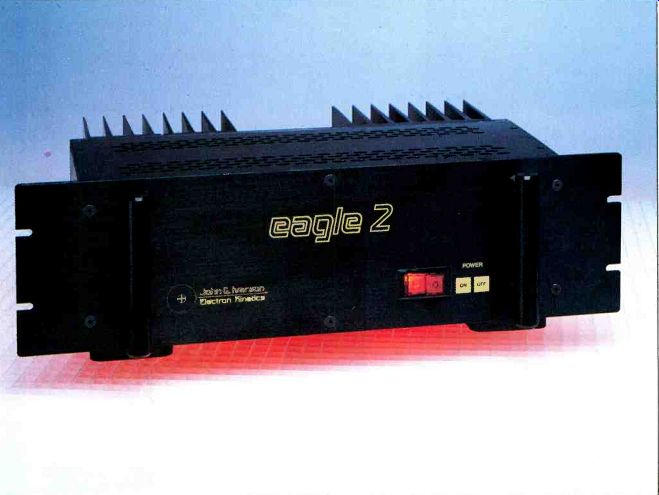
The Eagle 2 is John Iverson's newest power amplifier and is designed to give the listening public a sample of his latest thinking on amplifiers, plus some good old American construction, at a reasonable price.
John had a revelation after his recent updating of the bigger Eagle 7A. This concerned how to predict amplifier performance as a function of circuit topology, types of devices used, and operating points of the devices. (He does not say whether he means audible or only measurable performance.) John chose a simple common topology and made a breadboard to test his theories. Apparently they worked, and the result is the Eagle 2.
John also has said that he wants to make an amplifier with two to four controls on it, which the listener could use to get the sound he wants. These controls wouldn't affect things like frequency response, but might alter phase response independent of amplitude response, operating points of devices, etc. I give him every encouragement as I believe this can be done and would be an ultimate service to the listener.
What we have here is a dual, 120 -watt (into 8 ohms), Class -AB design with an enormous power supply and simple yet elegant construction. A U-shaped chassis forms the bottom and sides. On the bottom of this main chassis are a large power transformer, two 80,000-µF, 50-V filter capacitors, and a 25 -ampere rectifier bridge. The front panel has a single, illuminated, two -button power switch. Actual amplifier circuitry is all mounted on the inside of the rear panel, on a heavy, mil -spec, double -sided glass p.c. board. Input and output connectors terminate directly on the p.c. board without any discrete wiring. The board is designed for the shortest possible signal paths from input to output. Also mounted on the inside of the rear panel are four large Sanken output transistors, plus two TO-220 pre-driver and two TO-220 driver transistors for each channel. The filter capacitors are wired to the p.c. board via relatively short pieces of Monster Cable.
On the outside of the rear panel are two large heat sinks, two signal-input phone connectors, two sets of five-way binding posts for speaker connections, a line-cord socket, and a line fuse. A perforated top cover forms the last side of the enclosure. Parts and construction quality in this unit are first rate.
Circuit Description I wasn't given a schematic of the Eagle 2, but discussion with Iverson and some tracing on my part reveals the following topology: An LM351 Bi-FET op -amp serves as the input amplifier. The output of this op -amp is coupled to a pair of complementary bipolar pre -driver transistors operating as common -emitter amplifiers. The actual coupling is shown in Fig 1. The collectors of the pre -drivers are connected together through a bias regulator and into the bases of the driver transistors, which are complementary bipolar devices operated as emitter followers. The emitters of the driver stage are coupled to the bases of the two pairs of complementary output transistors, which are also operated as emitter followers. The discrete part of this circuit is phase inverting, and some negative feedback is applied from the output to the bases of the pre -drivers. An overall feedback loop is taken back to the input of the LM351. This design is totally d.c. coupled, with the result that the d.c. gain is the same as the a.c. signal gain. The topology just described is very similar to that of some early Marantz and BGW solid-state power amps.
Measurements Before we get into the measurements, a word is in order about the Eagle 2's power rating. Its spec sheet doesn't give the standard EIA/IHF rating stating how much power it will deliver, with both channels driven into what load impedance, over what frequency band, at how much distortion. Its rating is simply 120 watts/channel into 8 ohms, 200 watts/ channel into 4 ohms. It turns out that the unit clips at 110 watts/channel with both channels driven into an 8 -ohm resistive load, and at 200 watts/channel into 4 ohms, for an a.c. line voltage of 120 V. When I called to ask Electron Kinetics about this, they replied that the amplifier would put out at least its rated power into real -world speaker loads with nominal rated impedance of 8 and 4 ohms.
The Eagle 2 was first run at one-third power, or 40 watts/ channel, into 8 -ohm loads, with a test frequency of 1 kHz.
The heat sinks got quite hot to the touch, but the unit did not thermally cycle on and off. With 4 -ohm loads and a power level of 67 watts/channel, the heat sinks got hotter yet, and the unit did cycle on and off. As is typical of transistor amps that get very hot during this standard but difficult 1 -hour power preconditioning, the Eagle 2 remained quite cool in use even when driving difficult speaker loads to quite loud levels.
Voltage gain, measured into 8-ohm loads, was found to be 25.2 x or 28.0 dB -2 dB higher than the more usual power-amp gain of 26 dB. IHF sensitivity for 1 watt output into 8 ohms was 0.11 V. Total harmonic distortion plus noise, measured as a function of frequency, power, and load for 4and 8 -ohm loads, is shown in Fig. 2 Total harmonic distortion at 1 kHz, measured over a limited bandwidth (400 Hz to 80 kHz), is plotted in Fig. 3.
SMPTE-IM distortion below clipping was less than 0.01% for both 4- and 8 -ohm loads.
Thermal stability of output -stage quiescent current, or bias tracking with temperature, was excellent. This is indicated by the fact that the Eagle 2's a.c. line current, after running at high power with heat sinks hot, was measured as being only about 10% to 20% higher than the value at idling temperature.
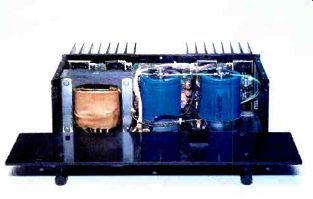
----- Removing the Eagle 2's front panel reveals its massive power supply, which almost hides the audio circuits.
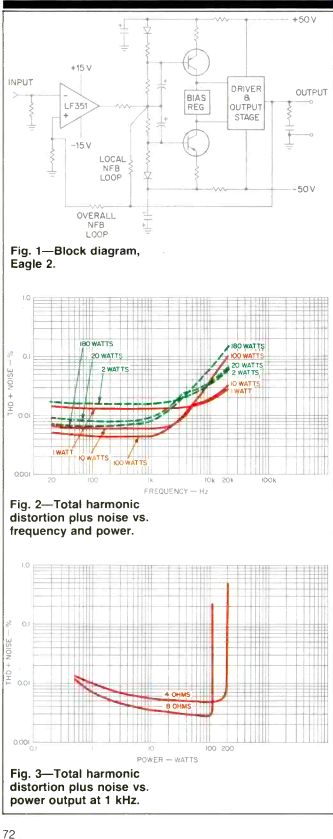
Fig. 1-Block diagram, Eagle 2.
Fig. 2-Total harmonic distortion plus noise vs.
frequency and power.
Fig. 3-Total harmonic distortion plus noise vs. power output at 1 kHz.
Damping factor, as a function of frequency and channel, is shown in Fig. 4. In the right channel it was higher than the 800 from 20 Hz to 20 kHz which Electron Kinetics claims, but in the left channel it fell below specification above about 13 kHz. One reason the damping factor is high at high frequencies is that the Eagle 2 does not have the output buffering parallel -RL network usually found in series with the hot output terminal in solid-state amplifiers. In addition, the Eagle 2 is stable with small capacitive loads of 0.01 to 0.5
µF, which is not always the case with other solid-state amplifiers that omit the parallel -RL network. This design shows the least effect of load impedance on waveshape during the transitions of high -frequency square waves or pulses that I have ever seen. No change is really visible for impedances from open -circuit down to 4 ohms. The consequences of this wideband, low output impedance would be flatter voltage delivery with frequency into speaker systems, especially loudspeakers which have wide impedance variations with frequency.
Rise and fall times into 8 -ohm loads were found to be 3 µS, from small signal levels up to clipping. One -watt frequency response into 8 -ohm loads was flat from d.c. up to 20 kHz, down -0.1 dB at 20 kHz, -0.8 dB at 50 kHz, and
2.8 dB at 100 kHz. Square -wave responses of the Eagle 2 are shown in Fig. 5. The top trace is for a 10 -kHz frequency, loaded with 8 ohms. The middle trace is also 10 kHz, with a 2-µF capacitor paralleling the 8 -ohm resistive load. Noteworthy here is the low level of ringing and overshoot, compared with most amplifiers. In the bottom trace, a 40 -Hz square wave is shown, with an 8 -ohm load on the amplifier.
There is no low-frequency tilt, because the Eagle 2 is totally direct coupled.
Recovery from clipping is not as good, as in Fig. 6 where a 10 -kHz sine wave is shown driving the amplifier into clipping with an 8 -ohm load. Considerable "sticking" is in evidence here as the circuit comes out of clipping. Also shown here is the general nature of the amplifier's residual harmonic distortion. The smaller trace is the harmonic residue for a 10 -watt output at 10 kHz into 8 ohms. As can be seen, the dominant harmonic component is at twice the fundamental frequency, and since the residue is not a sine wave, evidence of higher order even harmonics is also present in the photo.
IHF signal-to-noise ratio, A -weighted, below 1 watt into 8 ohms, was found to be 90.3 dB for the left channel and 89.8 dB for the right channel. These measurements would have been some 20 dB better if referenced to 120 watts of output into 8 ohms.
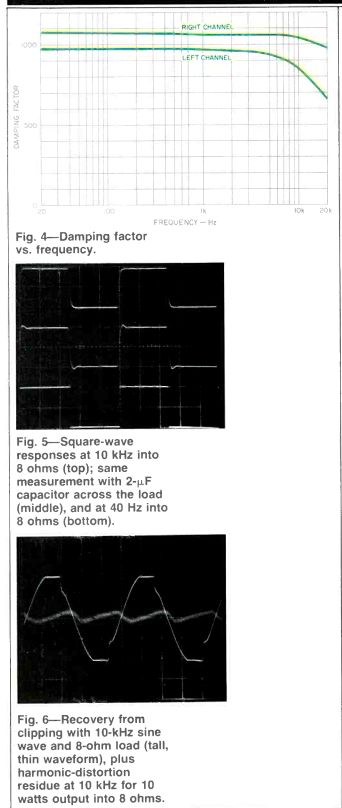
Fig. 4-Damping factor vs. frequency.
Fig. 5-Square-wave responses at 10 kHz into 8 ohms (top); same measurement with 2-µF capacitor across the load (middle), and at 40 Hz into 8 ohms (bottom).
Fig. 6-Recovery from clipping with 10 -kHz sine wave and 8 -ohm load (tall, thin waveform), plus harmonic -distortion residue at 10 kHz for 10 watts output into 8 ohms.
Crosstalk versus frequency, with the undriven channel terminated in 1 kilohm, was down about 88 dB at low frequencies, rising to -76 dB at 1 kHz, -60 dB at 7 kHz, 50 dB at 20 kHz, and -44 dB at 50 kHz.
On the basis of a rated power of 120 watts/channel into 8 ohms and 200 watts/channel into 4 ohms, IHF dynamic headroom for 8 -ohm loads measured 0 dB, and was +0.63 dB for 4 ohms. Clipping headroom for 8 -ohm loads was
0.38 dB and 0 dB for 4 ohms. (There is a negative number for clipping headroom into 8 ohms because the amp clips at 110 watts.) In attempting to measure peak available output current, I used a method different from the one used on the last amplifier I reviewed (Streets Electronics Model 950, January 1985 Audio). This time, the load was 0.1 ohm and the test signal was the IHF tone -burst signal which is normally used to determine dynamic and clipping headroom. The signal is a 20-mS burst of 1 kHz at one level, followed by a 480-mS burst at a level 20 dB lower, the whole pattern repeating every 500 mS. One slowly increases this input signal until the output across a 0.1 -ohm load begins to distort visibly.
Peak current (expressed in amperes) is then this maximum undistorted output voltage, divided by 0.1 (the resistance, in ohms). For the Eagle 2, I was able to get a current of about ±25 amperes peak.
Use and Listening Tests Equipment used to evaluate the Eagle 2 included an Infinity air -bearing turntable and arm with a Koetsu EMC -1B "Black" cartridge; conrad-johnson PV2 and PV5, Dyna PAS 2 and GC/BHK reference preamps; Acrosound 20/20 and several "home brew" tube power amplifiers, and Snell A/III and Infinity RS IIB speakers. I also used a pair of Stax SR -X/ Mk3 headphones.
The Eagle 2 was first auditioned on the Snell A/Ill speakers using the conrad-johnson PV2 preamp. Even though the amp had been plugged in and left on for about 1 hour, my initial reaction was that its sound was decidedly not nirvana.
It sounded somewhat dark and closed -in. However, after playing music for about another hour, it ended up sounding quite good. For best sound, this amplifier should be left turned on all the time; its power draw when idling is low enough to be no problem. In later listening, using a Dyna PAS -2 preamp and the Snell speakers, the Eagle 2 sounded excellent.
Using the Infinity RS IIB speakers and the GC/BHK preamp in combination with the Eagle 2 yielded the following listening notes: "Plenty of power, tight bass, very good spectral balance, had speaker mid- and high -frequency controls set flat with no desire to turn them down, sound quite smooth and natural without edginess. Only criticism is that the sound is not quite as open and spacious as I would like." Using the little Acrosound tube amplifier gave a better feeling of spaciousness and reality (within its power limitations) than the Eagle 2 on the RS IIB speakers and the Stax headphones.
Summing up, I feel that the Eagle 2 is a good -sounding, powerful little amp, well made and a good value in today's marketplace.
Bascom H. King
(adapted from Audio magazine)
Also see:
Electrocompaniet EC-1 Preamp (Nov. 1987)
MONSTER CABLE X-TERMINATOR SPEAKER PLUGS (Jan. 1986)
= = = =