by EDWARD TATNALL CANBY
DYNAMIC DUO
Mozart: Sonata in D for Two Pianos; Schubert: Fantasia in F Minor for Piano Duet. Murray Perahia and Radu Lupu, pianos. CBS IM 39611, digital.
By now, 205 years after it was writ ten, Mozart's brilliant sonata for two of the keyboard instruments of his time really sounds out of place on a pair of large, spare, steely modern grands.
Extra volume and power add nothing, at least on record; the scoring that pre supposed a much brighter and more wiry sound is thin and too sparse. Our renewed "fortepianos" are basically right but not yet carried to the superb levels of craftsmanship and sound that the modern harpsichord builders show us. So what to do? Don't worry about it. If two artists of the caliber of Perahia and Lupu can be heard, it is going to do the music credit on any instrument.
The pianos, to be sure, are recorded in what seems to me a long Columbia tradition-rather close, dry, and hard.
Not too helpful, if impeccable in the fi (aside from some minor pre-echoes, a usual analog fault and extremely hard to avoid in such powerful piano tones).
Still, nothing could spoil my enjoyment of these two strong but always careful artists.
The Schubert, on a single piano, is one of those strange and powerful works out of the composer's very last year. It too gets a compelling and well thought-out performance, if somewhat upsetting in terms of the usual conventions of Schubert interpretation today.
Not wrong-who can say? We didn't record Schubert himself back in 1828.
But here the sounds are not always the expected ones, if you know the piece. I do feel a lack of that wonderful filigree effect in the composer's high-up melo dies, and there isn't the right drama in the startling changes of key, which can knock you off your seat if the right player does them the right way. Yet why compare? A new and different interpretation is a lot better than a pedestrian reading of the notes. This is top-level music making, different or no.
Interesting, by the way, to find that the single piano on side two sounds just as big and loud as the two instruments on side one. That's part of the aesthetic impact of recorded music again, not good or bad but different.
Indeed, the Schubert sounds bigger, because his scoring is more favorable to the modern instrument.
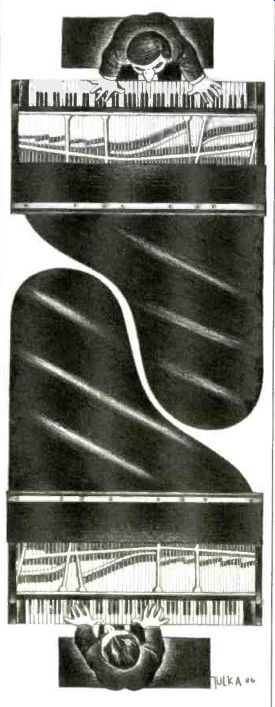
Perhaps a more audible stereo separation in the Mozart might have helped to compensate for the sight as well as the sound of a live performance? That sight is very unlike the visible impact of two players crammed together sidewise at a single key board! The one-piano duet has always been popular for informal playing, but to this day we seldom hear it on the concert stage. It sounds good. It looks awful. Two-piano music on stage, in case you have not seen it, is done with the pianos facing oppositely, curved sides fitting together and the key boards and performers at the far extremes right and left, visually heightening the sense of separation.
Mahler: Symphony No. 9; Symphony No. 10, Adagio. The Vienna Philharmonic. Loren Maazel. CBS 12M 39721, digital, two-record set.
Not too long ago I found the Mahler Fourth in this series full of inexplicable faults, including an audible lack of rap port, or so it seemed, between musicians and conductor. In this recording I stopped short at the end of the single long Adagio from the unfinished Tenth-superb! So good, indeed, that I was loath to try the Ninth until I had absorbed the glory of this one LP side.
A very great recording.
The Tenth symphony was sketched out by Mahler to its full enormous length, and Deryck Cooke spent long recent years in fleshing out the sketch into a performing version. Even so, the completed opening Adagio seems to stand in some infinite cosmos of its own-I believe that it is one of the great single expressions of Western musical thought.
I have not been an admirer of Maazel-but all that is now changed. One tries to keep an open mind. As for the orchestra, the Viennese musicians rise to their absolute finest. The music is the very end-extreme of Romantic harmony, with sound combinations built on the overtone series, however distantly, and therefore deriving from the bottom upwards. The violins ride in a sort of musical stratosphere, high upon the pinnacle of some of the most extraordinary chords ever imagined, achingly difficult to play, to tune and to understand. There is one razor-sharp dissonance after another, almost microtonal and beyond the tempered scale, with every tone to be heard as part of a harmony, on the extreme edge of comprehension. This sort of music is tremendously demanding for the violins, who must play these sounds in agreement with each other.
If they misfire, there can be no sense in the listening. They don't. I assume that this digital recording was made with the multi-mike technique still in use at CBS; the sound is even and well balanced. Still, those extremely tenuous, ultra-high notes, and the long, slow sweep of the musical sense-often pianissimo, extremely soft-ask for the CD format (CBS M2K 39721). There is loud music too, notably the famous passage where the en-tire orchestra, huge, plays a chord that includes every note in the chromatic scale simultaneously. Dynamic range with a vengeance! I consider the CD a must, satisfactory though the LP is.
Dvorak: "American" Quartet, Op. 96; Shostakovich: Quartet No. 1 (1938); Turina: La Oracion del Torero. The Fine Arts Quartet. Gasparo GS 223, $9.98.
There are some 14 current LP versions of the famous late work of Dvo rak, composed, like most of the " New World" symphony, in this country. It is, of course, purely Czech (i.e. Bohemian) music, and any resemblance to American tunes is unimportant. The man was honest enough to be himself and write his own.
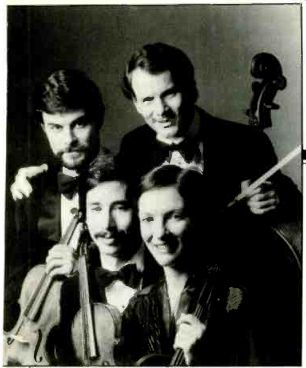
I very much recommend this recording, even though several others are now on CD (Denon has it with the Smetana Quartet). The Fine Arts Quartet is one of those curious groups that, though absolutely first-line since their formation in 1946. somehow never got the big headlines, the super publicity.
It often happens. Too easygoing? Not their music, but perhaps their collective personality. This quartet has played everywhere and is one of the busiest and most in demand, publicity or no. I rated the original members as tops; I could immediately hear in this recording that the new members, who have taken over one by one, have kept the tradition going. They are excellent, their style and presentation is perfection. They impress you, not as a quartet, not as virtuosi, but simply with the impact of the music and their under standing of it. They are far ahead of the Smetana Quartet out of the Czech homeland, as I hear it.
My praise applies not only to the wonderful atmosphere immediately evident in the Dvorak, but equally to the mid-period Shostakovich work, beautifully presented for a superb effect, and the extra filler, a serious Spanish-style piece by Turina. Each is given its own "costume," so to speak, its special style, and each is different.
Perhaps older readers will have had a twinge of memory-the Fine Arts once took on a major role in audio history. This was the group that did the first and most famous "Live vs. Re- corded" comparisons for Edgar Villchur and his AR speakers, put on at various audio shows. I was at some of the recording sessions and they were horrendous-what other group would have been so unfailingly understanding? The music was recorded outdoors in the middle of a wide meadow--an anechoic chamber deluxe. Incredible problems arose. from the white noise of wind in tree leaves to loud crickets.
In playback, the rehearsals involved perfect cuts between the live players and the recorded sound, back and forth-and the quartet even went along with the best trick of all. pretending to play their instruments while the sound was actually coming from the loud speakers. It worked. It sure sold AR too. If I do say so. even I was fooled though I knew where the shift-overs would occur. A beautifully contrived demo, thanks to the Fine Arts.
Dvorak: String Quartets in D Minor (Op. 34) and E Flat (Op. 51). The American String Quartet. Nonesuch 79126, digital, $10.98.
We've heard a number of Czech recordings of Dvorak, recently imported both from that country's Slovak segment and from its dominant musical center, Prague. Czechoslovakia is, of course, Dvorak territory, the old " Bohemia," part of the ex-Austrian Empire and for long a musical center rivaling Vienna itself. (Mozart made his greatest successes there. not in blasé Vienna.) Here, in contrast, are young American musicians, a quartet of them, playing the old-world music. It makes for an interesting comparison.
These people, without the slightest question, really understand the spirit of Bohemian Romantic music as Dvorak expressed it--that wonderfully smoky, atmospheric elegance laced with converted popular Czech dance tunes, the last pure expression of the Romantic spirit not yet troubled by incipient de cay. These quartets come some 20 years before Dvorak's visit to America, but they are youthfully mature works of the sort that made the composer famous in Europe.
The American String Quartet's only impediment. if I can call it that, is an excess of vibrato, particularly in the lead instrument, the first violin. It makes for difficult listening, somewhat obscuring both the harmonies and the melodic lines. I doubt if Dvorak's own audiences heard the music this way. Vibrato seems to be a feature of our age, a pseudo-Romantic trait that did not exist in the real Romantic period a century back. But to compensate, the Americans play an uncannily beautiful pianissimo, ultra-soft. A vital element in Dvorak. I'd put these players well ahead of the old-country performers.
Delalande: Simphonies pour les Soupers du Roy, Concert de Trompettes, Trois Caprices. The Jean-Francois Paillard Chamber Orchestra. Erato 75174, digital, $10.98.
The mysterious French! Mysterious to us. at least, and never more so than in the age of the Sun King, the last years of the 17th century and on. The color photo on the cover of this one is worth the price of the LP: Louis XIV unveiling a wonderfully tortured statue in the gardens at Versailles, a Greekish nude, his backside being eaten by a lion. Crowds of dandies surround the King and Queen, posed in their incredible finery, with the royal Person lit up as though by . . . well, the sun, more likely a floodlight. He is dressed in gorgeous red and a wide red hat, white stockings, and high-heeled, bowed white shoes. And of course he carries an elegant cane. Great buildings and green, sculptured terraces stand be hind him with the royal coach nearby.
Walk? Heaven forbid. It could be an Ektachrome slide taken at the spot.
What a digression-but necessary! The music is of the sort that accompanied almost every act of the king, from dawn virtually to dawn. It is florid, often dull, and highly ornamented, exactly like the picture-except when Dela lande could compose a bit more on his own, at some distance from immediate royalty. In that case he wrote a more intelligent and expressive music which-in its place-was also admired and approved of by Louis.
The Paillard ensemble, playing here, is more than faintly old-fashioned by non-French standards. Not only do they use modern instruments, but they produce a poor approximation of the lively rhythms inherent in the old notation. Some people just don't know how to dance; it is the same in music, old or new. The faster parts do move along satisfactorily and the sound is brilliant.
So look at that picture, and listen. Al most like audio/video.
By the way, the required (added) ornamentation is by Wiley Hitchcock, definitely not French; and so it is correct, even if the rhythm of the music tends to be slack. Not his fault. I used to know Wiley in New York.
Handel: Music for the Royal Fire works, Concerto for Two Horns in F, Ariodante Overture. La Grand Ecurie et la Chambre du Roy, Jean-Claude Malgoire. CBS M 42123.
Handel, the beefy, well-fed German who adopted England along with the Kings George as his new homeland, is claimed by the British and also (of course) by the Germans as one of their own, just on vacation. When the French get into the act. all sorts of things hap pen. That's what goes on here-the well-known French "authentic" instruments play Handel as he should sound-in France. Not exactly like the German and English.
Malgoire and his curiously named "orchestra" (The Grand Stable and the Chamber of the King) play with a high tension sound that is not really quite in line with our usual image of Handel double chins, white wig and all. Everything goes fast, almost hysterically fast. I've never heard such a furious clucking and cackling of old oboes and blatting of trumpets and horns! Of course, nobody knows precisely how all this genial music should go, and it is possible that Malgoire has the real Handel sound. It's enough to say that for a modern ear the effect is very French (and hence not very Handelian), and maybe we can like it that way.
The old instruments are expertly played but tend to be more out of tune than the corresponding instruments in several British versions of this same music, also performed with old-type instrumentation. You will note one oddity common to all such versions of this and other 18th-century music: The strings are relatively weak. the winds very prominent. Later strings were beefed up, after 1800, for a louder effect. The older violin is steely in sound and not very loud.
This LP is a revamping, apparently, of a two-record set that included-appropriately enough-the "Water Music." Now you can sample the French Handel on a single LP.
The "Royal Fireworks Music" had what must lave been an inauspicious opening. It was given outdoors and 12,000 or so tried to get into Green Park in London to listen and to watch the fireworks. Part of the stands caught fire halfway through the music--I have heard that the fireworks also went up all at once-and the show was hastily concluded, evidently without injury.
Handel did the whole piece complete a short time later--indoors.
= = = =
Also see: