MANUFACTURER'S SPECIFICATIONS
Frequency Response: 18 Hz to 38 kHz ±0.5 dB with 600 ohm load.
Output: 10 V maximum, 2.5 V rated with 600 ohm load. Gain: 0 to 15.5 dB. Hum and Noise: 100 dB below rated output, 20 Hz to 20 kHz.
IM Distortion: Less than 0.01% at rated output.
Filters: Separate 18-dB Butterworth high and low pass with adjustable corner frequencies. Dimensions: 19 in. rack mount with W.E. hole spacing, 3 1/2 in H. H, 5 ¾ in. D.
Weight: 6 lbs. Price: $299.00.
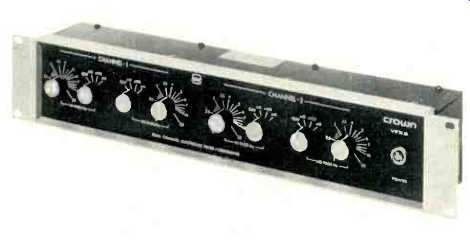
The Crown Model VFX2 is a dual-channel filter/crossover unit designed to provide continuously variable filters to perform either high-pass, low-pass, or bandpass functions in a professional, commercial or home high fidelity system. The unit is ruggedly constructed and fits the standard 19 in. rack mount, occupying only 3 1/2 in. of vertical rack space and 5 3/4 inches in depth.
The front panel has four sets of range/vernier knobs for the high- and low-pass frequency setting of the filters in the two audio channels. A shadow mask pushbutton switch controls the power. The rear panel controls are a screwdriver adjustable level (attenuator) control and a mode switch for selecting either the crossover (low pass) or filter (bandpass) outputs for each audio channel. Rear-panel connectors include a variable-gain bridging input for each channel in addition to the unity-gain unbalanced input. Output connectors (both high and low pass) are provided for inverted and noninverted (normal) modes.
For greater reliability, the VFX2 uses 1/4-in. phone jacks; input is by 3-conductor jacks balanced/unbalanced or 2-conductor jacks unbalanced unity gain; output is by 2-conductor jacks. To prevent the accidental moving of the range/vernier settings, the VFX2 has a smoked plastic cover that can be attached over the front of the unit.
The VFX2 filter set is quite useful for reprocessing or playing all types of records, particularly the early 78-rpm acoustics and electrics as well as the more recent monophonic 78s and LPs, the current stereo and matrix recordings. Other equally important uses include equalizing deficient program material in a manner not possible with the usual tone controls, constructing one-third octave or other narrow band pink-noise sources for use in acoustical measurements, etc.
Of particular interest to the professional and the audiophile is the use of the VFX2 as a high-quality dual-channel crossover with 18 dB/octave slopes and continuously variable crossover frequencies. Currently, there is renewed interest in electronic crossovers for use in bi- and tri-amplified speaker systems, with great interest in achieving true high fidelity bass performance by utilizing speakers specifically designed for low bass reproduction.
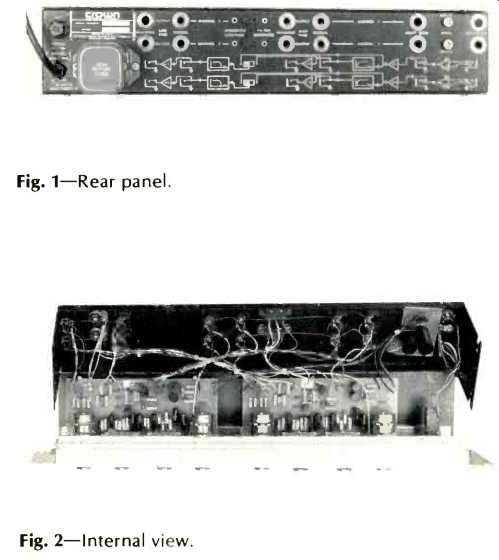
Fig. 1-Rear panel.
Fig. 2-Internal view.
The VFX2 utilizes five RC4558 dual operational amplifiers in each channel, in effect, 20 op-amps equivalent to 402 transistors, 44 diodes, and 2 zeners. The circuit appears to be a variant of a non-inverting voltage-controlled voltage source (VCVS) design, and consists of a 6 dB/octave stage cascaded with a second 12 dB/octave section. The latter is implemented with two operational amplifiers. Results of this design approach are very high input impedances, low output impedances, and low sensitivities to drift arising from temperature changes and circuit aging.
The liberal use of operational amplifiers in the VFX2 is apparent throughout the unit. There are buffer amplifiers at the inputs to assure very high (1 megohm) input impedances which permits use of the crossover with long cables and any type of preamplifier. Use of high supply voltages for the op-amps, e.g., ± 15 volts, assures that the crossover can handle up to 10 volts without overloading. At unity gain, this type of output is far greater than is required by any power amplifier. The liberal use of op-amps is also apparent in the availability of inverting outputs. Each of these inverting outputs requires one op-amp so that four of these op-amps are used to supply the four inverted outputs. The inverting outputs, although not essential, are a very useful addition because phasing of the loudspeakers can be made at the crossover rather than changing connections at the speaker or power amplifier. Phasing becomes particularly important when the crossover is set at very low frequencies (e.g., 100 Hz) such as when used with a high quality extended-bass system. An out-of-phase condition between the low-frequency speaker and the rest of the system would appear as an attenuation in the upper bass region and would definitely be audible. By merely changing the outputs from Normal to Inverted for one of the sections (high pass or low pass), the listener can quickly determine which jack gives the correct phasing.
The filter characteristic is a third-order Butterworth, which has a maximally flat response in the pass band of the filter to a time dependent signal such as is encountered with musical material. The phase shifts for this type of filter are, however, not linear with frequency. A linear response would be an ideal case since this would lead to a constant group delay at all frequencies and, consequently, the time dependent signal would not be distorted. However, human hearing is relatively less sensitive to distortions of this kind than it is to amplitude variations with frequency, e.g., ripple in the pass band.
Measurements of harmonic distortion products using a wave analyzer with an 80-dB range showed that second harmonic distortion was always less than 0.1% at input voltages less than 9 volts and at frequencies below 10 kHz. Third harmonic and all higher order distortion components were nearly unmeasureable, i.e., less than 0.01%. The second harmonic distortion reflected the internal residual distortion of the oscillator and not of the VFX2. The frequency response measured was the same as given in the VFX2 specifications.
The slopes of the filters were within 0.5 dB down to-60 dB relative to the bandpass output.
The corner frequencies as indicated on the front panel are reasonably accurate. However, for exact frequency settings, use a simple a.c. voltmeter, an audio oscillator and, if available, a frequency counter. Figure 3 shows the response curve for the VFX2 when set for a crossover frequency of exactly 100 Hz.
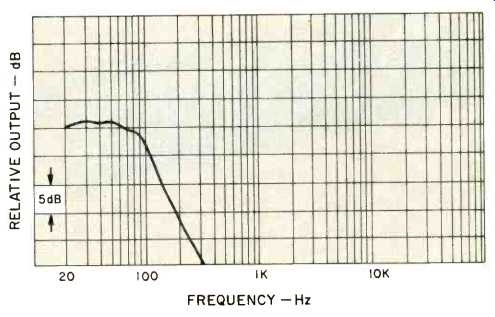
Fig. 3--Response with crossover frequency of 100 Hz.
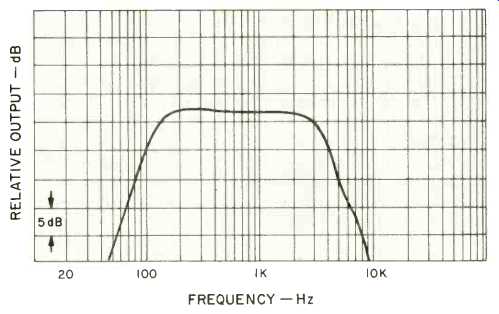
Fig. 4-Bandpass setting with cutoff frequencies of 160 and 3000 Hz, 18 dB/octave slope rate.
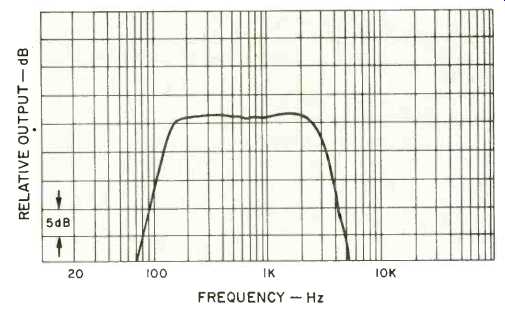
Fig. 5-Bandpass setting with cutoff frequencies of 160 and 3000 Hz, 36 dB/octave slope rate.
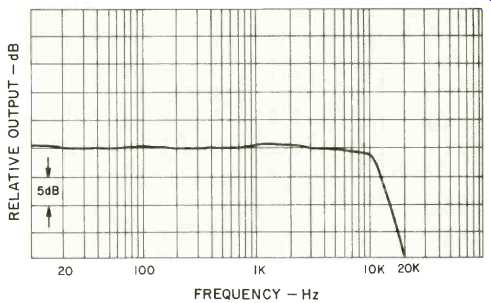
Fig. 6-Setting for noisy modern discs, high-pass filter at 20 Hz or off, low-pass at 10 kHz with 18 dB/octave slope rate.
In using the Crown VFX2 as a crossover in our system, we noted two deficiencies. The first is a lack of level controls on the high- and low-pass sections, which means that power amplifiers used with the VFX2 should have a volume control to compensate for varying power amplifier sensitivities and loudspeaker efficiencies. The second deficiency is the omission of a summed left-plus-right output for the low-pass filter. Experience shows that for reproduction of low bass, a single monophonic bass speaker (woofer) is adequate in small rooms where the left- and right-channel speakers are not widely spaced, particularly since bass frequencies below about 100 Hz are not directional. A crossover such as the VFX2 cannot be used in this monophonic mode, but must be used with two subwoofers. However, a suitable op-amp mixer is very easy to add to the VFX2 because of its op-amp design, thus permitting the use of one subwoofer in the common mode.
As mentioned earlier, the VFX2 is very useful as an 18 dB/octave filter for record collectors, particularly collectors of early acoustic and electrical 78-rpm shellac records. The unit is inserted in the Tape In and Out circuits or between the preamplifier and amplifier when they are separate units.
Figure 4 is a response curve for the playback of early acoustic 78-rpm records. The high-pass filter of the VFX2 is set at 160 Hz and the low pass filter at 3000 Hz. In practice, the low-pass filter (cutoff frequency) is usually adjusted for each recording as it is being played until the noise elements are removed or diminished appreciably. In Figure 4 the cutoff frequencies are at 160 and 3000 Hz with an attenuation rate of 18 dB/octave, while Figure 5 shows the same response, but at 36 dB/octave attenuation. Note that with such a steep attenuation, the cutoff point has shifted to about 2800 Hz at the high end. A shift towards a narrower bandpass has also occurred at the low end. In Figure 6 the high-pass filter is set at 20 Hz or turned off and low-pass cutoff frequency is set at 10 kHz, with an attenuation rate of 18 dB/octave. This is a useful setting when playing noisy LPs. As mentioned earlier, in practice the low-pass and high-pass filters are usually adjusted while the record is playing and the bandpass limits set for the least amount of noise.
During the past six months, the Crown VFX2, used as a crossover, has performed faultlessly in our music system.
The unit is set for a low crossover frequency of exactly 100 Hz and the common mode output is fed to a 60-watt amplifier having a high damping factor. The output of the amplifier is coupled to our Janis Audio Associates W-1 subwoofer.
Use of the VFX2 crossover and the W-1 subwoofer permitted us to hear the bass frequencies below 100 Hz in an extremely clean manner and in toto. In the usual high quality music system, the very low bass frequencies are too often missing since very few speakers can adequately reproduce musical frequencies much below 40 Hz. This is particularly true of the low-bass pedal organ frequencies such as the 23 Hz note recorded on the Advent 5009 record (Lemmen Vierne Dupre Widor) and the 27.5 Hz note on the ARK 10251-S (Organ Music From Westminster). There are many classical recordings in which the nine-foot concert bass drum, generally tuned to 31 Hz, is prominently featured, but the actual fundamental is rarely reproduced. On the Columbia MQ33172 (Carmina Burana), the Angel S-35430 (Pictures at an Exhibition), or the RCA QuadraDisc ARD1-0707 (Citizen Kane), to name a few, there is liberal use of this great drum, and this system reproduces it with awesome power and sonority. In the currently popular music the various bass instruments and, in particular, the ultra-low frequencies produced by synthesizers is superbly reproduced. The Crown VFX2 dual-channel filter/crossover is undoubtedly a very excellent crossover in this application.
-B. V. Pisha
(Audio magazine, 1975)
Also see:
Crown PZM-180 Pressure Zone Microphone (Equip.Profile, Mar. 1985)