One + One = Four
Dear Sir:
We favor the technique described in the article on bi-amplification by Lovda and Muchow in the September issue of Audio. We recently designed a 1-kilowatt system for a stadium using bi-amplification and Shure SR105 amplifiers with two low-frequency and six high-frequency horns.
By connecting our speakers individually to the amplifiers, we missed the advantages of the "bridged-pair series connection" scheme that the authors mention will double the power output of each amplifier. With this technique, we could have halved the number of amplifiers and saved our client substantial cost.
We congratulate the authors' honesty in bringing this cost and energy saving technique to the public's attention. Unfortunately, the a.c. input power is rated at more than twice the audio output, so this method cannot be used to generate electricity. However, by a slight increase in efficiency, an important solution to the energy crisis would result.
-Jon R. Sank, Cross Country Engineering, Haddonfield, N.J.
The authors reply:
We believe that Mr. Sank is referring to the comments in the "Summary" and, in particular, to Fig. 8A, the "Typical Biamplified Sound Reinforcement System for High SPL Operation." The intent of this portion of the article is to illustrate in general terms how to most efficiently utilize the components of a biamplified sound system. In the example described, the four 16-ohm, wide-range loudspeaker systems are two-way systems with biamplification capability. Both the 16-ohm, high-frequency section and the 16-ohm, low-frequency section of each system are made available for external connection. The Shure SR105 amplifiers used in this example, if operated at the mentioned maximum output-voltage capability of 28 volts rms, will deliver approximately 200 watts continuous to a 4-ohm load or 100 watts to an 8-ohm load. In addition, two SR105 amplifiers may be "bridged" to provide approximately 57 V rms output resulting in a total power of 400 watts to an 8-ohm load.
The question, then, is what circuit configuration of amplifiers and speakers will most efficiently drive the speakers for highest SPL operation? Analysis reveals that the optimum combination consists of four SR105 amplifiers split into two bridged pairs, with each pair driving two parallel connected, low-frequency speakers.
(Please note that due to a typographical error, the two low frequency speakers are shown series-connected instead of parallel-connected in Fig. 8A.) In this way, each pair of speakers constitutes an 8-ohm load. A bridged amplifier pair will deliver 400 watts to this 8-ohm load, while a single amplifier will deliver 100 watts to this 8-ohm speaker combination.
In the article, we elected not to explain in great detail the subject of amplifier bridging. Rather, it was included to inform readers that his technique was available with amplifiers offering this feature. We certainly hope that this explanation will clear up any confusion that may have resulted.
-John M. Lovda, Stephen Muchow, Senior Development Engineers
Shure Bros., Inc., Evanston, Ill.
=================
Vintage magazine ADs:
Any LUX amplifier or tuner that doesn’t meet or exceed every rated specification won’t ever reach you.
It's one thing to produce components with an impressive list of published specifications. It's quite another matter to ensure that every unit will meet or exceed each of those specifications. But this is precisely what LUX does with its entire line of power amplifiers, preamplifiers, integrated amplifiers and tuners.
LUX components were conceived and designed for that very special breed of audiophile whose critical requirements for accurate music reproduction are me only by separate amplifiers and tuners, And of those products, the very best that the state of the art can provide.
Hence, the following procedure takes place at our facilities in Syosset, New York.
Every unit received from the factory in Japan is removed from its carton and placed on a test bench where it is connected to an array of test equipment, which includes a Sound Technology 1700A Distortion Measurement System and 1000A FM Alignment Generator, McAdam 2000A Digital Audio Analyzer System, and Iwatsu Electric SS5100 and 5057Z 5057Z Synchroscope.
Every control, switch, meter and indicator undergoes an operational check-out. There nothing unusual about this. Any reputable manufacturer can be expected to do the same. Or at least spot check a shipment.
But LUX has only begun. Every specification is then measured against its published rating. That means 14 individual tests for a power amplifier, 14 for a preamplifier, 20 for an integrated amplifier and 7 for a tuner.
Each verified specification is entered by hand on a Performance Verification Certificate. Any unit that doesn't match or exceed every published specification is given the appropriate remedy. When a unit passes, it is returned to its carton together with a copy of the Certificate for the information of its future owner.
Another copy stays with us as a permanent record.
As for the specifications themselves, here are some examples. The Luxman M-4000 power amplifier has less than 0.05% harmonic and intermodulation distortion at any frequency from 20 to 20,000 Hz, even with both channels driven simultaneously to its rated output of 180 watts per channel into 8 ohms.
Another M-4000 specification: signal-to-noise ratio beyond 100 dB. Another example is the C-1000 preamplifier. Its phono-input circuits are virtually overload proof, accepting almost half a volt of audio signal at 1000 Hz.
The distortion of its phono-preamplifier circuits is an astonishingly low 0.006%, and the rest of the preamplifier circuits add only 0.001% more.
There's one more expression of our confidence in our products. If any of them malfunctions during the first three years, let us know. We'll not only fix it promptly, but will pay the freight both ways, as well as supply a shipping carton if needed.
Some day, all manufacturers may adopt these procedures. For LUX, it's the only way to go. From the very beginning.
With all this, we think that neither our specifications nor our procedures for verifying them is nearly so important as your satisfaction with the end result: the most accurate and musical reproduction you can hear.
The end result can be best appreciated at a select number of dealers whom we guarantee to be as dedicated to fine music reproduction as we are.
----------- One of these Performance Verification Certificates is included with every unit.
------------- Luxman M-4000 Power Amplifier-180 watts per channel minimum continuous power, both channels driven simultaneously into 8 ohms. Total harmonic and intermodulation distortion less than 0.05%. Frequency response: 5-50,000 Hz, ±1 dB. Signal-to-noise ratio:108 dB. Features include: separate power supplies for each channel, including output and drive stages. Two-meter power-output display in combination with LED peak-output indicators reveal dynamic range of program material. Output level set by precision potentiometer with 1-dB click stops. $1,495.00.
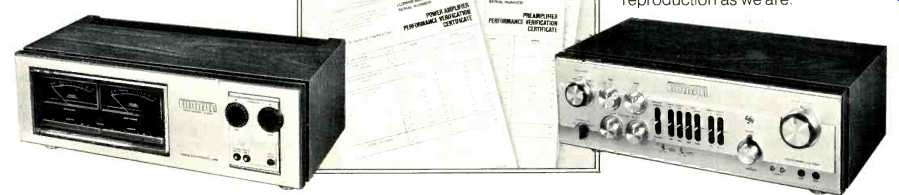
----------- Luxman C-1000 Preamplifier-Total harmonic and inter modulation distortion: 0.007% at 2.5 V, 20 Hz-20 kHz, all output signals. Frequency response: 2 Hz-80 kHz, +0,-0.5 dB. Signal-to-noise: >65 dB. Phono overload: 450 mV @ 1 kHz, 3.5 V @ 20 kHz. RIAA equalization: ±0.2 dB. Features include: tape-monitoring and dubbing for two decks, six selectable tone control turnover frequencies, linear equalizer, twin high and low noise filters, variable phono-input impedance, variable input sensitivities, "touch-mute" attenuator, speaker system selectors. $895.00.
LUX Audio of America, Ltd 200 Aerial Way, Syosset, New York 11791
In Canada: AMX Sound Corp. Ltd., British Columbia; Gentronic Ltd., Quebec
----------------
AR
New from Acoustic Research
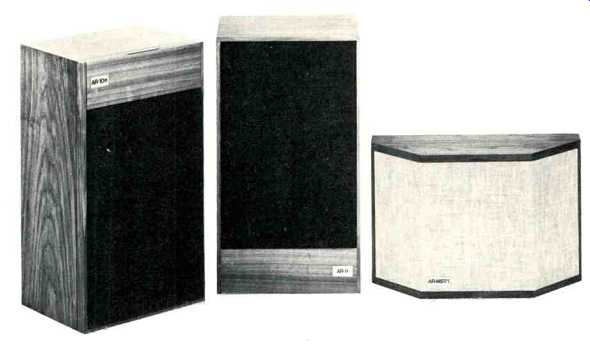
Introducing -- A new family of loudspeakers from Acoustic Research
AR-10 pi
The AR-10 pi is the most accurate musical reproducer that Acoustic Research has ever made. It shares the characteristics of AR's previous speaker systems, smoothness of response, uniform dispersion, and low distortion. A significant additional feature of the AR-10 pi is its ability to deliver uniform flat energy response in most listening rooms.
Further, the designed-in performance of the AR-10 pi is preserved, whether the speaker is positioned against a wall, in a corner, or even in the middle of a room. Setting a single switch, called the 'Woofer Environmental Control', will ensure the correct level of bass energy for any of these positions. It is not possible to do this accurately with conventional loudspeaker designs or equalization techniques.
AR-11
The performance drivers, and crossover of the AR-11 are identical to those of the AR-10n, except that the AR-11 does not incorporate a Woofer Environmental Control and the associated crossover components.
The AR-11 is designed for optimum performance when placed against a wall, as in the conventional bookshelf position, or slightly away from two adjoining room surfaces.
Both the AR-10 pi and the AR-11 use a 12 inch acoustic suspension woofer, a 1 1/2 inch dome midrange, and a newly designed 3/4 inch dome high-range.
AR-MST/1
The AR Miniature Studio Transducer offers at moderate cost the flat energy response of AR's other new speaker systems, together with the high power-handling capability required in many professional applications. Along with the AR-MST/1's small size, light weight, and shallow depth, these characteristics make the speaker especially appropriate or the monitoring of remote-location recordings as well as the accurate reproduction of music in the home, even at relatively high sound levels.
Guarantee--The workmanship and performance of all AR speaker systems are guaranteed for five years.
A complete description of the new family of AR speakers is available free. Mail us the coupon today.
Acoustic Research, 10 American Drive, Norwood, Massachusetts, 02062-- Telephone 617 769 4200.
---------
The Dual cassette deck
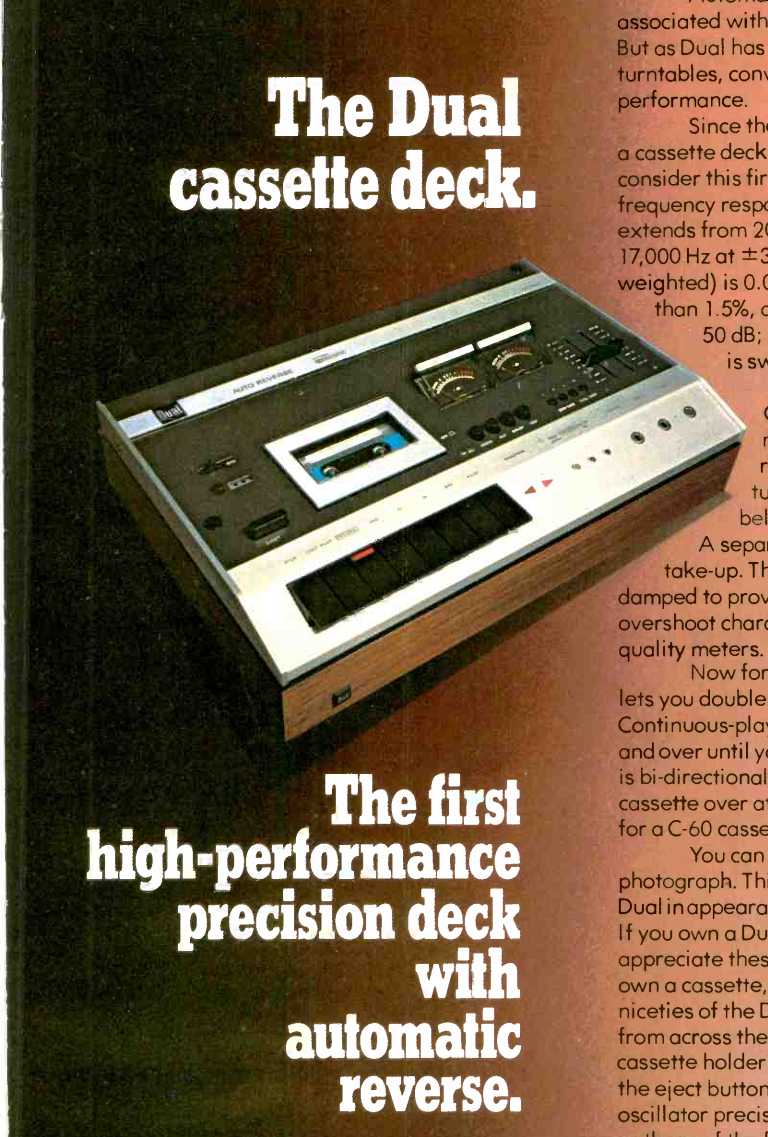
The first; high-performance precision deck with automatic reverse.
Automatic reverse has not been generally associated with high quality in tape recording.
But as Dual has long proven with automatic turntables, convenience can accompany precision performance.
Since the primary reason for selecting a cassette deck is its performance quality, let's consider this first. With standard tapes, the frequency response of the Dual cassette deck extends from 20 to 14,000 Hz at-±1.5 dB and to 17,000 Hz at ±3 dB. Wow and flutter (DIN weighted) is 0.07%. Harmonic distortion is less than 1.5%, and signal-to-noise is greater than 50 dB; 59 dB when the Dolby system is switched in.
The motor is Dual's well-known Continuous-Pole/synchronous motor which has long proven its reliability in our finest automatic turntables. A precision-ground flat belt transmits power to the capstans.
A separate drive belt powers tape take-up. The VU meters are ballistically damped to provide precisely the rise time and overshoot characteristics specified for broadcast quality meters.
Now for convenience. Automatic reverse lets you double the playback time of any cassette.
Continuous-play lets you hear both sides over and over until you shut the machine off. Recording is bi-directional, eliminating the need to turn the cassette over at the end of side one. Rewind time for a C-60 cassette is 60 seconds flat.
You can see the rest for yourself in the photograph. This cassette deck is also typically Dual in appearance: clean, functional, uncluttered.
If you own a Dual turntable, you've come to appreciate these qualities. And if you're about to own a cassette, you'll appreciate some additional niceties of the Dual. The meters tilt up for viewing from across the room. The viscous-damped cassette holder rises smoothly and silently when the eject button is pressed. The built-in Dolby test oscillator precisely adjusts for any tapes, today's or those of the future.
In short, this cassette deck was designed with the same philosophy that Dual has espoused for years: the most serious audio equipment can also be the easiest and most convenient to use.
Price: $450.
United Audio Products [Exclusive U.S. Distribution Agency for Dual] 120 So. Columbus Ave., Mt. Vernon, N.Y. 10553, USA
(Source: Audio magazine.)
= = = =