by IVAN BERGER
Delco-GM/Bose
WIZARDRY ON WHEELS
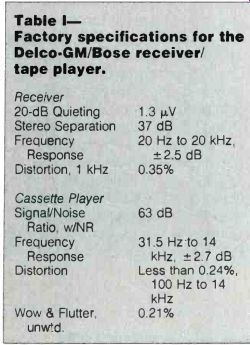
Table 1 -- (Factory specifications for the Delco-GM/Bose receiver tape player.
The gentleman below, named Morgan, is a dummy but an excellent listener. He's the lowest paid employee of the Bose Corporation, but he may be one of the most valuable-certainly one of the most expensive.
Morgan is the front man for Interval (Interpretive Visual Analysis Language), an extensive, computerized research program used by Bose (with Delco and other divisions of General Motors) to develop a revolutionary new car-stereo system.
What's revolutionary about it is its total systems approach, integrating the acoustical design of the car and the system in a way that can't be done in the home. "It's an engineer's dream," says Dr. Amar Bose, "being able to control all the listening parameters, including source position, listening position and environment. It's the first time the system and environment were designed together." To me, the biggest advantage of the new system is its ability to achieve good stereo balance on both sides of the car at once. That's no problem in home systems, where listeners tend to be roughly equidistant from the speakers. But in the car, with listeners far closer to one speaker than the other, conventional balance controls can only give one listener good balance by totally sacrificing it for the listener on the other side of the car. The DelcoGM/Bose system, however, does it with no balance control whatever.
The system's speakers are set far forward of the listeners, and angled so that each is aimed at the passenger on the other side of the car-a setup which owes a great deal to Interval and Morgan. As a result, the sound of the speaker nearest each listener is attenuated by his off-axis position, compensating for the attenuation of the opposite speaker by distance.
Each listener gets a definite stereo feeling, with a lush sense of ambience.
Stereo imaging is imprecise, as you'd expect with this arrangement, but the overall effect is far better than one gets in any but the most elaborate custom systems.
The advance Bose lays most stress on, however, is flatter frequency response, achieved through custom-engineered speaker enclosures and custom equalization matched to each model car. This work was mostly by Bose, but it could not have been done without heavy cooperation from GM and a considerable investment in car stereo research by both companies.
The four speaker enclosures used in each car (Fig. 1) are vented types, each with a volume of about three liters. Each holds a single full-range driver similar to that used in the Bose 1401 after-market car-stereo system--that is, basically a 2-ohm version of the one used in the Bose 901, beefed up to handle such mobile environmental problems as temperature, humidity and vibration.
Each of the enclosures also holds a highly efficient "digital-mode" or "two state" switching amplifier incorporating special equalization. Efficiency is particularly important in this application, since the amplifiers get little cooling air and cannot use the car structure as a heat-sink.
Car-stereo frequency response depends not only on stereo system but on the car's interior shape and upholstery and on the speaker placement.
According to Dr. Bose, "Even a 2-inch change in position is significant." There are obvious constraints on car design and speaker placement in the car (though GM's Fisher Body Division cooperated with Bose as far as possible), so most of the responsibility for flat response rests with the sound system. The speaker enclosures play a major role here. Car speaker designers rarely have more than a vague notion of the enclosure volume their speakers will work with, or of how much those enclosures will leak through window slots, open-back rear seats and so on. Matched speakers and enclosures for car use have, until now, been externally mounted mini speakers, which limits their possible locations. By working with GM's Fisher Body Division, Bose was able to engineer three-liter, tuned bass-reflex enclosures which could be mounted within the car's body panels, and be sure that space would be left within those panels to receive them.
Figure 2 shows the response of an unspecified speaker, both with and without enclosure, mounted in the door of an unnamed compact car. The improvement appears dramatic, with 15 dB claimed and about 17 shown; however, the system is not yet available on compacts (unless you count Corvettes). On larger cars which do offer the system, like the Cadillac Seville, Bose claims a difference of +5 dB at 50 Hz for the enclosure, enough to turn a bass droop into a hump.
Though the enclosure extends the bass, its port does not-at least, not directly. The port is not used in the conventional way, to extend bass frequency response, but only to increase low-frequency dynamic range. In any bass reflex, the port allows more output for a given cone excursion at the frequency to which the port is tuned.
"In conventional bass-reflex systems, with larger boxes," says Bose's John Wawzonek, "the resonance of the speaker and box alone would be low enough to give you decent bass response even without a port. Adding a port tuned just a bit below the speaker's resonance in the box extends the response a bit lower.
"But it also increases the bass roll off below resonance, from the 12 dB per octave of a sealed box to 18 dB per octave. In a larger box, that's a reasonable trade-off. But with a 41 inch driver in a three-liter enclosure, the resonance is about 90 Hz." Tuning a port to that frequency would give you no low bass at all. Instead, the bass is extended by active equalization circuits in the amplifiers. By 50 Hz or so, however, the speaker is reaching its maximum excursion. That's where the port, tuned an octave below the speaker's resonance, comes in, allowing greater air movement and sound output from the available cone excursion. The result, says Bose, is improved reliability and lower distortion, as well as more bass output.
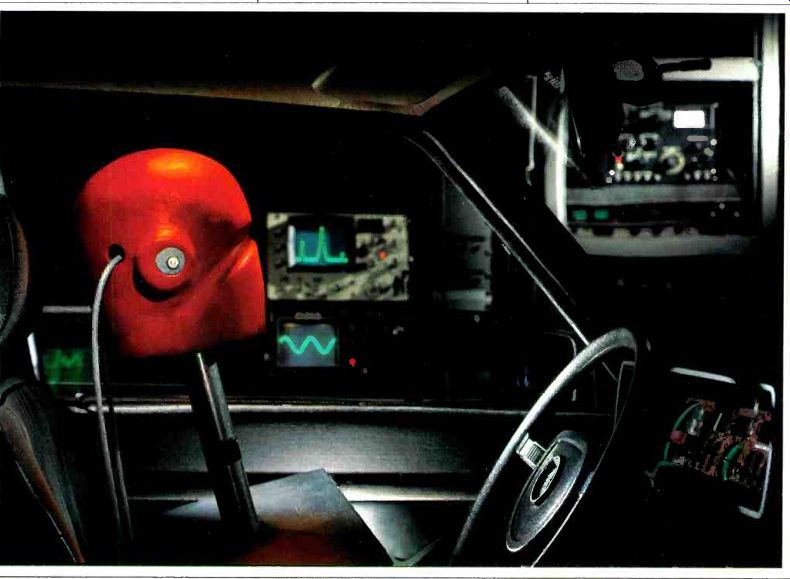
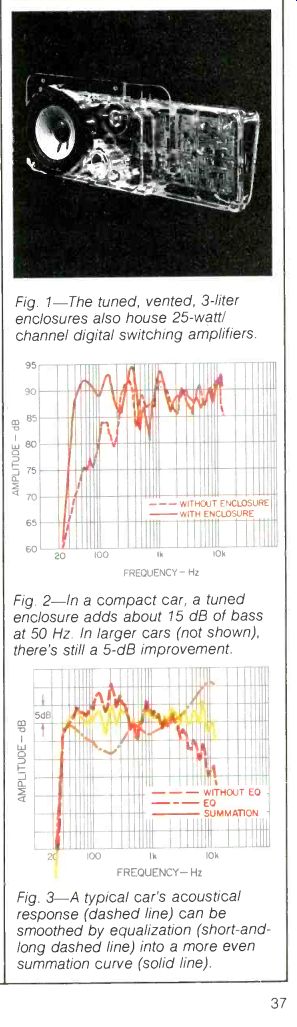
Fig. 1--The tuned, vented, 3-liter enclosures also house 25-watt/channel digital switching amplifiers.
Fig. 2--In a compact car, a tuned enclosure adds about 15 dB of bass at 50 Hz. In larger cars (not shown), there's still a 5-dB improvement.
Fig. 3--A typical car's acoustical response (dashed line) can be smoothed by equalization (short-and long dashed line) into a more even summation curve (solid line).
The enclosures also protect the speakers against water drips in doors, damage from objects loaded into trunks, and d damage during installation. The drivers in these enclosures have edge-wound, 2-ohm voice-coils for greater efficiency; the amplifiers, naturally, are designed for the low, 2 ohm load.
The amplifiers are "two-state" switching types, and switching amplifiers are extremely efficient. When their transistors are on, they pass maximum current with a minimum of resistance or voltage drop, in which case little power is dissipated as heat. When their transistors are off, they pass virtually no current, and again little power is dissipated.
A switching amplifier's output is basically a square wave from which the signal is recovered by low-pass filtering. In this instance, the square wave has a frequency of approximately 200 kHz and a duty cycle proportional to that of the input signal. Unlike other switching-amplifier designs, according to Bose, this one includes a negative feedback loop to control frequency response and distortion.
The equalization built into each amplifier does more than just extend the speaker's bass response. It also corrects for the car's acoustical problems (which can be quite severe-see Fig. 3). Surprisingly, the Interval research program showed that this equalization would have to be different for each car model offering the system (even the Riviera and Eldorado, which share the same basic body shell) and for the front and rear speakers in each car. The amplifier has another advantage, according to its designers: At high volume levels, it compresses more than it clips. (As the Riviera we used for auditioning was well insulated, and I don't normally listen at high levels, I forgot to check this.) As a result of all these frequency controlling techniques, the frequency balance was quite reasonable, without the whopping mid-frequency humps so common in car systems. There was less high-end sparkle than on good systems with separate tweeters. Bass was fine for rock and pop, but extreme low notes, such as organ pedal tones, were lacking-as they are for most car-stereo systems without sub woofers.
No user-controlled, multiband equalizer is included. This is "absolutely by design," says Dr. Bose, not only because the system's pre-equalization solves many of the problems people add equalizers to cure, but also because, "In a car, by the time you'd finished fiddling to get the sound just right, you could be on top of a telephone pole." No such equalizer seemed necessary to me either. 'There are bass and treble controls, nominally flat at their full-on positions. I never felt the need for any treble boost or, indeed, any treble-control adjustment.
However, I found it desirable to cut the bass a bit to relieve a slight bass heaviness. [So did I.-E.P.J. According to John Wawzonek, there actually is a bit of boost at the top of the bass control range to allow for the systems which might come off the assembly line needing it (and, I suspect, for listeners who like their bass juiced up a little). That brings us to where the controls are, and to Delco's part of the system-the in-dash receiver (Fig. 4). According to Dr. Bose, "We realized early on that a project like this would take three companies, one each with expertise in acoustics, in car receivers, and in building the car itself. With Delco and GM, we got the last two together." But, says Dr. Bose, his engineers resisted his suggestion that they test a GM Delco car-stereo receiver for use in the proposed system. (I can believe that, as Delco never publicly releases specifications, receipt of which audiophiles take as proof of hi-fi intent). He adds, however, that the test results showed the Delco to be the best mobile receiver around. I'm not so sure about this-but I can say the Delco is at least among the better car receivers, based both on my impressions over a weekend's informal testing of a Delco-GM/Bose system in a Buick Riviera and on Delco's in-house laboratory specifications (Table I). The receivers used with the DelcoGM/Bose system (Fig. 4) share all the features (and presumably some circuits) of Delco's E-2000 and E-2700 receivers with cassette. Those features include bass and treble controls, digital tuning with clock, scan and seek plus manual tuning, memories for eight stations (four AM, four FM), auto-reverse cassette with locking fast-forward and rewind, automatic pinch-roller release when the ignition's off, and DNR single-ended noise reduction.
The only two features obviously added for the new system are in its cassette section-a tape equalization switch and full-time Dolby B noise reduction. Having the Dolby circuits on constantly, without a defeat switch, makes sense; when was the last time you played a non-Dolby tape (unless it was a dbx one)? The DNR system worked well on FM, AM and tape. Switching it in reduced noise without appreciably softening high-frequency response; I left it in most of the time, even when listening to Dolby tapes.
The system receivers have no balance controls, as we've already seen.
The front-rear fader control is also unconventional. Instead of fading out all frequencies, it fades only the upper ones. This shifts stereo localization and apparent loudness towards the front or rear, but without affecting overall power level and bass output.
With the sound faded fully forward, rear-seat passengers get a slightly better stereo image than front-seat listeners, with no annoyance from the speakers behind their heads. The sound field from the rear speakers seems more solid and balanced in some GM models than in others.
Sound and sensitivity struck me as good on both FM (which is fairly common) and AM (which is not). Delco's system for setting station memories (tune in, pull out the button, press it in again) is more convenient than the separate memory-button system found on many import radios. As with many after-market radios, there is no stereo/ mono switch; automatic circuits gradually fade the stereo separation and decrease high-frequency response as the station fades into the distance. Signal overload was not a problem in the midtown New York areas where I normally test for that. I heard no wow and flutter, even when traversing bumpy roads. No ignition noise was heard, on AM or FM [except during our acid test for sensitivity-a trip through the Lincoln Tunnel between Manhattan and Union City, N.J. The receiver's ability to pull in stations going into and out of the tunnel has been equaled by only one other receiver, a portable, which had substantially worse noise performance.-E. P. ].
Behind all these developments lies an extensive, computerized research program, using Morgan and Interval.
The signals picked up by Morgan's microphone ears are analyzed by the Interval computer program, using fast Fourier analysis for frequency response, and "interaural cross-correlation" to measure the similarities and differences in time and amplitude between the sounds reaching each ear.
The human ears and brain, say Bose researchers, carry out similar cross correlations.
All measurements taken by Interval are stored in digital form, allowing for future analyses not foreseen at the time of the original tests. The system allows for remote sensing, too, so that what Morgan "heard" at Delco and Chevrolet test facilities in Michigan was simultaneously recorded and analyzed by computers at Bose in Massachusetts.
Ordering the Delco-GM/Bose systems in place of the standard radio system will add $895 to the base cost of the car (just over $15,000 for a Toronado). But the total cost of the system is higher ($1,125 in the Toronado's case), counting the saving you eschew by not ordering the normally radio-equipped car with no sound system at all. The systems will be available only in the U.S. and Canada, and in a few of the cars GM exports to other countries. Versions for smaller GM cars are likely, but not this model year.
There's no possibility that Bose will develop similar systems for other car makers, at least as long as they're working with GM. "We have to work so far in advance," says Dr. Bose, and "we know too much about GM's cars to work with other manufacturers." Other companies could, however, work up similar approaches.
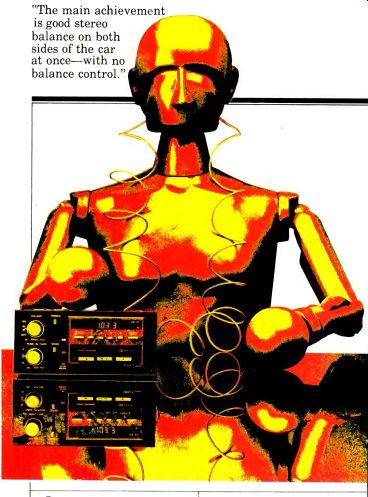
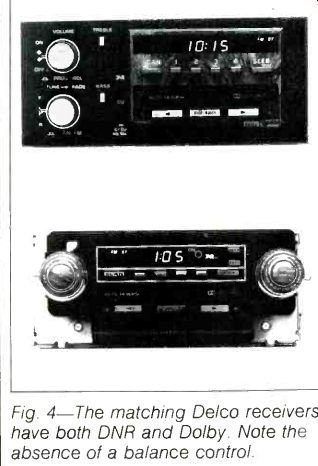
Fig. 4--The matching Delco receivers have both DNR and Dolby. Note the absence of a balance control.

Installing similar systems in existing cars might be possible, but only on an expensive, custom basis. Even assuming an installer had the computer equipment and expertise to perform similar analyses on individual cars, optimum speaker enclosure and placement might not be possible in many cases. In my own Saab, for example, the space where the front speakers would go in the Delco-GM/Bose system is occupied by the window crank and its associated mechanism. Even the cars for which the system is available will offer it only as a factory-installed option, since it requires a specially designed, specially routed wiring harness, according to GM, to avoid interference problems.
This much is sure: Morgan was the only one associated with this project that you could call a dummy.
(adapted from Audio magazine)
= = = =