The New Pluralism
DG's cross section of recent music gives signs of an emergent consensus: Anything goes.
by Robert P. Morgan
The music of the past ten years or so seems to show composers moving toward a new consensus, albeit a tentative one. Characteristically, it is not a question of the discovery and acceptance of a new musical language or style, but of the emergence of a tacit agreement that all the technical and expressive means of the past are now fair game, to be used either individually or in combination, as the requirements of a particular conception may dictate. Whatever else can he said about today's music, there is nothing doctrinaire about it; the old pressures for consistency, limitation, and restraint are gone. The new pluralism admits not only all of the varied possibilities of past and present Western concert music, but also those of popular and folk idioms drawn from cultures throughout the world.
Of course it was not always thus. In the early 1950s, the dogmas of serialism and indeterminacy held virtually exclusive sway among the more progressive young composers. And at the time, these two approaches seemed irreconcilably opposed: On the one hand a rigorous, quasi-scientific method of mathematical exactitude, on the other an essentially intuitive one with a decidedly irrational flavor. Perhaps the single most significant development of the postwar years was the gradual realization by composers of both stripes that serial ism and indeterminacy can he considered simply opposite extremes of an ultimately unbroken continuum of compositional possibilities. This opened up a period of radical experimentation in the 1960s in which the previously ignored middle ground was intensively explored. To be sure, serialism and indeterminacy were not discarded, but incorporated into a wider and more diverse range of compositional interests that encompassed textural music, trance music, quotation, collage, etc.
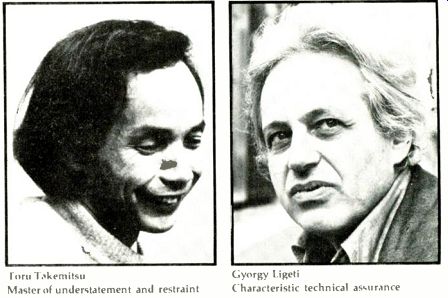
Takemitsu--Master of understatement and restraint; Gyorgy Ligeti Characteristic technical assurance
The 1970s brought no fundamental changes in compositional technique, only a shift in attitude toward the wealth of new possibilities already developed. As it became increasingly apparent that the number of foreseeable new compositional areas to he investigated was gradually shrinking to the vanishing point, more emphasis began to he placed on the integration of the techniques already available into a more consistent and communicative musical language. Recent music is more audience-oriented than that of the 1950s and '60s, but not because-as one keeps reading-composers have turned their backs on the radical methods of the immediate past. While this may be true of some (George Rochberg comes to mind), more typically composers seem interested in assimilating these methods and shaping them into a more direct and immediately accessible musical statement. Serialism is far from dead; indeed, evidence of its continued influence is everywhere apparent.
These thoughts were prompted by this large and varied group of recordings of contemporary compositions, the majority written within the past decade. Of the fifteen discs, all but two are part of a special release from Deutsche Grammophon. (Another reminder of the central role this label continues to play in the propagation of twentieth-century music; if only a major American company felt a similar responsibility!) All but three are devoted to music by Europeans. The exceptions, offering works by Japanese composers Toshiro Mayuzumi and Toru Takemitsu, reflect one of the most prominent characteristics of postwar music: its international--indeed, world-inclusive-quality. Both men belong to the generation of Japanese composers who reached maturity in the years immediately following World War II and who became interested in creating a synthesis of Western musical elements with aspects of their own musical and cultural heritage.
Mayuzumi is represented by two relatively early orchestral works, the Nirrma Symphony of 1958 and the Ma, 4atq Symphony, completed two years later. The former is the larger and more ambitious; purely orchestral segments alternate with sections featuring a male chorus in music derived from a type of Buddhist chant.
Mayuzumi juxtaposes and reconciles the harshness and austerity of the chant with the delicate timbre developments in the orchestral music-reminiscent of a toned-down Varese, though in fact inspired by the sound of Japanese temple bells-to produce a compelling image.
Mayuntmi's subtle transformations of color are taken significantly farther in Takemitsu's work. The four pieces here, all from the 1970s, are wonders of understatement and restraint. Working with most delicate manipulations of texture and articulation carried out almost exclusively at a soft yet varied dynamic level, Takemitsu produces a sort of latter-day musical impressionism.
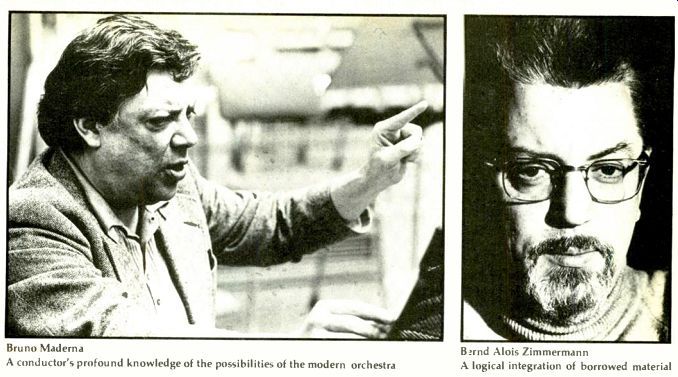
-Bruno-Maderna: A conductor's profound knowledge of the possibilities of the modern orchestra; Bernd Alois Zimmermann: A logical integration of borrowed material
The RCA and DG discs contain different versions of one composition. Quatrain, originally written for the Tashi ensemble (with which the composer has been closely associated) to perform with orchestra, was later reworked (as Quatrain II) for the chamber group alone. This is a beautifully paced work, which unfolds gradually through a process of continuously evolving variation. Although the two pieces are basically the same, the purely orchestral passages of the original version had to be extensively revised to render them idiomatic for the smaller group. Of the other Takemitsu compositions, I particularly like A Flock Descends into the Pentagonal Garden, a highly poetic orchestral creation in which his ability to give shape and substance to the most ephemeral musical materials shows to especially telling effect.
Of the European composers represented, Bruno Maderna resembles Takemitsu somewhat in general conception, but achieves radically different results. He also thinks primarily in terms of rich textural fields punctuated by lyrical moments; here however, the lyricism projects a very emotional character and occurs within the context of an intensely dramatic overall structure. These orchestral works were all written within the five years preceding Maderná s untimely death in 1973. He was a conductor of international reputation, specializing in contemporary music, and his profound knowledge of the possibilities of the modern orchestra is amply evident. All three pieces contain some degree of indeterminacy, but the frame within which choices are to be made is carefully specified; the purpose is to use complex rhythmic relationships to build textures of considerable density in which the exact positioning of individual details is of secondary importance. Typical is Quadrivium, a brilliant vehicle for four solo percussionists who play a wide variety of instruments.
The orchestra is divided into four roughly equal groups, each associated with one of the percussionists; and the score develops as an extended exploration of the possibilities of combination and opposition in this quadratic arrangement.
Luciano Berio's Coro 41976) reveals yet another facet of the internationalism of recent music. Almost an hour long, it contains thirty-one relatively short sections (which tend to get longer as the work progresses), each featuring a text in one of several languages (Italian, Spanish, French, German, English). Coro is aptly named: The chorus dominates each section, although the vocal articulation seems at times to be influenced by what is happening in the instruments. The composition principally is based on expressive and structural features derived from various types of folk music found throughout the world. Berio does not, however, use existing folk tunes (as he did, for example, in his Folksongs of 1964). Rather, as in his more recent Cries of London, he attempts to permeate the entire conception with the spirit of folk melody. His ability to sustain a structure of this length is impressive; effective transitions between the individual segments prevent formal fragmentation, and points of climactic emphasis produce a coherent larger shape. (Moreover, the consistency of approach places the work at some distance from another extended vocal piece, his 1972 Recital, which quotes liberally from virtually the entire range of Western vocal literature.) Although Coro has its problems, notably a failure to provide sufficient contrast over such a prolonged span, it suggests that Berio is moving in an important new direction-ultimately fruitful, I suspect.
Length becomes even more problematic in Stockhausen's Sternklang. Although this recorded version lasts more than two hours, it represents a considerably shortened form of the concert piece that consumed some three hours at its premiere performance in 1971. Another, more serious problem: A recorded rendition cannot reproduce essential aspects of the composer's original conception. Sternklang, written as open-air music, is scored for five separate small ensembles, each consisting of four performers, placed around a central percussionist at considerable distances ("as far as possible") so as to form the five points of a star. These groups interact, mediated by "sound-runners," who transport musical models from one ensemble to another; to coordinate it all, the percussionist (or "signalman") hammers out common tempos at appropriate intervals. The "Models," relatively simple rhythmic and intervallic patterns, are repeated, chantlike, in a mariner that will be familiar to those who know the composer's Stinnnung; but whereas Sti,nrnung was based entirely upon a single six-note chord, Sternklang uses five such vertical structures, all based on the natural harmonic series and performed in "pure" tuning. Thus, there is a good bit more harmonic variety than in the older work, although the rate of harmonic change is still extremely slow. Clearly, Sternklang needs to be not only heard, but seen-indeed, experienced as a total musical, spatial, and dramatic entity that aspires to become ritual.
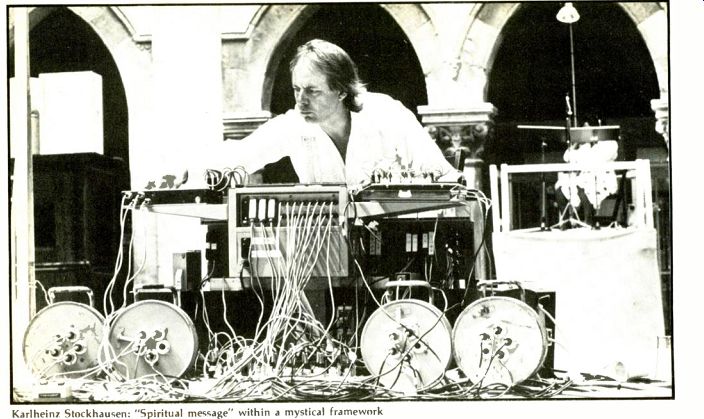
--------- Karlheinz Stockhausen: "Spiritual message" within a mystical framework
Much more successful is Stockhausen's Sirius (1977), an almost equally extended work for soprano, bass, trumpet, bass clarinet, and electronic sounds, based on the twelve "melodies of the zodiac" (one for each astrological sign). These melodies, originally produced by Stockhausen for Musik iet Baurll (1975), were meant to be played by music boxes. (A Swiss company actually manufactures a different box for each.) But here they have texts and are intended for live performance. And whereas the original melodies were formally complete in themselves, here they function as the principal source for elaborate variations and transformations, each controlling one
' of the twelve sections of the central segment of the work. This segment is entitled "Das Rad" ("The Wheel"), as the whole set can be rotated to begin a given performance with the sign appropriate to the time of year. There are also hvo briefer sections, an opening "Presentation," in which each performer is "introduced," and a closing "Annunciation," during which the composition's basic message is verbally delivered.
This mystical framework is typical of Stockhausen's recent output, as is the "spiritual message," apparently transmitted to earth from the star Sirius through one Jacob Lorber. I can't quite take all this seriously (although Stockhausen obviously does), yet at least in this instance, the musical results are impressive indeed. The unusual inventiveness of the complex and interesting relationships drawn from the basically simple zodiac tunes gives rise to a work that reveals new and unexpected secrets with repeated hearings.
Which brings us to the keyboard pieces. The Kontarsky brothers' duo-piano recording offers music by Bernd Alois Zimmermann and Gyorgy Ligeti. Zimmermann, not well known in this country (he killed himself in 1970), is represented by his Perspektiven and Monologe. The former is in two distinct parts, dating from 1955 and 1956, respectively; written under the spell of Webern and integral serialism, both nevertheless reveal a growing interest in the organization of musical sound in terms of large-scale blocks rather than discrete, pointillistic units. Monologe, a later version of a 1960 composition for two pianos and orchestra called Dialoge, is more individual.
The same year Zimmermann completed his magnum opus, the opera Die Soldaten. with which Monologe shares a juxtaposition of serially structured music with quotations from the standard literature. One of the first composers to think along these lines, he integrates the borrowed material into his own encompassing conception with a logic that is all too rare.
Ligeti's Three Pieces, entitled Monument, Selhstportrait, and Beroegungand written in 1976, are to date his only works for piano. All three movements are essentially light in character, yet they reflect the unusual level of musicality and technical assurance characteristic of this composer.
The middle piece, for example-in translation, the full title runs "Self-Portrait with Reich and Riley (and with Chopin also Present)"--is an affectionate evocation of facets of the three composers (e.g., Riley's pattern transformation, Reich's phase shifting, and the whirlwind rhythmic continuum of the finale of Chopin's B flat minor Piano Sonata), combined with Ligeti's own techniques of canonic and textural juxtaposition, in a work of true rhythmic inventiveness and insistence.
Finally, Pollini's five-disc set of twentieth-century piano music can be considered briefly, since all of these recordings have appeared previously. The set covers a considerable range of music written in this century, including three works from the postwar period. Boulez' Second Sonata dates from 1948, the composer's twenty third year, but already shows strong personal character. Though technically it owes much to Webern (who had then only recently been "discovered" in France), it also reveals the mark of Schoenberg in its extended scope and dramatic range.
The two works by Luigi Nono are more recent and were written especially with Pollini in mind. Como usu ola de fuerza y luz (1971) is a large-scale conception for soprano, piano, orchestra, and electronic tape (the latter consisting mainly of manipulations of prerecorded female voices and piano playing). Dedicated to the slain Chilean revolutionary Luciano Cruz and based on a poem about him by the Argentinian poet Julio Huasi, this dramatic and moving lament builds to a climax of overwhelming intensity (presumably portraying the "wave of power and light" of the title).
... Sofferte onde serene ..., completed five years later, uses piano and tape alone. Although it resembles the earlier piece in its investigation of relationships between Pollini's actual playing and its electronic transformation, it seems considerably more neutral in character and more static in harmonic conception.
The other material, dating from the first half of the century, includes almost the complete piano works of the Second Viennese School (only Berg's early Sonata, Op.
1, is missing), the first two of Bartók's three piano concertos, Prokofiev's Seventh Sonata, and Stravinsky's arrangement of three pieces from Petrushka. This makes an interesting and varied group, one that effectively illustrates the remarkable changes in keyboard writing that took place early in the century (as remarkable in their own way as the more recent extensions evident in the Ligeti and Nono compositions). Especially well represented is the new "percussive" approach apparent in the works of Stravinsky, Bartók, and Prokofiev. But ultimately more revolutionary, perhaps, is the rethinking of pianistic possibilities found in the works by Schoenberg and Webern, both of whom, guided by a radically new conception of musical organization, produce keyboard distributions far removed from anything previously envisioned.
I have said nothing yet about the performances. Since all are quite good, I will confine myself to mentioning the few that stand out. Most impressive is the Pollini set, which illustrates this artist's ability to deal effectively with an extraordinary range of literature, meeting each work on its own terms and bringing to it a penetrating insight and an apparently infallible technique. (He also deserves mention as the only pianist I can think of who, having established a major reputation as a performer of standard keyboard literature, continues to explore a varied body of twentieth-century music.) Finally, the Tashi quartet and Kontarsky duo must be singled out for the remarkable care, precision, and sensitivity they bring to their performances. But all of these discs are well done, and collectively they offer an arresting view of a significant cross section of the music of our time.
MAYUZUMI: Nirvana Symphony*; Mandala Symphony'. Japan Chorus Union*, NHK Symphony Orchestra, YOzó Toyama* and Kazuo Yamada', cond. PtiiLiPs 9500 762, $9.98. Tape: 7300 841, $9.98 (cassette). TAKEMITSU: Quatrain; A Flock Descends into the Pentagonal Garden.
Tashi, Boston Symphony Orchestra, Seiji Ozawa, cond. [Rainer Brock, prod.) DEUTSCHE GRAMMOPHON 2531 210, $9.98.
TAKEMITSU: Quatrain II; Water Ways; Waves. Tashi; various performers. [Max Wilcox and Peter Serkin, prod.] RCA RED SEAL ARL 1-3483, $8.98. Tape: ARK 1-3483, $8.98 (cassette). MADERNA: Aura; Biogramma; Quadrivium. North German Radio Symphony Orchestra, Giuseppe Sinopoli, cond. [Rudolf Werner, prod.] DEUTSCHE GRAMMOPHON 2531 272, $9.98.
BERIO: Coro. Cologne Radio Chorus and Symphony Orchestra, Luciano Berio, cond. [Rudolf Werner, prod.] DEUTSCHE GRAMMOPHON 2531 270, $9.98.
STOCKHAUSEN: Sternklang.Various singers, instrumentalists, and synthesists, Karlheinz Stockhausen, dir. [Rudolf Werner, prod.] DEUTSCHE GRAMMOPHON 2707 123, $19.96 (two discs, manual sequence). STOCKHAUSEN: Sirius.
Annette Meriweather, soprano; Boris Carmeli, bass; Markus Stockhausen, trumpet; Suzanne Stephens, bass clarinet; Karlheinz Stockhausen, dir. and electronic realiz. [Rudolf Werner, prod.
DEUTSCHE GRAMMOPHON 2707 122, $19.96 (two discs, manual sequence). LIGETI: Three Pieces for Two Pianos. ZIMMERMANN: Perspektiven; Monologe.
Alfons and Aloys Kontarsky, pianos. Rudolf Werner, prod. DEUTSCHE GRAMMOPHON 2531 102, $9.98.
MAURIZIO POLLINI: Piano Music of the Twentieth Century. Maurizio Pollini, piano; Chicago Symphony Orchestra, Claudio Abbado, cond. ; Slavka Taskova, soprano'; Bavarian Radio Symphony Orchestra, Claudio Abbado, cond. . [Rainer Brock and 'Karl Faust, prod.] DEUTSCHE GRAMMOPHON 2740 229, $49.90 (five discs, manual sequence) [from various DG originals, 1972-79]. BARTOK: Concertos for Piano and Orchestra, Nos. 1 and 2. BOULEZ: Sonata for Piano, No. 2. NONO: Como una ola de fuerza y luz'; ... Sofferte onde serene... . PROKOFIEV: Sonata for Piano, No. 7, in B Flat, Op. 83)
SCHOENBERG: Piano Works: Three Pieces, Op. 11; Six Little Pieces, Op. 19; Five Pieces, Op. 23; Suite, Op. 25; Pieces, Opp. 33a and 33b.
STRAVINSKY: Petrushka: Three Movements)
WEBERN: Variations for Piano, Op. 27.
-----------------
(High Fidelity, Mar 1981)
Also see: