.
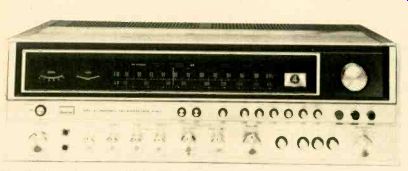
The Equipment: Sansui Model QRX-7001, a four-channel stereo FM/AM receiver, including QS and SQ matrix de coding and CD-4 demodulation, in metal case with wood top. Dimensions: 21 1/4 by 6 3/4 inches (front panel); 15 3/4 inches deep plus allowance for controls and connections. Price: $879. Warranty: two years for parts, one year for labor (exterior styling elements excepted), shipping not included. Manufacturer: Sansui Electric Co., Ltd., Japan; U.S. distributor: Sansui Electronics Corp., 55.11 Queens Blvd., Woodside, N.Y. 11377.
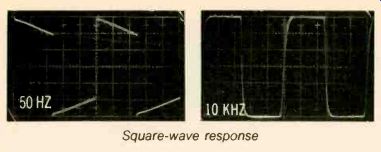
----------Square-wave response
Comment: We've been waiting for this one for quite some time. It includes Sansui's Vario-Matrix circuitry, which is similar in intent (though not in operation) to "logic" in matrix decoders. The logic circuits lean heavily on what is known as "gain riding"-electronics that automatically ad just levels in the four channels from moment to moment to achieve a psychoacoustic effect of increased separation;
Vario-Matrix varies the blend coefficients of the matrix circuitry instead, also for the purpose of giving an impression of greater separation in the perceived sound of complex quadraphonic placements. The present Vario-Matrix system evidently is the result of some refinement by Sansui and its semiconductor suppliers. Interim versions have been used in demonstrations for many months and appear to have been built without benefit of the full integrated-circuit complement or the precise circuitry incorporated in the QRX-7001.
It's not just a matrix decoder unit, of course, but an exceptionally versatile receiver. The FM scale (with Sansui's usual equidistant spacing between channels) and that for AM are below a series of lighting indicators, one for stereo FM reception and the remainder for operation mode, including one that lights up on detection of a CD-4 carrier. At the left of the dial are signal-strength and channel-centering meters; to the right are a 2-/4-channel indicator and the tuning knob.
Immediately below the dial are power on/off switch, high and low filter buttons, mode buttons (CD-4/discrete, SQ, QS. surround synthesizer, hall synthesizer, 2-channel front-only, and a back-on switch for stereo use), and three coin-slot rotary controls for adjusting CD-4 performance (carrier level, left separation, right separation).
Across the bottom are the remaining controls. The speaker switch has positions for two sets (separately or together) and off. Stereo headphone jacks are provided for front and back signal pairs. There are separate calibrated bass and treble controls for front and back signal pairs, ganged front and back left/right balance controls, and a separate front /back balance. The remaining knobs are for volume and selector (phono, FM auto, FM mono with no muting. AM). Between them are pushbuttons for loudness compensation, tape monitors 1 and 2, and aux input selection.
The aux and both tape inputs are quadraphonic sets, as are both tape outputs; the phono input is, of course, stereo only. All are pin jacks. There is a DIN input/output jack as an alternate for the tape-2 front connections. An FM discriminator output (another pin jack) is provided for a quadraphonic broadcast adapter, should a discrete method be approved by the FCC. Antenna connections for 300-ohm FM lead-in or long-wire AM are knurled binding posts that accept bared wires or spade lugs: a screw-and clamp connector is provided for 75-ohm FM antennas. The speaker terminals are the spring-loaded type intended for bared-wire leads. There are two AC convenience outlets, one of which is swi7ched by the QRX-7001's on/off button.
In ,:he lab the electronics with which the receiver accomplishes all its basic tasks turn out to be better than the specifications in all but a few particulars. The amplifier section, for example, is rated at 35 watts per channel (a good deal of muscle as 4-channel receivers go) at 0.4% THD. It meets these specs with room to spare at all test frequencies and output levels. Intermodulation, too, is well below the 0.4% spec, and response is both more linear and broader in range than the specs suggest.
In the FM section the mono performance exceeds the specs (although capture ratio, at 2.3 dB, proved a little poorer than the claimed 1.5 dB) and the mono quieting curve is exemplary for a product of this type. Stereo performance is not as good. Response and separation both are excellent. But distortion in our test sample, even at 1 kHz, measures a little higher than the under-0.5% specified and presumably contributes to the unimpressive stereo quieting curve, which shows that fairly strong (55-microvolt) signals are needed to receive stereo at all and that noise and distortion remain somewhat higher than ideal (50 dB of quieting constitutes fine performance; our test sample measures about 40 dB) even at high signal strengths.
The proof of this particular pudding is in its quadriphonic performance, however. The Vario-Matrix is certainly among the most satisfactory matrix decoders we have worked with. It does enhance apparent separation and closely approximates the unequivocal placements of discrete quadriphonics. But like even the best SQ logic systems, it is not without some audible side effects; specifically, there are times when one can hear the Vario-Matrix "action" working. We have yet to encounter an enhanced matrix playback system about which we have not-in some setup and with some program material-found this to be true. But we have heard none demonstrably superior to Vario-Matrix.
The data for QS performance most vividly suggest what Vario-Matrix will do. Those for SQ are not as good, though in theory (and assuming equally well designed basic matrix circuits) the system should enhance both equally. The limiting factor here appears to be the SQ matrix section itself, rather than the Vario-Matrix enhancement applied to it.
In QS, then, Vario-Matrix achieves approximately Sansui's talked-about design goal of 20 dB of separation among all four channels at 1-kHz. In testing with "center" signals (equal signals recorded in adjacent pairs of channels) the separation measures about 20 dB or better front-to-back and back-to-front, in the neighborhood of 10 dB side-to-side. Separation figures in this latter test measure only about half as good in SQ. Noise and distortion measurements also are not quite as good in SQ as in QS.
A comparison of response and separation figures measured through the QRX-7001 show good linearity: better than ±3 dB in all channels but right front for QS, and all but left back in SQ. Note that phono signals do not reach the matrix section via the CD-4 demodulator in the 7001 (unlike some quadriphonic receivers) and hence suffer no CD-4 band-limiting or level-adjustment attenuation. Mid range separation, too, confirms the fine 20-dB figure.
"Midrange" here (and in both QS and SQ) should be taken as the range between about 400 and 6,000 Hz. Beyond these points the separation dissolves quite rapidly in most of the measurements-as it does in other quadriphonic equipment (including CD-4) we've measured. (As we've pointed out before, it is the midrange in which the primary aural localization clues take place; separation outside this range is far less important for that reason.) The midband separation figures shown under "Additional Data" are, of course, all "worst-case." For example the 7 3/4 dB of QS separation shown in the LF channel was measured at 6 kHz with an LB input; other separation figures with this input, and those with the RF input, were approximately twice as high, while those with the RB input all were above 29 dB.
The CD-4 demodulator section of the QRX-7001 is un like any we've tested before. Using our "standard" JVC pickup and the setup disc supplied with the receiver (and cut for Sansui by JVC) as a reference, we had difficulty achieving optimum settings of the subcarrier and separation adjustments. With one sample we lost subcarrier lock altogether in trying to adjust separation with Sansui's disc.
But with regular Quadradiscs, we have used two samples for satisfactory playback with a variety of cartridges. In one instance we found we were getting adequate quadriphonic reproduction with a regular stereo cartridge, though the demodulator had been preset for a different (CD-4) pickup! And curiously, poor settings of the CD-4 adjustments for the cartridge in use made themselves felt more as a loss of clear separation than as the gross distortion that we have experienced with other demodulators. Hence Quadradisc reproduction with a poorly adjusted setup seems less likely to be aurally offensive with the QRX-7001.
The data shown in the curves and under "Additional Data" were measured by setting up the unit using our own test record (rather than the supplied record) and a certain amount of cut-and-try. We ended up with the carrier adjustment set three calibration points below full clockwise rotation and the separation controls full clockwise. The optimum setting will, of course, vary with the cartridge used; those having a higher output should be easier to set up for that reason.
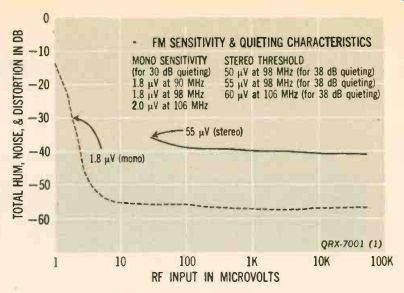
---------RF INPUT IN MICROVOLTS
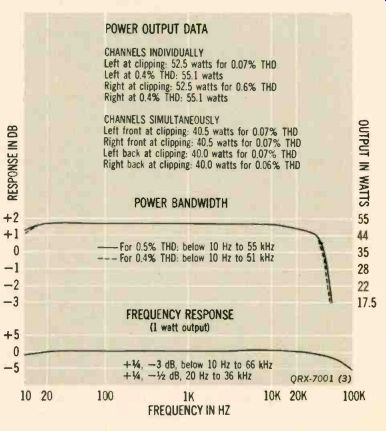
-------- FREQUENCY IN HZ
-------
Sansui QRX-7001 Additional Data Figures shown are "worst-case"; average separation within the specified range is much better. See text for example.
S/N measurements are unweighted. When hum was filtered out, the two matrix-decoder sections measured about 1 to 2 dB better in all channels; the CD-4 demodulator measured considerably better (by 3 to 4 dB in the left channels, 11 dB in both right channels), indicating that hum is a relatively large component of the total noise-though, because of its low frequency, not necessarily of the audible noise-in the demodulator.
------------
We had been highly impressed with past Vario-Matrix descriptions and public demonstrations and had hoped to find this receiver the best all-around quadriphonic model to date. In working with specific samples we can say unequivocally that the QRX-7001 easily has the finest QS section around, and its simulation section (the hall and surround effects) is probably the most versatile and useful of any on the market. But our reservations about the CD-4 and SQ sections prevent declaring this model a clear winner. It represents, rather, one important development in the current state of the quadriphonic art.
-------------
(High Fidelity, Jul. 1975)
Also see:
Onkyo A-7 Integrated Amp (Equip. Profile, Nov. 1977)
Equipment in the News (Jan. 1976)