The Lighter Side : Freda Payne ... Paul Simon ... Elton John ... Barry Manilow
reviewed by MORGAN JAMES ROYAL S. BROWN HENRY EDWARDS MIKE JAHN JOHN S. WILSON
---------------
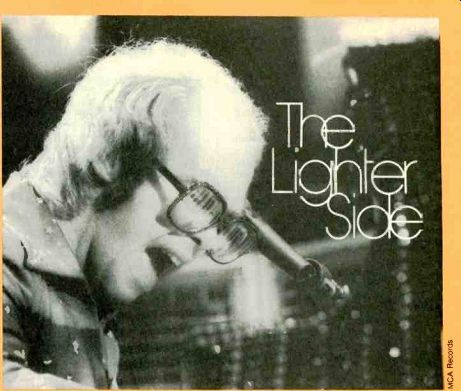
Elton John--an album that works musically in spite of the lyrics.
PAUL SIMON: Still Crazy After All These Years. Paul Simon, guitar and vocals; vocal and instrumental accompaniment. Still Crazy After All These Years; My Little Town; I Do It for Your Love; 50 Ways to Leave Your Lover; Night Game; Gone at Last; Some Folks' Lives Roll Easy; Have a Good Time; You're Kind; Silent Eyes. [Paul Simon and Phil Ramone, prod.] COLUMBIA P C 33540, $6.98. Tape: PCT 33540, $7.98; PC A 33540, $7.98.
ELTON JOHN: Rock of the Westies. Elton John, piano and vocals; Ray Cooper and Roger Pope, drums; Davey Johnstone and Caleb Quaye, guitars; James Newton Howard, electric piano and synthesizer; Kenny Passarelli, bass; vocal accompaniment. Medley; Dan Dare (Pilot of the Fu ture); Island Girl; Grow Some Funk of Your Own; I Feel Like a Bullet (in the Gun of Robert Ford); Street Kids; Hard Luck Story; Feed Me; Billy Bones and the White Band. [Gus Dudgeon, prod.] MCA 2163, $6.98. Tape: NO C 2163, $7.98; $7.98.
Rock music, like basic black in fashion, can hide a multitude of sins-such as poor lyrics. In rock that is played at any appreciable level of intensity, the words cannot be heard, except perhaps for a snatch here and there or a phrase that's repeated often enough to emerge through the clamor.
There are lyricists who have come up with some brilliant songs, but then a hundred of their mediocre ones slip in under the same blanket simply because they are masked as concerns the casual listener. A case in point is Bernie Taupin, lyricist for British rock pianist and singer Elton John.
While one declines to call any of his works brilliant, he has produced several gems, among them "Your Song," "My Father's Gun," and "Mona Lisas and Mad Hatters." John gives the man much credit, as in a notation from the sleeve of ' Rock of the Westies": -Without Taupin. E John would be serving pig swill to out-of -work cub-masters." Not true, according to a close examination of the texts of the newest f ohn/Tau pin LP. Including the printed words may be likened to a passer of bad checks attaching his confession to the checks.
Ore nine songs here, only three have much to offer, and even they aren't making new points. " Island Girl. ' is about a prostitute: "Grow Some Funk of Your Own" is about a fight over a girl. And "Street Kids” is pretty much as ii sounds.
Still, "Rock of the Westies” works musically, in spite of the lyrics. John's melodies, singing, and ability, to assemble one of the finest backup bands in rock carry it.
Paul Simon is quite a different matter.
His rock is relatively soft and at no time buries the lyrics. His newest recording, "Still Crazy after All These Years," is yet another sterling testimony to his abilities.
But which abilities? Performance, music composition, or lyric-writing/ The first two of these talents are unquestioned. But, while Simon has not to my recollection written a bad lyric, he seldom has written anything of real Eteary merit.
Even his best work tends to start strong and then drift off, as if the idea was his main interest. The title song illustrates this. The lyric doesn't say one bit more t.`. - :an can be garnered from reading the title, yet it comes off as deeply affecting. Simon is a much better lyricist than Bernie Taupin, and he doesn't hide his verbal insufficies, relying instead on emotional sing- nig at a smart turn of the arrangement to complete musically what he is unable to complete verbally One comes away from the experience entertained-at times moved-tut one re members the feeling, rather than any specific lyric.
If I appear to b€ picking nits, that is deliberate. Both of these recordings are in fact very good ones, among the best pop product to appear in months. And that is the point: Over the past decade so-called progressive rock has gotten something of a free ride as far as lyrics are concerned. Each of these records offers a different approach to lyrics and lyricism, and what to do with lyrics when they go awry. The whole question demands a good deal more attention than it has received, which means, for starters, listening a little more closely. M.J.
ARETHA FRANKLIN: You. Aretha Franklin, vocals; vocal and instrumental accompaniment; Gene Page, arr. Walk Softly; Mr. D.J.; The Sha-la Bandit; seven more. [Jerry Wexler and Aretha Franklin, prod.] ATLANTIC SD 18151, $6.98.
Tape: CS 18151 $7.97; TP 13151, $7.97.
There seems to be no musical situation in which Aretha Franklin cannot sing her best-and Arena's best is still the best. Like Ray Charles, she goes across all the boards.
------------------------
John F. Indcox
Aug. 27, 1902- Dec16. 1975
HIGH Fidelity’s first record reviewer and longtime theater and film record receiver
---------------------
The levels on which Franklin sings this time are quickly established on the first track of each side. Side 1 begins with her successful single, "Mr. D.J.," which she wrote; Side 2 begins with "Without You"- much energy, little song. The album was cut on the West Coast with arranger Gene Page, currently best known for his work with Barry White, though he was a heavy worker for many years before the Barry White period. He is a solid and supportive arranger, and he brought in a dependably funky rhythm section including David T. Walker, Ray Parker, Clarence McDonald, Scott Edwards, and Ed Greene. Also featured is Aretha's angel choir: Margaret Branch, Brenda Bryant, and Pam Vincent (with Cissy Houston too). The stage is set; here comes Aretha, strong and focused, sweetly abandoned.
And yet something is wrong. Aretha just rubs her magic on, no matter what the quality or intent of the song. I guess that's called professionalism, but the magic is so port able, so package-able. The album is stingy with real material-presumably a concession to "commercial reality." There are only two outstanding songs: Aretha's "Mr. D.J." and Van McCoy's "Walk Softly" ("Now that I've cried my love to sleep, don't wake it up-). The rest are automatic, stale, dull, corny, and full of lies.
I could listen to Aretha Franklin sing a dial tone. But it follows naturally: The more the song, the more the singer. We're ready when you (Franklin? Jerry Wexler? Atlantic Records?) are. M.A. DONOVAN. Donovan Leitch, guitar and vocals; instrumental accompaniment. Universal Soldier; Colors; Catch the Wind; Donna, Donna; Sunny Goodge Street; seven more.
PYE 502, $6.98.
THE SEARCHERS. Tony Jackson, bass and vocals; Chris Curtis, drums; John McNally, guitar; Mike Pender, guitar. Needles and Pins; Don't Throw Your Love Away; Take It or Leave It; Love Potion Number Nine; eight more. [Tony Hatch, prod.] PYE 501, $6.98.
Pye Records is a major British label that, like most British labels, would like to make a mark in the U.S. Its most recent effort is a reissue series titled "The Pye History of British Pop Music," which provides examples of the music of the pop groups involved in the so-called "British invasion" that occurred in the wake of the Beatles' American debut in 1964.
Donovan and the Searchers were a major part of that invasion. Donovan's mark was made in terms of modified folk music, while the Searchers dealt in what was, a decade ago, fairly standard British rock. Both of these albums are valuable to those interested in the pop music of the 1960s. The 1950s have long since been ground up by the nostalgia mill, and now it is time to reminisce over what seemed to be, in the words of the Seven-Up commercial, "a time of agonizing reappraisal." The Donovan LP is fairly representative of his early recordings, with his original version of "Catch the Wind" shining through. The Searchers' popularity did not last as long as did Donovan's, yet the band produced some pretty music. Its best- known song, "Needles and Pins," leads off this collection, but its version of the fairly obscure Rolling Stones tune "Take It or Leave It" is worth noting. M.J.
AMERICA: History ( America's Greatest Hits). America, vocals, keyboards, guitars, and bass; strings, rhythm, and vocal accompaniment. A Horse with No Name; I Need You; Ventura Highway; nine more. [George Martin, prod.] WARNER BROS. BS 2894, $6.98. Tape: f M 52894, $7.97; 01,M 82894, $7.97.
Part of the enjoyment of most "greatest hits" collections is the opportunity to trace the evolution of the artist's work in the concentrated form of a single LP. In the case of America, "History" demonstrates that rousing melody has characterized the group's career from its very beginning. This trio, all of whose members sing, play, and write, also has the ability to create pleasing lyrics dealing with love-found, lost, and unrequited. Then, too, these are three harmonious, plaintive voices. The result is un beatable. To ice this agreeable cake, add George Martin's clean, crisp, energetic production, in a class by itself.
Ranging from the merely pleasant ("Only in Your Heart") to the truly moving ("Sister Golden Hair" and "Lonely People"), America demonstrates that over four years it has produced music that is essentially the same. The group has not progressed; it has not regressed. It has consistently used its own successful formula, and the formula still works. When you have a winner, why look for variations? H.E.
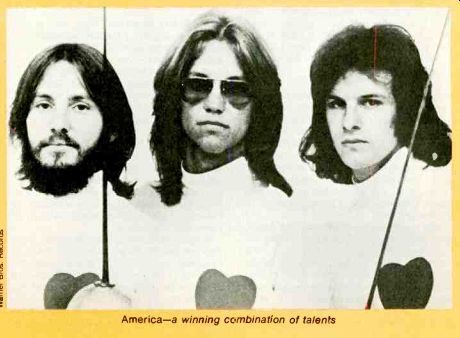
-----America--a winning combination of talents
===============
Critics Choice: The best pop records reviewed in recent months
BILL BLACK'S COMBO FEATURING BOB TUCKER: The World's Greatest Honky-Tonk Band. Hi LONDON SHL 32093. Jan.
CLAUDE B OLLING: Suite for Flute and Jazz Piano. Columbia M 33233. Dec.
A CHORUS LINE. COLUMBIA PS 33581. Nov.
ROGER DALTREY: Ride a Rock Horse. MCA 2147. Nov.
BLOSSOM DEARIE 1975. DAFFODIL BMD 102. Jan.
STEPHANE GRAPPELLI. PYE 12115. Jan.
JACKIE MCLEAN: Jackknife. BLUE NOTE LA 457H2 Nov.
MIKLOS ROZSA CONDUCTS His GREAT F ILM MUSIC. POLYDOR SUPER 2383 327 Jan CECIL T AYLOR: In Transition. BLUE NOTE LA 458H2. NOV. TINA TURNER: Acid Queen. UNITED ARTISTS LA 495G. Dec.
TIM Weisseito: Listen to the City. A&M SP 4545. Dec.
LESTER YOUNG: The Aladdin Sessions. BLUE NOTE LA 456H2 Nov.
============
HOT TUNA: Yellow Fever. Jorma Kaukonen, vocals and guitars; Jack Casady, bass; Bob Steeler, drums. Baby What You Want Me to Do; Hot Jelly Roll Blues; Free Rein; five more.
[Hot Tuna and Mallory Earl, prod.]
GRUNT BFL 1-1238, $6.98. Tape: 40 BFK 1-1238, $7.95: BFS 1-1238. $7.95.
This latest incarnation of Hot Tuna falls somewhere between the Grateful Dead and Canned Heat in that spectrum of flashy sounds labeled the " San Francisco sound." With "Yellow Fever," onetime Jefferson Airplane members Jorma Kaukonen and Jack Casady, together with drummer Bob Steeler, make music aimed at the groin rather than the head. "Yellow Fever" is in fact far more direct in its approach than the band's last disc, " America's Choice." Here the music is totally visceral, with none of the spacey, laid-back feeling of the earlier record-familiar too from the antics of the Jefferson Airplane and its successor, the Jefferson Starship.
"Baby What You Want Me to Do," the LP's opener, is a prime example of what Hot Tuna is up to this time around. Rough guitar and even rougher bass are held back only by the drums, played in the style of such drummers as Ginger Baker and Clive Bunker. In addition, Kaukonen's vocals provide another point of difference between this band and the many hot and heavy boogie bands that took up residence in the San Francisco Bay area during the late Sixties. His soft voice provides a unique, engaging contrast to the band's thunderous musical shenanigans, which make even "Jelly Roll Blues" take on an in discriminately rough edge.
While this approach will surely attract a good number of the heavy-metal kids who now subsist on a musical diet of Aerosmith and Montrose, the sound might grate on older Tuna fans who remember fondly the more airy sounds of yore. A little more variety could keep both camps happy. H.E.
CARMEN. Eric Carmen, lead vocals, piano, synthesizers, guitar, and harpsichord; strings, synthesizers, keyboards, horns, and vocal accompaniment. Sunrise; That's Rock 'n Roll; Never Gonna Fall in Love Again; seven more. [Jimmy lenner, prod.] Arista AL 4057, $6.98. Tape: H 5301-4057, $7.95; H 8301-4057, $7.95.
Even though the Raspberries was probably the most talented of the early-Seventies American bands that based its musical sounds on its more successful English counterparts, poor management and an un sympathetic record company prevented it from progressing past cult status. When the group disbanded, after its "Starting Over" LP achieved rave reviews but no sales, lead singer/composer Eric Carmen decided to try his luck solo.
The result is a craftsman-like first effort, but the unevenness of Carmen's writing de tracts from the disc's over-all impact. As a writer, he takes his lead from the Beach Boys and the Beatles, with songs that deal with scenes from a harried teen's existence: playing in a neighborhood rock band ("That's Rock 'n' Roll") and sitting by the telephone waiting for a call from his girl-friend ("Last Night"). The subjects are banal: the songs Carmen draws from them are far from earthshaking. Musically, the disc represents a variety of styles. Classical piano appears in a three-minute interlude on "All by Myself': Rolling Stones-style guitar figures are the musical peg of "No Hard Feelings": electronic wanderings set the mood for "Sunrise"; "Great Expectations" is nothing more or less than a standard Broadway show tune.
Only Jimmy lenner's production remains consistent throughout the LP: it shines even through the leanest moments. Yet lavish production itself can do only so much be fore it too grows wearisome. Carmen must write more songs like "Starting Over," from his Raspberries days; that would take the production pressure off lenner and allow him to relax just a bit. Then we'll have the extraordinary disc that Raspberries fans have been waiting for. H.E.
BARRY MANILOW: Tryin' to Get the Feeling. Barry Manilow, vocals and pi ano; keyboards, strings, rhythm, and vocal accompaniment. New York City Rhythm; Tryin' to Get the Feeling Again; Why Don't We Live Together; eight more. [Ron Dante and Barry Manilow, prod.] ArisTA AL 4060, $6.98. Tape: 40 H 5301-4060, $7.95; Of. H 8301-4060, $7.95.
It's hard to find fault with Barry Manilow.
With two earlier discs, he created for him self a musical reputation almost univer sally associated with "middle of the road" rock and along with it an amazing string of three smash singles that have attracted an ever-growing concert audience made up of teens and adults alike.
Manilow's dazzling success stems from two sources. On stage, he exhibits the kind of appeal that Cher would give her eyeteeth for. And on his previous LPs, his songs-his own compositions and those by others- demonstrate the power of a potent melody with an infectious musical motif. It's no surprise, therefore, that his new release is one of the catchiest-sounding discs in quite some time.
"Tryin' to Get the Feeling" captures a listener's attention on two planes. "New York City Rhythm" and "Bandstand Boogie" are sprightly, rhythmic numbers that grab you by the ankles and almost compel you to dance. They are designed specifically to get a crowd up, moving, and screaming. In contrast, "Lay Me Down," "As Sure as I'm Standing Here," and the title cut are, like Manilow's biggest hit, "Mandy," romantic and mushy enough to make any teenage female's heart pound. Plaintive vocalizing by Manilow backed by Ron Dante and the Flashy Ladies, soft piano and strings, ripe melodies and memorable motifs-it all adds up to a tour de force.
"Tryin' to Get the Feeling" will delight Manilow's devoted fans. It should also win some new ones. H.E.
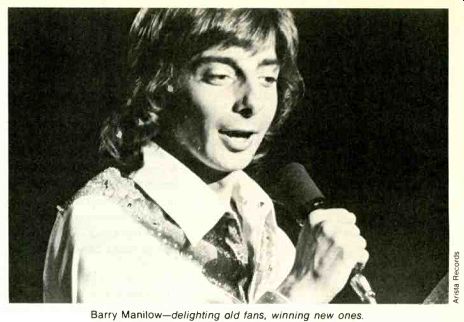
------Barry Manilow-delighting old fans, winning new ones.
DRACULA. Four scenes read by David McCallum and Carole Shelley; directed by Ward Botsford. CAEDMON TC 1468, $6.98.
Bram Stoker was an Irish writer who "made it" at age fifty, when his Gothic horror romance Dracula was published in 1897. He produced no other significant works, though he hardly had to: Dracula was enough to keep him in Guinness for the rest of his life.
This latest representation of Dracula is a good one indeed. David McCallum and Ca role Shelley read their parts well, with the feeling created by Stoker and without the false melodrama familiar to viewers of the many Dracula movies. McCallum, who achieved his principal fame playing popular TV and TV-type roles, here exhibits considerable ability for serious work. Director Ward Botsford, like the actors, distinguishes himself by keeping hands off.
There are, praise be, no special effects at all-no howling wolves, no creaking doors.
There is only the majesty of Stoker's prose.
M.J.
FREDA PAYNE: Out of Payne Comes Love. Freda Payne, vocals; horns, rhythm, strings, and vocal accompaniment; Ron Stockert, Jimmie Haskell, and Ben Benay, arr. / Hear Rumors; Look What I Found; Million Dollar Horse; six more. [Bob Monaco, prod.] ABC ABCD 901, $6.98. Tape: H 8022-901, $7.95.
For those of us hooked on the record business, one beautifully done project can wipe out the effect of twenty dead ones. This al bum by Freda Payne is easily one of my favorites for the year. What's more, it succeeds across the board, from look to content to intent.
Freda Payne has had an odd, stop-start sort of recording career. She had several hits in the r&b mold some years ago, but they were so formula-ized as to be faceless.
This never worked for Payne; she has too much face. She never got the personal treatment she needed. Till now. This album was produced by Bob Monaco, who produces Rufus, a group that has never made a bad LP. I do not know Monaco, but I will vouch for his style: He goes for the throat, in the nicest possible way.
Payne's new release combines her class, her sass, and her ease with high-energy market material. She sounds a bit like Melba Moore: I'll bet the two appreciate each other. Payne is beautifully supported by a West Coast rhythm section including Ron Stockert on keyboards. Dennis Belfield on bass (both members of Rufus). and Mickey McMeel on drums. Another equally fine rhythm section used is Scott Edwards on bass, 011ie Brown on drums (both from L.T.D.), and Ben Benay and Jimmy Benson on guitars.
Stockert wrote a particularly good string arrangement for "You Brought the Woman out of Me," sort of a "Son of Ode to Billie Joe" string sweetener written so often by Jimmie Haskell, whose arrangements ap pear elsewhere on this set and still work.
The material is consistently strong and to the point. It comes from such diverse sources as Paul Williams. Ashford and Simpson, and Lambert and Potter, but it is all chosen brilliantly and matches up some how.
A special nod must be given to the graph ics on the jacket, and on every ABC album I have received since. I don't know what's going on over there, but these covers are superb. Freda's is a concept cover designed by Earl R. Klasky and wonderfully photo graphed by Antonin Kratochvil at Cyrano, an atmospheric restaurant on Sunset Boulevard in Hollywood.
LESLIE WEST BAND. Leslie West, guitar and vocals, Corky Laing, drums; Mick Jones, guitar; Don Kretmer and Bill Gelber, basses; Frank Vicari, horns; Sredni Vollmer, harp; Ken Ascher, piano; vocal ac companiment. Money (Whatcha Gonna Do); Dear Prudence; We'll Find a Way; We Gotta Get out of This Place; six more. [Leslie West Band, prod.] PHANTOM BPL 1-1258, $6.98.
TAPE: al BPK 1-1258, $7.95; 4. BPS 1 1258, $7.95.
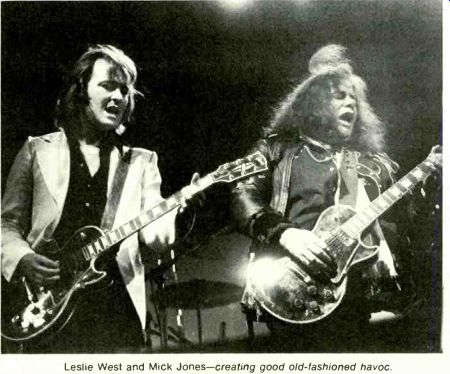
------ Leslie West and Mick Jones--creating good old-fashioned
havoc
Good old-fashioned havoc is the stock in-trade of Leslie West and his newest assemblage of accomplices. West's taste in music runs to the very loud, with tortuous guitar solos and Angst-ridden vocals, and he is very good at this sort of rock. His recordings are clean, crisp, and unencumbered by excess instrumentation or pre tense.
Though it's hard to pick a highlight from this fine album of hard rock, one might mention the Beatles' "Dear Prudence" and the Barry Mann/Cynthia Weil composition "We Gotta Get out of This Place." M.J.
HUDSON BROTHERS: Ba-Fa. Bill, Mark, and Brett Hudson, vocals, instrumentals, and songs. Apple Pie Hero; My Heart Can't Take It; Lonely School Year; nine more. [Bernie Taupin, prod.] ROCKET PIG 2169, $6.98. Tape: $7.98; 2169. $7.98.
Now take the Hudson Brothers. (Please.) Rarely have we been treated to a more lingering and less fulfilling case of show biz.
The Hudson Brothers are a natural, but nobody much cares. The public cares about all sorts of folk: Robert Blake, the loner of Baretta; pie-faced Elton John; jolly Gene Shalit; decrepit Groucho Marx. But we look at the Hudson Brothers and we know that, no matter what they say, they couldn't pay dues if they had to. You can like them the way you can like a Twinkle-until the real thing comes along.
The Hudson Brothers have had lots of contracts. They had a children's TV show, a grown-ups' TV show, an act, a costumer, and a lot of albums very much like this one. The music is uncannily like that of the Monkees. The three brothers sing in tune.
The song titles are quite good. The drummer plays a lot of splashes.
All of . this is produced by otherwise heavyweight Bernie Taupin, Elton John's writing partner, and recorded for John's estimable Rocket Records. They should all live and be well; at least this gives the boys something to do. M.A.
ART GARFUNKEL: Breakaway. Art Garfunkel, vocals; vocal and instrumental accompaniment. I Believe; Rag Doll; Break Away; Disney Girls; My Little Town; five more. [Richard Perry, prod.] COLUMBIA PC 33700, $6.98. Tape: II PCT 33700, $7.98; PCA 33700, $7.98.
Paul Simon and Art Garfunkel have hit upon a fascinating device that might save the record industry enough money to pay for the vinyl whose cost has skyrocketed, thanks to the Arabs and their high oil prices. They combined to perform the vocals on "My Little Town," an outstanding song written by Simon. And now that recording appears on two new Columbia LPs: Simon's "Still Crazy After All These Years" (reviewed separately this month) and Garfunkel's "Breakaway." The idea of getting double duty from the same track is indeed an interesting one, with tremendous potential. Why should Simon and Garfunkel be the only ones to benefit from such an arrangement? "My Little Town" used five backup musicians. Why shouldn't, say, pianist Barry Beckett use this cut when he gets around to making his first solo album? (No doubt he will. Arabs or no Arabs, everybody makes solo albums these days.) Garfunkel's voice is that of the perennial accompanist; he has not displayed the ability to be a feature performer. His best moments to date have come when he has sung songs of exceptional caliber, and those are lamentably scarce. Other than "My Little Town," the only interesting song on "Breakaway" is "Disney Girls," a Bruce Johnston composition that, although a mite sing-songy, is at least ear-catching. The rest of this over-arranged LP is simply boring.
-M.J.
DUDES: We're No Angels. Kootch Trochim, bass and vocals; Ritchie Henman and Wayne Cullem, drums and vocals; Ron Segarini, David Henman, and Brian Greenway, guitars and vocals. Saturday Night; Fuel Injection; I Just Wanna Dance; seven more. [Mark Slector, prod.] COLUMBIA PC 33577, $6.98.
Cross Barry Manilow with the Who and add a touch of Framptonesque vocals, and you come up with the Dudes, one of the more interesting rock hybrids to appear in recent months.
Its sound belies the fact that this band rose from the ashes of the Wackers and April Wine, two obscure but worthy bands of the Sixties. All six members are given credit for vocals, and the dense harmonies give a brightness to their sound that naturally belongs on car radios in the summer.
Guitarists Segarini, Greenway, and Hen man play with that clean but distorted effect popularized by the early Raspberries, and their solos and fills (skillfully herded by producer Mark Slector) give lightness to a potentially dark and dingy sound.
This is a group without pretensions, and because of it "We're No Angels" will out live many of the derivative discs being marketed today. H.E.
DAVID ESSEX: All the Fun of the Fair. David Essex, vocals and percussion; rhythm, strings, keyboards, synthesizers, horns, and vocal accompaniment. All the Fun of the Fair; Hold Me Close; Circles. [Jeff Wayne, .prod.] COLUMBIA PC 33813, $6.98. Tape: PCT 33813, $7.98; PCA 33813, $7.98.
As British superstars go, David Essex is one of the foremost heavies on the current pop charts. But as American superstars go, he remains largely unknown, except for "Rock On," his odd single of last year. One of the reasons for his lack of notoriety is the caliber of the albums he releases, of which "All the Fun of the Fair" is a good example.
Sounding somewhat like the soundtrack for a grade-B movie, "Fair" leaves the listener with a feeling of detachment, as if a preface had been mistakenly left out. The title song bears an unmistakable British trademark--not in the way that other British rock stars, like Bowie or Davies, brand their tunes, but in the way a British actor like Rex Harrison would if he recorded a pop-music disc.
Essex's attempts at more traditional rock forms, as in "Won't Get Burned Again," are dull and lifeless when compared to throaty singers like Coverdale or Rodgers, and the synthesizer tracks in the background turn a poor performance into a sacrilegious one.
The sooner he realizes that one must sweat a bit to come up with a decent rocker, the better off he will be. Until then, he would do better to try to land himself another movie role. H.E.
THE WHO: The Who by Numbers. Roger Daltrey, vocals; Peter Townshend, guitar; John Entwistle, bass; Keith Moon, drums; Nicky Hopkins, piano. However Much I Booze; Slip Kid; Squeeze Box; Dreaming from the Waist; Imagine a Man; Success Story; They Are All in Love; Blue, Red, and Grey; How Many Friends; In a Hand or a Face. [Glyn Johns, Prod.] MCA 2161, $6.98. Tape: 4111 C 2161, $7.98; ET 2161, $7.98.
The problem with resting on one's laurels is that they often are flattened in the process.
The Who has sizable accomplishments behind it, mainly the record and movie of Tommy. Several LPs have followed the creation of that rock opera, and this one is certainly the least of them. Only three songs have much in the way of merit. The semi-autobiographical hard-rocker "Success Story" is quite interesting, as is the similarly bombastic "In a Hand or a Face." And the real prize is a soft ballad titled "Imagine a Man." But three for ten is a good record only in baseball. -M.J.
Theater and Film
THE EIGER SANCTION. Original film sound track recording. Composed and conducted by John Williams. MCA 2088, $6.98. Tape: T2088, $7.98.
John Williams' moody, soulful and quite lovely theme (originally heard as a waltz) for Clint Eastwood's The Eiger Sanction could not be anything but a film tune. There is a Francis Lai mistiness to it that immediately evokes the almost self-conscious slickness of the entire medium of recent cinema. The theme keeps popping up in various forms and colors throughout the disc, broken here and there by the customary ostinatos, rock beats, sustained-string suspense sequences, baroque pastiches, etc.
Nothing terribly earthshaking, but eminently listenable. It would be more so but for MCA's typically dull sonics. R.S.B. T HE WIND AND THE L ION. Original film soundtrack recording Composed and con ducted by Jerry Goldsmith. ARISTA AL 4048, $6.98.
The demands of a film such as John Milius' The Wind and the Lion, which disappeared from New York before I had a chance to see it, probably give the composer precious little latitude. But I would have thought a composer like Jerry Goldsmith could avoid a bit better than he did the cliches of the genre, whether in the pseudo-Arabianisms or the inflated title theme (which seems to be derived from a rather grating American bugle call). In spite of a decent love theme-written in collaboration with Paul Francis Webster-and some good action music (as in the "Raisuli Attacks" cut), most of the music on this disc is so very dejo entendu that my main reaction was annoyance (heightened by the incessant reappearance of the bugle call motive). But I imagine the score fits the film quite well. R.S.B.
------
(High Fidelity, Feb. 1976)
Also see:
The Lees Side: Bill Evans, by Gene Lees. A varied career that has altered the course of jazz piano