High Fidelity Weds Schwann, Leonard Marcus; Culshaw at Large: Lump in the Throat, John Culshaw; The Lees Side: Music U.S.A.: 2. At a Nation's Heart, Gene Lees; Behind the Scenes.
-------------
HIGH FIDELITY Weds Schwann
There are no children yet, of course, but it gives me great pleasure to announce the marriage of the SCHWANN RECORD & TAPE GUIDES to HIGH FIDELITY, the consummation of which is here signaled by our first use of caps and small caps instead of italics to print their titles. Just before Christmas our parent corporation, American Broadcasting Companies, Inc., bought the company founded by William Schwann to publish his record catalogs-and for propriety's sake I think I should drop the metaphor right now. Bill will continue to head up the SCHWANNS under a long-playing contract, and his offices will remain in Boston.
The two publishing ventures-ours a critical review of records, SCHWANN's a catalog of them-make a most natural and happy combi nation, and we are all pleased that from the dozen and a half offers that Bill Schwann received over the past few years to purchase his organization he chose us as the "most compatible." The recent discussions we have had with him and his staff indicate that the pooling of knowledge and ideas will result in benefits to us both. For instance, SCHWANN lists new releases that may not be reviewed in HIGH FIDELITY; we review recordings that they may not list. But if the statement of fact is simple, the solutions are not.
There are several SCHWANNS, although SCHWANN-1 is the best known and most widely used. It lists the new releases each month, classical recordings available in stereo, and pop recordings up to two years old. On most occasions it is the record-buyer's bible.
SCHWANN-2, which comes out twice a year, takes over the listing of any pop records that are still available after two years. It is also the repository for mono recordings whether "electronically processed for stereo" or not, international pop and folk, spoken word, gospel, and a miscellany of everything from birdcalls to frequency test records.
SCHWANN'S CHILDREN'S CATALOG and BASIC RECORD LIBRARY describe themselves by their titles.
Finally there is the SCHWANN ARTIST ISSUE, about which I wrote last June. In that editorial I carped that this invaluable record guide, listed by performer, had to wait six years for its most recent publication.
From now on, I suppose, any carping will be via interoffice memo-at least before a public editorial-although I may as well tell you that we do not plan to wait that long in the future.
Carping may come from the other direction too, as in any family and in fact already has. Orthographists may note that we are spelling "catalog" two letters shorter than previously. (It turns out that the Merriam-Webster folk have switched their preference to SCHWANN'S spelling too.) Okay, Bill? Now about Odeon--
++++++++++++
Cushlaw at Large
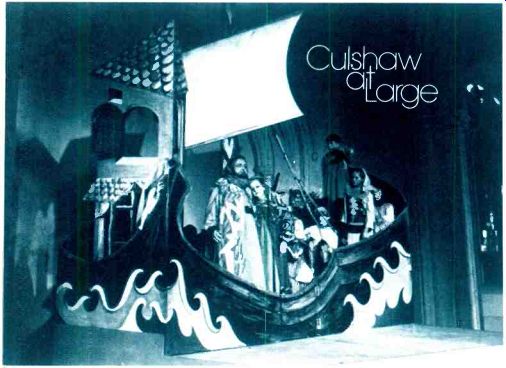
------Noyes Fludde as staged at the fourteenth Aldeburgh Festival Lump in the Throat
by John Culshaw

I AM CONCERNED with a solitary and unpredictable experience common to all of us, which is that moment when the emotional response to music bring about that curious physical phenomenon known as a lump in the throat. Operatic death scenes can bring it on easily, according to your taste and the quality of the performance: Think of the deaths of Violetta, or Otello, or Mimi, or Butterfly. Certain arrivals can have the same effect, like Isolde's in Act Ill of Tristan, al though there, of course, it is the orchestral explosion that triggers the response. Departures can also do it. as witness that incredible moment in the last act of Olen() when Emilia is virtually through the door before Desdemona cries out the farewell that she knows will he her last. Yet what has led me to this subject is not operatic at all, at least in the usual sense of the word.
In the course of sorting my records, which I dwelt on some time ago [June 19761 I came across and played the old but still excellent Argo recording of the late Benjamin Britten's Noye's Fludde, and it suddenly struck me that the biggest lump-raiser of all is a hymn or chorale within the context of a larger work. To see what I mean you have only to think of the St. Matthew Passion, or the curtain-rise on Act I of Die Meistersinger, or the prayer in Hansel and Gretel (neither a hymn nor a chorale, actually, but close enough to have the same effect), or the closing passage of Bernstein's Mass.
The Britten piece is the most consistently "lumpy" so far as I am concerned, although this may be because most of the performers are children and because the audience is invited at certain points to join in the hymns.
You must have a heart of granite not to be moved by the gradual emergence of the hymn "Eternal Father" during the storm scene, and especially by its final verse, when everyone in the building should be in full voice be cause the harmonies have reverted all of a sudden to those we remember from childhood. Yet even that splendid Victorian hymn is all but eclipsed by the one at the very end, based on a famous tune by Thomas Tallis. For me that is the ultimate lump in the throat, no matter how often I hear it.
A few years ago I produced a BBC television broadcast of Noye's Hackle from the Maltings at Snape, near Britten's home, which happened to be the last of a series of public performances that the television crew had also at tended to become familiar with the production. Television field crews are not necessarily specialists in, or even lovers of, music; most of their time is spent on football or at the racetrack or at political conventions, and to do the job at all requires a special kind of toughness rather than sensitivity. I know my way about the Maltings very well indeed, and such was my state at the end of the first performance that I was determined not to leave through any of the usual exit doors, where I would have inevitably met someone I knew. So I made for the lighting box at the back that provided a secret method of escape, and there I collided with the television sound engineer, who was as tough as they come. I looked at him, and he looked at me, and each of us knew why the other was there. "What did you think of it?" I managed to blurt out. He said, "It al ways makes me cry!"-and dashed out the door.
It is, of course, much easier to succumb when you have all the visual ceremony before you and when you are a member of an audience than when you are simply listening to a record. Yet in Noye's Fludde and the other examples I have mentioned, I do not find the experience much diminished by recording: The lump is still there at the right moments. Can it be that there is something basically reassuring or comforting about a hymn or a chorale? Or is it that they kindle some unconscious nostalgia for child hood, since for many of us in the Western world they were probably the first music we ever heard? Or is it simply that, in a world of seemingly endless violence and cruelty and ugliness, they represent some kind of vague haven of calm and stability, symbolized by a community of voices? It is certainly not for nothing that, when Tallis' great tune has brought Noye's Fludde to an end, the Voice of Cod is heard speaking to Noah:
For vengeance shall non more appeare, And nowe farewell, my darlinge deare.
+++++++++++++++++
The Lees Side

THE BEST WAY to see into the heart of a nation is to learn its music. The wonderful logic of Bach is inherently German in character, as is the disciplined use of harmonic progression by the nineteenth-century German Roman tic composers. When the Germans later stretched progression to the limit, it was always logically, and when at last Arnold Schoenberg assaulted the citadel of tonality, he did so systematically and arithmetically.
The French personality is revealed in the music of Rameau, Couperin, Debussy, Ravel, and, I would be inclined to say, Edgard Varese. And, of course, could anything be more Italian than the melodies of Verdi and Puccini? The Chilean composer Juan Orrego Salas told me once that he thought the reason his music was angular might be that he grew up within view of the jagged Andes, which vision early be came part of his consciousness. This led me to a curious speculation. Sibelius has always enjoyed greater respect and popularity in Canada than in the U.S. Could this be because the forested topography of much of Canada, particularly the more populous eastern third of the country, resembles that of Finland? Taste, a French composer observed, is the product of a thousand distastes.
(The observation is even better in French-"Le goat est le resultat de mille degofits"-since &goat carries the additional connotation of disgust and revulsion.) The aphorism precisely describes the process by which art is both made and appreciated. The selective processes of the artist are the result of his entire cultural experience: national, regional, local, and even familial. And he not only reflects but contributes to the national characteristics of music.
2. At a Nation's Heart by Gene Lees It has passed almost unnoticed by jazz critics that national musical characteristics survived the crossing of the Atlantic to turn up in jazz. It should be noted at once that there are conspicuously few Anglo-Saxon Protestants in jazz. This is not intended as a deprecation of the talent of the WASPs who do play jazz-guitarist Herb Ellis and pianist/composer Roger Kellaway are among the very best practitioners of the art. But generally the English are not as impassioned about music as, for example, the Welsh, the Irish, or the Italians. No doubt for that reason, the English have shown less talent for music than most other Europeans, just as surely as they have shown more for literature. The distrust of pleasure is inherent in the various forms of English Protestantism.
Whatever the reasons, most white jazz musicians are Jewish, Irish, or Italian, with a smattering of America's other ethnic minorities, including Mexican (bassist Ralph Pella) and American Indian (bassist Joe Mondragon). And usually the musical characteristics of a man's ethnic group turn up in his playing.
The Italian-Americans tend to be very lyrical players-for example, trombonists Frank Rosolino and Carl Fontana, guitarist Gene Bertoncini, pianists Gene DiNovi and Michael Renzi, drummer Ronnie Zito and his brother, pianist and arranger Torrie Zito, violinist Joe Venuti, and tenor saxophonist Flip Phillips. And film composers Dominic Frontiere and Henry Mancini possess an Italianate lyricism.
There is even a distinctively Italian vocal sound-not universal, to be sure, but common. Some would call it a gravelly sound, like that comedians affect when attempting to capture the speech of the archetypal Italian gangster, but it is perhaps better described as a woody texture, somewhat like that of a viola. It can be heard in many singers of Italian origin, including Tony Bennett, Frank Sinatra, Frankie Laine, and Perry Como. It is heard in the speech of celebrities like Anne Bancroft, Brenda Vaccaro, Congress man Peter Rodino, and late Richard Conte. Further, there is a tendency of New York-New Jersey area Italians to dentalize d's and t's and to liquefy the letter r when it follows either of these. The r is almost lisped, softening one of the harsher sounds in American English; at the same time, the woody or gravelly sound tends to desenti mentalize even the most sentimental songs. The combined effect, as in Sinatra's work, is extraordinarily lovely.
When I mentioned this sound to an Italian friend who himself has it, he quipped: "It probably comes from all the screaming and yelling at home when you're a kid." I am inclined to think, however, that it is the result of a physical characteristic in the vocal cords of many (but not all) Italians, just as blond hair is a characteristic of many (but not all) Swedes.
There is also a distinguishable black sound--a kind of soft, whispery airiness. It has nothing to do with regional accents; it is a quality of sound.
One perceives it in the singing of Os car Peterson, Carmen McRae, Sarah Vaughan, and particularly the late Nat Cole, whose piano playing was as soft, bouncing, and lyrical as his voice.
In fact, there is usually a relation ship between the way a musician sings or speaks and the way he plays his instrument. That whispery black sound is apparent in the work of such trumpet players as Miles Davis, Fred die Hubbard, and Clark Terry. Jack Teagarden had a lazy, careless enunciation, similar to the way he played trombone; Bob Brookmeyer's trombone has the same kind of mumbled laconic eloquence as his speech.
Jewish jazz musicians, such as Al Cohn and Ziggy Elman, sometimes sound Jewish, as if memories of cantorial singing and of Mediterranean modes are lodged in some secret chamber of the subconscious. And the Irish musicians, such as pianist Dave McKenna, trumpeter Bobby Hackett, composer Pat Williams, tenor saxophonist Zoot Sims, and baritone saxophonist and composer Gerry Mulligan, sound Irish-lyrical and humorous. I once asked Mulligan if he felt Catholic. After a moment's reflection, he said, "No, but I do feel Irish." "I would imagine so," I said, "be cause sometimes your playing makes me think of songs like 'Kerry Dancers.' " With which Mulligan told me that the late Judy Holliday, who had a remarkable gift for the apt phrase, used to say, when Zoot Sims began a solo, "There he goes, playing that Barry Fitzgerald tenor again." It is a startling description, for the bubbling, bouncing, joyous solos of Sims do in deed sound like the peal of Irish laughter.
It must be emphasized that these observations are generalities, not absolutes. Barney Kessel's guitar work does not sound Jewish, and Sal Nistico's tenor saxophone sounds less Italian than black. What a man ad mires is clearly a major factor in the formation of his taste and therefore his work, and sometimes the admiration overcomes whatever ethnic characteristics his music might otherwise have. But in general, national characteristics hold true, and many of those of Europe are among the most important forces in the shaping of American music.
And one of the factors that in turn shapes national characteristics in music is the language of the country, which subject I will consider in the next column.
+++++++++++++++
Behind the Scenes

Lenny at large. Leonard Bernstein's longtime exclusive association with Columbia Records has come to an end. Though it is expected that he will continue to record for CBS, he already has entered into extended arrangements with both Deutsche Grammophon and EMI. (CBS had previously released him for the DG Carmen, in an informal arrangement that resulted in the Boston Symphony Orchestra's participation in the Columbia recording of Stravinsky's Oedipus Rex led by Bernstein.) The DG association began last summer with Liszt's Faust Symphony, taped after the Tanglewood performance with the Boston Symphony.
Composers mentioned for future projects include Beethoven, Mendelssohn, Schumann, Stravinsky, and Bernstein himself. The first EMI sessions were held in November, a blitz with the Orchestre National de France scheduled to produce four discs: Berlioz' Symphonie fantastique and Harold in Italy (with Donald McInnes); the Schumann cello concerto and Bloch's Schelomo with Mstislav Rostropovich; and a Milhaud collection including La Creation du monde.
And Montserrat Caballe has told a French interviewer that she will be recording Salome with Bernstein-for Philips! CBS at Covent Garden. By the time this appears, CBS should have completed its recording of Donizetti's L'Elisir d'amore, made in conjunction with the December 1976-January 1977 revival of the year-old Covent Garden production. With one exception, the cast was to follow that of the stage performances: Ileana Cotrubas as Adina, Lillian Watson as Gianetta, Ing var Wixell as Belcore, and Geraint Evans as Dulcamara. The exception:
CBS's Placido Domingo, engaged for Nemorino before the Covent Garden cast was completed with Jose Carreras. The conductor: John Pritchard.
(The chorus and orchestra, of course, are those of the Royal Opera House.) After L'Elisir, CBS plans to complete Puccini's Trittico with 11 Ta barro. As with Gianni Schicchi and Suor Angelica, Lorin Maazel will con duct; Renata Scotto and Domingo will sing Giorgetta and Luigi. Now in the talking stages are Thomas' Mignon, Massenet's Cendrillon, and Meyerbeer's L'Africaine.
Philips' fiddlers. Somebody at Philips must be partial to fiddlers. With such distinguished performers as Arthur Grumiaux, Henryk Szeryng, and Herman Krebbers recording actively, the label has signed Salvatore Accardo to an exclusive contract. Accardo had already recorded a number of Vivaldi and Tartini concertos for Philips with I Musici; now he has completed the Bach solo sonatas and partitas, the two Mendelssohn concertos (with Charles Dutoit and the London Phil harmonic, his collaborators in the 1975 Deutsche Grammophon set of the Paganini concertos), and the Tchaikovsky concerto, Serenade mel ancolique, and Valse-Scherzo (with Colin Davis and the BBC Symphony).
Meanwhile, Grumiaux is finishing his stereo remake of the Beethoven violin sonatas, with Claudio Arrau.
(Both participated in distinguished mono cycles: Grumiaux with Clara Haskil, Arrau with Joseph Szigeti.) Shostakovich's symphonies. Decca/ London has a sizable Shostakovich cycle planned: the fifteen symphonies, to be recorded by Bernard Haitink and the London Philharmonic.
Dorati's not-just-Haydn. Antal Do rati's first large-scale project as principal conductor of the Royal Philharmonic has been a cycle of the Beethoven symphonies, of which Nos. 5, 8, and 9 have so far been released in England on Deutsche Grammophon's midprice Privilege label. Inevitably, however, his attention turned (re turned?) to Haydn, and for Decca/ London he and the RPO will record the three big oratorios. Already on tape is The Creation featuring Lucia Popp, Rend Kollo, Benjamin Luxon, and Kurt Moll, with The Seasons and U Ritorno di Tobia to come.
Verdi from Strasbourg. Alain Lombard and the Strasbourg Philharmonic have been pursuing their ambitious recording program for Erato, with major projects including the Verdi Requiem and Offenbach's La Perichole. The Verdi soloists are Joyce Barker, Mignon Dunn, Ermanno Mauro, and Paul Plishka, with the Slovak Philharmonic Chorus.
(Plishka, incidentally, replaced Pierre Thau as Mephistopheles in the an nounced cast of Erato's Faust; the cast otherwise remains as reported in Oc tober 1976: Montserrat Caballe as Marguerite, Giacomo Aragall as Faust, Philippe Huttenlocher as Va lentin, Anita Terzian as Siebel, Jocelyne Taillon as Marthe.)
The Of fenbach cast is headed by Regine Crespin, Alain Vanzo, and Jules Bastin, with Opera du Rhin forces and a narration by Alain Decaux.
French connection. Connoisseur Society has more on the way from many of the artists it has been promoting through its licensing arrangement with France's Pattie Marconi. The young pianists Michel Beroff and Jean-Philippe Collard have been active in the studio: Beroff with Bartok (two discs of excerpts from Mikro kosmos), Collard with Schumann (Carnaval, Abegg Variations, Op. 28 Romances) and Debussy (complete Images, L'Isle joyeuse, Suite ber gamasque, Masques); together they have recorded the four-hand-piano original of Dvadk's Slavonic Dances, a sequel to their disc of Brahms's Hungarian Dances. Alexis Weissenberg has recorded the Bach Goldberg Variations (with all repeats, on two discs), Gyorgy Cziffra the complete Liszt An-
flees de pelerinage. New to Connois seur Society is the fine Hungarian pianist Georges Solchany, who will be heard in the complete Bartok Mikro kosmos. From the late Jean Martinon will come an all-Dukas disc (the symphony and excerpts from the opera Ariane et Barbe-Bleue, with the Orchestre National) and the Schumann Fourth Symphony (with the Orchestre des Jeunesses Musicales); from Leonid Kogan, the Beethoven violin concerto (with the Paris Conservatory Orchestra under Constantin Silvestri).
Apocalyptic quad. The Austrian Preiser company, familiar for its extensive series of historical vocal reissues, has made its first quadriphonic recording:
Franz Schmidt's apocalypse oratorio, Das Buch mit sieben Siegeln.
In our November 1976 issue, re viewing Musical Heritage Society's reissue of the oratorio's previous recording, Abram Chipman noted that "nobody could possibly take the place of Julius Patzak in the role of St. John." Preiser has done its best to find a replacement, in the person of the (then) sixty-five-year-old tenor Anton Dermota. (Patzak, by comparison, was a mere stripling of sixty-two when the Amadeo recording was made in 1960.) The other soloists are bass Robert Holl as the Voice of God, soprano Margarita Kyriaki, mezzo Hertha Topper, tenor Thomas Moser, bass Arthur Korn, and organist Rudolf Scholz. Alois Hochstrasser conducts the Graz Concert Choir and the Lower Austrian Tonkunstler Orchestra.
++++++++++++++++++++++++
ADs
STANTON phono cartridge
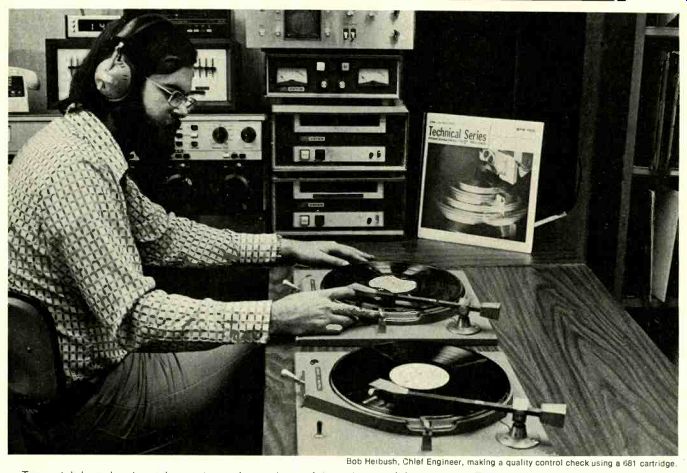
6 WKLS, Atlanta, broadcasts 100% disc-to-air. That's why it uses Stanton's 681 series... exclusively.
A Top notch broadcasters who capture a large share of the listening audience, are critically aware of the necessity to achieve a superior quality of sound. Station WKLS is just such a station.
As Bob Helbush, chief engineer, states: "We broadcast 100% disc-to-air except for some commercials. So, for maximum quality sound and phase stability, we use the Stanton 681 SE for on-the-air use. We consider it the ideal answer for that application. And our program director uses Stanton's 681 Triple-E for auditioning new releases before we air them".
And Don Waterman, General Manager, added: "Today, every station in the SJR Communications group ... all eight of them, all in Major Markets .. . use Stanton 681 cartridges on every turntable".
There are good reasons for this vast acceptance. Stanton's 681 Calibration Series cartridges offer improved tracking at all frequencies. They achieve perfectly flat frequency response to beyond 20 Kc. And the top-of-the-line, superb 681 Triple-E has an ultra miniaturized stylus assembly with substantially less mass than previously, yet it possesses even greater durability than had been thought possible to achieve.
-- Bob Heibjsh, Chief Engineer, making a quality control check using a 1381 cartridge.
Each 681 Series cartridge is guaranteed to meet its specifications within exacting limits and each one boasts the most meaningful warranty. An individually calibrated test resistor is packed with each unit.
Whether your usage involves recording, broadcasting or home entertainment, your choice should be the choice of the professionals ... the STANTON 681.
Write today for further information to Stanton Magnetics, Terminal Drive, Plainview, N.Y. 11803.
--------------
Phase Linear

You've got to be serious.
If you're interested in Phase Linear, you've got to be serious.
Serious about music. Serious about enjoying the most realistic sound possible from a home stereo system. Serious about acquiring quality state-of-the-art components built to deliver a lifetime of top performance.
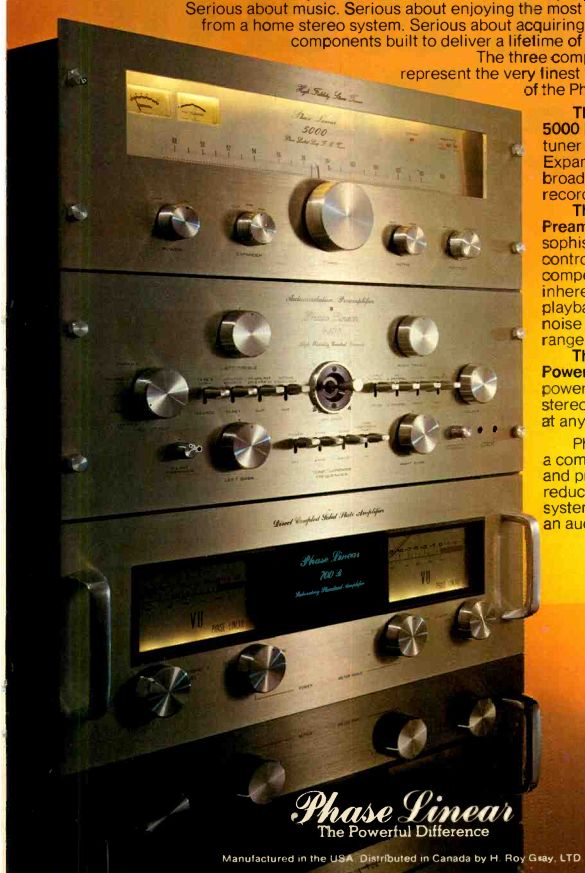
The three components featured here represent the very finest technical achievements of the Phase Linear Corporation:
The Phase Linear 5000 FM Tuner: An advanced tuner with a Dynamic Range Expander that restores FM broadcast signals to rival your records and tapes.
The Phase Linear 4000 Preamplifier: An incredibly sophisticated preamp and control center that actually compensates for limitations inherent in the recording and playback process through noise reduction and dynamic range expansion.
The Phase Linear 700B Power Amplifier: The most powerful, most dependable stereo amplifier you can buy, at any price.
Phase Linear manufactures a complete line of amplifiers and preamplifiers, a noise reduction unit, and a speaker system. Ask your dealer for an audition. If you're serious.
The Powerful Difference
Manufactured in the USA
Distributed in Canada by H Roy G say, LTD.
-----------------
The feel of excellence.
UNTIL YOU'VE LISTENED TO ESS's NEW HEIL AIR-MOTION TRANSFORMER SPEAKER SYSTEMS, YOU WON'T REALIZE HOW OBSOLETE YOUR CONVENTIONAL LOUDSPEAKER MAY BE.
YESTERDAY'S TECHNOLOGY
Your current loudspeaker, even a fine one, may be obsolete. Using yesterday's technology, technology developed over 50 years ago, it can not hope to compete with today's developments. No one expects yesterday's electronics to compete with today's solid state electronics.
Yet it is common to find well made speakers of 20 years ago that are just as good--sometimes better--than many loudspeakers on the market today. The reason is simple. High fidelity electronics have made tremendous advances; while loud speaker technology has remained virtually unchanged in the last fifty years . . . Until Oskar Heil perfected, and ESS introduced, the revolutionary Heil Air-Motion Transformer.
THERE IS A BETTER WAY-- THE HEIL AIR-MOTION TRANSFORMER
The Heil Air-Motion Transformer is not a mere improvement on old ways of reproducing sound; it is the discovery of a better way. As such, it bears the mark of genius. The result of four years research by Oskar Heil, the gifted molecular physicist and musician who invented the FET or field-effect transistor in 1934, long before it could be used; and the Klystron tube widely used in color TV transmitters. It was his vision into the fundamental laws of physics that resulted in a speaker design free of the deficiencies and performance limitations of conventional drivers.
THE SECRET? TRANSFORMATION
The Heil Air-Motion Transformer, the first significant breakthrough in speaker technology in 50 years, is equivalent in its impact on loudspeakers to the introduction of the jet engine in aviation. For the same reason. In conventional loudspeakers, in conventional airplanes, a heavy solid object had to be moved first--in the loudspeaker a cone, in the airplane a propeller. The jet and the Heil Air-Motion Transformer disgard these inefficient methods of moving air.
Air is moved directly. The inherent advantage of this simplification was augmented by the fact that this revolutionary driver is a "transformer" as well as a "transducer." It not only converts electrical energy into acoustic energy as do all transducers, it increases or transforms the energy five fold.
Unlike conventional speakers which push air only as fast as they move, on a one to one basis, the Heil Air-Motion Transformer squeezes air out 5 times faster than it itself moves to achieve instant acceleration. This fast "rise time" results in the crisp transients, remarkable clarity, high definition, astonishing dispersion and superb dynamic range achievable only by a Heil Air-Motion Transformer loudspeaker system.
LIGHT YEARS AHEAD OF THE INDUSTRY
Dr. Heil's efforts were realized in the Spring of 1973 when ESS introduced the amt 1, the first loudspeaker to incorporate the revolutionary Heil Air-Motion Transformer. The demand was unprecedented. More than 2,000 units were sold in the first ten days of its introduction. The first amt loudspeaker was not inexpensive. The suggested retail price was $298.00 each, or about $375.00 at 1977 prices.
Nevertheless, 20,000 amt l's were sold sound as clear as light in only 10 months, more loudspeakers at this price point than had ever been sold in the history of the high fidelity industry.
You have only to experience the airiness, dynamic range, low distortion, clarity and definition--in a word, the unparalleled performance of the Heil Air-Motion Transformer speaker system--to understand why.
SECOND GENERATION HEILS
As excellent as ESS's first generation speakers were, the second generation Heil Air-Motion Transformer speaker systems are even better. Not because of radical changes in the air-motion transformer (you can't make something that fine much better), but because we refined the transformer and vastly improved everything else.
The systems boast superb woofers and crossovers, and the cabinets are themselves fine furniture. Finally, we made the cost of owning audio excellence affordable by introducing lower priced Air-Motion Transformer systems with such high efficiency that they can be driven by low-priced, modest powered electronics. Or if you want to let the chips fall where they may, they will handle tremendous power.
Is your present system obsolete? Audition the new ESS line at one of your neighboring quality audio centers and find out.
YOUR EARS WILL APPRECIATE THE DIFFERENCE.
(800) 447-4700 (In Illinois call 800-322-4400)
ESS
9613 Oates Drive, Sacramento, CA 95827 USA
---------------------
Scott
Performance.
Scott Stacks Up.
Every serious listener knows that separate tuners and amplifiers offer greater system versatility and flexibility than the all-in-one receiver. But Scott separates stack up where it really counts-
performance.
Every one of Scott's complete line of tuners and amplifiers is engineered and designed to give you all the performance features you expect, at a price no higher than many receivers currently on the market.
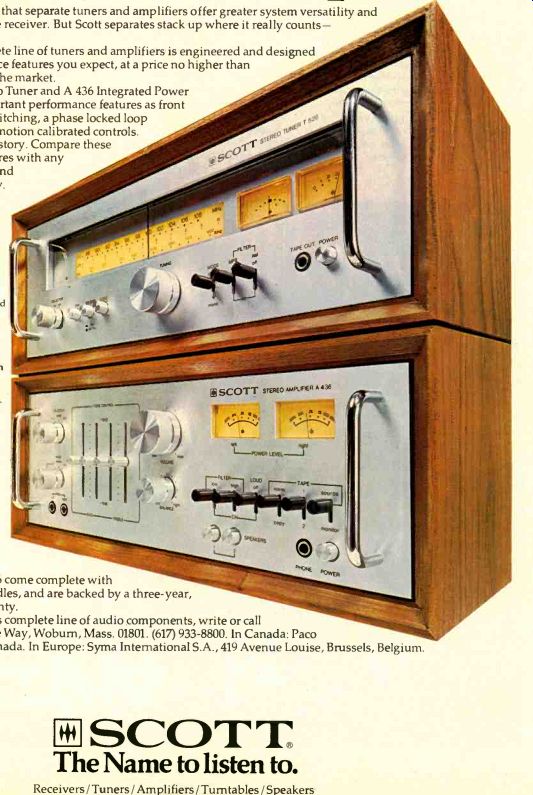
Scott's T 526 AM/FM Stereo Tuner and A 436 Integrated Power Amplifier provide such important performance features as front panel Dolby de-emphasis switching, a phase locked loop multiplex section and linear motion calibrated controls.
And that's only part of the story. Compare these important performance features with any other medium-priced tuner and amplifier on the market today.
The Scott T 526 Tuner IHF sensitivity rated at 1.9 µV, S/N ratio 68 dB and a capture ratio of 1.5 dB.
Signal strength and center channel tuning meters.
Four gang tuning capacitor for better image rejection.
AM section designed around a tuned RF amplifier using J-FET for improved signal-to-noise ratio.
AM noise suppression circuitry.
The Scott A 436 Amplifier 42 watts RMS per channel, driven into 8 ohms from 20 Hz to 20 kHz with no more than 0.3% THD.
True logarithmic meter amplifier obviates the need for range switching.
Individual channel power level meters calibrated in % of full power output capability eliminates confusing dB and VU readings.
Two completely independent tape monitors allow two tape recorders to be used simultaneously for direct tape-to-tape copying.
Instantaneous electronic protection circuit in the output stage.
IM distortion lower than 0.15% for a cleaner sound without listening fatigue.
High and Low filters, two auxiliary outlets and mic inputs.
And the Scott T 526 and A 436 come complete with professional rack-mount handles, and are backed by a three-year, parts and labor limited warranty.
For specifications on Scott's complete line of audio components, write or call H.H. Scott, Inc., 20 Commerce Way, Woburn, Mass. 01801. (617) 933-8800.
In Canada: Paco Electronics, Ltd., Quebec, Canada.
In Europe: Syma International S.A., 419 Avenue Louise, Brussels, Belgium.
SCOTT---The Name to listen to.
Receivers/ Tuners/ Amplifiers/Turntables, Speakers
-----------------
Electro-Voice
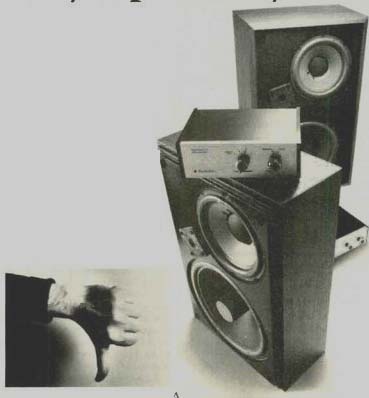
Hi-fi editors don't endorse anybody's speaker system.
But the Technical Editor of a leading hi-fi magazine recently wrote:
"What is the ideal or best speaker system? I really can't say.
If someone presented me with a product that sounded as good as the best, and was half the size, and had twice the efficiency, and sold for, say $400 a pair, I would be inclined to judge it as 'best'-
but you may not." Amazing. These are the very same design goals we set for a new E-V speaker system and achieved in the vented, equalized Interface: A.
In fact, compare these comments with the Interface specs:
Our vented, equalized design gives you a cabinet half the size of sealed systems. Our efficiency is up 2-3 dB, around twice that of other speakers. Low frequency response (3 dB down at 32 Hz) is unprecedented. And our suggested retail price, including equalizer, is $450 a pair.
Only you can decide if you agree with this Editor's high standards. Or if Interface: A performance is best. Listen to Interface at your E-V dealer. Send us your vote.
Interface Vented, Equalized Speaker System
Electro-Voice, Inc., a Gulton company 619 Cecil Street, Dept. 374H, Buchanan, Michigan 49107
--------------
TDK
OUR SECOND BEST IS BETTER THAN MOST OTHERS' FIRST BEST.

AUDUA is one of the world's finest cassette tapes. But it's not the best cassette tape made by TDK.
Our SUPER AVILYN (TDK SA) has the edge. And that's only if you're using the special bias/equalization setting on your tape deck.
However, if you're using the normal or standard setting, you'll have to settle for AUDUA-second best.
Chances are you won't find anything better, or with more consistent sound quality, for decks with normal tape selector settings. In other words, even if you don't own extravagant equipment, with AUDUA you can still hear extravagant sound reproduction.
You see, because of AUDUA's superior dynamic range at the critical high-end, you'll hear any music that features exciting "highs" with an amazing brilliance and clarity you won't get with any other tape.
( And when it comes to open-reel tape, you'll probably find nothing comes close to AUDUA open-reel for reproducing highs.) Whatever AUDUA you use-cassette or open-reel-you'll hear your system like you've never heard it before.
But there is something else you should hear before you try AUDUA.
The price.
Unlike other so-called "super premium" cassettes, AUDUA's price is down to earth. (That should make AUDUA sound even better.) Compared to what others consider their best, there's just no comparison.
So try the second-best cassette we've ever made.
You won't find much better.
TDK Electronics Corp., 755 Eastgate Boulevard, Garden City, New York 11530.
Also available in Canada.
Wait till you hear what you've been missing.
----------------
Technics by Panasonic
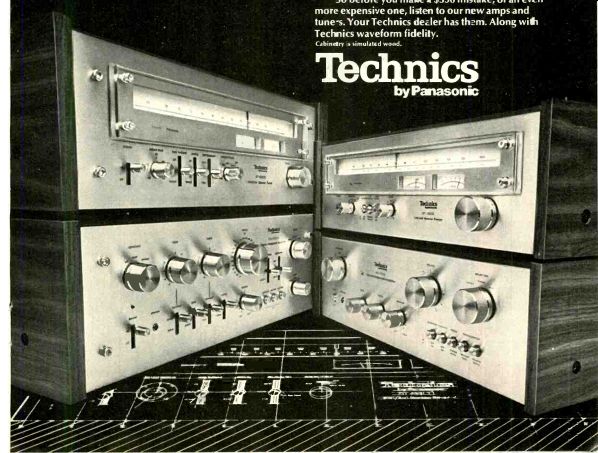
Waveform fidelity.
If you don't understand it, you could be making a $350 mistake.
Today a good amp and tuner can easily cost you $350,
$500,$700 or Even more. But no matter how much a component costs, if it doesn't have waveform fidelity, the music that's put into it won't be the music that comes out. And that's an expensive mistake to make.
It's also a mistake Technics won't let you make.
Because Technics' two new integrated amps, the SU-7600 and the SU-8600, as well as our two new tuners, the ST-7600 and the ST-86( 0, have superb waveform fidelity.
With both tuners, the waveform being broad ca=t will be the waveform you'll receive, with virtually no distortion or cross modulation. Because both have flat group delay filters in the IF sections.
So the time delay is constant for all frequencies.
There's also a Phase Locked Loop IC in the MPX sections. That's why, for example, with the top of our line. the ST-8600, you'll get stereo separation of 45dB at 1 khz and 35dB at 10 kHz. And a frequency response that's as flat a< it is wide, 20Hz to 18kHz (+ 0.2dB--0.8dB).
And with an 8-ganged tuning capacitor (5 for FM and 3 for AM) and a Technics developed 4-pole MOS-FET, broadcasts with the FT-8600 w U sound more like master tapes than FM.
You'll also find waveform fidelity in both ps.
Including our most powerful one, tie SU-8600. With 73 watts per channel, minimum RAS. both channels driven into 8 ohms from 20Hz to 20kHz, with no more than!) 0.08% total harmonic distortion.
And the SU-8600 will stay 73 watts regardless of the power-hungry transient bursts sound in many musical waveforms. The reasons: Six-fold independent power supplies for the control voltage and power amplifiers. The results: Virtually no transient cross talk distortion. And optimum waveform fidelity.
So before you make a $350 mistake, or an even more expensive one, listen to our new amps and tune-s. Your Technics dealer has them. Along with Technics waveform fidelity.
Cabinetry’s simulated wood.
Technics by Panasonic
---------------------
Look up to Realistic
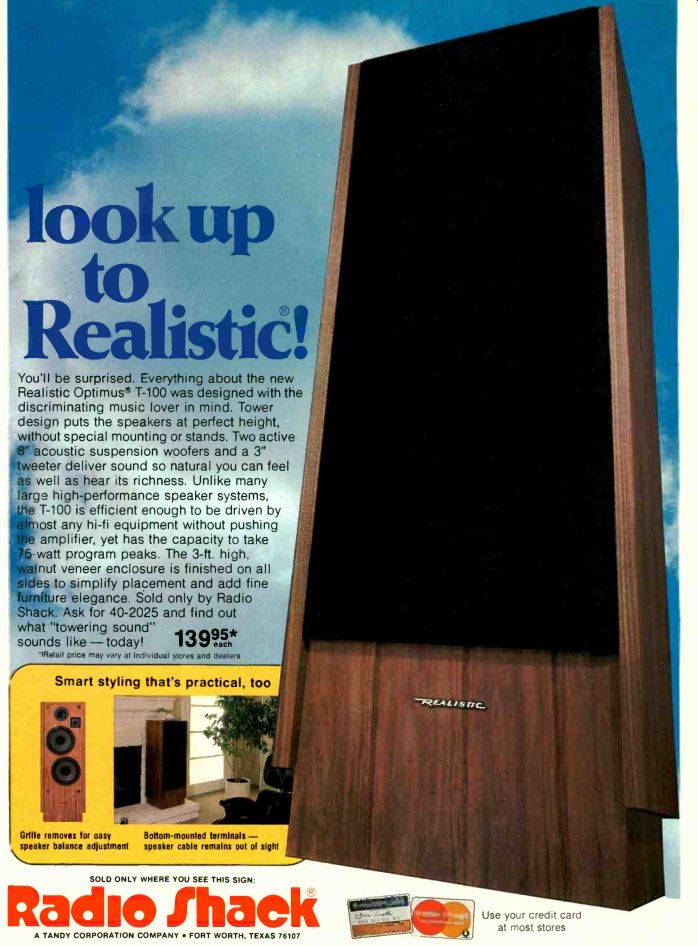
You'll be surprised. Everything about the new Realistic Optimus T-100 was designed with the discriminating music lover in mind. Tower design puts the speakers at perfect height, without special mounting or stands. Two active 8" acoustic suspension woofers and a 3" tweeter deliver sound so natural you can feel well as hear its richness. Unlike many large high-performance speaker systems, the T-100 is efficient enough to be driven by most any hi-fi equipment without pushing e amplifier, yet has the capacity to take 5-watt program peaks. The 3-ft. high, walnut veneer enclosure is finished on all sides to simplify placement and add fine furniture elegance. Sold only by Radio Shack. Ask for 40-2025 and find out what "towering sound" sounds like--today !
$139.95 , Retail price may vary at individual stores and dealers.
Smart styling that's practical, too.
Grille removes for easy speaker balance adjustment.
Bottom-mounted terminals--speaker cable remains out of sigh.
SOLD ONLY WHERE YOU SEE THIS SIGN: Radio Shack-- A TANDY CORPORATION COMPANY FORT WORTH, TEXAS 76107
Use your credit card at most stores Radio Shack operates as Tandy International Electronics in Australia. England, Belgium, Holland, Germany, France; and as Tandy Radio Shack in Japan
-------------------
EIGHT ALL--NEW MARANTZ UNITS.
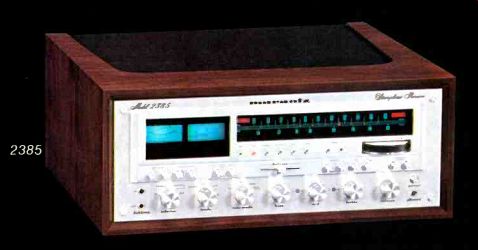
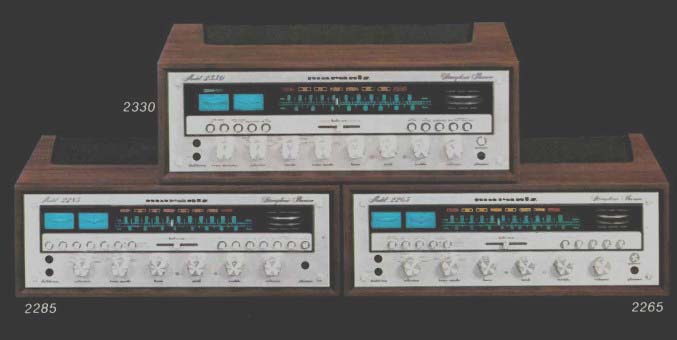
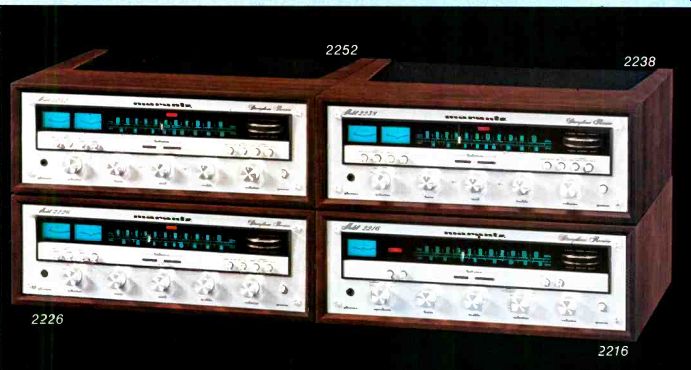
Probably the largest-and certainly the finest-line of stereo receivers ever unveiled.
And it all starts with the world's greatest receiver, the Marantz 2385, with output rated at an astonishing 185 Watts per channel (minimum RMS at 8 Ohms, 20-20,000 Hz, with no more than 0.05% Total Harmonic Distortion).
And at the other end of the line-up is the most incredible receiver value Marantz has ever offered: the 2216, with 16 Watts per channel, minimum RMS at 8 Ohms, 20-20,000 Hz, with no more than 0.5% Total Harmonic Distortion.
And there are 6 other new and outstanding Marantz receivers-with prices to match any budget, with all-new higher power output, and with range of features to match any degree of involvement with audio.
Never before has the incomparably thrilling sound of Marantz been available over such a broad spectrum of power and performance.
Never before has a receiver line packed so much muscle, either, and with such low distortion. Never before have you had more compelling reasons to buy your first receiver or to upgrade your present one. At last "component c 4 quality" acquires true meaning in describing receivers. The Marantz 2385 Receiver, for in stance, exceeds-in power, features and specifications-most separates on the market today, while still being packaged into a remarkably manageable size for such walloping power and vast array of features.
THE MOST IMPRESSIVE COMBINATION OF QUALITY PERFORMANCE FEATURES EVER ENGINEERED INTO A RECEIVER LINE.
Every possible technological advance that can improve performance has been designed into this new generation of Marantz receivers.
For example, the 2385 includes: Plug-in optional Dolby FM Noise Reduction Adapter for the lowest noise possible with FM reception. 18 dB per octave Bessel-derived high filter-an advanced linear phase design that reduces unwanted high frequency noise-and does the job with a more natural, less colored sound be-
cause it eliminates the overshoot and "ringing' common to other filters. 18 dB per octave 15 Hz sub-sonic Butterworth low filter cuts sub-sonic transients and rumble that effectively rob you of vital amplifier power. Never before has such advanced filter technology been applied to audio components or receivers.
The Marantz 2385 also offers: 2 LED peak power indicators to continuously monitor amplifier output to instantly let you know when transients are driving the amplifier to full output.
An amplifier section utilizing full complementary symmetry direct-coupled output in a massive triple-paralleled transistor array--an advanced design never before used in a receiver. The result is the highest day-in, day-out operating reliability and lowest Total Harmonic Distortion. 5-gang FM tuning capacitor, in conjunction with dual-gate MOS FET FM front end ensures virtually complete rejection of spurious signals, with an IHF usable sensitivity of 1.6 microvolts, and a 50 dB quieting sensitivity figure in stereo of 25 microvolts--virtually the finest such specification ever obtained in a receiver-even a separate tuner.
And the 2385 includes: Three tone controls for each channel--bass. treble and mid range-for maximum tonal flexibility. Selectable frequency turnover points to adjust range of influence of each tone control. Independent tape copy facility, which permits dubbing from one tape deck to another while listening to yet a third signal source, such as records or FM.
Linear phase IF filters for lowest distortion.
LED function indicators.
But look at the exciting array of features included in virtually every receiver: phase-
locked loop, a sophisticated circuit that maximizes stereo separation while minimizing distortion. Dual-gate MOS FET FM front end.
Full complementary symmetry amplifier section plus direct-coupling. 25 micro second de-emphasis switch for properly receiving Dolby FM, the new generation in stereo broadcasting. Gyro-touch tuning for smoothest, most accurate station selection.
See the new 1977 Marantz receiver line at your Marantz dealer now. Fantastic!
CHOOSE THE MARANTZ THAT'S RIGHT FOR YOU.
$670 Built-in FM Dolby system
Under $790 Optional Aug in Dolby FM adapter-FM de-emphasis
Under $1100
We sound better.
THE 1977 MARANTZ RECEIVER LINE OFFERS THE GREATEST CHOICE OF POWER AND LOWEST DISTORTION...
RIGHT ON UP TO THE FINEST
---------------------
...because it unlike some record "care" products Watts really works!
Watts Disc Preener. World's most popular record cleaning tool. Simply add a few drops of Watts "Anti-Static" solution to its moistened core and without transferring any liquids to the record's surface, Preener cleans and preserves the grooves of your new records. Watts Preener leaves no residue to clog the stylus, which can degrade the sound quality of your favorite record.
Watts Parastat. 2 Cleaners in One.
Parastat's special brush penetrates record grooves to loosen and remove dust and dirt. Ideal for records which have been mistreated with anti-static sprays.
Parastat also provides cleaning action for the maintenance of new records. With a drop or two (we're not in the fluid business) of Watts "Anti-Static" solution, to the Parastat's lower pad, the proper degree of humidity is applied-o relax dust-attracting static.
Record Care Products are distributed by: ELPA MARKETING INDUSTRIES, INC. EAST: New Hyde Park, New York, 11040.
Watts Dust Bug. Elegantly simple in design and function, the famous Dust Bug keeps a new record clean by removing dirt and dust which may settle on the record while in use. When the red plush pad of the Bug is slightly dampened with Watts "Anti-Static" solution which is supplied, Dust Bug provides just the proper degree of humidity to prevent the generation of static electricity. While imitated, the ultra-lightweight Watts Dust Bug has never bean equaled in performance and effectiveness.
WEST: 7301 E. Evans Pd., Scottsdale, Arizona 85260
-------------------
Lux
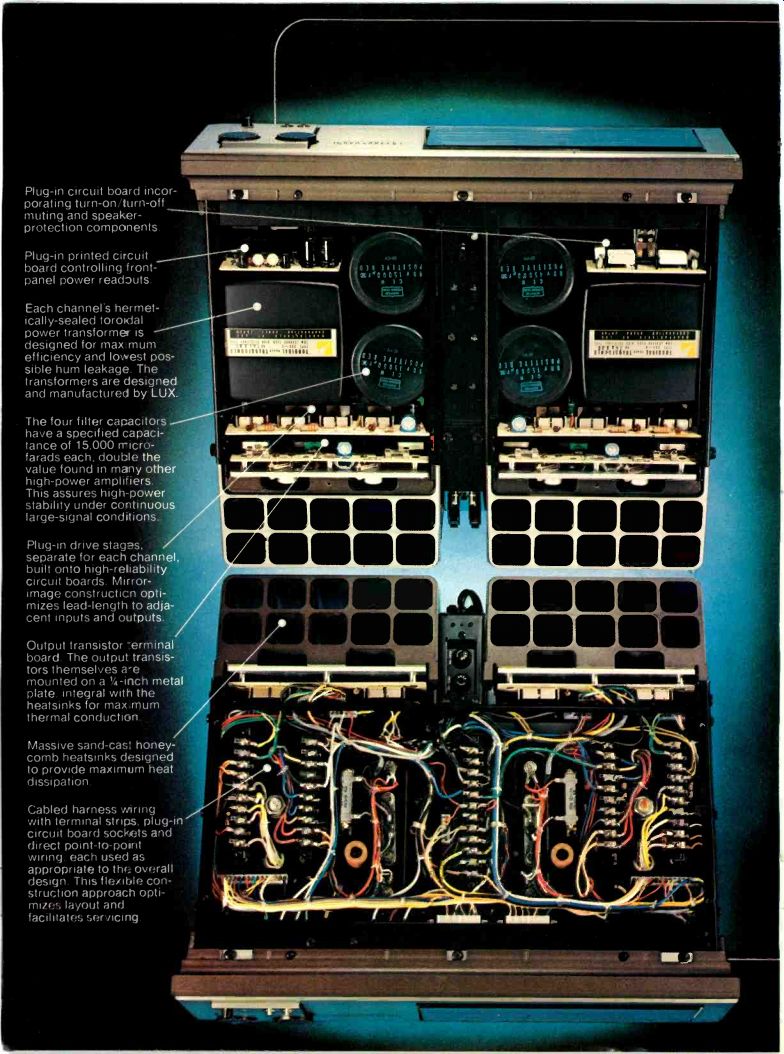

Plug-in circuit board incorporating turn-on/turn-off muting and speaker-protection components.
Plug-in printed circuit board controlling front-panel power readouts.
Each channel's hermetically-sealed toroidal power transformer is designed for maximum efficiency and lowest possible hum leakage. The transformers are designed and manufactured by LUX.
The four filter capacitors have a specified capacitance of 15,000 microfarads each. double the value found in many other high-power amplifiers This assures high power stability under continuous large-signal conditions.
Plug-in drive stages.
separate for each channel built onto high-reliability circuit boards. Mirror-image construction optimizes lead-length to adjacent inputs and outputs.
Output transistor-terminal board. The output transistors themselves are mounted on a 1/4-inch metal plate. integral with the heatsinks for maximum thermal conduction.
Massive sand-cast honey comb heatsinks designed to provide maximum heat dissipation.
Cabled harness wiring with terminal strips, plug-in circuit board sockets and direct point-to-point wiring, each used as appropriate to the overall design. This flexible construction approach optimizes layout and facilitates servicing.
LUX power amplifiers are designed to provide more than merely x watts per channel.
If your interest in a power amplifier is based primarily on its dollar cost per watt, you're not likely to give much initial thought to a LUX. We don't compete in that simplistic power game Our concerns are with every aspect of amplifier design and construction-to assure your continuing satisfaction throughout what you can expect to be a very long period of ownership. If you share these concerns, you may then find the LUX approach to have special significance and value well beyond purchase price. Especially when it comes to sonic excellence.
As Radio-Electronics neatly put: "There is much we still don't know about what makes one amplifier sound better than another--but LUX seems to have found some of the answers, at least:.
These solutions now exist because the research that LUX audiophile/engineers conducted went far beyond the obvious questions about amplifier design to those subtle but sonically significant aspects of high-power circuit design usually bypassed or ignored by conventional thinking, test techniques, and instrumentation.
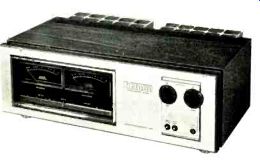
For example, ordinary protection circuits can introduce audible and unpredictable distortions when activated by certain types of loudspeaker loads. These are not disclosed. let alone cured, by the usual test procedures. LUX's solution: four separate sensing circuits sophisticated enough to distinguish the electronically subtle differences that can occur between Luxman M-4000 Power Amplifier 180 watts per channel minimum continuous power, both channels driven simultaneously into 8 ohms Total harmonic, Mid inter modulation distortion no more than 0 05% Frequency response 5-50 000 Hz.
1 dB Signal to noise ratio 108 dB Features include separate power supplies for each channel including output and drive stages Two meter power output display in combination with LED peak output indicators reveal dynamic range of program material Output level set by precision potentiometer with 1 dB click stops $1,495.00 Luxman M-6000 Power Amplifier. Similar features and specifications. except 300 watts per channel $2,995.00 normal high-level output signals and abnormal voltage/ current conditions Models M-4000 and M-6000 have fully independent power supplies employing separate toroidal power transformers for each channel. These allow the full wattage potential and signal-handling stability to be individually realized by each channel even under continuous large-signal drive conditions.
Massive honeycomb heatsinks provide the thermal dissipation necessary for overall reliability and long term performance stability.
The LUX difference goes beyond this. Every power amplifier undergoes an extensive series of tests at our New York facilities. This assures that each unit will match or exceed fourteen different published specifications. A Performance Verification Certificate attesting to the specific measurements obtained is packed with each unit. (Your dealer also has a copy and another stays with LUX as a permanent record.) With all this in mind, plus the features and specifications listed below and the revealing internal views at left, your selection of a power amplifier can best be made only at one of our carefully selected audio dealers where LUX and other fine components can be compared and evaluated. Assuming that you have the ability to distinguish the sometimes subtle sometimes obvious-differences among high-
power amplifiers, we'll be pleased to await your considered judgment.
LUX Audio of America, Ltd.
200 Aerial Way Syosset New York 11791
In Canada White Electronics Development Corp Ontario Results of extensive comparative tests yours for the asking.
What is perhaps the most exhaustive test of power amplifiers and preamplifiers ever made was recently conducted by Stereo Sound. Japan's leading audio publication. Among the many Japanese and American-made products tested were the Luxman M-4000 power amplifier and the C-1000 preamplifier With permission of the publisher, we have translated and reprinted the complete report We shall be pleased to send you a copy upon written request.
------------
Sony
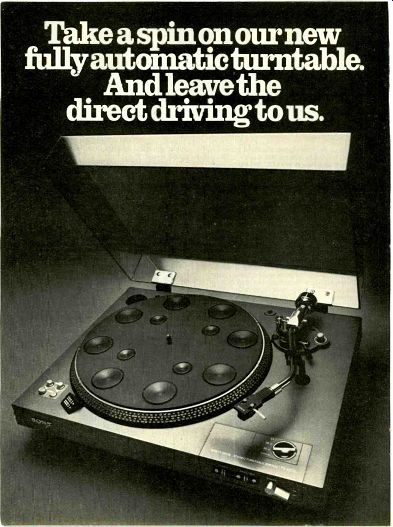
Take a spin on our new fully automatic turntable. And leave the direct driving to us.
With Sony's new PS-4300, you just sit back and enjoy the ride. Wherever the record takes you.
That's the blissful simplicity of a fully automatic turntable.
But the PS-4300 is more than purely practical. We like to think of it as a model union:
combining the convenient and the complex.
It is a profoundly engineered machine, with intelligent design slashing through down to the smallest detail.
We gave brushes the brush.
The motor that powers the PS-4300 is brushless and slotless. Direct drive, if you will.
This deceptively simple construction makes for a smooth-runt ling motor with less friction and noise than traditional DC motors. And it eliminates cogging.
What's more, this smooth-running motor is monitored by a smoothly-engineered 8-pole magnetic pick-up head. And our magnetic speed sensor works through an intricate electronic feedback system; driving the platter directly-without a jumble of belts and pulleys getting in the way.
So our torque is not a turkey, and we've got low wow and flutter and high speed stability to boot.
An electric eye.
For your ear.
Hands off the PS-4300! Our optical sensing system automatically returns the arm when your record is over.
Optical sensing is light years ahead of the conventional mechanical linkage. Eliminating the pressure and distortion you'd ordinarily get at the end of a record.
A tone-arm that's a strong arm.
Now we're not calling anyone clumsy. But there is the chance you might make a mistake and grab hold of the tone-arm while it's in motion.
That's why the PS-4300 has a tone-arm that's more than just statically balanced. It comes with a protective clutch device. (The only clutch you'll find on our fully automatic turntable.) This latching set-up protects your arm against too much strain.
Moving from arms to feet, ours are designed to cut feed back. They're rubber-soled: suspended by cup-shaped rubber shock absorbers.
And they're adjustable, let ting you level the turntable. So you might say our feet come with elevator shoes.
Our vibration-reducers are great shakes.
Sometimes the cabinet itself can vibrate-distorting what comes out of it.
Not so with the PS-4300.
Our cabinet is built out of a material with a low Q. Low Q materials hardly vibrate, and nobody watches their P's and Q's like Sony.
Even our platter has been undercoated with a damping material.
And what looks like a bad case of acne on our record mat is a series of bumps that provide an air cushion and absorb vibration.
An exercise in self-control.
You can see that we've covered just about everything when we created the PS-4300.
Even the cover.
Our dust cover is ingeniously simple. When closed, it leaves the controls accessible.
And what controls they are! One-touch, LED-indicated switches for start/stop and repeat.
One light tap starts everything going, while your record, under the dust cover, is in splendid isolation.
So if what you're looking for is an unmatched fully automatic direct drive turntable, drive on over to Sony.
SONY 1977 --- Sony Corp of America Sony. 9 W 57 St., N Y. NY 10019. SONY is a trademark of Sony Corp
----------------
ADC
THE ADC cartridge CAUSES NO PERCEIVABLE WEAR OVER THE LIFE OF YOUR RECORDS.
Unbelievable? Believe it.
A series of tests conducted by a leading independent audio-testing laboratory prove it.
The tests show that the PDC XLM-MKU cartridge causes no perceivable wear until after 60 plays. Industry sources estimate the life of a record" (the average number of times a record is played) to be 40 to 50 plays.
Other cartridge manufacturers may talk about less record wear, but ADC has proven no wear over the life of your record.
The reason is our unique patented design.
We call it the "induced magnet" cartridge.
Most cartridges are designed so that a heavy magnet is part of the moving system.
The ADC XLM MKU is different, because our engineers found a way to detach the magnet and reposition it above the stylus, so the stylus applies less pressure against the groove.
Less pressure means less wear.
The fact is, of all the leading brands, ADC cartridges have the lowest mass moving system you can buy. That means better sound and superior performance.
The XLM frequency response is exceptionally flat, from 15Hz to 24KHz ± 1.5dB.
And for the ultimate in stereo reproduction, it has a minimum of 28dB of V / channel separation.
Think about it. In the long run you'll probably spend more on your record collection than you will on your whole stereo system. So it mates sense to buy a cartridge with proof that it makes your records sound better and live longer.
The ADC low mass cartridge.
Unbelievable.
THE ADC LOW MASS CARTRIDGE.
IT HELPS YOUR RECORDS LIVE LONGER.
A-D-C
A BSR COMPANY
ADC Phono Cartridges
A Division of BSR Consumer Products Group Rte. 303, Blauvelt, N.Y 10913
THE PROOF:
267X Magnification
This is a photomicrograph of a 20kHz record groove that has never been played before.
273X Magnification This is a photomicrograph of a similar 20kHz record groove played 75 times with an ADC XLM-MKU cartridge. As you can see there is no difference.
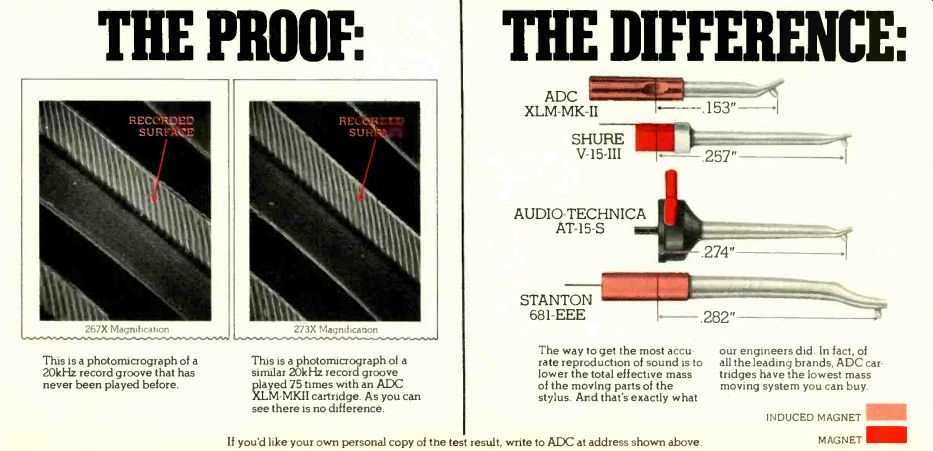
THE DIFFERENCE:
The way to get the most accurate reproduction of sound is to lower the total effective mass of the moving parts of the stylus. And that's exactly what our engineers did. In fact, of all the leading brands, ADC cartridges have the lowest mass moving system you can buy.
If you'd like your own personal copy of the test result, write to ADC at address shown above.
-----------------
You can study the glowing consumer response in your favorite hi-fi magazine. Objective.
informative, helpful.
You can talk with a knowledgeable owners who often talk of little else. Subjective, enthusiastic, convincing.
But it isn't until you actually listen to an Avid speaker system for yourself that you learn why they have won such unprecedented critical acclaim.
Only then can you sense the superb design, engineering, and craftsmanship that have made Avid the most accurate speakers in that--price range.
Only then, in light of you own listening pleasure, can you understand why Avid speakers can be your best buy.
That's why we invite you to audition one or more of fine selection of Avid speaker systems at war Avid dealer. Be an Avid listener.
Avid The most widely acclaimed new line of hi-fidelity speakers.
AVID Corp., 10 Tripps Lace E. Providence, RI. 02914. USA.
----------------
Discwasher

New D3 Fluid , The Discwasher System: the best record care system in the world.
Discwasher Group Columbia, Missouri
--------------------
Bolivar

There are a lot of good loudspeakers around these days.
Especially if you're going to pay $100 or $150.
Some ore pretty good.
Some are really good.
But good isn't erect.
Introducing Bolivar Speaker Works.
We make two loudspeakers.
Both are 3-way bookshelf systems.
One is $150;
the ether $114
Both are really efficient.
Twice as efficient as the current leader in that price range.) You won't need a big receiver to get a big sound.
The enclosures are the same kind used for expensive loudspeakers, but we finished the min a warm-toned vinyl.
No fancy wood veneers.
We put the money in the sound.
Come listen to Bolivar.
Then listen to any other speaker that costs about the same.
You'll buy Bolivar.
Bolivar Speaker Works Your nearest Bolivar dealer? That’s easy.
Call (800) 243-6100.
In Connecticut, 1-800-882-6500.
Bolivar Speaker Works.
Bolivar, Tennessee 38008
---------------------
Fisher
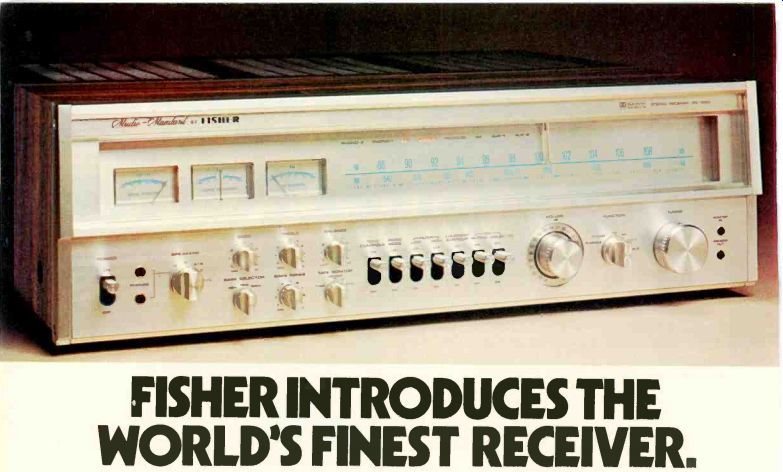

FISHER INTRODUCES THE WORLD'S FINEST RECEIVER.
This headline from any other manufacturer might sound like just so mans words. But, it's by Fisher, the company that started the high fidelity industry back in 1937. And the company who introduced the very first AM/FM stereo receiver 18 years ago.
In a sense, we've been building the RS1080 for 40 years ... researching, engineering, inventing, and refining our technology to finally develop what is surely the world's finest receiver at any price.
Our RS1080 is rated at an enormous 170 watts per channel, minimum RMS into 8 ohms, from 20 to 20,000Hz with no more than 0.1% total harmonic distortion. There is lots of pure, clean power to give you lots of pure, clean sound at any listening level. But power is only part of why the RS1080 is the world's finest.
Tuning. Precise, accurate tuning is a must for FM listening. And the RS1080 includes 3 separate tuning meters: signal strength, center-of-channel, and most important, a multipath meter with phase-locked-loop circuitry.
FM Dolby. For the ultimate FM listening experience, the RS1080 has built-in, factory calibrated FM Dolby decoder circuitry. This feature lets you hear the full dynamic range of Dolby broadcasted music. Another must if a receiver is designed to be the world's finest.
Other state-of-the-art features and specifications include 8-gang tuning. 1.7 µV FM sensitivity, plus all the front panel controls and rear panel input/output jacks you'll ever need.
Bass Extender.
A major exclusive feature of the RS1080 not found in any other receiver is our bass extender and bass range level control. At a flip of a control you can boost bass response up to 12dB at either 45 or 80Hz. Electrically tuned circuits assure sharp roll-off characteristics, and a tremendously noticeable improvement in bass response without muddying-up the mid range or increasing hum or rumble. The result is a truly sensational improvement in sound quality in your listening room with any speaker system.
Sure, maybe some late-comer audio manufacturers have good receivers on the market, but at Fisher, we are convinced that our RS1080, priced at $900*, is the world's finest. Look at and listen to the Fisher 1080. Available at fine audio stores or department store audio departments.
1977, Fisher Corporation, 21314 Lassen Street Chatsworth, California 91311. FISHER---The first name in high fidelity.
-------------------
Yamaha's new two-way beryllium dome NS-500.

A very responsive speaker with a rich, luscious sound. Highly defined, finely detailed. A deeply involving sound.
In a word, sensuous.
With the NS-5001. you get al_ of beryllium's advantage-3 (transparency, detail, and lack of distortion that go beyond the best electrostatic speakers), but at a price roughly half that of the NS-1000. Only $50C the pair, suggested retail price.
The joy of beryllium.
The ideal dome material for a high frequency driver must respond instantly to charges in amplitude and frequency of the input signal. So the ideal dome material must be virtually weightless as well as extremely rigid.
Beryllium is the lightest and most rigid metal known. Its density is less than two-thirds that of commonly used aluminum. and its rigidity is almost four times as great-thus pre venting dome deformation and consequent distortion. What's more, beryllium's sound propagation velocity is twice that of aluminum.
The beryllium Some found on the NS-500's high frequency driver is the world's lightest-about half the weight of one petal of a small sweet heart rose. Which is ore of the reasons for this speaker's exceptional sensitivity and response. And for its sensuous sound A closer look.
To be able to offer the sophistication of beryllium at a more affordable price, without sacrificing quality of performance, Yamaha designed the NS-500 as a two-way bass reflex system.
This gives the NS-500 a trace more emotion at the low end than the resolutely objective NS-1000. But it also gives the NS-E00 more efficiency (91dB SPL at 3ne meter with one watt RMS input). Which means you don't have to invest in the highest powered amplifiers or receivers in order to drive the NS-50C' to its fill rated output.
For an optimum match with the beryllium tweeter, Yamaha developed a very light, very rigid "shell" woofer.
And a special hermetically-sealed air core LC crossover with a carefully selected 1.8kHz crossover point.
As a result of these design parameters. the NS-500 boasts an insignificant 0.03% THD below 50dB SPL, from 40Hz to 20kHz, making it the perfect complement to Yamaha's state-of-the-art low distortion electronics.
Underneath the sleek monolithic styling of its solidly crafted enclosures, the NS-500 is fill of many exclusive Yamaha features and distinctive Yamaha touches of craftsmanship.
But to fully appreciate the beauty of the NS-500, you really should visit your Yamaha Audio Specially Dealer.
And if you're not familiar with tie name of your local Yamaha Audio Specialty Dealer, drop us a line. In turn, we'll also send you a free pre print of the Audio Engineering Society paper on Yamaha beryllium technology mentioned above.
P.O. Box 6600, Buena Park, CA 90622
--------------------
THE GAP BETWEEN MAXELL AND ALL OTHER TAPES HAS JUST WIDENED.
INTRODUCING UD-XL I AND UD-XL II.
Maxell tapes have always been considered by many people to be the highest quality tapes in the world.
But instead of sitting back and resting on our laurels, we've spent the last few years looking for wars to move even further ahead.
The results of our efforts are Maxell UD-XL I and UD-XL U. Two Tapes which are not only better than anything we've ever mode, they're better than anything anyone's ever made.
To begin with, JD-XL I is an improved version of our own UD-XL.
More specifically, it's a ferric oxide tape designed for use with the tape selector switch in the normal position (120 microsecond equalization and standard bias).
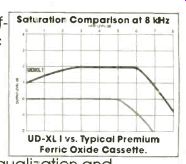
Its performance characteristics include the lowest harmonic distortion level of any premium cassette on the market today
An extremely flat frequency at 8 kHz
UD-XL I vs. Typical Premium Ferric Oxide Cassette.
JUST WIDENED.
Signal-to-Noise Ratio Comparison
UD-XL I vs. Typical Premium Ferric Oxide Cassette.
a response from the lowest to the highest frequencies.
And an exceptionally high resistance to saturation even at highest recording levels.
UD-XL II, on the other hand, is a ferric oxide tape specially formulated for use with the tape selector switch in the chrome position (70 microsecond equalization and high-level bias). It offers the low noise advantage of "chrome" without the disadvantages. Its performance characteristics include extremely low modulation noise and a 5 dB signal-to-noise ratio improvement over ordinary premium tapes.
If you'd like to know more about UD-XL I and 1.2D-XL II, stop into your local dealer and ask some questions. Not just about out tapes, but about our competitors' as well.
We think you'll soon discover something that we've always known.
The best just keeps getting better.
MAXELL. THE TAPE THAT'S TOO GOOD FOR MOST EQUIPMENT.
------------------
This is no way to nail down a hi-fi bargain.
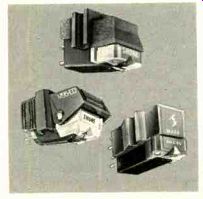
Some stores think that one of their cost-cutters in assembling a "bargain" stereo system is to install a run-of-the-mill, inexpensive cartridge. After all, who's going to notice a tiny cartridge when it's surrounded by powerful speakers and a dynamite turntable? Unfortunately, some shoppers are reluctant to insist on a better cartridge when buying one of these package specials. But you are made of sterner stuff! And if you insist on a Shure cartridge, "better" doesn't have to mean more expensive. Time and time again, consumer magazines have rated Shure cartridges the best in their price category.
As the source of sound for the entire system, that tiny Shure cartridge and its critical stylus determine what you'll ultimately hear. And as bargains go.
that's the best tip you'll hear today-or any day!
Shure Brothers Inc.
222 Hartrey Ave.. Evanston, IL 60204
Manufacturers of high fidelity components, microphones, sound systems and related circuitry.
---------------
The Onkyo Challenge ...

The TX-4500 stereo receiver with Quartz Locked Tuning succeeds where others fail.
Hirsch-Houck, world famous audio test lab, said of the TX-4500.... "literally impossible to have the slightest mistuning." The:, added.... "Tuner always matched the best measured performance we were able to obta n by manual tuning.-* Olkyo's secret weapon in the war against high-priced low-fi is the exclusive Quartz Lrcled Tuning, a system that maintains pinaDint reception, maximum channel separation and minimum distortion.
In almost every case, Hirsch-Houck's results from their tests were better than we statit on cur specs. Perhaps we're too modest.
Tt-ey fur-her added...' Both its FM Tuner and Audio Amplifier performance are in almost every respect far above the norm for receivers, especially in this price range, and in some areas the performance rivals that of the most highly regarded separate components." Conclusion, again quoting from Hirsch Houck.... "Over the years we have found that most competitively priced receivers are fairly equal in their overall performance characteristics. It appears to us that the Onkyo TX-4500 may be just a little more equal than its peers, so as to speak." Ask your Onkyo dealer for a copy of the Hirsch-Houck Test Report or write to us.
Your dealer also has Onkyo's TX-2500, a modest priced version featuring Servo Locked Tuning, which is the next closest thing to Quartz Locked Tuning.
Try the Onkyo Challenge. There s no way you can lose. You'll find out what makes us quietly superior.
Stereo Review October. 1976 TX-4500 Quartz Locked AM/FM Receiver 55 Watts per channel, min. RMS, at 8 ohms from 20 Hz to 20 kHz with no more than
0.1% Total Harmonic Distortion.
----------------
Some $5 blank cassettes have the nerve to tinker with Beethoven.
We think it's outrageous.
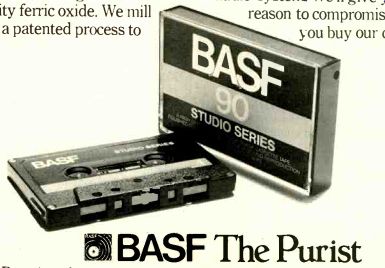
Beethoven, even when he was deaf, knew exactly how a piccolo sounded in relation to the rest of the orchestra. Some cassette manufacturers would just as soon forget.
Their cassettes give the piccolo and other high frequency sounds a distorted prominence. They appear to do this deliberately, regarding absolutely natural sound as raw material to be improved upon.
At BASF, we think this is an abomination. We're purists; we stake everything on total accuracy of sound reproduction. You will never encounter artificially enhanced high frequencies in our cassettes. We believe that if you care enough to buy an expensive audio system, the last thing you need is a cassette that imposes its own dubious tastes upon your sensitive ears.
Faithful reproduction entails more than miracle ingredients and fanciful initials on a cassette label.
At BASF, we begin with the best quality ferric oxide. We mill it by a patented process to achieve maximum packing density and uniformity of coating. We use an exclusive chemically cross linked polymer binding which will never deteriorate and cause head-related frictional noise or wow and flutter.
We use a unique multi-stage polishing process, and our slitting technique results in an edge that's clean even when viewed under a microscope. Even our cassette case is different, incorporating our patented Special Mechanism, designed to assure smooth tape feed for years of dependable performance.
Is completely natural sound worth that kind of effort? To people who know the difference, it is.
At BASF, we're purists. We've been obsessed with total accuracy since we invented magnetic tape back in 1932. There are no short cuts to perfection. But you knew that when you planned your own audio system. We'll give you no reason to compromise when you buy our cassettes.
BASF--The Purist
Our Promise: the purest, most accurate sound that cape can reproduce.
------------------
RTR
RTR sound is a singular creation Like the human voice and all things striving for perfection, RTR sound systems have only one maker. Each critical component is designed and manufactured by RTR. From hand-wound voice coils to hand-rubbed cabinetry, everything fits and operates as one. Thus RTR systems approach the perfection of realistic sound.
Few others are so dedicated.
They create systems from the components of many manufacturers-often including transducers built by RTR. Though they build fine speakers, they build only finite systems. That is the law of group creation.
If you strive for realistic sound at a sound price, seek your nearest franchised RTR dealer.
He will show you a singular solution.
For dealer list write RTR, Dept. HF, 8116 Deering Avenue.
Canoga Park, CA 91304
---------------------
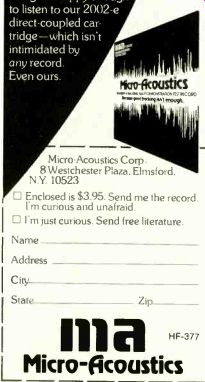
Learn the naked truth about your phono cartridge.
If you're the kind of music lover who wants to get the very most from your stereo system. you can't afford to be without the Micro-Acoustics Transient and Tracking Ability Demonstration Test Record. Because it does what no test record ever did before.
Until now, test records concentrated on tracking ability--how well a stylus keeps contact with record grooves on louder, harder-to-follow passages. at low stylus pressures.
But cartridges need good transient ability. as well. To accurately reproduce the sudden start-and-stop bursts of sound at all frequencies that differentiate one instrument from another
...and localize instruments in space.
Micro-Acoustics' new 1T2002 test record is the only record specifically designed to test both abilities. On side 1 of this easy-to-use disc is a series of electronic and musical tests incorporating technology we've developed as the world's leading manufacturer of recording styli.
Side 2 is a dramatic demonstration of quality music, played by the top names in the business.
One small catch: Our record has humbled many a proud stereo cartridge, and may well make you un happy with what you're using. Unhappy enough to listen to our 2002-e direct-coupled cartridge-which isn't intimidated by any record.
Even ours.
Micro-Acoustics Corp.
8 Westchester Plaza. Elmsford.
N.Y. 10523 Enclosed is $3.95. Send me the record.
I'm curious and unafraid.
----------------------
THEY'RE EVERY MICROPHONE YOU EVER WANTED.
We've taken the latest advances in electret technology one step further. By combining them with advanced acoustic technology to make professional condenser microphones more portable, more practical and less costly. A lot less.
The secret is our "family" concept.
One common powering module (K2U) serves three different compact heads: omnidirectional (ME20), cardioid (ME40) and shotgun (ME80). Thus, for most studio and location situations, it's no longer necessary to carry three different microphones. Or pay for three different complete units. Each head contains its own microphone capsule and "front-end" electronics, all exactly matched to its own precisely-controlled acoustical environment.
Resulting in the first electrets with response and directionality to rival our famous RF condenser models in all but the most critical applications.
The Powering Module, runs on a single 5.6V battery, or phantom-powered directly from your recorder, preamp or other auxiliary equipment. A miniature LED monitors power and indicates proper voltage. Connection to preamps, mixers, etc. is balanced* low-impedance via a 3-pole Cannon XLR connector. Best of all, of course, is the great versatility. In a matter of seconds, you screw on whichever head you need and go! If all this sounds good to you, call or write us. We have a lot more good things for you to hear.
Powering module and heads available separately. Prices subject to change without notice.
Unbalanced version also available.
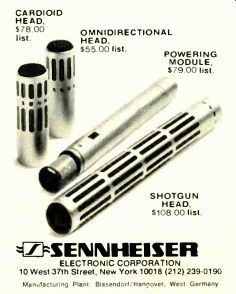
CARDIOID HEAD, $78 00 OMNIDIRECTIONAL list' del HEAD, $55.00 list.
POWERING MODULE, $79.00 list.
SHOTGUN HEAD, $108 00 list.
ELECTRONIC CORPORATION
10 West 37th Street, New York 10018
(212) 239-0190
Manufacturing Plant. Bissendorf/Harmoyer, West Germany
--------------------
FLEXIBLE CC 1-1 Model 217 Suggested Retail $250.00 PREAMPLIFIER
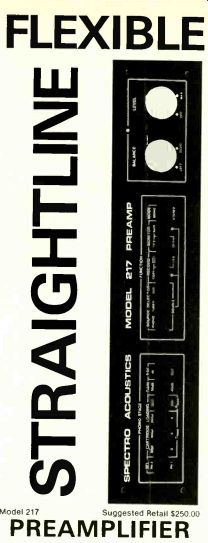
The Spectro Acoustics Model 217 is the first preamplifier to provide complete facility to accurately "load" any standard phono cartridge to the manufacturer's specifications. With these idealized conditions, true ultra-accurate "flat" response is possible.
A gain selector optimizes noise and overload conditions depending on the output of the individual cartridge and a third order Butter worth subsonic filter eliminates sub-audible turntable rumble and potentially destructive low frequency acoustic feedback from high power amplifiers. Switching includes two phono inputs for NB cartridge comparisons and bi-directional bypass copying for two tape decks.
Distortion:
THD 0.05% 20Hz-20kHz IMD 0.0075% SMPTE
Noise:
Phono: S/N 82 db "A" weighted High Level: SIN 110 db "A" weighted
Frequency Response:
10Hz-100kHz ± 1 db (Flat within 1 db to the limits of a calibrated Sound Technology 1700A analyzer) The straight-line design has no tone controls or equalization to alter the linear response in any way. However, full flexibility is maintained for the audiophile who wishes to patch in an equalizer or any other outboard signal processor.
SPECTRO ACOUSTICS INC.
1309 E Spokane Pasco, Washington 1509) 545.1829 99301
-------------------------
Pearlcorder-S

A MICROCASSETTE recorder that's so unique, it's like having your own mini-studio in your pocket with remarkably good fidelity for music as well as voice. It's smaller than a checkbook (5 1/4" from top to bottom, slightly thicker than a pack of cards), and lightweight (12 ounces with batteries), but it's packed with studio precision and professional features:
60 minutes recording time.
Capstan drive for constant tape speed, built-in electret condenser microphone.
AC bias, record-warning light.
All metal construction for years of dependable service.
Ore-hand operation: instant loading.
Fast forward and rapid rewind.
Automatic level control.
Connects to your stereo or full-size recorder with a Compaticord, for both recording and playback.
The Pearlcorder-S performs beautifully in an office, in your car, even on airplanes;
and it's backed by the reputation of the Olympus Optical Co., Ltd., a company famous for fine cameras, medical and other precision scientific instruments.
The Pearlcorder-S. Carry one. And have a studio with you.
Available at fine photographic, audio, and A-V dealers everywhere. Or write for our brochure, "Pocket Full of Miracles." OLYMPUS CORPORATION OF AMERICA
60 minutes of sound in this actual-size MICROCASSETTE."
-------------------
COLLECTOR’S ITEM
It's Add 'N Stac? the world's only expandable cassette and 8-track storage system. Expandable because it provides as much tape storage as your collection calls for. Add 'N Stac' is a module, so you can buy only one or a few at a time.
Each module has a patented interlocking device on all four sides. As your collection grows you simply lock one module into the next and-Presto!-expansion space.
Add 'N Stack is available in either cassette or 8-track size. Both come in a selection of colors to help you match your decor or color-code your collection by category. Pre-drilled mounting holes let you create a striking wall unit, or if you prefer, stack an arrangement on a table or shelf.
Store, organize and protect your expanding tape collection with the world's only expandable system. At under $2.00 a module, it's definitely a collector's item.
.. all in all this is the best storage system we know of for the serious collector"
-HIGH FIDELITY

Add 'n Stag a product of Royal Sound Company, Inc.
For information ask your dealer or write:
Royal Sound Co.. Inc., 248 Buffalo Ave., Freeport, N.Y. 11520 USA
Registered U S Patent Office. U.S. and Foreign Patents
-----------------
There has never been anything quite like the new Nakamichi 600 Cassette Console, either in appearance or performance. Elegant functional styling, coupled with world-famous Nakamichi engineering, establishes standards that are unlikely to be equaled for years to come.
By design, the 600 is a study in human engineering. All of the operating controls, as well as all adjustment and calibration controls, are engineered into the graceful front panel, assuring ease of operation and maintenance.
The shape of the future.
But the real news is in the increased dynamic range of the 600. The Nakamichi Focused-Field Crystal Permalloy head not only assures a remarkable frequency response of 40 to 18,000 Hz; it achieves superior penetration of the tape coating, producing a higher, undistorted signal level. Special IM Suppressor circuitry reduces saturation nonlinearities and increases dynamic range to an incredible 68dB at the standard 3% distortion figure with Dolby on. Program material may be recorded at levels 3 to 4dB higher than previously possible.
To take full advantage of this available head room, the Nakamichi 600 employs precise peak reading meters with an unheard of 47dB range. Full meter deflection is an unprecedented 7dB.
That's a big plus any way you look at it! Naturally, this superior dynamic range yields a vastly improved signal to noise ratio and impressive openness of sound. The tape transport, designed especially for the 600, is light and positive in action, and employs a pulse controlled DC Servomotor, which cuts wow and flutter to a minimum and guarantees constant tape speed, unaffected by fluctuation in line voltage or frequency.
Additional features include built-in Dolby Noise Reduction, 400 Hz calibration tone, MPX filter for FM recording. memory re wind, and individual record level controls plus master level control and independent bias and equalization switches. The 600 is the first in an innovative group of special components, The Recording Directors' Series, designed to provide unequalled performance and exceptional flexibility.
So visit your Nakamichi dealer soon, and get a glimpse of the future, or for additional information write Nakamichi Research (U.S.A.), Inc., 220 Westbury Ave., Carle Place, New York 11514.
------------------------
What you don't know about effective tip mass won't hurt you, just your records. You can find out what you don't know by contacting us for our comprehensive cartridge brochure. Bang & Olufsen Bang & Olufsen of America, Inc., Dept. 11G 515 Busse Road, Elk Grove Village 60007
----------------
Could the ultimate system be all Crown? When listening becomes an art, It depends on how you define "ultimate." But Crown may be the only top-quality, state-of-:he-art manufacturer whose components could build a complete, ultimate hi-fi system.
For instant:: A CX-824 tape deck, world renowned for reliable performance. Connected to an IC-1EOA pre-amp. With the signal amplified by a DC-300A power amp, proved in many thousands of hours of professional use. output controlled, monitored and switched by an 0C-150. Possibly a VFX-2 for personal control of crossover points. And sound faithfully reproduced by ES-212 electrostatic speakers.

All Crown. We think that system would be somebody's ultimate. Certainly ours. Maybe yours.
Write us today for the name of your nearest Crown dealer. he'll talk to you--ultimately.
crown Box 1000, Elkhart IN 4E514
--------------
At Sound Industries, we don't give you great loudspeaker Gurus, just great loudspeakers
Most speaker companies today offer the world the designs of their "Great Guru of Loud speakers" He's usually someone who's recently re-in vented the speaker principles of his particular design (and who's been modest enough to put his name on the grille cloth).
At Technical Sound Industries we haven't re-invented the speaker or their physics principles, but we have taken a long look at what the customer wants. Not East Coast sound. Not West Coast sound. But accurate sound. Efficient sound. And clear sound. With the lowest distortion.
At Technical Sound Industries we believe that two heads are better than one, and three are better than that when it comes to speaker design; so we've assembled the designs and opinions of many good engineers in our speakers. We've coordinated this effort with high-speed computer design techniques. And we've come up with a full line of the most listenable speakers you've ever heard. A line of speaker products based on some pretty heavy engineering that's yielded our Bass Linear Motion Transformer m and our Sila-Sealed Power Dome Tweeter with hi-temp epoxy voice coil. The beautiful parts are the prices and the hot lacquered walnut veneered cabinets. TSI Loudspeakers . . . optimized accuracy in transducers.
For more information write: Technical Sound Industries, Inc., 1435 Jacqueline Drive, Columbus, Georgia 31906.
Call our dealer hotline for where to buy: 1-800/241-0914 or 404-563-8403.
Technical Sound Industries, Inc "We are bridging the gap between good sound and technology"
---------------
These essential music-making tools let you get in, around, and behind your music. One part, one track at a time. Then when all the elements are the best they can be, you blend them together and generate the finished product. A process that involves your innermost sensitivities and perceptions. A personal statement.
The 3340 has undoubtedly helped more people make more demos and masters than any other tape recorder. Our new model, A-3340S, has extended high end frequency response in the sync mode, plus manual cueing. The Model 2 is about the best value going in small mixers-6-in, 4-out with full panning and multiple patch points. Plug in a few high quality TEAC ME-Series electret condenser mics, and you could be quite literally in business.
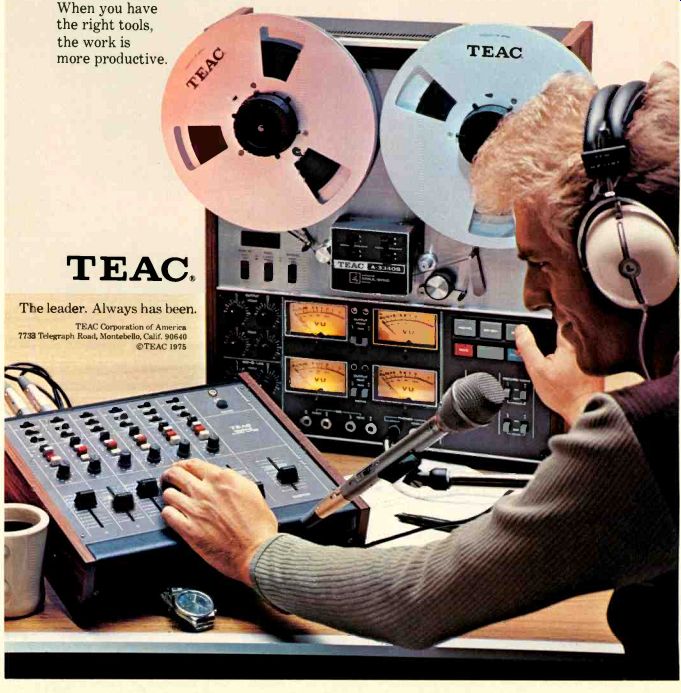
When you have more productive.
It's all in your hands now.
the right tools, the work is TEAC.
The leader. Always has beer..
TEAC Corporation of America. 7733 Telegraph Road, Montebello, Calif. 90640
TEAC 1975
---------------------
JVC Professionals.
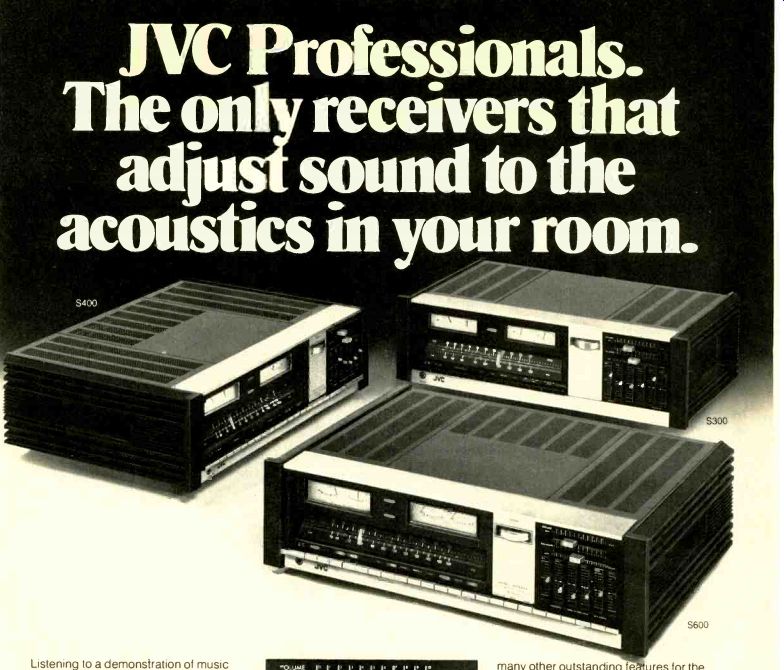
The only receivers that adjust sound to the acoustics in your room.
Listening to a demonstration of music systems at a dealer is an excellent way to make a buying decision. But it can be misleading. Because what you hear in the dealer's acoustically designed sound room may not be what you hear at home The reason is simple. Sound quality is determined by various factors, including the size of a room and its acoustic elements. Drapes. Carpet.
Furniture. Windows. Ceiling height. Walls They all play a role in the sound you hear To help you get the best sound from your music system-wherever you listen to it-JVC has built into its top three receivers (S600, S400, S300) their exclusive SEA graphic equalizer system.
This unique 5-zone control lets you create 371,293 different tone adjustments. As a result, you can custom tailor the sound to compensate for any room size and acoustic surfaces. The graphic equalizer also enables you to overcome deficiencies in old or poor recordings and the placement of speakers. Nobody else has this built-in feature. Nobody. And the only
Exclusive 5-zone SEA graphic equalizer system for better performance from components and] listening room.
way any other make of receiver can match the sonic versatility of these three j VC models is by your adding to it (at an additional cost of $100 or more) a separate, outboard graphic equalizer.
When you consider that you get the built-in graphic equalizer plus JVC's S600 many other outstanding features for the price of a conventional receiver in their price ranges, you can understand why the JVC professionals are rapidly becoming the #1 receiver to own.
JVC also offers the less sophisticated, moderately priced $200 and $100 receivers with precision, linear slide controls for bass, treble and volume.
Regardless what you plan to spend for a receiver-think like a professional and get the best. Think JVC.
Visit your local JVC dealer, or call toll-free (outside N.Y.) 800-221-7502 for his name.
JVC America, Inc., 58-75 Queens Midtown Expressway, Maspeth, N.Y. 11378 (212) 476-8300. Canada: JVC Electronics of Canada, Ltd., Scarborough, Ont.
-------------
The sound the audio world now demands.
Dynaco's LMS AKE LMS: The new Dynaco hallmark of its Laboratory Monitor Series
-speakers with lasting musical satisfaction. The rock-solid beauty of one inch thick genuine walnut veneer cabinets (33% thicker than the others) enhance the sound as well as the decor. They complement the output of high compliance linear suspension woofers with massive magnet structures and oversize 4 layer voice coils for highly efficient transfer of maximum energy levels. Rigidly isolated 5 inch midrange drivers add maximum definition in the three larger models.
The same aluminum voice coil ultra-dispersion dome tweeter used throughout is paired in the top two models for maximum energy capability.
Only at selected dealers-write for one nearest you.
Priced from $169-approximate retail value.
For descriptive literature write LABORATORY MONITOR SERIES by DYNACO, INC.
Coles Road- Box 88, Blackwood, N.J. 08012 609/228-3200
-----------------
+++++++++++++++++++
-------------
(High Fidelity, March 1977)
Also see: