
I own a twelve-year-old McIntosh C-22 preamplifier that is still operating on the original Telefunken vacuum tubes. The preamp was pronounced healthy at a recent clinic con ducted by McIntosh Laboratory. A supposedly knowledgeable professional told me that to re-tube my preamp would undoubtedly result in an audible improvement in its sound quality. Another professional states that this is not necessarily true. Who is correct? (The tubes test well in a drugstore tube tester.)
Morris T. Reagan, Greenfield, Wis.
You have had the word from the horse's mouth (McIntosh); what else do you need? Incidentally, some terrible tubes test "okay" on drugstore tube testers.
I have a Kenwood KA-6100 50-watt amp and a pair of its LS-405A loudspeakers, which have a recommended power requirement of from 10 to 100 watts. When I was listening to the latest record of Boston at full blast, my output meters registered 50 watts at their highest. But when I turned down the volume, a ringing sound appeared. Presto, a blown tweeter! When I took my speaker to the local authorized dealer, he told me he could fix it under warranty. He also told me that it was my fault and that "no speaker the size of the LS-405A" could take 100 or even 50 watts. I was amazed and told him of the manufacturer's recommendation; he only said that printing was cheap and that anyone could say something will take a certain number of watts. In other words, when I feel like checking out my speakers at full blast, I'm not able to. That's disgusting! What I need to ask you people is, where can I find a speaker the size and price of the LS-405A that will take 50 or even 100 watts of power? Is there one?
-Gary A. Lucero, Albuquerque, N.M.
Sorry to hear you've blown your tweeter, but your experience merely points up the problem with loudspeaker power ratings, which are not really power ratings at all, but merely indications of appropriate amplifier-power range. In arriving at a rating, the speaker manufacturer makes certain assumptions about the peak-to-average power ratios of typical music and the frequency distribution of that power. Most instruction manuals clearly warn that the speaker is not meant to withstand the "recommended power" level on a continuous (for example, sine-wave) basis. The woofer may stand up for a brief period, but the power-handling ability of most tweeters is limited to a handful of watts. For this reason, the tweeter is frequently protected with a fuse even when the woofer is not. And even though the tweeter's capacity may be limited, that sufficient for the high-frequency power in music when one takes into account the music-energy distribution curve and the peak-to-average factor-at least with "typical" music. (In rock, of course, both factors are extreme, and your source material puts maximum stress on the tweeter for a given listening level.) If you think this is an unfair way to characterize a loudspeaker, consider the following.
Let's say the continuous power rating of a tweeter is 5 watts. Had the manufacturer rated the total system at 5 watts, purchasers would assume that it would work well with a 5watt amplifier, which is certainly not true because such an amp would run out of steam long before it is delivering 5 watts in the tweeter's frequency range.
Frankly, had you been using an amplifier of greater than 50-watt capability at the time the mishap occurred, you might still have your tweeter intact. It seems to us that you drove the KA-6100 into hard clipping at the levels you were cranking out. When that occurs, a lot of high-frequency power (above and beyond that needed to replicate the input signal) is delivered to the tweeter. Using an amplifier without sufficient power capacity is one of the best ways to kill a tweeter.
I have a Heath AD-1304 audio processor connected between my receiver and cassette deck. When I play a Dolby-encoded cassette, the recording occasionally sounds better if don't decode it but, instead, allow the audio processor to provide the noise reduction (plus some expansion). What is the net effect in terms of the source material?
-H. L. Beck, Anchorage, Alaska.
If we define fidelity in the narrow sense of reproducing precisely what is on the tape, without alteration, use of the Heath AD-1304 to "decode" a Dolby-encoded tape is improper.
Dolby-B encoding compresses high-frequency information in varying degrees de pending both on signal level and on spectral distribution. The Dolby-B decoder is meant to expand the signal in a precisely compensatory fashion, restoring the dynamics and response of the signal that went into the encoder, while the Heath expander is not reciprocal to the encoding process.
That is not to say that under some conditions the AD-1304 won't sound better. Because of tape compression, Dolby mistracking, recorder nonlinearity, or a number of other foibles, what comes out of the Dolby decoder may not be an exact replica of the original. Conceivably, the AD-1304 might come closer. Finally, the original program might have been compressed or noisy even before encoding. In such a case. Dolby does nothing to improve matters, while the AD-1304's single-pass noise-reduction circuitry helps to reduce such pre-Dolby noise and the expander helps to improve the dynamic range.
If you like what you hear, enjoy.
My system consists of a Dynaco 410 power amp, Pioneer RT-701 open-reel deck, ADC 500 frequency equalizer, Nikko Beta II preamp, DBX 3BX dynamic range expander, DBX II 122 noise-reduction system, Technics SL-1600 direct-drive turntable with Shure v15 Type III cartridge, and a pair of Bang & Olufsen Beovox M-70 speakers. I'm planning to purchase some direct-to-disc records, and I want to preserve them on tape if possible.
Will my system be able to handle such records? I understand that they have a wider dynamic range than commercial records.
Myles Uyesono, Lihue, Hawaii.
The dynamic range that you can record with the DBX II 122 noise-reduction system and an open-reel deck exceeds by far that which can be recorded on disc. Therefore, you should have no trouble in recording direct cuts with minimal degradation. (Presumably, there will be some-otherwise the recording could have been mastered on tape.) The rest of your equipment should also handle the dynamic range without problems.
After blowing the woofer of my AR-2ax speaker (my fault) and incurring a $50 repair charge, I bought the fuses Acoustic Research recommends for them. Before installation, I had the fuse resistance measured on a lab instrument designed for low resistances. The value obtained was about 2 ohms. Since the nominal impedance of this speaker is 5 ohms, putting these fuses in the circuit would reduce the damping factor to a minuscule 2.5.
Is AR more interested in avoiding warranty costs than in how their speakers sound?
-Robert Malanchuk, Columbus, Ohio
We doubt the fuse recommended has anything to do with warranty costs. If it did, the fuse would in all likelihood be mandatory, not optional. The fuse is chosen to protect the speaker; its resistance is a side effect that, unfortunately, does degrade performance a little. If you don't like the sound with the fuse in place, there is nothing to do but leave it out and take your chances, or find an amp with a circuit (like the Dynaguard used by Dynaco in some of its products) that will limit the power to the speakers electronically.
I am interested in buying a pair of headphones that I can use with my GAS Thalia preamplifier. It only accepts phones with impedances of 600 ohms or more, and thus far I have been unable to locate any headphones with such a high impedance. Can you suggest any?
-Jay Aronowitz, New Hyde Park, N.Y.
The professional line-impedance level is 600 ohms, and there are a number of high-quality headphones that match. For example, AKG's K-140S, K-141, and K-240 are all 600-ohm models; so are the Beyer DT-440 and Sennheiser HD-400. You probably won't run into much trouble with a 400-ohm phone, and that opens up your options considerably.
We regret that, due to the volume of reader mail we get, we cannot give individual answers to all questions.
ADs:
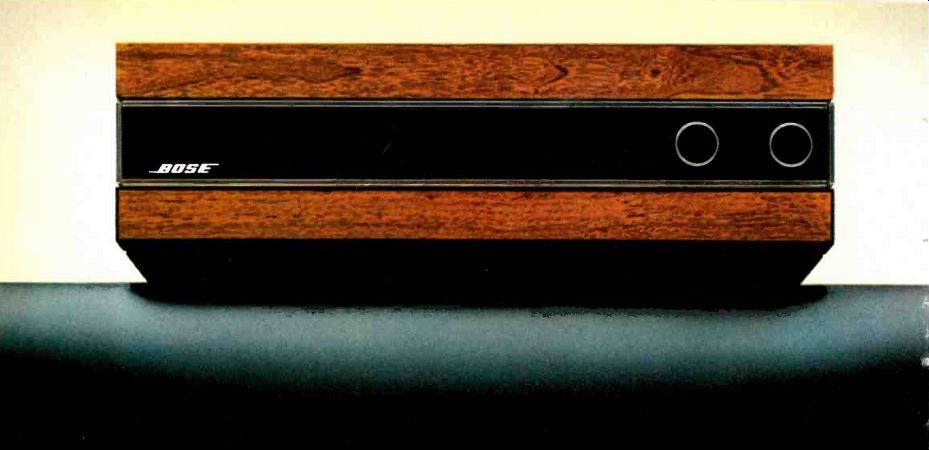
Introducing the Bose Spatial Control Receiver.
The first and only receiver to let you control the spatial image of sound.
The Importance of Spatial Properties of Sound
Imagine you are at a live performance. The music which reaches your ears comes not only directly from each instrument, but from every surface which reflects the sound. This combination of reflected and direct sound creates the spatial image of sound; it provides the ambience that makes music sound lifelike.
The Bose/Spatial Control Receiver is the first and only receiver that creates, in your living room, a variable spatial distribution of sound, allowing you to adjust the spatial image for different kinds of music.
Controlling the Spatial Image
When you are listening to orchestral music, move the spatial slide control to the wide position. Special circuitry directs middle and high frequencies to the rear outside drivers and be front drivers of the Bose 901 Series III or IV loudspeakers. This creates a broad, dispersed pattern of reflections. You experience the breadth and spaciousness of a symphony orchestra.
Should you be listening to a soloist or small group, slide the control toward the narrow position. Now more sound energy is directed to the inside rear drivers to create the focused sound image you associate with intimate performances.
Built-in Bose 901 Equalizer
The Bose 901 Series IV equalizer, built into the Spatial Control Receiver, gives you substantial savings when purchasing 901 loudspeakers since you don't need to buy a separate equalizer.
The third speaker connection terminal on each Bose 901 Series III or IV loudspeaker makes it possible to control different sets of drivers independently. It is the key to varying the spatial properties of sound.
The Spatial Control Receiver is a complex combination of a stereo preamplifier and equalizer, switching circuits, compensation circuits, and four main power amplifiers. Bose-developed logic circuitry, using CMOS components, controls the complex interconnections among these elements, for ease of operation and great versatility.
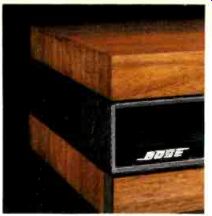
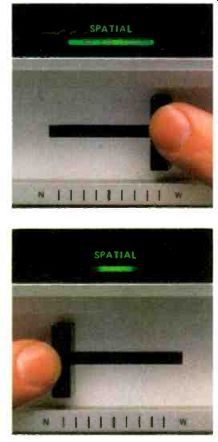


Simply program the receiver for your speakers by setting the switches on the rear panel; the rest happens automatically as you operate front panel switches. Programmability gives you several options. For example, the spatial slide controls can also be used as a balance control between two sets of speakers, one equalized and the other unequalized.
Six Power Amplifiers Offer Extraordinary Versatility
Four Direct-Coupled Fully Complementary power amplifiers drive the different arrays of 901 drivers when the receiver is in the spatial mode.
Two fully independent power amplifiers drive the headphones with an unequalized signal, regardless of the speakers in use. Each amplifier is individually accessible; you can, for example, enhance the realism of your system with a time delay accessory, without adding a separate amplifier.
Source and Room Compensation Controls Give More Accurate Overall Frequency Response
Bose has made precise measurements of the acoustic properties of different rooms and recording techniques and found that conventional tone controls are simply inadequate to compensate for the problems that occur in typical listening environments.
The unique Source and Room Compensation Controls found on the Spatial Control Receiver approach the effectiveness of a more complicated graphic or parametric equalizer but are as easy to use as standard tone controls.
The Source and Room Compensation
Controls embody the basic characteristics of the 901 Series IV equalizer controls and extend their range of control to lower frequencies.
In acoustically "dead" rooms, they help restore brilliance and clarity to the high frequencies. They can also largely eliminate boominess in poorly mixed records without affecting bass fundamentals and they can restore much of the fullness lost when room surfaces absorb excessive sound energy.
The Result: Unparalleled Performance and Versatility The Bose Spatial Control Receiver offers discriminating listeners an unequalled system for the realistic reproduction of sound. No other receiver lets you control the spatial aspects of recorded music. No other receiver has been designed to take full advantage of the unique sound-producing characteristics of the world-renowned Bose 901 loudspeaker system.
And no other receiver gives you such extensive control over the acoustic variables found in widely different room environments and recordings.
No other receiver offers the total listening experience of the Bose Spatial Control Receiver.
100 The Mountain, Framingham, MA 01701, USA.
---------
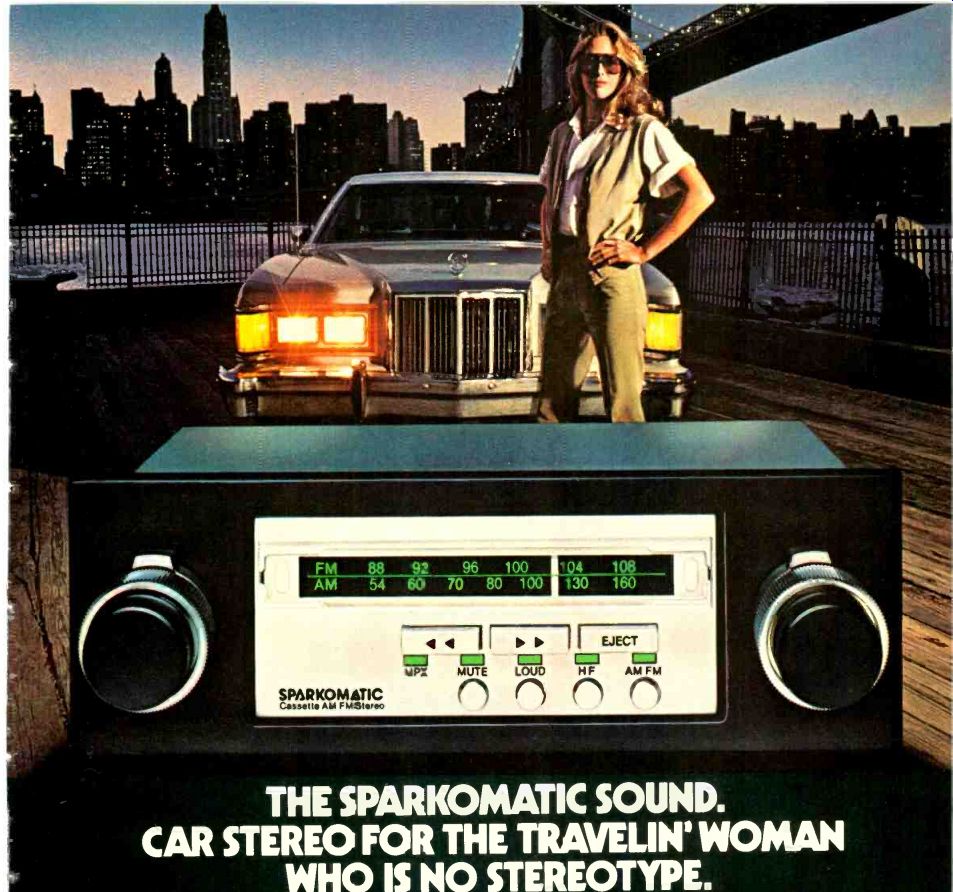
THE SPARKOMATIC SOUND. CAR STEREO FOR THE TRAVELING WOMAN WHO IS NO STEREOTYPE.
You're a travelin' woman because on know the action doesn't stay put. And one of the driving forces in your lifestyle is music-today's spectacular high fidelity sounds. Which means the stereo that shares your driving space had better share your high standards.
Meet Sparkomatic's High Power AM/FM Stereo with integrated Cassette SR 3100. A whole new generation of car high fidelity designed for your demanding expectations. Styled along the lines of the most beautiful and sophisticated home components. With reception and sound reproduction that compare as well.
This particular Sparkomatic Stereo is a High Power tour de force--45 scandalous watts of stereophonic power. With sensitivity and separation a purist like yourself will love. Advanced efficiencies like feather touch electronic switches activate major high fidelity functions. Separate bass/treble and balance/fader controls put you in total command of the performance. What you ultimately hear is the ultimate achievement in car sound.
There are 20 unique Sparkomatic car stereos to choose from, including many other High Power models. A set of Sparkomatic speakers completes a sound system in fabulous high fidelity fashion.
Because you're a travelin' woman who is no stereotype, Sparkomatic has your type stereo.
Visit a Sparkomatic dealer for a demonstration.
SPARKOMATIC---For the Travelin' Woman ... and Man.
For our free catalogs on Car High Fidelity write: "For The Travelin' Woman of Man", Dept. HF, Sparkomatic Corporation, Milford, 18337
---------
Klipsch La Scala
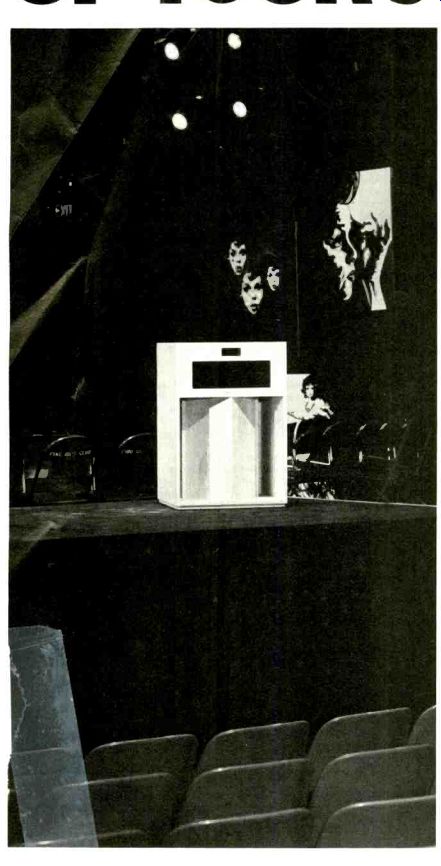
The Klipsch La Scala is the speaker musicians use. Designed for theatre use, they can fill a monster like Radio City Music Hall, an auditorium, an opera house or your house.
These high performance loudspeakers perform like no others-with far less distortion.
Feed them rafter-splitting rock or a gentle ballad. The three balanced horns give it right back the way you put it in.
Because of this sound and their moderate size and weight, La Scala’s are ideal for road shows or one night stands. They are available in birch plywood, raw or black. Industrial models are also available with heavy duty woofers, fiberglass exteriors, handles, aluminum edge trim and corner protection.
Up your system at home or on the road. Put your ear to La Scala and hear what you've been missing.
Klipsch---Please send me your FREE color brochure on the full line of Klipsch loudspeaker systems, along with a list of Klipsch dealers.
Name Address City State Zip, Klipsch
PO. Box 688
Hope, Arkansas 71801, USA
In Canada Superior Electronics, Inc
---------
Meteor Vamp1
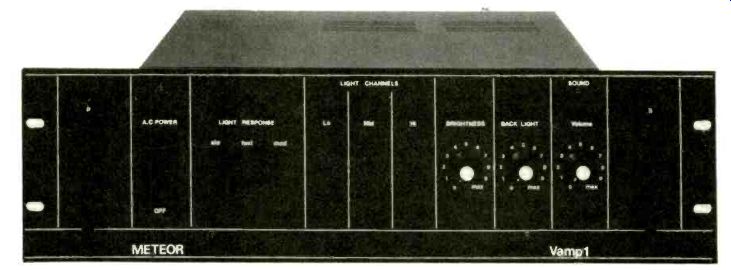
The new Meteor Vamp1 sinfully satisfies two senses with 100 watts of audio and 1500 watts of lighting
Vamp 1 an ultra low distortion power amplifier with a big difference-built in lighting. Vamp 1 features unique sound to light translation-circuits that cater for all musical tastes. Coupled to three light channels using red, green and blue elements, Vamp 1 can follow the delicate rolling color changes that enhance classical works or switch swiftly to the beat of rock or disco dance music.
Just connect any line audio source from your preamp, mixer, receiver, tape unit or tuner, and professional sound to light translation is yours.
Visual and aural satisfaction from one single unit.
See Vamp 1 at selected audio dealers or complete the coupon for further details.
METEOR LIGHT and SOUND COMPANY
155 Michael Drive, Syosset, New York 11791
Telephone (516) 364-1900. Telex 96-1396
A member of the Hammond Industries Group.
West Coast Telephone (213) 846-0500 Canada 14161
677-0544, England (Byfleet) 51051
LIGHT and SOUND COMPANY
Michael Dr. Syosset. NY 11791
Please send information on Projectors Strobes Loudspeakers Effects Lighting controllers Disco Walls Lasers Mobile Installations Disco Floors Amplifiers Fined Installations Disco Ceilings Name Address City State Zip
---------
Also see: