By HANS H. FANTEL and LARRY KLEIN

NEARLY ALL of today's phono cartridges-even the relatively inexpensive ones-perform at a level of fidelity that was not possible only five or ten years ago-and they are still undergoing improvement. Out of an awareness of certain common problems and issues that are of continuing concern to manufacturers and music listeners, HIFI/STEREO REVIEW arranged a symposium in which major cartridge designers (and our own Julian Hirsch) were asked a number of questions on the present state of the art of phono-cartridge design. We present a digest of the symposium within the framework of these questions, which form the focal points of current thinking among the engineers practicing in this very complex and somewhat controversial field.
-Editor
• What enables modern cartridges to reach performance standards that were unattainable five years ago? All the experts agree that the main factor in recent progress has been the lowering of the effective mass of the moving parts of the stylus. With a reduction of the stylus mass to 1 milligram or less, modem styli have less inertia. Hence they can accelerate and decelerate faster, and more accurately follow the high-frequency impressions in the record-groove walls. Julian Hirsch also mentions "improvements in the technique of diamond finishing, which permit low-mass, bi-radial (elliptical) styli to be made economically," and Benjamin Bauer of CBS Laboratories similarly credits smaller stylus-tip radii with more accurate high-frequency tracing. Harry A. Pearson of Sonotone, along with Bauer, mentions improved damping of the stylus. Herb Horowitz of Empire points to new magnetic materials as a significant factor, a view shared by Pickering's John Bubbers. "Today's materials, both for the armature and for moving parts, are far lighter and stronger than those available five years ago," says Bubbers. "Besides, we've improved fabricating techniques.
A whole new art has grown up around precision manufacture and quality control of these miniature parts." Peter Pritchard of ADC agrees that superior materials are responsible for some of the improvements, but adds that new design concepts have contributed also.
• What are the chief limiting factors on cartridge performance today? How might they be overcome? Some designers suggest that we are reaching a practical limit of refinement in cartridge design. K. Hagen-Olesen of Ortofon, for example, believes that "with a stylus mass of less than one milligram and stylus forces of two grams or less, we are already close to the point where a record player becomes more like a delicate laboratory instrument than a practical device for home use." Pritchard maintains that the record itself is the area most in need of refinement. Empire's Horowitz agrees and elaborates: "We need greater stiffness in the vinyl material used for records, but this must be done without sacrificing low noise levels in the recording." Not everyone is quite so content with present-day cartridges. Julian Hirsch, along with the majority of engineers, still sees room for improvement. The way to achieve it, says Hirsch, is by "still further reduction of moving mass and tracking force. I look forward to the day when tracking at 0.25 gram will be common place." John Wood of Euphonics maintains that further lowering of the mass throughout the cartridge and tone-arm are necessary. Bauer is quite specific about how he expects low-mass moving parts in the cartridge to be achieved in the future: "Aside from using lighter magnetic materials, one might employ improved shank materials with higher strength-to-mass ratios. For example, titanium might be used to good advantage here." In addition, Bauer proposes new design concepts to provide "decoupling action, where the stylus tip mass becomes gradually de coupled from the mass of the shank assembly at high frequencies, say, beyond 15 kHz. I suspect that one might make stylus shanks of some modern plastic like Delrin.
These new plastics are light, strong, and possess inherent internal damping not commonly found in metals."
• Do you work with record companies to calibrate or standardize factors other than tracking angle? On this point reactions ranged from indifference to ill-concealed passion. In one area of standardization there is a technical tug-of-war that keeps cartridge designers and recording companies pulling in opposite directions.
The cartridge men would like companies to keep down velocities to the NAB's (National Association of Broad casters) standard-reference recorded program levels. This would make records relatively easy to trace and minimize distortion. Yet, in efforts to reduce surface noise or to make their records sound louder than those of the com petition, the velocities on the discs of some manufacturers rise to peaks of 24 cm/sec-and higher. Even the nimblest stylus has difficulty following such frantic groove wiggles and tends to lose contact with the groove walls at the velocity peaks.
Despite some disagreement, diplomatic relations are maintained between the record companies and cartridge makers. Shure, Empire, Sonotone, Pickering and others participate in the activities of various record-industry committees aimed at setting standards for cutting angles, groove dimensions, equalization, and so forth. Ortofon also supplies cutting heads to a large number of record manufacturers for use in cutting their master discs.
• Do you feel that the main reproduction problems now lie in the high- or the low-frequency areas? What specific factors are most influential in these areas? It is generally agreed that the low-frequency characteristics of a cartridge are mainly determined by its compliance. Greater compliance allows the stylus to follow the larger excursions of the groove walls that represent low and loud bass notes. Good reproduction of highs, by contrast, generally depends on low effective stylus mass.
This means low inertia and enables the stylus to follow the rapid zigzag of the groove walls that embody the treble sounds, executing rapid hairpin turns with a minimum of skid or bounce.
Partial dissent is expressed by Ortofon's Hagen-Olesen who holds the view that even in the mid-range and over most of the lower frequencies, stylus mass is the main determinant of cartridge behavior. "Because of lower tip mass, less damping is necessary," he explains. "And the damping force forms the major part of the stylus' mechanical impedance (resistance to movement) at the middle and low frequencies. Therefore, a decrease in damping force means that we can also track the middle and lower frequencies with less stylus force. Compliance is the dominant factor only at the very lowest frequencies." Irving Fried of IMF, who works with an English-built cartridge, pursues an unorthodox path toward elimination of high-frequency tracing troubles. He states that optimum results are obtained when the conversion from mechanical vibration to electrical signal takes place directly at the stylus tip. In this way he claims to side step problems of cantilever resonance and damping that usually intervene between the stylus tip and the signal generating elements.
Bauer of CBS deplores the fact that some of today's pickups exhibit a 6 to 10 db undamped resonance peak in the area of 12 to 16 kHz. He admits that the audible effect of this is lessened by the high-frequency equalization curve, and it therefore does not pose a major problem with the better cartridges. But he adds: "I hope you will forgive me for being a perfectionist, but I definitely think that here lies an area for future improvement."
• Why is a range of tracking forces specified for each cartridge instead of a specific optimum tracking force? "Many people favor minimum tracking force in order to minimize record wear," says James Kogen of Shure.
Yet he observes that some "loud" records are cut at too high a level to be reproduced at the minimum force.
Consequently, the tracking force may have to be in creased for these records. "We therefore must specify maximum tracking force to denote the force beyond which the stylus will retract into the housing." Sonotone's Pear son also emphasizes that a suitable range of tracking is needed to accommodate different types of records.
To Empire's Horowitz, tracking-force figures look "like a case of spec-manship. Few cartridges operate well at the low end of their rated range of force. Usually the listener will get the least distortion near the upper limit of the indicated tracking-force range." A given cartridge in a tone arm with high inertia and bearing friction obviously requires more force to hold it in the groove than when installed in a well-designed low-mass, low-friction arm. And Pickering's Bubbers doesn't trust stylus-pressure gauges: "Most of them are off by more than a gram-so it is very practical to indicate a permissible range to the user."
• What is your reaction to the statement that cartridge-compliance figures are inaccurate or misleading? This question triggered some spirited comments about what constitutes the "right" way to measure compliance.
Some insisted that compliance should be measured as simple displacement stress under static conditions, while others maintained that it must be measured dynamically with the stylus moving vigorously. This, they contend, corresponds more closely to actual working conditions encountered by the stylus in the record groove.
"Most of the elastomeric materials used to hold the stylus within the cartridge show a decrease in compliance at increasing frequency," says Sonotone's Pearson.
"Their compliance also varies according to the amplitude of their motion. When you measure compliance under static conditions, you sometimes get readings 100 per cent higher than under certain dynamic conditions en countered in a record groove." Pearson stresses the fact that Sonotone's measurements represent dynamic data.
Because compliance changes at different frequencies, Fried of IMF feels that it should be presented as a mechanical-impedance curve (plotted against frequency) rather than as a single figure. Horowitz and Kogen suggest that manufacturers should at least make clear whether a given compliance reading represents static or dynamic conditions.
Ortofon's Hagen-Olesen is at loggerheads with all this.
While most of his colleagues regard dynamic compliance measurements as more realistic, Hagen-Olesen maintains that "compliance is a static measure and should therefore be taken at zero frequency." Pickering's Bubbers shares this classic pure-physics view. "Compliance is defined as the inverse of the spring constant of the system and hence should be measured statically. All measurements would then be directly comparable and there would be no further need to define standard conditions of measurement." Joseph Grado of Grado Laboratories offers the controversial comment that "a cartridge with a stiffer compliance sometimes tracks better than a high-compliance unit. High ... compliance may result from sloppy coupling and, when used with a high-mass tip, make the sound hashy or bassy."
----------------
SYMPOSIUM PARTICIPANTS
Benjamin B. Bauer, Vice President, CBS Laboratories John Bubbers, Vice President of Field Engineering, Pickering and Company, Inc.
Irving M. Fried, President, IMF Joseph Grado, President, Grado Laboratories K. Hagen-Olesen, President, Ortofon Julian D. Hirsch, Hirsch-Houck Laboratories Herb Horowitz, President, Empire Scientific Corp.
James Kogen, Shure Brothers, Inc.
Harry A. Pearson, Director of Research. Sonotone Corp.
Peter E. Pritchard, President, Audio Dynamics Corporation John F. Wood, President, Euphonic! Corporation
----------------------
Julian Hirsch fails to see much meaning in the whole compliance controversy. He points out that required tracking-force (in a quality tone arm) is an eminently practical index of compliance. "That's all the user needs to know. He shouldn't concern himself about compliance."
• The main quoted specifications for cartridges are frequency response and compliance. What other specifications do you consider significant? "The most important thing is how it sounds," says Grado. "Lab tests do not always correlate with listening tests. There are instances when a cartridge with poorer specs sounds better than one with superior paper data." Kogen and Bubbers agree that printed specifications alone do not provide a reliable index of sound quality.
"The fact is that no standard measuring techniques are available for many cartridge characteristics," says Kogen.
"This creates considerable confusion and sometimes opens the door to dishonesty in specifications. We can vary frequency response and distortion measurements all over the map, depending on what test record we use, what tracking force, record speed, recording level, etc." Bubbers regards stylus mass, damping, and compliance as an indissoluble and interdependent trinity. Hence he feels that separate listing of any of these factors is none too meaningful even to the engineer, let alone the layman.
Kogen suggests that a joint measure of these factors might be devised in terms of what he calls "trackability." This would express the ability of the stylus to maintain contact with the groove under any conditions of frequency or recording velocity. "Trackability," says Kogen, "would be a performance measure; compliance and mass are merely design parameters." Fried of IMF agrees with Kogen, and would like to see a mechanical impedance curve presented as part of a cartridge's specifications.
Most experts agree that among the presently established measures, stylus mass is more a determinant of cartridge performance than stylus compliance. Pritchard, Wood, and Bauer emphasize the importance of listing inter modulation and harmonic distortion, along with the more commonly available information.
• How significant do you find tracking angle? Has 15-degree tracking made an audible improvement? Sorting out the sneers and huzzahs, the testimony was mixed: "I never heard any improvement from a 15-degree stylus" (Empire). "A definite, audible improvement" (Shure). "Nobody really understands it" ( Pickering). "A minor matter. Other things are more important" (IMF). "It never hurts to standardize" (Hirsch). "This is one large advertising gimmick" (Grado). (Continued on page 50)
• Is special mounting care necessary with an elliptical stylus cartridge? Is the improvement obtained minor, major, or illusory? Strife is rife once again. Bubbers brands the elliptical stylus as "a questionable solution to a spurious problem." He explains that the whole problem of inner-groove distortion, which the elliptical stylus is supposed to solve, wouldn't have arisen if some of the records weren't cranked up to excessive loudness levels. "But as long as a few recording engineers won't let up on the throttle, I sup pose the ellipticals help to a small degree," he admits.
ADC's Pritchard agrees and states that "the improvement can be major when playing heavily modulated inner grooves." He goes on to add, however, that if the record companies would compensate for inner-groove distortion in the recording process there would be very little need for elliptical styli.
Sonotone's Pearson sees no merit in the elliptical stylus: "We noticed no improvement, and the extra care required to properly orient it is a definite disadvantage to the user." Wood feels that ellipticals are "worthwhile," but warns that they "must be mounted at the proper angle and used with a low-enough tracking force-under 2 grams -or record damage will result." Kogen and Horowitz agree that "improvement is significant," while Bauer reports that in a series of tests conducted a year ago he found ellipticals "no better, and on the average perhaps a bit worse, than 0.5-mil round styli." He had better luck with a more recent batch, which yielded better sound. Apparently manufacturing techniques have improved within the last year. He warns, however, that an inexpensive or improperly made elliptical can severely damage records.
Opposed or in favor, most designers agree that the elliptical stylus presents serious problems in quality control, demands complex optical equipment for proper mounting on the shaft, and care in home installation. Im properly produced or installed, it offers no benefit and might cause record damage.
• Do you anticipate improvements in the material of which records are made? How would such improvements affect cartridge performance? Because the mass of the stylus interacts with the elasticity of the record material to form a resonance, the record material has a direct effect on cartridge performance.
Hirsch hopes that record makers will use harder sub stances in the future. This would have the effect of raising the stylus resonance, possibly far beyond the audible range, where it could not cause noticeable response peaks.
Locating the stylus response beyond 15 kHz generally contributes toward smoothness of sound and also reduces record wear in the high-frequency region.
Hagen-Olesen points out that harder record materials would permit making stylus assemblies that are more robust and less susceptible to damage from careless handling. Yet Horowitz suspects that record materials will probably be made softer in the future to reduce back ground noise. "That will make high-frequency reproduction even more difficult," he predicts. Most of the cartridge fraternity is evidently too disillusioned with the record makers to expect much help from them. Only Bubbers, a veteran of the recording studios and a pioneer in stereo recording in this country, acknowledges the vast improvement in record materials over the past decade.
• What flaws, if any, do you find in the cartridge tests performed by various consumer testing organizations, including HIFI/Stereo REVIEW? "My main gripe," says Bubbers of Pickering, "is that the testers rarely specify which test record they use.
[HIFI/STEREO REVIEW'S Julian Hirsch does--see, for example, his cartridge test reports in the July 1965 issue.Ed.]
Also, they seem to work on the specious assumption that the test record is always right. You can use ten different test records with a given cartridge and get ten different results. It's just one more instance of the ubiquitous engineering problem of finding a valid and reliable primary standard." Ortofon's Hagen-Olesen suggests a partial solution to this problem: "The actual recorded waveform (including possible over-swing on a square wave) should be used as reference so that the cartridge which reproduces a waveform nearest to the recorded one might be considered best." Hagen-Olesen goes on to buttress his argument for visual comparison of the waveform in the record groove with the reproduced waveforms: "If you com pare only the reproduced waveforms of different cartridges, the one with the least overswing will seem the best. Yet often there is overswing in the recorded waveform. Hence your conclusion is misleading, because it will favor the cartridge least able to produce the high-frequency overswing." ADC's Pritchard feels that there is so little difference between the frequency response and separation characteristics of the best cartridges that these characteristics now have much less significance than they did a few years ago. The factors that should be concentrated upon are those that are really responsible for one cartridge's sounding superior to another-namely, distortion characteristics and tracing ability. Horowitz of Empire feels that most independent testers lack intimate knowledge of specific design considerations and are therefore unable to judge such factors as reliability and life span.
Hirsch deplores the lack of "really good, low-distortion musical recordings which can show up the differences between cartridges. Except in a very few recordings, such differences are not audible. This leads me to believe that the distortions in commercial pressings far exceed the distortion levels of the better cartridges."
----------------------------
SKATING AND ANTI-SKATING IN RECORD PLAYERS: TWO VIEWS
ONE of the current subjects of hi-fl controversy, not only among some cartridge manufacturers but record-player manufacturers as well, is the phenomenon of skating, the tendency of the tone arm and stylus to move toward the center of the record as a result of tone-arm geometry. Julian Hirsch touched upon this subject in his May issue Technical Talk column, and we present below two views on the subject prompted by Mr. Hirsch's discussion.
-Editor
--------
JULIAN GORSKI, United Audio; New York, New York
THE QUESTION of the significance of skating is, not surprisingly, of considerable interest to the manufacturers of the Dual record player, since a major feature of the Dual 1019 is its sophisticated anti-skating system.
Since its introduction, we have received many questions on this feature, some of which, together with our responses, may be worth bringing to the attention of readers of HIFI/STEREO REVIEW.
Q. How serious is the problem of skating?
A. It is at least as serious as any other factor known to introduce distortion into a high-fidelity system. However, unlike other types of distortion, those from skating result from the physical deflection of the stylus from its center position toward the inner groove wall. As a result, the same amount of excursion is not available to the stylus on each side, which is hardly the most desirable condition for optimum record reproduction. Other factors of longer range consequence include cumulative stylus fatigue and uneven stylus wear, both affecting record-groove wear.
Q. Is skating a problem affecting all tone arms? A. No, only with tone arms that are designed and engineered to the highest standards of precision, and with bearing friction low enough to permit them to skate. Since skating force is relatively small (about 12 per cent of the tracking force), the bearing friction found in most tone arms provides an involuntary "anti-skating" force. How ever, any bearing friction high enough to override the skating force will also have a restrictive effect on light weight tracking as well.
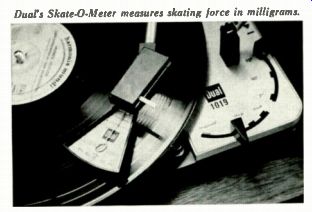
----------- Dual's Skate-O-Meter measures skating farce in milligrams.
Q. Why don't all the better tone arms have anti-skating devices? A. Some do, but others which once had anti-skating de vices proved to be unreliable or caused difficulty in handling the tone arm and were subsequently discontinued.
Other reasons have to do with the general lack of objective knowledge about skating, owing partly to the unavailability of instrumentation for obtaining this knowledge.
During the research leading to the development of the Dual 1019's tone arm, Dual found it necessary to design and engineer an entirely new type of instrument, the Skate-O-Meter. This highly sensitive instrument, which can be used on any tone arm, provides the first objective and directly measurable (in milligrams) data on the forces acting upon the stylus during actual play on either test records or normal recorded material. (The grooveless record, although an interesting demonstration device, inadequately represents actual playback conditions.)
The data provided by the Skate-O-Meter relate to skating force, anti-skating force, tone-arm bearing friction, stylus radii, counter-force applied by shut-off mechanisms, and even variations in the elasticity of the materials used in records. With information of this type now made available, much of the mystery (and perhaps resistance) about the question of skating can be lifted.
Q. How should anti-skating be applied?
A. By an equivalent counter-force applied in the same plane as the skating force, but in the opposite direction.
This counter-force should be precisely calibrated, easily applied, utterly reliable, and constant over the entire playing area. It should also permit continuously variable adjustment, as skating force varies according to both tracking force and stylus radius.
Q. What effect does the elliptical stylus have on skating force?
A. The elliptical stylus causes more skating force than the conical. Because its tracing radius (generally 0.2 or 0.3 mil) is less than half the 0.7 mil of the typical conical stylus, the elliptical stylus penetrates more deeply into the soft surface of the vinyl. The increased friction thus results in more skating.
Q. Can't the distortion from skating be eliminated simply by increasing tracking force enough to let the stylus make better contact with the outer groove wall? A. This may relieve the symptom of skating, such as may be observed on the oscilloscope, but doesn't eliminate the essential problem of skating itself: the biased stylus.
In fact, by increasing tracking force, even more force is applied against the inner groove wall. And, of course, the total tracking force may then be more than the optimum for the given cartridge.
-----
EDGAR VILLCHUR Acoustic Research, Inc. Cambridge, Massachusetts
IT’s possible to make a very impressive, if misleading, demonstration of the apparent need for side-thrust compensation, or anti-skating, in a record player. The output of a stereo cartridge playing a test record is displayed on an oscilloscope or monitored through speakers.
One channel is badly distorted. Anti-skating force is then applied using some sort of weight or spring device, and the distortion clears up.
There is one step missing from this demonstration. The distortion can be eliminated just as well by increasing the vertical stylus force a little--about 10 to 15 percent. Or to put it another way, the demonstration requires that the stylus force be carefully adjusted to just below the value at which the cartridge, without anti-skating, will play the test tone without distortion.
To say that anti-skating reduces tracing distortion is inaccurate because the statement is incomplete. The effect of anti-skating is simply this: it reduces the stylus force that is required to play a particular recorded pas sage without distortion. The amount of stylus-force reduction permitted by anti-skating depends on several elements of stylus and arm design, but is typically in the range of 10 to 15 percent.
Those who are interested in the theoretical explanation of this conclusion are referred to an article in the October 1962 Journal of the AES by Professor F. V. Hunt of Harvard, "The Rational Design of Phonograph Pickups." Those who are interested in checking it out for themselves can do so quite simply with no special equipment other than a test record, although an oscilloscope connected across the amplifier output is helpful for displaying the waveforms. The HIFI/STERFO REVIEW Model 211 test record (the low-frequency tracing test band) or the CBS STR 111 test record (which includes higher recorded velocities) are suitable.
On a record player with a properly adjusted anti-skating device you increase the stylus force from zero until it just plays the test band without distortion on either channel. Disable the anti-skating; the distortion will reappear on one channel. Then increase the stylus force further, leaving out the anti-skating, until the distortion disappears again. If the cartridge was distortionless at 1.25 grams with anti-skating, it will probably require another 1/8 to 3/16 gram for the same performance without anti skating.
In short, the beginning and the end of the virtue of anti skating compensation is that it decreases by a small amount the stylus force required for proper tracing.
Hunt's analysis indicates the range of this decrease as between 7 and 19 percent, the lower figure applying to the better-designed arms of low inertial mass and greater length. Side-thrust compensation does not change the final performance.
I cannot improve on the rigor of Professor Hunt's analysis, but I did confirm it by experiment, using both commercial record players with side-thrust compensation devices, and an AR turntable specially rigged with an anti-skating device (see photo). Stylus force was adjusted in increments of 1/32 gram by adding tiny weights to the cartridge shell.
The only potential advantage in reducing stylus force from 1 1/2 grams to 1 5/16 grams is reduction in record wear.
However, there is evidence to indicate that once the stylus force is in this low range, permanent deformation (in other words, damage) of the plastic record groove no longer takes place because the elastic limit of the material is not exceeded. This would mean that a 12 1/2 percent reduction in stylus force brings either a much smaller reduction in record wear, or no significant reduction at all.
The question then becomes whether the inclusion of an anti-skating device is worth it-a question posed more from the point of view of bother when playing records than of cost. (Hunt, incidentally, who feels that some corrective action is warranted, says that most proposed anti skating devices "have lacked the elegant simplicity which earns universal adoption," but that was in 1962.) There are tone-arm characteristics relating to minimum distortion and to tracing ability at low stylus forces which are less glamorous than anti-skating but much more important. One of these is low inertial arm mass, requiring a very light cartridge shell, so that normal record warp has minimum effect in changing the instantaneous force between record and stylus. Another is neutral balance, which keeps vertical stylus force on the record the same no matter what the cartridge height (in some changers the stylus force at the top of a stack of records is increased as much as 50 per cent). A third is the ability to adjust the exact needle-to-pivot length to compensate for varying cartridge mountings; without such an adjustment the tracking error and attendant distortion of some popular cartridge-arm combinations is quadrupled. These are the things that count.
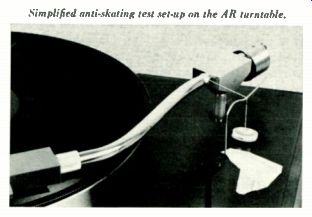
---Simplified anti-skating test set-up an the AR turntable.
---------------------
====================
Also see:
Turntables -- What Are Your Options (Jan. 1985)
Source: Stereo Review (USA magazine)