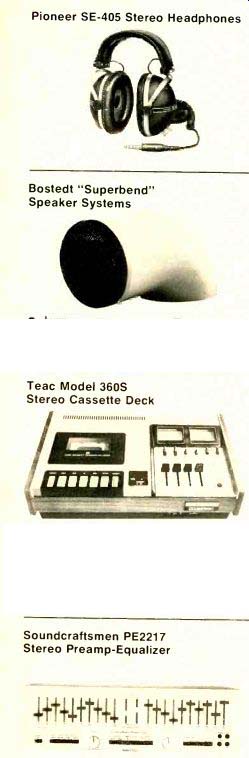
Pioneer SE-405 Stereo Headphones
A new addition to Pioneer's growing line of stereo headphones is the Model SE-405, which features full-size acoustically isolating earcups and integral volume controls for each channel. Cushions for the earcups and the extendable (with detented action) headband are foam filled plastic; the cups and headband are linked by pivoted yokes. An 8-ohm dynamic element with a 13/4-inch polyester-film diaphragm is used in each earcup.
Frequency range is stated as 20 to 20,000 Hz. Sensitivity is 0.3 volt for a sound-pressure level of 113 dB, and signal-handling capability is 0.5 watt. The coiled connecting cable, 161/2 feet long, is fitted with a standard three-conductor phone plug. Exclusive of the cable, the headphones weigh just over one pound.
Price: $44.95, which includes a permanent storage case.
Bostedt "Superbend" Speaker Systems
INTERNT’L ENTERPRISES COMPANY is importing the Swedish made Bostedt "Superbend" speaker system, a two-way design of markedly distinctive appearance, utilizing an enclosure molded of high-impact plastic. The two drivers-a 5-inch mid-range/woofer (approximately the same diameter as the stovepipe-shaped enclosure) and a 1.5-inch tweeter-radiate horizontally from behind an anodized wire-mesh grille.
According to the manufacturer, the balance of high frequencies to low frequencies can be altered by aiming the speaker toward or away from the listening area.
Frequency response is 65 to 14,000 Hz ±3 dB, with a 12-dB-per-octave cross over network dividing the frequency band between the two drivers at 1,800 Hz. Nominal impedance is 8 ohms, and minimum recommended amplifier power is 15 watts per channel. Power-handling capability is 35 watts per channel continuous. The Superbend is available in glossy colors of white, black, and red-all with a black grille. The overall dimensions are 12 x 7 1/4 x 6 1/4 inches. Price: $125.
Teac Model 360S Stereo Cassette Deck
THE Model 360S, the latest cassette deck from Teac, has a transport mechanism with performance comparable to that of Teac's deluxe Model 450 as well as many of the operating features of the more expensive machine. Dolby B-Type noise-reduction circuitry is incorporated. with all calibration controls accessible to the user. Bias and equalization are switchable for CrO2 "high-performance," and standard tapes. In the CrO2 position the playback equalization is also altered to the values recently proposed for that tape type. Two large recording level meters are supplemented by a peak indicator- a light-emitting diode that warns against overload on short-term transients. Slider-type recording- and playback-level controls are used. There is a switchable multiplex filter to remove the 19-kHz pilot signal from stereo FM broadcasts, and a memory-rewind feature that automatically stops the tape at a point preselected on the three-digit index counter.
With CrO2 tape, the frequency response of the 360S is 40 to 15,000 Hz +- 3 dB. Response is within the same tolerances to 13.000 Hz with high-performance tape, and to 10.000 Hz with standard tape. Signal-to-noise ratios are 60 dB with Dolby, 50 dB without. Wow and flutter are 0.07 percent. The micro phone inputs have an impedance of 600 ohms; adjacent to them is a stereo head phone jack. that will drive 8-ohm phones.
The Teac 360S comes mounted on a wood base; dimensions are 17 3/4 x 4 3/4 x 10 1/4 inches. Price: $359.50.
Soundcraftsmen PE2217 Stereo Preamp-Equalizer
HAVING offered elaborate one- and two-channel multi-band equalizers for some years, Soundcraftsmen has now added signal-switching and magnetic phono-input facilities to their ten-band stereo equalizer to create the Model PE2217 Preamp-Equalizer, a unit de signed to function as a highly flexible integrated control center for a two-channel stereo system. While VOLUME and BALANCE are conventional knob adjustments, all the frequency-related functions of a typical preamplifier-bass and treble adjustment, filters, loudness compensation-are handled in the PE2217 by the equalizers. The equalizers have ten slider-type controls for each channel spanning a range of ±12 dB, acting at the center frequencies of the ten octaves of the audio-frequency band. Gain-control sliders adjust the output levels of the equalizers; LED (light-emitting diode) indicators permit the equalizers to be set for unity gain to facilitate A-B comparisons with the unequalized signals and to prevent overload of subsequent stages.
The remaining PE22 17 controls are all pushbuttons. They activate the I.ED indicators, select reversed stereo, left or right channel to both outputs, or mono, and operate tape-monitoring functions for two stereo tape decks, permitting dubbing from either one to the other.
The inputs for two magnetic-phono sources, tuner, and auxiliary are also pushbutton-selected. The equalizers can be switched to affect only the "to tape" signals, the preamplifier output signals, or both. There are tape-dubbing jacks and two stereo headphone jacks on the front panel, and two sets of outputs and six a.c. convenience outlets on the rear panel. The rated output of the PE2217 is approximately 5 volts for load impedances ranging from 600 to 2,000 ohms, with harmonic and intermodulation distortions of less than 0.02 percent. Signal-to-noise ratios are 80 dB for the phono inputs, 95 dB for high-level in puts. Frequency response with the sliders centered is 10 to 100,000 Hz-0.25 dB. The preamplifier measures 20 x 7 1/4 x 11 3/4 inches. Price: $499.50, which includes a walnut-grain cabinet or optional hardware for rack mounting of the unit.
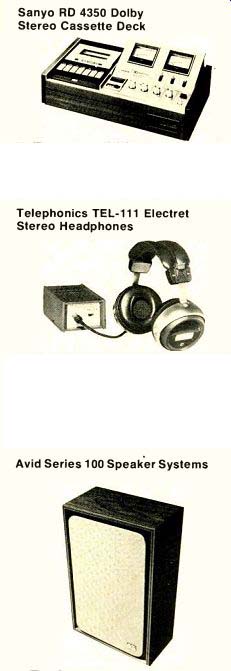
Sanyo RD 4350 Dolby Stereo Cassette Deck
THE top model in Sanyo's growing line of Dolbyized stereo cassette decks is the Model RD 4350, equipped with a ferrite record/playback head, a memory-rewind feature that halts the transport at any preselected point on the tape, and a novel tilt-up instrument panel that cants the recording-level meters for easier viewing. Seven piano-type push keys, including CUE, PAUSE, and a wide push bar for STOP, operate the transport. Separate level controls are provided for re cording and playback, and there are switches to select NORMAL Or SPECIAL tape-type characteristics, recording through microphone or line inputs, and to activate the Dolby circuits. At the end of a tape the transport automatically shuts off and disengages completely.
Specifications include a record-playback frequency response of 40 to 15,000 Hz ±3 dB, a signal-to-noise ratio of 50 dB, and wow and flutter of less than 0.15 percent. Transport speed accuracy is at least 99.8 percent. Dimensions of the deck, including its wood base, are 17 x 9 x 5 inches. It weighs 12 pounds. Price: $329.95.
Telephonics TEL-111 Electret Stereo Headphones
MAKING its first entry into the con sumer audio market, Telephonics has introduced a line of stereo and four-channel headphones featuring the Model TEL-111, a stereo headset that employs the electret-condenser principle. Electret transducers closely resemble conventional electrostatic designs, except that the membranous diaphragm is permanently polarized with an electrical charge, eliminating the need for an external power supply to develop the required bias voltage. In each earpiece the Model TEL-111 has a 2 1/2-inch, push-pull diaphragm that has been clamped to form two radiating surfaces- a small circular one for the higher frequencies and a larger crescent-shaped area for lows. The phones are driven from the speaker terminals of an amplifier or receiver through step-up transformers installed in an external control box to which the headphones and the speakers are connected. A switch selects either source.
The TEL-111 has ring-shaped foam filled cushions designed to isolate the wearer from external sound. The head band is padded, and attaches to the ear pieces through sliding length adjustments for custom fit to the individual wearer. The frequency range of the phones is said to be 18 to 24,000 Hz, arid total harmonic distortion does not exceed 0.2 percent for a sound-pressure level of 115 dB. An input of 2.4 volts at the transformer drives the phones to a level of 104 dB ±3 dB at 1,000 Hz. The headset weighs 17 ounces exclusive of cable and control box. Price: $87.50.
Avid Series 100 Speaker Systems
THE first consumer products from the Avid Corporation are three speaker systems of the air-suspension type, featuring simple, attractive styling and user-replaceable grille cloths. At the top of the line is the Model 103 ($139.50; shown), incorporating a 10-inch woofer, 4 1/2-inch cone-type mid-range, and a 1-inch dome tweeter. The Model 102 ($109.50) is a two-way system employing the woofer and the tweeter from the Model 103; the Model 100 ($79.50) has an 8-inch woofer and a 1 3/4-inch cone tweeter. All the systems have a nominal impedance of 8 ohms and level controls to adjust high-frequency output to suit the room acoustics. (The Models 100 and 102 have three-position switches; the Model 103 has a five-position switch, with the central three positions affecting only high frequencies and the extreme settings altering both mid- and high-frequency levels.)
Frequency responses are 35 to 18,000 Hz (40 to 18,000 Hz for the Model 100) ±5 dB.
The Model 103 has crossover frequencies of 500 and 3,500 Hz; the two less expensive systems are crossed over in the region of 2,500 Hz. Power-handling capabilities range from 75 watts (Model 100) to 150 watts (Model 103). The systems are said to be somewhat more efficient than the usual air-suspension de signs, with 1-watt white-noise inputs producing sound levels of 83 to 86 dB at a three-foot distance. The mid-and high-frequency drivers of the Models 103 and 102 are fused as a safeguard against amplifier overdrive.
The grille cloths of the Avid speaker systems can be removed from the front of the enclosures-and from the frames on which they are stretched-for washing or replacement with a fabric of the owner's choice. Avid offers pre-cut re placement grille cloths in eight optional colors ($3.95 per pair). The enclosures, clad in walnut-grain vinyl, measure about 25 x 15 x 9 1/2 inches for the Models 103 and 102, and 12 3/4 x 21 x 8 1/2 inches for the Model 100. Low wooden bases for floor placement are included in the price of the Model 103; they are optional for the Model 102 at $3.95 each.
Prices are slightly higher in the West.

++++++++++++++++++++++++++++
Vintage magazine ADs:
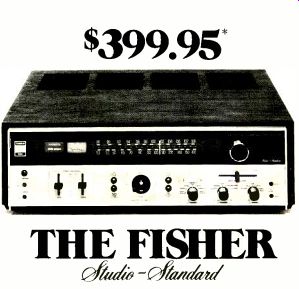
$399.95 THE FISHER. Provisions for external CD-4 demodulator.
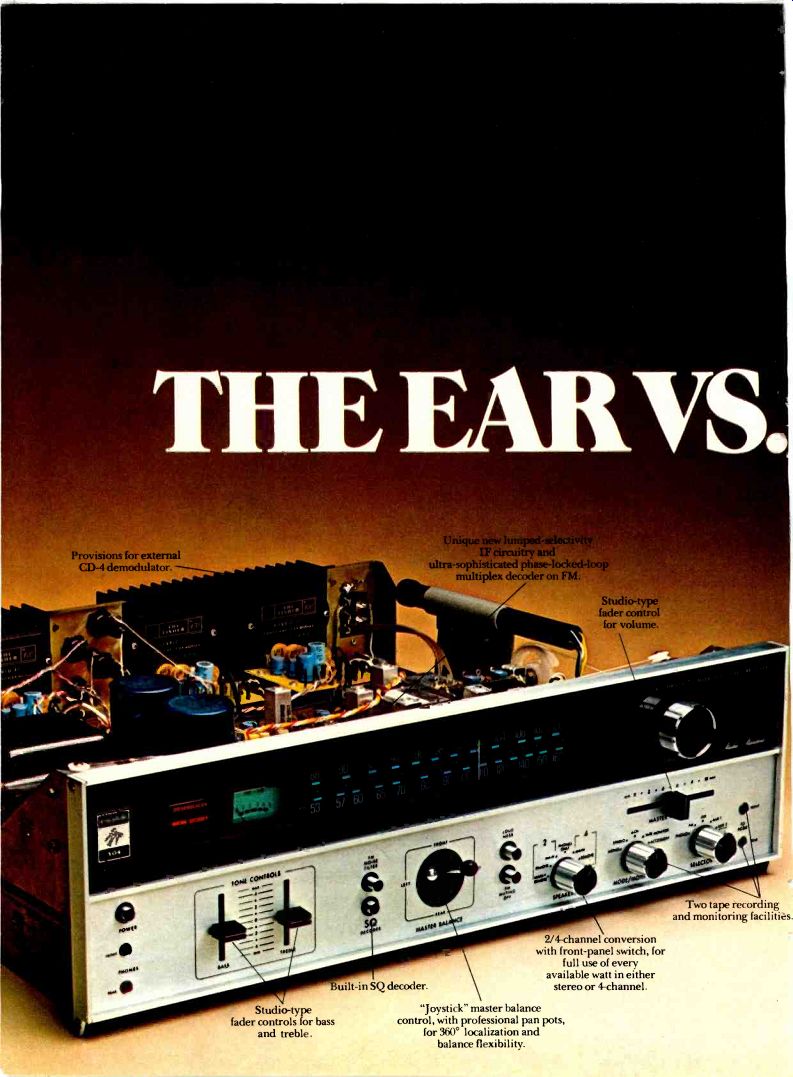
Built-in SQ decoder.
Unique IF circuitry and ultra-sophisticated phase-locked-loop multiplex decoder on FM.
Studio-type fader control for volume.
2/4-channel conversion with front-panel switch, for full use of every available watt in either stereo or 4-channel.
Studio-type "Joystick" master balance fader controls for bass control, with professional pan pots, and treble. for 360° localization and balance flexibility.
Two tape recording and monitoring facilities.
If you want the best 4-channel sound, you've got to pay for it, right? And, conversely, if your budget is limited, you've got to accept something less than the very best. So goes the conventional wisdom of the audio world.
In these fast-moving times, however, conventional wisdom may be out of date by the time it becomes conventional. The new Fisher 304B is a case in point.
From the ear's point of view (if we may mix our metaphors) there isn't really anything better than the 304B. A few other 4-channel receivers are more powerful and somewhat more versatile, but they don't produce purer sound; nor does the 304B lack any important features that the others have. In a somewhat less luxurious form than the latter, the 304B is "state-of-the-art.' That's why its remarkably low drain on the pocket. $399.95,* is such a triumph.
Do you realize that a good tube receiver, for stereo only, cost about as much ten _years ago? How did we do it? With the latest IC chips, for one thing. They do save space and money. And with the kind of production techniques and plant facilities that simply didn't exist a few years ago.
But that's our business. Your concern is the performance of the 304B. The specifications below will give you an idea. They're factual and conservative, easily verifiable by anyone with measuring equipment.
And audible to anyone with an ear.
Fisher Radio, Dept. SR-2 , 11-40 45th Road, Long Island City, N.Y. 11101.
-------------------------
Sony
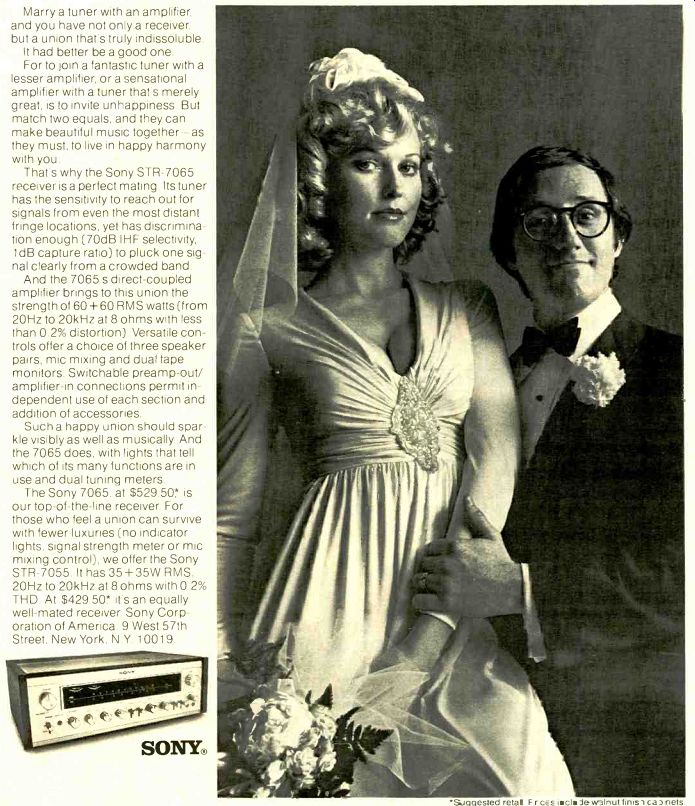
A tuner and an amplifier should be mated somewhat more carefully than a husband and wife.
Marry a tuner with an amplifier, and you have not only a receiver, but a union that truly indissoluble.
It had better be a good one.
For to join a fantastic tuner with a lesser amplifier, or a sensational amplifier with a tuner that's merely great, is to invite unhappiness. But match two equals, and they can make beautiful music together--as they must, to live in happy harmony with you.
That's why the Sony STR-7065 receiver is a perfect mating. Its tuner has the sensitivity to reach out for signals from even the most distant fringe locations, yet has discrimination enough (70dB IHF selectivity, 1 dB capture ratio) to pluck one signal clearly from a crowded band.
And the 7065's direct-coupled amplifier brings to this union the strength of 60 +60 RMS watts (from 20Hz to 20kHz at 8 ohms with less than 0.2% distortion). Versatile controls offer a choice of three speaker pairs, mic mixing and dual tape monitors. Switchable preamp-out/ amplifier-in connections permit in dependent use of each section and addition of accessories.
Such a happy union should sparkle visibly as well as musically. And the 7065 does, with lights that tell which of its many functions are in use and dual tuning meters.
The Sony 7065, at $529.50',' is our top-of-the-line receiver. For those who feel a union can survive with fewer luxuries (no indicator lights. signal strength meter or mic mixing control), we offer the Sony STR-7055. It has 35+35W RMS. 20Hz to 20kHz at 8 ohms with 0.2% THD. At $429.50, its an equally well-mated receiver. Sony Corp oration of America. 9 West 57th Street. New York. N.Y. 10019.
--------------------------
A DEMONSTRATION OF QUADRIPHONIC SOUND
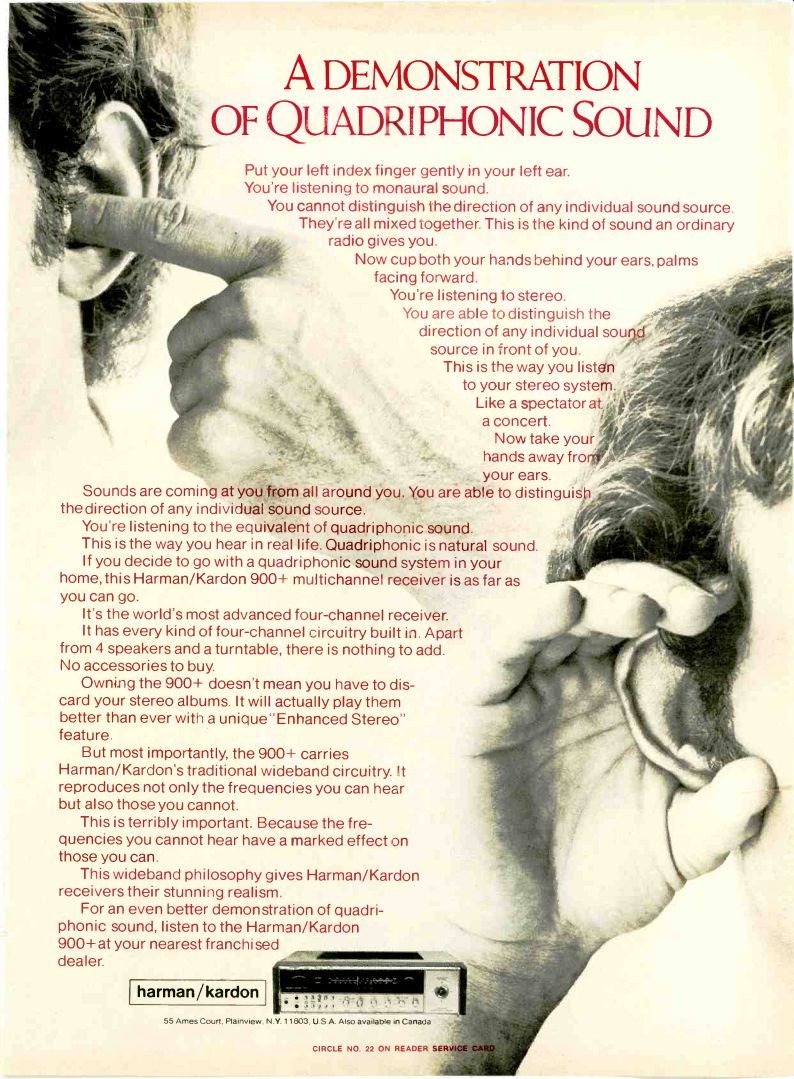
Put your left index finger gently in your left ear.
You're listening to monaural sound.
You cannot distinguish the direction of any individual sound source.
They're all mixed together. This is the kind of sound an ordinary radio gives you.
Now cup both your hands behind your ears, palms facing forward.
You're listening to stereo.
You are able to distinguish the direction of any individual sound source in front of you.
This is the way you listen to your stereo system.
Like a spectator at a concert.
Now take your hands away fro your ears.
Sounds are coming at you from all around you. You are able to distinguish the direction of any individual sound source.
You're listening to the equivalent of quadriphonic sound.
This is the way you hear in real life. Quadriphonic is natural sound.
If you decide to go with a quadriphonic sound system in your home, this Harman/Kardon 900+ multichannel receiver is as far as you can go.
It's the world's most advanced four-channel receiver.
It has every kind of four-channel circuitry built in. Apart from 4 speakers and a turntable, there is nothing to add.
No accessories to buy.
Owning the 900+ doesn't mean you have to discard your stereo albums. It will actually play them better than ever with a unique "Enhanced Stereo" feature.
But most importantly, the 900+ carries Harman/ Kardon's traditional wideband circuitry.
reproduces not only the frequencies you can hear but also those you cannot.
This is terribly important. Because the frequencies you cannot hear have a marked effect on those you can.
This wideband philosophy gives Harman/Kardon receivers their stunning realism.
For an even better demonstration of quadriphonic sound, listen to the Harman/Kardon 900+ at your nearest franchised dealer.
harman/kardon---55 Ames Court. Plainview. N.Y.11803. U.S.A. Also available in Canada.
------------------
If you've got what it takes, the Navy can challenge you with over$17,000 worth of advanced training in electronics or nuclear power.
The New Navy offers high school graduates a challenge with a future.
And if you're qualified to meet the challenge, you can get training and experience that puts you ahead of the pack in the exciting fields of nuclear power or electronics.
These special Navy programs are tough. And besides the technical training, you'll have your share of the unglamorous chores. Everybody does.
But the rewards and your personal satisfaction make it all worthwhile.
Learning to operate and maintain or repair the Navy's sophisticated electronic systems or nuclear power plants will give you, skills you can use for a lifetime.
And as a sailor you'll see the world while you're still young. You'll make new friends. And get higher pay than any sailor in history.
Get all the details from your local Navy Recruiter. Or mail the coupon below.
Or call toll-free 800-841-8000 anytime.
E Be someone special in the new Navy.
TO: Captain Robert W. Watkins, USN Navy Opportunity Information Center P.O. Box 2000, Pelham Manor, N.Y. 10803 471
Please send more information on:
Advanced Electronics Program Nuclear Power Program
Other Navy career opportunities.
If you really don't want to wait, call 800-841-8000 toll-free (24 hours a day, seven days a week). In Georgia, call 800-342-5855.
Call collect: In Alaska- 272-9133, in Hawaii--533-1871.
Name Address City Phone State (Please Print) Date of Birth
--------------------
Empire
The sound comes at you from all directions.

Empire's unique Jupiter cylinder produces the kind of sound no conventional box speaker can deliver. Our all-around sound is simply phenomenal- it radiates in all directions: front, rear, left and right.
The Jupiter's perfect three-way system uses Empire's heavy 12 inch down facing woofer for bass you can feel as well as hear, a powerful mid range for crisp, clear alto and voice tones, and a lightweight ultrasonic tweeter with wide angle dispersion.
The power of the Jupiter 6500 speaker is awesome- it can deliver an impressive performance without overload, burnout or strain.
Best of all. the virtually indestructible Jupiter enclosure is made of Uniroyal Rubicast, a new, space-age acoustic material with a mar-proof surface, making it ideal for today's casual living.
Jupiter speakers are completely weatherproofed for indoor or outdoor listening.
Empire's new Jupiter 6500 Speaker list price $149.95. Available at better hi-fi dealers. For your free “Empire Guide to Sound Design" write: EMPIRE SCIENTIFIC CORP., Garden City New York 11530. Mfd. in U.S.A
-----------------
Straight talk about a stylus
Listen carefully and you can still hear some audiophiles refer to the record stylus as ... "the needle." Although we are not about to quibble over semantics, we would like to go on record, sc to speak, as observing that the stylus of today bears no more resemblance to a needle than it does to a ten-penny nail. In fact, it is probably the most skillfully assembled, critically important component in any high fidelity system. It must maintain flawless contact with the undulating walls of the record groove- at the whisper-weight tracking forces required to preserve the fidelity of your records through repeated playings.
We put everything we know into our Shure Stereo Dynetic Stylus Assemblies-and we tell all about it in an informative booklet. "Visit To The Small World Of A Stylus." For your copy, write:
Shure Brothers Inc. 222 Hartrey Ave., Evanston, Illinois 60204 Ill. USA
-----------------------
"Box Populi" We were wondering how to tell you how great this speaker is. Stereo Review said it for us in September.
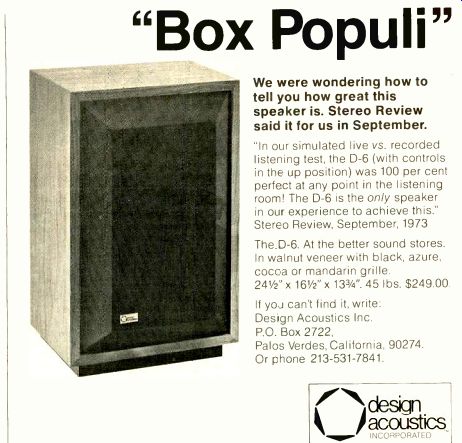
"In our simulated live vs. recorded listening test, the D-6 (with controls in the up position) was 100 percent perfect at any point in the listening room! The D-6 is the only speaker in our experience to achieve this." Stereo Review, September, 1973. The D-6. At the better sound stores.
In walnut veneer with black, azure, cocoa or mandarin grille.
24 1/2" x 16 1/2"x 13 3/4". 45 lbs. $249.00.
If you can't find it, write: Design Acoustics Inc.
P.O. Box 2722, Palos Verdes, California, 90274. Or phone 213-531-7841.
----------------------
Texaco Opera
For your listening enjoyment
DIRECTLY FROM THE STAGE OF THE METROPOLITAN OPERA HOUSE IN NEW YORK
THE OPERAS IN FEBRUARY LES CONIES D'HOFFMANN Hoffmann, a poet, is in love with a prima donna. He tells his drinking companions the story of his three past loves-a mechanical doll, a courtesan, and an innocent young girl. His prima donna, he confides, is all three but when she comes to pick him up after her performance she finds him dead drunk.
LA BOHEME
Perhaps the best-loved of all operas. Much of Puccini's early lice went into this score and he himself would sob at little Mimi's pathetic fate. When Toscanini conducted it fifty years after the world premiere, which he had also conducted, Olin Downes of The New York Times hailed it as music of "imperishable youth."
OTELLO
The year is 1887 and there were those who thought Italian opera was dead. "And then one evening at the Scala in Milan," Franz Werfel tells it, "the tremendous, dissonant opening chord of tell came crashing out, that blow of a giant's fist smashing the stone of the tomb. 'I am here still,' Italian opera cried."
DER ROSENKAVALUER
Richard Strauss once boasted he could describe a silver spoon in music. Here he tonally fashions for us a silver rose. With his matchless librettist he also tells the bittersweet story of a gallant lady who looks in her mirror and knows it is time-time to give up her young lover to the girl who appears in the second act.

Please send quiz questions to Texaco Opera Quiz, 135 East 42nd Street, New York, N.Y. 10017.
These live broadcasts, heard throughout the United States over the Texaco-Metropolitan Opera Radio Network, and in Canada over the CBC English and French Radio Networks, are proudly presented by Texaco for the pleasure of opera lovers everywhere. This season's broadcasts will be the 34th consecutive year of Texaco's exclusive sponsorship.
DATE 1973
Dec. 8 Dec. 15 Dec. 22 Dec. 29 1974 Jan. 5 Jan. 12 Jan. 19 Jan. 26 Feb. 2 Feb. 9 Feb. 16 Feb. 23 Mar. 2 Mar. 9 Mar. 16 Mar. 23 Mar. 30 Apr. 6 Apr. 13 Apr. 20 Apr. 27
OPERA COMPOSER TIME (E.T.) L'ITALIANA IN ALGERI (Rossini) DIE ZAUBERFLOETE (Mozart) RIGOLETTO (Verdi) MANON LESCAUT (Puccini)
SALOME (R. Strauss) 2:00 CARMEN (Bizet) 1:30 SIMON BOCCANEGRA (Verdi) 2:00 TRISTAN UND ISOLDE (Wagner) 1:00 LES CONIES D'HOFFMANN (Offenbach) 2:00 OTELLO (Verdi) 2:00 LA BOHEME (Puccini) 2:00 DER ROSENKAVALIER (R. Strauss) 1:30 IL BARBIERE DI SIVIGLIA (Rossini) 2:00 I VESPRI SICILIAN! (Verdi) 2:00 LES TROYENS (Berlioz) 1:00 DIE GOETTERDAEMMERUNG (Wagner) 12:30 MADAMA BUTTERFLY (Puccini) 2:00 L'ELISIR D'AMORE (Donizetti) 1:30 DON GIOVANNI (Mozart) 2:00 PARSIFAL (Wagner)
TURANDOT (Puccini), '21st Broadcast Live From Boston Schedule subject to change
Please check your local newspaper for radio station.
--------------------------
"THE LITTLE LADY IS AMAZING" ALICIA DE LARROCHA CSA 22 35 NEW on "Alicia de Larrocha's performance of Iberia is one of the great keyboard interpretations of our day." THE GRAMOPHONE "... nobody alive has the extraordinary ability she brings to Spanish music."
'THE NEW YORK TIMES
-------------------
ELECTRO-VOICE, INC.
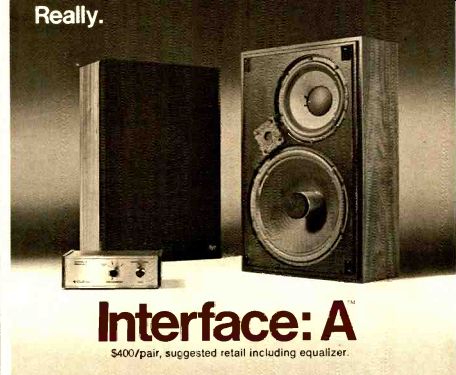
This speaker system extends deeper into the lowest octave. with lower distortion and higher efficiency, than is possible from any similar-size acoustic suspension system.
Really.
Interface: A $400/pair, suggested retail including equalizer . Obviously we haven't tested every acoustic suspension system ever made to substantiate this claim. Rather, we rest our case on the exhaustive studies of speaker design now appearing in major technical journals, plus cur own laboratory tests. For a condensed statement of our design concept, plus a bibliography of applicable research, write us direct. Then listen. We think you'll be convinced.
ELECTRO-VOICE, INC., 616 Cecil St., Buchanan, Mich. 49107
----------------------
RABCO
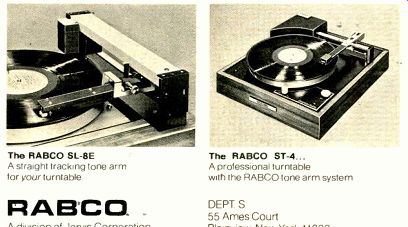
We play it straight.
Master records are made by machines that drive the cutting head in a straight line across the record. A play back system that moves across your record in any other way, results in wear and distortion.
With a conventional pivoted arm system, the revolving groove "pulls- the stylus toward the center of the record. This is called, "skating force:
Skating force causes wear on the inner wall of the groove and the stylus, and results in a loss of separation as well as distortion levels simply not acceptable to the serious listener.
Most good pivoted arm systems do have anti-skating devices. But they can only be set for "average- skating force... and an anti-skating device that remains constant cannot fully compensate for all of the varying forces exerted during the playing of a record. Even the total elimination of tracking error does not eliminate the inherent problem of the pivoted arm- skating force.
The RABCO system plays it straight. The pickup moves in a straight line The record is played precisely as it was originally cut. It has no anti-skating device for one reason: The RABCO system eliminates skating force.
We want to tell you more about how we eliminate both skating force and tracking error. Drop us a note and we'll send full information straight away.
The RABCO SL-8E A straight tracking tone arm for your turntable RABCO A division of Jervis Corporation The RABCO ST-4...
A professional turntable with the RABCO tonearm system, DEPT S 55 Ames Court Plainview. New York, 11803.
---------------------
A NEW STANDARD IN PERFORMANCE D-200E
Two-way cardioid dynamic microphone.
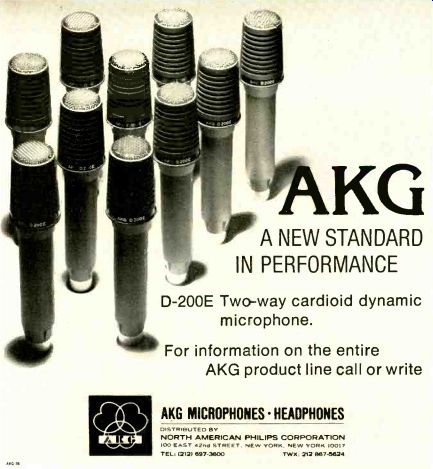
For information on the entire AKG product line call or write AKG MICROPHONES HEADPHONES DISTRIBUTED BY NORTH AMERICAN PHILIPS CORPORATION. NEW YORK, NEW YORK 10017.
-------------------
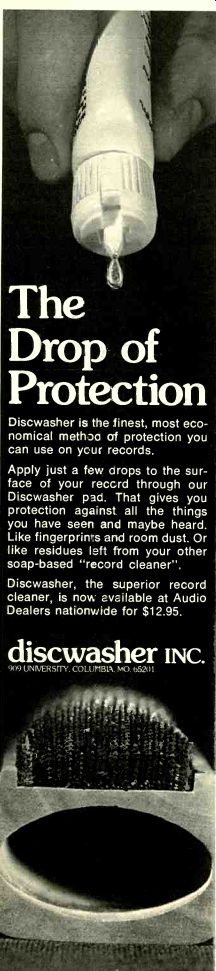
The Drop of Protection Discwasher is the finest, most economical method of protection you can use on your records.
Apply just a few crops to the surface of your record through our Discwasher pad. That gives you protection against all the things you have seer and maybe heard.
Like fingerprints and room dust. Or like residues left from your other soap-based "record cleaner".
Discwasher, the superior record cleaner, is now available at Audio Dealers nationwide for $12.95.
discwasher INC.
Also see:
EDITORIALLY SPEAKING, WILLIAM ANDERSON