AUDIO'S DIGITAL FUTURE--Signal processing by computer will mean the end of noise and distortion. ROBERT BERKOVITZ
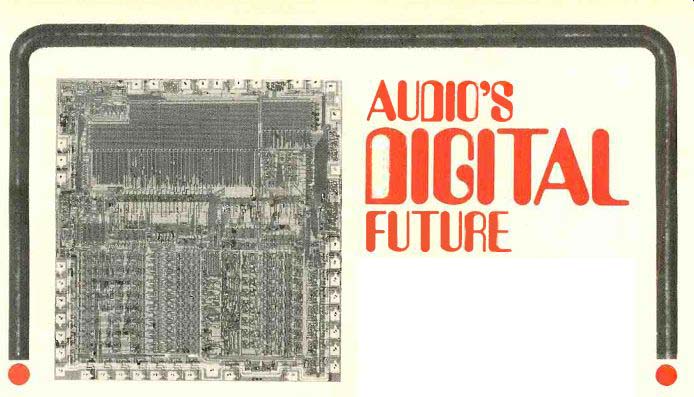
---- Bell Labs' new MAC-8 microprocessor chip is shown framed by an ordinary paper staple, both with the same enlargement. The device contains over 7,000 transistors fabricated on a single chip of silicon, and ii can execute over a hundred thousand electronic logic ("thinking") functions per second while using only 0.1 watt of power.---
THERE was almost nothing about the first mechanical phono graphs of one hundred years ago that could not have been duplicated by technology available to the ancient Greeks. And even our "modern" methods of sound recording and reproduction, based on electricity and magnetism, are far from being the most sophisticated systems of their kind. For example, the human hearing system converts incoming sound waves into streams of electrical pulses sent along nerve pathways to the brain. Although this is sometimes compared to the operation of a microphone converting sound waves into electricity, our biological hearing system is profoundly different.
A good microphone will produce an electrical output with a varying pattern which is an exact replica of the pattern of changing air pressure; the electrical signal sent to the brain by the ear contains no such simple replica, but consists mainly of bursts or volleys of electrical discharges. The electrical discharges result from the firing of individual nerve cells which either fire or do not-they have no intermediate state. They either make or withhold their contribution to the total stream of impulses, like members of the audience at a stadium match-lighting ceremony.
It is the statistics that count. A second-more subtle but no less important-characteristic of the biological hearing system is that the streams of electrical impulses moving toward and through the brain are combined, select ed, and interpreted along the way to permit the detection of certain features of a sound which may be of special importance. Indeed, it is these two properties of the central nervous system communication by simple impulses and the complex interconnection of path ways-that scientists now believe form the physical basis of thought and memory.
By now, almost everybody knows that digital computers are designed along similar lines. But comparing a computer to the human brain because both can sort or calculate is like claiming that a plastic sponge is the same as a living sponge because both soak up water. The subtlety of the living brain still eludes even the most thorough of investigators. However, men have learned to mimic the nervous system's operating principles and have found that there are important advantages to communication systems based on pulse transmission. We have also learned how to produce equipment to process and interpret "message" pulses. The same techniques are now being applied in a limited way to the recording and re production of music, with results that have staggering implications for the re cording and high-fidelity industries as well as all music listeners.
The operating principles of the human brain and central nervous system (combined with other techniques which that brain has invented) form digital technology. This technology is bound to change almost every aspect of music recording and reproduction within a few years. The rapidity with which the change is likely to take place can be attributed to the development of highly complex new integrated circuits-the ubiquitous "chips." The sound we hear in our homes will certainly be different when digital re cording becomes common. Consider tape or disc recordings that have no inherent noise, so that the dynamic range of music reproduction is limited only by the listening environment. Or consider master recordings, free of any audible noise and distortion, that may be copied through hundreds of generations yet still sound exactly the same as the original. Consider disc recordings immune to scratches and dust, discs that do not wear out and that give superb reproduction with relatively low cost cartridges. Think about making a multitrack recording in a studio, exploiting virtually every effect in the re cording engineer's repertoire, mixing down the recording and making a per-feet master without a recording console full of switches and meters--and with out ever once cutting into the original tape. If you also consider that the equipment making all this possible will eventually cost less than present methods, you can develop some idea of the impact digital technology will have on both studio recording and home playback systems.
How Do Digital Systems Work?
It would be a good idea at this point to define "digital." Electrical circuits which work with pulses have been with us for decades in such applications as telephone-dialing circuits and remote-control units for TV sets. Most of these systems are not, in the fullest sense of the word, digital. Digital systems are unique in this respect: information is moved about in the form of groups of pulses which represent numbers.
Numerical representation is a key point, for it allows these groups of pulses to be dealt with like other numbers, using various mathematical techniques. It is the application of these two concepts which brings to bear upon music recording and reproduction the powerful techniques of digital signal processing.
The sounds produced by human voices and musical instruments are not digital, of course. In order to take advantage of the technology we have been talking about, it is necessary first to convert a sound to digital form. Sup pose you have an instrument that measures the air-pressure variations produced by sound and shows its value on a meter of some sort. Every so often you look at the meter and write down its reading. If you do this at frequent intervals and make a graph of the resulting list of numbers, you will get a pattern of dots which can be connected together to give a continuous line.
Question: how often do the readings have to be taken to insure that nothing of consequence will occur between two readings and therefore be missed? The answer to this question depends on the fidelity one expects in the result. For telephone conversation, the answer would be about 5,000 readings per second. For a single channel of high-fidelity music, about 40,000 samples per second are necessary. This process of taking periodic measurements, or sampling, can be carried out automatically by an electronic circuit at very high speeds. Other circuits take care of smoothly connecting these values so that listeners have absolutely no way of telling that the program has been chopped into segments, the segments converted into a list of numbers, then later reconverted and reassembled into a facsimile of the original program.
This process would be a matter of only academic interest, even to engineers, were it not for the fact that in re cent years extremely powerful techniques have been developed for the large-scale storage and manipulation of numbers. The digital revolution that is about to strike the music industry has largely come about because it is now possible to make machines that can do simple mathematical operations at a rate far in excess of 40,000 times each second. The numbers generated by the sampling process, if converted to bi nary form, can be accepted and used by a computer. This conversion pro cess can be carried out at high speed by a small electronic module, an analog-to-digital (A-D) converter that can fit into the palm of one's hand. A corresponding module at the output of the computer, the D-A converter, does the reconversion job.
Before considering the interaction between a music signal and a computer, let us take a closer look at the two converters which have just been mentioned and consider the remarkable results they are able to produce even in "If things are working right, there is absolutely no way in which we could possibly tell [a digital] copy from the original." the absence of a computer. First, let us say we make a "perfect" direct-disc (no tape) recording. Later, if we duplicate the record, we obtain not only a copy of the music but also a copy of all the noise produced by dust, scratches, and wear as well. If we didn't play the original but instead made a copy of it and then made a copy of our copy, we would find that with each copy step the background noise increased. The quality of the program would also be diminished by the distortion added to the music with each succeeding generation.
Various noise-reduction techniques can help, but there is almost nothing that can be done to eliminate the degradation totally. The problem arises be cause, in addition to playing back the music, we are playing the imperfections of the record's material, the accidental scratches and dust particles that have found their way onto the surface of the record, and the minute, but cumulative, noise present even in the best electronic equipment.
Now let us use digital conversion to make a similar series of recordings. Be fore recording on the disc, the signal passes through the analog-to-digital converter, emerging as a stream of pulses in groups, each group representing a number. It is easiest to record the pulses in sequence, one after another, leaving blank spaces where necessary.
Thus, a very short period in our recording, consisting of a single value, might for example be represented by the binary number 1101001111100011. It is not at all hard to make a circuit that responds only to those pulses occurring just at specific time intervals. It is also easy to make the circuit insensitive to impulses that differ in shape from those which we intend to use in our recording. In copying a digital recording, the presence of a pulse in the original is used to generate a fresh, brand-new pulse for recording onto the copy; this is a further guarantee that nothing at all will be lost during the copying process.
To play back either the original or the copy, we simply feed the stream of pulses to our digital-to-analog converter, connect the output to an amplifier and loudspeaker, and listen. If things are working right, there is absolutely no way in which we could possibly tell such a copy from the original.
This, then, is the basis for the extraordinary integrity (or fidelity) of digital recordings or transmissions. First, they can be played in such a way as to totally separate the information in the recording from those physical characteristics of the recording itself that might cause noise and distortion. Second, copying is transformed into a kind of regeneration, so that losses or degradation that might be transferred from an original to the copy are almost completely suppressed. Because the characteristics of recording or transmission media are more effectively suppressed by digital systems, magnetic or disc recordings and FM and AM broadcasts will tend to have the same general properties so far as reproduction quality is concerned. Standards, however, will have to be different from those for today's broadcasts.
Digital Signal Processing Now let us put a computer between the analog-to-digital and digital-to-analog converters. The computer need not be large or in any way formidable.
Indeed, some of the hobby computers being sold in stores all over the country today and costing no more than a few hundred dollars can do significant signal-processing work, at least in measurement applications. However, appropriate computers for audio use will be designed for that specific purpose.
Take, as an example, DITTO, a sixteen-channel digital delay network built at Acoustic Research. DITTO can fairly be said to have almost no intelligence, but it has memory enough to hold about 9,000 binary numbers and sixteen simple programs, and it includes some typical digital circuitry along with the inevitable A-D and D-A converters. Although used primarily as a research tool, DITTO has entertained many hundreds of visitors to the Audio Engineering Society conventions during the past few years by making a small demonstration room sound like a recital hall, a concert hall, or a cathedral. This system can even shift the listener's apparent position in the hall, enabling him to hear the difference it would make.
To use DITTO, one adds to a standard stereo system sixteen additional loudspeakers and the special sixteen-channel power amplifier built for use with the system. The same ordinary stereo recordings fed to the main system are also fed to DITTO; the same signal comes from each of the sixteen loudspeakers at a slightly different time. The heart of this system is a full scale research computer programmed to analyze the acoustical properties of the hall to be simulated; its results are entered via the keyboard on the front of DITTO. Sixteen different sets of acoustical characteristics can be stored in DITTO at any one time; one can therefore jump to any of sixteen simulated rooms in a fraction of a second by touching the appropriate button on the control panel. When a good recording--especially one with realistic room reverberation in it-is played through the system, the results can be strikingly realistic, particularly if heard with the room lights turned out or the eyes shut.
In principle, there is nothing to prevent DITTO from being operated with a little deck of punched cards, presumably marked "Concertgebouw, Amsterdam," "Symphony Hall, Boston," "The Musikvereinsaal, Vienna," etc.
Similar but far simpler devices of the same kind are beginning to appear on the market for consumer use, although these do not partake of digital technology in the sense in which the term is used in this article.
Delay units based on similar concepts were introduced for professional use years before AR's unit was built.
The Delta-T systems, based on designs by Dr. Francis Lee of M.I.T. and made by Lexicon, meet extremely high standards of audio performance, and some permit recording engineers to obtain various special sound effects in addition to simple time delay. The EMT All-Electronic Reverberation System, the first digital product to reach the marketplace that can fairly be de scribed as a special-purpose computer, is conceptually similar to AR's DITTO system, but it is much more complex in operation. (Continued overleaf)
-----------
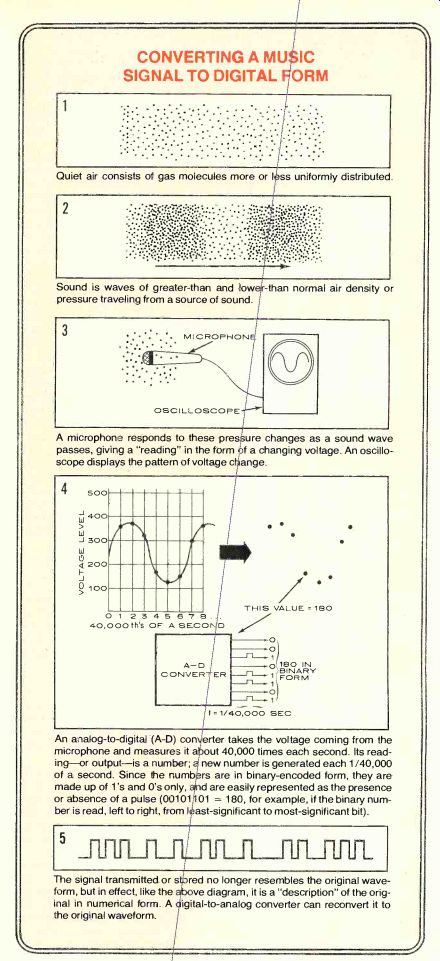
CONVERTING A MUSIC SIGNAL TO DIGITAL FORM
1. Quiet air consists of gas molecules more or less uniformly distributed.
2. Sound is waves of greater-than and low pressure traveling from a source of sound.
-than normal air density or
3. A microphone responds to these pressure changes as a sound wave passes, giving a "reading" in the form of a changing voltage. An oscilloscope displays the pattern of voltage change.
4. An analog-to-digital (A-D) converter takes the voltage coming from the microphone and measures it out 40,000 times each second. Its reading-or output-is a number; new number is generated each 1/40,000 of a second. Since the numbers are in binary-encoded form, they are made up of l's and 0's only, d are easily represented as the presence or absence of a pulse (00101 01 = 180, for example, if the binary number is read, left to right, from least-significant to most-significant bit).
5. The signal transmitted or s red no longer resembles the original waveform, but in effect, like the ve diagram, it is a "description" of the original in numerical form. A digital-to-analog converter can reconvert it to the original waveform.
-------------------------
Artificial delays and reverberation are far from being the only signal-processing uses in the audio field that will grow out of digital techniques. Thomas Stockham of the Soundstream Company, responsible for some remarkable restorations of old operatic recordings (the recent Caruso release on RCA, for example), has been increasingly turning his attention to development of efficient and practical digital systems for professional and domestic music re cording and reproduction. Full details are unavailable at present, but clearly Stockham's efforts are partially aimed at replacing the recording console with a special-purpose computer, thereby enhancing the precision, flexibility, and potential of the studio process.
Stock ham and his colleagues delivered a most impressive demonstration of digital recording a few months ago to members of the Audio Engineering Society in New York City. Using a converted instrumentation tape recorder running at 30 inches per second, sever al minutes of opera were recorded in stereo on three tracks (the purpose of the third track was not disclosed).
True, this is a relatively high tape speed. But still, the information density on the tape was far higher than that of any digital recording system for audio applications demonstrated up to that time. The music reproduction was, as expected, remarkably clear, with no apparent distortion, noise, or overload.
Digital Radio?
Will there be digital broadcasting, bringing to listeners all over the country--or all over the world, by satellite-the same superior fidelity avail able from digital tape or disc recordings? The answer to this question depends largely on the willingness of government agencies in various countries to set new standards for such transmissions. Digital transmission and recording require much more frequency separation between stations than is presently provided by the regulations.
In the United States, for example, government regulations require that FM stations be spaced a certain distance apart on the FM dial to prevent interference between them. The amount of separation is dictated by the level at which the station modulates its signal and also by the frequency con tent of the program being transmitted.
In the case of FM broadcasting, the separation required is at least 200 kHz (200,000 Hz). Digital broadcasting of high-fidelity stereo signals, however, might require five times as much separation between stations. This would make it necessary to reduce the number of available channels for FM broadcasting to one-fifth the present number unless some new and different method of transmission were adopted.
Should digital broadcasting systems be developed, it is most likely that new space for high-fidelity broadcasting would be allocated in an entirely different frequency band, one where the increased separation of stations would not matter.
As for disc recording, something considerably less sophisticated than the existing video disc will be perfectly satisfactory for a digital program: the required frequency response is about 500 kHz (500,000 Hz), which is beyond the capabilities of conventional LP re cord/playback technology, but certainly not out of bounds for some possible "intermediate" system. Tape recording presents some remaining technical problems, but, as Stockham's demonstration shows, these can be dealt with by improving technology instead of requiring entirely new methods of magnetic recording. It is therefore likely that existing phonograph and tape-recorder technology will serve (in modified form) for digital products, but this cannot be said to be true for radio broadcasting.
How Soon?
Since the technology for digital processing is readily available, most of the remaining engineering work has to do with adapting the technology to audio applications. Digital techniques have already been proved in many years of service in telephone and military communications, and they have even found their way into such prosaic applications as the headphone audio systems in the passenger cabins of Boeing 747's.
Nor is cost likely to be an object in the future. The complexity of digital audio electronics is no greater than that involved in designing and building pocket calculators, and the basic elements-integrated circuits-are similar or identical. And, as M.I.T.'s Prof. Francis Lee, who directs advanced development for Lexicon (a company that has pioneered in the field of speech time-compression--see Craig Stark's "Tape Progress" in March STEREO Review), recently noted: "When Lexicon's [speech compression] unit was first introduced in 1972, the cost of the digital memory portion of the circuit was approximately $100. Today it is about $2.50." Of course, some audio techniques are unlikely to be affected significantly by the digital revolution. Dolby B-type noise reduction, for example, is al ready available from a number of manufacturers in the form of low-cost integrated circuits. While the same job could be performed by digital circuits, the need for expensive conversion techniques would make such a digital version impractical in any case. In deed, it is not yet clear that digital techniques could ever compete with the high quality and low overall cost of to day's cassette format at its best.
In recent years new tapes, together with noise reduction, have brought professional recording very close to the point at which purely technical flaws are quite inaudible. As the first professional digital recorders become avail able, studio engineers will have to com pare their results closely with those obtainable using the finest current equipment embodying Dolby professional (A-type) noise reduction. It may be that the main contributions of the digital revolution to professional recording will be archival permanence and extreme ease of editing and mixing. But, from the home listener's point of view, broadcasting, disc recording, and the making and playing of open-reel tapes seem to be very likely beneficiaries.
------------ Author Robert Berkovitz, research director at Acoustic Research, enters computer-generated data into DITTO, AR's digital time-delay system, at a recent Audio Engineering Society convention. For the past several years, Berkovitz has supervised the application of advanced techniques, including digital methods, to various audio products.
--------
Also see:
AUDIO QUESTIONS and ANSWERS --Advice on readers' technical problems. LARRY KLEIN