STEREO REVIEWS SELECTION OF RECORDINGS OF SPECIAL MERIT--BEST OF THE MONTH
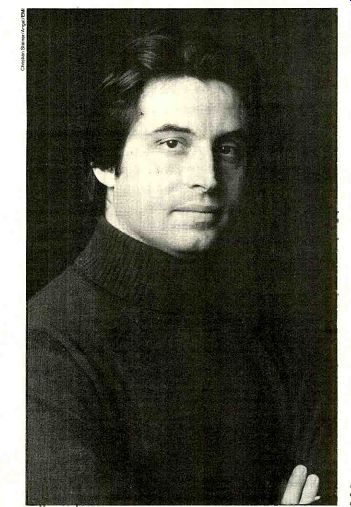
---------- Riccardo Muti: an established interpreter of the Romantic repertoire
makes a bold and vibrant response to a Baroque challenge.
Riccardo Muti: Irresistible Vitality in 2 in Vivaldi's Gloria And Magnificat
IT is well known from his justly celebrated Four Seasons (twenty-eight versions in the current catalog) and other works that Antonio Vivaldi was an innovator in the field of instrumental writing and a tireless creator of concertos of every description. We have also learned, through their still-widening representation on records, that his large-scale choral works often incorporate concertante elements. And now the surging strength and irresistible vitality Riccardo Muti brings to a new Angel recording of the Gloria and Magnificat remind us that Vivaldi, once celebrated as a composer of operas, was also possibly the originator of the quasi-theatrical Italian religious masterpieces that flow in a steady line through the Stabat Maters of Pergolesi and Rossini to the Requiem Mass of Giuseppe Verdi.
Muti, principal guest conductor of the Philadelphia Orchestra (and, appar ently, heir apparent to the Ormandy podium), has already established a rep utation as an interpreter of Romantic symphonic and operatic music through a now considerable list of recordings, and his approach to Vivaldi is, perhaps not surprisingly, essentially Romantic too. The results are bold and vibrant, a dramatic kind of music making that is enriched by an ideal choral-orchestral fusion, first-rate contributions by solo trumpet and oboe, and, above all, two
altogether exceptional solo vocalists.
Teresa Berganza's work in the Magnificat, the less familiar of these two works, is especially outstanding: her particular flair for florid music makes her solo "Et exultavit" exhilarating.
The darker-hued tones of Lucia Valentini Terrani rise to the solos in the Gloria with uncommon warmth and nobility. Both artists sing with extraordinary expressiveness, clarity, and accuracy throughout. The continuo registration is noteworthy, though I would have welcomed an even stronger presence. But no matter: overall, I have only the highest praise for these performances.
A "churchy" quadraphonic ambiance is distinctly, though subtly, in evidence, particularly when checked against the stereo. And there are moments of real brilliance in the heavier choral passages such as the double fugue "Cum sancto spiritu" of the Gloria. Vivaldi borrowed this music from the finale of another Gloria by G. M. Ruggieri, who had scored it for two choirs and orchestras. Though Vivaldi reduced these to one in his version, your quad switch will rather ironically move the passage back in the direction of Ruggieri's original intention.
-George Jellinek
VIVALDI: Gloria; Magnificat (both ed. Malipiero). Teresa Berganza (mezzo-soprano); Lucia Valentini Terrani (contralto); New Philharmonia Chorus and Orchestra, Riccardo Muti cond. ANGEL D S-37415 $7.98.
Perlman and Giulini: A Brahms Violin Concerto to Rank With the Best
WHEN you get around to it (and you ought to make it soon), put An gel's new recording of the Brahms Violin Concerto with Itzhak Perlman, Carlo Maria Giulini, and the Chicago Symphony right up near the top of your list. In their quite different ways, the Oistrakh/Szell and Heifetz/Reiner collaborations will continue to be the major competition in this endlessly beguiling work, but for myself I would not want to be without all three for the brilliant illumination they together shed on every facet of the music.
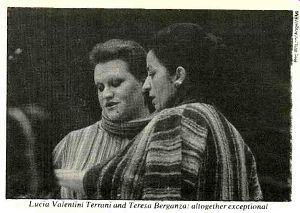
----- Lucia Valentini Terrani and Teresa Berganza: altogether exceptional
The combination of Penman's gutsiness and sentiment (but not sentimentality, mind you!) and Giulini's classic poise combined with Italianate warmth-not to mention the superb responsiveness of the Chicago players and Angel's fine recording job-adds up to a wonderfully invigorating listening experience. The enormous expansiveness of the opening movement is carried off with sweep and brilliance, yet all the elements are kept in perfect proportion as regards phrasing and dynamics. The slow movement comes through with particular eloquence, most especially in the closing pages, and the finale is played with terrific gypsy brio.
The sonics could hardly be bettered.
Quadraphonic ambiance is kept suit ably muted, as befits a work whose focus is often on the solo instrument. The violin is therefore rather closely miked, but not at the expense of the orchestra, which contributes steadily and gloriously, under Gittlini's baton, to these riveting proceedings.
-David Hall
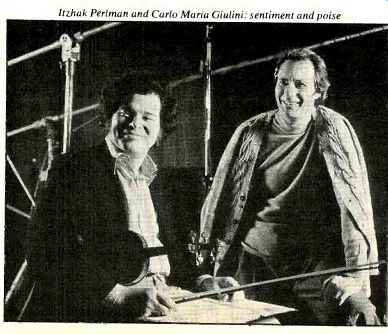
---- Itzhak Perlman and Carlo Maria Giulini: sentiment and poise
BRAHMS: Violin Concerto in D Major, Op. 77. itzhak Perlman (violin); Chicago Symphony Orchestra. Carlo Maria Giulini cond. ANGEL 0 SQ-37286 $7.98. 4X5-37286 $7.98.
Earth, Wind & Fire's Neo-progressive Soul Hasn't Disappointed A Fan Yet
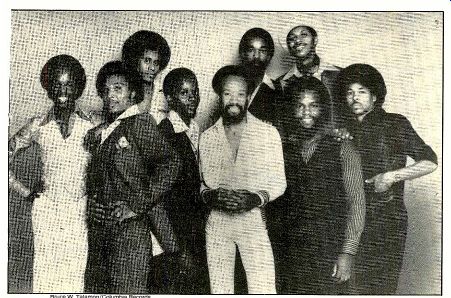
THE pyramids, the all-seeing eyes, the Egyptian icons, and the space cities that adorn the surrealistic cover of "All 'n All," Earth, Wind & Fire's new album, might lead you to expect music on the weird side-computerized burbles designed to accompany some kind of close encounter with extraterrestrial visitors. But don't be deceived by this Hollywoodish come on. The music is delightfully earthy in its appeal, an aural collage of rich vocal and instrumental textures underscored by highly danceable rhythms that never surrender to triteness. Though the very name of this group partakes of astro logical symbolism, and though the lyrics of their songs often hint of galactic mysteries, the nine men who compose Earth, Wind & Fire play a kind of music that might be called neo-progressive soul, for it is a full light-year beyond what most groups are doing these days, soaring to celestial heights while sending out waves of mundane thrills.
------------- 79 Bruce W. Talamon/Columbia Records
All the members of this company are instrumentalists as well as singers, which might account for the imaginative way they use their voices, punctuating long excursions into engaging melody with exciting bursts of high falsetto. An important factor in their development has been the leadership of Maurice White, whose background has given him a broad view of the musical spectrum. As a youth in Chicago, White served his apprenticeship as drummer with the Ramsey Lewis Trio, joining that combo back in the mid-Six ties when Lewis began to adapt his jazzy piano style to r-&-b hits, starting with Dobie Gray's The In Crowd. Thus he was a forerunner of the jazz-soul-rock fusion common today. When White moved out on his own in the early Seventies, he drew on this experience, deftly incorporating jazz-flavored instrumentals and innovative singing into the popular format. As a percussionist, he used the kalimba (an amplified, Westernized version of the ancient African thumb piano) to introduce more intricate rhythms and colorings into the group sound.
All of these elements permeate this splendid new album. While it can safely be said that Earth, Wind & Fire is one of the few groups never to disappoint a fan, this set clearly ranks among their finest efforts, approaching the excellence of "That's the Way of the World" (Columbia PC 33280). Serpentine Fire, the opener, is a high-step per guaranteed to set even the most sluggish soul in motion, while I'll Write a Song for You projects a sweet folk flavor. The most interesting track here is Runnin', a long instrumental complemented by group scat-singing and jazzy horn solos.
As is usual with EW&F albums, there are some strange moments when conversation and snatches of melody appear from nowhere and fade away like ghosts. That adds just an intriguing touch of mystery, of course, as does the fact that this album has two pockets but only one record. There is supposed to be a poster in one of the pockets, but in my copy it was empty--unless there was some invisible mojo tucked inside, if so, it worked.
-Phyl Garland
EARTH, WIND & FIRE: All 'n All. Earth, Wind & Fire (vocals and instrumentals).
Serpentine Fire; Fantasy; In the Market place/Jupiter; Love's Holiday/Brazilian Rhyme; I'll Write a Song for You; Magic Mind; Runnin'/Brazilian Rhyme; Be Ever Wonderful. COLUMBIA JC 34905 $7.98, 0 ICA 34905 $7.98, JCT 34905 $7.98.
------
Earth, Wind & Fire, often celebrated but rarely identified, is (from
left to right) Verdine White. Al McKay, Larry Dunn, Philip Bailey, Maurice
White, Fred White. Johnny Graham (with the hat). Andrew Woolfolk (with the
striped shirt), and Ralph Johnson.
Les Saltimbanques: You Simply Won't Believe the Dazzlingly Melodious Score
FRENCH operetta-the opera bouffe or opera comique that captivated Par is, amused the Western world, and was burnished to a high gloss by Offenbach in the second half of the nineteenth century-did not just fade away: it went out in a blaze of glory. Though, one would have to be very lucky today to find the name Louis Ganne even in the library card catalog, in 1899 Les Saltimbanques, his three-act operetta based on circus life, was the talk of Paris. After that, the fickle French lost interest in opera bouffe, and it is a little hard from this distance to figure out just why. Certainly it could have had nothing to do with Ganne's chef d'oeuvre and biggest success, for a Pattie-Marconi recording just released in the United States by Connoisseur Society shows it to have been a pearl, however cavalierly it may have been tossed away through the caprice of fashion.
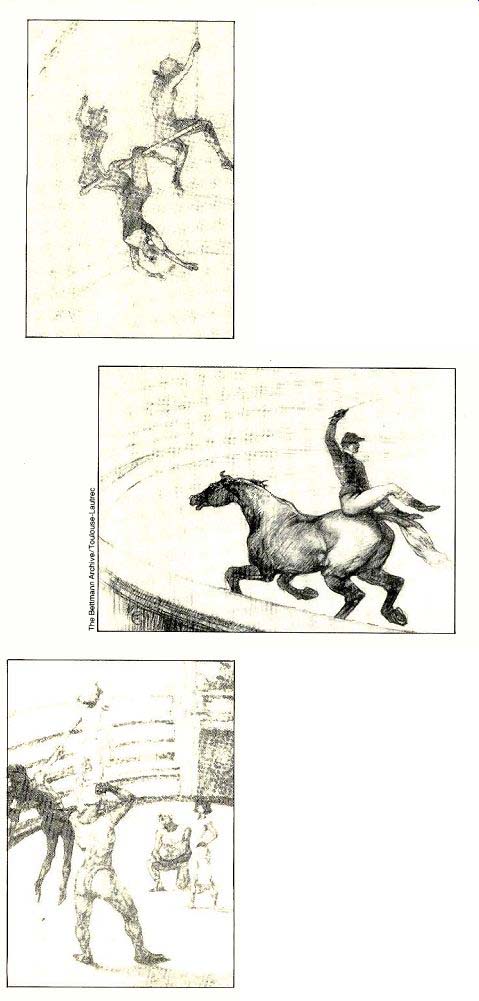
Les Saltimbanques (literally, The Tumblers, but better translated as The Circus Troupe) has a plot that would put one of those old-time, early-technicolor Hollywood circus movies to shame. But what music! What marches, waltzes, gypsy ballets, love duets, and circus processions! Ganne was no hack, but a composer of genuine talent who studied under Cesar Franck and Massenet and learned his craft to perfection. The whole scintillating score, stinting on nothing and abounding in voluptuous melody, is a seamless, bright-colored tapestry that bemuses, surprises, and ingratiates at every turn. Moreover, the performance on these discs is positively dazzling.
Presented complete (except for some sensible cuts in disposable dialogue) with a superb cast, Ganne's sumptuous, richly orchestrated circus score is done full justice.
Eliane Lublin makes a lusty character out of Marion the chambermaid, and Mady Mesple, despite the curious fragility of her voice, is utterly winning as the wistful heroine Suzanne. Tenor Raymond Amade as the clown Paillasse who loves her, baritone Dominique Tirmont as the likewise-smitten strongman Grand-Pingouin, and Claude Cales as the soldier Andre whom she loves never sound a false note in either their singing or their characterizations. The role of the circus owner Malicorne is taken by that superb interpreter of French song, the baritone Jean-Christophe Benoit. All of them manage to make Maurice Ordonneau's at times fatuous lyrics sound as inspired as Ganne's music.
The recorded sound is open and spacious-in fact, just about flawless. This latest in a series of half-forgotten French operettas that deserve our renewed attention is supplied by Connoisseur Society with a cover containing a full-color reproduction of a circus scene by Seurat; the cost of this might better have been invested in a text, either in French or English, an almost indispensable adjunct to the enjoyment of this brilliantly performed recording.
Eric Salzman's well-researched notes fill in every twist and turn of the action, but it is far more fun when you can fol low it (in my case with a Xerox copy of the hard-to-find libretto) with the words.
-Paul Kresh
GANNE: Les Saltimbanques. Mady Mesple (soprano), Suzanne; Eliane Lublin (so prano), Marion; Raymond Amade (tenor), Paillasse; Claude Cales (baritone), Andre; Dominique Tirmont (baritone), Grand-Pin gouin; Jean-Christophe Benoit (baritone), Malicorne; Jacques Pruvost (baritone), Inn keeper; Andre Batisse (tenor), Comte des Etiquettes. Rene Duclos Chorus; Orchestra de ('Association des Concerts Lamoureux, Jean-Pierre Marty cond. CONNOISSEUR So CIETY/PATHE MARCONI CS2-2 139 two discs, $15.96.
Hank Williams Jr.: Stepping Out at Last From Behind His Father's Legend
How do you think it would feel to have someone else's legend pop into everyone's mind every time your name is mentioned? Hank Williams Jr. must know. He's been graceful about it, of course, and has continued to write, cryptically but fondly, about his father in his songs. He started out, at his mother's behest, imitating Hank Sr. to a tee for the soundtrack of a bio graphical movie when he was in his middle teens. But he's been writing his own songs and cultivating his own singing style ever since, and I've had a feeling for some time now that it was about to dawn on us how good he really is.
His new Warner Bros. album "The New South" brings that day measurably closer. What he's got that's most reminiscent of Hank Sr. is a sense of power behind the voice. His father was maybe the most raw and direct singer I ever heard; if there was any ornamentation at all it was purely accidental his only trademark was putting every thing he had behind his vocal cords.
Hank Jr. gives you the same feeling about his ability to concentrate energy like that, but to a lesser degree than his father did; there are more shadings, a broader kind of vulnerability about him. But he's good, and this may be the most nearly balanced version of him any of his albums has yet presented.
The production has the marks of Waylon Jennings on it, and he of course understands about singers who won't fit into just one category. The backing is clean, sprightly, idea-prone, and yet it doesn't argue with the fact that it's the singer's show. The songs include a few that Williams wrote-he doesn't write in the economical, ultra-distilled way his father did, but is more of a suggester, a meanderer-and a good variety of tempos and a good mix of the new and the familiar, of country and rock, of romance and realism. It's only a matter of time before Hank Jr.
will be widely recognized as one of the really good ones, and it'll be a lot less time after this one.-Noel Coppage HANK WILLIAMS JR.: The New South.
Hank Williams Jr. (vocals, guitar, dobro); Waylon Jennings, Leon Sherrill (guitars); Chris Plunkett (bass); other musicians. Feelin' Better; Montgomery in the Rain; Looking at the Rain; You're Gonna Change (or I'm Gonna Leave); How's My Ex Treating You; Uncle Pen; Once and For All; Storms Never Last; New South; Tennessee; Long Way to Hollywood. WARNER BROS. BS 3127 $6.98, M8 3127 $7.97, M5 3127 $7.97.
Lou Rawls: One of The Most Meltingly Seductive Vocal Styles Since Nat "King" Cole
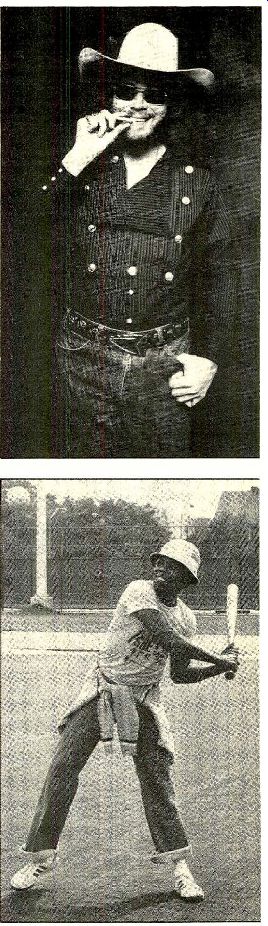
---------- Hank Williams Jr.: a meanderer; Lou Rawls: unstrained ease
IF you really want to see your Aver age Rock Critic turn stone blue with contempt and get his granny glasses all steamed up, just mention the name Lou Rawls. And then, if you want to see his eyes pop and his funny cigarette drop, hit him with the fact that Lou has a slick and very sophisticated new album out on Philadelphia International titled "When You Hear Lou, You've Heard It All." What, he will cry, happened to the sensitive young black singer from Chicago who first gained attention in the Sixties, whose intensity in singing soul music should have made him a star, whose records never sold all that much but who won a thoroughly respectable critical following with such things as Tobacco Road and Natural Man? A sellout, nothing but a sellout, he'll mutter as he retires to his floor pillows to dream up a really perceptive piece on the sociopolitical import of the Sex Pistols.
Hmmm. Well, that may all be true enough, but it misses one important point: Lou Rawls had something to sell out with: a voice of sheer gossamer and one of the most meltingly seductive vo cal styles since the days of the great Nat "King" Cole. And it's all displayed here in an album that's as Glassily assured as the lobby of the St: Regis and as sleekly crafted as a Gucci wallet. When Rawls takes off on an old standard such as Unforgettable, ac companied by a Gamble-Huff instrumentation that sounds as if it drifted over from the string section of the Philadelphia Orchestra at the Academy of Music, you know that he made the right decision. If you have the basic goods to be a Charm Singer, why shouldn't you be? And why shouldn't you do it with the unstrained ease and silkiness that come naturally to you? How many Sixties singers could do the same? How many could handle the slippery likes of If I Coulda, Woulda, Shoulda without sounding like Popeye singing She Didn't Say Yes? For once let your pleasure meter be your guide. Forget what Lou Rawls was doing in the Sixties (he obviously has) and see if he isn't one of the best singer-singers we've got around in the Seventies. And would someone please pick up our Rock Critic? I think he's fainted.
-Peter Reilly
LOU RAWLS: When You Hear Lou, You've Heard It All. Lou Rawls (vocals); orchestra.
Lady Love; I Wish It Were Yesterday; One Life to Live; Dollar Green; Trade Winds; There Will Be Love; Unforgettable; That Would Do It for Me; If I Coulda, Woulda, Shoulda; Not the Staying Kind. PHILA DELPHIA INTERNATIONAL JZ 35036 $7.98. JZA 35036 $7.98, JZT 35036 $7.98.
--------
Also see:
Source: Stereo Review (USA magazine)