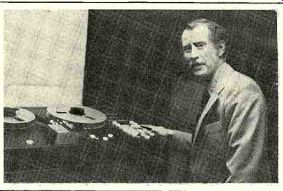
By Craig Stark. Contributing Editor Stark at the control panel of 3M's thirty-two-track digital recorder.The machine is the heart of 3M's $150,000 mastering system.
MORSE MOZART
UN-rit. recently, the key premise of high fidelity recording and reproduction has been relatively easy to state, though frustratingly difficult to achieve. Whether one is dealing with a pattern of vinyl squiggles on a disc or a pattern of magnetic flux on a length of tape, the rule has been simply this: the pattern recorded should be an analog of those rapid variations in air pressure that our ears and brains interpret as "sound." From instant to instant, every pressure variation, however minute, must be turned into a precisely analogous representation in mechanical motion, magnetic flux, or electrical current, or the "fidelity" will suffer.
Our progress in the analog realm has been remarkable, for even the best-trained ears now find it hard, in an A-B demonstration, to distinguish a studio master tape or direct-to-disc original recording from a top-quality cassette copy of it. Yet, trained ears can instantly hear the difference between an original (source) and recorded (monitor) version of a simple 1,000-Hz sine-wave tone fed through the very best studio mastering recorder you can find. The "gritty" or "grainy" quality be hind the tone on the tape is unmistakable, and it must inescapably be there (even if we don't hear it distinctly) on even the best analog recordings of music and speech.
In recent years, too, each decibel of improvement in analog recording has become harder to achieve than the last. True, when metal-particle tapes, such as 3M's Metafine IN (and its counterparts from other companies) appear, analog recording will make another quantum leap forward, possibly achieving a state close enough to perfection to suffice for all but the most critical applications. Yet, the inherent problems with the analog-recording principle remain. By trying to represent each and every one of an infinite number of continuous amplitude variations over the whole 80-dB or so dynamic range of music, the limitations of tape-motional stability in the recorder and of magnetic nonlinearity in the tape conspire to guarantee that we shall capture none of those changes perfectly.
Digital recording, on the other hand, abandons the whole idea of a one-to-one copy of reality. It begins by imposing a set of definite limits-on frequency response, on dynamic range, and on distortion, for example. But within those pre-established limits, it is capable of doing a far better job than any analog technique. Are those predetermined limits good enough? Well, compare the following digital specifications with those of your analog recorder-or of any analog recorder you've ever heard of:
S/N: 85 to 95 dB (without Dolby or any other noise reduction)
Harmonic distortion: 0.03 percent
Frequency response: 0 to 20,000 Hz ±0.5 dB (up to and including 0-VU level)
Wow and flutter: unmeasurable
Copy-to-copy degradation: none
I didn't dream up those specs. They're taken from digital recorders available (though in limited quantities) to the professional market right now. The Japanese company Denon, for one, has produced a whole series of discs whose master tapes were recorded digitally on a modified video recorder. Mitsubishi has demonstrated several digital recorders in the last year or so and, in conjunction with Teac and Tokyo Denka, has also shown a few digitally encoded discs and U-Matic cassettes.
My colleague Bert Whyte's digital recording of Rimsky-Korsakov's Capriccio Espagnol, made with the Boston Pops on a Soundstream recorder, was one of the highlights of the last Audio Engineering Society Convention in New York. There, too, 3M, which has been working with the BBC, introduced both a thirty-two-track digital mastering recorder and a four-track digital mixdown deck.
SINCE theory suggests that there are quite a number of conceivable "systems" for recording music digitally, any description of the process must necessarily be very general. An article by Robert Berkovitz ("Audio's Digital Future") in the July 1977 issue of STEREO REVIEW provides an excellent introductory discussion of digital techniques, but for our purposes a brief, simplified summary will do.
The input signal, on its way to the digital recorder, is first processed to remove any ultra sonic frequencies. Then the amplitude of the to-be-recorded signal waveform is "sampled" at a rate at least twice as high as the highest frequency that remains after filtering (at least 40,000 times per second in the case of 20,000 Hz, for example). The sampling process results in a steady stream of instantaneous sig nal-waveform values 1/40,000 of a second apart. An analog-to-digital converter expresses these values as numbers-binary numbers-and it is this information rather than the waveform itself that is recorded on the tape.
The playback process recovers the numbers from the tape and checks their accuracy by means of various programmed digital error-detection and correction techniques. With the correct numbers available, the digital-to-analog converter can re-create the signal's instantaneous amplitude values. Of course, what we end up with might look like a picket fence with constantly varying picket heights, but each picket represents the amplitude of the waveform every 40,000th of a second.
Another filter following the converter processes these fragments into a smooth, continuous, and remarkably accurate waveform, and the result is sound reproduction so good it has to be heard to be believed. And, as if this weren't enough, when you copy a digital signal, then copy the copy and so forth, there is none of the increase in noise and distortion that invariably creeps in with analog dubbing.
It's rather difficult to make a mere number "noisy" or "distorted." All this "near perfection" has its price, of course. The 3M system will set you back about $150,000 just now, for example, and "simple" two-channel digital recorders are currently priced in the $15,000 to $40,000 range. Prices will drop in time, but for the near future, at least, digital decks are likely to find themselves restricted mainly to professional applications.
Yet, home digital audio recording will come. Memorex's Michael Martin suggested some time ago that, if the need were felt, one could build a home digital recorder--with all the fancy "pro" specs-to sell in the $1,500 to $2,000 range. As if to prove it, Sony al ready has a "black box" digital adapter that can work in conjunction with its Betamax video recorder, though it isn't being offered for sale quite yet. At the present time, since none of the professional formats are compatible, tapes made on one digital recorder cannot be played on another. Happily, however, all the main entrants in the professional area are represented on a committee (chaired by Jay McKnight, president-elect of the Audio Engineering Society) that is already at work establishing standards for professional applications. These standards will be used with consumer machines when appropriate.
I AM convinced that digital recording will in time be as routine in the home as analog is to day. If it seems at first almost sacrilegious to chop the music of Mozart up into little Morse-code-like bits, just remember that those bits, when reassembled, can bring us closer to the music than was ever possible using conventional analog techniques.
A hundred years before Edison, the philosopher Immanuel Kant argued that so long as we believed that our perceptions had to conform, point by point, to the world external to us, we were never going to reach a satisfactory understanding of it. There's a parallel here, of course, with the difference between analog and digital recording. The analog recording system tries to copy everything exactly, and while it can be very good, it ultimately disappoints us. It seems safe to say-paraphrasing another philosopher--that digital recording is an idea whose time has come. And I, for one, am very pleased to bid it welcome.
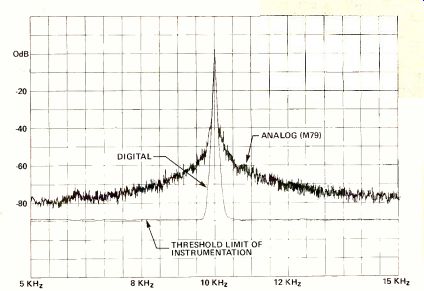
----------The frequency spectra of a 10,000-Hz sine wave recorded
by analog and digital methods. The digital recording has a high degree
of "spectral purity" (no spurious frequency components); the
analog recording is noise-laden largely owing to "scrape flutter."
-------
Also see: Regulars
Source: Stereo Review (USA magazine)