CLASSICAL LPs and Tapes: A Wind Band Spectacular; Zimerman's Elegant Mozart; Tao "Archdukes"; A Goossens Sampler; Vivaldi's "Orlando Furioso"; Through the Opera Glasses; New Sounds from the Avant-Garde; Vivaldi's Sacred 'Choral Music
.
Reviewed by: RICHARD FREED, DAVID HALL, GEORGE JELLINEK, PAUL KRESH, STODDARD LINCOLN, ERIC SALZMAN
AMEMIYA: Summer Prayer; Monochrome Sea. FELDMAN: The King of Denmark. Yasukazu Amemiya (percussion). RCA JAPAN RVC-2154 $14.95 (plus $1 handling charge from Audio-Technica U.S., Inc., 33 Shiawassee Avenue, Fairlawn, Ohio 44313).
Performance: Spectacular
Recording: A knockout
The recorded percussion spectacular, practically a recognized genre a few years back, makes a mighty comeback here with the work of Yasukazu Amemiya. His Summer Prayer for solo percussion, percussion ensemble, and tape involves more than five dozen percussion instruments, Eastern and Western all, through the magic of multitracking, played by the composer. Monochrome Sea, similarly inspired by the composer's own poem, is an equally evocative (if slightly less spectacular) East-West percussion piece. The King of Denmark, by the American composer Morton Feldman, is, ironically, the most Oriental-sounding of all in its ultrasoft, spare, improvisatory character. The title is a dedication to the king who protected the Danish Jews during World War II, but nothing could be further from program music than this gentle abstraction. Amemiya's own music, in sharp contrast, is intensely dramatic at every moment. Its tremendous range is superbly re corded and reproduced by Japanese RCA, obviously a great deal more adventurous than its ...
---------
Explanation of symbols:
= reel-to-reel stereo tape
= eight-track stereo cartridge
= stereo cassette quadraphonic disc
= digital-master recording
= direct-to-disc recording
Monophonic recordings are indicated by the symbol
The first listing is the one reviewed; other formats, if available, follow it.
-----------------
... parent company. It is certainly one of the most remarkable demonstrations of the high state of audio technology that I have heard in quite a while, and it isn't even digital. E.S.
J. S. BACH: Musical Offering (BWV 1079). Deutsche Bachsolisten, Helmut Winschermann cond.VARESE SARABANDE VX 81063, $7.98.
Performance: Overbearing
Recording: Good
Although the component parts of Bach's Musical Offering are united by Frederick the Great's "Royal Theme," there is a compositional dichotomy that makes a performance of the entire work almost impossible. On the one hand, Bach used the Royal Theme to generate a series of ricercare and canons probably de signed more for study than performance. On the other hand, the magnificent trio sonata, which includes the theme as a tribute to its creator, was specifically intended to be per formed. To perform the entire work as a cycle is questionable, but to perform it all in one style is folly. Nonetheless, it is frequently presented in its entirety, in performances ranging from the emotional expansiveness of Munchinger to the cool intellectualism of Harnoncourt and Leonhardt. None of them is completely successful; the cerebration kills the trio sonata and emotion does violence to the ricercare and canons. Obviously what is needed is two styles of performance: cool clarity for the contrapuntal studies and amore projected emotional style for the sonata.
In this recording of the Musical Offering, Helmut Winschermann has put the pieces in what is probably the most logical order: the sonata is used as the centerpiece, with five canons before and five after; the rambling three-voice ricercar is used as an opener, and the more tightly wrought six-voice ricercar brings the work to its logical conclusion. The instrumentation includes strings, harpsichord, and flute. But, though the homogenized string sound is fine in itself, it is all but impossible to hear the complex counterpoint of the canons without the use of some woodwinds to point up the various linear levels. The general stylistic approach is purely romantic with absolutely no reference to Baroque performance practice. The strings use a heavy vibrato and play in a seamless, unarticulated legato.
All polyphony is lost, and the contrapuntal studies turn into grotesque character pieces.
The sonata comes off rather better, but here too romantic mannerisms destroy the linear writing. There is one bright spot: Gottfried Bach's harpsichord reading of the three-voice ricer-car is beautifully smooth and well paced, and his use of rubato marks the widely spaced statements of the Royal Theme. But this is hardly sufficient to save the record. S.L.
J. S. BACH: The Passion According to St. Matthew. BARBER: Prayers of Kierkegaard, Op. 30.
WELCHER: Dervishes. JOHNSON: Past the Evening Sun. Gloria Capone (soprano, in Barber); Southern Baptist Theological Seminary Chorus (in Barber); Louisville Orchestra, Jorge Mester cond. LOUISVILLE LS 763 $7.95.
Performance: Good
Recording: Good
Of chief interest here is Samuel Barber's Prayers of Kierkegaard, a work that made a great impression on me back in December 1954 at its first New York performance (by Charles Munch, the Boston Symphony and Cecilia Society, and soprano Leontyne Price).
At long last we have a recording, and it has been well worth the wait. Kierkegaard's deeply moving text is first heard in a quasi-Gregorian melody intoned by the male choir, and out of this grows a musical structure that is majestic, intensely lyrical, and, at its climactic point, highly dramatic. This is prime Barber at his neo-Romantic best-not over whelming, perhaps, on first hearing, but the work will grow in impact upon repetition. The Louisville forces do well by Barber's score, most especially the chorus, whose singing carries enormous conviction and whose diction is decidedly better than average. The only weak element is soprano Gloria Capone, who deserves A for effort but whose voice lacks the body to do justice to the text.
Dervishes, by Eastman School graduate and erstwhile Louisville principal bassonist Dan Welcher, is an overlong, ostensibly serialis orchestral essay. It makes pleasant listening for about half its course. Hunter Johnson's Past the Evening Sun is an unpretentious and effective elegy for President John F. Kennedy. Jorge Mester and his players are in first rate form with these works as well, and they benefit from the excellent production work of Andrew Kazdin. D.H.
RECORDING OF SPECIAL MERIT
BEETHOVEN: Piano Concerto No. 3, in C Mi nor, Op. 37; Andante Favori in F Major (G. 170). Sviatoslav Richter (piano); Philharmonia Orchestra, Riccardo Muti cond. ANGEL Cl S-37512 $7.98.
Performance: Intensely lyrical
Recording: Very good
Sviatoslav Richter's way with the C Minor Concerto is to underscore the Innigkeit and to let the virile, extroverted elements in the end movements pretty well take care of them selves. Thus, the basic tempo of the opening movement is more than usually deliberate, and there is no exploitation of virtuoso tricks in the finale. It is flawless articulation and limning of phrase of which one is made most aware, and, as might be expected, the great slow movement becomes the very heart and soul of this performance. Only the recording by Schnabel in his prime is in the same league.
And don't let the tacking on of the Andante Favori as an encore put you off: Richter's playing of it is simply fabulous in both tonal beauty and phrase inflection. Riccardo Muti and the Philharmonia Orchestra players pro vide loving collaboration with Richter throughout the concerto. The piano is beautifully recorded, and the orchestra sounds full bodied and well balanced-though the acoustic envelope is a trifle reverberant in four channel playback; two will do here. D.H.
BORODIN: In the Steppes of Central Asia (see GLAZOUNOV)
BORODIN: Polovetsian Dances (see TCHAIKOVSKY)
BRAHMS: Four Serious Songs, Op. 121; Two Songs for Alto and Viola, Op. 91; Stundchen; Auf dem Kirchhofe; Therese; Wie Melodien Zieht Es Mir; Sapphische Ode; Der Jager; Regenlied; Vergebliches Stiindchen. Janet Baker (mezzo-soprano); Andre Previn (piano); Cecil Aronowitz (viola, in Op. 91). ANGEL S-37519, $7.98.
Performance: Very good, mostly
Recording: Excellent
These songs are all late Brahms (post-1880), contemplative, philosophical, and solemn.
There are a few infrequently heard items among them (Therese, Der Juger, Regenlied), but, as is usually the case, the most often re corded and best-known songs in the group are also the best. Janet Baker is in good vocal form here, steadier in tone than she has been in some recent releases. I would prefer a more passionate rendering of the Four Serious Songs (curiously, that approach is more likely to come from baritclne or bass interpreters), but the music is eloquently served here as well as in the two songs with viola.
Best in the sequence are the songs that lie in the artist's lower register. Wie Melodien Zieht Es Mir envelops the listener in a velvety, caressing sound, and a similar effect is achieved in Sapphische Ode, delivered most movingly in an inward, serene mezzo-piano. Dame Jan et does not modulate her tone in the upper range as well as she used to. The notes are there, but the voice takes on a metallic edge.
Still, this is a rewarding and beautiful recital with only one distinct disappointment: a humorless Vergebliches Standchen. Singer and pianist have excellent rapport, and the sound is outstandingly good. G.J.
BRUCKNER: Helgoland (see WAGNER)
BRUCKNER: Symphony No. 5, in B-flat Major (see Best of the Month, page 93) CHAUSSON: Symphony in B-flat Major, Op. 20; Soir de Fite, Op. 32. Orchestre du Capitole de Toulouse, Michel Plasson cond. SERA PHIM S-60310 $3.98.
Performance: Mostly fine
Recording: Occasionally coarse
A new recording of Chausson's attractive symphony is always a pleasure (I can't recall a really disappointing one), and the presence of the previously unrecorded Soir de Fete makes this an especially intriguing release.
Soir de Fete, Chausson's final work for orchestra (and one of his last in any form), seems to have a bit of everything in it. It opens rather like the overture to Chabrier's Gwendoline, then goes its way with echoes of both of Chausson's mentors-Massenet and Franck-and an occasional patch of color that suggests exposure to the Russians, who by the late nineteenth century were influencing French composers more productively than Wagner had done a bit earlier; at the end it seems to call up D'Indy's Istar. The piece is not so much eclectic, however, as amorphous. It is the sort of thing Franck had better luck giving shape to. It is given a fine performance here, though, and for the most part so is the symphony. Plasson has a good feeling for Chausson, and he has what seems to be quite a good orchestra (which will have toured here by, the time these words are in print).
Only the slow movement of the symphony is a disappointment, because its climaxes are hammered out instead of voluptuously swelling and expanding. The occasionally murky, coarse character of the sound does not help:
++++++++++++++++++++
Zimerman's Elegant Mozart
KRYSTIAN ZIMERMAN won the Chopin Competition in Warsaw at the age of eighteen in 1975, and two years later Deutsche Grammophon released his first recording, a stimulating assortment deriving from the competition, of large and lesser Chopin pieces (2530 826, reviewed here in September 1977). Young Zimerman has not been rushed into overproduction by DG: his only recording since then appears to have been as one of the four pianists (Martha Argerich is one of the others) in Leonard Bernstein's recording of Stravinsky's Les Noces (2530 880, re viewed in these pages last July).
Now a third disc is at hand that tells us a bit more about this pianist, a collection of Mozart sonatas in which Zimerman indicates that he has possibly an even surer instinct for Mozart than for Chopin. Tempo's throughout the four sonatas are a little brisker than we are used to (though nothing like the whirlwind speeds favored by Glenn Gould in his recordings of these works), but the music breathes comfort ably and there is space for as much flexibility as anyone could want without a conspicuous shifting of gears. The D Major in particular is an all but intoxicating delight in Zimerman's hands, with animation, lyricism, and an altogether remarkable regard for dynamic and tonal shadings blended into something incredibly close to a Mozartian ideal. Articulation is as crisp and clean as one likes to hear in Scarlatti on the piano, and yet the phrases really sing. This is, in short, honest-to-goodness elegance, with nothing either superficial or contrived, and it is simply irresistible. No previous recording known to me of any of these four works has offered so much immediate or sustained pleasure.
IN addition to providing Zimerman with superb sound, DG offers exceptionally comprehensive annotation by Jurgen Kochel, whose descent from Ludwig Kochel (Mozart's cataloger) is neither confirmed nor in any way alluded to on the liner, but whose name of course looks especially appropriate in this context.
-Richard Freed
MOZART: Piano Sonatas: F Major (K. 280); B-flat Major (K. 281); D Major (K. 311); C Major (K. 330). Krystian Zimerman (piano). DEUTSCHE GRAMMOPHON 2531 052 $8.98, 3301 052 $8.98.
+++++++++++++++
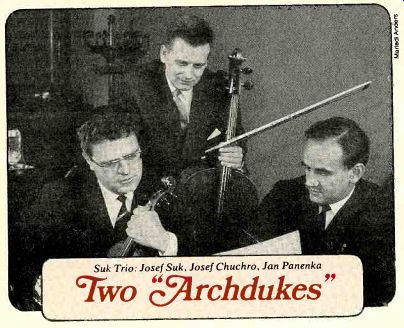
Suk Trio: Josef Suk, Josef Chuchro, Jan Panenka
Two Archdukes
IT has been very instructive to listen to four discs, each pressed in a different country, representing a total of three different recordings but only two different performances of the grandest of all piano trios: Beethoven's "Archduke." The Suk Trio's 1961 Supraphon taping, issued in the U.S. on Crossroads in 1966, then on Vanguard in 1975, has been regarded by many as the finest stereo version of the work; this is what is now reoffered on the Legend and Quintessence discs. The 1975 re make, taped simultaneously by Nippon Columbia for its Denon digital series and by Supraphon itself in SQ quadraphony, is essentially the same nobly straightforward interpretation as before, but it may be appreciated more fully because of the superior balance and clarity in both new recordings. Jan Panenka's eloquent piano, somewhat over-prominent in parts of the earlier version, is more deftly integrated into the sonic fabric now, Josef Chuchro's cello is luminously clear throughout, whereas it is occasionally less than that in the earlier recording, and nothing impedes the sweetness of Josef Suk's tone.
Sonic shortcomings were hardly noticed in the face of the splendid performance, though, and that earlier version still exerts a unique appeal for me: it is just that much more spontaneous in its flow, I think, than the new one, which is perhaps a little mellower and also perhaps a little more "studied." Actually the differences are very, very slight, but the 1961 recording literally does sound better than ever in the new Quintessence edition, which must be reckoned an outstanding bargain. The new mastering has produced a sound even cleaner and with the instruments in more equable balance than we heard on Crossroads, the most satisfying of this classic item's numerous previous incarnations. The bright-sounding cassette, even with its noticeable hiss level (and not a word of annotation), may just be the single most basic chamber-music recording available in that format. The more expensive Legend import (from England) is rather less successful, with a more pronouncedly wiry edge on the violin and some muddy cello.
Both the Japanese and Czech recordings of the 1975 sessions should be considered by collectors to whom sonic excellence is as important a factor as musical quality. I suspect different takes may have been used by the respective companies for the opening of the first movement, but if so the difference is certainly negligible. A choice between Denon and Supraphon might be made on the basis of price or of four-channel availability (which in this case comes down to the same decision), and it may be said that the Czech pressing is a very good one, the sound handsome in both two-channel playback and the SQ quadraphonic mode. Denon's two-channel digital recording is so sensationally fine, however, that no one who invests in it is likely to feel he has spent his money foolishly. The spaciousness and realism are breathtaking, as is the absolute silence of the surfaces (the Japanese now seem to have moved into the No. 1 spot for excellence of pressings; I thought I had forgotten to turn on the amplifier until the music began), and so, more than ever, are the glory of the "Archduke" and the more or less proprietary eminence the Suk Trio has established for it self in its performances of the work.
-Richard Freed
BEETHOVEN: Trio in B-Rat Major, Op. 97 ("Archduke"). Suk Trio. Denon/PCM OX-7035-ND $14 (from selected audio stores or the Discwasher Group, 1407 North Providence Road, Columbia, Mo. 65201).
BEETHOVEN: Trio in B-flat Major, Op. 97 ("Archduke"). Suk Trio. SUPRAPHON 0 4 11 2137 $7.98 (from Qualiton Records, Ltd., 65-37 Austin Street, Rego Park, N.Y. 11374).
BEETHOVEN: Trio in B-flat Major, Op. 97 ("Archduke"). Suk Trio. LEGEND LGD 002, $6.98 (from Qualiton Records, Ltd.).
BEETHOVEN: Trio in B-flat Major, Op. 97 ("Archduke"). Suk Trio.QUINTESSENCE PMC-7082 $3.98, P4C-7082 $4.98.
+++++++++++++
... indeed, it is the bright immediacy of the sound, almost as much as the elegant voluptuousness of the performance itself, that makes Ernest Ansermet's recently reissued version on London STS-15294 the winner it is. R.F.
RECORDING OF SPECIAL MERIT
CHOPIN: Piano Concerto No. 2, in F Minor, Op. 21; Trois Nouvelles Etudes; Scherzo No. 2, in B-flat Minor, Op. 31. Emanuel Ax (piano); Philadelphia Orchestra, Eugene Ormandy cond. (in concerto). RCA ARLI-2868 $7.98, ARK'-2868, 7.98.
Performance: Exquisite
Recording: Limpid
CHOPIN: Piano Concerto No. 2, in F Minor, Op. 21; Andante Spianato and Grande Polonaise in E-flat Major, Op. 22. Bruno Rigutto (piano); Luxembourg Radio Orchestra, Louis de Froment cond. PETERS INTERNATIONAL PLE 045 $6.98.
Performance: Very good
Recording: Warm and full
Emanuel Ax's first all-Chopin record (RCA ARL1-1569) was so impressive that all I could say about it (STEREO REVIEW, October 1976) was that it was "simply one of the most beautiful records of anything ever offered to the public." His first recording with orchestra is again Chopin, and it serves to validate my 1976 finding that "Mr. Ax is a poet, with Cho pin in his blood and most assuredly in his fingers." It is sensationally beautiful. The en tire program, in fact, is illumined by the most elegant communicativeness, and the tone Ax draws from his instrument-especially in the concerto's final movement-is so breathtakingly lustrous that one might well be enthralled by this facet of his playing alone.
There is expectedly fine cooperation from Ormandy and his orchestra and limpid sound from RCA. Comparisons with Rubinstein, Arrau, or anyone else in this repertoire would be quite beside the point: music-making on this exquisite level defines itself.
It is Bruno Rigutto's misfortune that his 1973 recording of the F Minor Concerto reaches us at the same time as Ax's new one, for comparisons will be made. Rigutto, about whom no information is vouchsafed in the liner material (the cover photo shows him to be about the same age as Ax), is, on the evidence here presented, also a first-rate pianist but neither the poet nor the master of tone that Ax is. Rigutto's is a somewhat less intimate, more grand-scaled approach, with slightly brisker tempos throughout and a more overtly dramatic handling of the slow movement; on its own terms, this is a thoroughly enjoyable performance, and so is that of the Andante Spianato and Grande Polonaise. There are thoughtfulness and understanding in abundance as well as the most reliable technique.
Froment provides a very sympathetic partner ship, and the sound itself is warm and full.
Nevertheless, Ax's record is not only worth the extra dollar, it is the sort of Chopin record one simply has to have, no matter how many duplications of the music it may create in an existing collection. R.F.
CHOPIN/GODOWSKY: Etudes: Op. 10, Nos. 1, 3, 5 (two versions), 6, 7; Op. 25, No. I. Trois Nouvelles Etudes, No. 1, Op. Posth. Waltzes: Op. 64, Nos. 1, 3; Op. 69, No. 1; Op. 70, Nos. 2, 3; Op. 18 (concert paraphrase). Jorge Bolet (piano). L'OISEAU-LYRE DSLO 26 $8.98, 0 KDSLC 26 $8.98.
Performance: Flying fingers
Recording: Excellent
Leopold Godowsky's "transcriptions" of the Chopin etudes (fifty-three versions of the original twenty-seven) and waltzes are legendary extravagances that I never expected would ,actually be performed by anyone again. Well, here they are, at least a selection of them, in the hands of a pianist known for old-fashioned virtuosic pianism, and it's all very disappointing. The reason these arrangements are not performed any more is simple:
they're much too tasteful. Tasteful arrangements of difficult originals made ten times more difficult that end up sounding like pretty parlor distortions, accurately played but with out real bravura or depth of feeling-why bother?
E.S.
DVORAK: Symphony No. 9, in E Minor, Op. 95 (" New World"). Concertgebouw Orchestra, Amsterdam, Colin Davis cond. PHILIPS 9500 511 $8.98, 7300 671 $8.98.
Performance: Cool
Recording: Good
DVORAK: Symphony No. 9, in E Minor, Op. 95 (" New World"). Berlin Philharmonic Orchestra, Ferenc Fricsay cond. PRIVILEGE 2535 141 $6.98, 3335 141 $6.98.
Performance: Freely romantic
Recording: A mite bass-shy
Neither Philips' new Colin Davis disc nor the Privilege reissue (on Deutsche Grammophon's new mid-price label) of the 1960 Berlin recording by the late Ferenc Fricsay offers significantly more insight into Dvorak's familiar masterpiece than the best of the more than two dozen other versions currently listed in Schwann. The Davis reading is scrupulous to a fault, with a plentitude of repeats, but it is totally lacking in temperament; the recording as such is first-rate. Fricsay offers lots of temperament in the form of tempo speed-ups and slow-downs, but he leaves out the exposition repeat in the first movement; the recorded sound seems somewhat brash as a result of either a thinning out of bass in the tape-to-disc transfer or a boost in the mid-range (the net effect is the same in either case). Kubelik and Giulini, both on Deutsche Grammophon, pro vide the best in contrasting views of the music at full price, while versions by Jascha Horenstein and Bruno Walter are best buys in the budget category. D .H .
FELDMAN: The King of Denmark (see AME MIYA)
GILBERT AND SULLIVAN: Excerpts from Four Savoy Operas. The Gondoliers: From the Sunny Spanish Shore; In Enterprise of Martial Kind; Take a Pair of Sparkling Eyes; On the Day When I Was Wedded; Small Titles and Orders; Finale. The Pirates of Penzance: Poor Wand'ring One; When a Felon's Not En gaged; Stay, Frederic, Stay!
H.M.S. Pinafore: Hail, Men-o'-Wars-Men; I'm Called Little Buttercup; When I Was a Lad; Never Mind the Why and Wherefore. The Mikado: A Wand'ring Minstrel; As Someday It May Happen; The Sun Whose Rays; Here's a How-
De-Do!; On a Tree by a River; There Is Beauty, in the Bellow; Finale. Marion Studholme (soprano); Edmund Bohan (tenor); Jean Al lister (contralto); Ian Wallace (baritone).
English Chorale; London Concert Orchestra, Marcus Dods cond. CHALFONT C77.003 $7.98 (from Chalfont Records, P.O. Box 11101, Green Lantern Station, Montgomery, Ala. 36111).
Performance: Good
Recording: Excellent
This album, called "A Gilbert & Sullivan Spectacular," is a smorgasbord of selections from four popular Savoy Operas performed by a brave little group who have never been associated with the D'Oyly Carte Opera Company but have its style down pat. Edmund Bohan, who comes from New Zealand, acquits himself well in romantic ballads usually as signed to the male love interest in the operettas-Take a Pair of Sparkling Eyes, A Wand'ring Minstrel, that sort of thing. Ian Wallace has a tougher tradition to uphold in the comedy roles, and he handles himself nicely in When I Was a Lad and Koko's "little list" of people the world could do without.
Though he's no match for Martyn Green, Peter Pratt, or even John Reed, he's plausible and musically sound. Marion Studholme is a savory Yum Yum in The Sun Whose Rays and handles the coloratura effects in Poor Wand 'ring One with ease, but Jean Allister's attempts to be the fierce Duchess of The Gondoliers and Katisha of The Mikado are just not quite terrifying enough. When the quartet teams up with the English Chorale and the London Concert Orchestra under the adroit Marcus Dods in moments from some of the big first-act finales, however, the results are very impressive. And the recorded sound is so alive that this might be just the starter al bum to send some incipient Savoyard down the primrose path. P.K.
GLAZOUNOV: Symphony No. 6, in C Minor, Op. 58. Moscow Radio Orchestra, Vladimir Fedoseyev cond. BORODIN: In the Steppes of Central Asia. U.S.S.R. Symphony Orchestra, Yevgeny Svetlanov cond. Columbia/ MELODIYA M 35104 $7.98.
Performance: Good Glazounov
Recording: Best in Glazounov
Glazounov comes off better in the balletic middle movements of this symphony than in the end pieces, one of which is rather stuffily academic, the other academically over stuffed. Vladimir Fedoseyev and his Moscow players make the most persuasive case possible for this music in a taut, high-quality performance that is handsomely recorded. On the other hand, Svetlanov's run-through of Borodin's little masterpiece seems rather coarse in both performance and sound until the very last moments, when the playing achieves impressive poetic impact.
D.H.
GLIERE: Russian Sailor's Dance (see TCHAIKOVSKY) GRANADOS: Tonadillas; Canciones Amatorias. Pilar Lorengar (soprano); Alicia de Larrocha (piano). LONDON OS 26558 $7.98, 5-26558 $7.98.
Performance: Good
Recording: Good, with reservations
Combining the two song collections of Enrique Granados on one LP may be a natural
--------
A Goossens Sampler
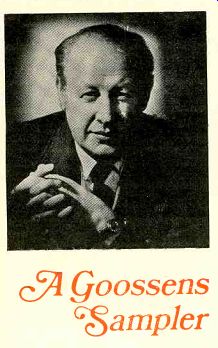
SIR EUGENE GOOSSENS, who died in 1962 at the age of sixty-nine, was not only one of the more prominent conductors of his time, but was also regarded as one of the more significant British composers of his generation. His own music, however, was not too widely performed in his lifetime and has not survived him with much vigor. It is good now to hear a sampling of it, and highly appropriate that an entire side of Unicorn's new Goossens album feature the artistry of his celebrated oboist-brother, Leon (both Eugene and Leon always used the French spellings and pronunciations of their given names). It may be further noted that one of their two musical sisters, Marie, is the solo harpist of the National Philharmonic in the performance of the Divertissement recorded here. In fact, the interrelationships and cross-currents represented on this disc are so intriguing that space simply has to be taken to catalog them.
The last of the three movements of the Divertissement is a ballet flamenco that makes use of a tune borrowed from a work by Enrique Fernandez Arbos, who was not only one of Sir Eugene's teachers but was subsequently co-conductor with him of the Saint Louis Symphony Orchestra for part of the period between the reigns of Rudolph Ganz and Vladimir Golschmann (in the late Twenties and early Thirties). Nearly four decades later, Walter Susskind, who conducts the Oboe Concerto here, became music director of that orchestra, and he now serves as music advisor to the Cincinnati Symphony, of which Goossens was conductor from 1931 to 1947. Gaspare Chiarelli, conductor of the Divertissement, was once a pupil of Goossens, later conducted in Cincinnati himself, and now conducts youth orchestras in Canada-which country's National Youth Orchestra was founded by Susskind when he was conductor in Toronto and Chiarelli was a student there.
And at one time Susskind was conductor of the Carl Rosa Opera Company, as Goossens' father and grandfather had been; he also went to Australia a few years after Goossens did, but not with the same orchestra.
As for the music itself, the Oboe Concerto, preserved here in its original 1948 recording (this portion of the disc is of course mono; the remainder was taped in 1976 and 1977 in stereo), is by all odds the strongest component of the retrospective package. It was composed in 1928 and introduced by the two brothers on the occasion of Leon's New York debut ( Eugene was at that time conductor of the Rochester Philharmonic). The piece calls upon the soloist to put his instrument through its paces in the most brilliant manner, and it happens to have real substance, too; it would be a nice addition to the skimpy repertoire Of post-Baroque oboe concertos in general circulation now.
The Divertissement, composed more than thirty years later than the concerto, was the last work Goossens completed. Its middle movement, a scherzo and folk tune, is an orchestral setting of the Two Studies he com posed for piano in 1924, material he used in at least one additional setting in the intervening years. It has an agreeably Delian cast and was meant to reflect a summer landscape at sun set, with a shepherd leading his flock down a hillside and a village church bell heard in the distance. The opening movement is an over ture dance prelude, full of energy and color, if not quite so full as the aforementioned ballet flamenco, which concludes the work with a most convincing evocation of gutsy flamenco spirit.
The Six Songs from "Chamber Music" (Goossens obtained James Joyce's permission successful matchings of words and music, suggesting a natural gift as a songwriter.
Searching for Lambs (heard here in Leon Goossens' arrangement as a lovely pastoral for his instrument) and When Thou Art Dead were also originally songs, the latter from a set of incidental music for the Margaret Kennedy play The Constant Nymph and the former a tune Eugene used again in the slow movement of his String Quartet No. 2. The Islamite Dance was composed for Leon in its present form, and the Old Chinese Folk-Song was arranged by him from a piece Eugene wrote at the age of nineteen for violin or cello with piano.
IT hardly needs saying that all the performances are as accomplished and communicative as the most affectionate dedication on the part of outstanding musicians could make them. The sound is splendid in the new recordings, the transfer of the Oboe Concerto from 78's belies its age, and the domestic pressing is itself exemplary. A lovely surprise all around.
-Richard Freed
GOOSSENS: Divertissement. National Phil harmonic Orchestra, Gaspare Chiarelli cond. Six Songs from "Chamber Music," Op. 51. Meriel Dickinson (mezzo-soprano); Peter Dickinson (piano). Islamite Dance; Searching for Lambs, Op. 49; When Thou Art Dead, Op. 43; Old Chinese Folk-Song, Op. 4. Leon Goossens (oboe); David Lloyd (piano). Oboe Concerto, Op. 45. Leon Goossens (oboe); Philharmonia Orchestra, Walter Susskind cond. UNICORN UNI-75005 $7.98.
and logical idea, yet this is the first time it has been done by a major label. In execution, though, the project has fallen short of the ideal. Pilar Lorengar is an attractive vocalist, but in this repertoire she must be compared with Victoria de los Angeles and Teresa Ber ganza. By their standard she fails to project the insinuating charm, the sense of involvement, and the mastery of communication through pointing up of words and musical phrases that we expect in these brief and colorful vignettes.
Alicia de Larrocha makes a masterly contribution here, relishing the guitar effects, fanciful embellishments, and massive sonorities the music calls for. Her bravura pianism is brilliantly captured, but the engineers' failure to give equal prominence to the vocalist re sults in a somewhat lopsided balance. G.J.
HAYDN: II Mondo della Luna. Domenico Tri marchi (baritone), Buonafede; Luigi Alva (tenor), Ecclitico; Frederica von Stade (mez zo-soprano), Lisetta; Arleen Auger (soprano), Flaminia; Edith Mathis (soprano), Clarice; Lucia Valentini Terrani (contralto), Ernesto; Anthony Rolfe Johnson (tenor), Cecco. Members of the Chorus of Radio Suisse Romande; Lausanne Chamber Orchestra, Antal Dorati cond. PHILIPS 6769 003 four discs $35.94, 7699 078 $26.94.
Performance: Stylish
Recording: Good
In 1777 Haydn made an operatic setting of Carlo Goldoni's II Mondo della Luna express ly for the ceremonies attending an Esterhazy marriage. The work seems not to have been performed again until modern times, when it became the first Haydn opera to be revived. It is still the best known of the composer's considerable operatic output.
In a way this is too bad. Il Mondo della Luna (The World of the Moon, not, as it is usually translated, The Man in the Moon) is far from Haydn's best work in the theater.
The Goldoni libretto, by 1777 already a quarter of a century old and previously set by such notables as Galuppi, Piccini, and Paisiello, is one of those rather strained and overly sophisticated eighteenth-century comedies about human folly-in this case the folly of a gentleman who believes that he has been transported to the moon when he is only being conned into letting his daughters marry their lovers. Since the dramatic premise is slight and the dramatic movement almost nonexistent, it is not surprising that Haydn had a good deal of trouble getting going with it. The fun is in the second act, set in the false and fantastic world of the make-believe moon, where the characters put on outlandish costumes and act out a grotesque charade. Only here did Haydn's inspiration take fire in a series of arias, ballets, and ensembles that are entertaining and expressive.
Still, Il Mondo della Luna is a product of the mature Haydn, and all of it, even the less-notable first act and the brief, anticlimactic third act, is solid stuff. This highly commend able recording is part of a series of Haydn op eras being produced by Philips together with the Radio Suisse Romande and the European Broadcasting Union. The stars of the cast are Domenico Trimarchi as "Goodfaith," the dupe, and Frederica von Stade as the servant girl Lisetta (a kind of predecessor of De-spina). Luigi Alva is a bit uneven in the role of the fake astronomer, while the other tenor, Anthony Rolfe Johnson, is modestly effective in another comic servant role. The other women are good, especially Edith Mathis in the lightweight part of one of the daughters.
The orchestra catches the spirit of the work under Antal Dorati's sensitive and stylish di rection, and the whole thing is very attractively recorded. A full libretto with translations is included. If you want to begin to explore the Haydn operas, I suggest starting somewhere else (Orlando Paladino, for example). But if you are a confirmed Haydn fancier, operati cally inclined or not, this set is well worth your while. E.S.
HOLMBOE: Cello-Concerto, Op. 120 (see KOPPEL)
JANACEK: String Quartet No.- 1 ("Kreutzer Sonata"); String Quartet No. 2 ("Intimate Pages"). Smetana Quartet. SUPRAPHON 0 4 11 1995 $7.98 (from Qualiton Records, Ltd., 65-37 Austin Street, Rego Park, N.Y. 11374).
Performance: Elegantly impassioned
Recording: Quite good
With the Complete Works of Everybody coming at us every ten days or so, it is rather a shock to find that neither of the JANACEK quartets has been listed in Schwann since the retirement of the Crossroads disc (22 16 0014) on which both were performed by the quartet named for the composer. Those performances, however, are apparently still in circulation (as Supraphon SUAST-50556) from the same source as this new release, and any one who is shopping for a recording of these works would be well advised to go for that version. It is not that the illustrious Smetana Quartet in any way lets down its own standards or is uncomfortable in the Janacek idiom, but, to a slight degree, its refinement some times clashes with the earthiness of the material. The Janacek Quartet is more intense in this regard and certainly not without suavity or refinement of its own. I should not want to belabor this point, for in its own right the Smetana Quartet gives us stunning performances-one might call them elegantly impassioned--and the important thing is that these extraordinary works be heard. These new performances, incidentally, are also available in a digital recording on Denon (OX-7066-ND), the Japanese and Czechs having taped the same sessions with different equipment. The Denon version is in a class by itself sonically, but the Supraphon is impressive enough, will appeal to SQ-quadraphonic listeners, and costs much less. R.F.
JOHNSON: Past the Evening Sun (see BARBER)
RECORDING OF SPECIAL MERIT
KOPPEL: Cello Concerto, Op. 56.
HOLMBOE: Cello Concerto, Op. 120. Erling Bli6ndal Bengtsson (cello); Danish Radio Symphony Orchestra, Ole Schmidt cond. (Koppel), Janos Ferencsik cond. (Holmboe).
Bis LP-78 $8.98 (from Qualiton Records, Ltd., 65-37 Austin Street, Rego Park. N.Y. 11374).
Performance: Excellent
Recording: Excellent
Bis designates this disc Volume One in a survey of "Contemporary Danish Music for Orchestra"--an adjunct of its own, apparently, to the recent "Anthology of Danish Music" to which various companies contributed. If subsequent volumes are as intriguing as this first one, the series should receive a good deal of happy attention: both of these concertos are more than attractive and should be seized upon to augment the still smallish repertoire of concerted works for the cello. Both seem to be in the nature of drama in instrumental terms, not unlike Bloch's celebrated Schelo mo but with a wider range of mood. Herman D. Koppel, seventy years old now, has been highly regarded in Denmark for a long time, but I can remember encountering his name only once on a record released in this country, and that was as pianist rather than composer (in Niels Viggo Bentzon's Chamber Concerto, available briefly on Turnabout). His Cello Concerto, composed in 1952, is large-scale, romantic, expressive, and distinguished by a most imaginative use of orchestral color with in a fairly conventional framework. The concerto of the better-known and extremely prolific Vagn Holmboe, introduced less than five years ago, is a more inward work and has a more unusual layout: five interlinked movements, the last three of which are really more or less a vivace interrupted by a long solo cadenza. The performances are not only expert in every sense but must be regarded as definitive, since both works were written for Blondal Bengtsson (who was only twenty when he first played the Koppel concerto). The sound, too, is first-class. The only nit to be picked in the whole presentation is the (to me) irritating presence of applause at the end of the Holmboe side (both sides were recorded in concert, and the applause could have been eliminated from the one as easily as from the other). But that should deter no one from buying and enjoying this altogether excellent disc. R.F.
RECORDING OF SPECIAL MERIT
LECLAIR: Concertos for Violin and String Orchestra: G Minor, Op. 10, No. 6; C Major, Op. 7, No. 3; A Minor, Op. 7, No. 5. Jaap Schroder (violin); Concerto Amsterdam, Jaap Schroder cond. TELEFUNKEN 6.42180 AW $8.98, 4.42180 $8.98.
Performance: Gorgeous
Recording: The best
A ballet-master turned violinist and composer, Jean-Marie Leclair (1697-1764) has always fascinated me. He was an excellent composer with a French dance background who studied in Italy, so that his music has the elegance of France and the fire of Italy. Naturally I looked forward to hearing this disc of three of his concertos for violin and strings.
As a performer of early music myself and as a follower of authentic performance practice, I have consistently been especially critical of "authentic" performances. On first hearing this record, my reaction was, "Good Lord, there they go again with all those scratchy sounds and no musicianship." On second hearing, however, I realized that Jaap Schroder and his fellow musicians were playing magnificent music superbly. True, the sound is thin on the old instruments. True, the articulation is jerky, at least as compared with the Romantic long line. But the detail of ornamentation, the clarity of all of the parts, the spring brought to the dance elements of the ...
+++++++++++++++++
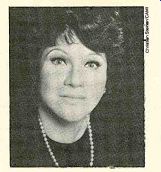
--- MARILYN HORNE: She always astonishes and thrills
VIVALDI'S "Orlando Furioso"
VIVALDI'S modern reputation is closely associated with the church and the church-run young ladies' orphanage for which he was music director. It is therefore hard for us to imagine his working-and working success fully-amid the sensuous gardens of the Baroque opera theater. But Vivaldi was famous in his native Venice as an opera composer.
According to his own (improbable) accounting, he composed no less than ninety-four theater works! These operas have not fared well; only about twenty survive in whole or in part, and all of them had vanished from the boards by the late eighteenth century.
The Italian poet Torquato Tasso's romantic epic on the subject of the love-crazed crusader Roland was a popular operatic subject. Vivaldi himself worked on three different versions of an Orlando opera, and the third, produced in 1727, was one of his most successful works. Orlando Furioso, newly released by RCA, is a fine choice for revival since it has the kind of fantasy and exoticism-mountains, groves, and temples, knights and Saracens, sorceresses and enchantments, love and madness-that might appeal to a modern audience. And it has a score by a composer who, possibly more than any other of his age, best embodies the qualities of imagination, fire, fantasy, and passion.
Not that it is an easy opera to present to a modern audience. The original is five or six hours long, filled with vast stretches of dry recitative and something like three dozen arias, all stylized in form if not expression.
The edition used for this recording was pre pared by conductor Claudio Scimone, and it almost amounts to a highlights selection; even so, Scimone has retained great stretches of the recitative in order to make the action moderately comprehensible. Some of this recitative is quite expressive, and in the third act, where accompanied recitative, choruses, a duet, arioso fragments, and instrumental interjections are mixed together, Vivaldi (or, at least, Vivaldi/Scimone) achieves something of a genuine musico-dramatic impact. Other wise there is the typical alternation of long stretches of recitative occasionally relieved by the most beautiful, difficult--and irrelevant--arias.
The whole point is, of course, the singing, and it is only with the emergence of singers like Marilyn Horne that the lost glories of the Baroque can even be reattempted. Home is truly glorious here. Even in the eighteenth century, Vivaldi admirers already commented on the composer's predilection for using the voice as a kind of super instrument, and it takes an extraordinary vocal instrument like Home's to re-create the effects he intended.
She never melts our hearts the way Victoria de los Angeles does, but she always astonishes and thrills. (I might mention that the part of Orlando was apparently intended for a woman, not a male alto. This brings up an interesting question: how were the mad scenes-in which Orlando is specifically de scribed as naked-actually staged?) The women, all four of them, do distinctly better than the men here, and this is especially noticeable in their (very properly) added ornamentations and decorations. The modern operatic tenor/baritone style does not lend it self to the spinning out of this kind of Baroque ornamental gold, but all the women manage it easily and artfully-though none as completely as Ms. Horne.
WHATEVER the problems, let me emphasize the fascination and beauty of this score and its realization. The playing and conducting produce a high level of excitement, and the recording-made in Italy and originally re leased by French Erato-affords us a rare glimpse of the lost glories of Baroque opera.
-Eric Salzman
VIVALDI: Orlando Furioso. Marilyn Horne (mezzo-soprano), Orlando; Victoria de los Angeles (soprano), Angelica; Lucia Valentini Terrani (mezzo-soprano), Alcina; Carmen Gonzales (contralto), Bradamante; Lajos Kozma (tenor), Medoro; Sesto Bruscantini (baritone), Ruggiero; Nicola Zaccaria (bass), Astolfo; Amici della Polifonia Chorus; I Solisti Veneti, Claudio Scimone cond. RCA ARL3-2869 three discs $23.94.
" using the voice as a kind of super instrument"
+++++++++++++++
....music eventually told me more about Leclair than had all my past performance and re search. The moral of this review is that it may rake at least one hearing to turn off one's prejudices and another to accept the performers' viewpoint. Buy the record and listen, and then, at least a day later, listen again and all will be revealed to you.
S.L.
LISZT (arr. Boskovsky): Hungarian Rhapso dies Nos. 2, 3, and 5; Mephisto Waltz No. 1. London Philharmonic Orchestra, Willi Bos kovsky cond. ANGEL El S-37278 $7.98.
Performance: Lush
Recording: Excellent
This is Willi Boskovsky's second volume of orchestrated versions of Liszt Hungarian Rhapsodies. In a review of the first album (with the Philharmonia Hungarica), Richard Freed said the conductor showed a "surprising flair" for this material. I hasten to agree; Boskovsky is plainly as much at home in Budapest as in Vienna. Even the hackneyed Rhapsody No. 2 emerges with elegant subtlety, though the listener is not in the least short changed when it comes to the rousing climax.
The dark-hued, elegiac No. 5 never once bogs down in bathos. And No. 3, with its four contrasting moods and movements, responds especially well to Boskovsky's sensitive, balletic treatment. The Mephisto Waltz No. I perhaps has been heard on discs too often to scare us much any more, but, spilled up for the occasion and played to a fare-thee-well by the London forces, this danse macabre for a Satan in gypsy garb can still raise a few goose-bumps, particularly in four-channel playback.
P.K.
LISZT: Mephisto Waltz (see TCHAIKOVSKY)
RECORDING OF SPECIAL MERIT
MAHLER: Symphony No. 6, in A Minor ("Tragic"). Berlin Philharmonic Orchestra, Herbert von Karajan cond. DEUTSCHE GRAMMOPHON 2707 106 two discs $17.96, 3370 026 $17.96.
Performance: Intensely poetic
Recording: Very fine
In company with the remarkable recordings by Solti and Bernstein (and not to pass over the revelatory elements in those by Horenstein and Szell), this album by Karajan and his Berliners is yet another exceptionally distinguished recorded realization of Mahler's impassioned music. But whereas Solti and Bernstein exploit the drama and urgency of the music, Karajan searches out new poetic vistas. Not that the Karajan performance is lacking in urgency-his basic tempo for the first movement is the same as Bernstein's but what we do find here is a little less savagery in the percussion department as compared with Solti's version and a passionate lyricism in the slow movement that eclipses even Bernstein's.
As he already demonstrated in his magnificent recording of the Fifth Symphony, Karajan is totally the master of Mahler's structure and big line, with the result that he can turn his attention here also to the finest details of timbre and blending of tone color without appearing to be fussy about it. I have in mind the evocative alpine episodes with the distantly
-----------------------
THROUGH THE OPERA GLASSES
By Irene Kilbourne
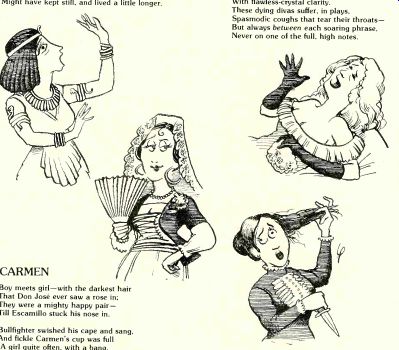
AIDA Had these fond lovers, sealed within their tomb, Been born in this more scientific day, They would have known their singing would consume Their scant supply of oxygen, and they, Instead of singing their duet out stronger, Might have kept still, and lived a little longer.
Boy meets girl-with the darkest hair That Don Jose ever saw a rose in; They were a mighty happy pair Till Escamillo stuck his nose in.
Bullfighter swished his cape and sang.
And fickle Carmen's cup was full (A girl quite often, with a bang, Falls for a guy who's full of bull).
But Don Jose is still her lover;
At the arena gate he grabs her;
The music swells (it's nearly over) And sure enough, he ups and stabs her.
The moral of this tale is choice;
It's one of wisdom's treasured pearls:
It takes a bit more than a darn good voice To win these cigarette-factory girls.
LA TRAVIATA
Coughing, consumptive Violetta lies, And while we melt in charity, She sings the scene before she dies With flawless-crystal clarity.
These dying divas suffer, in plays, Spasmodic coughs that tear their throats But always between each soaring phrase, Never on one of the full, high notes.
LUCIA DI LAMMERMOOR
How can she sing like a high-strung lute And trill her every thought and sigh With that anticipatory flute Shadowing her like the F.B.I.?
A difficult spot in which to work; No wonder the poor girl went berserk.
-----------------
... sounding cowbells: they have never been more magically captured than here. Likewise, the long introduction to the massive finale has never seemed more doom-haunted. As to the basic musical substance of the score, it is the singing line that seems uppermost in Karajan's conception-note the emphasis on string tone throughout much of the first movement--and the result is an overall reading less fraught with Angst and more redolent of song.
The recording as such is not as spectacular as that of Karajan's Bruckner Fifth, nor as fiercely full-bodied as that accorded Solti in his Mahler Sixth, but it is surely good by any standards. D.H.
MOROI: Symphony No. 2. Yomiuri Nippon Symphony Orchestra, Shigenobu Yamaoka cond. VARESE SARABANDE VX 81062 $7.98.
Performance: Strange
Recording: Good
Try this one on your friends. Never mind who wrote it, just ask them to guess the period and country of origin. Not to prolong the suspense, the Japanese composer Saburo Moroi wrote his Second Symphony in 1937-1938, and it was premiered by Joseph Rosenstock with the Japan Philharmonic. It is purely in the late-Romantic central-European mode somewhere between Bruckner and Sibelius.
The feeling of the music is very agitated and apocalyptic, and there is something indiscernibly odd about hearing this somewhat awkward record of it. It is like some dusty antique that turns out to be neither as old nor as well-made as first appeared but which still has value for curiosity lovers. E.S.
RECORDING OF SPECIAL MERIT
MOZART: Clarinet Quintet in A Major (K. 581); Quintet for Piano and Winds in E-flat Major (K. 452). Richard Stoltzman (clarinet); Ida Kavafian (violin); Lucy Stoltzman (violin); Daniel Philips (viola); Fred Sherry (cello); Peter Serkin (piano); Allan Vogel (oboe); Robert Routch (horn); Bill Douglas (bassoon). RCA ARLI-2863 $7.98, ARS I-2863 $7.98, ARKI-2863 $7.98.
Performance: Elegant
Recording: Very good
Though the record is billed as by the chamber group Tashi, that sterling clarinetist Richard Stoltzman is the only musician of the nine list ed above who plays in both works. Stoltzman, Peter Serkin, Ida Kavafian, and Fred Sherry are the four who actually make up Tashi; the other players are guests. Be that as it may, this full group of musicians has given us a most enjoyable fifty-five minutes of utterly lovely Mozart performed with great style and verve. Some may find the opening movement of the Clarinet Quintet a bit on the slow and romantic side, but when it comes to the slow movement only the adjective "ravishing" will do, especially as applied to Stoltzman's clarinet. The variation-finale is delectable here in its amalgam of sentiment and wit. The crown of the Quintet for Piano and Winds is also the gorgeous slow movement, in which the winds singly and in ensemble emit honeyed tones in heavenly harmonic successions. Peter Ser kin's pianism is alert and lovely to the ear.
The recording is just fine in both body and ambiance. A splendid disc, especially for someone just beginning to explore the chamber-music repertoire. D . H.
MOZART: Quartets for Flute and Strings: D Major (K. 285); G Major (K. 285a); C Major (K. 285b); A Major (K. 298). Andreas Blau (flute); members of the Amadeus Quartet. DEUTSCHE GRAMMOPHON 2530 983 $8.98, 3300 983 $8.98.
Performance: Elegant but uneven
Recording: Very good
The four flute quartets may not be among Mozart's most important works, but they are al most embarrassingly likable, and they have certainly been well represented on records (record companies are encouraged, no doubt, by Mozart's having been considerate enough to tailor the quartets to fit comfortably together on a single disc). Andreas Blau is solo flutist of the Berlin Philharmonic, and the Amadeus Quartet is, of course, a distinguished one; but, despite the credentials of the participants, the present release is a little uneven in its yield. Much of it is rather mat ter-of-fact, as in the opening movement of K. 285b, where the performers seem content with a tidy execution of the notes and reluctant to be entrapped by the music's charm.
And yet the ensuing variation movement of the same work is remarkable for its elegant expressiveness and the unexpected depth revealed in this presentation. The recording it self is very good, though occasionally the flute is a bit too far forward. The most consistently pleasurable recording of these four works is still the one by William Bennett and the Grumiaux Trio on Philips 6500 034. R.F.
MOZART: String Quartet No. 18, in A Major (K. 464); String Quartet No. 19, in C Major (K. 465, "Dissonant"). Alban Berg Quartet. TELEFUNKEN 6.42178AW $8.98.
Performance: Distinguished
Recording: Very good
MOZART: String Quartet No. 3, in G Major (K. 156); String Quartet No. 8, in F Major (K. 168); String Quartet No. 13, in D Minor (K. 173). Quartetto Esterhazy. TELEFUNKEN 6.4218IAW $8.98.
Performance: Very good
Recording: Very good
Having begun with the last four quartets, the Alban Berg Quartet appears to be working backward toward completion of its Mozart cycle. This new disc of the last two of the six quartets dedicated to Haydn has all the virtues of this group's earlier Mozart recordings (K. 499 and K. 575 on Telefunken 6.41999, K. 589 and K. 590 on 6.42042) and none of their shortcomings. Here, in fact, is the sort of distinguished music-making we heard on the ABQ's initial Haydn record (Op. 74, No. 3, and Op. 76, No. 3, 6.41302)-attuned to the spirit of the works, well judged as to tempos, phrasing, and internal balance, and complemented by splendid recorded sound. It hap pens, though, that the Smetana Quartet's presentation of K. 464 and K. 465 on Denon OX-7039 shines with a mellowness and Innigkeit neither the ABQ nor any other contender quite approaches, and Denon's sound is not merely splendid but phenomenally realistic.
The Quartetto Esterhazy's attractive presentation of three of the most interesting of Mozart's earlier quartets is another case of a record that is more than admirable in its own right and yet is outclassed by the competition.
Of course, collectors attracted only to these ...
-------------
LUCIA DLUGOSZE WSKI: sonically inventive
New sounds from the Avant-Garde
VOLUME 2 of the "New Music for Vir tuosos" series on New World Records features Harvey and Sophie Sollberger, flutists extraordinary, trombonist Stuart Dempster, and Bertram Turetzky, who has al most singlehandedly made the double-bass a major new-music instrument. All of the music on the disc is nearly as difficult to listen to as it is to play, but there are rewards for the per severing. The styles range from the American expressionism of Andrew Imbrie's Three Sketches to the tense, block-like structures of Ralph Shapey's Configurations to Harvey Soil berger's own lyrical abstraction. Robert Morris' Motet on "Doo-Dah" is, believe it or not, based on the Stephen Foster tune, but don't expect to sing along; you have to listen hard to hear it.
Everything here, with one exception, be longs within the general framework of the academic or abstract-expressionist avant garde. The exception is Robert Erikson's General Speech, which requires the solo trombonist to play a notated score at the same time as he articulates a phonetic version of a speech of General Douglas MacArthur through the 'bone. Alas, without the visual setting, the general effect is a little like run-on flatulence.
These performances are of the kind that ex tend our notions of what instrumental perfor mance is all about. As usual, New World's notes provide all you might want to know (and more) about the composers and their works, and there is also an excellent essay on "the new virtuosity" by Harvey Sollberger.
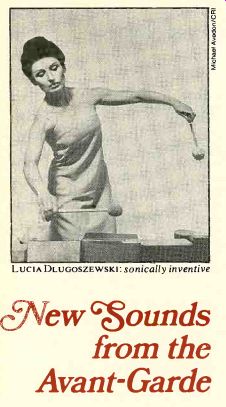
One of the key aspects of that new virtuosity is sound discovery, and one of the most sonically inventive composers in new music is Lucia Dlugoszewski, whose recent sudden rise to prominence in avant-garde circles was long overdue. A new CRI record holds her Tender Theatre Flight Nageire for brass and percussion (the title is simply a compound of the names of the four movements). It has her very best qualities of fantasy and poetic invention; these rituals of the imagination are daring and fascinating. Her partner on the al bum is C. Curtis-Smith (that is his full professional name), who is also a composer a little bit out of the modern-music mainstream. He is best known for his techniques of bowing on piano strings, which are used here in his Uni sonics to blend the piano and saxophone in unusual ways (including plucked piano sounds, multi-phonics on the sax, etc.). His Music for Handbells is just that, and a very pretty sound it is, too-if you can take eight minutes of it. The whole record is off-beat, but interesting.
ANOTHER CRI record contains two compositions whose composers were awarded cash prizes and a recording subsidy by the American Academy and Institute of Arts and Letters. I was not previously very familiar with the work of Harold Blumenfeld, who, by his own account, "spent most of the Sixties in experimental opera production" and turned his full attention to composing only in this decade. His Voyages comprises atmospheric settings of poems by Hart Crane for baritone, viola, guitar, and percussion. The work is at tractive, but I don't like the reading it gets here from baritone Patrick Mason, who seems to confuse performing sensitivity with a snooty, nasal, "cultivated" sound.
The other work is by George Perle, a difficult composer to classify. He is an artist who paints recognizable musical landscapes in the manner of abstract expressionism; in other words, he is a kind of musical abstractionist or serialist who nevertheless uses traditional materials. His String Quartet No. 7 is dry, la conic, and quietly witty. It is also well played by the New York String Quartet. Like the other two, this last album is technically more than adequate in terms of recorded sound.
-Eric Salzman
SOLLBERGER: Sunflowers. Harvey Sollberger (flute); Claire Hedrich (vibraphone).
MORRIS: Motet on "Doo-Dah." Harvey Sollberger (flute); Donald Palma (double-bass); Daniel Shulman (piano). LEWIS: Inflections I. Bertram Turetzky (double-bass).
SHAPEY: Configurations. Sophie Sollberger (flute); Robert Black (piano).
IMBRIE: Three Sketches. Stuart Dempster (trombone); Kevin Aanerud (piano). ERICKSON: General Speech. Stuart Dempster (trombone, recitation). NEW WORLD NW 254 $8.98.
DLUGOSZEWSKI: Tender Theatre Flight Nageire. Instrumental ensemble, Gerard Schwarz cond. CURTIS-SMITH: Unisonics. Trent Kynaston (alto saxophone); C. Curtis-Smith (piano). Music for Handbells. Handbell choir, C. Curtis-Smith cond. COMPOSERS RECORDINGS, INC. CRI SD 388 $7.95.
PERLE: String Quartet No. 7. New York String Quartet.
BLUMENFELD: Voyages. Patrick Mason (baritone); instrumental ensemble, Arthur Weisberg cond. COMPOSERS RECORDINGS, INc. CRI SD 387 $7.95.
---------------
... three particular works will not find them collected elsewhere on a single disc. Quite aside from the matter of more distinctive performances from the Quartetto Italiano on Philips, however, I would not recommend the Telefunken disc because of its irritating and gratuitous side break: the three-minute first movement of K. 156 is on side one and the remainder of the work on side two. R.F.
RECORDING OF SPECIAL MERIT
MOZART: Symphony No. 25, in G Minor (K. 183); Symphony No. 29, in A Major (K. 201). English Chamber Orchestra, Benjamin Britten cond. LONDON CS 7103 $7.98.
Performance. Strong stuff
Recording: Dark-colored
Benjamin Britten did not enjoy a wide reputation as a conductor during his lifetime-at least not of other composers' music. Nor have I heard the earlier releases of his performances of Mozart and Schubert, all, I believe, recorded in the early Seventies near Britten's sea-coast home in Aldeburgh. How ever, I am quite willing to accept these new releases as ample evidence of Britten's great talents in this direction. These are the two gems among the early Mozart symphonies the little G Minor and the exquisitely witty, contrapuntal A Major-and they are per formed here with great vigor and purposeful ness. There's no rococo pretty-pretty but rather a surprising monumentality achieved with a minimum of heaviness and a maximum of insight. Good, strong stuff. E.S .
MOZART (trans. Tsunoda): Symphony No. 40, in G Minor (K. 550); Serenade in G Major (K. 525, "Eine Kleine Nachtmusik"). New Koto Ensemble of Tokyo, Yoshikazu Fukumara cond. ANGEL S-37553 $7.98.
Performance Eerily apt
Recording: Excellent
Having previously tailored Vivaldi's The Sea sons to Japanese specifications in a remark able demonstration of the koto's ability to speak in any accent it chooses, the New Koto Ensemble of Tokyo now turns its attention to Mozart. The results are both heartening and surprising. The koto, an instrument long associated with the classics of the Orient, is six feet long and looks like a zither, but its thirteen silken strings, each with a shiftable bridge, can be made to sound like the very music of the spheres. It is not so surprising that the eight members of the ensemble under Yoshikazu Fukumara can play Eine Kleine Nachtmusik with all the necessary nocturnal charm; the work is probably sturdy enough to survive transcription for a kazoo, and the treatment it receives here is uncommonly magical. What is amazing is how, from the complex harmonics of its opening notes to the last measure of its celestially lovely rondo, these players bring off the G Minor Symphony, which is challenge enough for the greatest orchestras and conductors of the western world. Perhaps the secret is that the music is so familiar that we tend to hear the orchestration in our heads and thus fill in whatever gaps the koto players must of necessity leave unfilled. Or perhaps it is simply that this is a really great group of instrumentalists for whom no challenge is too daunting. Certainly the symphony retains its original poise and power in this brave experiment, which by all odds should not have succeeded. However strangely, it does. P. K .
RECORDING OF SPECIAL MERIT
PEETERS: Missa Festiva, Op. 62. POULENC: Mass in G Major; Exultate Deo; Salve Regina. John Scott (organ, in Peeters); Choir of St. John's College, Cambridge, George Guest cond. ARGO ZRG 883 $8.98.
Performance: Splendid
Recording Excellent
The seventy-five-year old Belgian Flor Peeters seems to combine elements of Gregorian chant, the ceremonial and processional music of the Gabrielis, and a feeling for his own time in his best works, of which the Missa Festiva must be reckoned one. It is not a concert work in liturgical form, but a liturgical work suitable for concert presentation, and it receives a fervent and vital performance here, quite uninhibited by any misguided restraint in the name of piety. It will not be everyone's cup of tea, but I would be surprised if the beauty and power of this presentation failed to revise the thinking of some listeners who have always felt sacred works of this sort to be outside their range of enthusiasm.
With the Poulenc side we are on somewhat more familiar ground: at least the ingratiating Sanctus of the G Major Mass is familiar enough, and boy soprano Jonathan Bond's
solo in the "Hosanna" that follows radiates unabashed sincerity and intimacy. Since the Mass is only seventeen minutes long, there is also room for two shorter pieces by Poulenc, the one brisk and jubilant, the other more touching and intimate than even the Mass.
The vocal tapestry in these three works is less rich than that of the Peeters, and there is an endearingly ingenuous quality to them which Guest and his singers have caught just right.
Altogether a splendid record, with excellent sound-but, regrettably, without texts.
R.F.
POULENC: Mass in G Major; Exultate Deo; Salve Regina (see PEETERS) PREVIN: Every Good Boy Deserves Favour
PROKOFIEV: Piano Concerto No. 3, in C Major, Op. 26
PURCELL: Dido and Aeneas. Janet Baker (mezzo-soprano), Dido; Peter Pears (tenor), Aeneas; Norma Burrowes (soprano), Belinda; Anna Reynolds (mezzo-soprano), Sorceress; Felicity Lott (soprano), Second Lady; Felicity Palmer (soprano), First Witch; Alfreda Hodgson (mezzo-soprano), Second Witch; Robert Tear (tenor), Sailor; Timothy Everett (boy soprano), Spirit. London Opera Chorus and Aldeburgh Festival Strings, Steuart Bedford cond.
LONDON OSA 1170 $7.98.
PURCELL: Dido and Aeneas. Tatiana Troyanos (mezzo-soprano), Dido; Richard Stilwell (baritone), Aeneas; Felicity Palmer (soprano), Belinda; Alfreda Hodgson (mezzo-soprano), First Witch, Spirit; Patricia Kern (mezzo soprano), Sorceress; Elizabeth Gale (soprano), Second Lady; Philip Langridge (ten or), Sailor; Linn Maxwell (soprano), Second Witch. English Chamber Choir and Orchestra, Raymond Leppard cond.
MUSICAL HERITAGE SOCIETY MHS 3810 $4.95 (plus 95c postage and handling from Musical Heritage Society, 14 Park Road, Tinton Falls, N.J. 07724).
Performances: MHS slightly better
Recordings: Both very good
Purcell's concise little masterpiece of an opera receives ,idiomatic, scholarly, and affectionate performances in both of these versions, but there are notable differences be tween them. Raymond Leppard (MHS) follows standard performance practice in concluding the second act with Aeneas' forlorn line "For I obey your will, but with more ease I could die." In his liner notes, Leppard re marks on Purcell's "really superb sense of theatre" which led him to cut out "distracting" parts of the libretto. "Who," Leppard asks, "after Aeneas's incredibly moving agonized acceptance of what he believes to be God's command to leave Dido, would want a jolly chorus of Witches . . .?" And yet this is precisely what we hear in the Benjamin Britten/Imogene Hoist edition con ducted by Steuart Bedford ( London). Apparently, Britten was convinced that Purcell must have composed music for the scene be cause "the drama cries for it." He therefore supplied music from other Purcell works.
While I find the traditional ending quite effective in its own way, the Britten emendation sounds perfectly in character also. Both sets offer outstanding Didos. I prefer Tatiana ...
--------------
Troyanos' straightforward singing in Act I, but in the final scene Janet Baker's heartrending pathos and poignancy in the aria "When I am laid in earth" is just about unsurpassable.
In general, Miss Troyanos displays the richer tone. Dame Janet the clearer, more pointed articulation. Both Belindas are good, and so are the supporting singers. All seem to be spe cialists; in fact, Felicity Palmer and Alfreda Hodgson appear in both casts in different roles.
London scores with Anna Reynolds' Sorceress-less menacing in sound, perhaps, than Patricia Kern, but steadier and vocally more imposing. This slight advantage, how ever, is decidedly offset by the casting of Sir Peter Pears as Aeneas. Though he handles the important Act II recitative eloquently, the distinguished tenor is sixty-five and the assignment is simply too much for his frayed tones.
Richard Stilwell, on the other hand, may be the best of the many interpreters who have so far recorded this rather perilous role. Another drawback in the London set is the boy soprano in the role of the Spirit, though some listeners may not share my jaundiced view of treble voices in opera.
Both conductors deserve high praise for creating a Baroque aura without losing sight of the score's dramatic qualities. London's sound is somewhat warmer and more opulent, but I noted a miscalculation in their handling of the lovely echo effect in the chorus "In our deep vaulted cell"; the dynamics are much too low, virtually vanishing at moderate listening levels.
Of the two sets under review, I prefer the one on MHS. Prospective purchasers, how ever, should also investigate the Colin Davis version (Philips 6500 131) and Janet Baker's' earlier version on L'Oiseau-Lyre 60047. In my view, they are the best in the catalog. G.J.
RAVEL: Piano Concerto in G Major (see Best of the Month, page 90)
ROZSA: Music from the Films. Julius Caesar; Lady Hamilton; The Killers; Lydia; The Private Life of Sherlock Holmes; Five Graves to Cairo; The Red Danube. Erich Gruenberg (violin); Royal Philharmonic Orchestra, Miklos Rosza cond. DEUTSCHE GRAMMOPHON 2584 021 $8.98.
Performance: Very good Recording Sensational ROZSA: Suites from the Film Music. Lust for Life Suite; Background to Violence Suite (from Brute Force, The Killers, and The Naked City). Frankenland State Symphony Orchestra, Miklos Rozsa cond. VARESE SARABANDE VC 81053 $7.98.
Performance: Okay
Recording: Serviceable
Movie music from the "golden age" of Hollywood has come to be so respected that you now have to look up recordings of film scores by Miklos Rozsa under "classical composers" in the Schwann catalog. Not only are there original-soundtrack recordings of his contributions to the cinema on the market, but composer-conducted symphony orchestras are turning out whole series of his oeuvre for the movies on various labels. These al bums are accompanied by shamelessly laudatory liner notes, plot summaries, and lavish photographs from the movies themselves.
Rozsa, now seventy-one, is an old hand at the business of scoring movies and one of its most skillful practitioners. At the same time, he has always been fond of heavy orchestration and could write kitsch with the worst of them. It is sometimes difficult to distinguish his movie work from his concert scores, since he borrowed at will from either side of his output to enhance the other. Deutsche Grammophon has now recorded two discs of this material (the present album is the second) and is busy readying a third, while Varese Sarabande is rereleasing several of the albums Rozsa originally made for Decca.
The Deutsche Grammophon disc, containing excerpts from five scores, has the advantage of later-and headier-sound. The Royal Philharmonic heaves and sighs great ominous chords from the music for Lady Hamilton and churns out an overture that was supposed to precede Julius Caesar (the studio decided to use Tchaikovsky's Capriccio Italien instead), another love theme and a waltz from Lydia, mysterioso moods from the thriller Five Graves to Cairo, and Eastern European atmosphere from The Red Danube; there's even an eight-minute violin solo for the sleuth of Baker Street from The Private Life of Sherlock Holmes. It all worked wonderfully well in the movies, where you scarcely noticed most of it behind the action, but, despite the solid craftsmanship in evidence, this is fairly insubstantial stuff taken separately. That is less true of the suite from Lust for Life on Varese Sarabande, where, for the story of Vincent Van Gogh, Rozsa effected a fine compromise between Debussyan tone colors and the Hungarian romanticism that is his natural idiom.
But in the suite called Background to Violence, there hangs more of the familiar yard goods. Rozsa wields a firm baton on both discs, but the Frankenland State Symphony Orchestra is no match for the Royal Philharmonic. Those aspiring to collect the complete works of Miklos Rozsa will want both albums, of course, as well as the sequels due any minute. Rozsa has never been an idle man. P.K.
RECORDING OF SPECIAL MERIT
SCHUBERT: Mass No. 5, in A-flat Major (D. 678). Wendy Eathorne (soprano); Bernadette Greevy (contralto); Wynford Evans (tenor); Christopher Keyte (bass); Choir of St. John's College, Cambridge; John Scott (organ); Academy of St. Martin-in-the-Fields, George Guest cond. ARGO ZRG 869 $8.98, KZRC 869 $8.98.
Performance: Robust
Recording: Bright and crisp
If the Mass in A-flat is not the greatest of Schubert's works in this form, it is surely the most appealing and endearing. We might have expected it to turn up more frequently on records, but it was less than two years ago that this title returned to the pages of Schwann (in the form of Dennis Russell Davies' Nonesuch recording, H-71335), after having been unlisted there for years. George Guest, who has given us a fine series of Haydn Masses on Argo, is no less at home in those of Schubert,
------------ The Death of Dido, engraving by Marcantonio Raimondi (1475-1534)
--------------
... as he has demonstrated in his account of the E-flat (Argo ZRG 825). His new A-flat has a bracing, robust character quite in keeping with the particular strain of lyricism that in forms this work-in which the (truncated) liturgical text seems almost incidental at times to the sequence of woodland scenes evoked by the music itself. Here we have, too, a welcome opportunity to enjoy-in the limited solo exposures-the Irish contralto Ber nadette Greevy, whom we have not heard of ten enough. On Nonesuch, however, there is a no less welcome opportunity to enjoy Jan De Gaetani, whom we cannot hear too often.
Both versions, in fact, are more than satisfying, the chief differences, aside from price, being the use of men and boys alone instead of a mixed chorus on Argo and a closer sonic focus on the new disc, which makes more of the brass, organ, and drum contributions but which also tends to exaggerate somewhat the almost music-hall swagger in Guest's treatment of the "Quoniam." Personally, I like that swagger, and I like the overall brightness and crispness of the Argo sound, but I feel Davies shows a subtler hand here and there, and possibly a somewhat greater sense of the overall proportions of the work. The differences, in fact, are just great enough to pro vide an excuse (if one be needed) to acquire both versions and enjoy them in alternation.
For those not so disposed, it should be noted that Nonesuch offers more valuable documentation-including the text, which is very much to the point in view of Schubert's omission of several portions of the customary text of the Mass-and quieter surfaces. R.F.
SCOTT: Piano Concerto No. 2; Early One harmonic Orchestra, Bernard Herrmann cond. HNH 4051 $7.98.
Performance: Excellent
Recording: Very good
I find it hard to agree with the annotator's cheery assertion that the pieces recorded here are likely to enhance the reputation of Cyril Scott. Scott described his First Concerto, re corded by the same forces and reviewed favorably in these pages last June (HNH 4025), as "not a deep work but an enlivening one." Enlivening, I'm afraid, is just what the Second Concerto is not: both it and the free-form rhapsody on Early One Morning (a tune Scott's friend Percy Grainger treated much more effectively) simply fail to come to any point, and I find little of the striking individuality that makes the First Concerto so interesting and refreshing. Grove's Dictionary lists an intriguing catalog of works for this com poser, and I would still be interested in hearing some of the shorter orchestral pieces, the chamber music, or the score for the ballet with the unlikely title The Incompetent Apothecary. But if I had come to the present disc first instead of the recording of the First Concerto I do not think I would be inclined to seek out more. The performances them selves, though, are just as committed, and the recording every bit as fine, as on the earlier release. R.F.
SCRIABIN: Preludes: Op. 11, Nos. 2, 5, 9, 15, 16, 21, 22, 24; Op. 13, Nos. 1, 3; Op. 15, No. 1; Op. 16, Nos. 2, 3, 4; Op. 22, Nos. 2, 3. Mazur ka in E Minor, Op. 25, No. 3; Etude in C-sharp Minor, Op. 42, No. 5; Satanic Poem, Op. 36; Album Leaf, Op. 45, No. 1; Froglike, Op. 51, No. 1; Poe me Ailee, Op. 51, No. 3; Poeme Languide, Op. 52, No. 3; Poeme, Op. 52, No. 1; Poeme, Op. 59, No. 1; Sonata No. 9, Op. 68. Vladimir Sofronitski (piano). WESTMINSTER GOLD WG-8538 $3.98.
Performance: Authentic style
Recording: 1960 concert
Vladimir Sofronitski (1902-1963) enjoyed a generation and more of eminence as a distinguished teacher and concert pianist in Russia.
He married one of Scriabin's daughters and became a specialist in the interpretation of the Russian mystic's works. Some dozen years prior to the current Westminster issue, a number of the eight Sofronitski LP's issued on the Russian MK label were available in this country as imports, but they are long gone. This collection of twenty-six Scriabin pieces stemming from a recital given in February 1960 at the Moscow Conservatory makes for fascinating listening-as much for the juxtaposition of the pieces on the disc as for their actual substance. Side one is devoted exclusively to preludes composed between 1894 and 1897, and, with the exception of Op. 13, No. 1, which opens the side, none lasts more than two minutes. The Chopin influence is quite evident, but so is Scriabin's own special poet ic sensibility.
On side two we have ten pieces covering the period from 1898 to the beginning of the final phase in the Sonata No. 9. There are touches of the Debussy idiom and a super charged post-Wagnerian chromaticism, all culminating in the fourth-dominated, highly condensed language of the seven-and-a-half-minute sonata. Thus, a particularly fascinating aspect of this recording is the overview it musical language.
Sofronitski had an enormous reputation in the Soviet Union for doing what he did, and I found it instructive to compare his interpretations with some of the outstanding Scriabin recordings made in this country by Vladimir Horowitz and Ruth Laredo. It seems to me that there is more poetic sensitivity in Sofronitski than in Laredo. On the other hand, Horowitz's performance of the Ninth Sonata is incomparably more electrifying than Sofronitski's, though here one must also take into account the impact (or lack thereof) of the recording itself, for in the bigger pieces the Soviet sonics (generally decent mono) are understandably somewhat diffuse. One can only marvel, by the way, at the awesome qui et of the Russian musical audience; one is aware of its presence, but no more than that.
D.H.
RECORDING OF SPECIAL MERIT
SHCHEDRIN: Symphony No. 2 ("Twenty-five Preludes for Full Symphony Orchestra"). Moscow Radio Large Symphony Orchestra, Gennady Rozhdestvensky cond. WESTMINSTER GOLD WG 8357 $3.98.
Performance: Handsome
Recording: Splendid
Because his rather outrageous (in my opinion) adaptation of Bizet's Carmen music as a bal let score has achieved considerable popularity, it is not surprising that many are inclined to think of Rodion Shchedrin (b. 1932) as a clever concocter of Morton Gould-style orchestral scores a la Russe. But this Second Symphony--a real blockbuster-will definitely force some second thoughts on the matter.
++++++++++++++++++

MARGARET MARSHALL: breath-taking divisions
Vivaldi’s Sacred Choral Music
THE more of Vivaldi's sacred music that be comes available on records, the more one realizes that this was his greatest métier.
He was, after all, a priest, and although he was unable to fulfill his duties in that office (a fact we make far too much of), the power and profundity of his sacred music convinces us of his religious sincerity. In the first two volumes of a projected complete series, Vittorio Negri has caught Vivaldi's magnificent vision in overwhelming readings, and Philips has captured the brilliance of the Venetian mas ter's love of antiphonal sonorities (these are all works for soloists, two choirs, and two or chestras). It is a set of records that should make history.
The lion's share of the solo work is admirably done by Margaret Marshall. From the first entrance in the Introduzione al Dixit, one is struck by Vivaldi's transference of violin technique to the voice, a hallmark of high-Baroque vocal writing. Miss Marshall is understandably cautious in her approach to this fierce writing, but all in all her work is stunning. She even manages to get in some breath taking divisions in the da capos. Ann Murray is her equal in the duet "Virgam virtutis tune" from the Dixit Dominus. Their timbres are almost too well matched for the antiphon al style of writing in the "Gloria et divitiae" of the Beatus Vir, but the ease with which they toss the passage work back and forth be tween them is thrilling. Even more thrilling is the virile duetting of Anthony Johnson and Robert Holl in the "Dominus a dextrin tuis" of the Dixit Dominus. For her part, Anne Collins displays a rich, vibrant contralto that is more at home in sustained than in coloratura passages. The John Alldis Choir produces a sumptuous, full-bodied sound that is perfect for Vivaldi's massed sonorities. The extravagant harmonies that open the Kyrie are beautifully set the rugged Latin diction barked out on repeated notes emphasizes the bursting energy of the music.
Negri's conducting is straightforward and clear, his expression based on the meaning of the texts. The antiphon in the Beatus Vir, for example, returns six times as a sort of ritornello. Each time it is colored differently de pending on its textural and musical juxtaposition. The image of light coming out of dark ness ("Extortum est in tenebris lumen rectis") in the same psalm is dramatized by a well-placed crescendo. Such dynamic interpretation is consistently used throughout the al bum. Perhaps this approach is a little on the romantic side, but it is effective and it is certainly in keeping with Vivaldi's musical imagery.
THIS album is a must for every collection. It justifies the Vivaldi buffs' enthusiasm, and those who are a little overfamiliar with his mannerisms will hear them, plus a lot of fresh ideas, in a new and exciting context that proves once again that he was a master.
-Stoddard Lincoln
VIVALDI: Complete Sacred Choral Music, Volumes 1 and 2. Introduzione al Dixit (RV 636); Dixit Dominus (RV 594); Kyrie (RV 587); Beatus Vir (RV 597); Lauda Jerusalem (RV 609); Domine ad Adiuvandum Me (RV 593). Margaret Marshall (soprano); Ann Mur ray (mezzo-soprano); Anne Collins (contralto); Anthony Rolfe Johnson (tenor); Robert Holl (bass); John Alldis Choir; English Chamber Orchestra, Vittorio Negri cond. PHILIPS 6700 116 two discs $17.96.
--------------------
Subtitled "Twenty-five Preludes for Full Symphony Orchestra," the symphony has five distinct movements, with the individual preludes proceeding uninterrupted within each of them. My overall impression of this highly eclectic and very skillful work is that it is a post-Shostakovich counterpart to the Bartok Concerto for Orchestra. A frankly virtuoso orchestral piece calling for greatly aug mented percussion forces and including some mildly aleatoric elements, this symphony is no exercise in "socialist realism" or political propaganda. As indicated in an epigraph in the published score, it is a memorial to the Russian dead of World War II, but there is nothing in it of the merely ceremonial.
Begun at the time of the "thaw" in 1962 and completed in 1965, Shchedrin's Second has many echoes of Shostakovich's long-sup pressed Fourth Symphony, which was first heard publicly in 1962. Like Shostakovich's score, Shchedrin's is prodigal and wide-ranging in both its substance and variety of orchestral color. The end movements are in the main somber and turbulent, whereas fantasy and virtuosic brilliance are dominant throughout the three middle movements.
There is much interconnection of basic motivic material, and the polyphonic texture is very skillfully handled. Whether Shchedrin will eventually become heir to the Prokofiev/ Shostakovich symphonic mantle can scarcely be known yet, but certainly this symphony represents a bid in that direction.
Gennady Rozhdestvensky is a master in the handling of big, complex symphonic structures. His performance here is a knockout, and it is well served by the Soviet recording.
This disc is worth your investigation. D.H.
TCHAIKOVSKY: 1812 Overture.
GLIERE: Russian Sailor's Dance.
BORODIN: Prince Igor: Polovetsian Dances.
LISZT: Mephisto Waltz. National Philharmonic Orchestra, Charles Gerhardt cond. QUINTESSENCE PMC-7064 $3.98.
Performance: Sizzling
Recording. Excellent
Just what the world needed-another 1812 Overture. This program is enough to make a classical-music lover turn in his turntable for a few blessed moments of silence or trade his soul for an ounce of Mozart. Well, at least these shopworn blockbusters are well per formed here. Such fleshy music is meat and drink to Charles Gerhardt, and on this Quintessence rerelease he gets a perfect opportunity to show his stuff. With the National Philharmonic Orchestra of England rehearsed to a fare-thee-well, Gerhardt spares no effort to bring off his material-the singing chorus and military hardware so essential to produce a real rouser from the pages of the 1812, the crackling energy necessary to bring the Sail or's Dance to a leaping-Lena Bolshoi ending, his own spectacular orchestration of the Mephisto Waltz to chase any sinners within ear shot straight down to the Lower Depths. It's disappointing that he did not have a chorus on hand for the Polovetsian Dances, but for a purely orchestral treatment this is one of the most sizzling ever caught on discs. P.K.
TCHAIKOVSKY: Symphony No. 2, in C Mi nor, Op. 17 ("Little Russian"); Romeo and Juliet, Fantasy Overture. Philharmonia Orchestra, Riccardo Muti cond. ANGEL 0 S-37472, $7.98.
TCHAIKOVSKY: Symphony No. 3, in D Major, Op. 29 ("Polish"). Philharmonia Orchestra, Riccardo Muti cond. ANGEL 0 S-37496, $7.98.
Performance: Romeo outstanding
Recording: Low percussion a mite heavy
Muti's way with this music is expectedly more in the Italianate lyrical-humanist manner than echt Slav, so it seems fairer to react to his readings as they are than to indulge in fruitless stylistic comparisons. It is the Romeo and Juliet performance here that carries the day: very solemn in the opening, then splendidly volatile and lyrically intense. The laconic treatment of the funeral-cortege evocation near the close offers fresh insight and some food for thought-a highly effective touch. The ensuing chorale for winds is played with ravishing beauty.
In the symphonies Muti pays great attention to details of texture and color and points his rhythms nicely, particularly in the lighter movements. I have heard more dynamic performances of the finale of No. 2, but the polonaise finale of No. 3 comes off with great dash. My one reservation applies to the re cording, which to my ear gives undue presence to the timpani and bass drum, especially in the finale of the Little Russian. D.H.
WAGNER: Das Liebesmahl der Apostel (The Feast of Pentecost). BRUCKNER: Helgoland. Ambrosian Male Voice Chorus; Symphonica of London, Wyn Morris cond. PETERS INTERNATIONAL PLE 043 $6.98.
Performance: Very good
Recording: Very good
Here are two choral works-early Wagner and late Bruckner-related in their obscurity.
Das Liebesmahl is a Biblical scene Wagner set to his own text for a choral festival in Dresden. The year was 1843; Rienzi and The Flying Dutchman had been successfully launched and Tannhauser was already in progress. Echoes of all three resound in this mu sic, together with anticipations of Lohengrin and, as annotator Jack Diether observes, even Parsifal. Wagner's inspiration, however, ran somewhat unevenly here: the confrontation of the Apostles (twelve basses in unison) and the Disciples (full or divided chorus) lacks the dramatic force suggested by the overall de sign. I also find it rather odd that the orchestra's entrance is preceded by more than twenty-two minutes of a cappella singing.
From that point on, though, the music is un deniably effective.
Helgoland, Bruckner's last completed work, relates a moment in history when the angry sea is said to have thwarted the attack of invading Romans against a German out post. The event is supposed to have occurred in pre-Christian times, but that did not pre vent Bruckner from ending his cantata with a fervent peroration in his best ecclesiastical manner. This is characteristic, powerful Bruckner, combining strong tone painting and expert choral writing. The recording is de tailed and transparent enough to point up a few imprecisions in choral attacks, but the performances are generally first-rate. G.J.
WELCHER:Dervishes (see BARBER)
======
Also see:
Source: Stereo Review (USA magazine)