-------------
Is the late resurgence of interest merely on unusually eloquent last gasp, or ore we indeed witnessing
By John Morthland
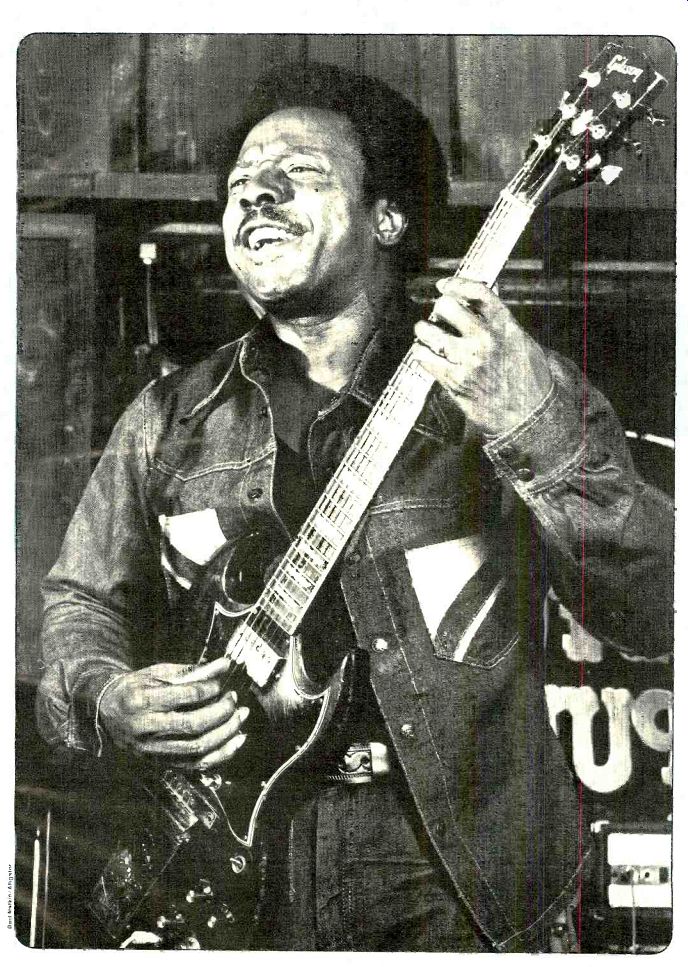
BY the mid Seventies, the Blues had been pronounced dead and buried, written off as the music of a time, a place, and a way of life alien to most contemporary Americans. But "the blues never die," as the peerless Chicago pianist Otis Spann reminded us in the Sixties, and the late Seventies have witnessed a surprising resurgence of interest, especially among white fans.
While it would be something of an overstatement to say that blues music is thriving today (the current activity may be more like an unusually eloquent last gasp), several blues veterans have renewed faltering careers, some lesser-known performers are attracting real attention for the first time in their lives, and there's even some young talent coming up. The number of white blues bands has also increased, even if most of them are not really known yet out side their home bases. Such bands reflect changing tastes at a grass-roots level, and should one or more of them land a contract with a major label and click with the public, we could see a repeat of the white blues movement of the Sixties.
The most conspicuous artifact of the New Blues so far is, unfortunately, the Blues Brothers' "Briefcase Full of Blues" (Atlantic 19217), which, through some strange alchemy, has turned the painfully amateurish singing and harp playing of Saturday Night Live mainstays John Belushi and Dan Ackroyd into a runaway platinum best seller. That fluke aside, the current up-and-comer is George Thorogood, the Kid Flash of white blues guitar. He attacks his material with such innocence that it's hard not to like it even though he's simply recycling the previously tried and true. His albums "Move It On Over" (Rounder 3024) and "George Thorogood and the Destroyers" (Rounder 3013) have been making the charts even though they're on an independent, poorly distributed label. Ranking below Thorogood and his group are any number of other white blues bands-such as the All-Stars ( Charlottesville, Virginia), the Thunderbirds ( Austin, Texas), and the Nighthawks (Washington, D. C.) some of which have albums out on specialty labels that are even smaller than Rounder.
FOR those who prefer the real thing, Muddy Waters has released three solid albums on Blue Sky in the last two years ("Hard Again," PZ 34449; "I'm Ready," JZ 34928; and "Muddy Waters Live," JZ 35712). None is on a par with his epochal Fifties sides-that would be asking too much-but they do provide a fitting capstone to the career of this mighty bluesman and belong at the head of any list of contemporary-blues releases.
"Contemporary" here means electrified and with a back-up band. Originally, of course, the blues was the music of a solitary performer backed only by his own acoustic instrument, almost BLUES SOURCES
IF your local record store doesn't carry these small specialty labels, you might try writing to them directly at the following addresses:
Alligator Records, P.O. Box 60234, Chicago, III. 60660
Blind Pig Records, 208 South First Street, Ann Arbor, Mich. 48103
Delmark Records, 4243 North Lincoln Avenue, Chicago, Ill. 60618
Tomato Records, 611 Broadway, New York, N.Y. 10012
Trix Records, Drawer AB, Rosendale, N.Y. 12472 always a guitar. It was a rural music, mostly confined to Mississippi Delta blacks, though there were also blues-men working in other Southeastern states and in the Texas-Louisiana area.
With a few exceptions, the blues followed a twelve-bar pattern with a simple 4/4 beat. The lyrics were almost always about women, whiskey, and rambling, and the same verses often wound up in several different songs.
Singers moaned and cried their songs, creating a sound that was stark and foreboding, brimming over with raw emotion. Blues was-and is-a limited form technically; each individual per former has to develop the nuances that make his music uniquely his own.
The Thirties was the era of country blues, the music of fish fries and Saturday-night partying. Chicago was al ready a recording center by then, and by the late Thirties and early Forties a distinctive Chicago blues sound had evolved. This was aided by the massive migration of rural Southern blacks to the Northern cities, which peaked around the time of World War II.
Post-war blues was largely, though not entirely, Chicago blues. There were also a West Coast blues movement and an active scene in Memphis, but both went fairly slick fairly soon. Chicago blues stayed closest to the original Delta blues, but, even so, the noisy, congested Northern city presented a new way of life quite unlike that of the rural South, and the music changed as the lives did. Instruments were added: first the bass, then harp (harmonica), piano, drums, and, finally, horns. The blues went electric so that the musicians could make themselves heard over the crowd noise in the taverns where they played. The music became more rigid in form, because to work with a band a singer had to follow set patterns, and it became more aggressive in character.
-------------
BLUES...
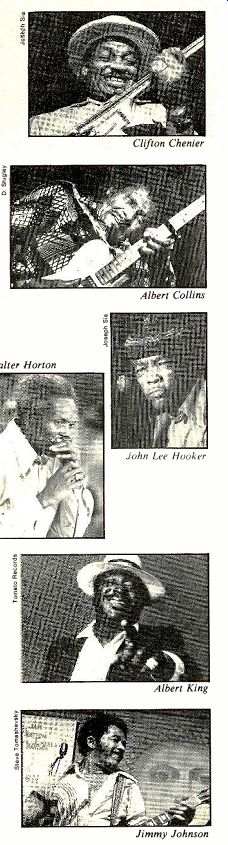
Clifton Chenier Albert Collins John Lee Hooker Albert King
But that raw Delta sound remained at its heart.
The blues kept its popularity with urban blacks through the Fifties and into the Sixties, but new generations were growing up for whom the Delta wasn't even a distant memory. City life was the only life they knew, and their music-soul music-was even more frenetic, more aggressive, more contemporary. The blues became increasingly unfashionable among blacks, an unwelcome reminder of the repressive conditions prevailing before the Civil Rights era.
The music got a second wind in the mid Sixties, but with a twist, when British bands (the Rolling Stones, the Animals, the Yardbirds) took this black American music and introduced it to white American kids. Before long there were hundreds of white blues bands on both sides of the Atlantic (most of them just plain embarrassing), and some young white musicians John Hammond, for instance-took up blues in its traditional (not rock-adapted) form. Even more significant, for the first time ever the black masters of the blues were playing to mainly white audiences. However, for most white rock fans the Sixties blues revival was merely a fad, and as such it passed quickly.
The Living Chicago Blues series on the Alligator label (see below) makes a case for the blues as an ongoing tradition, at least in the Windy City. The bands there work some of the same clubs their illustrious predecessors did, and their music is still full of hard times-and still helps people to transcend those hard times. Little has changed in that respect, though it's hard to believe, as some enthusiasts contend, that the scene today is "as big as ever." That a scene exists at all-1n Chicago and in certain pockets in the South and West is enough. Today the blues is the music of small, independent labels; the leader, in both quantity and quality, is Alligator Records.
WHAT follows is a survey of contemporary black blues on the specialty labels. It ignores those artists (Waters, B. B. King, Bobby Bland) who still record for major labels, as well as reissues, imports, the white revivalists, and the deeply moving country blues of Johnny Shine and a couple of others (all categories in which there is current activity also). The list is not exhaustive but is more than just representative. It should go quite a long way toward helping you to discover-or rediscover the magic of the blues; but from that point you really have to travel on your own.
CLIFTON CHENIER BAND: Cajun Swamp Music Live. TOMATO TOM2-7002 two discs. Clifton Chenier plays zydeco, the blues-based music of the black Cajuns living in the Louisiana bayou country. Zydeco isn't easy to describe, but Chenier and his rollicking band charge through waltzes and two-steps, white Cajun standards, popular country songs, and straight blues, with Chenier singing in both French and English. It's infectious stuff, meant primarily for all night dancing and partying, and Chenier's accordion wails like nothing you've ever heard before. Chenier's growing old and can't work as hard as he used to, but on this album he sounds more energetic than he has for some time. The man should be considered a national treasure.
ALBERT COLLINS: Ice Pickin'. ALLIGATOR AL-47I 3. Finally, this kinetic Tex as guitar whiz has an album fully representative of his talents. Collins churns out insistent solos that are usually built around a flurry of shrieking high notes set off by either a sudden outburst of low ones or a dramatic silence. He plays with a rhythmic thrust that gives the songs momentum, and his timing is impeccable. He calls what he does "the Cool Sound," which is as good a description as any. The six-piece back-up band is sympathetic, and the material displays the sly, mock-worldly sense of humor peculiar to the blues.
JOHN LEE HOOKER: The Cream.
TOMATO TOM2-7009 two discs. Hooker is the great "primitive" of this bunch, the one whose Delta roots are most explicit. One of the most over-recorded of bluesmen, he is at his best working alone or with just a second guitar. Then he can let his instincts guide him-dropping a bar or two here, adding one there, declaiming lyrics that sound made up on the spot even when they aren't.
The result is a sort of blues stream-of-consciousness that always keeps the listener on edge. On this recent live double album, Hooker's voice is dark and brooding, his guitar work terse and penetrating, but working with a band led him to iron out too much of the eccentric timing and phrasing that make his music unique. What we get is four sides of boogie-two too many.
WALTER HORTON: Fine Cuts. BLIND PIG BP006-78. As a blues harpist, Horton leans more toward the sweetness of Sonny Boy Williamson than the manic edge of Little Walter. He is more effective as a sideman than as a leader and often seems more concerned with showing off his technical range than with expressing real feelings.
But his range is impressive, and not too many other bluesmen could get away with a set that puts La Cucaracha and Ellington's Don't Get Around Much Anymore along side more traditional fare. Horton is erratic and the band here is a little stiff, but when everything jells it's clear he's as good as anyone blowing harp today.
ALBERT KING: New Orleans Heat. TOMATO TOM-7022. It must have seemed a good idea at the time to pair Albert King, an often self-indulgent guitarist who tends to milk a few tricks for more than they're Jimmy Johnson worth, with producer Allen Toussaint. Presumably it was hoped that Toussaint would impose some discipline on King (and give him some New Orleans second-line funk in the bargain), but the most one could say for their album is that it has some rhythmic diversity. Generally, though, Toussaint has framed King's listless singing and cliche guitar work with production formulas. Predictable horn arrangements and a grating, super-shrill female chorus mar nearly every track, including the pointless remakes of such King standards as Born Under a Bad Sign and The Very Thought of You.
LIVING CHICAGO BLUES, VOL. 1: The Jimmy Johnson Blues Band; Eddie Shaw and the Wolf Gang; Left-Hand Frank and His Blues Band. ALLIGATOR AL-7701.
Jimmy Johnson's voice has the purity and urgency of a gospel singer (which he once was), his music deftly incorporates elements of soul (which he once played for a living), and his guitar style owes a lot to Otis Rush (who's a good man to emulate). Eddie Shaw plays a squawking sax, sings in a gravelly voice, and has a delightful penchant for raunchy lyrics. The Wolf Gang is Howlin' Wolf's old band, sounding a tad more sedate here than they ever did behind the master, though Hubert Sumlin's guitar is still one of the most bracing in all of contemporary music. Left-Hand Frank is a throwback to twenty-five years ago, with an approach that's noticeably closer to the Delta roots. He has an appropriately lazy voice, his solos cut right to the bone, and he sounds best on medium-tempo numbers.
This is the best album in this series.
LIVING CHICAGO BLUES, VOL. 2: Carey Bell's Blues Harp Band; Magic Slim and the Tear Drops; Johnny "Big Moose" Walker. ALLIGATOR AL-7702. Carey Bell is such a soft, sensitive singer that unless you specifically concentrate on his vocals you hear them almost subliminally. He's equally graceful as a harp player, and here he fronts a crack band (which includes his son Lurrie on guitar). These are the best recordings thus Chicago journeyman has ever made, especially the slow numbers.
Magic Slim, on the other hand, is an un-s original singer and guitarist backed by an equally ordinary boogie band. Johnny Walker is a jaunty, upbeat pianist who also suffers here from working in pedestrian company. Aside from Carey Bell's soothing blues, there's not much of interest here.
LIVING CHICAGO BLUES, VOL. 3: Lonnie Brooks Blues Band; Pinetop Perkins with Sammy Lawhorn; Sons of the Blues. ALLIGATOR AL-7703. Lonnie Brooks is a biting guitarist whose Texas and Louisiana roots shine through on everything he plays. His smoky vocals add to the mood, and his band knows how to hit a groove and hold it. Pinetop Perkins-who ordinarily plays in Muddy Waters' band-is a rather lightweight singer, and the only thing wrong with his piano work is that it doesn't really drive the band the way it should.
Fortunately, the band can fend for itself, and Blues After Hours here shows just how seductive this music can be. The Sons of the Blues (also known as the S.O.B. Band), whose members include Carey Bell's son Lurrie and Willie Dixon's son Freddie, exhibit more style than substance, making for a fairly humdrum set.
ROBERT "JUNIOR" LOCKWOOD : Does 12. TRIX 3317. Lockwood, an old running buddy of the legendary Robert Johnson, is a real find. He plays twelve-string guitar on most of this album, which allows him to indulge his passion for a jazzier sound. Since his sax player, Maurice Reedus, is similarly inclined, Lockwood's blues are much more experimental, and more interesting harmonically, than most.
Nevertheless his earthy interpretations of three Johnson songs show just how true to his roots he remains. The band swings as effortlessly as it rocks, which gives the whole set the relaxed feel of a late-night blowing session.
OTIS RUSH: So Many Roads. DEL-MARK DS-643. To understand why this relatively obscure Chicago guitarist has such a strong cult following, you have to hear his skitterish previous album, "Cold Day in Hell" (Delmark 638). This live set, which includes such Rush favorites as I Can't Quit You and the title song, simply doesn't do him justice. Not that it's bad:
Rush plays fluent guitar, and though he does plenty of stretching out here, he seldom spreads himself too thin. But no real sparks fly either, and that's precisely what Rush at his best provides.
SON SEALS: Live and Burning. ALLIGATOR AL-4712. Arkansas-born Son Seals makes Albert King, his main influence, seem positively arthritic in comparison; he is easily the most exciting of the younger Chicago bluesmen. Seals can weave subtle threads of soul and jazz (even disco) into his music and still have it come out sounding like nothin' but the blues. And though he can also play guitar as fast and flashy as the next show-boater, he's usually disciplined enough to rein himself in before technique replaces emotion. What's most impressive about this set is the aggressive presence of Seals and his steamrolling band, which is the way a live album should be.
KOKO TAYLOR: The Earthshaker. ALLIGATOR AL-4711. Are you ready for a female Howlin' Wolf? Koko Taylor's coarse, growling blues are probably about as close as we're ever going to get. One of the very few women ever to hold a place in the overwhelmingly male blues world, Taylor's basic approach is to step up to the mike and just cut loose. She sounds battered here, but still willing and able to go another round against whoever wants to mess with her (though she'd rather be out partying).
The band, a cannily composed mix of youngsters and veterans, is solid, if unspectacular, on this set of mainstream Chicago blues. If you've wondered how Hey, Bar tender (the John Belushi favorite) sounds in the hands of a pro, look no further.
John Morthland, a free-lance writer, has contributed to Country Music, Cream, and Rolling Stone, among other publications.
-------------
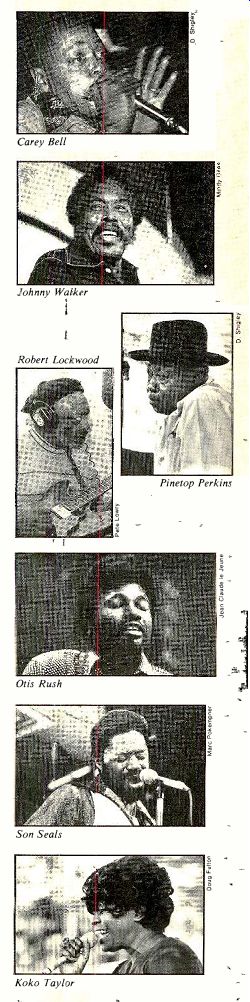
Carey Bell Johnny Walker Robert Lockwood Otis Rush Son Seals Pinetop Perkins; Koko Taylor
----------------
Also see:
Source: Stereo Review (USA magazine)