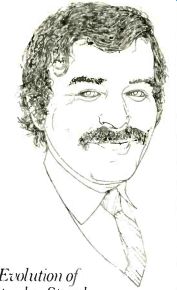
Back to the Source
WITHIN the audio com munity there is a history of home-brew tape recorders that, in some respects, is genuinely thought-provoking. As recently as the 1960's many hi-fi enthusiasts bought tape recorders (open-reel, of course) in kit form, and only a short time before that you could buy naked tape transports and combine them with whatever electronics you liked or could put together yourself.
The typical result would be embarrassed by the meanest of today's cassette decks, but this hobbyist activity inspired a fine and fearless tradition of setting one's own standards as to how a tape recorder should work and assembling a deck accordingly.
Some of the latest fruits of this tradition can actually be bought by consumers, as in the case of the Mark Levinson ML-5, and others can at least be heard on releases on several audiophile labels. Among the latter, none is as radically distinctive as the brainchild of inventor Keith Johnson, which is used principally at present for many of the offerings from Reference Recordings (P.O. Box 77225-X, San Francisco, Calif. 94107), an esoteric record label that Johnson credits with honing much of his sensitivity for high-end concerns.
Johnson came to tape at the age of seven, constructed a stereo machine in junior high school, learned to build heads at Ampex, taught at Stanford, where he accrued live-recording experience, and had his recorder in essentially final form by about 1960. It is a conspicuous example of what professional-level analog tape machines could have been like today if industry thinking had gone a little differently during those critical years.

Johnson's first concern was equalization, to combat noise at low recording levels and distortion at high ones. "As an experiment," he recalls, "we put two ordinary re cording channels in series, operated one at very low levels and the other at very high ones, and listened critically to the combination of the two, representing the worst of both the noise and distortion worlds. Being able to hear the problems clearly and authentically, we adjusted equalization independently on the two channels until the combination suggested a single characteristic that seemed to sound best. It turned out to be considerably different from what has become the industry standard, but it was what we elected to use in the final machine." To optimize results using this equalization characteristic, the Johnson team needed a hedge against high-frequency tape saturation. This took the form of a special record head that focuses the very-high-frequency bias (3.5 MHz at present) in a tight field pattern, enabling the tape to pass out of the bias-influence region before the impinging audio is weakened significantly. Additional benefits include a more strictly defined effective position for the record gap and vastly reduced sensitivity of the entire re cording system to bias-strength fluctuations. Focused-field technology was neither new nor completely unutilized even in 1960, but Johnson's work appears to take it to its most sophisticated form.
-----The hobbyists' activity inspired a tradition of setting one's own standards as to how a tape recorder should work and assembling a machine accordingly.-------
Cleaning up the high frequencies naturally brought low-frequency deficiencies to the foreground. "Fortunately," says Johnson, "topologies permitted by solid-state electronics let us wrap feedback around the "We adjusted equalization independently . . . until the combination suggested a single characteristic ... considerably different from what has become the industry standard."
-Keith Johnson heads themselves in a way that per mitted useful control of the dynamic range-particularly large for low frequencies-the electronics had to pass. Largely for preservation of phase integrity, we made the present machine flat within 1 or 2 dB down to 3 or 4 Hz, and it is free of noticeable head-contour effects without resorting to resonant circuits." There are other novelties in Johnson's recorder-such as exceptionally narrow tape tracks ("Wider tracks would bring on severe alignment headaches for, at best, a 3-dB S/N improvement more appropriately obtained elsewhere") and a 15-ips speed limit ("Faster only aggravates head-contour effects") that have fascinating and intricate implications. In sum, the device brings many old and some new ideas together in a machine that, in detail, almost amounts to a new species of tape recorder. And the technology is, in general, also applicable to home recorders.
Listening to what this machine can do is the only way of determining whether it represents what analog tape recording should have been. My own exposure to it has given me great cause to wonder how much better analog recording might be today if it had evolved along the same lines as Keith Johnson's machine did.
Also see: THE HIGH END (Jan. 1986)