Discs and tapes reviewed by: Richard Freed, David Hall, Stoddard Lincoln
BARTOK: Piano Concerto No. 1. Vladimir Ashkenazy (piano); London Phil harmonic Orchestra, Sir Georg Solti cond. Sonata for Two Pianos and Percussion. Vladimir Ashkenazy, Vovka Ashkenazy (pianos); David Corkhill, Andrew Smith (percussion). LONDON 0 410 108-1 $11.98, 0 410 108-4 $11.98.
Performance: Stunning
Recording: Demonstration quality
A few years ago Vladimir Ashkenazy and Georg Solti gave us a wonderful record of Bartók’s Second and Third Piano Concertos. Their cycle has now been completed with an account of the First that is on the same high level and even more impressively recorded. In comparing this performance with that of Pollini and Abbado (DG 2530 901), I found more steely brittleness and sheer drive coming from the latter team, more warmth and a greater sense of folk roots from Ashkenazy and Solti, who benefit from a digital recording that is more vividly detailed and puts the orchestra more fully in the picture.
Still more impressive, perhaps, is the over-side sonata, in which Ashkenazy is joined by his son. Although Solti is not listed as a participant in the performance of the sonata, he has contributed a reminiscence of his own early performances of the work-first as page-turner with Bartok and his wife as pianists and Ernest Ansermet conducting, and later as pianist with Geza Anda. In any case, this performance is one of the strongest the work has yet received, and it is unarguably the most splendidly re corded. It is demonstration quality on LP, and should be even more impressive when it appears on CD.
- R.F.
BEETHOVEN: Symphony No. 3, in E MU Major, Op. 55 ("Eroica"). Cleveland Orchestra, Christoph von Dohnanyi cond. TELARC 0 DG- I 0090 , $12.98; 0 CD-80090, no list price.
Performance: Fleet
Recording: True to life
When Christoph von Dohnanyi, the Cleveland Orchestra's new music director, was on hand in the early fall of 1983, the Telarc team managed to slot two days of recording at Severance Hall for the Schubert Unfinished and Beethoven's Eroica and Eighth symphonies. The Eroica was done on the second day and seems to have benefited from adjustments made on the basis of playbacks from the earlier session.
For my taste, Dohnanyi's reading of the Eroica falls just short of greatness.
The pacing throughout is essentially the same as Toscanini's, but Dohnanyi fails to bring to the opening movement the pointing of crucial phrases and sharp ness of accent that made the Italian maestro's interpretation so revelatory.
-------
Explanation of symbols:
= Digital-master analog LP
= Stereo cassette
= Digital Compact Disc
= Monophonic recording
==============
MEDEE: REVIVAL OF A MASTERPIECE
ALTHOUGH Lully has justly been dubbed the "father" of French opera, his unfatherly monopoly on the genre and the fanatical personal cult he fostered made it next to impossible for his talented contemporaries to break into the field. Upon his death in 1687, the doors of the Royal Opera were finally opened to other composers, and the suppressed dramatic genius of Marc-Antoine Charpentier came into full flower with M&Ee, his only tragedie lyrique.
Working with the librettist Thomas Corneille, the talented younger brother of the more famous Pierre, Charpentier produced an opera that is the equal if not the superior of any by Lully. But it was coldly received by Lully's followers, who considered it too Italianate, and it quickly fell into oblivion. The superb recording of this magnificent work by William Christie and Les Arts Floris sants proves how mistaken Charpentier's contemporaries were and affords us the opportunity to savor its many beauties for ourselves.
Les Arts Florissants is an ensemble of experienced singers who are well versed in the early French vocal style and a group of instrumentalists who are equally experienced in the playing of early instruments. The result is a homogeneity of style and ensemble that is often breathtaking.
On first hearing Jill Feldman's light soprano voice in the title role, you won der how she will manage the fury of the denouement, but she does. Without forcing, she imbues the text with an underlying passion that moves from tenderness to rage in a slow, calculated crescendo of hate. The high point of the opera occurs in the last scenes of Act III, where Med& laments her fate, plots her cruel revenge, and invokes her demons.
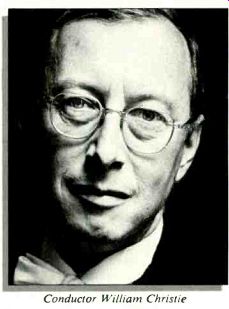
Conductor William Christie Equally remarkable is Gilles Ragon as Jason. His voice is high and supple, capable of the tenderest love scenes with Creuse and snarling taunts to Medee. Agnes Mellon, as Creuse, is sweetness and light, seemingly innocent of the havoc she raises. Even the final agony of her death is expressed in whimpers rather than the shrieks one would expect from being mortally burned by a poisoned robe.
Rage and madness are left to Creon as he is driven to suicide by Medee's spells. Jacques Bona portrays this conniving villain with all the virility and wiliness the part demands. The many lesser parts are also well handled, especially Catherine Bagnalet's melting performance of the Italian Air in the final divertissement of Act II.
The many divertissements with their dances and choral music are a repeated delight, and the orchestra's performance of the "angry" music is the embodiment of Baroque rage. The continuo of theorbos and harpsichords sup ports the recitatives with constant inventiveness. Finally, leader William Christie deserves the utmost praise for his tremendous work of editing and bringing to life this masterpiece of the French lyric theater.
Charpentier's Medee cries out to be staged. Nothing could be more inspiring to that end than this recording. Stoddard Lincoln M.-A CHARPENTIER: Medic. Jill Feldman (soprano), Medee; Jacques Bona (bass), (Creon); Agnes Mellon (soprano), Creuse; Gilles Ragon (tenor), Jason; Philippe Cantor (baritone), Oronte; Sophie Boutin (soprano), Nerine; others. Les Arts Florissants, William Christie cond.
HARMONIA MUNDI HM 1139/41 three discs $35.94, HM 40.1139/41 three cassettes $35.94; 0 HM 90.1139/41 three CD's $51.
===============
The music flows much too easily to achieve its intrinsic heroic stature. Matters take a far better turn in the Marcia funebre. The opening pages unfold in an atmosphere of hushed eloquence, and the later dramatic sequences are brought into sharpest relief. The scherzo is beautifully paced, with the horns in the trio sounding gorgeously brazen.
The very opening is marred, however, by a slight but quite audible rhythmic boggling in the strings as they set the pulse. The finale goes with brilliance and brio through its variation patterns, and in the slow peroration Dohnanyi achieves a true sense of summation.
Hearing the work uninterruptedly on CD, I was impressed by the way the recording captures the Severance Hall acoustics. The ambience is a mite plushy, but it provides impressive transient impact and tonal body.
- D.H.
BRAHMS: Violin Concerto in D Major, Op. 77. Uto Ughi (violin); Philharmonia Orchestra, Wolfgang Sawallisch cond. RCA 0 ARC1-5185 $12.98, C) ARK1-5185 $12.98.
Performance: Good
Recording: Good
Among the eighteen or so readings of the Brahms Violin Concerto currently listed in Schwann, this one has very much its own character. It lies chiefly in the contrast between the lyrical, Italian-
ate tonal quality of the soloist and the decidedly middle-European, Romantic quality of the orchestral accompaniment. There is no fundamental incompatibility, but Uto Ughi's luminescent fiddling is set in sharp relief against the orchestral fabric.
Ughi displays his finest musicianship in the most lyrical passages, such as in the first-movement coda and through out the slow movement, which sounds as achingly lovely here as I've heard it anywhere. Not that he is lacking in virtuoso fire: there is plenty of that in the rugged episodes of the first movement and in the dashing cadenzas.
As in the earlier RCA issues of his Mendelssohn and Bruch concerto performances, Ughi is spotlighted here by the engineering, but not obtrusively so.
The Philharmonia's sound is properly full-bodied and bright.
- D.H.
BRAHMS: Clarinet Trio in .4 Minor, Op. 114; Horn Trio in E-flat Major, Op. 40. Peter Schmidt (clarinet); Gunter Hoegner (horn); Andras Schiff (piano);
Erich Binder (violin); Friedrich Dolezal (cello). LONDON al 410 114-I $11.98, 410 114-4 $11.98.
Performance: Superb
Recording: Likewise
Five or six years ago Andras Schiff recorded the Brahms viola sonatas with Pal Lukacs for Hungaroton. This launch of Schiff's chamber-music activity for London/Decca confirms the happy affinity for Brahms suggested on that earlier disc and encourages a hope for further recordings with his present colleagues, who are members of the New Vienna Octet and first-chair players in the Philharmonic. While both of these works have been given some distinguished presentations on records, I don't think either of them has come through more persuasively than here.
The performances themselves are breathtakingly beautiful, in the most truly Brahmsian sense, and the recording is a model of clarity and balance. In short, superb on every count.
- R.F.
COPLAND: Our Town, Three Pieces; Rodeo. Four Episodes; Piano Variations; Four Piano Blues; Danzon Cuba-no. James Tocco (piano); Lukas Foss (piano, in Danzon).
PRO ARTE CD PAD 183 $10.98, PAC 183 $10.98.
Performance: Fluent
Recording: Excellent
Since only two titles-the Variations and the Blues-are duplicated, this package might be considered a sort of supplement to Leo Smit's otherwise definitive two-disc set of Copland's "Complete Music for Solo Piano" on CBS. James Tocco, who has already given us Bernstein's piano arrangement of Copland's El Sal6n Mexico in his collection of Bernstein's piano music on Pro Arte, fills out a whole side here with Copland's own transcriptions of other familiar orchestral fare. No matter how brilliantly played (and the playing here has brilliance to burn), the Our Town and Rodeo excerpts seem pale substitutes for the well-known orchestral originals. The two-piano version of the DanzOn Cubano, which happens to be that work's original form, is given a persuasive reading with Lukas Foss on the second instrument. The really lifelike recording is further enhanced by the superb DMM pressing.
More for piano fans than Copland fans, I would think, but definitely first rate in every respect.
- R.F.
DEBUSSY: Chansons de Bilitis; Fetes galantes.
RAVEL: Histoires naturelles.
Jan DeGaetani (mezzo-soprano); Gil bert Kalish (piano). NONESUCH 78025-1, $8.98, 78025-4 $8.98.
Performance: Exquisite
Recording: Excellent
Jan DeGaetani and Gilbert Kalish are noth consummate artists, and when the two work together, focusing on a single body of work, the result is perfection.
French art songs, especially the songs of Debussy and Ravel, require particular awareness of style and exquisite technique, and this remarkable team has both. Here is an album to cherish.
- S.L.
DONIZETTI: Lucia di Lammermoor. Edita Gruberova (soprano), Lucia; Kathleen Kuhlmann (mezzo-soprano), Alisa; Alfredo Kraus (tenor), Edgardo; Renato Bruson (baritone), Enrico; Robert Lloyd (bass), Raimondo; Bruno Lazzaretti (tenor), Normanno; Bonaventura Bottone (tenor), Arturo. Ambrosian Opera Chorus and Royal Philharmonic Orchestra, Nicola Rescigno cond. AN GEL 0 DSCX-395I three discs $35.98, 4D3X-395 I three cassettes $35.98.
Performance: Convincing
Recording: No-nonsense
Like Joan Sutherland, Edita Gruberova possesses a voice of stronger, more dramatic quality than the average coloratura soprano, and she throttles it down judiciously to achieve a degree of shading and an emotional palette that do not come spontaneously with such an instrument. Unlike Sutherland, she enunciates her lines in a forward enough manner that one can usually under stand them, even though she is not a native Italian.
In this recording, Gruberova offers a middle-of-the road Lucia, neither fluttery nor unduly hefty. Though her voice lacks natural softness and sweetness, she is able to approximate these qualities by using it with skill, intelligence, and insight. The phrasing and rhythm are consistently alive, and, over the long haul, the interpretation is a very satisfying one.
Alfredo Kraus remains one of the wonders of the tenor world. Stylish, noble, and personable, he delivers an Edgardo who is at once a romantic hero and a musical paragon. The performance is close to the written text, with none of the traditional cuts and few traditional liberties. Nor is the final scene transposed down from the published key. Renato Bruson, more comfortable in be! canto repertoire than as a Verdi baritone, spins out Enrico's lines with haughty aplomb, and Robert Lloyd's ample bass makes the most of the hypo critical Raimondo, showing how so self assured and pontifical a man can be a menace.
Nicola Rescigno surpasses his usual standard in pacing this performance, which has an ebb and flow and an evocative orchestral color that vibrantly en liven the score. Nothing sounds perfunctory; the supporting cast is as com mitted and capable as the principals, and the choral and orchestral forces likewise enter into the spirit.
Though there is nothing flashy or singular about it, this Lucia is one of the most solidly achieved and thoughtfully inflected be! canto operas on records.
Angel-EMI's digital sound matches it for ease and atmosphere. John W. Freeman HAYDN: Quartet in F Major, Op. 74, No. 2; Quartet in G Minor, Op. 74, No. 3 ("Horseman"). Salomon String Quartet. HYPERION 0 A66124 $13.98.
Performance: Superb
Recording: Excellent
The Salomon String Quartet is one of the finest ensembles performing today.
Their keen sense of phrasing and their sure tempos, use of rubato, and control of dynamics bring a clarity and feeling of warmth to whatever they play. The fact that they perform on authentic instruments only heightens their unerring devotion to authentic style. True, you must get used to the "white" sound those instruments produce as well as what seems like a lack of brilliance on the part of the first violin, but once you do you'll hear Haydn's music as he would have heard it himself. Let us hope the Salomons will record all of these fabulous quartets.
S.L.
HAYDN: Symphonies: No. 26, in D Minor ("Lamentation'); No. 41, in C Major; No. 43, in E-flat Major ("Mercury"); No. 44, in E Minor ("Trauer"); No. 48, in C Major ("Maria Theresa"); No. 52, in C Minor. L'Estro Armonico, Derek Solomons cond. CBS 0 I3M 39040 three discs, 13T 39040 three cassettes, no list price.
Performance: Brilliant
Recording: Splendid
Here's a wonderful album exploring Haydn's Sturm and Drang period with six powerful works that drive home the master's forward-looking originality.
This is not the mellow old "Papa" Haydn, but the titanic youth out to change the world. Violinist Derek Solomons leads a group of some twenty musicians playing early instruments in strongly profiled performances that re veal Haydn's mastery of form and de tail and re-create the somewhat spiny sound of the eighteenth-century orchestra with its "white" strings, penetrating woodwinds, and barking horns. Each instrument is strongly timbred, contributing to a tonal fabric in which the threads seem to pull in all directions only to prove their strength. This is real, no-nonsense Haydn, gruff, strong, and fascinating under Solomon's skillful direction. And the recorded sound is absolutely first-rate. S. L.
MENDELSSOHN: Violin Concerto
(see Best of the Month, page 65)
MENDELSSOHN: Symphony No. 3, in A Minor, Op. 56 ("Scottish"); A Midsummer Night's Dream, Overture, Op. 21. Bavarian Radio Symphony Orchestra, Sir Colin Davis cond. ORFEO 0 S 089841 $13.98.
Performance: Impressive
Recording: Very good
The Mendelssohn Scottish Symphony has not lacked for fine recorded performances; I would single out those by Karajan, Maag, and Bernstein from the currently available crop. Also in the top rank is the new one by Sir Colin Davis, who more than anyone I have heard thus far manages to bring something of an epic dimension to the work.
The opening pages are treated virtually as ballad narrative, and this tone persists throughout, reaching its apogee in a singularly gripping reading of the slow movement, followed by an Allegro guerriero that packs tremendous muscle.
The solemn processional epilogue that concludes the work, and which is so often pompously anticlimactic, comes off here with utter conviction.
Davis recorded the overture and other excerpts from the Midsummer Night's Dream incidental music with the Boston Symphony back in 1976, and that performance, paired with the Italian Symphony, is still available on Philips. His new digitally recorded version offers the same measure of verve and fantasy.
The recording as a whole is brilliant and full –bodied--a real asset for the symphony. I did have a small problem, even after a careful calibration check of my equipment, with an over-resonant timpani "E" in the allegro episodes of the overture, but this is a really minor reservation. Overall, the performance and recording are outstanding.
- D.H.
MOZART: Piano Concertos No. 17, in G Major (K. 453), and No. 21, in C Major (K. 467). Andrea Nemecz (piano); Budapest Symphony Orchestra, Arpad Job cond. SEFEL 0 SEFD 5020. $12.95, 0 5020 CS $12.95; 0 5020 CD, no list price
Performance: Cultivated
Recording: Very good
The young Budapest-born New York pianist Andrea Nemecz and conductor Arpad Jo6 deserve a lot of credit for boldness and derring-do in invading the Mozart piano-concerto territory staked out for recording by the likes of Murray Perahia, Vladimir Ashkenazy, and Rudolf Serkin. The musical result of their collaboration is thoroughly creditable if not blazingly inspired.
The solo-piano entry at the opening of the G Major reveals Nemecz's execution as elegant and precise, yet with ample warmth of phrasing and touch.
She fares best in the slow movement, where Job shapes the all-important wind parts lovingly. The final movement is taken a bit deliberately for my taste, but the concluding presto is a delight.
The C Major Concerto begins at an easy (perhaps too easy) pace and could use more edge in the attacks. The slow movement, fortunately, is not mooned over but flows with restrained eloquence. The finale crackles with the soloist's taut articulation of the main theme: a shade more poise might have been in order, but such reservations are to a large degree matters of taste.
One point on which there can be no reservations is the virtually ideal re corded sound-clear and warm in surround, with flawless balance between piano and orchestra. No obtrusive spot lighting here. Kudos to producer Harold Lawrence.
D.H.
MOZART: Violin Concerto No. 4, in D Major (K. 218); Rondo in C Major (K. 373); Adagio in E Major (K. 261); Ron do Concertante in B-flat Major (K. 269). Pinchas Zukerman (violin); St. Paul Chamber Orchestra, Pinchas Zukerman cond. CBS M 37839, © MT 37839, no list price.
Performance: Crisp and clean
Recording: Intimate surround
This disc completes the cycle of Mozart violin concertos that Pinchas Zukerman has been doing for CBS with the St. Paul Chamber Orchestra, of which he has been director since 1980. A decade and more ago he recorded the same repertoire for Columbia with Daniel Barenboim conducting the English Chamber Orchestra.
Zukerman as violinist now seems a bit more chaste tonally than he did in his earlier recordings, but the more intimate acoustics in St. Paul may contribute to this impression. The general atmosphere here is one of music making tailored for a spacious living room rather than a large concert hall, and thus the performance is in the Mozartian manner.
As for overall interpretation, I might question the deliberate pacing at the opening of the D Major Concerto's finale, though it could be justified as a more effective contrast in tempo between the slower and faster sections of the movement. It is good to have the three shorter concerted pieces laid out on the disc as a kind of miniature "concerto." There is a bracing briskness in Zukerman's pacing of the K. 373 Ron do, and, after extracting every bit of the K. 261 Ada gio, he brings a joyous bounce to the brilliant K. 269 Rondo Concertante. As noted, the sonics are intimate but crys tal clear and full-bodied.
-D.H.
MOZART: Die Zauberfinte. Margaret Price (soprano), Pamina; Luciana Serra (soprano), Queen of the Night; Peter Schreier (tenor), Tamino; Kurt Moll (bass), Sarastro; Mikael Melbye (baritone), Papageno; Robert Tear (tenor), Monostatos; Maria Venuti (soprano), Papagena; Theo Adam, Speaker; others.
Rundfunkchor Leipzig; Staatskapelle Dresden, Colin Davis cond.PHILIPS 0 411 459-1 three discs $35.94, 411 459-4 three cassettes $35.94; 411 459 2 three Compact Discs, no list price.
Performance: Beautifully molded
Recording: Crystalline
My intimate association with Mozart's Die Zauberflote dates from the summer of 1955 when 1 assisted Herbert Graf in staging the work at the Salzburg Festival. Wilhelm Furtwangler was to have conducted the performances, but he died the previous fall; his place was taken by Georg Solti. The settings and costumes were by Oskar Kokoschka.
Now, thirty years later, 1 have enjoyed the experience of studying the new Philips recording of this lovely score. The purity of the music, which illuminates the fairy-tale/allegory, is rivaled only by certain works of Handel and Bach. You feel, somehow, that you are a bigger person for having listened attentively to it.
Sir Colin Davis, with superior forces, has here achieved a "complete" Zauberflote. Each role is strongly cast, and the singing throughout is of unusually high caliber. German actors substitute for the singers in the spoken dialogue, and they deliver their lines with conviction and humor. Together the two casts create the illusion of a live performance.
The program notes are refreshingly in formative and interesting; the English translation of the text by Robert A. Jordan is admirable.
Sir Colin's attention to details of orchestration, to balance, to bits of melody that are sometimes glossed over makes this performance a particularly rewarding one. Under his sensitive direction, the Staatskapelle Dresden plays not only with graceful accuracy but also with obvious dedication and devotion to the work at hand. The same may be said for the Rundfunkchor of Leipzig, which sings its passages with eloquence and fervor.
Among the fine soloists, Peter Schreier, Kurt Moll, and Mikael Melbye deserve, I feel, special praise. Luciana Serra sings her two impossibly difficult arias with precision and bravura, but I wonder (quibbling) if there exists today a voice of the weight and mobility we imagine Mozart wanted for the role.
Last, Margaret Price sings with a tonal purity and an effortless line that remind me of Elisabeth Grommer, the nearly ideal Pamina of the 1955 Salzburg Zauberfldte.
By all means, for the continuing pleasure it will give you, add this recording to your library. Robert Ackart OFFENBACH/ROSENTHAL: Cake Parisienne. Pittsburg Symphony Orchestra, Andre Previn cond. PHILIPS 0 6514 367 $11.98, 7337 367 $11.98, 411 039-2, no list price.
Performance: A little tame
Recording: Smooth
OFFENBACH/ROSENTHAL: Carte Parisienne. GOUNOD: Faust-Ballet Music. Montreal Symphony Orchestra, Charles Dutoit cond. LONDON 0 411 708-1 $11.98, 411 708-4 $11.98, (c) 411 708-2, no list price.
Performance: Fizzy
Recording: Big and bright
Both of these new recordings offer Gate Parisienne absolutely complete. Andre Previn is stylish and persuasive in the sections that call for an insinuating sort of charm and sheer voluptuousness, but rather under-animated in the frothy overture (not so frothy here) and the other sections that call for sparkle and fizz. These are qualities Charles Dutoit supplies in abundance, with no shortage of voluptuousness or polish, and Lon don's big, bright recording suits the music better than Philips's clean but dryish and rather bottom-heavy one.
Between the two, I'd certainly choose Dutoit.
The Ballet Music from Act V of Faust may remain a gooey bore, even in Dutoit's tasteful hands, but it is a substantial filler. Philips offers no second work, but does list the headings of the respective sections of Gaitt5 Parisienne, London doesn't even indicate how many numbers there are in either work. R.F.
RACHMANINOFF: Piano Concerto No. 3, in D Minor, Op. 30. Dimitris Sgouros (piano); Berlin Philharmonic Orchestra, Yuri Simonov cond. ANGEL 0 DS-38105 $11.98, 4XS-38105, $11.98.
Performance: A bit wild
Recording: Luscious
Boy wonder Dimitris Sgouros made his London debut at the age of thirteen in this most formidable and sophisticated of the Rachmaninoff concertos. A year later, at the ripe old age of fourteen, he undertook the present recording.
Speed and brilliance, verging on the hectic, characterize the opening movement working up to the larger of the Rachmaninoff cadenzas, which young Sgouros milks for all it's worth. Given this approach, it's not surprising that the slow movement should lack the necessary poise. To the finale Sgouros brings a prickly, nervous quality rather than the sense of fulfillment implicit in its musical substance.
Here, then, is "wow" technique in excelsis, fully aided and abetted by conductor Yuri Simonov and accorded luxuriant, digitally recorded sound. It's a fascinating record, but it will be interesting to see whether in ten years, say, Sgouros can match the musicianship and poise of an Ashkenazy in this work. For the present, one thing is sure: nobody needs to worry about this lad's technical prowess!
- D. H .
RAVEL: Histoires naturelles (see DE BUSSY) SCHUBERT: Sonata in A Minor (D. 821, "Arpeggione"); Introduction and Variations on a Theme from Die Schtine M011erin (D. 802); Serenade (D. 957). James Galway (flute); Phillip Moll (piano). RCA 0 HRC1-5303 $11.98, C) HRK1-5303 $11.98.
Performance: Suave
Recording: Good
There have been recordings of the Arpeggione Sonata on every instrument but the arpeggione, and collectors can now add a flute version to their hold ings. It works very well, as well it should, because the melodies are indestructible. The piece based on Trock'ne Blumen from the Schone Mallerin cycle is legitimate flute music and one of the few major nineteenth-century works for that instrument. In both these works and the famous serenade (Standchen), James Galway offers his usual silver tone and suppleness of line. There are many beautiful moments, but I would have preferred a little more articulation to the constant legato, which can be cloying. Phillip Moll is an excellent Schubert player and shines forth in his accompaniments, especially when the music allows him to take the lead. A fine album.
S.L.
SCHUBERT: Winterreise, Op. 89 (D. 911). Hermann Prey (baritone); Philippe Bianconi (piano). DENON 38C37-7240 $17.98.
Performance: Excellent
Recording: Outstanding
SCHUBERT: Winterreise, Op. 89 (D. 911). Martti Talvela (bass); Ralf Go th6ni (piano). His a/ LP-253/254 two discs $25.96.
Performance: Very good
Recording: Excellent
Hermann Prey's recording of Winterreise with Karl Engel, made by Electrola more than twenty years ago, circulated here briefly on Vox; the one he made later for Philips, with Wolfgang Sawallisch as his pianist, was apparently never issued here. His accompanist in this new recording, made by Denon in Hamburg in April of last year, is a very young French pianist, Philippe Bianconi, whose name will not be familiar to many of us but who has an obvious feeling for Schubert and proves to be a superb partner for Prey.
For his own part, Prey gives a distinguished account of these songs, mostly as straightforward and un-histrionic as Ernst Haefliger in his splendid recent recording for Claves. Prey's voice is a richer instrument, and he exploits a broader range of colors, but his emphasis, like Haefliger's, is always on musical values and textual sense. The emotional impact of the twenty-four songs gains appreciably in the cumulative effect made possible by having the entire seventy-four-minute sequence uninterrupted on Compact Disc. The documentation is especially fine, too: the CD, in its own container, shares a slip case with a forty-four-page booklet containing readable texts, a substantial essay on the music by Karl Schumann, and biographies of the artists, all in Ger man, English, French, and Japanese.
Haefliger's pianist, Jorg Ewald Dahler, plays an 1820 Viennese instrument; both Bianconi and Ralf Gothoni, who accompanies Martti Talvela in the Bis recording, favor modem Bosendorfers and sound no less idiomatic. Talvela's approach is in the same general style as Prey's. Both are a bit more expansive than Haefliger, but this was probably determined, at least in part, by the different nature of the voices themselves. Talvela uses his dark bass lightly, keeping it agile and limpid, avoiding ponderousness. This is another truly distinguished recording of Winterreise, beautifully realistic, as we would expect from Bis, and enhanced further by Direct Metal Mastering.
After listening to Prey, Talvela, and Haefliger, and sampling again the several recordings of Winterreise by Fischer-Dieskau and Hotter, the wonder of these songs is only magnified. All of these fine singers and pianists do honor to Schubert and draw us into his world.
Consideration of sonic as well as musical excellence would have to give first place to Prey on CD, but I should not want to be without the unique poignancy of Haefliger's clearly articulated, al most understated performance on LP--and all the others mentioned here would be more than welcome for alternate listening.
-R. F.
WEILL: Quartet in B Minor; Quartet No. 1, Op. 8. Sequoia String Quartet. NONESUCH 0 79071-1, $11.98, 79071 4 $11.98.
Performance: Strong Recording: Fine Those familiar with Kurt Weill's Three penny Opera, Mahagonny, or The Seven Deadly Sins will be pleasantly surprised to hear these two early string quartets.
The B Minor Quartet of 1918 reveals a Weill well versed in the late-nineteenth century Romantic idiom. The nominal First Quartet, Op. 8, of 1923, is more tightly woven, more stringent in its idiom, showing the composer's growth in mastering his craft. Both are fascinating works that deserve a place in the chamber-music repertoire.
The Sequoia String Quartet turns in strong performances, dramatically contrasting the long, sinuous chromatic lines of the music with its short, jabbing motivic passages. A welcome addition to the catalog.
S.L.
Collection
CHO-LIANG LIN: Bravura. Falla: Suite populaire espagnole; La vida breve, Danse espagnole. Kreisler: Liebeslied; Liebesfreud; Tambourin chinois; Tempo diminuetto. Mozart: Serenade in D Major, Rondo. Schumann: Romance in A Major. Rachmaninoff: Vocalise. Wieniawski: Capriccio-Valse. Sarasate: Introduction and Tarantella. Cho-Liang Lin (violin); Sandra Rivers (piano).
CBS 0 IM 39133, IMT 39133, 0 MK 39133, no list price.
Performance: Brilliant
Recording: Very good
Cho-Liang Lin offers us here a widely varied collection of musical lollipops, with the Spanish and Polish providing the most substance. The Falla comes off with great elan and color, and the Sarasate and Wieniawski pieces are played as the true dazzlers they are. The rather less-known Wieniawski is a consider able piece and well above the lollipop category.
While Lin plays the Schumann Romance with fetchingly lovely tone, the special magic in Fritz Kreisler's music, except the stately Tempo diminuetto and the picturesque Tambourin chinois, seems to elude him. Both Liebesleid and Liebesfreud, as well as the Mozart rondo transcription, need a kind of tasteful schmalz that is lacking here.
That aside, Lin shows himself to be a brilliant executant in total command of his technique and his instrument. It remains to be seen whether his musicianship will mellow as he attains ma ture years. The violin sound is crystal line in clarity and brilliance, and the piano is handsomely recorded within an appropriate perspective.
D.H.
-----------------------
Also see: