Is an Orchestrated Art of Fugue Legitimate?
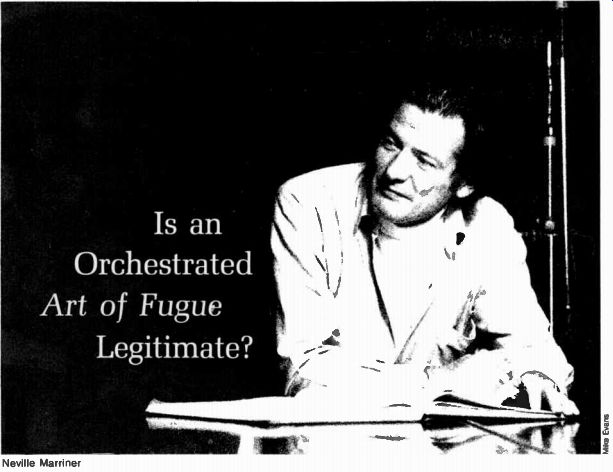
-- Neville Marriner
Neville Marriner's new Philips recording is delightful to listen to, but how much does it have to do with Bach's musical intentions? by Paul Henry Lang P HILIPS' NEW Art of Fugue is an excellent recording: The instrumentalists are able and responsible, the ensemble is tidy, and the sound is very good. Yet one wonders whether what they play so well is artistically legitimate.
It is well known that throughout the baroque era the practice of making transcriptions and arrangements was part of everyday musical life; Bach him self employed it frequently, and at times in surprisingly disparate media. Thus Neville Marriner and Andrew Davis can claim innumerable precedents for their arrangement of The Art of Fugue. They can also invoke the fact that nowhere did Bach indicate for what instrument or instruments it was intended.
However, this work calls for very special considerations.
In the baroque era, a few distinguished composers, arrived at the height of their profession, were motivated to summarize their knowledge and experience in a work they called a Kunstbuch. The Art of Fugue is such a summa of all instrumental contrapuntal techniques known to Bach. A Kunstbuch (literally "art book," but the term cannot be properly translated) not only was a personal monument, but also served didactic purposes; accordingly, while The Art of Fugue explores the limits of tonal polyphony, it is also a deliberate demonstration of contrapuntal techniques, a fugue tutor.
First of all, we must dismiss the still prevalent idea that fugue is a " form" and that it is "strict," following rigid principles of construction, for these notions were born in the minds of nineteenth-century theoreticians like Ebenezer Prout who actually warned their students to stay away from Bach's fugues be cause they are not correctly written and allow too many exceptions. Actually, the fugue fulfills itself in a freely developing texture; the strictness is neither in the heeding of some imaginary rules nor in the observance of a specific external form, but in the logical and imaginative deployment of its musical sub stance. Fugal writing was the essential mode of Bach's and of other baroque composers' musical thinking. It informed most of their music-even their arias and ritornels could be "fugues." Thus the fugue was neither a form nor a type. As a matter of fact, Bach calls the fugues in this work simply "counter points" ("Contrapunctus" 1, 2, and so forth). The Art of Fugue (1749) reverts to an age already vanishing, when the mastery of canon and fugue was the emblem of professional rank and standing among musicians. It is the supreme study of contrapuntal procedure based on tonal harmony, the unsurpassed peak of the musica combinatoria. The devices Bach uses are mind-boggling. There are fugues with one, with two, with three subjects and a final unfinished and possibly projected quadruple fugue; a counter fugue in which the answering voice-part is the inversion of the first voice; all manner of canons-straight, inverted, cancrizans (backward motion), and mirror canons; and so forth. And when several of these de vices are combined and are, in addition, augmented or diminished in rhythmic values, the resultant polyphonic web defies the imagination. Indeed, a good deal of this music is addressed to the eye as well as to the ear, because certain forms of imitation, like the cancrizans, are difficult if not impossible to hear as such without the visual aid of the score. Incidentally, the chorale prelude usually tacked to the end of The Art of Fugue does not belong there and is not re corded here.
This Kunstbuch was not intended to be listened to in one sitting; these fugues and canons must be studied, one by one, and only long familiarity with them will enable us to comprehend their unparalleled polyphonic architecture. Finally, we must realize that this music also embodies a symbolism that 'goes be yond the musical substance.
As mentioned above, Bach did not stipulate any particular instrument for this score, but there can be no question that it was composed for the keyboard.
Good part-writing always takes into consideration idiomatic requirements, as Glenn Gould's recording of the first half of this work on the organ ( Columbia MS 6338) confirms. Also, by far the most satisfactory performances in the new Philips recording are those using the harpsichord and the organ by themselves; almost half of the work is played on claviers-then why not all of it? There are weighty reasons why either the harpsichord or the organ is preferable to any orchestration.
The notes speak of a "great degree of emotional exaltation" expressed in this anthology, but surely we are dealing here with a very special kind of expressiveness, quite different from the warm outpouring we so often find in Bach's other works. Expression, the conveying of emotional exaltation, is directed at something; it is, to quote Rousseau, "the language of the heart"--i.e., ego-psychic projection. But this music is largely self- motivated. It is non-referential, without any programmatic or poetic impulse-nothing comes from without. In a way, it is severe self-discipline, al most a sacrifice, because to a considerable degree the composer shuts out his personal feelings. To be sure, modulation, chromaticism, the minor mode itself do have affective connotations in the sense we are accustomed to them, but what gives these fugues and canons their unique "expressiveness" is their pro genitive contrapuntal intensity, the ever new combi nations, the magnificent linear design.
The arrangers of this version, using an ensemble consisting of strings, two oboes, English horn, and bassoon, added a dimension and a gratuitous opulence not at all envisaged by Bach. The claim that "texture and structure are revealed in [their] score with particular clarity" and that the orchestrators "produced enough variety to avoid any semblance of monotony" by alternating various sonorities must be disputed. On the contrary, by calling on color, and injecting the inevitable dynamic and expressive shadings without which neither strings nor wood winds can play, they dulcify and dramatize and therefore siphon away attention from the magical linear unfolding of the counterpoint. The baroque composer did not orchestrate in the manner Messrs.
Marriner and Davis do with their little orchestra. Furthermore, it was a mistake to sandwich organ and harpsichord, with their unencumbered rendering of the part-writing, between the orchestrated numbers, which create a totally different aural atmosphere. Concerning the avoidance of " monotony" (which must be the reason why there are so many orchestrated versions of The Art of Fugue), this should not be an issue at all. No attentive listener could take in an integral performance of The Art of Fugue even with the fanciest orchestration without soon relaxing his alertness. One simply cannot concentrate be yond four or five of the fugues, and surely this work is not suitable for mere hedonistic listening. This is not one work, but a compendium, a collection of contrapuntal essays to be studied and savored, an anthology to be sampled in small doses. Listen to two or three fugues, score in hand, and repeat each several times; then next day proceed to another batch.
Though everyone plays well in this performance, I must single out Andrew Davis and Christopher Hog wood at the harpsichord(s) and/or organ. They are impeccably stylish and sure-fingered, and take the fast movements with impressive clarity. Also their embellishments are judicious and discreet, employed only where they are really needed, and the organ registration is tasteful.
BACH: The Art of Fugue, S. 1080 ( ed. Marriner and Davis). Andrew Davis and Christopher Hogwood, harpsichord and organ; Academy of St. Martin-in-the-Fields, Neville Marriner, cond. PHILIPS 6747172; $13.96 ( two discs, manual sequence).
+++++++++++++
Il Prigioniero: Opera as Mind Projection
by Patrick J. Smith
Despite imperfections, London's premiere recording offers a powerful example of Luigi Dallapiccola's personal brand of pessimistic humanism.
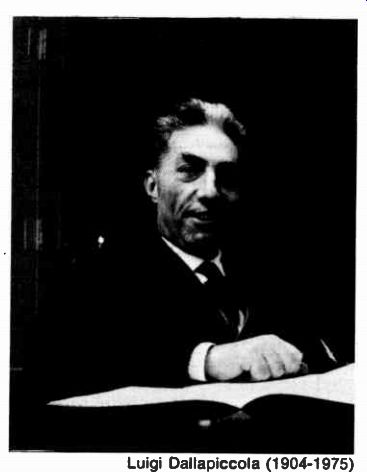
---------- Luigi Dallapiccola ( 1904-1975)
LUIGI DALLAPICCOLA'S two one-act operas, Volo di flotte ( 1940) and Il Prigioniero ( written 1944-48; pre miere, 1950), remain grievously underperformed works. To me, they are two of the strongest operas of the past several decades, not least because they are works very much of this time. Volodi flotte is taken from Saint Exupéry's Vol de nuit, about flying the mail in South America in the Twenties; Il Prigioniero is about a political prisoner. Although the latter's set ting is the Spain of the Inquisition and King Philip, and although it talks of the revolt in Flanders, the op era is worlds apart from the grand-opera treatment of Verdi's Don Carlos and is wholly contemporary in spirit.
The strength of both scores, moreover, lies in good measure in the fact that Dallapiccola himself fashioned the librettos and that the music and the libretto go beyond the mere re-creation of a story to reflect his own mind, his attitudes, and, most important, his humanistic philosophy.
The operas have suffered because of this identity of composer and work-that is, both are perhaps short on stage-conscious "drama" and can be considered static. I, however, find ample "drama" in both works and feel that this philosophic projection is the source of their lasting value. The kind of mono drama, or externalization of interior processes, that Il Prigioniero ( and, to a lesser extent, Volo di flotte) represents grew out of Tristan und Isolde and can be evidenced most clearly in the stage works of Arnold Schoenberg, especially Erwartung. Though it is true that Il Prigioniero employs more than one character on-stage, its entire focus is on the prisoner, and his almost total lack of stage interaction with the others leads one inevitably to view the whole of the work as a fantasy taking place in the prisoner's mind-a mind driven to the brink through deprivation and torture.
It is as if Florestan's scena at the beginning of Act H of Fidelio were to become the opera itself.
Il Prigioniero is--understandably, given the time of its composition (and its gestation goes back to 1939)--the most pessimistic of Dallapiccola's stage works, yet it is not un-redeemably bleak. The composer in tends a large measure of ambiguity in his telling of the story (an ambiguity that extends from the words themselves to the use of the music), so that a question mark is ever present, even after the end-in-death.
The story itself is briefly told: The prisoner's mother acts as prologue, leading us through her anguish and anxiety to the dungeon in which her son has been imprisoned and tortured by the Inquisition. Dallapiccola employs an off-stage chorus, chanting church litanies, as the immanent reminder of the Church's power. He likewise uses the Jailer much as T. S. Eliot used the tempters in his play Murder in the Cathedral. This man, who calls the prisoner his "brother" ("fratello"--a key word in the score), gives the poor man hope by telling him of the Flemish re volt against Philip, which will bring him freedom.
The prisoner, desperate, responds, rising out of his lethargy, and begins to grope his way out of the end less dungeon. Eventually he finds himself in the spring air, under a starry sky. In a moment of ecstatic transport he thinks he has escaped-but precisely then the chorus intervenes, signaling his doom. The Grand Inquisitor appears (sung by the same person who has been the Jailer), calling the prisoner "brother." The prisoner realizes that he has been tricked into hope and allows himself to be led unpro testing to the auto-da-fè, mumbling "la libertà."
On the face of it, bleak. Yet not so, as Dallapiccola himself is at pains to make clear in his notes (contained in the recording), for even though hope, the "ultimate deception," has been used to accentuate the prisoner's agony, it has led to his temporary restoration to energy and life, to hearing of an attempt to gain freedom (he never knows that the revolt failed), and to his own attempt. And thus the importance of the final "la liberte”--so different from that sung by Don Giovanni! Not for the prisoner (except in the large sense of release from pain), yet there are in his actions a promise to others and an evidence of man's continuing will to break free (and thus, so like Don Giovanni after all). We have here a conscious avoidance of the nihilism of so many contemporary writers and playwrights.
It must be added that this reading is influenced through knowledge of Dallapiccola's works, in which this very theme-that of man continuing, de spite, in spite-is central. In Volo di none it is evidenced both in the scene (one of the most powerful in contemporary opera) where we hear the report of the doomed pilot, lost in a storm, his gas tank empty, using the last drops to rise above the buffeting clouds and wind to see the stars a final time, and, most directly, in the final scene in which the anguished plane-dispatcher Rivière (himself an ex-pilot) orders the flights to go on, without interruption, because they must. Similarly, the final scene of his last opera, Ulisse, is not the reunion with Penelope, but the Eternal Wanderer back on the sea, under a starry sky, questing still.
Dallapiccola's music is cohesively intertwined with his story. Much was once made of the fact that Il Prigioniero employs "rows" in the Schoenberg manner. Dallapiccola was an admirer of Schoenberg's music and studied with Berg. He uses organizational techniques of the latter, derived from Wozzeck, in the opera. But the influences remain only technical, for Dallapiccola's music is wholly personal. Al though there is of course a good measure of harsh and brutal music, as befits the subject, there is a constant emphasis on cantilena throughout. Texture is to the fore-a spare and subtle use of his large orchestra allied with a sure sense of vocal writing. Dallapiccola everywhere wishes to bring out the flexible expressiveness of the music, not only through constant attention to phrasing, but through dynamic changes, shadings between song and speech, and orchestral coloristic effects. It is a bit simplistic to call this " Italian" or to set it up as the Mediterranean answer to Schoenberg (much as Nietzsche set up Bizet against Wagner), but there is no doubt that this strong lyric influence serves to soften the contours of the opera and that this in turn deepens and enriches the work.
The rows themselves, when broken down, are seen to be very close to diatonic chord patterns and progressions, and although there is no "key center" Dallapiccola's reliance on intervals that imply a yearning toward a central note of repose provides the musical emotional equivalent to the yearnings contained in the story.
One must congratulate London Records and Antal Dorati for putting this very important work onto records (at last). By and large it is an effective performance and makes a good case for the merits of the op era. Maurizio Mazzieri conveys the emotions of the title character with force and clarity. Yet I feel that Dorati and his singers have overemphasized the harshness of the score at the direct loss of the lyric.
There is all too much disjunct, mezzo forte hammering at the notes, particularly from Giulia Barrera as the Mother, as if "this is how one sings this type of music." But if you sacrifice phrasing and shading and the countless examples of soft singing required by the score, the performance tends to monotony. I would also prefer a less overtly "oratorio" approach, with the singers a little farther from the micro phones, to give a greater sense of the stage (and of the interrelation of voice and instrument). The gravest miscalculation, though, is made with the final choral entry (which "awakens" the prisoner from his rosy dream). Dallapiccola specifies that this entry must be "formidable: Every spectator must be literally bowled over and submerged in the immensity of the sound." In order to achieve this, he directed that loudspeakers be used-quite unusual for its time. One can imagine what a John Culshaw would have devised-entirely consistent with the composer's intentions-for the phonograph at this culminating point, but Dorati and the record producer here have settled for just another if entry, and thus most of the punch is lost.
Nonetheless, this is a recording worth having in your library. Let us hope that soon Volo di flotte will join it there.
DALLAPICCOLA: II Prigioniero.
The Prisoner The Mother The Jailer; The Grand Inquisitor Two Priests
Maurizio Mazzieri (bs)
Giulia Barrera (s)
Romano Emili (t)
Gabor CareIli (t), Ray Harrell (D)
University of Maryland Chorus; National Symphony Orchestra, Antal Dorati, cond. [James Mallinson, prod.]
LONDON OSA 1166, $6.98.
+++++++++++
A Remarkable New New-Music Group
by Alfred Frankenstein
Boston Musica Viva debuts with two Delos discs that rank "among the finest expositions of modern (mostly) American music on records."
BOSTON MUSICA VIVA, a remarkable ensemble devoted to the performance of contemporary music, very ably led by Richard Pittman of the New England Conservatory, makes its discographic bow with a pair of records-one given over to four works by three women, the other containing six pieces by five men.
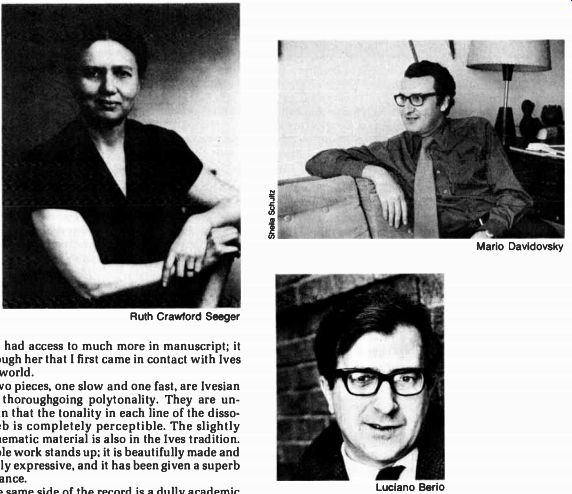
The Two Movements for Chamber Orchestra by the late Ruth Crawford Seeger were composed in 1926, when the music of Ives, by which they were strongly influenced, was the property only of a secret cult. Miss Crawford (she did not marry Charles Seeger until 1931) was close to Henry Cowell, who had published a few pieces by Ives in his New Music Edition and had access to much more in manuscript; it was through her that I first came in contact with Ives and his world.
-----------
Ruth Crawford Seeger
The two pieces, one slow and one fast, are Ivesian in their thoroughgoing polytonality. They are un Ivesian in that the tonality in each line of the dissonant web is completely perceptible. The slightly folksy thematic material is also in the Ives tradition.
The whole work stands up; it is beautifully made and admirably expressive, and it has been given a superb performance.
On the same side of the record is a dully academic chamber concerto by Thea Musgrave, a modernist kind of academia that seems to me lifeless and uninteresting. The second side is given over to two works by a real find, the Boston composer Joyce Me keel. Planh ( Provencal for plaint), a lament for solo violin, is played with somewhat acid tone by Nancy Cirillo and is easily skippable. But Corridors of Dream, which follows, is a masterpiece.
Corridors of Dream is a kind of cantata for mezzo (Jan Curtis) and small orchestra based on texts by four different German poets, some of them sung in German, some in English. Miss Mekeel uses an in credible variety of vocal effects in the course of this work, including Schoenbergian Sprechstimme and declamation in the manner of the Japanese Noh drama. Furthermore the soloist is not the only one who utters vocal sounds; she is assisted at times by the conductor and the flutist-the latter singing through his flute, and that you have to hear. The orchestra is handled as a blazing tissue of color. The whole thing is one of the most dramatic American concert pieces of recent years.
The find on the second record is Joseph Schwantner, who is new and very good. [Schwantner's Modus Caetestis, on Composers Recordings SD 340, made a strong impression last month on Royal S. Brown.] His two pieces here, Consortium and In Aeternam, are brilliant, vigorous, and commanding.
They are gut-breakingly difficult virtuoso pieces ordered by a robust and inventive mind.
Ives's good old Largo, which everybody plays and Mario Davidovsky Luciano Berio records (Schwann lists four other current versions of this short trio for violin, clarinet, and piano), serves a rather surprising purpose here. In this context, it sounds as traditional as Beethoven (and as mighty in musical creativity), and it provides a spot of contrast to the modernisms with which it is surrounded.
Luciano Berio is represented by O King, a lament for Martin Luther King using only the vowels of his name in a soprano voice (Elsa Charlston) supported in unison by instruments varying the monotony with their different timbres and special effects-mutes, ponticello, flutter tongue, and so on. A marvelous piece, one of Berio's finest.
Mario Davidovsky's Synchronisms No. 3 for solo cello (Jay Humeston) and tape is an utterly absorbing study in color, rhythm, and musical space. Unfortunately it is only four and a half minutes long. Donald Harris' Ludus II ends the set rather lamely, to my taste, in another example of academic modernism. But the vividness of all the rest makes this disc extremely important. Both of these discs are, in fact, among the finest expositions of modern American (and other) music on records.
BOSTON MUSICA VIVA: Twentieth-Century Chamber Works. Boston Musica Viva, Richard Pittman, dir. [ Amelia Haygood, prod.] DELOS DEL 25405 and 25406, $6.98 each.
DEL 25405: CRAWFORD Seeger: Two Movements for Chamber Orchestra. M IMI.: Planh; Corridors of Dream Must:man: Concerto.
DEL 25406: Beam O King DAVIDOVSKY: Synchronisms No. 3. D.144imia: Ludus II. liras: Largo. Sorwarrnien: Consortium; in Aeternam.
-------------
(High Fidelity, Jan. 1976)
Also see:
Classical: Milstein's Bach ... Die tote Stadt ... Beethoven choral works.