--
The Lees Side
The Best Pop Vocal Group Ever?
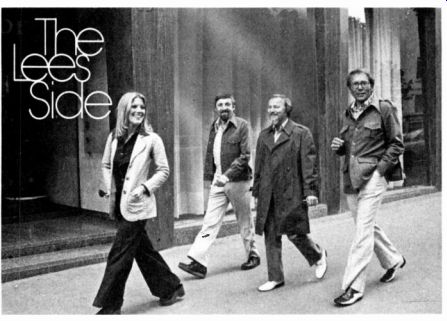
---The Singers Unlimited step out: Bonnie Herman, Gene Puerling, Don Shelton,
and Len Dresslar
by Gene Lees
AT A SHOP in Manhattan that specializes in hard-to-get records, a copy of an old Hi-Lo's album was sold recently for a cool fifty bucks. The Hi Lo's are enshrined in our memories as the best vocal group that ever was, and a good many people wonder what happened to it.
I have good news and bad news. First the bad news: It died. Now the good news: It has been reincarnated. And the Singers Unlimited is even better than the Hi-Lo's.
The new quartet has made eight al bums for the German MPS/BASF la bel, which is recording more good American music than most American record companies. But MPS has al ways had poor distribution in the U.S., and you have to search for Singers Unlimited albums and even pound on a counter now and then while demanding in an authoritative voice that they be ordered for you.
Two of the members, Gene Puerling and Don Shelton, were with the original Hi-Lo's. Puerling, in fact, founded the Hi-Lo's and wrote its vocal arrangements. He does the writing for this quartet too, but it is infinitely more complex, since he overdubs on multitrack machines, sometimes going up to twenty-seven voices. Puerling writes wonderful harmonic things-textures and tensions and weaving inner lines that are sung with eerily accurate intonation, beautiful blend, and absolute ease. Ease in doing difficult things is one of the hall marks of art, and this seeming lack of effort is one of the most striking things about the group.
One difference between the Singers Unlimited and the all-male Hi-Lo's is a remarkably talented Chicago woman named Bonnie Herman, the lead voice of the Singers. Her singing is a poignant combination of vulnerable innocence and un-self-conscious sensualism. She has impeccable taste in phrasing and attack, and her voice is not easily forgotten. "She's a chameleon. She can be anything she wants to be," says pianist/arranger Clare Fischer, the onetime accompanist for the Hi-Lo's who recently wrote the orchestral arrangements for a Singers Unlimited recording.
What happened to the Hi-Lo's? How did this new group come into being? "Our demise was really rock," Puerling said. "Toward the end, we were sitting one day at the Tropicana in Las Vegas, and Don Shelton laid it on us that he'd had an offer from a group called the l's and Jamie in Chicago. It was a good offer, and we all told him he should take it. I tried re placing him, but it never really worked, and the group fizzled.
"I went to Chicago too and tried get-ting into the commercials field, but that didn't work either, and I moved to the San Francisco area.
"Then one day I got a call from Don Shelton saying that the J's and Jamie had broken up and that maybe we should try to put a group together again. I flew to Chicago and had a meeting with Don and Len Dresslar, who was also with the J's and Jamie and who's now our bass singer. We got together with Bonnie Herman, and I began to do some writing. Then we decided to try an experiment. I wrote an arrangement for multiple voices on
'The Fool on the Hill,' and we went into the studio to try overdubbing it. It took us thirty hours to do, with all the voices. Now we do an entire album in thirty hours.
"I played the tape for Audrey Morris, the singer and pianist, who's an old friend. She's also a friend of Oscar Peterson's, and she played it for him.
Oscar took it to MPS in Germany, and they signed us. We did our first album in 1967, with Oscar. I don't think it's our best. We only had two days with Oscar before the recording. After that we did an album called 'A Cappella,' which was released in this country under the title 'Try to Remember.'
'The Fool on the Hill' is in that one." There is a problem in recording the quartet with instrumental accompaniment: Because the string bass takes over the root-motion function, Dresslar doesn't get a chance to use that beautiful bottom register of his voice; indeed, the group isn't heard much below midregister, and there is a loss of richness. A good many people prefer the a cappella albums.
Herman, Shelton, and Dresslar are all based in Chicago, where they are active in the commercials business.
Puerling, who still lives near San Francisco, works on nothing but the Singers Unlimited. "I tell myself," he said, "that I should get into other things-the studio scene, perhaps-but the group takes up an awful lot of time and ... frankly, I just can't see myself going into anything else. It's very satisfying, and I love it." Amazingly, Puerling never studied music formally: "I took two piano les sons when I was a kid and hated it. In fact, I once flunked music in school.
I've always just dug vocal groups. I got interested in choral classes in junior high school in Milwaukee, and I organized little choruses.
"I don't recommend not studying, though. That's something I want to get into more, studying. Now it's just through ear." I just had to tell Puerling an anecdote that illustrates how professionals feel about him and Singers Unlimited. One day I was sitting at the piano, working out the chord changes of "Emily." A harmonic sequence at the end was giving me trouble, so I called Johnny Mandel on the quite reason able assumption that, since he wrote the tune, he should know the changes.
He gave them to me, then asked, "Have you heard the Singers Unlimited do it?" "Yes." "Good," Johnny said. "Now throw out my changes and use Gene Puerling's."
Singers Unlimited on Records IN TUNE. MPS 20905. Accompanied by the Oscar Peterson Trio. Neither group is heard at its best.
TRY TO REMEMBER. MPS 20903. A cappella. This is one of Singers Un limited's finest.
CHRISTMAS. MPS 20904. A cappella, with harmonies kept comparatively pure and simple. One of the prettiest Christmas LPs around.
INVITATION. MPS 22016. Accompanied by the Art Van Damme Quintet. There are nice moments, but the group doesn't stretch out enough.
FOUR OF Us. MPS 21825. Accompaniment by piano, bass, drums, guitar. with occasional additions of flute and alto saxophone by Don Shelton. Les Hooper, who wrote the instrumental arrangements, seems to know how to give support discreetly.
Very attractive.
A CAPPELLA 2. MPS 22343. Simply stunning.
FEELIN’ FREE. MPS 22607. This re cording has just come out, so keep your eye out for it. Pat Williams' instrumental accompaniments work beautifully. The album is brighter, more up-tempo, and the group gets a chance to swing more. In a word.
superb.
SENTIMENTAL JOURNEY. This one will be released in a few months. Watch for it. because the large-orchestra arrangements are by Robert Farnon, whom we seldom get a chance to hear any more. The problem of integrating Singer. Unlimited with orchestra has been solved, and with Puerling and Farnon this is a sort of summit meeting of huge arranging talents. "Sentimental Journey" is gorgeous.
+++++++++++++
Behind the Scenes

RCA on Broadway. When Thomas Z. Shepard left Columbia Masterworks to become a vice president and classical a&r chief of RCA Records, we re ported ["New and Views," June 19741: "He doesn't expect to have much time for studio work, recognizing that his primary responsibility is administrative. But we weren't surprised to learn that he expects to produce some original-cast albums ('that's my fun'), something RCA hasn't done much of recently." So we still weren't surprised when RCA announced that it would record (and Shepard would produce) albums from two big-name.
Broadway-bound musicals.
Pacific Overtures is the latest collaboration of producer/director Hal Prince and composer/lyricist Stephen Sondheim, and Shepard is almost a third member of that team, having produced recordings of their Company, Follies, and A Little Night Mu sic. (The last recording he produced for Columbia was of Prince's revival of Candide; his first RCA recording was a London-cast Little Night Mu sic-he had already coproduced Columbia's original-cast album with Goddard Lieberson.) John Weidman's book is set in Japan after Commodore Perry's 1853 "visit"; the cast is all Asian.
Rex features perhaps the biggest of all Broadway names: composer Richard Rodgers. This is Rodgers' first collaboration with lyricist Sheldon Harnick, whose previous credits include Fiorello!, She Loves Me, The Apple Tree, and Fiddler on the Roof. Sherman Yellen's book "is a story of intrigue and romance in the court of Henry VIII of England." Nicole Williamson is scheduled for the title role.
Karajan's Lohengrin. Scheduled for completion in January was Herbert von Karajan's latest operatic project, a complete Lohengrin for EMI. According to last word, the cast was to include Rene Kollo in the title role, Anna Tomowa-Sintow as Elsa, Ursula Schroder-Feinen as Ortrud, Siegmund Nimsgern as Telramund, and Karl Ridderbusch as the King. The orchestra, of course, is the Berlin Philharmonic.
Release is scheduled for May. Buffalo, Cincinnati. Two American orchestras that haven't been heard from on disc for a while have resumed recording, under their respective music directors.
With the Buffalo Philharmonic, Michael Tilson Thomas has finally be gun work on the complete works of Carl Ruggles, one of the two projects announced at the time of his signing as an exclusive Columbia artist. The compositions recorded are Sun Treader, Evocations, Men and Mountains, and Portals. Thomas' other announced project, the complete works of Perotin, has yet to materialize.
Meanwhile, the Cincinnati Symphony has signed a two-year contract with Vox to record three discs in the 1975-76 season and four in 1976-77, all conducted by Thomas Schippers. Already on tape is Rossini's Stabat Mater, with soprano Sung-Sook Lee, mezzo Florence Quivar, tenor Kenneth Riegel, bass Paul Plishka, and the Cincinnati May Festival Chorus.
(Schippers should know the piece; his New York Philharmonic recording is still in the Columbia catalogue.) RCA's operatic futures. RCA is planning what promises to be a busy operatic summer. Three projects are penciled in: a new Forza del destino with Leontyne Price, Placido Domingo, and Sherrill Milnes, conducted by James Levine; Andrea Chenier with Renata Scotto; and the first stereo commercial recording of Montemezzi's Amore dei tre re, with Anna Moffo.
Nonesuch in St. Paul. Barely past thirty, Dennis Russell Davies has al ready accumulated an impressive list of credits (chronicled in the August 1975 MUSICAL AMERICA, when he was Musician of the Month), chief among them the conductorship of the St. Paul Chamber Orchestra (since 1972) and the music directorship of California's Cabrillo Festival (since 1974). Now he has added recordings to the list. A pair of records taped by Nonesuch in November in St. Paul's House of Hope Presbyterian Church will be released this month, and the occasion will be marked by promotional activities in St. Paul.
One disc contains three eighteenth century works: a J.C. Bach G minor Symphony (Op. 6, No. 6), the Michael Haydn symphony that once masqueraded as Mozart's "Symphony No. 37" (Mozart did write the introduction), and the Mozart K. 62a Cassation (billed as a first complete recording). The other disc, recorded with a Ford Foundation grant, offers two new works by William Bolcom, written for the St. Paul Chamber Orchestra: the 1971 Commedia, for (almost) 18th century orchestra and the 1975 song cycle Open House (texts by Theodore Roethke), with tenor Paul Sperry, who sang in the work's premiere last October.
Another quad first. To the list of repertory making its quadriphonic bow may be added the complete organ works of Bach. The rather unexpected source is Delos, the small West Coast company. Organist Wolfgang Riibsam plays the Metzler organ of Frauenfeld, Switzerland, and at the end of 1975 fourteen discs' worth had been taped.
The miking, Delos director Amelia Haygood told us, aims for a maximum of direct, rather than reverberant, sound; the result will be issued on SQ discs. Four volumes should be avail able by March, containing, respectively, the six organ concertos, a miscellaneous collection, the eighteen Leipzig chorales, and the Orgelbuchlein.
Boult's Eiger. Despite his advanced age and poor health, EMI continues to coax Sir Adrian Boult into the recording studio as often as possible. Among other repertory planned, he has lately been returning to Elgar. On tape or planned are a complete Dream of Gerontius (with the London Philharmonic Choir and New Philharmonia Orchestra, and soloists Helen Watts, Nicolai Gedda, and Robert Lloyd) and the two symphonies (with the London Philharmonic). Incidentally, Boult's 1969 EMI recording of The Kingdom (the only complete recording ever made) has now received its first domestic re lease. Connoisseur Society issued the two-disc set, its first vocal release, as the initial product of a new licensing arrangement with English EMI similar to that with Pattie Marconi, the French EMI affiliate ["Behind the Scenes," July 1975]. Treigle Memorial. The Norman Treigle Memorial Fund announces a new stereo LP assembled from "previously unknown private tapes" made available to the nonprofit fund, "set up by his colleagues to establish scholarships for young American singers" after the bass-baritone's death in February 1975 at the age of forty-seven.
The contents: "seventeen songs of faith, including traditional hymns, oratorio, spirituals, and a rock prayer which is the only music known to have been composed by Norman Treigle himself." The price: $6.50 post paid, from the Norman Treigle Memorial Fund, Box 1137, Ansonia Station, New York, N.Y. 10023.
+++++++++++++
An Interview with Alexander Kipnis
by James Drake and Joseph Tempesta

When Mary Garden began a lecture tour of the United States after she had retired from the operatic stage, she was asked by a New York Times interviewer which male vocalist she considered the greatest interpreter of Debussy. "It is not a Frenchman, but a Russian," she answered. "It is Alexander Kipnis." Now eighty-five and a well-respected voice teacher, the successor to Chaliapin in the Russian repertoire and the master of French, German, and Italian opera is enjoying a renewed appreciation on long-playing records. A superb musician whose career spanned three continents in three decades, Alexander Kipnis reflects on his recordings, his roles, and the legendary singers with whom he performed.
Is it true, Mr. Kipnis, that the rich bass voice you possess was once that of a boy soprano? It seems to be a trick of nature that most boy sopranos eventually become bassos, while most boy altos seem to become tenors. I had a high soprano voice as a boy, and I sang both coloratura and straight arias.
As a boy in the Ukraine I was greatly influenced by Russian folklore and especially by the music of the Russian peasants, although no one in my own Dr. Drake. associate director of continuing education and education professor, and Dr. Tempesta, associate professor of history, both of Ithaca College, conducted this inter view under the auspices of the Gustave Haenschen Oral History Project.
family either played or sang. Once in a while I can remember my mother singing as she would be working around the house, and later on I was astonished to recognize what she sang as "La donna mobile" or Schubert's Serenade. Where she heard them, I don't know.
My father made his living by selling heavy fabrics for winter coats, and he too neither played nor sang. He died very young-I was only twelve when he died-but he was a very learned man, although music was not a part of his background. So as a boy, my own musical influences were mainly from the music of the Russian peasants. I would hear their songs at twilight when they would play and sing for themselves, and by the time I was four or five years old I had learned most of their songs.
What prompted you to make singing your own career? I first studied music for a single, practical reason-I wanted to avoid becoming an ordinary Russian soldier. In Russia, a man who knew music could become a military bandmaster and upon being drafted would immediately become an officer. ... And so I began my career with the full intention of becoming a bandmaster. I had to study two instruments, one brass and the other string, and so I learned the trombone and the double bass. This was ... quite before I was aware that I had a voice.
My vocal studies began rather accidentally at the Warsaw Conservatory, where I was graduated as a conductor. Like most others, the Conservatory had a choir and students were required to sing in it as part of their musical training. The chorus master took me aside and told me that I had a better voice than the others, and he urged me to develop it. So I took some lessons from an Italian teacher there, and I went as often as I could to the opera. I became very involved with singing, and like every young musician and young singer I thought I knew everything about the voice. I realized later on that, in spite of the fact that I had heard many great singers, I knew very little about vocal production.
Which of the singers you heard as a young artist made the deepest impression upon you? Unquestionably, Mattia Battistini made the most profound impression on me then, and I heard him in his prime. He had the kind of voice that made the voices of the other cast members sound like tin in comparison to a golden bell. And of course the size and phrasing he brought to an aria-he was not a good-looking man, but what a singer! Believe me, when he would appear in Ballo in maschera or Quo vadis, the audience would sit in awe of him, wondering how a man could possibly sing that wonderfully. For me, hearing Battistini was almost disastrous, because I thought to myself, "What's the use?" I could never sing like that! But, fortunately, the drive that a young singer has and that lets him continue after a disappointment kept me trying and trying again.
The French basso Marcel Journet also impressed me, I must say. His range was so colossal that he could sing both the baritone and the basso roles. I heard his Escamillo and his Mephistopheles when I was singing in Wiesbaden-this was just after the close of World War I. The first performance I heard Journet in was Faust, and part of it was un intentionally comical.
If you know the opera, you'll know that Mephistopheles' first line in the opera is "Me voici" ("I am here"), which he sings after he has been summoned by the weary philosopher Faust. Staging Mephistopheles entrance is a bit of a problem, be cause his entrance has to be dramatic and magical, and so typically the staging calls for an entrance from below the stage, by way of an elevator. The stagehands wait for Faust's lines summoning the Devil, and then they start the elevator so that Mephistopheles can utter his "Me voici" in time.
Except in this performance. Here I was, sitting in the opera house eagerly awaiting Journet's appearance as the Devil, and at the appointed moment the tenor, as Faust, sang "Satan, appear," and then came a tremendous crescendo-but no Marcel Journet! Suddenly, we heard "Me voici" coming from beneath the stage! He sang almost two pages of the score before they finally started the elevator. You see, the whole cast was singing in German, except for the tenor and for Marcel Jour net, who sang their parts in French. But the stage hands, who spoke only German, were waiting for a German cue from their French Faust! But once he finally got on-stage, he sang incredibly. To tell you about his range-I will never for get his "Le veau d'or" in Faust. He took a high G in it, and he sang it like the best baritones. Imagine that! Both of these great singers are considered part of the "Golden Age." Do you believe in a Golden Age? Each generation has its share of great voices, though I don't think it is wise to speak of them as members of a Golden Age. When I was a young singer in Bayreuth, I remember a group of us sit ting and talking with Siegfried Wagner. Someone in the group asked him, "What do you think of to day's singers compared to those of the past?" He replied by saying that, while the singers of the past were indeed great artists, we had as great artists in the present. During the course of his answer he paid me a great compliment by saying that I sang the role of Gurnemanz in Parsifal as well as an earlier basso had. ... Many critics consider your Gurnemanz in Parsifal to have been your greatest role. Would you agree with them? Gurnemanz requires a beautiful voice, and it makes extreme legato demands of the singer. I feel that I gave my best to that role, and so vocally speaking I would agree that Gurnemanz was my best part. But vocally and dramatically, my best role was Boris Godunov. I have rather strong views about Boris, because it is a distinctly Russian opera involving a distinctly Russian character. In spite of the success that some singers have had in the role, I really don't believe that a singer can perform it well unless he is Russian by birth and speaks the language natively. Ezio Pinza, at least in my judgment, is a good illustration of my point. While his Boris was in many ways well received, in my opinion it was absolutely the wrong part for him. He had no knowledge of the character and absolutely no knowledge of the Russian language. In my case, the music seemed to fit my own character-and, of course, I had a natural ad vantage in knowing the language.
You sang Varlaam to Chaliapin's Boris early in your career. Did you incorporate much of his characterization into your own? Perhaps dramatically I might have, but not vocally. When I sang with him his voice was already shattered, even though he was not very old. I had not heard him prior to [that], ... though I think he was principally a great actor more than a great singer. During that particular performance, I and the other cast members sang in Italian, while Chaliapin sang in Russian. Many years later I also sang the part in Russian to an Italian cast.
At that stage in your career, what other roles would have been in your repertoire? It would have included, among others, the role of Titurel as well as Gurnemanz in Parsifal, since in Bayreuth and then in Wiesbaden, where I sang for five years in my early career, I had to agree to alter nate the two roles with a colleague. I also sang Col line in La Boheme, Bartolo in The Marriage of Fig aro, Kedal in The Bartered Bride, Ferrando in II Trovatore, Sparafucile and Monterone in Rigo letto, and Ramfis in Aida.
What tenors might have sung Radames to your Ram /is in Aida then? I sang with Giovanni Martinelli, whom I admired greatly as a person and as a singing actor, although the bloom of his voice was already gone by the time I sang with him. I also sang with Beniamino Gigli and Giacomo Lauri-Volpi in Aida, and of the two I found Gigli's voice more suited to the role. I felt that Lauri-Volpi's voice was somewhat too lyrical in timbre for Aida. But I admired them all.
You certainly gathered the admiration of your own fellow artists, not the least of which was Mary Garden's admiration for you. What roles would you have sung with her? I sang with her in several operas, among them Le Jongleur de Notre Dame, Thais, Sapho, and Pel leas et Melisande. She had what I would call an al most "sexless" voice, which is the way the voice of a Melisande should be. I think her characterization of the boy juggler in Le Jongleur was so convincing because of this sexless quality in her vocal production. She was definitely a better ac tress than a singer, and though she could color her voice in a number of ways she did not have the voice for Salome. That is a role that requires, first of all, a very sexy voice and one that has an enormous top to enable the singer to rise above the waves of the Strauss orchestration. But somehow she managed it.
As an actress she was totally involved in her parts. I will never forget the first performance of Pelleas et Melisande we sang together. In the segment of the opera in which Arkel sings "Si retais Dieu ..." ("If I were God, I would take pity upon the hearts of men"), she fell into my chest and cried so hard that even after the curtain had rung down she was still weeping. And in the last act, in which as Arkel I showed her child to her, I was startled to see real tears in her eyes. Afterward she wrote me a letter and in it paid me a very great compliment, saying that she had never seen or heard anything like my Arkel.
You are credited with the discovery of undoubtedly the most famous of all Wagnerian sopranos, Kirsten Flagstad. How did this come about? I first met her in Oslo and sang with her there, only to find that she had never sung outside Scandinavia. When I first tried to speak with her she didn't understand me, either in German, Russian, or French. She spoke only Norwegian at the time, and the mezzo-soprano in the company served as our translator. I asked Flagstad if she would like to sing outside the Scandinavian countries. And when she said that she would I recommended her to the general manager of the Berlin State Opera, and he invited her to sing some small parts in Bayreuth. I also recommended her in Brussels, and she was engaged to sing Sieglinde there. This was her first appearance outside Scandinavia, and from there, of course, her career was simply one success following the other.
Flagstad's repertoire, at least in her prime years, was Wagnerian, while your repertoire was remarkably diverse. Do you consider the great Wagnerian roles more difficult than, say, the Verdi or Mozart roles you sang? I sang a number of Wagnerian roles, including Wotan, Hagen, and Pogner in Die Meistersinger, in addition to the two Parsifal roles I mentioned earlier. If I may use Wotan as an example here, it is a typically Wagnerian role, and the difficulty with it is that it is too high for a bass and too low for a baritone. It is essentially a dramatic baritone part, and like most other Wagnerian roles it is very long and requires the singer to make certain vocal adjustments in order to meet its demands. And the demands, naturally, are different from those in the Mozartean or Verdian repertoire.
Of the Wagnerian parts I sang, Pogner seemed in demand wherever I appeared, and in fact my first appearance in the United States was as Pogner. It got to the point that when I was offered my Metropolitan contract I asked that Pogner be excluded from my repertoire. I had sung it so much that I no longer had a proper artistic interest in it. Of the Wagnerian roles in general, and in comparison to those in other repertoires, I am of the opinion that in the past one didn't have to be, shall we say, a great singer in order to be successful in the Wagnerian parts. The problem with most Wagnerian singers, even those today, is that if the Wagnerian scores are taken away from them they simply do not sing well. In the Wagnerian operas the orchestral score indicates everything-even the acting.
Wagner indicated almost every gesture, every step in the score. So a singer doesn't create a Wagnerian part in the sense that he or she creates a part in, say, Faust or Don Giovanni.
Curiously, Hans Sachs did not form a part of your repertoire, even though it is considered a brilliant dramatic role.
It is a brilliant dramatic role, unquestionably. But I refused to sing the part, and I did so solely on political grounds. I refused it at a time when Adolf Hitler's propaganda forces were nearing their zenith, and I wanted no part in any of it. I was not German by birth, and hence I did not feel myself possessed of Germanic blood or to be a member of some elite German race. I was singing in Bayreuth at the time, and I discovered that Hitler was a member of the audience during several of my performances there. He was the guest of Winifred Wagner.
Were you ever introduced to him? I tactfully refused an introduction to him. During the 1933 season at Bayreuth, Mrs. Kipnis and I were staying in an apartment that the conductor Karl Muck had formerly occupied, and one day, quite unexpectedly, Winifred Wagner personally asked me if I should like to meet Hitler. . . . He would be her guest, and I should come accordingly. The very thought of meeting Hitler actually made me ill-I can't tell you how I felt. But I felt as if I were somehow trapped. I would not accept, for obvious reasons, and yet having signed my con tract well before 1933 I could hardly refuse coldly an invitation from Winifred Wagner directly. Too, the invitation was sudden, and I had no other social obligations that could justify my not accepting her own invitation.
I was growing more desperate as time wore on, and so my wife and I went for a walk near where we were living. We happened to meet the Ernest Newmans on the street, and, as we had wanted to spend an evening with them during our stay in
------------- 61 Pieper holl In Bayreuth 1933, as Pogner, the role Kipnis asked not to sing at the Met
Bayreuth, we asked whether or not they had plans for that evening. To our relief they had no definite plans, and so we immediately extended an invitation to them. What would have been the horror of having to meet Hitler therefore became one of the happiest times I can recall. That evening we talked and laughed and played and sang, we dined well and drank our shares of fine red wine-from seven in the evening till three in the morning.
Fortunately for all of us, you recorded almost all of the parts you performed. Do you recall your first sessions in a recording studio? Very well. My first recordings were made for the German Odeon company, after World War I- these were acoustical recordings, as were all phonograph records until the mid-1920s. I was not happy with my acoustical recordings, and I don't think it is possible to judge any artist who made records by that process solely on the basis of what the records contain. The process itself placed certain limitations on the singer. Typically, the studios in which these recordings were made were not very large, and either from an opening in one wall of the studio or else from a booth-like structure in the room a large horn would project, into which the singer was supposed to focus the voice.
What made recording difficult in the acoustical process was that the most powerful tones in the voice, the fortissimo a score might call for, could not be recorded fully without ruining the master record. As singers, we were instructed to move away from the horn when a fortissimo approached and then move very close to it when the soft tones, or pianissimi, were called for. This made the whole matter of making an acoustical record a rather unnatural feat. Too, everything one sang had to be made to fit the four minutes of which records of that time were capable of playing. This of ten meant that tempi had to be accelerated, or in some way altered, to make the aria fit the recording. And then in the end the final recordings captured only a part of the singer's timbre and certainly not the full resonant tones a member of an opera house audience would hear.
The first electrical recordings were an improvement, but mainly in that more of the voice's timbre could be captured on the master recording. Still, everything had to be made to fit the four-minute playing time. . . . And even in the first electrical recordings, the fortissimo was still difficult to record satisfactorily. I remember asking one of the engineers I happened to be working with during one of my early electrical sessions whether or not I should sing a certain note as forcefully as the score called for. He told me that if I did he could record it, but that after ten or so times the record would no longer be playable.
--------62 During a master class at the Berkshire Music Center in Tanglewood.
Kipnis makes a point for a young soprano who has just sung Schubert's Erlkonig.
I made both acoustical and electrical recordings for the British HMV company by virtue of their connection with the German Electrola company, which was organized by Deutsche Grammophon, with whom I made recordings after I left the Odeon company. Because of the link between HMV and Victor at the time, I recorded for Victor when I came to the United States. And later on I also recorded for Columbia.
Do you have definite preferences among your recordings? Again, I would not consider the acoustical recordings I made representative of what my voice was like at the time they were made. The interpretation I brought to the arias is evident in the records, but the timbre of my voice was not completely captured on them. Among the electrical records I made, I was the happiest with my recordings of Brahms songs, which I did with Victor, and with my Hugo Wolf Society recordings and finally with my Boris Godunov records. As far as the actual sound quality of my records is concerned, I generally prefer those I made for the HMV company to those I made for Victor.
Seraphim has now re-released many of your recordings. Are you pleased with the reissues? In every sense, yes. Seraphim has re-released them with my consent, and we mutually selected which ones would be issued. They asked me if I might be interested in writing the album notes, which I did, and I am very much impressed with the actual fidelity of the re-recordings. I have been fortunate because most of my records (except for the Victor Brahms songs, which RCA reissued many years ago) have been reissued in recent years either in Europe on the Austrian Preiser label or in this country on the Seraphim, Victrola, and Columbia labels. I gave my best to each of my recordings, and it gives me a great sense of pleasure to know that my records are being heard by people I did not have the privilege of singing for in an opera house.
This may be an unfair question, but we'll ask it anyway. If you could magically surround yourself with the greatest singers in your own lifetime-all the vocal ranges included-who would be some of the singers you would choose to sing with you? It is not an unfair question, but it is a difficult one to answer. It would depend upon the repertoire
partly. But I can at least tell you some of the singers I greatly admired during my career, although I'm sure that I may not remember to mention many that I would otherwise, if I had a great deal of time to compile a list.
If I had to choose among tenors I could sing with, my choices would be Lauritz Melchior in the Wagnerian repertoire and Jussi Bjoerling in French and Italian roles. I sang with both of them many, many times, and Melchior and I were very close friends. His voice was, to my thinking, unique in this century-he had not only volume, but warmth as well. If you listen, for instance, to the last act of his Tristan, where acting is inconsequential and the voice alone matters, his is superb.
And Bjoerling-well, anyone who has listened to any of his recordings knows what a great tenor he was, and, of all the Italian tenors I personally sang with, I consider him the greatest. After Caruso, he had the finest tenor voice of our century. But Caruso is still the crowning achievement in singing.
He is what any singer would hope to be. He was a dream that may never again be realized, and it would have been a privilege to have sung with him.
I would also choose Jacques Urlus, as well as Alfred Piccaver, the fine English tenor, and Giovanni Martinelli, Beniamino Gigli, and Leo Slezak. I sang with all of them, and in their own ways each was a great tenor, a great artist. Among baritones, I would choose those I was much impressed with when I heard them or sang with them. Battistini would be at the very top-there were no other baritone voices like his. And I would also want Titta Ruffo, Leonard Warren, Michael Bohnen, Lawrence Tibbett, and Giuseppe de Luca. De Luca was in a class by himself, one of the greatest singing actors of our time. I was also very much impressed by the baritone George Baklanoff, especially in Rigoletto and in Tosco. He was a superb actor, and he treated the character Scarpia in Tosco the way he should be treated. With Baklanoff in the character, you could watch Scarpia gradually evolve from the nobleman he first was to the savage character he became. Too many baritones ignore the fact that this is a nobleman, this Baron Scarpia, and from the moment he makes his entrance they treat him as if he were Mephistopheles.
Sopranos would be very difficult to choose among, because there were so many great ones. I admired both Lotte Lehmann and Kirsten Flagstad in the Wagnerian roles, and I would choose them first. And in the Italian repertoire, my first choice would be Zinka Milanov, who I think possessed one of the greatest voices of our century. I sang with her many, many times, both early in her career and then later on, and we did a number of recitals together. And my choices would surely include Rosa Ponselle, Elisabeth Rethberg, Geraldine Farrar, and Amelita Galli-Curci. And one immediate preference I would have among mezzo sopranos would be Louise Homer-she could sing as high as the finest dramatic soprano, and she was a beautiful woman as well.
Bassos would be very, very difficult for me to choose among, both because there were-and are- many great ones and because my own conception of the basso voice leads me not to prefer certain singers that are perfectly fine artists in their own right. I would choose Marcel Journet, for instance, but I would not choose Pol Plancon-he was just not my sort of voice. I would choose Nicolai Ghiaurov, but perhaps I would not immediately choose Cesare Siepi-only because our styles are different. But Cesare Siepi is a very fine, very highly respected artist, and that is as it should be. I am only speaking about my own concept of singing here, and so I would not want to be taken as suggesting that Siepi today or Plancon in the past are anything less than great singers.
And Ezio Pinza? I had an artistic regard for Pinza's singing. He had a fine voice, he worked very, very hard in those roles he sang, although he was not a profound musician by any means. But if you happened to sing in the same clef that he did, and if you happened to sing well, you could not count on being a friend of Pinza's. I say this out of personal experience, having sung with him in Don Giovanni where 1, as Leporello, had to imitate the Don's voice. Pinza had a rapid vibrato in his voice, and over-all his voice was lighter in timbre than mine was. So, at the appointed time in the opera, I did a vocal caricature of Pinza as the Don, making my voice lighter and adding a tremolo to it. He stood in the wings hating the laughter I got from the audience, and, when he had his turn to do a similar caricature of me, the audience did not react so favorably because he could not make his voice dark enough or his vibrato even enough to make a convincing vocal imitation of my Leporello. From then on we were not friends, and by his own choice.
A last question: You are scheduled to sing an 8 p.m. performance, let us say. What would you do during that day to prepare for the performance? I had a very definite routine that I followed during my singing career. After eating lunch I would usually lie down for a time, sleeping for perhaps an hour or so. Then I would go for a long walk, possibly two miles. Later I would have one or two cups of tea and two pieces of dry toast. Then, about an hour before the performance, I would be in my dressing room putting on makeup and getting into costume, vocalizing a little bit for myself, always starting lightly, and then slowly, gradually, I would be in full voice. Then I was ready.
+++++++++++
The Muzas Are Heard
by Gabrielle Mattingly
Polish Classical Recordings Stage a Boomlet For the prospering Polish Record Center in Chicago, Bacewicz and Karlowicz are no joke
OPERATING OUT of a small storefront in the Polish section of Chicago, the Polish Record Center of America shares unprepossessing quarters with a travel agency and lures as few as fifteen retail customers a week into its lair. But the importer does a
$100,000-a-year business, supplying ethnic retailers in North America with Muza, Pronit, and Veriton records, all products of Polskie Nagrania, the Polish state record company. The demand used to come mainly from Poles in search of the popular tunes of their youth in their homeland; now the classics are the big money-maker.
Muza, the classical label, has more than 600 records in its catalogue, many of them recordings of music available from no other source. Into this category fall the current best-selling composers of the PRC: Bacewicz, Karlowicz, Paderewski, Penderecki, and Szymanowski, all of the twentieth century, and none, with the exception of Penderecki, well known in the West. Paderewski (the best known name, although not as a composer) wrote the work that has been the PRC's top seller for several months: The epic, sprawling Polonia Symphony (Muza SXL 0968) initially sold out in a day and sold out promptly each time it was re-ordered.
Who is buying these recordings, and how are they finding out what's available? PRC's manager Jozef Zielinski (also a conductor) says that most of his business is with retailers around the country who stock imports, especially classics. He also sells Muzas to Peters International, the largest of the record importers, and to independent whole sale-retail dealers like August Rojas of Los Angeles, who specializes in classics for the connoisseur. Rojas, in fact, influences the purchase orders that go to Poland. "If Rojas orders a particular thing," Zielinski says, "I know I will have to have twenty times more of it than some other thing." Mail-order customers, another large group of buyers, were introduced to Muzas through the PRC's ads in nationally distributed music magazines and catalogues. Unless released on Philips, Deutsche Grammophon, or some domestic label like Mace or Bruno, Polish recordings are seldom reviewed, so these intrepid music lovers must usually order their Muzas without foreknowledge, a risky method of buying records, especially when names like Rozycki, Noskowski, Zarebski, Kurpinski, and Szabelski are involved. (Interested readers may write for records and a catalogue to the PRC, 3055 N. Milwaukee Avenue, Chicago, Ill.
60618.) Not everything offered by the PRC is esoteric, of course. Among its most popular items are thirty four discs encompassing the complete works of Chopin played by such Polish artists as Witold Malcuzynski and Regina Smendzianka, Wie niawski played by violinists Bronislav Gimpel and Wanda Wilkomirska, and the operas of Poland's scarcely noticed nineteenth-century com poser Stanislav Moniuszko, whose Halka is the country's national opera.
More than anything else, buyers seem to focus on what has been and is being done in this century.
Among Polish composers, one name stands out above all others: Karol Szymanowski (1883- 1937). He is a shadowy cosmopolitan figure among early twentieth-century European composers, although lately some interest in his large output has been awakened in this country. Dense in texture and impressionistic, almost a synthesis (if one is imaginable) of Reger, Strauss, Scriabin, and Debussy, Szymanowski's music has never really caught on outside Poland, even when championed by such eminent and influential interpreters as Arthur Ru binstein and David Oistrakh. His creative value hasn't yet been widely assessed, but he probably deserves a place next to Frederick Delius in the musical pantheon.
Muza offers a good sampling of Szymanowski's oeuvre, mostly in stereo. The newest releases from the PRC are his Second Symphony (SXL 0981), a collection of songs (SXL 0980), and the Piano Sonata No. 3 (SXL 0973), dating from 1917 but sounding of more modern vintage. Earlier releases of interest are the opera King Roger (SXL 250/51) and the two violin concertos (SXL 0383) played-one each-by Wilkomirska and Charles Treger, winner of Poland's Wieniawski International Violin Com petition in 1962.
A four-record survey of Szymanowski's orchestral, instrumental, vocal, and chamber music is offered in acceptable mono as well. Practically everything in this set is also available in more modern recordings; the most notable exception is the most attractive item, the Symphonie Concertante for Piano with Orchestra (once recorded by Arthur Rubinstein). For good measure, a seven inch 45 of the composer playing two of his mazurkas is included.
A good introduction to Szymanowski's style is the ballet-pantomime Harnasie (SXL 0249). The overside is devoted to music from the opera Pan Twardowski (1921) by Ludomir Rozycki (1884- 1953), who after Szymanowski is the best known member of the "Young Poland" movement that was formed in 1905 by Polish composers then studying in Berlin.
Mieczyslaw Karlowicz (1876- 1909) was a short lived contemporary of Szymanowski from whom much had been expected. His output (fourteen opus numbers plus some unpublished manu scripts) is almost entirely orchestral, symphonic poems predominating. None of the diffuseness that characterizes Szymanowski's music is heard here; Karlowicz is always clear and straight forward without being blatantly obvious or simple. His command of orchestral forces is impressive, as is his sense of form, which never falters even in long rhapsodic works. What makes his premature death all the more regrettable is that his music possesses real individuality. If he had lived out a normal life span, there can be no doubt that the name Karlowicz would have been an important one in twentieth-century music.
Judging by sales at the PRC, however, he has been discovered by many Americans. His violin concerto (XL 0179) is his best-known work (though not his best) and has been issued domestically several times. The Muza recording, in mono, offers Wilkomirska in top form, backed by Witold Rowicki and the Warsaw Philharmonic. As a filler, Muza offers one of Karlowicz' last works, the symphonic poem The Sorrowful Tale. Three other symphonic poems and an orchestral rhapsody are available on two discs (XL 0269 and XL 0290) per formed by the Warsaw Philharmonic under Stanislaw Wislocki, the leading champion of Karlowicz' music. A recent Muza issue (SXL 0862) features some lovely unpublished songs by the youthful Karlowicz sung by baritone Andrzej Hiolski.
His celebrated minuet aside, Jan Paderewski (1860- 1941) is usually thought of not as a com poser, but as a great pianist or famous politician.
Yet his catalogue of compositions is lengthy-an opera, a cantata, a symphony, several works for piano and orchestra, an unfinished violin concerto, and numerous piano solos and songs.
With the advent of the so-called Romantic revival, American recording companies have paid
----------------- 65
---------------66 IGNACE JAN PADEREWSKI MIECZYSLAW KARLOWICZ GRAZYNA BACEWICZ KAROL SZYMANOWSKI
some attention to Paderewski, particularly the flashy virtuoso vehicles for piano and orchestra.
These works are undoubtedly calculated to spotlight Paderewski the Pianist rather than Paderewski the Composer. His Symphony in B minor, the Polonia, is a purely orchestral work and as such is a better example of his music: It is closely related in mood and style to Rachmaninoff's Second Symphony. Especially interesting is the Muza recording of Variations and Fugue in E flat minor, op. 23 (SXL 0570), which is coupled with the sonata in the same key, Op. 21. Both of these works for solo piano were written in 1903, a year that the busy virtuoso set aside solely for com posing. "I think this is my best piano composition," he wrote in his Memoires of the Variations and Fugue. His masterly handling of the four-part concluding fugue displays an originality of conception and execution that is not a hallmark of his eclectic style, a style that at the same time never lacks personality.
Scarcely known in the West, the redoubtable Grazyna Bacewicz (1913-69) has been called "the world's greatest woman composer" and has remained a Western cosmopolite throughout her remarkably fecund career, counter to the nationalist trends of between-the-wars Poland and the Social ist realism dictates of the Communist regime. Her forte is structural unity, a skill possibly developed under the tutelage of Nadia Boulanger when Bacewicz studied with that great pedagogue in pre war Paris. The pervading influence upon her, however, was Bela Bartok, although the ghost of Szymanowski often hovers in the background, as it does with most Polish composers of her generation. In any event, Bacewicz' music never gives the slightest indication that it was written by a Pole-or a woman.
Though Muza doesn't list any of her four sym phonies or seven violin concertos, she is nevertheless well represented, and practically all recordings of her works are available from the PRC. Three recent issues feature five mature large scale works. The two piano quintets on SXL 0608 span thirteen years (1952-65) and give a good sampling of her style while demonstrating her mastery of form and consummate skill in writing for strings. (She was a concert violinist and a skilled pianist.) The First Piano Quintet is a powerful work echoing Bartell( and Shostakovich; the Second evinces a mild flirtation with serialism, super imposed on her earlier style, that characterizes the last period of her creativity. The Viola Concerto of 1968 (SXL 0837) continues this vein; to a lesser ex tent, so does the Concerto for Two Pianos and Orchestra of the same time. A most interesting work is her Second Piano Sonata (SXL 0977), which, more than any other, shows her indebtedness to Szymanowski, notably that composer's Third Piano Sonata. A good introduction to Bacewicz is Muza XL
0274, which contains four symphonic works dating from 1953 through 1965.
The reputation of Krzysztof Penderecki is well established in the West, and most Muza recordings of his work have been released in this country by Philips and Mace. Inexplicably, the PRC continues to receive a heavy demand for his music, even when the recordings are duplicated on more read ily available labels. The same is true for Witold Lutoslawski. Several interesting items by this composer are offered by the PRC, notably the First and Second Symphonies (XL 237 and SXL 0453, respectively). Despite increased sales of Polish classics, the over-all volume of Polskie Nagrania sales for 1974-75 in this country was down appreciably from 1972- 73. When I asked about the immediate future of Polish record sales in the U.S., Zielinski replied: "In this business, you have to be doing fifteen things to stay alive. Selling records counts as just one thing. Sales are down except for the classics, but this doesn't reflect diminished interest in Polish music. It's entirely the economy. If it comes down to eating or buying a recording of some Polish composer you've never heard of and whose name you can't pronounce, most people will buy something they can eat. Still, the popularity of the classics seems to grow every month."
+++++++++++
The New Releases
A Song Team for Schoenberg and Schubert
Jan DeGaetani and Gilbert Kalish bring idiomatic ease to Schoenberg's subtly erotic Hanging Gardens and fresh insight to Schubert songs.
by David Hamilton
ALTHOUGH BOTH SIDES of Nonesuch's new release by the team of Jan DeGaetani and Gilbert Kalish are enthralling, pride of place must go to Schoenberg's Book of the Hanging Gardens, of which we have not had a convincing recording for some eight years- that is, since Son-Nova 2 disappeared from the catalog. That performance by Bethany Beardslee and Robert Helps captured to near-perfection the intensity and mystery of these subtly erotic songs, and it was recorded with still-startling presence and clarity.
DeGaetani and Kalish bring comparable expertise to their rendition. Like Beardslee and Helps, they have no difficulty with the idiom: The asymmetrical rhythms, the wide-ranging, irregular vocal line, and the dynamic extremes are uttered with even more security and conviction than most singers muster in, say, Mozart. As a result, we listeners don't have to wrestle with the sense of uncertainty, even discomfort, that marks the two other currently available recordings of the cycle. However different from all previous songs, in these performances Schoenberg's George settings are unmistakably songs-lyrical expressions-rather than strenuous mechanical tasks to be accomplished only with considerable strain.
-----------
... and Schoenberg in the Cabaret?
SCHOENBERG'S "CABARET SONGS" (Brettl-Lieder) actually antedate his brief direct association with Ernst von Wolzogen's Berlin literary cabaret, the lieberbrettl, in late 1901. Three of them use poems from Deutsche Chansons, a 1900 anthology including the work of Bierbaum, Dehmel. Falke, Liliencron, Wedekind, and other young writers who sought to reach a wider audience-and certainly did, for the book sold thirty thousand copies in its first year. During 1901, Schoenberg also set several other poems in similar style, but it was "Nachtwandler" from Deutsche Chansons that impressed Wolzogen. This seems to have been the only one of the songs actually per formed, although without much success. Scored for the oddly balanced combination of piccolo, trumpet, snare drum, and piano, it tells of a nocturnal carouse in mock-military terms; the idiom is fundamentally close to Brahms (particularly that of the Zigeunerlieder), unrelated to the military songs that Mahler had written in the 1880s.
The other songs, in more conventionally popular styles, are accompanied only by piano. They never lack characteristic touches of elaboration and subtlety. Marni Nixon sings them with a flair that will pleasantly surprise those who remember her deadpan Webern performances in the Robert Craft complete set. The voice isn't quite so pure as it was, but the diction is vastly more idiomatic, the entertainer's gusto very palpable.
On the other side of the disc, she and the admirable Leonard Stein (director of the Arnold Schoenberg Institute) turn to more serious matters, nine Schoenberg songs from the decade 1893-1903. Only one of these has been published so far: "Gedenken," also recorded by Helen Vanni and Glenn Gould on Columbia M 31312. There are some attractive songs here (the in fluence of Hugo Wolf is distinctly audible, along with that of Brahms), including an expressive setting of Hofmannsthal's "Die Beiden." If Nixon is occasion ally impelled to demand of her voice a tonal weight greater than it naturally commands, these honest and musical performances are still a good introduction to this literature.
Good sound, and an authoritative commentary by Stein, running from the back liner into a four-page insert that also contains complete texts and English translations. D.H.
SCHOENBERG: Brettl-Lieder; Early Songs. Marni Nixon, soprano, Leonard Stein, piano. [Peter Dellheim, prod.] RCA RED SEAL ARL 1-1231, $6.98.
Sraltl-Utackw: Galathea: Gigerlette: Der genUgsame Liebhaber, Einfal tiges Lied: Mahnung; Jedem das Seine; Ane aus dem Spiegel von Arkadien; Nachtwandler (with Andrew Lolya, piccolo. Ray Crisara, trum pet; Morris Lang, snare drum). Early Songs: Mein Herz das ist em n befer Schacht; Em n Schiltlied; Madchenlied: Madchenfruhling; Die Heiden; Waldesnacht; Deinem Slick mich zu bequemen, Gedenken; Nicht doch!
----------------------------
tailed underlining of the text (I miss Beardslee's hollow sound on "der kalte, klare Morgen" at the end of the sixth song, for example), but very beautiful in its own way. And Kalish's playing is finely articulated, if recorded with something less than the immediacy and focus that Son-Nova accorded Helps. Too often, sustained piano notes drop over the threshold of audibility sooner than they should in a really well balanced setup.
Those who are fortunate enough to own the older recording will find this new one a fascinating complement; those who aren't so fortunate should ac quire this one at once.
And not only for the Schoenberg, because DeGaetani and Kalish have something special going in Schubert as well. Their program mixes four well known titles with five relative rarities, and each song has been carefully thought out on its own terms.
"Biondel zu Marien" and "An mein Herz" have been recently available only in the big Fischer-Dieskau packages, and in both cases I much prefer the warm detail of the new recording to the rather routine work of the celebrated baritone. DeGaetani's fioritura in the first of these songs is of a purity and light ness rarely heard.
"Heidenraslein," simple and warm, comes up bright as a new penny, and Mignon's "Nur wer die Sehnsucht kennt" carefully balances the more passionate middle section against the need for making the major climax at the repeat of the pensive opening strain. Also very good is "Schafers Klagelied," the contrasting middle part sparkling and then shading into melancholy.
"Rastlose Liebe" is particularly hard to bring off; if taken at a suitably impetuous pace, it almost always comes out shrill or strenuous (or both), while a slower tempo emasculates the rhythmic drive. De Gaetani and Kalish make the right choice, and even if the singer sounds under stress at times, shape and impulse are preserved, the piano galloping forcefully along. "Sprache der Liebe" and "Ganymed" fall into a reverielike trance that, though lovely to hear, sacrifices something of their potential.
And, finally, one performance that is likely to be controversial: "Der Musensohn," taken at a tempo markedly faster than any I've ever heard in this song.
Just to be sure, I checked out sixteen other recordings, going back to Elena Gerhardt a half-century ago, and found none that sent Goethe's poet rambling through field and wood at such a clip. Schubert's marking is ziemlich lebhaft (rather lively), which doesn't suggest anything extreme. But DeGaetani and Kalish are so proficient that they don't sound as if they're doing anything extreme. There is no sense of strain, but rather a light, exhilarating whirlwind of perpetual motion. Though it may be "wrong," it does recognize the clearly propulsive intent of the piano part and the vocal rhythm, raising it to the nth degree of exuberance-and it does rather make everybody else's performance sound just a bit stodgy.
Tradition is often a fine thing, but it deserves to be re-examined now and then. That's what I like about these performances. They are not willful or eccentric, but proceed from the musical text and from a desire to present the music and the words as directly and clearly-and coherently-as possible. The singing is always true, the diction almost impeccable (the "almost" referring to DeGaetani's u, which tends to acquire about half an umlaut even when none is called for), the piano playing superior in its steadiness and tonal shading. Even when I disagree with the results, I have learned from this record: at its best, it makes most other Lieder singing sound fussy.
Nonesuch's thoughtful packaging includes valuable notes by Robert Erich Wolf and fine translations: for Schubert, by Stephen Ledbetter; for the Schoenberg, by Wolf, who again (as in his Pierrot lu noire for Nonesuch) brilliantly evokes in English the steamy elegance of Jugendstil poetry.
Schonberg: Das Buch der hangenden Garten. Op. 15. Schubert Songs. Jan DeGaetani, mezzo-soprano; Gilbert Kalish, piano. [Marc J. Aubort and Joanna Nickrenz, prod.] NONESUCH H 71320, $3.96.
Schubert: Schafers Klagelied; Rastlose Liebe: Blonde! zu Marien; Der Musensohn: Nur war die Sehnsucht kennt, D. 877/4; Heidenrdslein: Sprache der Liebe; An mein Herz; Ganymed.
++++++++++++++
Bernard Herrmann and the Subliminal Pulse of Violence
Superb new recordings mark stages in a composing career: from the soft-hued Ghost and Mrs. Muir to the brutal Psycho.
by Royal S. Brown
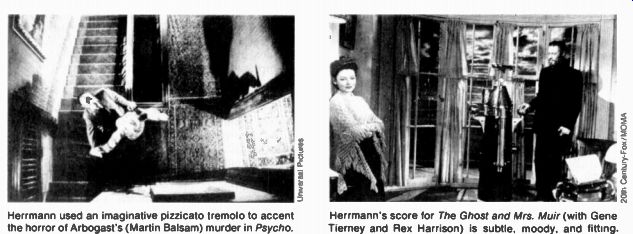
------------------- Herrmann used an imaginative pizzicato tremolo to accent the horror of Arbogast’s (Martin Balsam) murder in Psycho. Herrmann's score for The Ghost and Mrs. Muir (with Gene Tierney and Rex Harrison) is subtle, moody, and fitting.
Two OUTSTANDING NEW RECORDINGS, released lust before Bernard Herrmann's death last Christmas Eve, represent very different phases of the film com poser's career. Joseph L. Mankiewicz's warm and bittersweet The Ghost and Mrs. Muir (1947) was only the seventh film Herrmann had written for. And al though the soft-hued, beautifully orchestrated score (one of his personal favorites) ranks among his best, it has never attracted a great deal of attention.
Psycho, composed in January and February of 1960, was Herrmann's thirtieth feature-film score and his sixth in succession for director Alfred Hitchcock.
The brutally obsessive, string-orchestra-only music has come to be considered one of the classic examples of the immense emotional dimension a score can add to its film.
The film Psycho has more importance on many different levels than almost any movie made in the U.S. since Citizen Kane, which Herrmann also scored.
For though the American cinema had produced its share of horror pictures and of films that have chipped away at the solid facade of well-ordered American causality, none brought out so vividly, so unrelentingly, just how close the elements that would destroy this facade lay beneath the surface of everyday reality. Always a master at transforming the basic decor of Americana into absurdist objects in a Kafka-esque labyrinth. Hitchcock turned the ordinary bathroom shower into a gruesome trap.
Herrmann's style in Psycho, as has been pointed out often enough, broke with several sacrosanct tenets of film scoring, notably by largely avoiding themes per se and by limiting the instrumentation to a string orchestra. Particularly intriguing is the harmonic technique: Much of the music is shaped around a single seventh chord-also used in the prelude to Hitchcock's Vertigo (1959)-heard at the outset of the prelude. (The final chord of the score, how ever, expands to a multi-flatted ninth.) Because of this essentially chordal orientation, Herrmann is able to avoid the aural relief of harmonic resolution, and the listener is no more able to latch onto a comfortable resting place in the music than he is in the film.
A tension is created between the indefiniteness of the harmonic language and the exaggerated definite ness of the rhythmic idiom, which in many places is so relentless, so heavily accentuated that the listener is aware not so much of temporal divisions as of a subliminal pulse suggesting primordial violence.
Furthermore, at least in the prelude and its reappearances, Herrmann alleviates what might be the music's tendency to excess by introducing, from time to time, a short, ascending-descending motive that seems to draw everything slightly back toward reality, bleak as it might be.
But there is no alleviation when it comes to the murder scenes (and the "Discovery" sequence). Hitchcock had at first wanted no music here, and it was only at the composer's insistence that the director, dissatisfied with his non-scored first efforts, relented. The result is one of the most remarkable segments in the history of film music: a series of slashing, shrieking strokes starting in the high violins, descending in superimposed, open minor ninths, and repeated with the addition of one of the most macabre of all musical effects, the glissando.
One is reminded of Thomas Mann's description of the glissando as "a naturalistic atavism, a barbaric rudiment from pre-musical days" used by the fictitious composer in Dr. Faustus to create "images of terror" in his musical vision of the apocalypse.
Throughout the score Herrmann uses the string orchestra as if its resources were anything but limited: for instance, the pizzicato tremolo preceding the second (Arbogast's) murder sequence.
It should go without saying that, if ever a sound track recording was needed, it was for Psycho. It is astonishing that none was issued at the time of the film, and it was almost ten years before that omission was even partly remedied, with the appearance of the London Phase-4 "Music from the Great Movie Thrillers"--read Hitchcock films--(SP 44126), which includes a fifteen-minute "Narrative for Orchestra" based on the Psycho music.
But a complete version was needed, and Unicorn has now provided that, allowing one to follow the progressions and accumulations of the music's cells.
Among the sequences revealed here and not heard on the Phase-4 release are the nervous, mono chromatic snippets of "Temptation": the extended bit of converging contrary motion as Sam and Lila come closer to the "Discovery" in "The Hill": and the combination of bitter nostalgia and horror-suspense in "Bedroom" and "Toys." Herrmann's tempos are quite similar to those on the earlier recording. The prelude in both is taken at almost exactly the same pace, which is to say some twenty beats per minutes slower than on the sound track. In fact, now that I'm used to the slower tempos of the Unicorn performance, I find the Phase-4 version quite acceptable, especially with its amazingly present sound. But the new prelude is more subtle, more dynamically varied. The murder sequences are much more effective here, thanks to Unicorn's more reverberant recording.
Herrmann and the string players of London's National Philharmonic are obviously deeply involved in a performance that, while not always mirroring what is heard in the film, brings back with over whelming effectiveness Psycho's sledgehammer impact and reveals the staggeringly wide-range accomplishment of a musician working within a self imposed system of restraints. In a word, the disc is invaluable.
Were it not for the moody harmonies-much more triadic than Psycho's but nonetheless characteristic-the Ghost and Mrs. Muir score would almost seem not to be by the same composer. Yet first and foremost one is struck, as in Psycho, by the thorough appropriateness of the music for the film, one of the many outstanding efforts by Mankiewicz, who has shown particular skill in film adaptations of theatrical works (Julius Caesar, Suddenly Last Summer, Sleuth). There is, for instance, a marvelous title theme whose sea-like swell (suggesting the locale) melts wistfully into a typically rich, non-thematic chordal progression in the high strings.
Here, too, one has the chance to appreciate the exquisite subtlety of a master orchestrator. In addition to the lovely transparency created by the frequent winds-and-harps combinations, the score is filled with unexpected, emotion-stirring shifts in instrumentation, often in the middle of a melodic phrase.
And, yes, even though some of the score tends toward the non-thematic, The Ghost and Mrs. Muir contains some strikingly beautiful melodies, the most haunting of which belongs not to the ghost of Captain Gregg (Rex Harrison), but to Lucy Muir (Gene Tierney). I was greatly impressed both by Elmer Bernstein's interpretation of the score and by the airily spacious and clear recorded sound, which greatly enhances the latticework textures of the instrumentation.
Bernstein's disc also features an exceptionally imaginative use of directionality-the two harps, for in stance, are divided between the speakers, and the movement from one to the other adds a nice touch to a seascape that momentarily takes your breath away.
For once, the liner notes accompanying both re leases (Fred Steiner for Ghost, Christopher Palmer and Steiner for Psycho) provide fairly complete in formation on the films (a full list of credits would have been nice, though) and an extremely useful breakdown of the various cues, with some often fascinating additional commentary.
Psycho. Original film score by Bernard Herrmann. National Philharmonic Orchestra, Bernard Herrmann, cond. [Christopher Palmer, prod I UNICORN RHS 336, $7.98.
THE GHOST AND MRS. MUIR: Original film score by Bernard Herrmann. Elmer Bernstein, cond. and prod. FILM Music COLLECTION ALBUM 4, $8.00 plus $0.60 handling to members only (annual membership $10; Elmer Bernstein's Film Music Collection, Box 261, Calabasas, Calif. 91302).
++++++++++++++
Dvorak's Masterly Miniatures: Abram Chipman, There's nothing minor about the Slavonic Dances and Legends
[missing segments]
Antal Dorati Rafael Kubelik Masterly Miniatures
'dings of the Slavonic Dances and Legends
nce between miniatures and minor music.
by Abram Chipman
sical min-
- ley are in the black rg in their 2 and 7); nnor (Op.
er sorrow pi, or a warm and exuberant joy
(Op. 46, Nos. 1, 5, and 6; op. 72, No. 1). Such simple descriptions, furthermore, will just not do; most of these moods-and others too-appear at least fleetingly in each piece.
Although the dances are charming and touching in the four-hand-piano originals, the composer's orchestration adds much more in dazzling and resourcefully applied color. In either format, the listener will quickly come to appreciate the flawless proportion, not only within each number, but within each set of eight. Each sequence nicely balances tem pos, keys, dynamic scales, and ethnic sources. (The melodic material is original, but Dvorak drew on at least ten different dance types from various Eastern European countries.) One must approach each set as an eight-movement work, and fortunately we now have an ample selection of recordings that treat the music that way.
For several years, Vaclav Neumann's three-disc Telefunken set (36.35075, filled out with the three Slavonic Rhapsodies, the Czech Suite, and The Wood Dove) has had that field to itself in this country. Though I am second to none in my admiration for the Czech Philharmonic (which had previously recorded the music under Vaclav Talich and Karel Sejna), I find the Telefunken performances soporific--inexorably uninflected in pacing and phrasing, with distant and overly generalized sonics.
Far more to my taste is the approach of George Szell in his two integral recordings with the Cleve land Orchestra: a superb mid-Fifties mono set (with his own transcription of the Smetana E minor Quartet as a filler) and a stereo remake that Columbia has issued in various guises, most recently "complete" on a single disc-a format made possible by chopping out all the repeats! Now Columbia has restored these performances, in their entirety, on Odyssey. Szell and his orchestra brought to this music an individualized profile, an intensity, and a dynamism that in my view have not been matched by the composer's countrymen: the blazing fury of Op. 46, No. 8; the proud grandeur of Op. 46, No. 6; the boldly crooning trumpets in the trio of Op. 46, No. 3; the sweep and lilt of Op. 72, No. 2; the steeply controlled rubato in the central section of Op. 72, No. 3; the tempestuous splendor of Op. 72, No. 7; the almost Beethovenian compassion of Op. 72, No. 8, which can so easily border on the maudlin. (One persistent mystery in Szell's performance of this final dance: Why eviscerate the pair of tutti chords at the end by reducing the scoring to winds and pizzicato strings and dropping the dynamics?) The Odyssey transfer has retained the solidity and detail of the original uncut Columbia.
By coincidence, Antal Dorati's new Turnabout recording of the Slavonic Dances with the Bamberg Symphony follows hard on the heels of Mercury's Golden Import reissue of the set he made near the end of his Minneapolis Symphony tenure. Neither ensemble is on a par with the Cleveland Orchestra or even the Czech Philharmonic, but both are under crisp control here, delivering the pulsating drive that characterizes Dorati's approach to the music. For the most part the interpretation hasn't changed much: a broad and swaggering Op. 46, No. 4; a heroic, driving Op. 46, No. 8 (comparable to Szell's); a perky and buoyant Op. 46, No. 7. In both accounts Dorati takes a brisk and tough-minded view of Op. 72, Nos. 2, 4, and 8, as if he were uncomfortable with their emotional content. There are minor interpretive changes: The Minneapolis performances contained a minimum of rubato, even by the Szell standard; the Bam berg discs reveal subtle Luftpausen at transitional passages and moderate slowdowns for the central sections of Op. 46, No. 3, and Op. 72, No. 2.
The Mercury engineering is closer and drier, with brighter winds and tighter bass transients. In two channel playback, the Turnabout QS-encoded discs sound more resonant but also less transparent. The differences are marginal, and individual systems and ears will be more comfortable with one or the other.
'Rafael Kubelik too made an earlier recording of the Slavonic Dances, but his Vienna Philharmonic mono version is easily superseded by his new pair of DG discs. Though the Bavarian Radio Symphony is even less tidy than either of Dorati's orchestras, it more than compensates with its bravura zest, plasticity, and sparkle, to say nothing of the consistently limpid and expressive solo woodwind work. The open and airy sonics, the tricky rhythmic articulation of the timpani, and the clarity of doubled winds and strings are all joyous assets.
Although Kubelik's op. 46 is well-paced, flexibly molded, and thoroughly enjoyable, it is in Op. 72 that he sheds new light. The rubato of No. 2 is the most voluptuous in any of the complete sets, without lapsing into the heavy bathos of Stokowski's single version (a filler on the recently issued London SPC 21117). Kubelik is puckishly jovial in the trio of No. 6, yet makes No. 4 an atmospheric nocturne of almost unbearable poignancy (No. 8 too is deeply felt). This is the most freely expressive, lightest, and most gracious Op. 72 we have had.
One might characterize the Kubelik and Dorati approaches as, respectively, "poet and peasant." (Sze11's more abstractly symphonic approach is something else again.) It is helpful that the Turn about and DG editions have been issued as pairs of single discs, thus allowing a purchaser to complement Kubelik's illuminating Op. 72 with Dorati's Op. 46. The Sze11 and Dorati/Minneapolis sets can be had only as a whole, and neither starts Op. 72 at the be ginning of a side. (Odyssey's automatic sequencing is especially inconvenient.) The full price of the Mercury and DG editions is partly offset by their more generous fillers. Turn about offers none at all; Odyssey has Sze11's Carnival Overture, one of the half-dozen or so best on records-he whips up the outer sections brilliantly but brings more repose to the middle section than most conductors do. Dorati/Mercury offers a side's worth of the familiar Bartered Bride orchestral excerpts in a reading as taut and incisive as one could ask, though shy on sly and folksy humor. Each Kubelik disc has a filler. The Scherzo capriccios , with Op. 46, gets a flowing and affectionate reading, less precise and martial than the Neumann/Czech Phil harmonic (Nonesuch H 71271) but with great point and wit in the solo playing; Kubelik's customary lateral division of first and second violins pays even handsomer dividends here than in the dances. The op. 72 filler, My Home, is not top-drawer Dvorak, but Kubelik's leisurely reading makes a better case for it than the crisper and more ferocious Kertesz version (London CS 6511 or CS 6746) or the bigger and more bombastic Rowicki (Philips 6500 287). The complete Dvorak collector, as well as piano duet hobbyists, will want the keyboard format of the Slavonic Dances, and, of the recordings available, only the new Supraphon consistently keeps the mu sic above the pleasant salon level. Vlastimil Lejsek and Vera Lejskova, a Brno-based husband-and-wife team, probe deeply into cross-rhythms and inner voices (note Op. 72, No. 1) and have a grand time with the shifts of rhythm and the play of light and shade in these scores. Gruffness and tenderness are projected with equal authority, and the dynamic changes are explosive. Brendel/Klien (Turnabout TV-S 34060) and Eden/Tamir (London CS 6614-Op. 46 only, with ten Brahms Hungarian Dances) play well and stylishly, but Lejsek and Lejskova bring out such color and detail that, briefly, one may not miss the orchestration. Turnabout's single budget-priced disc (at the cost of some omitted repeats) does have a considerable price advantage, and the pleasant, clean Turnabout sound is superior to the rather shallow toned Supraphon.
The Lejsek/Lejskova set is filled out with four of the ten Op. 59 Legends, like the Slavonic Dances originally written for piano duet but better known in the later orchestral form. (Beecham was fond of No. 3, certainly the catchiest of the Legends.) Here, however, the orchestration seems to me all but essential, and I am pleased that Supraphon has concurrently released a new recording of all the Legends conducted by jiti Pinkas.
The melodic appeal of the Legends may not quite match that of the Slavonic Dances, but at its best this is prime Dvorak, and there is ample poetry and warmth, with modest but effective use of the orchestra. In mono days, Supraphon made a superb recording of the Legends with Sejna conducting the Czech Philharmonic, but in recent years we have had to make do with the 1972 version by Raymond Leppard and the London Philharmonic (Philips 6500 188). Serviceable as that recording has been, in this case a second-rank Czech orchestra proves preferable to a first-rank foreign one. The Brno State Philharmonic has its rough edges, but its sheer robustness and limpid expressivity in this music puts the rather "up tight" London Philharmonic in the shade. Some spluttery surfaces aside, the Supraphon pressing is smooth, the sonic ambience rich and detailed.
Dvorak: Slavonic Dances (16), Opp. 46 and 72; Carnival Overture, Op. 92. Cleveland Orchestra, George Szell, cond. [Paul Myers and Thomas Frost, prod.] ODYSSEY Y2 33524, $7.96 (two discs, automatic sequence) [from COLUMBIA M2S 726, 1965].
Dvorak: Slavonic Dances (16), Opp. 46 and 72. Smetna: The Bartered Bride: Overture; Polka; Furiant: Dance of the Comedians. Minneapolis Symphony Orchestra, Antal Dorati, cond. MERCURY SRI 2-77001, $13.96 (two discs, manual sequence) [from SR 2-9007, 1959]. V E13
Dvorak Slavonic Dances (16), Opp. 46* and 72'. Bamberg Symphony Orchestra, Antal Dorati, cond. TURNABOUT ON-S 34582* and 34583', $3.98 each QS-en coded disc.
Dvorak: Slavonic Dances (16), Opp. 46° and 72'; My Home Overture, Op. 62'; Scherzo capriccioso, Op. 66°. Bavarian Radio Symphony Orchestra, Rafael Kubelik, cond. [Rudolf Werner, prod.] DEUTSCHE GRAMMOPHON 2530 466° and 2530 593', $7.98 each.
Dvorak: Slavonic Dances (16), Opp. 46 and 72; Legends, Op. 59, Nos. 1-4. Vlastimil Lejsek and Vera Lejskova, piano. [Jaroslav Kreek, prod.]. SUPRAPHON 1 11 1301 /2, $13.96 (two discs, manual sequence). Dvorak: Legends (10), Op. 59. Brno State Philharmonic Orchestra, Jiff Pinkas, cond. [Zdenek Zahradnik, prod.] SUPRAPHON 1 10 1393, $6.98.
Slavonk Dances. Op. 46:No. 1, in C; No. 2, in E minor; No. 3, in A flat; No. 4. in F: No. 5, in A; No. 6, in D; No. 7, in C minor; No. 8. in G minor. Slavonic Clancy's, Op. 72: No. 1, in B; No. 2 in E minor; No. 3, in F. No. 4. in D flat; No. 5, in B flat minor; No. 6, in B flat; No. 7, in C; No. 8, in A flat.
+++++++
The Lighter Side
Paul Williams ... Dionne Warwicke ... Tom Scott ... Supertramp ; Critics' Choice--Pops
reviewed by: MORGAN JAMES, ROYAL S. BROWN, HENRY EDWARDS, MIKE JAHN, JOHN S. WILSON
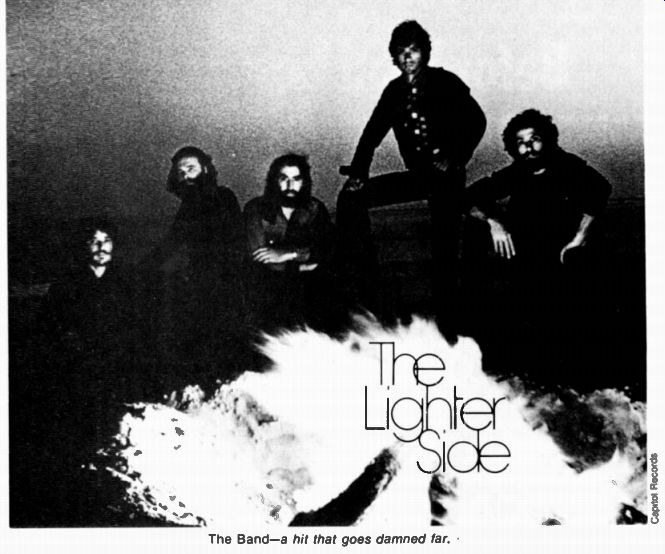
--------The Band-a hit that goes damned far.
THE BAND: Northern Lights-Southern Cross. Richard Manuel vocals and keyboards; Rick Danko, vocals and bass; Levon Helm, vocals and drums; Robbie Robertson, guitar; Garth Hudson, keyboards; Byron Berline, fiddle. Forbidden Fruit; Hobo Jungle; Ophelia; Acadian Driftwood; Ring Your Bell; It Makes No Difference.- Jupiter Hollow; Rags and Bones. CAPITOL ST 11440, $6.98. Tape: Mb 4 XT 11440, $7.98; 0- MT 11440, $7.98.
This recording is easily the Band's best since "Music from Big Pink" was issued in 1968. And since the latter may be considered one of the top ten LPs ever made by a rock group, the arrival of "Northern Lights-Southern Cross" is an important event indeed.
During the years that have passed since "Big Pink" skyrocketed Bob Dylan's former backup band to national prominence. the Band has honed and polished its techniques. Its peculiar brand of country rock has become more distinctive and refined, novelty having been replaced by majesty.
Robbie Robertson's song-writing has like wise improved. He composed the music and lyrics for all eight tunes on this album, and he did a fine job.
Best of all is "Acadian Driftwood"
A folktale about a French-Canadian family driven from its home and resettled in Louisiana, this historical vignette is poignant and deeply moving, yet without melodrama. Another song that ranks high is "Rags and Bones," a cityscape as seen through the eyes of a rag-picker. "Forbidden Fruit" is an up-tempo and very pleasing sermon on the subject of being satisfied with one's lot, and "It Makes No Difference" is as fine a love song as I have heard in some time. "Jupiter Hollow" is a dreamlike series of impressions set off in the composer's mind, apparently, by a glimpse of the northern lights. "Ring Your Bell" is an upbeat tune about an outlaw on the run, and
"Ophelia" is a similarly up-tempo chronicle of lost love. Finally, there is "Hobo Jungle," a downbeat, somewhat distressing account of a world where "nobody knows where they're going, but, at the same time, nobody's lost." Throughout the LP, one encounters excellent musicianship, especially by Robertson on guitar and by the two keyboard players: Richard Manuel, who concentrates on piano and clavinette, and Garth Hudson, who favors organ and synthesizer. In all, "Northern Lights-Southern Cross" is a work of subtle magnificence that grows on the listener with each hearing. Like Babe Ruth, rock music strikes out a lot-but when it connects, the hit goes damned far.
M.J. Tom SCOTT: New York Connection.
Tom Scott, reeds, synthesizer, arrangements, and most songs; Ralph Mac Donald, percussion; Hugh McCracken and Eric Gale, guitars; Gary King, bass; Steve Gadd, drums; Richard Tee and Bob James, keyboards. Dirty Old Man; Midtown Rush; Uptown and Country; six more. [Tom Scott and Hank Cicalo, prod.] ODE SP 77033, $6.98.
Tape: WO CS 77033, $7.98; 018T 77033, $7.98.
From the sound of it, this is a rare project where everything went right. Tom Scott is often billed in the trades and tabloids as the boy wonder of the record business. I re member him as young, but I never remember him as a boy. He operated with the grownups almost from the beginning. At twenty-six, he has surpassed nearly every one who does what he does, which is play all reeds, write, and orchestrate.
Scott worked for several years with a rhythm section called the L.A. Express, all of whose members toured extensively with Joni Mitchell, with Scott doing a great deal of the arranging. He decided to go to New York and record with the cream of that city's musicians (names listed above). The result is one of the fullest and most alive al bums I've heard in years. Perhaps the reason is that everyone involved was asked to do the thing he does best and then allowed to do so.
After the basic tracks were recorded in New York, he and co-producer/engineer Hank Cicalo brought the tapes home to L.A., where he interwove an amazing array of colors-flutes, saxes, Lyricon, and other synthesizers. Scott did for himself what he has been doing for other people's albums
Explanation of symbols exceptional recording
---------
Recorded tape:
Open Reel
8-Track Cartridge
Cassette
----------
for years: He sweetened, deepened, accentuated.
Among the highlights are Scott's tune, "Dirty Old Man"; "Uptown and Country," with slide guitar, harmonica, and other an tics by Hugh McCracken; "Time and Love," by Ralph MacDonald and Bill Salter: "You're Gonna Need Me," by pianist Richard Tee, who plays it with amazing grace along with guitarist Eric Gale on bass and a smoking L.A. brass section.
Scott's last LP for Ode, "Tomcat," was a hit. Square that and you have the beginnings of this. Whether it will hit, only God and Tiny Tim know for sure, but this is one album about which it can be fairly said that the music is its own satisfaction. Applause to Scott, Cicalo, and the family. M.A.
SUPERTRAMP: Crisis? What Crisis? Roger Hodgson, vocals, guitars, and keyboards; Bob C. Benberg, drums and percussion; Dougie Thomson, bass; John Anthony Helliwell, wind instruments and vocals; Richard Davies, vocals and keyboards. Easy Does It; Sister Moonshine; Ain't Nobody but Me; seven more. [Ken Scott and Supertramp, prod.] A&M SP 4560, $6.98. Tape: 40 CS 4560, $7.98; 8T 4560, $7.98.
"Crime of the Century," last year's Supertramp debut LP, brought to these shores the music of an English group with a top artistic and commercial reputation. That disc proved an intriguing but uneven demonstration of the band's ability to bring to life the mundane experiences and far more vivid fantasies of a group of prototypical English youths. However, along with an American tour last winter, it won the rock quintet a goodly number of devoted fans.
"Crisis? What Crisis?," the follow-up LP. will solidify Supertramp's reputation. It is a totally entrancing recording that puts on display dazzling virtuosity accompanied by honest musicianship. All of the numbers are composed by group members Roger Hodgson and Richard Davies, but each is written in a different style. Folk rock rubs shoulders with electric rock blues, and bal lads exist side by side with rock anthems.
With provocative lyrics and a gift for melody, Supertramp has been able to create a disc to be enjoyed as well as analyzed. The mind reels-and in this case it's a sensation that one will find thoroughly delightful. H.E.
DIONNE WARWICKE: Track of the Cat. Dionne Warwicke, vocals; rhythm, strings, horns, and vocal accompaniment arranged by Thom Bell. His House and Me: Jealousy; Once You Hit the Road; five more. [Thom Bell, prod.] WARNER BROS. BS 2893, $6.98. Tape: 411 M5P 2893, $7.97; M8P 2893, $7.97.
I listen to this album, and I hear irony. Dionne Warwicke, as we all know, became famous alongside Burt Bacharach and Hal David, functioning brilliantly as their demo singer. She did other things well, but her real impact was her purity with their songs.
Time passed. The charming tightness of the Bacharach/David style lost favor. Indeed, what major force in pop music ever
------- Dionne Warwicke Flourishing under strong leadership.
dated faster? Warwicke too lost momentum. There followed a long searching period for her, testing new material and attitudes. Every hustling producer in the business was sure he could make her hit again, but none did.
Meanwhile back in Philadelphia, Thom Bell, a man of low profile and high output, was producing an endless string of hits for groups such as the Spinners and the Stylistics. (His excellent song-writing partner is Linda Creed.) Nobody understands the record medium or pop-r&b-crossover song writing any better than Bell. Many of his songs bear a resemblance to Bacharach-David material. It is as if he caught the essence-the catchiness-but loosened the rigid time concepts. There is no dancing to Bacharach, and record buyers like to dance.
Thus the irony-that this longtime distinguished representative of the best of black pop music should be the man to extend a familiar but limited white style. I rush to add that this view comes from a reviewer's eye; Thom Bell is a leader, not a follower, and there is no one like him in our business.
Warwicke's first outing (and hit) with Bell was "Then Came Love," in which she shared the stage with the Spinners, whose lead singer deferred to her with the utmost graciousness. The Spinners don't need help in making their long string of Bell-inspired hits. Here at last is Warwicke's own album with Bell at the helm. "Track of the Cat" is as well planned and executed as all of his others. Warwicke flourishes under strong leadership, singing with precision and conviction. Several tracks are receiving air play, and all are good.
The recording is a prize example of what it is, and that says a great deal for all involved.
M.A.
PAUL WILLIAMS : Ordinary Fool. Paul Williams, vocals; keyboards, horns, strings, and rhythm accompaniment. Flash; Lifeboat; Lone Star; seven more. [Paul Williams, prod.] A&M SP 4550, $6.98. Tape: NO CS 4550, $7.98; 8T 4550, $7.98.
During the past few years, this elfin, whimsical, and extremely talented com poser/performer has succeeded in creating a slew of hit tunes, while also developing for himself a substantial following as a recording and concert artist, film composer.
TV personality, and actor. "Ordinary Fool," Paul Williams' latest recorded outing. will not only please those fans, but inevitably win him more.
The disc contains nine compositions, including "Lonely Hearts," the theme from Day of the Locust: "Old Souls" from Phantom of the Paradise: and "Ordinary Fool," which will be heard in the forthcoming Bugsy Malone. Six of the songs were writ ten by Williams alone, three with partners.
Each is a carefully produced and well-sung specimen of the art of commercial song writing. "Flash," as basic as basic can be, is an irresistible rhythmic excursion; it could easily climb to the top of the pop charts.
Ordinary? A fool? Paul Williams is neither. What is he, then? The best answer I can come up with is: a gold mine. H.E.
----------------
Critics Corner
The best pop records reviewed in recent months AMERICA: History. WARNER BROS BS 2894 Feb
BILL BLACK'S COMBO
FEATURING BOB TUCKER: The World's Greatest Honky-Tonk Band Hi /LorsiooN SHL 32093. Jan.
CLAUDE B OLLING: Suite for Flute and Jazz Piano. Columbia M 33233 Dec BLOSSOM DEARIE 1975. DAFFODIL BMD 102 Jan S T E PHANE GRAPPELLI. P YE 12115. Jan.
S TEVE KUHN: Trance. ECM 1052. Feb.
BARRY MANILOW: Tryin' to Get the Feeling. ARISTA AL 4060. Feb.
FREDA P AYNE: Out of Payne Comes Love. ABC ABCD 901. Feb.
Miklos ROZSA CONDUCTS HIS GREAT FILM MUSIC. POLYDOR SUPER 2383 327 Jan
TINA TURNER: Acid Queen. UNITED ARTISTS LA 495G. Dec.
Fars WALLER: The Complete Fats Waller: Vol. 1,1934-35. RCA BLUEBIRD AXM 2-5511. Feb.
Tim WEISBERG: Listen to the City. A&M SP 4545. Dec.
----------------
THE CHIEFTAINS: The Chieftains 5. Paddy Moloney, uilleann pipes and tin whistle; Sean Potts, tin whistle; Michael Tubridy, flute, concertina, and tin whistle; Sean Keane and Mar tin Fay, fiddles; Derek Bell, harp, oboe, and timpan; Peadar Mercier, bodhran and bones; Ronnie McShane, bones. The Timpan Reel; Give Me Your Hand; Three Kerry Polkas; Breton Music; The Chieftains' Knock on the Door; The Robbers' Glen; The Goose and Bright Love; The Humours of Carolan; Summertime, Summertime; Kerry Slides. [Paddy Moloney, prod.] ISLAND ILPS 9334, $6.98.
When the average American thinks of Irish music, he most likely thinks of the Clancy Brothers. The Chieftains, however, are recognized in Ireland as being among the finest purveyors of traditional Irish music.
The group, made up primarily of former workers in the Dublin post office, has been at it for better than a decade but only now is coming to attention in the U.S. "The Chieftains 5" (fifth LP, that is: there are seven men in the band) is a masterpiece of Celtic gaiety. The Chieftains play such instruments as the bodhran (a drum made by stretching goatskin over a round frame, rubbing it with dung, and curing it in the sun) and the traditional uilleann pipes, the Irish version of bagpipes. The songs are newly composed, by piper Paddy Moloney, but of traditional form and intent.
As with all folk music from the British Isles, there is that charming and undeniable harking back to the medieval and baroque, especially as played on fiddle and pipes.
"The Robbers' Glen" is evocative of the times when nomadic Gaelic tribes were, ac cording to the liner notes, "so incomprehensible to the orderly English" they were considered robbers. And "Summertime, Summertime" changes color and texture 'marvelously as it depicts the changing of seasons from spring through fall. This is instrumental music seriously played but containing all the humor and good feeling of the Irish.
Carona. Ajay Avery, vocals, drums, and percussion; John Dupree, bass; Clair Louis Hinton, vocals, guitars, banjo harmonica, and percussion; John Salz, vocals, guitars, piano, and percussion. Make Your Move; Just What You Do; Timbuktu; seven more. [Rick Stanley and Cayenne, prod.] BU C KSNO RT BR 01, $6.98.
Cayenne is the house band at Rainbow Cattle Company, a San Francisco gay bar whose patrons usually dress as cowboys These customers will find the group's appeal appropriately matched by its music: folk rock that is spirited, melodic, and rhythmic. Indeed, all the ingredients on this disc blend together to produce a listening experience that is a delight.
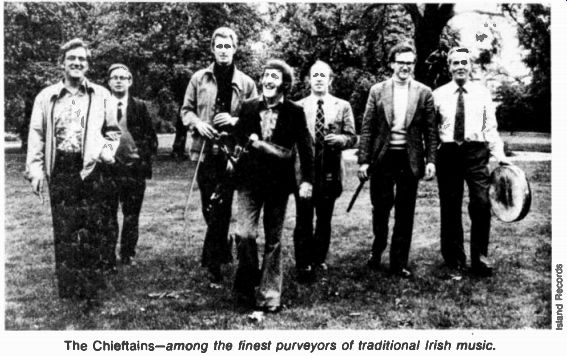
-------- The Chieftains-among the finest purveyors of traditional
Irish music.
I don't know what Cayenne plans to do with its career, but this disc-properly distributed and publicized-could and should earn a fair degree of national attention. H.E.
RITA Coolidge: It's Only Love. Rita Coolidge, vocals; rhythm, orchestral, and vocal accompaniment. Born to Love Me; I Wanted It All; Am I Blue; seven more. [David Anderle, prod.] A&M SP 4531, $6.98. Tape: WO CS 4531, $7.98; 11. ..8T 4531, $7.98.
Rita Coolidge is one of those interesting people who have had an extensive recording career and no hits. It's not supposed to go that way, but sometimes it does.
I first heard of her when she toured as a member of foe Cocker's Mad Dogs and Englishmen entourage. She was a great backup singer. Soon she went on her own for A&M. Later she married Kris Kristofferson and quietly receded into the background of his performing career. She sounds very much the same now as she always has: a lovely lady with a dependable, lovely voice, simple and true to her material.
This album is really a combination of two projects, both of which work well enough. Most of the tracks are in the straight pop formula, but two are from the past, "Mean to Me" and "Am I Blue," ac companied in fine fettle by Barbara Carroll, Chuck Domanico (he sounds particularly wonderful when he plays in this style), and Colin Bailey. Coolidge sounds exactly the same on all tunes, regardless of roots-pure and spaced out.
The more I write the more I can't find anything wrong. What I can't do the most is care. M.A.
HAROLD MELVIN AND THE BLUE NOTES: Wake Up Everybody. Harold Melvin and the Blue Notes, vocals; orchestral accompaniment. Wake Up Everybody; Keep On Lovin'; You Know How to Make Me Feel So Good; four more. [Kenneth Gamble and Leon Huff, prod.]
PHILADELPHIA INTERNATIONAL PZ 33808, $6.98. Tape: 40 PZT 33808, $7.98; PZA 33808, $7.98 MFSB: Philadelphia Freedom. MFSB, all instrumentals. Zach's Fanfare # 2; Get Down with the Philly Sound; Philadelphia Freedom; eight more. [Kenneth Gamble and Leon Huff, prod.]
PHILADELPHIA INTERNATIONAL PZ 33845, $6.98. Tape: EEO PZT 33845, $7.98; PZA 33845, $7.98.
THE O' JAYS : Family Reunion. The O'Jays, vocals; instrumental accompaniment. Unity; Family Reunion; You and Me; four more. [Kenneth Gamble and Leon Huff, prod.] PHILADELPHIA INTERNATIONAL PZ 33807, $6.98. Tape: 411 PZT 33807, $7.98; C.PZA 33807, $7.98
Harold Melvin and the Blue Notes, MFSB, and the plays are all prime examples of the ascendancy of the " Philadelphia sound" as the nation's most popular rhythm-and-blues music. Created by producers Kenneth Gamble and Leon Huff, this sound is creamy soul music, polished yet full of sprightly rhythms, equally satisfying as either listening or dancing music. How ever, these three discs-all successful, though uneven in quality-demonstrate that too much of the Philly sound can be wearisome.
"Wake Up Everybody" delivers an utterly compelling title track; Harold Melvin, one of the most persuasive r&b singers around, pours gallons of feeling into the inspirational lyric. The instrumental group MFSB, in its "Philadelphia Freedom" LP, produces a lively dance hit in "The Zip." The Mays trio has a big, big hit: "I Love Music," another up-tempo exhortation. But then the recordings disintegrate into dreariness, and one is left with endless repetitions of the Gamble-Huff formula. H.E.
STARR: Blast from Your Past. Ringo Starr, drums and vocals; vocal and instrumental accompaniment. You're Sixteen; No No Song; It Don't Come Easy; Photograph; Back off Boogaloo; Only You (And You Alone); Beaucoups of Blues; Oh My My; Early 1970; I'm the Greatest. [Richard Perry, George Harrison, and Pete Drake, prod.] APPLE SW 3422, $6.98. Tape: MB 4XW 3422, $7.98; . 1 8XW 3422, $7.98.
This single-disc compilation of tracks from Ringo Starr's several solo albums under scores just how much that man has given the world of popular music. While other ex Beatles have cornered the market on head lines, Ringo has provided a great amount of lighthearted, happy music. Songs like "You're Sixteen." "No No Song," "Oh My My," and "I'm the Greatest" cannot be taken too seriously, but they are a lot of fun.
"Photograph" contains George Harrison's worthy lyric of lost love, although it's presented in such an up-tempo, offhand manner that it sounds to the casual listener like just another fun song.
The only low points on this album are when Ringo gets too campy. In the old 1955-56 Platters song "Only You" and in the country tune "Beaucoups of Blues," his normally cheerful singing bogs down in bathos.
KIM CARNES. Kim Carries, vocals and keyboards; rhythm, strings, and vocal accompaniment. Bad Seed, Nothing Makes Me Feel As Good As a Love Song: Good Old Days; eight more. [ Mentor Williams, prod.] A&M SP 4548, $6.98. Tape: fe CS 4548, $7.98; Ot 8T 4548, $7.98.
Some producers churn out product as fast as it comes their way, and that is their security. Others wait, however long or uncomfortably, until they feel that special click with an artist.
Mentor Williams seems to fit in the second category. He must have felt that special knowing a few years ago with Dobie Gray, whose hit "Drift Away" he both wrote and produced. Since that happy cresting, Williams has not been inactive, but he has kept a low profile. Now here he comes again, laying it all on the line for singer/writer Kim Carnes. She is every bit the talent that Gray is though the similarity ends there.
As a new performer, Carnes is in competition with a scattering of attractive ladies awaiting their slot: Patti Dahlstrom. pretty and talented but too dark and unhappy so far; Harriet Schock, who wrote "No Way to Treat a Lady" but can't yet relax into artist status; Chi Coltrane, another good near miss (as yet). The list is long. Kim Carnes stands out. For one thing, her songs,
--- Kim Carnes: A clear and shining presence
... co-written with Dave Ellingson, for the most part, are not just strong, but consistently so. And they are clear enough to get cover records. Carnes's voice is supple but husky, easily contemporary rather than working at it.
Throw away all those credentials and she still has what counts most: that clear and shining presence, that X factor that breaks so many hearts forever. Nobody knows for sure if a new artist has this mysterious presence until the album is made-that truth is the core of this horse race.
At any rate, Mentor Williams' intuition, luck, and considerable skill have provided Ms. Carnes with a distinguished stage for her recording debut. The album mix is fine, but a little too hot for my taste. The acoustic piano in particular is over-brilliant and often too far out in front. M.A.
MELANIE: Sunset and Other Beginnings. Melanie Sarka, guitar and vocals; vocal and instrumental accompaniment. Perceive It; I've Got My Mojo Working; Loving My Children; Almost Like Being in Love; What Do I Keep; Afraid of the Dark; Where's the Band; You Can't Hurry Love; Sandman; People Are Just Getting Ready; Dream Seller; The Sun and the Moon. [Peter Schekeryk, prod.] NEIGHBORHOOD NL 3001, $6.98.
Melanie as an interpreter and Melanie as a singer of her own compositions are two entirely different and quite unequal things.
Though she has, on occasion, written a worthy song, most of her compositions are a bit on the dull side-pretty impressionism, words strung together because they roll nicely from the tongue, regardless of whether they mean anything. On the other hand, Melanie's versions of music written by others have often been brilliant. Her " Carolina in My Mind" is a classic, and no body has touched Phil Ochs's "The Chords of Fame" and Randy Newman's "I Think It's Going to Rain Today" in the exquisite manner she has.
On "Sunset and Other Beginnings," this gap is perfectly apparent. True, by recording Lerner and Loewe's "Almost Like Being in Love" and even Holland-Dozier-Holland's "You Can't Hurry Love," she is put ting her own work in with some pretty fancy company. In no way do her songs measure up to the company they keep.
"Perceive It" is interesting and "The Sun and the Moon" pleasantly tragic, but they are no more than vehicles for her very expressive voice. She has employed better vehicles in the past and, in fact, does on other cuts on this LP. Melanie should consider doing so more often. M.J.
DONNA Summit Love to Love You Baby.
Donna Summer, vocals; string and horn accompaniment; Mike Thatcher, arr. Full of Emptiness; Love to Love You Baby; Pandora's Box; four more. [Peter Bellotte, prod.] OASIS OCLP 5003, $6.98.
Donna Summer is one of those Americans who had to go to Europe to find success in music. She is already hot there, and the single from this set, "Love to Love You Baby," is getting hotter by the day in the U.S. charts. Summer is a singer of huge
range and talent. She sings high and low, loud and soft, laid back and out front, and through it all she maintains her sweetness.
The title track, nearly seventeen minutes long, takes up all of Side 1. (There is a shortened version for radio.) It is built on the currently popular disc mode-continued repetitions of the title line and little else for lyric, plus convincing sounds of a woman making love. All of this built primarily around one repeated chord in a pocket groove, featuring harmonic interludes, strings, an annoyingly polite bass solo, and various other production values in vogue. It works, and it holds.
But Side 2 tells another story. All five songs were written by producer Pete Bellotte and one of the two keyboard players, Giorgio Moroder (he was also the mixdown engineer, and the sound is gorgeous). They are tedious, stiff, and stiffly played, with blunt and limited harmonies. I have rarely heard less prettiness five times in a row.
(The fifth is a reprise of the first.) Donna Summer sings beautifully throughout, but her work has almost nothing to do with the songs. "Full of Emptiness" is a tragic-type lyric crooned lightly. "Need-a-Man Blues" is another kind of tragedy, sung with out of-place sauciness.
The obvious intent is to sell Summer for sexy, and from the album photos it is clear that she is beautiful. But she doesn't make it as a torch singer-she has no bitterness, no desperation, no dark passion. She only sounds true when she's having fun, on the hit side.
Recorded in Germany, the disc has the uncommonly good sound we have come to expect from that country's best studios. But good sound doesn't make good music. The rhythm section is tense and dull and dated.
It has none of the free flow of the best American rhythm sections. I would love to hear this lady record with any number of fine producers closer to home. It would not be hard to find material to fit her essence, instead of boxing her into inferior material.
Welcome to Donna Summer, a lady with a bright future. M.A.
DAVID BLUE: Comin’ Back for More. David Blue, guitar and vocals; vocal and instrumental accompaniment. Comin’ Back for More; Oooh Mama; When the Rains Came; Who Love; Save Something (for Me Tonight); Lover, Lover, Lover; Hollywood Babies; 23 Days = 2: Any Love at All: Where Did It Go.
[John Guerin, prod.] ASYLUM 7 E 1043, $6.98.
This performer started out as David Cohen, changed his name to David Blue, changed it to S. David Cohen, then changed it back to David Blue again. Tune in tomorrow for the next episode of his wanderings through the wonderful world of surnames.
If indeed there is to be another name change, might I suggest Robert Goulet? For in "Comin’ Back for More," Blue has created an ordinary collection of ordinary love songs. which neither his considerably evocative voice nor the assistance of such luminaries as Bob Dylan (harmonica) and Joni Mitchell (background vocals) can make special. Blue has written all the songs him self except one: Leonard Cohen's rather routine "Lover, Lover, Lover." Among Blue's compositions, "Holly wood Babies" attempts to break out of the romantic mold but does so by painting a picture of Hollywood decadence, as if an other statement on that subject could possibly be useful. "23 Days #2" is an interesting if gloomy portrait of an angst-ridden woman, and "Where Did It Go" is confusing enough lyrically to hold one's attention for a little while: M.J.
JOHN DENVER: Windsong. John Denver, guitar and vocals; vocal and instrumental accompaniment. Windsong; Cowboy's Delight; Looking for Space; Spirit; Shipmates and Cheyenne; Late Nite Radio; Love Is Every where; Two Shots: I'm Sorry; Fly Away: Calypso: Song of Wyoming. [Milton Okun, prod.] RCA APL 1-1183, $6.98. Tape: 0'0 APK 1 1183 $7.95; 40._ APS 1-1183, $7.95.
There is something to be said for type casting. That is, you always know what you are going to get. Those who watch Jacques Cousteau usually expect to see fish. Those who purchase a John Denver album anticipate polite, melodic visions of soaring eagles, snowcapped mountains, babbling brooks, the roar of the sea, or a rainbow, with perhaps a lonesome old dogie thrown in. In short, a travelogue.
That is precisely what Denver has given us in his newest RCA album, "Windsong." The only really serious diversion from this well-trod trail is a tune titled "Late Nite Ra dio," which is one of those songs composers produce when on the road between dates and stuck in a motel room alone at three in the morning. Denver has found his niche and, as evidenced once again, plays it well.
M.J.
+++++++
Film and Theater
FAREWELL MY LOVELY. Original film soundtrack recording. Composed and conducted by David Shire. [David Shire, prod.] UNITED ARTIS T S UA-LA 556-G, $6.98.
This is David Shire's first soundtrack al bum. Fortunately, it will not be his last-a Hindenburg disc is forthcoming on MCA. Anyone who has seen such pictures as The Conversation (the music for which is entirely solo piano) or The Taking of Pelham 123 cannot help but have been affected, even if on an unconscious level, by the moodiness of Shire's evocative scores.
His dimly lit night-jazz for Dick Richard's Farewell My Lovely continues this excellence. In fact, it must be considered one of 1975's outstanding film scores, both for the depth it adds to the movie and for the sheer quality of the music as heard on this disc, which presents even more than is heard in the film. For starters, Shire has come up with a Philip Marlowe theme that, while certainly suggesting the Thirties set ting so well recaptured by the film, has a definite Sixties-Seventies blues feeling. A more high-pitched, sireny "Velma" theme likewise probes deeply into the listener/ spectator's emotions. And there are brief moments when the music has an almost fairy-tale sadness, slightly recalling Brian Easdale's exceptional ballet for The Red Shoes. Throughout, Shire uses his orchestra with great skill, with some striking high lighting of certain themes in the solo winds.
He also travels widely between a couple of nicely orchestrated period numbers and some ultramodern string and percussion sounds, with one stop for some vintage but thoroughly classy action music ("Take Me to Your Lido"). The success of these diverse styles, particularly the rather avant-garde ones, proves a rather interesting point: Be cause of the more abstract function it plays, film music need not necessarily relate to the specific time reality of the film. There is, in fact, a haunting timelessness to David Shire's scores, and, if they work especially well in their movies, it is because they suggest the broadest, rather than the most limiting, implications of the cinematic situations. Farewell My Lovely is a perfect example of this. The excellent performances and sound are an extra bonus here.
R.S.B.
PSYCHO; THE GHOST AND MRS. MUIR. Original film scores by Bernard Herrmann. For an essay review see related article.
----
(High Fidelity, Mar. 1976)
Also see:
Too Hot to Handle (Jan. 1977)
News and Views: Time-lapse audio ... Lincoln Center on TV... Cassettes of the future