MANUFACTURER'S SPECIFICATIONS
Gain at 1 kHz: 0 dB.
Maximum Input Level: 6.0 V rms.
Input Impedance: 40 kilohms.
Rated Output: 2.5 V_rms.
Clipping Level (Output): 7.0 V_rms.
Output Impedance: 1 ohm, d.c. coupled.
Frequency Response: 20 Hz to 20 kHz 10.5 dB.
THD (20 Hz to 10 kHz): Less than 0.2 percent.
Internal Noise: 40 pV maximum rms, 20 Hz to 20 kHz.
Power Requirements: 105-125 V, 50/60 Hz, 8 watts.
Dimensions: 16 1/8 in. (42.5 cm) W x 2 1/8 in. (7.3 cm) H x 7 3/8 in. (19.4 cm) D. Weight: 7 lbs. (3.2 kg) . Price: $299.00.
When Dick Burwen comes up with his version of a "click and pop" eliminator, you can be pretty sure that it will have some circuitry approaches that have not been tried before.
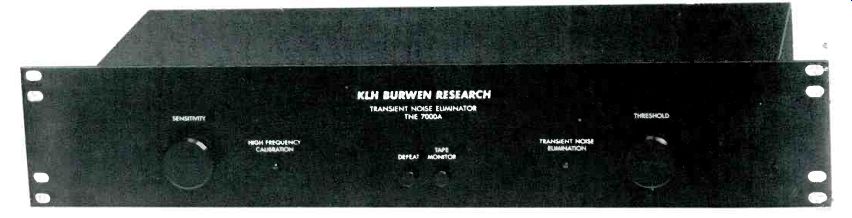
Burwen is one of the current innovators of the audio industry, and it is always interesting to see what he his going to come up with next. His Model TNE7000 Transient Noise Eliminator (his term, not ours) is simple enough looking on the outside. There are only two rotary controls, one labeled Sensitivity, the other Threshold. Between them, at panel center, are two pushbuttons, one for defeating the noise eliminator circuitry, the other for tape monitoring (which controls appropriate tape-out and tape-in jacks on the rear panel, replacing those that may have been used up in connecting this device to a stereo component system). An indicator light next to the sensitivity control is identified by the words High Frequency Calibration, while a symmetrically positioned indicator near the threshold control is identified as a Transient Noise Elimination indicator.
The rear panel of the TNE7000 has the required pairs of input and output jacks plus the aforementioned tape-out and tape-in jacks.
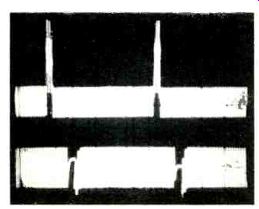
Fig. 1--Synthesized transient "clicks" in the upper, input waveform, are effectively suppressed by the Burwen TNE7000, as shown by the output wave form (lower trace).
Burwen's Approach
As explained in the instruction manual, musical transients and unwanted noise transients are sufficiently different in character so that they can be differentiated from each other even though both are present in a composite signal. According to Burwen, musical transients have an attack time of around 2 milliseconds with a decay time that can last from between 0.1 to several seconds. Transient noise attack time is much faster, varying from 50 to 200 millionths of a second with a duration of no more than 0.002 seconds. Transient noise also contains high energy in the ultrasonic frequency region from 20 kHz to 50 kHz, where there is virtually no musical content.
Transient noise elimination in the TNE7000 consists of two steps, detection and elimination. The system detects pops and clicks by their high energy content in the super-audible region. The entire signal is switched off until the transient has passed and, during the off time, a smoothly varying signal is substituted so that the listener will not detect an absence of signal. Off time is only between 80 and 600 millionths of a second. A time delay of 40 millionths of a second is inserted in the signal path to give the detector time enough to detect the transient and suppress it by means of the signal-off switching circuit.
The TNE7000 uses steep-slope high-pass filtering, full wave rectification, and a high-speed pulse detector. The system involves high-frequency pre-emphasis ahead of the switch, complementary de-emphasis afterwards, sampling and holding of the low frequency content of the music, phase matching and switch spike cancellation.
In using the device, one starts out with both the Threshold and Sensitivity controls at minimum (counterclockwise) positions. The Threshold control is then used to adjust the sensitivity of the detector circuit to music and to ticks and pops in the presence of high-frequency program information, while the Sensitivity control adjusts the sensitivity of the detector circuit to high-frequency program information. This control is advanced (while program material is playing) first until the high-frequency calibration LED indicator is only dimly lit.
The threshold control is then adjusted, primarily by ear, to the maximum setting that does not cause audible distortion.
As this control is advanced, the Transient Noise Elimination LED will begin to flash on and off each time a tick or pop is "removed." To make the flash appear bright enough to be observed, the duration of the light pulse may be more than 200 times the actual time the audio is turned off internally to eliminate the pulse sound.
Static Measurements
Only a few bench measurements were made on our sample of the TNE7000, since such a device is best evaluated under actual use conditions. We did confirm the following: Harmonic distortion at 20 Hz measured only 0.01 percent decreasing to 0.006 percent at 1 kHz, and increasing to 0.05 percent at 20 kHz. Response was flat within ±0.5 dB from 10 Hz to 23 kHz, and gain was indeed 0 dB or unity. Noise at the output measured 90 dB below a referenced level of 0 dBm (0.775 volts), and maximum output before encountering clipping distortion was in excess of the 7 volts claimed.
In an effort to demonstrate graphically what the TNE7000 can do, we concocted a repetitive signal with the aid of an audio oscillator and a square-wave pulse generator. The input signal, is depicted in the upper trace of the 'scope photo of Fig. 1: The fundamental sinusoidal frequency was 10 kHz, and while we realize that the square wave pulse had a repetition rate which was lower than that (note that a couple of 10 kHz alternations fit inside of each pulse in the upper waveform of the photo), we hoped that the steep rise time of the pulse would confuse the TNE7000 into believing that it was of a higher basic frequency and qualified for "instant removal." As you can see by the lower trace of Fig. 1, measured at the output of the TNE7000 with absolutely no "doctoring," our hopes were more than justified. The spikes of the pulses are gone, and in their place there appears to be the "smooth transitional waveform" of which Mr. Burwen speaks in his instruction manual. Frankly, we were as proud of our synthesized "ticks and pops" as we think Burwen ought to be concerning his uncannily clever Transient Noise Eliminator.
Listening & Use Tests
Fortunately for us (and for the user), Burwen is honest enough to tell us what the TNE7000 will not do as well as what it can do. Specifically, he warns against trying to clean up records that are heard as broadcast from a stereo FM station. It seems that the sub-carrier products that spew forth from most FM tuners and receivers (19 kHz, 38 kHz, etc.) will confuse the device and desensitize its detecting circuitry. It will also be ineffective with mono signals (such as AM), since it senses the difference between left and right channels as it does its thing. However, plugging into only one channel of the device when listening to mono would solve that problem. Finally, the TNE7000 will not be as effective or sensitive when subjected to program sources played back on a tape deck because of the loss of high frequencies through the tape recorder (the high frequencies that are used to differentiate between musical transients and the unwanted click and pop kind). That left us pretty much confined to record playing, but we had no trouble at all finding an ample supply of tick and pop-laden discs in our collection. Our available sources of clicks and pops, moreover, were sufficiently diverse to enable us to check out everything from minute "static-sounding" clicks all the way to "knife-blade gouge" types and everything in between.
Let us say at the outset that really severe scratches are not completely eliminated by the TNE7000. They are, however, much diminished in intensity and become devoid of that awful high-frequency splatter that typifies them under ordinary listening conditions. Their diminution is in no way ac. companied by any alteration in overall musical tonal balance that is detectable by these ears. While earlier pop and click eliminators were most effective on the knife-gouge type of scratch in record, the TNE7000 is most, in fact, totally effective on the most subtle (and much more prevalent) types of ticks and pops that plague so many of our records. Since these types of pops predominate in my record collection, at least, I would vote for the TNE7000 over earlier models which failed to suppress these disturbances but worked marvelously on the mightier clicks and pops.
One final word about discs ...
If you still own some CD-4 records (left over from the age of four-channel quadraphonic sound), remember that they contain frequencies up to 45 kHz and will not be helped much by the TNE7000, considering its operating principles. Even so, that left me with countless records that were helped by the Burwen device, and I'm quite certain all you readers must own at least a couple right?
--Leonard Feldman
(Audio magazine)
Also see:
KLH Model Fifty-Two Stereo Receiver (Equip. Profile, Aug. 1973)
= = = =