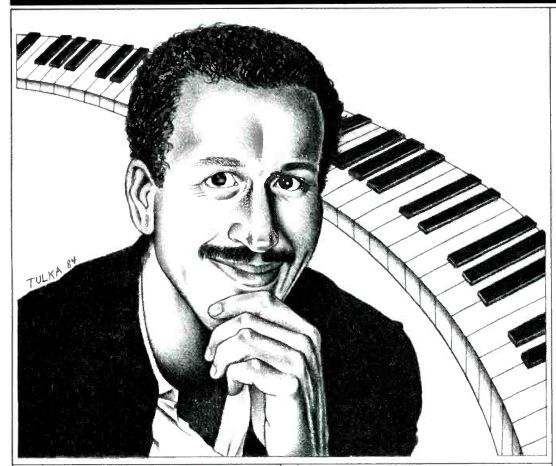
KEITHBOARD ARTISTRY
The Köln Concert: Keith Jarrett ECM 1064-2.
When's the last time a piece of popular music brought tears to your eyes with its breathtaking splendor? Well, be prepared and get your hanky out when you put Keith Jarrett's The Köln Concert on your Compact Disc player.
In truth, you won't be weeping throughout, for in between its moments of sheer majesty and introspective beauty, this recording swings, rocks, drifts and soothes.
Jarrett is nominally a jazz musician, although his work defies true categorization. (The New Schwann, that venerable reference guide to recordings, has listed him in its classical category.) This concert recording of a 1975 performance at the Opera in Köln, Germany catches Jarrett in one of his most accessible modes, weaving beautiful melodies throughout a typical freeform performance. There is a wonderful ebb and flow to this material, as Jarrett drifts along in the wash of a lovely introspective pattern, then builds subtly and slowly to a swelling crescendo from which he smoothly descends to the next melodic well.
Although this is a solo piano concert, Jarrett's music has moments of such density and richness that the memory retains the impression of an orchestrated piece. In contrast, there are also passages of such shimmering delicacy that they seem to have been created in the listener's mind and not by a musical instrument at all. Such a moment occurs about a third of the way into the first piece, when a last, deep piano note reverberates and fades, leaving a hazy cloud of sound into which a quick, light arpeggio is tossed like a glittering handful of silvery fairy dust.
The recording is ECM splendid. It is crystal-clear, with an impeccable sense of space; just the sound of the audience applauding conveys an accurate aural impression of the size of the hall. Hats off to the producer, once again ECM's brilliant Manfred Eicher, and to the engineer, Martin Wieland.
Surfaces are, of course, pristine, and those all-important stretches between distant, thoughtful notes are blessedly silent.
One problem here has nothing to do with the technical handling of this CD. Keith Jarrett, like a few other instrumentalists who become totally engrossed with their work (the late Glenn Gould comes to mind), has a habit of accompanying himself vocally. His subdued but audible whoops, howls, and groans of delight may prove distracting to some listeners. Personally, I enjoy hearing the artist get so lost in his own performance.
Although this CD offers more than 59 minutes of Jarrett at Köln, it is missing the fourth side of the original two-disc vinyl album. For faultless, durable sound, stick with the CD. For seven more minutes of Keith Jarrett's exquisite pianism, get the double vinyl set as well. Paulette Weiss
Max Steiner: Film Score for King Kong. The National Philharmonic Orchestra, Fred Steiner.
Southern Cross SCCD 901.
Max Steiner was unquestionably one of the finest composers of film scores from the '30s through the '50s. The hallmark of a fine composer for the film medium is, of course, the knack for integrating the score into the action of the film itself. Not much film music can stand on its own in an expanded concert presentation, and the very attributes that make it good for the film may militate against it in the concert hall.
The exception, of course, is the symphonic synthesis, often done by someone other than the composer, which presents highlights of the score in a condensed form 8 or 10 minutes in length. If you recall the immensely successful film music series on RCA conducted by Charles Gerhardt, you know what I have in mind.
For anyone except the real film buff or Steiner devotee, there is simply too much King Kong here. Otherwise, the music is beautifully played, and the recording engineering and production are excellent.
John M. Eargle
Mountain Dance: Dave Grusin. GRP D-9507.
Have a drink. Grab a handful of nuts or pretzels. Chat with a friend. Put Dave Grusin's Mountain Dance on your CD player. Listen, sip, talk, listen, nibble. Get the picture?
Mountain Dance will not exactly command your full attention. The tunes are attractive, the recording-another rare pop original digital master-is excellent, but, despite the obvious technical competence, both in musicianship and studio-to-disc processing, there's little here of real substance.
The cuts are uniformly pretty, varying in tempo and intensity from the introspective Grusin acoustic piano solo, "Thanksong," to more up-tempo boppers like "Captain Caribé." With the exception of the somehow thin "Rag Bag," with its skinny, whining synthesizer accents, the recording is technically excellent throughout; the CD captures delicate textures and textural contrasts, lovingly reproduces the wide variety of sounds the keyboards and synthesizers whip up, and gives real definition to aural space and instrumental placement.
Grusin and company dared to record live, direct to a two-track digital format. This meant forgoing the remixing step on which most pop records depend for final balancing, diminishing and/or eliminating mistakes, and generally perfecting the final product. Give Grusin a pat on the back for his bravery. Then have another drink. Have a pretzel.... Paulette Weiss
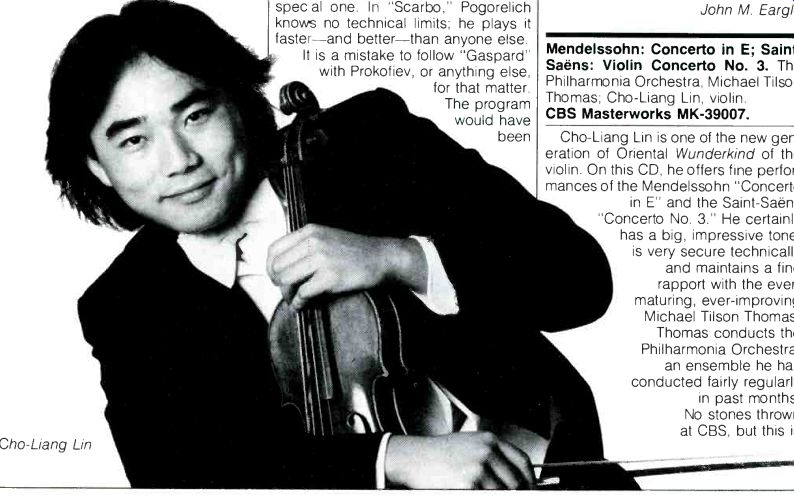
Cho-Liang Lin
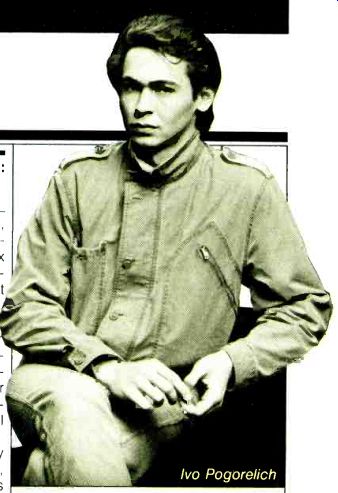
Ravel: Gaspard de la nuit; Prokofiev: Sonata No. 6. Ivo Pogorelich, piano.
Deutsche Grammophon 413 363-2.
The sensational young Yugoslavian, No Pogorelich, has been raising eyebrows for a few years. His unorthodox interpretations at the prestigious Chopin Competition a few years ago split the panel of judges down the middle and resulted in his failure to qualify.
While there may be certain norms for performing Chopin, Ravel and Prokofiev allow for a bit more experimentation. In the case of the three poems for the piano in "Gaspard," the unorthodox approach brings out more detail than I had thought possible.
"Ondine" starts out at what many would call a practice tempo; however, the musical line remains pliant. As things build in complexity, the tempo gradually increases. By the time the cascades in thirds arrive, Pogorelich is well up to speed, and the figurations ripple as you may have rarely heard them.
"Le Gibet" is given a more usual treatment, but Pogorelich's skill in half pedaling makes the performance a spec al one. In "Scarbo," Pogorelich knows no technical limits; he plays it faster-and better-than anyone else.
It is a mistake to follow "Gaspard" with Prokofiev, or anything else, for that matter.
The program would have been better planned with Ravel all the way, ending with "Gaspard." Pogorelich handles the asperities of Prokofiev's writing without any unusual insights, and I found the performance less than convincing.
The piano is given a big hall sound, which fits the music perfectly.
Recommended for the Ravel.
-John M. Eargle
Mendelssohn: Concerto in E; Saint Saëns: Violin Concerto No. 3. The Philharmonia Orchestra, Michael Tilson Thomas; Cho-Liang Lin, violin.
CBS Masterworks MK-39007.
Cho-Liang Lin is one of the new generation of Oriental Wunderkind of the violin. On this CD, he offers fine performances of the Mendelssohn "Concerto in E" and the Saint-Saëns "Concerto No. 3." He certainly has a big, impressive tone, is very secure technically and maintains a fine rapport with the ever maturing, ever-improving Michael Tilson Thomas.
Thomas conducts the Philharmonia Orchestra, an ensemble he has conducted fairly regularly in past months.
No stones thrown at CBS, but this is an English recording, with an EMI balance engineer at the controls, and, frankly, it is of much better quality than most domestic CBS recordings. The solo violin is moderately forward in its projection, but it is never obtrusive.
Balances are generally good, and the sound is very clean and in a fairly spacious ambience.
-Bert Whyte
Girls with Guns: Tommy Shaw, A&M CD 5020 DIDX 138.
I never much cared for Styx as either a river or a band, but I really do like Tommy Shaw's solo debut, Girls with Guns. Mr. Shaw, Styx's ex-lead singer and songwriter, proves himself an intelligent, talented rocker. He has created a balanced albumful of slam-bang cuts and softer rock ballads, all with memorable melodies and arrangements, as well as lyrics that actually communicate coherent thought. I'm very much taken by the passionate tenderness that underlies the intensity of his vocals. I never noticed this quality when he was a member of Styx; maybe it was always there, maybe going solo set it free. Maybe I'm just in love. In any case, this 1984 album is high on my short list of discs to listen to again, in between the flood of new albums I'm supposed to review.
The hit title song is an exciting opener that crashes out of the gate at breakneck speed and doesn't stop until it slams to an abrupt end at the finish line. Shaw's got a way with guitars as well as girls, and lots of both is how he likes it. His work with acoustic guitar, six- and twelve-string electric guitars, and mandolin shines through with searing power on "Come in and Explain," with firm elegance on "Kiss Me Hello," and with simple folksy sweetness on "Little Girl World." The arrangements and subtle special effects are inventive. I'm particularly fond of the use of overdubbing and echo on Shaw's expressive voice, which is applied and removed both to place his vocals tangibly in aural space and to emphasize the meaning of a lyric (the reverberated stretch added to the word "shout" in "Kiss Me Hello," for instance). Synthesizers buzz thinly against massed instrumentals, and tubby bass drums thump in marvelously restrained punctuation.
There is a tendency on the part of producer Mike Stone to bunch instruments up into his own version of Phil Spector's famous "wall of sound." This makes for an interesting CD transference problem, once again involving an analog recording that seems to have been made unclear deliberately for rock 'n' roll effect. The instrumental masses are quite blurred and muddy, with little of the crispness that usually comes across so well on a Compact Disc. Sibilants, in particular, are smeary and distorted, as is the extended hiss of a cymbal. True, the A&M Compact Disc version of this recording has wonderful silences between cuts, from which each song emerges with explosive power. However, the songs themselves are so chockfull of sound that there are very few silent spots to admire within them. (The brilliant and effective dead pause on "Kiss Me Hello" is one notable exception.) Whether a slight added clarity and a guaranteed extended playing life are worth the higher price tag of CD over LP is ultimately your decision, one rock fans rarely get to make with new recordings like this. Girls with Guns is one of the few pop CDs released at approximately the same time as the original LP, a move major record companies make only when they're absolutely certain that they're dealing with a hot artist. According to all reports, Shaw is heading up his own personal rock 'n' roll heat-wave here in the chill of early winter. As for me, I'll take the CD and send Tommy Shaw a big box of chocolates and a mash note.
-Paulette Weiss
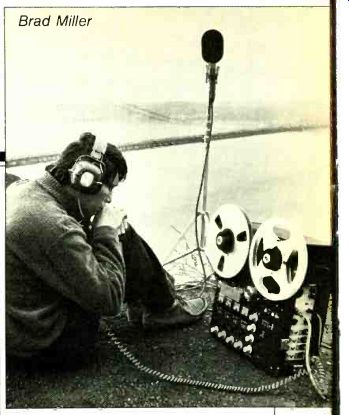
The Power and the Majesty, Vol. II: Brad Miller
Mobile Fidelity Sound Lab MFCD 812.
Mobile Fidelity got its name from the remote environmental recording activities which Brad Miller presided over in the '60s and '70s. More recently, it has become known for prestige reissues of best-selling product licensed from other record companies.
In this second volume of The Power and the Majesty, Miller has gone back into the field, this time armed with the latest gear, to record some of the most demanding sound sources that exist -- steam locomotives. He made four channel, original recordings which were then mixed down to two-channel format for LP and CD purposes. (One suspects that he has in mind a quadraphonic release at some date in the future.) The dynamic range is stupendous, and you had better start off at low volume until you have taken the real measure of your system and its capability of handling extremely low frequencies at high levels.
About the program itself, unless you are a train devotee, you will find it hard to sit straight through the disc's full playing time. There are many long and arid stretches, but when the locomotives do roar by, stand back!
-John M. Eargle
Bartók: Bluebeard's Castle. The Hungarian State Opera, Janos Ferencsik.
Hungaroton HCD 12254-2.
I looked forward to this CD with much anticipation. Bartòk's early opera has a particular kind of magic that can only be described as Magyar, which is inherent in the music as well as the Hungarian language itself. (The old Walter Berry/Christa Ludwig collaboration with Istvan Kertesz on English Decca captured this magic so well.) "Bluebeard" seemed such a natural for Hungaroton, but, alas, it is not the case here.
The problem is the two soloists. Instead of real Hungarians, we are presented with Russians. Not Russian voices of the Boris Goduonov sortbut voices of the Soviet type! The dialog between Bluebeard and his latest wife, Judith, comprises the entire opera, and to hear it carried out in rough,
declamatory style is simply not right.
Even the Hungarian language doesn't help; it might as well be Russian.
In purely recording terms, the production is excellent, but I really can't recommend this CD on musical grounds.
-John M. Eargle
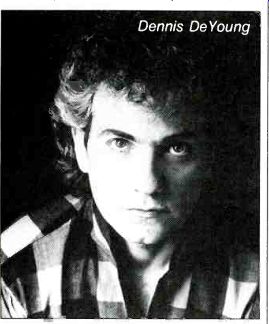
Desert Moon: Dennis DeYoung. A&M CD-5006 DIDX 82.
1984 was the year Styx shot soloists out onto the pop charts, and the bullets were flying fast and furious. The big hit for ex-Styx keyboardist and vocalist Dennis DeYoung was "Desert Moon," the title song of his first solo album.
This poignant ballad of innocence and first love was accompanied by a video remarkable for its romantic restraint, considering its potentially sappy, sentimental subject. Restraint may be the key descriptive term for this entire recording as well, as becomes apparent in the Compact Disc version released at approximately the same time as the analog LP. This is a nicely eclectic gallery of songs. The energetic opener, "Don't Wait for Heroes," rocks along with some neat keyboard action on an attractive tune from DeYoung's own hand. With its tongue-in-cheek, male, doo-wop vocal chorus: precious. all girl backup vocals, and white-boy street rap from DeYoung, "Boys Will Be Boys" pokes fun at the "forever young in the summertime" rock genre. The basic rock line on "Suspicious" is shot through with jazz inflections, from its
lightly swinging chorus backup to DeYoung's bluesy but bogus synthesized harmonica. DeYoung has a dead-center sense of humor that appears throughout the album; it comes through wonderfully in both the musical arrangements and lyrics of "Gravity." Against the celestial "born born born" of a heavenly chorus, DeYoung rocks out with a line about wanting to climb Mount Everest but "... that mountain's so steep/I know my nose will bleed, 'cause gravity don't sleep/It don't sleep." Where the aforementioned restraint becomes obvious is in the production and execution of some of these intelligently arranged and attractively melodic tunes. The clarity of the Compact Disc version exposes a production job just a shade too staid for the material.
There is an adequate sense of aural space but little imagination used in spatial presentation. Most vocals and instrumentals cluster at mid-center.
There are, indeed, forays into split channel effects; instruments do not necessarily occupy the same aural location through all eight cuts, and a peppering of electronics-like the stretching of the vocal chorus on "Fire" and the very subtle secondary delayed echo on DeYoung's vocal in "Boys Will Be Boys"-do add extra interest. However, there's a general lack of power here, a subdued quality to DeYoung's vocals and to many otherwise fine instrumental passages that may speak of his inexperience as a producer.
The CD's sparkling-clear sound is evident from the rock-solid opening drum that rolls out on the disc's first cut, to the last fading note of the saxophone that closes out the final cut, "Dear Darling (I'll Be There)." This is one of those borderline CDs. Whether you shoot the works on the more expensive digital package or set your sights on the less costly analog disc, you'll wind up with a satisfying solo first from Dennis DeYoung.
-Paulette Weiss
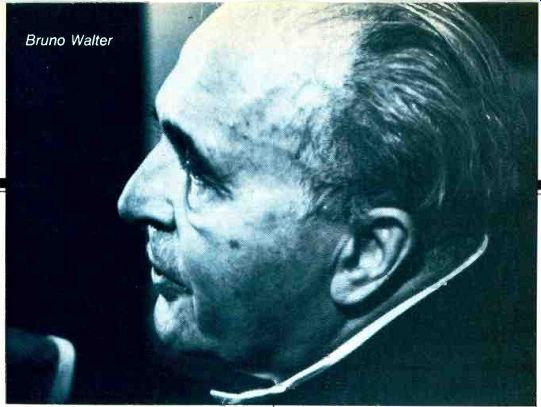
Mahler: Das Lied von der Erde. The New York Philharmonic Orchestra, Bruno Walter; Mildred Miller, mezzo-soprano; Ernst Haefliger, tenor.
CBS/Sony 35DC 115. Mozart: Symphonies Nos. 36 and 38. The Columbia Symphony Orchestra, Bruno Walter. CBS/Sony 35DC 74.
CBS/Sony is embarking on a noble project, the reissuing on CD of the vast bulk of Bruno Walter's stereo catalog.
Whenever possible, they are going back to the original half-inch, multitrack master and mixing directly to a new digital two-track format. By multitrack, of course, I mean the original threeor possibly four-track source tape. Furthermore, the remixes are taking place under the supervision of John McClure, the producer of the original sessions.
What is amazing here is just how clean and quiet some of these 24-year old master tapes can be! I suspect that source tapes of similar quality exist in the vaults of RCA, EMI and Decca, among others, and I hope that they follow this important precedent.
The Mahler was recorded in Hollywood in April 1960, presumably while the orchestra was on tour. The recording venue, again presumably, was the American Legion Hall on Highland Avenue, where so many of Columbia's West Coast classical recordings were made.
Walter pioneered the music of Gustav Mahler, long before the great Mahler rebirth of the mid-'60s, and it would probably sadden him to hear today's typically overblown performances.
Walter was such an even hand with these rich and easily overstated scores that his recordings stand today as the models of how this music should be conducted.
Only when the music is played back at elevated levels does the tape hiss of a quarter-century ago become apparent. There are occasional traffic rumbles which serve to tell us how little things have changed over the years.
The production is very simple by today's multi-mike standards-and that is all to the good. Some of the older microphone designs were a bit brighter at the high end than today's models, and that can often be noticed.
Otherwise, the recording beats most of what is typically done today.
The Mozart symphonies were also recorded in Hollywood, during late 1959 and early 1960. The Columbia Symphony Orchestra was the name given to a group of freelance musicians assembled for Columbia's West Coast classical recordings. The sound is clean and the production technique simple. Would that more of today's recordings had the natural sheen to the strings that these recordings exhibit.
Heartily recommended!
-John M. Eargle
===================
ADs:
Consumer Information Series--BOSE.

VCR: stereo or hi-fi?
You can hear the difference.
by Dr. William R. Short-Project Engineer
The first article in this series discussed the importance of audio in your video system. As a fellow videophile, I want to elaborate on that topic, especially since there seems to be much confusion about the difference between stereo VCR and hi-fi stereo VCR. When video tape recorders were first introduced, the engineering emphasis was on picture reproduction quality. After all, there was nothing new about recording audio on magnetic tape. In the first VCR tapes, a very narrow track-about half the width of a track on a standard audio cassette-was allotted for audio. To make matters worse, VCR recording speed was about half the 1 1/4 ips used in audio cassette recording. Naturally, the sound quality was not very good.
When VCR's became available for home use, audio quality still was not of major concern. One reason was that people used their VCR's primarily for "time shifting" network programming (frequently broadcast with poor audio quality) for subsequent viewing.
Today, however, VCR audio quality is playing a larger role. The advent of stereo TV, music videos and a wider selection of prerecorded material provides better listening options. And, of course, the sound capabilities of VCR hardware have kept pace with developments in software, in both VHS and Beta formats.
Actually, the first advance in VCR sound came when manufacturers divided the sound track into two channels for stereo recording. While this was an improvement, using the same overall track width to hold twice the amount of program material resulted in a noise level that was twice as high as before. The inherent limitations of the track width demanded further research.
Comparison of VCR and Hi-Fi VCR Tape Formats.
On conventional stereo. or 2-channel, videocassettes. sound is recorded on two narrow tracks located at the edge of the tape.
Bose has spent the last 20 years developing unique Direct/Reflecting speakers-components that are capable of filling your entire listening room, not just a limited section of it, with exciting, lifelike sound. It may be the "widescreen sound" you experience at the movies . . . or the rich sonic ambience that surrounds you in the concert hall...
On new hi-fi stereo videocassettes, sound is recorded across nearly the entire width of the tape. using methods which allow simultaneous recording of video within the same area.
At last, big breakthroughs in VCR sound were realized with the creation of hi-fi stereo tapes and decks-first Beta Hi-Fi, then VHS Hi-Fi. Both systems use nearly the entire width of the tape for audio signals, without affecting video signals which are recorded across the same area.
The true significance of these technological advances is the dramatic improvement they can make in your home entertainment experience. But the full potential of the technology cannot be realized unless every component in your system measures up to stringent standards. And, speakers are the components that must meet the highest standards, since they ultimately must reproduce the recorded sound.
We invite you to experience Bose speaker sound at any of our authorized dealers. They are now playing the Bose Music Video-a hi-fi VCR program which demonstrates the breakthroughs we've discussed. We think you'll enjoy hi-fi VCR. And we think that Bose speakers will help you enjoy it the most.
Dr. Short holds an Sc. D. in Electrical Engineering from MIT
Covered by patent rights issued and/or pending.
Copyright 1984. Bose Corporation. All rights reserved.
(Audio magazine)
More music articles and reviews from AUDIO magazine.
Also see:
Classical Record Reviews (Jul. 1990)
Sony D-5, Portable COMPACT DISC PLAYER (March 1985)
= = = =