Company Address: One Sony Dr., Park Ridge, N.J. 07656.
When I first encountered this smallest of all CD players, I had to force my way through a crowd of enthusiastic audiophiles who were attending the 1984 Japan Audio Fair. Meanwhile, back in the United States, Sony had elected to introduce this amazing little product at the same time as it was being introduced in Japan. That in itself tells you how important Sony felt this product was going to be.
There are several significant breakthroughs involved in the design of the D-5. First and foremost, it is a very low-cost unit, carrying a suggested retail price of less than $300. Second, this CD player can be plugged into a high-fidelity system or used on the move with an optional battery pack/carrying case (costing $49.95) and optional stereo headphones of your own choosing.
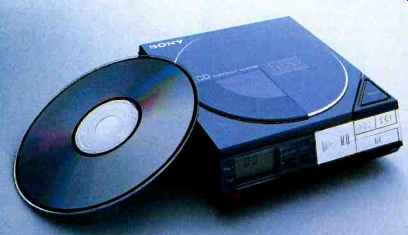
Finally, the D-5 is actually smaller in width and depth than the plastic case in which CDs are normally packaged; it measures only 5 inches by 5 1/4 inches.
The height of the player is a mere 1 1/2 inches, and it weighs slightly more than 1 1/4 pounds.
Despite its low cost and small size, the D-5 performs very much like its heavier and costlier counterparts, though it lacks the programming and random-access features which have constituted the major differences between one CD player and another.
Nonetheless, the most important display and access features have been retained, and, of course, the superb performance inherent in the CD format has not been sacrificed in any way.
The D-5 incorporates a digital liquid crystal display which lets you know what track is being played, how much time has elapsed on a given track, and, at the press of a button, the amount of time remaining on the entire disc and the number of tracks remaining. In addition, there is a battery condition indicator and two other LCD indications: One for "AMS" (Automatic Music Sensor) and the other for music "Search" or audible fast-scanning of a disc's contents.
After pressing the "Open" button on the D-5's top surface (in the corner), a disc may be loaded directly onto the turntable. A special safety switch automatically disengages the D-5's mechanism whenever the loading door is open. All other controls and the display are found on the player's front. These include a time remaining button for the display, a "Mode" button (which toggles between the "AMS" and "Search" functions), a toggling play/pause button, a power switch, a stop button, a continuously variable headphone volume control, and a mini stereo-headphone jack. A line-output jack (also a stereo mini type) and a d.c. input terminal are on the rear of the D-5. An a.c.power adaptor which delivers 9 V in the correct polarity is supplied, but the battery contained in the optional case, or an optionally available car-battery cord, could also be connected at the d.c. input terminal.
When the battery case is used, it must be loaded with six C-size alkaline batteries whose life is approximately 5 hours at normal listening levels. Rechargeable nickel-cadmium batteries may also be used with the optional battery case. Charging time for these would be around 15 hours, with fully charged nickel-cadmium batteries supplying around 2 1/2 hours of playing time.
Much of the engineering that made Sony's car CD players possible has also been applied to the D-5. For example, a single-chip, high-density VLSI has been used for primary digital functions and for simplified and stabilized player functions. In addition, the miniaturized laser-optical assembly found in the Sony car CD players has also been used.
Basic performance of the D-5, as might be expected, is very much like that of Sony's car CD units (one of which, the CDX-R7, I measured and reported on for the July 1984 issue). Sony has, so far, continued to use steep, analog, output filters which cut off above 20 kHz, but response up to that frequency is extremely flat. The usual low distortion and high separation figures can be expected from this player. Output via the line-level jack is approximately 1.6 V, not unlike the voltage levels one expects from a larger table-top or shelf-mounted CD player.
Use of 32-ohm headphones, such as those recommended by the manufacturer, results in a maximum power output from the phone jack of around 10 mW per channel-enough to drive some of those new high-efficiency stereo headphones to more than adequate sound levels.
In my hands-on tests, I found that the D-5's controls operated reliably and positively and that sound quality was as good as that obtained from any of the larger Sony CD players.
The D-5's optional carrying case Because of Sony's efforts at creating small, portable music sources such as the famous Walkman, it was inevitable that the D-5 would be greeted in many circles as the "Walkman CD." In fact, Sony emphasizes that this product is not in the Walkman category: It is not intended as a product to be carried on a belt loop by morning joggers. The elaborate stabilizing techniques used in Sony's car CD players have not been incorporated in the D-5 (nor does Sony claim they have been); therefore, if you bounce the unit around too much when a disc is being played, it will mis-track. What Sony did intend for the D-5 was that it be used on a fairly stable surface-at home, walking (not jogging), in the park, on the beach, or wherever else you happen to be when you crave noise-free music reproduction of wide dynamic range. That being the case, Sony seems to have succeeded admirably with its D-5 CD player.
Leonard Feldman
Sony. The one and only.
(Audio magazine)
More music articles and reviews from AUDIO magazine.
Also see:
Classical Record Reviews (Jul. 1990)
= = = =