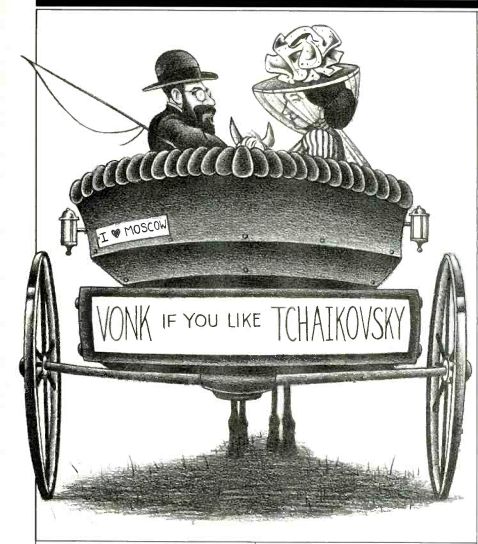
Tchaikovsky: The Nutcracker. The Dresden Staatskapelle. Hans Vonk. Capriccio 10071/72, two-disc set.
Carl Maria von Weber: Ouverturen. The Dresden Staatskapelle. Gustav Kuhn. Capriccio 10052.
Pachelbel: Canon. New Bach Collegium Musicum of Leipzig, Max Pommer; Ludwig Guttler, trumpet. Capriccio 10046.
Over the years, recordings from the superb Dresden and Leipzig orchestras have appeared in U.S. record catalogs. In recent years, however, these ensembles have taken a back seat as classical labels bank more heavily on orchestras and conductors with wide international appeal.
During the early '80s a few Denon audiophile import LPs showed just how good things were, musically and technically, in East Berlin, but it has remained for the CD to bring us a wealth of newly recorded material using the most up-to-date digital techniques.
The continuing shortage of CDs has spurred the importing of product from everywhere, just to keep the bins full, and many small European labels are cropping up. One of these companies is Delta Music GmbH, of Konigsdorf, West Germany, whose Capriccio label is engaged in a number of joint ventures with VEB Deutsche Schallplatten, the state-run East German recording company.
Three Capriccio releases have recently arrived, and they are well worth raving about. The most ambitious of these is Tchaikovsky's The Nutcracker ballet, complete on two CDs. Minimal miking emphasizes precise spatial localization of every section of the ensemble. At the same time, there is enough air and sheen about the sound to satisfy anyone. If we can speak of both the structure and the texture of sound, then this recording has them both in equal measure. The venue was St. Luke's church in Dresden; the acoustics are well managed and never get in the way of the music.
The playing is sensitive and straight forward, and the niceties of Tchaikovsky's orchestration are reproduced with a naturalness that seems to be all too rare in this age of overproduction.
Producer Bernd Runge and engineer Eberhard Hinz both deserve special credit for their fine work, as does Hans Vonk, a conductor previously unknown to me. This is a recording not to be missed! Another Dresden Staatskapelle re cording, this time conducted by Gustav Kuhn, is a collection of overtures by Carl Maria von Weber. While it is easy to dismiss these works for what they may lack in emotional dimension, we must take note of von Weber's importance in the evolution of German opera and his conception of the overture as a summary of operatic action. Included here are the well-known "Euryanthe," "Abu Hassan," "Oberon" and "Der Freischutz" overtures. Lesser known are those of the operas "Preziosa," "Beherrscher der Geister" and "Jubel." As before, the recording venue was St. Luke's church and Eberhard Hinz was the engineer. The sonics are equal to those of the Tchaikovsky.
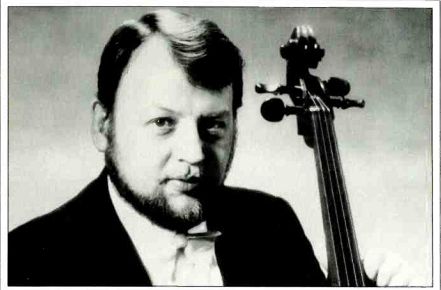
Despite its name, the third Capriccio CD is actually a Baroque sampler, containing 17 assorted movements from concertos and cantatas of various composers (including the ubiquitous Pachelbel "Canon"). The performing group is the New Bach Collegium Musicum of Leipzig conducted by Max Pommer. If there is a featured performer here, it is the trumpeter Ludwig Guttlier, whose facility with the various Baroque trumpets is the equal of any soloist active in the West. The group is made up of members of the Leipzig Gewandhaus Orchestra, and the playing is first rate.
All of the Capriccio CDs come with notes in three languages. but the type is quite small and you may have trouble reading it. These superb recordings are distributed in the U.S. by De los International. John M. Eargle
Shostakovich: Cello Concertos Nos. 1 & 2. The Bavarian Radio Symphony Orchestra. Maxim Shostakovich; Heinrich Schiff. cello. Philips 412 526-2.
Virtuoso cellist Yo-Yo Ma gave us a superb performance of the Shostakovich First Cello Concerto on a CBS CD, MK 37840. It was coupled with the Kabalevsky Cello Concerto, a tuneful and ingratiating work which becomes more impressive after a few hearings.
This new Philips CD logically couples the Shostakovich First Cello Concerto with the Second. The Second Concerto has not yet become a staple of the cello repertoire; in fact, this is the only recording of it currently available in any medium.
Heinrich Schiff's performance of the First Concerto is as virtuosic as Ma's, but he takes a different approach to the work. With his somewhat lighter tone and the benefit of a lovely, very open and transparent sound, there is more delineation of the music's rich sonorities. Schiff achieves a wonderful rapport with conductor Maxim Shostakovich, son of the composer. Maxim's reading is very vigorous and emphasizes the rhythmic and dance--like elements of the score. Shift's cello is re corded with a slight prominence which displays the ravishing tonal qualities of his instrument. Inner balances are well handled, and there are some glorious horn passages which soar with thrilling effect in the spacious ambience of Munich's Herkulessaal.
The Second Cello Concerto has unique scoring that often gives it a mysterious, otherworldly quality, alternating tender lyricism with a sort of wistful melancholy. The finale is very dark and brooding and ends on a sustained diminuendo tone, accompanied by a variety of sharply percussive effects played at fairly low level at a more distant perspective.
Wonderfully evocative performances, splendid playing from the Bavarian Radio Symphony, and compellingly natural sound add up to a most desirable CD.
-Bert Whyte
Telemann: Horn Concertos. The Academy of St. Martin-in-the-Fields Iona Brown: Hermann Baumann, horn. Philips 412 226-2.
A new digital recording, made in London in February 1984, this absolutely delightful CD is outstanding for its clarity and its superb balance among strings, horns and harpsichord in a warmly resonant ambience.
Hermann Baumann, on principal horn, is a virtuoso player. In fact, he performs these ingratiating concertos in the manner of the original scoring, which is without "stopping"-putting a hand inside the bell of the instrument.
The resultant sound is very well projected, with a big, brassy, gutteral quality. In the "Concerto in D Major" which begins this recording, the two other horns are equally well reproduced. Conductor Iona Brown elicits some splendid playing from the always eloquent Academy of St. Martin-in-the-Fields orchestra.
Four horn concertos and a horn suite may be a bit too much for nonstop listening. Sampled individually, they can be most tasty musical hors d'oeuvres!
-Bert Whyte
Primitive Love: Miami Sound Machine. Epic EK 40131.
The Miami Sound Machine blew in from southern climes and burned a hot little hole in the radio airwaves with its first major-label single, "Conga." The exciting Latin percussion blew away the cooler sounds of British and Brit-
influenced American rock and set even staid hearts fluttering and stodgy old feet tapping.
Gloria Estefan's solid, sophisticated vocals blaze out on cuts like "Conga" and "Primitive Love" and waft out gently on delicate ballads like "Words Get in the Way" and "Falling in Love (Uh Oh)." The hit "Bad Boy" has been encouraging young men all over the country and beyond to think naughty thoughts about lead singer Estefan, whose good looks only exacerbate the situation.
This Compact Disc version of the analog original sizzles with the passionate music encoded within. The jugle of percussive effects that bring the 10 cuts to pulsing life are captured crisply and cleanly, running the dynamic gamut from timbales to congas to sweet, silvery chimes. There's a lot of fancy electronic effects here, as vocals are accented and punched into the foreground, synthesizers sweep through the background like banks of stringed instruments, percussion and voices are shifted forward and back.
left and right. Although the layering be comes very complex and lush in spots.
individual instruments rarely get lost. In general, this is a very exciting, excel lent production job.
I do have minor quibbles with some production choices here: The trumpet too often is pulled too far into the back ground and sounds weak and wimpy as a result; ditto for the whistle that opens the title track. I like my Latin trumpets brassy and blaring, and my disco whistles shrill and piercing-but I guess that's just me.
The CD's extended dynamic range is used to superb effect here. The sense of aural space and movement is excellent, and the ever-glorious digital silences are a perfect launching pad for the percussive explosions of the Miami Sound Machine.
Pour yourself a tall, cool, iced Passion Punch, put on your sunglasses, and flip on the old air conditioner be fore you tangle with Primitive Love. It's hot, hot, hot.
-Paulette Weiss
Diva, Original Soundtrack Recording. Music composed and conducted by Vladimir Cosma.
Ryko RCD 10010.
Jean-Jaques Beineix's mod, glossy thriller had a significant cult following a few years back; it even had a few de fenders among the more notable film analysts. It is, I suspect, those partisans who will be interested in this disc; for all its sonic excellence and technical sheen, it seems to me essentially rather like the film-much ado about very little. Hollow and affectless, it resembles the demimonde it implicitly criticizes. And Vladimir Cosma's score is apposite. It has something for every musical taste.
The patina of sophistication, per haps designed to fool the listener/viewer into thinking he has reached the Realms of High Art, is provided by the opening cut: The famous aria for soprano from Catalani's La Wally. It is here sung correctly but without much feeling by Wilhelmenia Wiggins Fernandez. After that, the composer plays his "Sentimental Walk," which is virtually a carbon copy of the Erik Satie "Gymnopedies." For the rock-music devotee, there's rock-thriller music; for the Orientalist there are numbers ("The Zen in the Art of Bread and Butter," if you can believe that) with chaste percussion and alto woodwinds; there s also some high-tech chase music for those accustomed to TV's movie of the week ("Metro Police" it's called, and about as original as the title suggests).
In a total of 12 numbers there are several rearrangements, and by the time the disc stops you may not be sure what the heck its spirit was.
The digital recording is superb, the separations clean, the orchestrations aptly lush. But unless you were a devotee of the film, I suspect one hearing might he more than sufficient.
-Donald Spoto
Different Light: The Bangles. CBS 40039.
The Bangles are better musicians than The Go-Go's were, but as yet they have confined their material to the same arena of preoccupations as that other girl group did, i.e., clothes and high-school style romance.
On Different Light lead vocals (as well as writing chores) are split among the four band members. Their voices work very well together in a sugary, pouty style of singing that the height ened clarity of the CD brings into sharp, sweet relief. When they all chime in at once, hearing the fullness of the sound is like being rushed by a phalanx of angelic Amazons.
Against The Bangles' own service able accompaniment, producer David Kahne occasionally adds a breathtaking string or keyboard arrangement that makes the most out of the basic pop stock. The effect-filigree against burlap-presents new possibilities in both the fashion and recording worlds.
Although there's plenty of sustain from various instruments and a generous presence of voices, enough space is left for the CD's extensive dynamic range to shine. On songs without a constant background wash, each note of finger-picked. scratched or muted guitar confidently juts out to add a flattering rhythmic edge to the music. Exceptional care has been taken with the percussion, from top to bottom. On "Walk Like an Egyptian," the tambourine and maracas sparkle like a belly dancer's beads; on other cuts, the envelope of the bass drum consistently brings to mind a quickened heartbeat.
It's sad to say that the album's brightest gems are all covers, including the Prince-penned "Manic Monday" and Jules Shear's poignant "If She Knew What She Wants." The Bangles' exuberance, freshness, and affection for the lighter side of life, however, make them worth attending to, like a trip to 31 Flavors.
-Susan Borey
Vivaldi: The Four Seasons. The Taverner Players. Andrew Parrott: John Holloway. violin. Denon 38C37-7283.
Although the classical repertoire is expanding very rapidly on CD, in such a new format the music of many com posers is not available at all, or has only token representation. Nor are we talking about esoteric, little-known music, but much that certainly is considered to be in the standard repertoire.
Of course, the record companies can hardly be blamed for trotting out all the famous "old warhorses" and as sorted other chestnuts for the most basic of reasons-they are sure-fire sellers! Granting this, would you believe that this fine CD recording of Vivaldi's The Four Seasons is the 15th version to appear in the fledgling format? My quibble about this is that 15 versions are a bit much for even the most dedicated devotee of CD and Vivaldi to sort through. Surely a half-dozen recordings by acknowledged masters of this music should be enough? Instead of more redundant versions, the concentration should have focused on the gaps in the classical repertoire.
Be that as it may, this CD joins the Hogwood/L'Oiseau-Lyre and Ozawa/ Telarc recordings as one of the most musically and sonically satisfying versions of this ingratiating music. The Taverner Players are a group of exceptionally talented musicians who perform on original instruments or copies of same. Andrew Parrott, their founder and conductor, has had the benefit of studying under such luminaries as Claudio Abbado, Sir Colin Davis and even Leopold Stokowski. In fact, in his finely wrought performance of this work, the very expressive string playing is reminiscent of Maestro Stokowski's renowned string sound.
The engineer who recorded this music is Britisher Tony Faulkner. Tony, one of the best classical recording engineers in the business, espouses the use of such "purist" mike techniques as Blumlein (coincident figure-of-eight) or M/S (figure-eight/cardioid "middle-side"), although he has recently been using a pair of the new Bruel & Kjaer omnidirectional condenser mikes. He achieves a lovely, clean sound, with precise localization and a lot of depth, all clothed in the warm ambience of Rosslyn Hill Chapel in London.
Considering the superb performance and the musical realism of the recording, I'd say this Denon CD is the recording of choice for Vivaldi's great "Four Seasons" score.
-Bert Whyte
Tchaikovsky/Mendelssohn: Violin Concertos. L'Orchestre Symphonique de Montreal, Charles Dutoit; Kyung Wha Chung. violin. London 410 011-2.
Kyung Wha Chung recorded these same two violin concertos for London/ Decca early in her career. If I recall, this was in the early '70s, and her interpretations were very well received.
In this splendid new digital recording, her performances clearly reflect growth and maturity as a violin virtuoso of international renown. She has al ways been secure in the technical mastery of her instrument. Now she adds a new dimension to her artistry with her richly expressive playing and deeper involvement with the music.
Engineer John Dunkerley has developed a recording technique which fully exploits the fabulous acoustics of St. Eustache Church. This is evident from the notable series of recordings he has made with the Montreal orchestra in this locale, and he has provided Kyung Wha Chung with a recording of equal stature. It is a very natural, open sound, yet it never lacks in orchestral definition. The violin is projected just forward of the orchestra and clearly reveals the richness of the artist's tonal resources.
Dutoit's Montrealers get better and better, and his accompaniment for the violinist is nicely balanced, displaying a good rapport between these artists.
How nice to have this kind of wonderful music making on CD, where the high harmonics of the solo violin will remain pristine and audible forever, instead of expiring at the grinding stylus/ groove interface of a vinyl disc! If you are fond of these two great staples of the violin concerto repertoire, you will find this CD particularly rewarding from both musical and sonic viewpoints.
-Bert Whyte
Zoolook: Jean-Michel Jarre. Disques Dreyfus FDM CD-18118.
Sound: A- Performance: B +
Fans of the "space orchestra" that Jean-Michel Jarre created on his hit Oxygene will be surprised by Zoolook, an album that seethes with primal rhythms and ethnic atmospheres. Using the latest in digital sampling technology, namely the Fairlight CMI and Emulator, Jarre creates a global dance orchestra, and his instruments are vo cal sounds from around the world.
Jarre sampled people speaking and singing more than 20 languages, edit ed them into phonetic fragments, re processed them in his synthesizers and placed them at his fingertips on the keyboard. The result is a colorful and dynamic recording that is well served by this CD, which unveils the many layers of Jarre's arrangements.
Instead of album-length epics, Zoolook contains discrete tracks exploring a variety of textures and moods. "Ethni-color" is a slow-motion panorama with droning choirs and voices calling out at the borders of intelligibility.
Bassist Marcus Miller locks in and rips into a dark funk, prowling beneath the wail of jabbering, syncopated voices and swelling synthesizers. Jarre's punchy Linn Drum programming and Miller's catchy bass lines approach hip-hop dance-ability at times, as on "Zoolookologie." Laurie Anderson puts in an appearance on "Diva," imitating a digital keyboard playing her voice.
It's the kind of technological contradiction that Anderson thrives on.
Jarre still has a penchant for corny melodies, a pop sensibility that recalls the '60s Moog ditty "Popcorn." But when he's operating on the plateaus of rhythm and sound, he's exhilarating.
The CD format heightens the textural interplay that Jarre is best at, weaving together digital sounds, digitally sampled sounds, and analog sounds into a recording that smashes electro-acoustic distinctions.
-John Diliberto
================
Advertisement:
TELARC THE HIGHEST STATE OF THE NEWEST ART. TELARC CD PORTFOLIOS--THE CLASSY WAY TO START A COMPACT DISC COLLECTION.
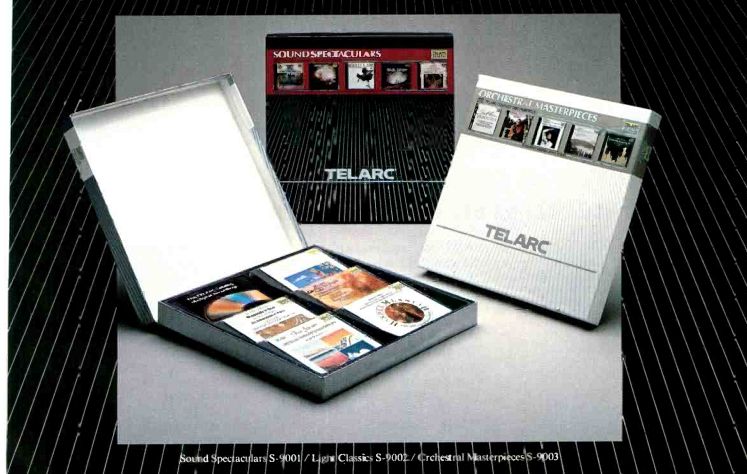
With Telarc's CD portfolios, giving a friend-or yourself-the gift of music is easier than ever.
Each portfolio includes five spec-ally selected Telarc CDs of first-rate performances. Sound Spectaculars puts a system to the test with such selections as Tchaikovsky's "1812 Overture?' Light Classics features favorites like Vivaldi’s "The Four Seasons:' Orchestral Masterpieces offe7s some of the grandest music ever, including Beethoven's "9th Symphony." Don't wait, give the gift of a Telarc CD portfolio today.
= = = =
Also see: