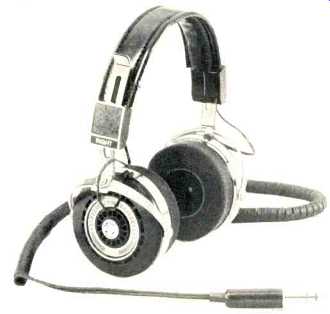
MANUFACTURER'S SPECIFICATIONS: Elements: 50-mm dia. (2 in.) Decilite dynamic, velocity operated. Source Impedance: 157 ohms at 1 kHz, designed to operate with source impedances of 3.2 to 600 ohms. Frequency Response: 15 to 20,000 Hz. Sensitivity for 100 dB SPL: 0.9 V rms, sine wave, at 1 kHz; 0.5 V rms pink noise. THD: Less than 0.5% at 1 kHz, 100 dB SPL. SPL at 1% THD, 1 kHz: 108 dB. Power Handling Capability: 5 V continuous. Cord: 3-conductor, coiled, 3 meters (10 ft.) extended. Earcushions: Soft acoustical sponge. Headband: Extendable, with self adjusting, pivoting yokes and soft, padded vinyl cover. Weight: 285 grams (10 oz.) less cord. Price: $49.95.
The Manufacturer's Specifications section above just about tells the entire story, since there is very little more that can be said. However, some additional details may be interesting to the reader. For example, the foam pads are doughnut-shaped, 2 3/4 in. outside diameter with the "hole" opening 1-5/16 in. diameter, and the depth is 3/4 in. The color is dark drown, matching the brown plastic cups which have a shiny chromed trim ring. The cups are vented both in back and around the sides, which accounts for the low isolation from external sounds. The cups themselves are 3 inches in diameter and are held by a double swivel, permitting full adjustment to the wearer's ears. The extendable portion of the band has detents to ensure that it remains in the selected position. The band itself is a sturdy steel strip, vinyl covered, with the detent mechanism encased in molded plastic terminations of the band. The cord is dark brown in color, miniature in dimension, and is coiled in a very compact form, with the three leads terminating in a detachable plug, rather than a molded one which is difficult to replace if ever one wants to change to some other form of plug. The d.c. resistance of each phone was measured at 148 ohms in the maximum-volume position and 869 ohms in the minimum-volume position, indicating that the level control is a series resistance, which would be a distinct advantage if the phones were to be used on 600-ohm circuits. The impedance of the single phone was measured at 240 ohms. Weight is specified as 10 oz. for the phones, less cord, though the cord and plug add only another 3 oz. to the total.
Measurement Method
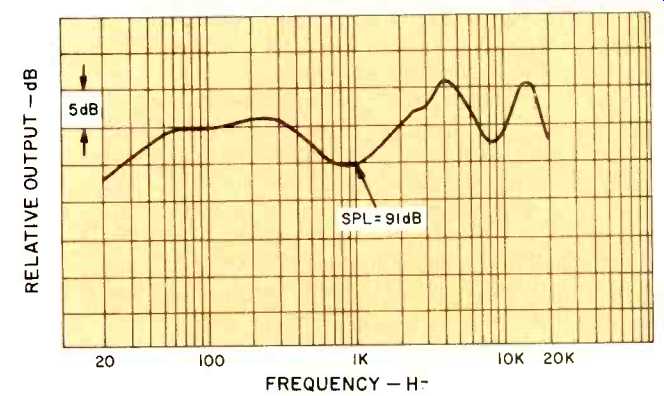
Fig. 1-Frequency response of Koss HV/1A stereophones.
Determining the performance characteristics of headphones is a fairly complicated project. The phones must be coupled to a microphone by means of an artificial ear of specific characteristics-and here there is a difference of opinion. In general, the cavity between the microphone diaphragm and the headphone diaphragm is specified as 6 cu. cm for headphones and 2.5 cu. cm for hearing-aid phones. For some years, this observer has used a shop-built artificial ear which gets modified occasionally in striving for improved performance. The "ear" consists of a maple block 5 1/2 inch in diameter and 6 1 inches long-about the dimensions of the average head as far as spacing goes.
Through the center is a 3/4-in. hole to accommodate an AKG C-451E condenser microphone, and on the front is a B & K metal adapter. The microphone is inserted just far enough to provide the 6-cu. cm cavity. The microphone-suitably modified for single-ended use rather than for the phantom powering normally used-has its output fed into the proper receptacle on a graphic recorder, the Justi-Meter III. For a frequency run, the source is the B & K QR-2009 test record, which has a sweep from 20 to 20,000 Hz, and it's equalized in such a manner that it can be reproduced "flat" with networks using R and C elements, as is the case with Justi-Meter III. The record is reproduced, and the output fed to an amplifier with the signal terminated by the amplifier's normal load resistance. The signal is adjusted to 3.0 volts, and the headphone driven from this 3-volt signal through 100 ohms-about normal for receiver headphone jacks.
Frequency runs are made for both phones, and a second measurement is made by reproducing a 400-Hz square wave through a loudspeaker and with the headphones off the "ear," the output of the microphone is measured. The phones are then placed on the ear, and the output again measured. This gives the isolation, in dB, with the phones on the ear, as compared with the signal without the phones.
There are many uses where a high degree of isolation is desired, as where one is recording in the presence of a live source, and airborne sound from the source should be reduced as much as possible in order to hear the actual sound that is being recorded.
Performance
Figure 1 shows the frequency characteristic of the HV/1A phones, averaged between the two phones of the pair.
While that may seem a little unscientific, it is actually almost the way we hear the phones. And besides, the two curves were never more than 3 dB apart over the entire range from 20 to 20,000 Hz-a remarkable feat. Furthermore, these phones offer the best-thus, flattest-response of any that we have measured with the exception of the Koss ESP-9.
Sound pressure level from these phones measured 91 dB with the 3-volt signal applied through 100 ohms, a value which is lower than the loudest ones tested, but still within the ball park. The HV/1A phones are still 3 dB louder than the Koss ESP-9, and to the average user, adequately loud for any normal purpose, though perhaps not loud enough for the rock buff. In any case, they were comfortable to wear for periods up to one hour, at least, and were not tested for more than that at one sitting.
Because of the openings in the cup and the softness of the foam pads, isolation from outside sounds was less than 2 dB, so the phones would not be suitable for recording in the vicinity of the live source, but for simply listening to music, they are excellent.
-C. G. McProud
(Source: Audio magazine )
Also see:
Koss HV/X or HV/XLC headphones (ad., June 1980)