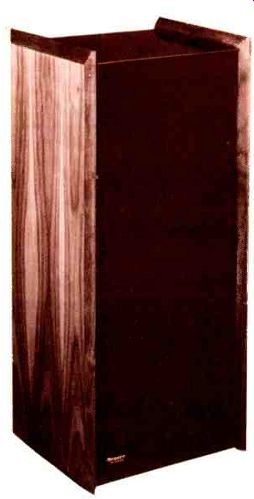
Manufacturer's Specifications:
System Type: Four way, full range.
Woofer: 10 inch.
Frequency Range: 35 Hz to 42 kHz.
Crossover Points: 760 Hz, 6.5 kHz, and 15 kHz.
Nominal Impedance: 8 ohms.
Suggested Amplifier Power: 35 watts and up.
Level Controls: One bass, one mid range, and one tweeter.
Dimensions: 34 in. (86.4 cm) H x 14 in. (35.6 cm) W x 13 in. (33 cm) D.
Weight: 75 lbs. (34.1 kg).
Price: $947.50.
The Nuance, by Fulton Musical Industries of Minneapolis, Minnesota, is a four-way, full-range loudspeaker system.
Standing 864 mm (34 in.) high, this sealed-enclosure system houses a 254-mm (10 in.) Woofer which covers the frequency range from 35 Hz to a crossover at 760 Hz. A 127 mm (5 in.) midrange carries the range up to 6500 Hz, a mid-tweeter handles the next band up to 15 kHz, and a super tweeter takes the response upward to a stated limit of 42 kHz. These individual drivers are staggered back from the front of the enclosure in the now-familiar manner which corrects for the individual time delay of each driver so that a nearly coherent wavefront is present for axial sound.
Connection to the system is interesting in that the user may choose either normal wiring, with all speakers driven from a single amplifier, or bi-amplification of woofer separately from midrange and tweeters. The terminals and connecting straps are available on the rear of the enclosure and a well-illustrated owner's manual explains details of this setup.
Three level controls (woofer, midrange and tweeter) are provided for user adjustment of speaker balance to suit various room acoustic situations and individual sound preference.
Two user-replaceable fuses are provided, a 2-amp woofer fuse and a 1-amp tweeter/midrange fuse.
The enclosure is of walnut veneer, and there is an interesting accent decoration which is utilitarian as well as attractive.
A dark glass plate. with vibration isolators, is placed on the top of the enclosure. The Nuance is just tall enough to be a suitable place on which to set a drink at a party or place a lamp. The glass plate can be readily wiped off, whereas an unprotected walnut top could be ruined. I wish more manufacturers would recognize that speakers get kicked, tipped over, and have drinks placed on them, just as other pieces of fine furniture do. If it's worth this kind of money, it's worth protecting.
The owner's manual is thorough, and most persons should have no difficulty successfully following its instructions to get proper performance from the Nuance.
Measurements
Impedance, measured at the terminals of the Fulton Nuance, versus frequency for two of the equalizer positions is shown in Fig. 1; the designations MAX and MID refer to equalizer settings. The low bass resonance rise at 40 Hz ac counts for the highest impedance, with a second impedance peak around 1 kHz. Above this 1-kHz peak, the impedance drops with increasing frequency, showing no absolute minimum value within the audio range. It drops to 5 ohms at 20 kHz and could possibly indicate amplifier problems if its phase were such as to represent a large capacitive reactance load. Figures 2 and 3 are the polar impedance plots corresponding to the two equalizer positions of Fig. 1. It is evident from the polar plots that the Nuance's impedance, while still dropping at 20 kHz, presents a load that is principally resistive. This speaker system should, for all intents and purposes, be considered an 8-ohm system and should present no load problems to any good amplifier.
The anechoic frequency response, measured at one meter on axis with a drive level of constant voltage corresponding to one average watt into 8 ohms, is shown in Figs. 4 and 5;
Fig. 4 is the amplitude response and Fig. 5 is the phase response. The phase response is corrected for an air-path delay of 3.328 milliseconds. The amplitude response shows reason able smoothness up to 8 kHz, where there is a drop in sound energy; two Nuance units were measured and the responses were essentially identical. The equalizers on the speaker were set to their mid position for these measurements. Although the high-frequency performance in this measurement could be improved by repositioning the measuring microphone directly in front of the tweeter, the one-meter, axial location is the reference position used for all Audio speaker tests and is a position which can be accurately duplicated by any acoustic laboratory. The system is essentially minimum phase be low the cutoff of 8 kHz but departs from this condition above that frequency.
Figure 6 is the result of our three-meter room test. The loudspeaker was placed in its recommended room position and the microphone was placed at a typical listening location, one meter off the carpeted floor and three meters in front of the loudspeaker. The frequency spectrum of the first 13 milliseconds of direct sound from the Nuance is shown in this measurement. Two listener-speaker geometries are shown: A 30-degree off-axis position corresponding to a stereo left-channel speaker situation, and a direct on-axis situation. The two curves are displaced 10 dB for clarity of presentation. This measurement shows a considerable departure between 13-millisecond early sound and the anechoic response of Fig. 4; upper register differences appear due to midrange energy which reflects off floor and ceiling. A more balanced sound will be presented to the listener if the speakers are rotated toward the listening location, according to this measurement, and it may prove helpful to pull up the highest registers by means of preamplifier equalization.
The measured horizontal and vertical dispersion patterns are shown in Figs. 7 and 8 for the MID setting of all equalizers on the speaker. Horizontal response is uniform within 15 degrees of center position, but begins to drop off smoothly for larger off-axis angles. This is principally caused by the fall- off of the higher frequencies due to the narrower directivity pattern of the tweeters. The vertical dispersion pattern is less smooth and shows the effect of housing the time-delay staggered configuration of individual speakers in an enclosure which extends past the units to form a planar front surface for grille mounting. The result is a lobed pattern in the vertical plane. The Fulton Nuance should never be positioned, according to this measurement, such that the left channel of a stereo pair is at a height different than that of the right channel.
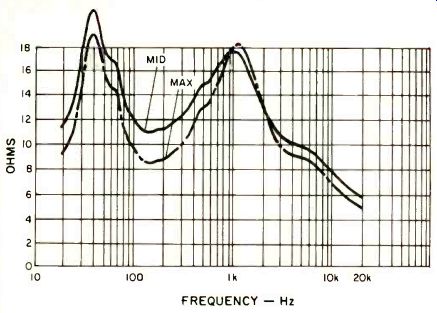
Fig. 1--Impedance at the terminals of the Fulton Nuance with two equalizer settings.
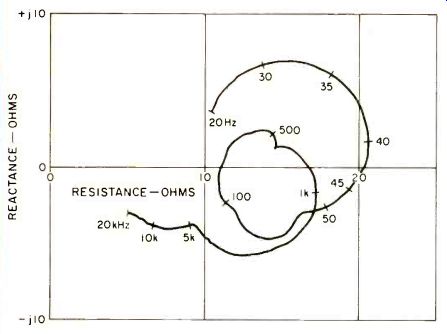
Fig. 2--Complex impedance (reactance vs. resistance) at the terminals with all equalizer pots in the "Mid" position.
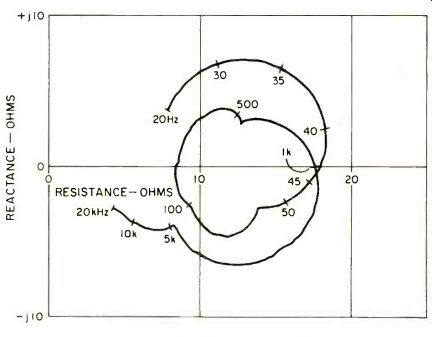
Fig. 3--Complex impedance with all equalizer pots in the "Max" position.
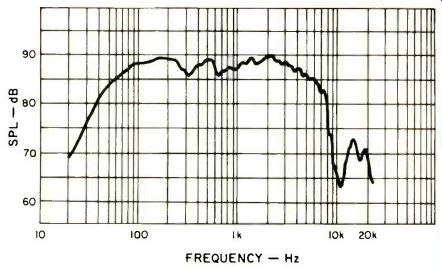
Fig. 4--Anechoic frequency response taken at one meter on the center axis with a constant voltage drive level corresponding to one average watt into 8 ohms; equalizers are in "Mid" positions.
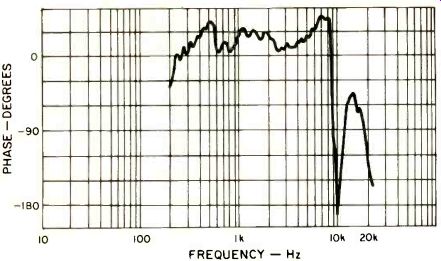
Fig. 5--Anechoic phase response at one meter on axis with "Mid" equalizer settings.
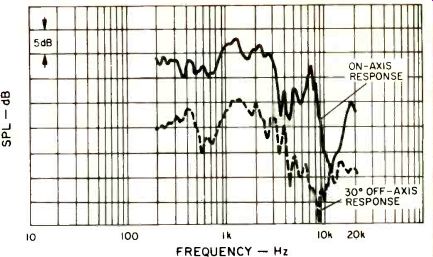
Fig. 6--Three-meter room test.
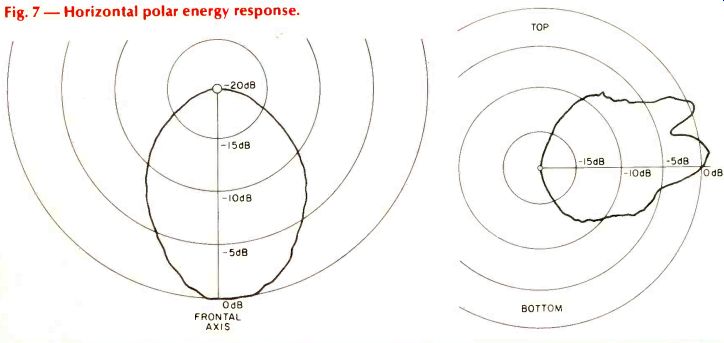
Fig. 7--Horizontal polar energy response.

Fig. 8--Vertical polar energy response.
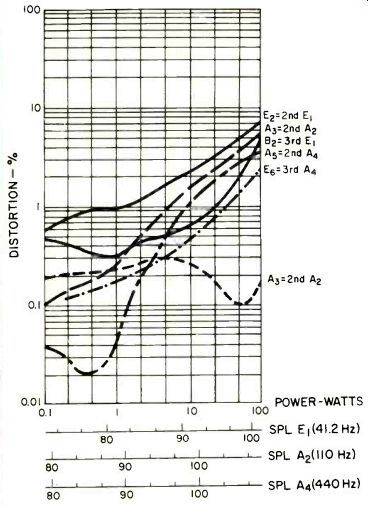
Fig. 9--Harmonic distortion for the musical tones E, or 41.2 Hz, A2 or 110 Hz, and A4 or 440 Hz.
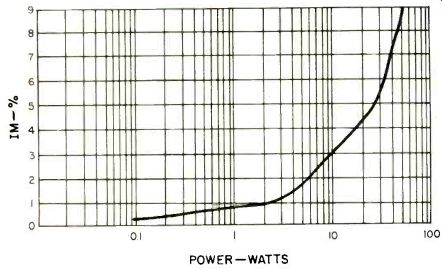
Fig. 10--IM distortion on A4 (440 Hz) by E1 (41.2 Hz) when mixed in a one-to-one ratio.
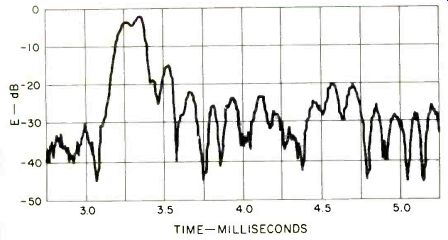
Fig. 11--Energy-time curve.
Harmonic distortion measurements for pure tones of 41.2 Hz (E1), 110 Hz (A2), and 440 Hz (A4) are shown in Fig. 9. This loudspeaker is capable of handling robust power levels with quite low harmonic distortion, even on the low bass.
The IM test, Fig. 10, measures the extent to which a higher musical tone, A4, is modulated by the presence of the lower musical tone, E,. Both tones are mixed at equal level, and the rms value of the sidebands on A4 is shown as a percentage of the acoustic level that A4 would have if the lower tone were not present. The data are plotted as a function of average power in watts referred to 8 ohms. Below 1 watt the modulation is essentially an amplitude variation on A4, with increasing amounts of angle modulation appearing with increases in power level, until at 40 watts there is 10 percent p-p amplitude modulation and 10 degrees p-p angle modulation. At the highest power levels, a small average migration of the acoustic center of sound toward the listener suggests that a small amount of depth and lateral image shift of certain orchestral voices may be experienced at heavy levels of low frequency content, such as kick drum reproduced at high intensity.
Acoustic transfer uniformity is another measure of a loudspeaker's ability to handle program dynamics. In this test, the ratio of sound pressure to driving voltage should remain constant for any tone at any power level within the system's normal range of reproduction. If this ratio changes with drive level, then we can expect both musical timbre and image localization to alter with sound intensity. Four musical tones, C2 (65 Hz), A2 (110 Hz), Middle C (262 Hz), and A4 (440 Hz) were used to check the Nuance. These are tone-burst tests in which a tone is applied for a short duration simulating a staccato passage. The low bass tone of C2 was handled up to 100 average watts with less than a 0.1 dB departure from perfection. Middle C and A2 were essentially perfect up to 2 average watts, then the ratio of acoustic output to applied voltage began to diminish at higher levels. Al was down 1 dB at 20 average watts while Middle C was down 0.3 dB at this level. A4 was down 1.4 dB at 20 average watts (all referenced to an average power of 0.1 watt). This implies that strongly played musical chords will have a mild tendency to dull since the acoustic output of the higher partials will diminish faster with increasing power than that of the lower tones. One might also expect a lateral shift of stereo imaging for sudden, high intensity passages of sound. To place this in perspective, it should be pointed out that these subjective effects will begin to take place above sound pressure levels in the order of 100 dB at one meter from the speaker, a moderately robust level.
Another form of distortion of program dynamics is checked by what we call the crescendo test. A low-level tone is measured for sound level change when a broad-band in coherent noise is superimposed at an average level 20 dB above that of the tone. The intent of this test is to determine the extent to which an orchestral inner musical voice is modified by a sudden swelling of sound from nearby instruments.
The Fulton Nuance does quite well in this test. Less than half a dB of tone change is induced by peak incoherent signals of 300 watts. This means that orchestral shimmy, where solo instruments are blurred and shifted in the stereo illusion by sudden high-intensity ensemble bursts, is essentially nil.
The energy-time curve is a measure of percussive impulse response; the measured curve for the speaker is shown in Fig. 11. The microphone is placed one meter from the front surface of the loudspeaker and along the geometric axis. The first sound commences at 3.200 milliseconds and has a broad peak in the 3.25 to 3.35 millisecond time range. The series of events occurring with periods of around 1.4 milliseconds are repetitive time-domain echoes corresponding to the drop off in frequency response above 7.5 kHz (Fig. 4). This is an effect dictated by the relationship between the time domain and the frequency domain: Namely, sharp edges in frequency response mean sideband ripples in the time response, and conversely. It would be my interpretation of this energy-time measurement that impulsive sounds may have a coloration corresponding to an apparent spectral dominance (or, Per haps, hangover) in the 7- to 8-kHz range, even though the net sound energy was not peaked in this range.
Listening Test
After experimenting with a variety of room locations for the Fulton Nuance, I settled on a reasonably conventional position, slightly away from a solid wall and enclosing a 60-degree angle relative to the listener. This configuration appeared, to my ears, to give the most accurate sound. I also preferred the sound which I got when the Nuances were rotated toward the listening position, which brings up the high-frequency response and seems to improve stereo lateralization of percussive instruments.
Low-frequency performance of these speakers is quite good, and one can get a substantial amount of gut-thumping bass without distortion. The lower midrange is smooth and well balanced with this bass response, though I felt the up per midrange (commencing in the octave above Middle C) is down in level and, from that frequency range upward, not as satisfactory.
There are three level controls on the Nuance--woofer, midrange and tweeter. The midpoint, or 12 o'clock location, is the reference position for these screwdriver adjustable controls. One difficulty I experienced in setting these controls for best timbre balance is caused by irregularities in the vertical response, and there seemed to be no one control setting where there weren't some listening positions that didn't have difficulty in the upper partials. This creates a blurring of the stereo illusion on orchestral strings and causes a stridency in piano and human voice. On material with extremely fast percussion, such as Hot Stix (M&K RT 106), I used a 4-dB boost in preamplifier equalization at 9 kHz to restore what, to me, was a proper sense of snap. All of this, of course, is a very personal subjective impression. Others may find the Fulton Nuance as well balanced in midrange to treble as I did the bass to midrange.
In several other respects, such as the ability to handle large orchestral dynamic range without evidence of strain and de livery of clean, low distorted solo instrument voices at robust as well as soft levels, the Fulton Nuance is an excellent performer.
-Richard C. Heyser
(Editor's Note: Fulton informs us that Nuance speaker systems produced since submission of this pair are wired with some 25 feet of Fulton's high-technology Brown Series wire, which results, they tell us, in a "startling improvement in inner detail of mids and highs. Complementing this is a new higher order crossover, designed to have greater speed," says Fulton, "which provides up to 3.5 dB more energy in the 200 to 800 Hz range, as well as above 7 kHz." Terminal impedance of the Nuance, Fulton also said, is now smoother, a minimum of 7.6 ohms at 20 kHz and above, so that the system is compatible with virtually any amplifier or receiver. The particular nature of the vertical dispersion was an important design goal, says Fulton, in that a properly controlled shape for the vertical polar pattern insures good depth and perspective in the sound field, good sense of height in the stage presence, and proper placement of instruments in their correct size. -E.P.)
= = = =
Also see:
Astatic phono cartridge (ad, June 1981)
Adcom Crosscoil (ad, Feb. 1980)