Dual 1209 automatic turntable;
Wollensak 6154 four-channel tape deck; Altec Lansing 714A receiver;
Barzilay cabinet kit
OUR FIRST QUAD TAPE DECK
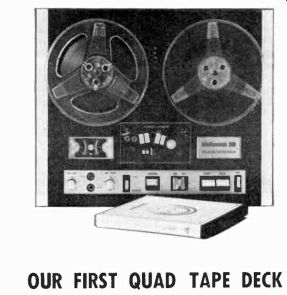
THE EQUIPMENT: Wollensak 6154, a three-speed (7 1/2, 3 3/4, 1 7/8 ips) stereo tape deck with built-in preamps; quarter-track stereo and mono record and playback, plus four-channel or quadriphonic stereo playback. Dimensions: in walnut case supplied: 16 1/2 by 6 by 13 5/8 inches. Price: $499.95. Manufacturer: 3M Company, 3M Center, St. Paul, Minn. 55101.
COMMENT: For the pioneering audio enthusiast who wants to sample four-channel or quadriphonic stereo on open-reel tape (and still enjoy the usual facilities of a conventional tape deck), the 3M Company is offering its Wollensak Quad/Stereo series of which the Model 6154 is the deck version designed for hookup into an external sound system. The unit is, in brief, a home stereo tape machine with two additional playback channels. For quad sound, you connect the deck's four outputs to two stereo amplifiers which drive two pairs of (front and rear) loudspeakers. For conventional two-channel stereo, of course, simply ignore the outputs marked "rear" on the side cf the deck. The unit records in regular two-channel stereo or in mono, and it handles 'eels up to seven inches in diameter.
To listen with headphones, there's a topside jack and a separate headphone level control on the side.
Another useful feature is the 6154's bias switch for suiting the circuits to different kinds of recording tape, the high position being recommended for low-noise tape such as Scotch 203. A special pair of jacks permits input mixing via the left- and right-channel level controls on the front (or top, if you place the unit horizontally) panel. Each of these controls, by the way, must be moved past a detent position to snap on-a safety feature to avoid accidentally recording over an already recorded tape. A press-to-use record button, which must be operated together with the main start button, further ensures against accidental recording or erasure.
For live recording you can plug microphone cables directly into jacks on the control panel. Additional features here include a tape/source switch for monitoring, a stop control, the fast-forward and rewind control, aid the unit's main power switch. Two VU meters, just above the left-hand end of the panel, come on with the power and operate for both recording and playback. Between the tape reels there's a four-digit index counter with reset button. Speed change is accomplished by moving a small slide switch located behind the head cover; this was judged a minor inconvenience. The tape, during record or playback, is held against the heads by pressure pads and a capstan idler which all move into place on their small carriages. Pressing the stop button releases both. There is thus no "pause" or editing control as such. However, you can press the start button and hold it down; this will put the tape in contact with the heads without activating the reels. Then by moving either reel with your other hand it is possible to find a specific passage for editing or splicing-again, slightly inconvenient, but only important to those who do a good deal of their own serious recording.
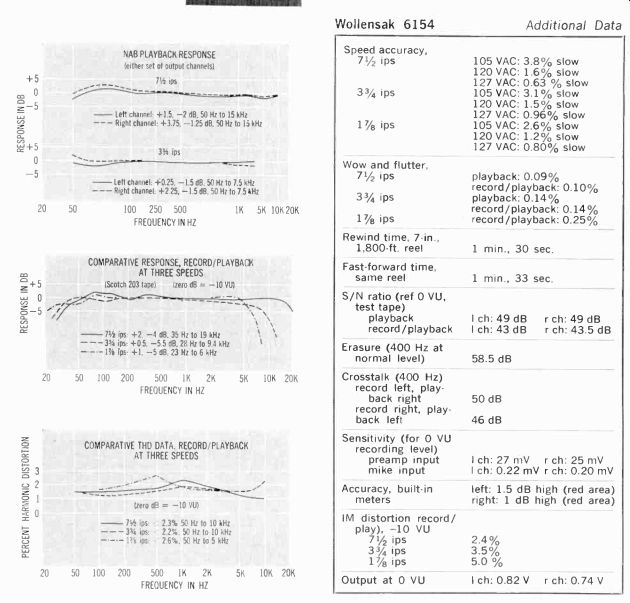
Comparative record/playback response data taken at the unit's three speeds show very good performance at 7 1/2 ips: within plus or minus 3.5 dB from 35 Hz to 20 kHz, with the high end rolling off progressively at the slower speeds. NAB playback response was linear within a few dB at both the 7 1/2- and 3 3/4-ips speeds within the normally tested frequency limits (see accompanying graphs).
Regular tape recorder functions aside, the big thrill with the Model 6154 came when we hooked it up to play four-channel tapes. We ran a set of output cables to one stereo amplifier and connected its outputs to a pair of front left and front right speakers.
We ran another pair of cables to a second amplifier driving a pair of rear speakers. A few adjustments of the amplifier volume controls and we were ready.
The 09-stage brass in the Berlioz Requiem really sounded as if they were coming from far off, through an imaginary hole 'n the side wall. Trick pop arrangements put sound all around us. And so on. Interestingly enough, these sonic-enhancement effects were fully perceptible in what must be classed as an aver age-small room, about 15 by 14 feet. It may be a quirk of irony but it seems to us that the small space of a normal-size room which must accommodate the added equipment needed for quadriphonic sound actually benefits from the added channels to a more dramatic extent than a relatively large room. We have heard quadriphonic sound in rooms ranging in size up to that of a small theater-and it seemed to us that the larger the room, the less overt was the quad effect.
Be that as it may, our romp with the model 6154 demonstrated another thing: open-reel tape is the natural medium for four discrete channels; if quad sound succeeds in other formats-such as cassettes, cartridges, or discs-it will have to match some pretty high audio standards to do so.
The other model in this series, the Wollensak 6364, comes with a built-in amplifier and carrying case at $599.95; the 6364 plus a pair of A-1050 pedestal-mounted speakers costs $659.95.
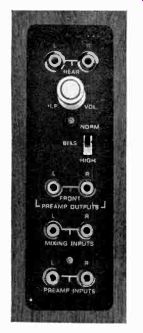
--------------38 Connector panel on Wollensak sports extra pair of Output jacks for rear channels in quadriphonic play back. Front channel jacks also are provided, plus regular inputs, mixing inputs, bias switch. headphone level control.
---------------------------
Wollensak 6154 Additional Data
FEATURE-LADEN AUTOMATIC RUNS AT PERFECT SPEEDS

THE EQUIPMENT: Dual 1209, anautomatic turntable with integral arm. Chassis dimensions: 13 by 10 1/4 inches; add 1 inch to rear and to right for tone-arm overhang; allow 5-inch clearance above and 2 3/4-inch clearance below mounting board. Price: $129.50. Optional walnut mounting base, Model WB-93, $12.95. Manufactured by Dual of West Germany; distributed in the U.S. by United Audio Products, Inc., 120 S. Columbus Ave., Mt. Vernon, N.Y. 10553.
COMMENT: Excellent performance and a host of useful features characterize this recent entry by Dual in the quality automatic record player class. The turntable runs smoothly, silently, and accurately at all of its three speeds (33, 45, and 78 rpm); the tone arm which has adjustments for balance, tracking force, vertical angle, antiskating or bias, stylus overhang, and set-down point-will permit today's ultrasensitive and high-compliance cartridges to track at their aver age-low recommended stylus forces-for instance, 1 gram for the Shure V-15 II Improved or for the Stanton 681EE.
The unit is supplied with a long spindle, a short spindle, and a single-play 45 rpm doughnut adapter.
With the long spindle the 1209 will handle up to six records of the same size and speed for automatic play.
The platter will start and the arm will cue automatically if you move the operating switch to "start." Otherwise you can cue the sequence manually by lifting the tone arm; as you move it toward the record a switch is tripped and the platter starts. Set the arm down wherever desired and you're off and running. To reject a record during play and thereby select the next one in the pile, you also move the switch to "start." A special dodge enables you to repeat the same record indefinitely: place the 45-rpm ring upside down on the long spindle after the record has dropped to the platter.
The short spindle permits the playing of one side of a record at a time; this mode too can be activated, automatically or manually, in the same manner as the long spindle. To stop the turntable in either single-
play or multiple-play mode, you either can move the switch to "stop" (and the arm will lift off the record and return to its rest position), or you can lift the arm manually and do the same thing. During movements of the arm off the record, in either mode, a muting device silences the system. The change cycle (which takes ten seconds) is smooth, flawless, and very gentle on the records.
Thanks to its improved motor, the Dual 1209 has absolute speed accuracy. A strobe disc, supplied with the unit, enables you to adjust the auxiliary or vernier speed control for on-the-nose accuracy at the three-speed settings. CBS Labs found that only one adjustment-at 33 rpm-was required; the other speeds then "locked in" and showed no measurable error at any of the test line-voltages (105, 120, and 127 VAC) used. For those interested, the total speed variation provided by the vernier adjustment at 33 rpm ranges from plus 4.4 percent to minus 3.3 percent-a very healthy allowance 4or this function. The platter weighed in at 4 lb., 7 oz. A nonferrous, one-piece casting, it was obviously well balanced and well mated to its motor and transmission system. Total audible rumble by the CBS standard was well down at-54 dB; aver age wow and flutter an insignificant 0.03 percent.
The arm, like the platter and motor, shows every sign of careful design. A metal tubular type, it is balanced longitudinally by a movable counterweight that has provision for a coarse, and then a fine, adjustment.
The cartridge fits onto a small platform that slips out of the shell when you move the finger-lift back. The plastic gauge and hardware supplied make it easy to install any cartridge with optimum adjustment for stylus overhang (to minimize lateral tracking angle error) and for vertical attitude (to permit the cartridge to track at whatever vertical angle has been designed into it, presumably 15 degrees). No significant change in vertical angle, by the way, occurs from one to six records on the platter. You set tracking force by a dial near the pivot end of the arm; its associated scale is accurate enough to obviate the need for a separate stylus gauge. The scale is numbered from 0 to 5; for these settings, CBS Labs measured the following actual stylus forces: for 0, 0; for 0.5, 0.5; for 1.0, 1.0; for 2.0, 2.0; for 3.0, 2.9; for 4.0, 4.0; for 5.0, 5.1. This same precision is evident in the antiskating or bias compensator, which is another knob on the chassis plate near the arm pivot. Calibrated in two scales (red for conical or spherical tips, black for ellipticals), the settings shown in the instruction manual, which correspond to the number of these scales, were found to be correct-with an elliptical requiring, as it should, slightly more bias than a spherical tip. The arm had a resonance of 6.5 Hz with a 7-dB rise-of no great consequence. Its friction, both laterally and vertically, was negligible, falling somewhere below 10 milligrams.
Only 0.1 gram stylus force was needed to trip the automatic cycling mechanism, which is excellent.
And so Dual has once again come up with a fault less automatic turntable at a competitive price. Not to be overlooked either is the ease with which you can install it: once a suitable cutout is made the unit can be lowered readily into it from the top.
NEW RECEIVER CAPTURES RECORD NUMBER OF STATIONS
THE EQUIPMENT: Altec Lansing 714A, a stereo FM/AM receiver. Dimensions: 16 5/8 by 5 3/8 by 13 3/8 inches. Price: $399. Optional cabinet, Model 42162, $28.50. Manufacturer: Altec Lansing Co., 1515 S. Manchester Ave., Anaheim, Calif. 92803.
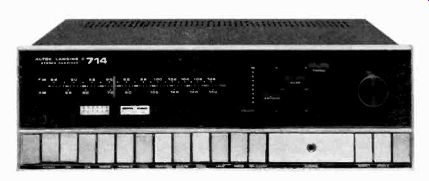
COMMENT: Altec Lansing, a company long known for its high-quality speaker systems and professional audio products, has come up with a splendid stereo receiver that can serve as the heart of a first-rate home music system. The new 714A combines an extremely sensitive tuner with a clean, high-powered amplifier in a handsomely styled format.
FM performance either met or exceeded manufacturer's specifications. IHF sensitivity came in right on the nose at 1.9 microvolts; for an RF input of 1,000 mV, the set reached a quieting level of -43 dB. Distortion was low on mono. rising somewhat on stereo.
Signal-to-noise ratio was excellent at 72 dB; response on both mono and stereo was linear across the audio band, and both channels were well balanced and amply separated for stereo listening. Capture ratio was outstanding at 1.1 dB. In our cable-FM test the 714A easily climbed into the champion class by logging a total of sixty stations, of which forty-five were judged suitable for critical listening or for off-the-air taping. Even without the cable antenna hookup, the 714A-fed only by an indoor folded dipole in a difficult reception area-pulled in no less than thirty four FM stations, of which twenty-two were in the "good to excellent" class. Our past data tells us that this is a new record; we did not realize, in fact, that so many FM stations could be received here without the help of our mountain-top master antenna system.
And for those interested, the set's AM section--in terms of number of received stations and their clarity--impressed us as better than average vis-a-vis the AM sections of other receivers we've tested.
Complementing the tuner section, the 714A's amplifier offers high power, linear response, accurate equalization, very low distortion, and ample controls and features that, in sum, strike us as somewhat more and better than you'd expect in a combination set at its price. Again, the unit's specifications were either met or exceeded in CBS Labs' tests. With both channels driven simultaneously the 714A furnished better than 44 watts on each channel; its bandwidth response for this power level at rated distortion of 0.5 percent ran from below 10 Hz to 30 kHz. Frequency response at a 1-watt level extended within 0.75 dB from 20 Hz to 20 kHz; beyond these limits, it rolled off to -3 dB at 10.5 Hz and at 32 kHz. The square-wave photos reflect the roll-off but show no signs of "bending" or "spiking" in the lows or of "ringing" in the highs. Harmonic distortion curves ran so low that we had to expand the vertical percent age scale of our graph to show their actual values.
No significant rise in THD was found at 1/100th of rated power output (440 milliwatts); THD in fact was consistently below the 0.5 percent specified by the manufacturer under all test conditions. As for IM distortion, at about 0.1 percent for any load up to rated power output, it is hardly worth mentioning.
Sensitivity on all inputs is very well suited for to day's program sources, and signal-to-noise ratio is excellent. The 67 dB measured on the low-sensitive phono 1 input, for instance, is outstanding for a receiver. Like many of the other tested parameters, it begins to suggest the kind of ultrahigh performance you'd expect of a perfectionist-designed separate amplifier. Tone controls, loudness contour, and filter characteristics all were exemplary; disc equalization was highly accurate, providing linear response within plus or minus 1 dB across the 20-Hz to 20-kHz band.
The volume range switch (a useful option for low level listening) reduces the total output by exactly 10 dB, but has absolutely no effect on the amplifier's response-which is as it should be. The completely transformerless audio circuitry is protected by three fuses (one in each output channel plus one for the main power line), and also by a current-limiting circuit that automatically reduces the current to the output transistors in case of overload. Construction and parts, attention to detailing, layout of parts, and dressing of internal wiring all bespeak careful chassis design, and it is good to see such a level of professionalism in home equipment.
Just to really sew it up, A-L designers have come up with an original front-panel style that combine strikingly good looks with a logical and easy-to-use control layout. Controls that are in the "either/or" category are push-to-use types that form a decorative strip across the lower portion of the escutcheon. Controls that regulate amounts of circuit action are in the form of sliders above, to the right of the tuning dial.
The former group includes: power, FM, AM, phono 1, phone 2, aux, tape monitor, high filter, muting, loud ness contour, mono/stereo mode, volume range, speaker 1, speaker 2. Between the volume range and speaker selectors is a headphone jack, live at all times.
The tuning dial blacks out when the set is turned off.
For FM operation, there's both a signal-strength and center-of-channel meter plus a stereo indicator. The signal-strength meter also operates on AM. The sliders regulate volume, channel balance, treble, and bass. To their right is the tuning knob.
The rear contains the inputs corresponding to front-panel selectors. There's also a pair of stereo jacks for feeding signals to a tape recorder. Additionally, the 714-A has a "center-channel" output for driving a separate amplifier with a mono (A plus B) signal. Another option provided is the facility for patching in accessory devices, such as a speaker equalizer, reverb unit, and so on via the "accessory out and in" jacks. Speaker connectors are the spring-loaded type: just strip the lead, press the button, and insert. Two sets of stereo speakers may be connected at once; the front-panel switches choose either, both, or none.
FM antenna terminals accommodate 300-ohm twin-lead; for AM there's a built-on loopstick plus a long wire terminal. A local/distant FM switch also is provided. Two AC outlets (one switched), two grounding terminals, the fuse holders, and the power-line cord complete the rear picture. The owner's manual-clearly written and amply illustrated-includes a de tailed presentation of extra loudspeaker hookups. All told, the 714A is one beautiful piece of audio machinery that should be given a long serious look by anyone in the market for a new, high-quality stereo receiver.
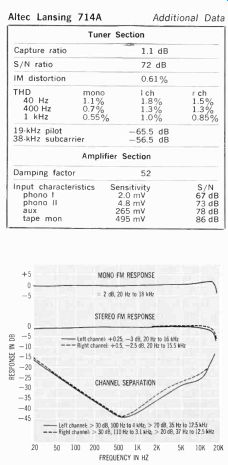
---- Altec Lansing 714A Additional Data
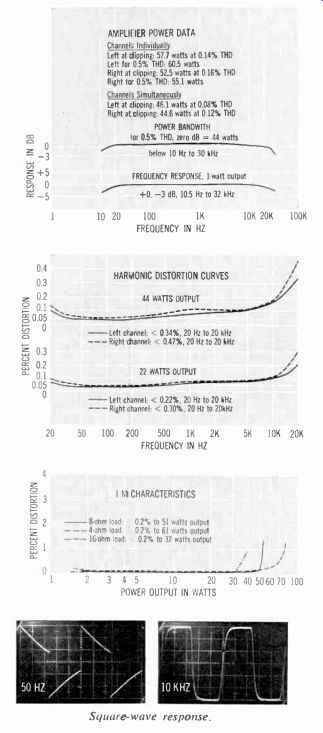
AMPLIFIER POWER DATA" Channel:. Individually Left at dipping: 57.7 watts at 0.14% THD Left for 0.5% BO 60.5 watts Right at clipping: 52.5 watts at 0.16% THD Right for 0.5% THD: 55.1 watts Channels Simultaneously Left at clipping: 46.1 watts at 0.12% THD. Right at clipping: 44.6 watts at 0.12% THD; Square-wave response.
KIT CABINET BOASTS UTILITY AND STYLE
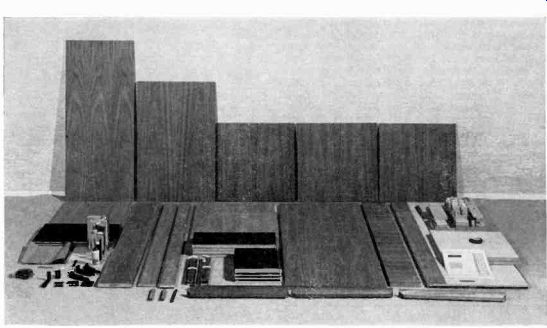
THE EQUIPMENT: Barzilay K-101, an equipment con sole in knock-down form for assembly and final finishing. Over-all dimensions: 58 1/2 inches wide; 19 inches deep; 29 1/2 inches high. Section dimensions: turntable compartment, 18 3/4 by 16 1/4 inches; panel for components including tape deck, 38 1/4 by 16.5 inches.
Price: $179.50. Manufacturer: Barzilay Co., 16245 So. Broadway, Gardena, Calif.
COMMENT: We have always believed that "audio furniture" should consist of something more than a traditionally designed piece that has been cursorily revamped to make room for the equipment while, often as not, its poverty of creative and functional design is disguised by an ornate exterior. There is no real reason why an audio cabinet cannot be attractive while performing utilitarian functions such as: housing and protecting high-performing sound equipment, assisting in the logical arrangement of components to facilitate rather than inhibit their use and enjoyment, providing installation aids such as ventilation and shock-mounting, and permitting the owner to get at the installed units for interchanging connections or for service-removal without the concomitant need for a major demolition job.
Jack Benveniste of the Barzilay Company--a confirmed audiophile and designer who possesses taste and a formidable knowledge of woods and their structural intricacies-is one of a handful of U.S. furniture designers whose work in this area exemplifies these ideas. For years he has been creating equipment housing and storage systems in a variety of styles and shapes which the Barzilay Company has offered in both knock-down and assembled form. A recent offering is the Design Ten series, of which the K-101 is the kit version. What you get is a set of precut pieces, assorted hardware, glue, and finishing materials. What you end up with, after a fair amount of work, is a handsome, versatile cabinet whose soft walnut glow may be all the more pleasurable because it was your hand that rubbed it in.
The K-101 can accommodate any normal array of stereo components, including a standard-size tape deck, turntable, and receiver (or separate amplifier and tuner). If a receiver is used, there's even space on the panel for inserting a cassette recorder in addition to the larger deck-if that's your bent. A lift-up lid covers it all; under it the equipment section is divided between the large sloping panel and the turn table well. The slant of the panel makes it easy to get at the units installed in it; braces, fitted under and beneath, help hold everything in place. The panel over the turntable well may be removed and cut out for direct installation of a turntable, although we preferred to use the base or plinth on which the particular unit used in this setup (the Norelco) is normally supplied. As seen in the photo, it fits the space with room to spare.
Note the three-section front of the cabinet. The center piece is permanently attached to serve as a structural member as well as to hide the chassis and wiring projecting down behind it. The end sections, however, are actually the fronts of huge drawers that can store records, tapes, headphones, and whatnot.
They slide quite easily on heavy-duty bearings; when shut their respective grain patterns all match to present a harmonious appearance, which is further enhanced by the thick walnut strips across the tops.
If you enjoy working with wood and if you gain satisfaction in seeing something useful and good looking grow step by step under your hands, you'll enjoy assembling the K-101. The wood is precut, except for the component panel in which you will have to make openings to accommodate your specific components. This is best done, of course, with an electric saber saw-which this editor enjoyed wielding for a few moments instead of his typewriter. Finishing the cabinet is mostly a matter of patient rubbing and sandpapering; we recommend doing the job on a rainy Saturday, fortified by a hearty breakfast and with your favorite recordings playing. You'll need help when fitting the components into the panel, so prime a good friend for the temporary use of his hands and brawn.
When it's all cone you'll have a perfect right to feel proud for having selected such an excellent cabinet and for having done most of the work yourself. You may even be converted to the notion that ''audio furniture" makes sonic sense, a sort of relating of timber to timbre.
Precut panels (opposite page) form cabinet shown partially completed (above) and fully finished (left). Cutouts must he made in large panel to accommodate components: electric saber sass' is the recommended tool to use. Components are secured to this panel by metal braces and by wooden brackets fitted to interior sides of the cabinet. Turn table or changer may he installed in a separate panel at the right, or simply placed (in its own base) directly on the panel.
Storage drawers at each end under equipment are handy and capacious.
-------------
(High Fidelity)
Also see:
EQUIPMENT IN THE NEWS--The latest in audio gear.
Understanding Tonearms (Audio, June 1980)--part 1
Understanding Tonearms (Audio, June 1980)--part 2
Tone Arm Damping--The Overlooked Feature (High Fidelity, Jul. 1975)
The New Releases, FEATURE REVIEWS--Boulez' fresh view of Pelleas; Shostakovich's 14th-a new protest? Julius Caesar and Handelian splendor.