News and Views: Betamax's home videotape ... New noise-reduction systems ... The lost (headphone) cord.
Breaking the Umbilical Cord Electro-acoustically

There you are ensconced in your stereo headphones as the music incites an irrepressible urge: You just have to get up and dance. A dozen pirouettes later you find-amazingly- that you haven't become tangled in the wire and fallen on your face. That's because you're wearing a new type of headphone, one of several successfully demonstrated in Germany last summer, that does away with cables and transmits audio to the listener via modulated infrared "light." Models from Beyer are newly available in the U.S.; units by Sennheiser, still in prototype, are to be introduced in the near future.
The transmitter portion of each system accepts audio from whatever source the user chooses and modulates an array of infrared transducers resembling a battery of miniature searchlights. The radiation it projects into the room is, of course, invisible. And although infrared is popularly defined as "heat rays," one can barely feel the warmth even an inch or so from the transducers.
Sennheiser cordless headset is self-contained.
The carrier is multiplexed to accommodate the two channels of a stereo source (no, the channels don't re verse when you turn around), and it seems to diffuse through a room well enough to allow one to move around freely without fear of finding dead spots. A Sennheiser spokesman indicates that the useful range of its system (outdoors) has been found to extend up to several city blocks. (But neighbors should agree on whose transmitter will be on.) The Beyer system allows transmitters to be operated in tandem, so that good coverage can be achieved even in large film studios.
The infrared, with a wavelength of 930 nanometers or thereabout, is gated on and off at the carrier-frequency rate (95 kHz in the Sennheiser and Beyer systems), with the carrier itself frequency modulated. Both of these manufacturers offer headsets with integral receiving and de modulating circuitry based on infrared-sensitive diodes.
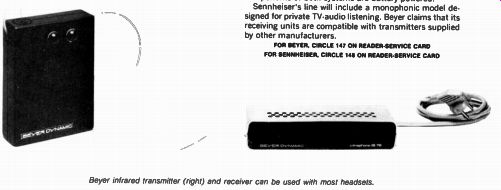
Sennheiser's receiving modules are compatible with its HD-414 and HD-424 headsets. Beyer also offers a non-integral receiver-demodulator (carried by the listener) into which an existing headset can be plugged. The portable components of both systems are battery-powered.
Sennheiser's line will include a monophonic model de signed for private TV-audio listening. Beyer claims that its receiving units are compatible with transmitters supplied by other manufacturers.
Beyer infrared transmitter (right) and receiver can be used with most headsets.
Coming Events
High Fidelity Music Show, Inc., the organization headed by Teresa and Robert Rogers that sponsored the show in Philadelphia last November, has events planned for two more cities in the immediate future. Both are booked into downtown sites-a return from the suburban locations with which the industry has experimented over the last decade.
Detroit will have its show at Cobo Hall from Friday the 13th (lotsa luck!) through Sunday the 15th of February.
The same location was used for the Rogerses' 1974 show, which they called a "smash hit." San Diego gets its turn in March, at the Convention and Arts Center. This-the first "professional hi-fi show" in San Diego, according to the sponsors-opens on Friday, March 12, and runs through Sunday, March 14.
So Who's Tim?
TIM (transient intermodulation distortion) and his friends, phase distortion and difference-frequency distortion, may soon crowd their way into your audio equipment spec sheet and make it yet a little more complicated. All of this is to a good purpose, however: it should make for better sound. B&K (Bruel & Kjaer) Instruments, Inc., of Denmark recently announced new systems designed to measure Equi these effects, which some engineers believe to be more revealing than conventional measurements in terms of correlation to audible sound quality. Look for these elusive effects to become areas of research and development and- finally-competition in the marketplace, probably starting with high end equipment.
DBX Bids for the Inside Spot
The field of built-in noise-reduction systems for consumer tape machines. heretofore dominated by the Dolby B circuit, will be expanded. David Blackmer, president of DBX. Inc., has announced a license agreement whereby DBX noise reduction will be offered in Teac's line of recorders- and in all three formats, open-reel. cassette, and cartridge.
(A full feature article on noise reduction will appear in next month's issue.) Teac's DBX will use the 2:1 double-ended compression/ expansion of units currently sold as add-on accessories.
DBX contends that an improvement in effective signal-to noise ratio of about 30 dB (20 dB more than that claimed by Dolby) is attributable to this system. Increased head room is cited as an ancillary advantage. In addition. the levels set during recording and playback are not critical to the operation of the system: that is, level alignment is not required for correct signal recovery.
------
(High Fidelity, Feb. 1976)
Also see:
Lighter Side: Freda Payne ... Paul Simon ... Elton John ... Barry Manilow