Linear Ban Gets CB Industry Support
The Citizens Radio Section of the Electronic Industries Association recently filed comments with the Federal Communications Commission endorsing a proposed ban on the manufacture and marketing of "linear amplifiers." These add-on devices, which can increase the power of a CB transmitter from the legal 4 watts to 200 or more, are generally considered to be responsible for a large part of the CB-caused interference in home television receivers and audio equipment. In filing its remarks the EIA group noted that sales of such amplifiers to legitimate radio amateurs ("hams") are minimal and incidental. (Hams, with their higher allowable radiating power, can buy bigger basic transmitters and hence don't need the add-on power.) We congratulate the Citizens Radio Section on its en lightened stand and number ourselves among those favoring the proposed rule. Cutting off these pestiferous devices at the source is indeed a welcome prospect provided that an illicit market is not permitted to develop.
We note with some satisfaction that the first prosecution for making and selling linear amplifiers took place in Los Angeles earlier this year and resulted in a conviction. But it is not enough.
From where we sit, it looks like time for the FCC to show that it intends to enforce its rules and for Congress to give it the tools to do so effectively. Local law-enforcement agencies could help too-perhaps by observing vehicles and reporting any extra beefy antenna, cables, or other evidence suggesting that an illegal transmitter is aboard to the FCC. While we are on the subject of antennas and the FCC, why can't the commission demand a power-handling limit (or even an integral, non-replaceable fuse) for these components to thwart over-muscular transmissions? It seems a truism that the direst penalty is no deterrent when the likelihood of apprehension appears remote. The commission has increased enforcement levels, but the effort still has the air of tokenism. Let's stop kidding around.
If peaceful phonographs and untrammeled television for the great majority means the big stick for the outlaw, loud mouth linear operators, then so be it.
Stanton Magnetics' Left-Handed Stylus
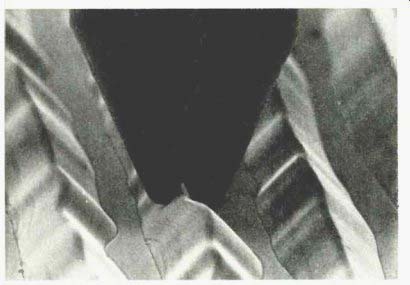
No, it doesn’t require a tone arm suspended from a skyhook, and it doesn’t connect to the preamp via six feet of shore line. It does, however, need a turntable that runs counterclockwise (the opposite of the usual rotation) if the music is to sound normal--and it has a serious purpose. Designed to work with a 681 Calibration series cartridge, the new 681-BPS styli are meant for direct playback of metal matrices and scampers, both of which are "negatives" of the final disc. (That is, they have ridges instead of grooves.) The new stylus design makes it possible to check a matrix before the metal mother has been made from it and, similarly, a stamper without a test pressing. Thus time can be saved in record manufacture and quality improved in the final product.
Model BPSR, which takes a tracking force of 3 to 7 grams, can be used to polish away small flaws that result from imperfect plating. For minimal wear to the matrix or stamper, the BPSM tracks at 1 to 1.5 grams. We suspect that the BPS styli (unlike other Stanton professional products that have achieved status in the home high fidelity market) will have virtually all of its application in the record industry.
For Collectors Only
It's astonishing what gets printed these days. Even ten years ago there was only a handful of dedicated souls publishing esoterica for the specific benefit of record collectors, but the numbers have grown many fold and the variety and reliability of the available materials increased enormously in the interim. Partly, this is symptomatic of what has been happening in publishing in general; partly, it is an index of the degree to which the collecting of antique and arcane recordings has gelled into a recognized and relatively widespread pursuit-not just something occupying a few "nuts." These thoughts are occasioned by our perusal of the 1977 Kastlemusick Directory for Collectors of Recordings.
It costs $12.50 for the forty-odd-page directory plus a supplement. This may seem a bit steep, but considering the limited market and the work involved in preparing the con tents-plus the difficulty of obtaining its information else where-it is not at all unreasonable. It identifies listees as private collectors, stores, mail-order houses, and so on, and gives a brief resume of the special interests of each (such as out-of-print operatic recordings, Edison cylinders and discs, old radio material, new-release LPs of Moravian music). An index covers the more "special" of special interests. There also are listings of publications and associations.
It's easy to pick holes in such a project, and we have found some. But for a first edition (which it seems to be we trust there will be more) it strikes us as an eminently competent job. The wonder is that it ever got published at all, and we're glad it did. (If you're interested, Kastle musick is located at 170 Broadway, Suite 201, New York, N.Y. 10038.)
==============
ADVERTISEMENT:
His destiny was to die in poverty and disappointment.
Yet his genius gave the world some of the most beautiful music ever heard.
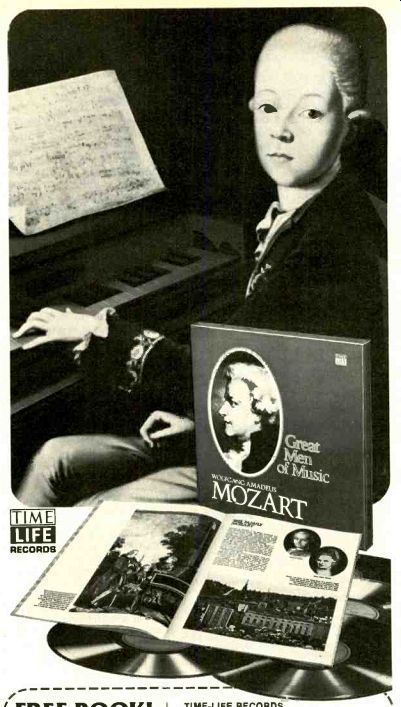
At the age of 6, Wolfgang Amadeus Mozart was the talk of Europe. By the time he was 8, he had sat on the knee of Empress Maria Theresa, delighted the court of George III, and composed four sonatas.
Fame came early but fortune always eluded him and when he died of kidney disease at 35, he was destitute and had to be buried in a pauper's grave.
Yet he left the fickle world an astonishing body of music, ranging, like his life, from lighthearted frolics to epic tragedy... as you will discover in TIME-LIFE's magnificent boxed set on Mozart-the first in a book and record series called GREAT MEN OF MUSIC.
Here is a "connoisseur's choice" of Mozart's creations, recorded in finest stereo sound by artists who have no peer. You'll hear Leontyne Price singing from The Magic Flute... Van Cliburn's rendition of Piano Sonatas Nos. 10 in C and 11 in A...Heifetz's interpretation of Violin Concerto No. 4 in D...
The boxed set on Mozart is only the beginning of GREAT MEN OF MUSIC-an unparalleled collection of the world's greatest music, performed by leading artists of our time. In future sets, you will thrill to the genius of Bach, Beethoven, Tchaikovsky, Brahms, Debussy, Mahler... more than 20 composers in all.
And you'll listen with new understanding as well as enjoyment. Because each set is enriched with a color-filled booklet on the composer's life and times, plus program notes that tell you exactly what to listen for.
Start by auditioning Mozart for 10 days free. You'll receive four 12-inch LP stereo records (the kind which usually retail for $6.98 each) in an elegant slipcase, the background booklet complete with Listener's Guide, AND the valuable deluxe edition of The Golden Encyclopedia of Music-yours free just for purchasing Mozart and agreeing to examine future sets.
If after ten days you decide you'd like to own this $45.87 value, it's yours for only $17.95, plus shipping and handling. If however, you are not completely delighted, return the album and encyclopedia and owe nothing.
Send no money. Just mail the coupon at the right.
Or write TIME-LIFE RECORDS, Time & Life Building, Chicago, Ill. 60611.
Experience the greatness of Mozart as your introduction to the Great Men of Music series
TIME-LIFE RECORDS. Time & Life Building, Chicago, Ill. 60611
YES, I would like to audition MOZART in the GREAT MEN OF MUSIC series. Please send this four-stereo-record album to me for 10 days free examination. Also send The Golden Encyclopedia of Mimic to examine free for 10 days and to keep free if I keep the Mozart album. If I decide to keep MOZART, I will pay $17.95 ($19.95 in Canada) plus shipping and handling, will then receive future albums In the GREAT MEN OF MUSIC series, shipped an album on the same time approximately every other month, Each album will be $17.95 ($19.95 In Canada) plus shipping and handling and will come on the same 10-day-free-audition basis.
There is no minimum number of albums that I must buy and I may cancel my subscription at any time simply by notifying you. If I do not choose to keep MOZART and The Golden Encyclopedia of Music, I will return them in 10 days, my subscription for future albums will be cancelled and I will not be under arty further obligation.
THE GOLDEN ENCYCLOPEDIA OF MUSIC. $17.95 retail value. 120 pages, 11 1/3" x 11" format. More than 100 Illustrations 24 pages. In full color.

==============
(High Fidelity, Oct. 1977)
Also see:
Bach on the Piano? Why Not? After All, He Was a Piano Salesman
Link |