by Norman Eisenberg
High Fidelity Pathfinders--The Men Who Made an Industry
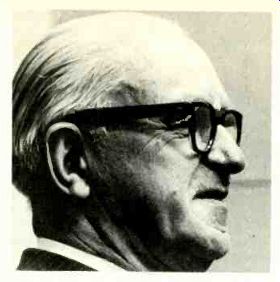
FRANK H. McINTOSH--Seventeenth in a series
FOR AS LONG as many of us can recall, "Mac" audio equipment has enjoyed a reputation for quality as consistently high as any in the field. In great measure this stems from the perfectionist standards set by Frank H. McIntosh, founder and president of the company that manufactures Mac products.
He is both an astute technician and a musician-a combination that has characterized the genus "hi-fi nut" from the beginning. An acknowledged innovator in amplifier circuit design, McIntosh is an accomplished cellist who, while still a high school student in the early 1920s, performed with his brothers in the McIntosh String Trio over Radio Station WOAW (now WOW) in Omaha, their hometown.
"Our trio specialized in the light classics," he recalls. "I was offered a music scholarship, but I turned it down since I was more interested in engineering." He got a part-time job at WOAW, eventually becoming chief engineer. During this period McIntosh also taught math and radio at a YMCA school, wrote columns on radio for various newspapers, and did a stint as radio editor for Popular Mechanics magazine.
In 1929, feeling he was ready for his first "steady" job, he went to work for Bell Telephone Labs. This was a boom time for the radio industry, and McIntosh estimates that during his eight years with Bell he either in stalled or worked on the equipment for 235 radio stations. After a period spent with other firms, mostly working with broadcast equipment, he joined the Radio and Radar Division of the War Production Board early in 1942 and served until the war's end. In 1945 he started his own consulting business, and it was then that his interest seriously turned to high fidelity.
While working with Frank Stanton, then president of CBS, in setting up a subscription-music service in 1946, McIntosh became disenchanted with the quality of the amplifiers available.
He decided to build his own-one that would provide both higher power and lower distortion than ever before. Up until then it had been a tradeoff: You could have either relatively high power and high distortion, or low power and low distortion. McIntosh's solution, worked out over a period of about two years, was the "unity-coupled" circuit. He patented the circuit and in 1949 set up his own manufacturing company, McIntosh Laboratories, in Silver Spring, Maryland.
The amplifier that embodied the new concept was the Model 50W-1, which produced an unprecedented 50 watts output from 20 to 20,000 Hz at less than 0.3% distortion. It was built around a new transformer designed by McIntosh that used two primary windings in parallel instead of in series, as in the past. A detailed technical analysis was published in Audio Engineering magazine (December 1949) by McIntosh and a young associate named Gordon Gow, who today is the company's executive vice president and director of sales.
McIntosh recalls the combined enthusiasm and skepticism that greeted this prodigy when he first demonstrated it before a meeting of the IRE.
A major skeptic was 0. B. Hansen, then chief engineer for NBC. Hansen spent hours studying the amplifier and ended up ordering fifty of them.
Another major order came from the Canadian Broadcasting Corporation, and McIntosh Laboratories was off and running.
But McIntosh was not entirely satisfied. The 50W-1's performance could be documented by measurements, but what was the effect on listeners? How important was it to provide power and distortion at levels that, in those days, were still psychoacoustic frontiers few had yet approached? He began conducting his own A/B listening tests, and the results were some axioms that have since become basic to high fidelity sound-some times disputed, sometimes qualified, but always taken to be as near to gospel as anything can be in sound reproduction. One axiom was that inter- modulation distortion (the production by an amplifier of spurious sum-and-difference frequencies caused by the beating of two simultaneous original frequencies) is more noticeable and more objectionable than harmonic distortion (simple multiples of an original single frequency) even when both show the same measured value.
Another was that any kind of distortion becomes detectable and objectionable when it rises by a quantity of 0.5% or more, even if the total distortion does not exceed 1%. (The upper and lower limits of distortion in McIntosh's early experiments were 0.2 and 0.7%.) Out of these tests also came the "two-to-one" theory: Any doubling of distortion can be heard as objectionable, and-conversely--a reduction of distortion by half can be heard as an improvement in the sound.
The 50W-1 amplifier was followed by the Model AE-2 preamp and a 20-watt power amp, the Model 20W-2.
Among the better-known products that appeared later were the C-8 and C-20 preamps and the MC-75 and MC 50 power amps. McIntosh Laboratories' first venture into FM came in 1962, and in 1971 it launched its own speaker line. The present product line includes the MC-2300, a stereo basic amp designed to deliver 300 watts per channel.
A relative latecomer to solid-state ("we had to be sure of reliability since we were offering three- to five-year warranties on all our equipment"), the company showed considerable ingenuity with its clinics at retail outlets in the 1960s. McIntosh estimates that, thanks to these clinics, something like 94% of all Mac equipment sold in the past two decades is still in use. This stability is reflected too in the company's personnel roster, which with a handful of exceptions still includes everyone taken on since the early Fifties. It has a similar record with its dealers.
Today, at the age of seventy, Frank McIntosh still runs his company, located since 1954 in Binghamton, New York His newest interest is room equalization. The staff for some time has been measuring the response of representative home listening rooms and is amassing data on acoustical conditions that can degrade the response of a sound system. This activity is expected to culminate in a new service-and-product offering: A trained dealer will analyze a listening room using a multiband pink-noise device and in stall a specially designed filter for the client's electronics. No date has been set fop the program's official inception, but both the diagnostic and corrective equipment are being developed at the factory.
==============
(High Fidelity, Oct. 1977)
Also see:
In the Loudspeaker Testing Lab (by Emil Torick)
Bach on the Piano? Why Not? After All, He Was a Piano Salesman