BEST RECORDINGS of the MONTH--Jazz: Miles Davis' "Water Babies" . .. Vocal: "An Evening with Diana Ross" ... Orchestral: Josef Krips' Mozart Symphonies ... Opera: Rimsky-Korsakov's May Night.
-----------------------------
More recent Miles (1973) with the plug-ins
New (Old) Miles: An Album That Will Be Relevant Long After All The Electronic Groups Short-circuit.
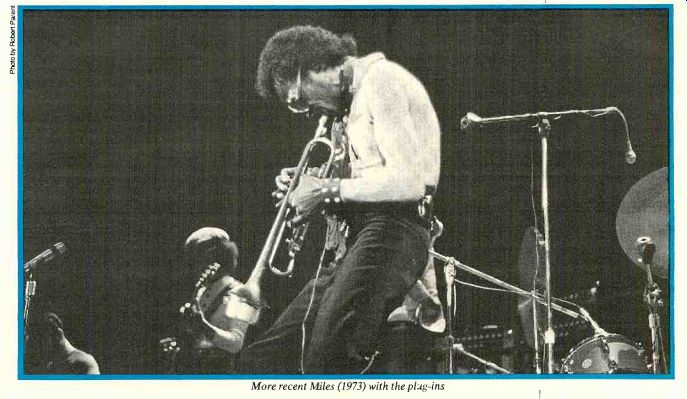
“WATER BABIES" is the finest, most outstanding new Miles Davis album released since 1970, when "Bitches Brew" appeared and signaled a new direction for Miles: toward a rock-influenced, highly electronic brand of near-jazz aimed at the vestiges of the flower-children audiences who took their love beads, peace signs, and smokes to the Fillmores East and West night after night. Unfortunately, Miles' continuing quest for the youth market saw him sacrificing his artistry for a sound that became increasingly artificial and boring, and he never got beyond second billing to such a group as Blood, Sweat & Tears (which, ironically, sometimes grabbed young audiences by playing a music fashioned after the very sound Miles himself had created and already abandoned).
I liked "Bitches Brew" and some of the releases that followed, but as the emphasis on rhythm and synthetically produced sounds increased, Miles was playing worse and worse, less and less, until his input was reduced to mere incidental sounds within a whole that was saying very little to begin with. This may have made Miles a richer man financially, but it robbed him of his prestige as a jazz artist, and it precipitated a general migration from jazz to a bastardized, electrified form of pseudo rock that ha emasculated virtually a whole generation of exceptionally gifted jazz players.
"Water Babies" is a new album in the sense th it has not been released in any previous form, but the recordings date back eight to ten years, to the period immediately preceding "Bitches Brew." We re assured by Columbia that these e not "leftovers" from their vaults, and, indeed, they don't sound like it According to a Columbia news releases these recordings were scheduled f issue but were "bumped in favor of the next Miles stage--‘Bitches Brew'," which is like substituting water for wine. For wine this is, and a ne vintage too. Hearing Miles' clear, sharp tones again without that damn wah-wah device is a joy, and Capricorn, Wayne Shorter composition propelled by the driving rhythmic work of Tony Williams and Ron Carter, features such magnificent solo work by Miles (playing a wide open horn), Shorter himself (on tenor), and Herbie Hancock (on acoustic piano) that it alone is worth the $6.98 list price. The following track-Sweet Pea, another Shorter piece-gives us the Miles of old at his brooding best, then a soulful, raspy tenor statement from Shorter, followed by Hancock, who maintains the mood, and it makes one wonder if we will ever again hear these men play such exquisite music.
Chick Corea and bassist Dave Holland are added for side two, on which we hear an electric piano-an unobtrusive omen of things to come. But this, too, is a fine side containing some glorious statements from Miles and Shorter, and the album is one that will be relevant long after the more recent Miles Davis efforts, the Headhunters, Weather Report, and Return to Forever all short-circuit.
-Chris Albertson
MILES DAVIS: Water Babies. Miles Davis (trumpet); Wayne Shorter (soprano and ten or saxophone); Herbie Hancock and Chick Corea (keyboards); Ron Carter and Dave Holland (bass); Tony Williams (drums).
Capricorn; Sweet Pea; Two Faced; Dual Mr. Tillman Anthony; Water Babies. COLUMBIA PC-34396 $6.98, PCA-34396 $7.98, PCT-34396 $7.98. A Glittering Evening With Diana Ross: Teasing Messages From the Chiffon Beyond “An Evening with Diana Ross" is the Motown siren's latest re lease, apparently a complete transcript of her one-woman show at the Ahmanson Theatre in Los Angeles late last year (it was also adapted for a TV special aired in March). It isn't precisely what you'd call easy-chair listening.
With this lady, you'd better be sitting bolt upright in one of those thousand-dollar leather-and-chrome Mies van der Rohe jobs, preferably in dinner clothes and ready to go-go-GO! She sure as hell is, and she proves it on all four sides of a two-disc album that glitters with her customary brittle chic (somehow you can hear the expensiveness of the clothes) and glows with her lowdown, earthy sexiness (always, for some reason, a surprise).
Diana Ross may or may not actually be the ultimate super-cool, super-beautiful, super-desirable black super star of the Seventies that the fantasies of Barry Gordy, Motown, or even the general public make her out to be. But it doesn't really matter. She comes across that way, even on recordings.
She was a gigantic turn-on from the time of her early appearances with the Supremes, and she has remained one through her solo act, her lugubrious (but successful) film debut, and her rare but special TV "specials." Like all great glamour stars, she has a hint of mystery about her. Is she laughing with you, or at you? Are her tears manufactured, or are they true barometers of the changing moods of another human being? If she's smart (and she is), we'll never know. All she need do to keep our attention is continue to send us these teasing messages from the Chiffon Beyond.
"Evening" doesn't break any new ground-Ross is superb in a medley of hits from her days with the Supremes and amateurish beyond belief in another called The Working Girls in which she vainly tries to imitate Billie Holiday, Josephine Baker, Ethel Waters, and Bessie Smith-but, overall, her galvanically exciting personality carries everything off. The engineering and production hum richly around her, in keeping with the million-dollar production number she is. To me, Diana Ross is like that gorgeous sweep of chrome statuary by Brancusi called "Bird in Flight" Her albums have al ways seemed to me only useful pedestals designed to display a remarkable objet d'art. The objet is as stunning as ever, and this new pedestal is one of the best she's had so far--Peter Reilly
DIANA ROSS: An Event with Diana Ross. Diana Ross (vocals); orchestra. Here' Am/I Wouldn't Change a Thing; The Lady Is a Tramp; Touch Me in the Morning; Smile/ Send In the Clowns; Love Hangover; Girls.
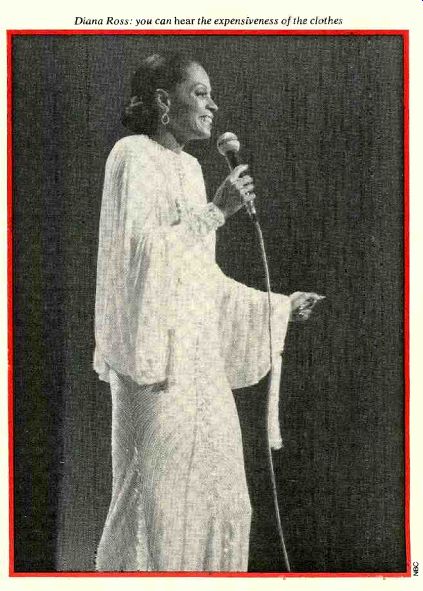
--------- Diana Ross: you can hear the expensiveness of the clothes
Six Medleys: The Point; The Working Girls; The Motown Story; The Supremes; Reach Out; One Giant Step.MOTOWN M7-877R2 two discs $11.98, 9-840NT $9.98, 9-840NC $9.98.
The Legacy of Josef Krips: Charm and Substance in Model Mozart Performances
THE late Josef Krips, never regarded as one of the most exciting or glamorous conductors of his generation but enormously revered by his fellow musicians, completed a major recording project with the Concertgebouw Orchestra of Amsterdam shortly be fore his death at the age of seventy-two in 1974: the last twenty symphonies of Mozart. Philips has only now gotten around to releasing the first three discs in this series, and no superlatives would be excessive for them; they are an enhancement of the Mozart discography as well as of Krips' own, and would have been sufficient by themselves to identify this conductor as one of the truly great practitioners of his art.
The Symphonies Nos. 39 and 40, re corded in 1972, are simply models of Mozart performance-aristocratic but not austere, expressive without excesses, the majestic mellowness of the E-flat and the angelic pathos of the G Minor making themselves felt in the most direct and thoroughly musical manner without any awareness of an "interpreter" being thrust upon us.
There are other recordings of these familiar works that are equally stylish and several that are more dramatic, perhaps, but none that are, overall, more satisfying than these.
The two discs of earlier symphonies, both recorded in 1974, are even more remarkable. The greatest of these six works, No. 29 in A, has not been given so persuasive and well-balanced a presentation on records since the unforgettable debut disc of Peter Maag in 1951, and the slight but enchanting No. 27 in G rivals, in Krips' hands, the grace and fluidity of the similarly memorable old 78's of Sir Thomas Beecham. The "Little G Minor" (No. 25) may lack the driving fury of Solti's vivid mono version (just reissued on Lon don R-23238), but it is a different sort of drama that Krips perceived in this ...
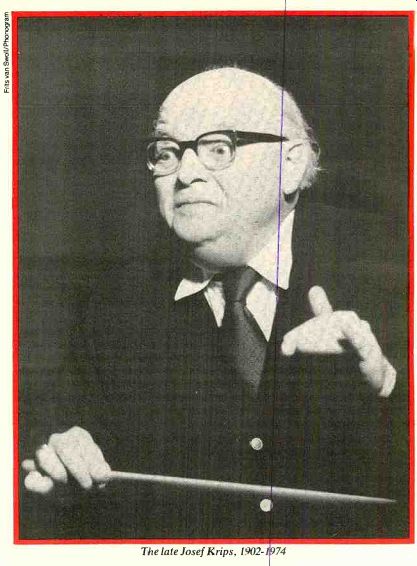
------- The late Josef Krips, 1902-1974
...score, and on its own scale it is no less compelling. The three remaining symphonies--Nos. 22, 24, and 26, all more or less in the Italian opera mold emerge with not only more charm but more substance than they have disclosed in any of the previous recorded versions.
Krips looks extremely happy in the jacket photographs, as well he might, for this is quite a testament he left us: extraordinary Mozart by any standards, with the great orchestra responding at the top of its form and the sound itself exemplary in its balance and definition. By the time these words appear in print Philips will have released three additional discs in this series Symphonies Nos. 21 and 36 on 6500.525, Nos. 32, 33, and 34 on 6500.526, and the Haffner and Jupiter on 6500.429; there is every reason to expect that these will be similarly satisfying, but there is no need to wait for completion of the series to begin enjoying the outstanding discs already available. The two made up of earlier works, as ready mentioned, are especially desirable for their literally surpassing quality; not one of the six performances engraved on 6500.528 or 6500.529 i matched by any of the current competition.
-Richard Freed
MOZART: Symphony No. 22, in C Major (K. 162); S phony No. 27, in G Major (K. 199); Sym No. 29, in A Major (K. 201). Concertgebouw Orchestra, Amsterdam, Josef Krips cond. PHILIPS 6500.528 $7.98.
MOZART: Symphony No. 24, in B-Hat Major (K. 18 ; Symphony No. 25, in G Minor (K. 183); S phony No. 26, in E-flat Major (K. 184). Concertgebouw Orchestra Amsterdam, Josef Krips cond. PHILIPS 6500.529 $7.98.
MOZART: Symphony No. 39, in E-Hat Major (K. 54 ); Symphony No. 40, in G Minor (K. 550). Concertgebouw Orchestra, Amsterdam, Josef Krips cond. PHILIPS 6500.430 $ 7.98.
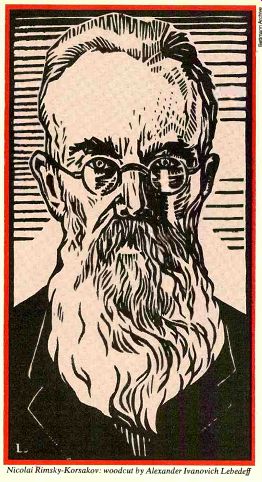
----- Nicolai Rimsky-Korsakov: woodcut by Alexander Ivanovich
Lebedeff Rimsky's May Night: The Warmth, Color, Magic, and Humanity of Life in the Ukraine
RIMSKY-KORSAKOV'S real genius was for opera. He wrote fifteen of them, but, although Coq d'Or is occasionally played in the West, the others are likely to turn up only in the Soviet Union, where they stoutly resist translation and transportation-except, fortunately, in the form of recordings.
May Night is the second of the fifteen, written in 1878 and produced I S I two years later in the Maryinsky Theater in St. Petersburg. It is based on a collection of stories by Gogol about vil lage life in the Ukraine and is complete with a pompous, lecherous old mayor, a drunken charcoal-burner who keeps muttering "I'm my own mayor," and a distiller who proposes to manufacture spirits in an old house inhabited, it seems, by other kinds of spirits, a waspish sister-in-law, and the required young lovers. The twist is that the may or is making eyes at the same young lady as his son, setting up a-conflict re solved in the end only by the appearance of the Russalki, spirits of departed young ladies who were deserted by their lovers.
This is not exactly an action-packed opera: it has a pair of love scenes-one serious, one comic-for a first act, a slapstick second act, and a fairy finale along the lines of Giselle. And if opera is (as someone has said) an art of exits and entrances, then this one doesn't make the dramatic grade. But none of this need concern the record listener; whatever May Night may lack in dramatic conflict is richly compensated for by the warmth, the color, the magic, and the humanity of the setting.
The Ukraine is an ancient southern land to the Russians, and the idyllic vision-the lyricism and the humor of country life-is brilliantly caught by Rimsky. The score is full of folk melody treated in the simplest, most vivid manner. Rimsky is never afraid to be direct, and his strokes are always telling: the solo violin in the first love duet; the drunken charcoal-burner who tries to dance the Hopak and cannot; the musical enchantment of a May night on which anything can happen; the orchestration whose brilliance is so perfectly adapted that you notice it only in retrospect (this is a score without a wasted or unheard note!); the mastery of the vocal lines as an expression of character and mood; the extension of folk materials, authentic and invented, to make scenes and ensembles of considerable size and power.
I don't want to imply that May Night is another Boris, but it is much, much more than merely a folkloric operetta.
Rimsky elevates the attractiveness of the story and the musical invention to epic dimensions without ever failing to charm us, engage us, excite us, or stimulate our imaginations.
Part of the problem with Russian op era performances and recordings has been the weakness of the singing, the routine nature of the performance, and the inadequacy of the recording quality. Perhaps those days are largely past. The characterizations here are superb, and all of the male solo singing is excellent. Even the women, always the weaker side (why?) in the Russian vo cal department, are satisfactory, and of course the choral singing is wonderful.
The entire production is full of a character and spirit that always work with and within the music. Conductor Vladimir Fedoseyev's direction is inspired, and the recording is crystalline.
-Eric Salzman
RIMSKY-KORSAKOV: May Night. Alexej Krivchenja (bass), Mayor; Konstantin Lisovsky (tenor), Levko; Anna Matjushina (mezzo-soprano), Sister-in-law; Ljudmilla Sapegina (soprano), Hanna; Jury Yelnikov (tenor), Distiller; Ivan Budrin (baritone), Kalenik; Olga Pastushenko (soprano), Maiden/Russalka; Chorus and Symphony Orchestra of the Moscow Radio, Vladimir Fedoseyev cond. DEUTSCHE GRAMMOPHON 2709 063 three discs $23.94.
--------
Also see: