Reviewed by: CHRIS ALBERTSON, NOEL COPPAGE, PAUL KRESH, PETER REILLY, STEVE SIMELS, JOEL VANCE
AMERICA: Harbor. America (vocals and instrumentals). God of the Sun; Sergeant Dark ness; Sarah; These Brown Eyes; Monster; and seven others. WARNER BROS. BSK 3017 , $7.98, M83017 $7.97, M53017 $7.97.
Performance: Treading water
Recording: Very good
You can't sue yourself for plagiarism, which may come in handy for America with parts of this album. is harmless enough, settling into a sort of Mom-and-Dad and-Bud-and-Sis rock that Ozzie Nelson --would've no doubt loved. It even slips up occasionally and gets tuneful, . especially in Don't Cry Baby. Producer George Martin continues to make a little song go a: long way for America, and every now and then the group still writes a lyric you wouldn't want to get downwind from, but, as I said, "Harbor" is mostly just harmless. N.C.
---------
Explanation of symbols:
= reel-to-reel stereo tape
= eight-track stereo cartridge
= stereo cassette
= quadraphonic disc
= reel-to-reel quadraphonic tape
= eight-track quadraphonic tape
Monophonic recordings are indicated by the symbol
The first listing is the one reviewed; other formats, if available, follow it.
------------
ASHFORD & SIMPSON: So, So Satisfied. Nickolas-Ashford and Valerie Simpson (vocals); orchestra. Over and Over; It's You; If You're Lying; Destiny; and four others. WARNER BROS. 'BS 2-992 $6.98', M82992 $7.97, M52992 $7.97.
Performance: Good
Recording: Good
An agonized r-&-b gospelese seems to be this--duo's predominant performing style. It fits their songs, which generally deal with the "heavy" topics suggested by such titles as Destiny or If You're Lying ("I died/I died a thousand times/I cried . .") or Maybe I Can Find It. Even in So-So Satisfied, it doesn't sound as if anyone's going to be satisfied for very long. But Valerie Simpson and Nickolas Ashford are the kind of skillful, up-front musicians who can handle all of this somberness without letting it lapse into turgid and their vocal blends, ornate and--distended as they often are, have the calm assurance of total professionalism. Your enjoyment of this album will depend on your gloom threshold. For me, one side was enough. By side two, it was beginning to get to me.
- P.R.
BAD COMPANY: Burnin' Sky. Bad Company (vocals and instrumentals). Burnin' Sky; Morning Sun; Leaving You; Like Water; Heartbeat; Everything .I Need; and five others. SWAN SONG SS 8500 $6.98, U TP 8500 $7.97, CS 8500 $7.97.
Performance: Strictly by rote
Recording: Good
When I reviewed the first Bad Company al bum, I recall, I made some irresponsible statements to the effect that this band was destined to be the greatest thing since indoor plumbing and that they had enormous potential for growth. Well, I am finally ready to take it all back. Mea culpa. In four albums these guys have only managed to come up with perhaps three reasonably memorable tunes, and they have now reached the point where they can't even manipulate their own formula (the search for the Ultimate Imitation Rolling Stones Riff) with the slightest degree of imagination. Paul Rogers remains, technically, a great vocalist, but I haven't believed a word he's sung since he left Free, and the rest of 'the group might as well be Kiss, Aerosmith, or any other of the undistinguished loud noises currently being enshrined in vinyl. Hell hath no fury like a rock critic whose expectations have been rudely. dashed, I guess.
-S.S.
THE BEACH BOYS: The Beach Boys Love You. The Beach Boys (vocals and instrumentals). Roller Skating Child; I'll. Bet He's Nice; Airplane; Love Is a Woman; Johnny Carson; Let. Us Go On This Way; I Wanna Pick You Up; and seven others. REPRISE MSK 2258, $7.98, ((3) M82258 $7.97,' M52258 $7.97.
Performance: Eccentric but: lovable
Recording: Good
If you review records professionally (or even if you just listen to a lot of records), you eventually reach a point where it becomes: difficult to separate your reactions to an artist's work from what you know, or think you know, of his personality as it is conveyed by reporting or hype in the various media-and your reactions to that.
I adore the Beach Boys, so just like any other fan I've devoured every word about them I could get my hands on over the years.
And, what with the kind of press the Boys have been getting lately-the stories about Brian Wilson's ... er ... health problems are only slightly less ubiquitous than those about Cher's affairs or Keith Richards' drug busts-I wonder whether the reactions I have to this new album are the result of my own projections. Does it sound weird to me because I'm afraid Brian is? Would it sound weird if none of those press items had ever appeared? I haven't quite gotten it worked out to my satisfaction.
That bit of confessional background out of the way, I can tell you a few concrete things about "The Beach Boys Love You." First of all, both musically and thematically it's a kind of back-to-the-roots record for them. The production is generally sparse, with very few of those- ethereal vocal choirs that characterized most of their Seventies work, and by and large the subject matter of the songs is the same middle-American teenage stuff-cars, girls, cruising, watching TV- that dominated their earliest records. The sound of it recalls "Wild Honey" in its primitiveness and spontaneity, which is good, and some of the songs (especially Roller Skating Child) are just delightful, lyrically dumb but melodically irresistible despite the signs of strain Brian's voice is showing. But take a cut like Johnny Carson. The lyrics make about as much sense as something by the Ramones, and for the life of me I can't tell if it is just another example of the half-baked humor the Boys have been peddling for ages or the work of somebody who hasn't got all his marbles. I'll give this one a conditional B-plus and wait a few months to see how it sinks in.
- S. S.
RECORDING OF SPECIAL MERIT
JORGE BEN: Tropical. Jorge Ben (vocals and guitar); instrumental accompaniment. Taj Mahal; My Lady; Pais Tropical; Jesus De Praga; Georgia; and four others. ISLAND ILPS 9390 $6.98, Y81-9390 $7.98, ZCI-9390 $7.98.
Performance Imaginative and expert
Recording: Good
Jorge Ben pulls off a--really imaginative and often exciting fusion of bossa-nova, jazz, and rock in this album of his own material. He is a very fine singer (mostly in Portuguese), with that easy, coaxing manner one associates with the best bossa-nova stylists. As a guitarist he's close to virtuoso class as he switches brands, moods, and textures at will. The arrangements are as extravagantly thick and heavy as the scent of sandalwood in an over heated room, but they fit Ben's work perfectly. The best tracks are Jesus De Praga, a complex mixture of several styles, all expertly done, and My Lady, a showpiece, eight-minute song in English in which Ben introduces himself and his talents and immediately establishes himself as one of the more interesting composer/performers you are likely to hear this year. The sound is .good enough, but somehow the quality of Ben's work seems to call for a more special kind of engineering.
-P.R.
DEE-DEE BRIDGEWATER. Dee-Dee Bridge water (vocals); instrumental accompaniment. My Prayer; My Lonely Room; It Ain't Easy; and five others. ATLANTIC SD 18188 $6.98, TP 18188 $7.97, CS-18188 $7.97.
Performance: Very good: in the light moments
Recording: Excellent
Dee-Dee Bridgewater's a bit of a drag in her "serious" moments such as My Lonely Room and You Saved Me--same old r-&-b, gospel-style, same puffed-up dramatics as a thousand other young singers. When she lightens up, however, as she does here in a "fast" version of My Prayer (as opposed to the "ballad" version that ends the album), or in a fast, furious, and very funny song called Every Man Wants Another Woman, she's a flashy, gaudy de light. Her delivery of this last song against what sounds like an enormous jug-band back ground is broad, loud, and farcical. Her big, flexible voice wrings every bit of comedy out of this cautionary tale about men and women with wandering eyes, and there's a chorus, too, that injects its own "tsk-tsk's" all through Bridgewater's sermon on extracurricular mounting. The production work by Stephen Scheaffer is really fine, with especially impressive guitar playing by Cliff Morris and Jerry Friedman in the "fast" version of My Prayer. Bridgewater ought to leave the heavy breathing to others who do it a lot better and concentrate on her comic gift.
-P.R.
RECORDING OF SPECIAL MERIT
BING CROSBY: A Legendary Performer. Bing Crosby (vocals); instrumental accompaniment. 01' Man River; Three Little Words; It Must Be True; Wrap Your Troubles in Dreams; Just a Gigolo; I'm Through with Love; Just One More Chance; Some Sunny Day; and five others. RCA CPLI-2086(e), $7.98.
Performance: Masterly
Recording: Good reprocessing
Bing Crosby remains the master, the seminal pop vocalist of the century. He is, though he would deny it, an art form unto himself.
The RCA archives are- not especially rich in Crosby performances. In the early Thirties, when Bing became a national sensation, he re corded for Columbia, and for many years thereafter he recorded for Decca. What the Victor vaults do contain are examples of the young Crosby's vocals with the Paul White man orchestra, some odd sides from the period just before he became a star, and a-few he made when his style and stage personality were serenely perfect three decades later.
The earliest track on this collection is Crosby's 1928 vocal on the Whiteman dance version of Ol' Man River, especially notable for the way he handles the bridge, as though his voice were a jazz horn. Three Little Words has him with his cronies, the Rhythm Boys, on a Duke Ellington date. (In 1932 he record ed again with Ellington as a soloist on St. Louis Blues.) Just a Gigolo, as George T. Simon points out in his liner notes, is an artistic success because Crosby empathizes with the character, creating pathos where other singers of the era would have made bravura hash out of it.
The second side of this album is made up of a date Crosby had with Bob Scobey's 'Frisco Jazz Band behind him in 1957, and his vocals are something to marvel at. How can anyone sound so casual and be such an uncanny craftsman at the same time? Crosby has given the answer: "I don't sing; I phrase." Within that brief statement is the gist of the artistic success or failure of every vocalist who reached his prime after he did, from Sinatra to Presley (both of whom operated on the same principle). It didn't hurt Crosby, of course, to have a fine voice. And it sure won't hurt to have this album for your special collection.
J. V.
RECORDING OF SPECIAL MERIT
JONATHAN EDWARDS: Sailboat. Jonathan Edwards (vocals, guitar, harmonica); instrumental accompaniment. Blow On Chilly Wind; Evangelina; Sailboat; People Get Ready; How About You; Girl from the Canyon; Weapon of Prayer; and four others. WARNER BROS. BS 3020 $6.98, M83020 $7.97, M53020 $7.97.
Performance: His best yet
Recording: Excellent
Jonathan Edwards has a winner in "Sail boat." It has a whole slew of songs you can stand to hear a lot of times-which is a good thing, since you probably have been, are, and will be doing just that. In addition to writing some himself, he includes tunes here that range all the way from one by Curtis Mayfield to one by the Louvin Brothers. Carolina Caroline may have a few holes in its syntax, but what the hell-it's the catchiest of the Ed wards originals, a terrific juke-box tune. He went to Jesse Winchester for three songs, and here he delivers them in a benignly decorated, straightforward way that actually gets me into them (at least two of them) deeper than Winchester's original versions did. Edwards seems to have great confidence in his voice these days and doesn't hesitate to give it some tough assignments. He also plays some of the tastiest harmonica he has yet put on record.
The album is tuneful and artfully arranged (only once or twice is it self-consciously so). Goldarned good.
- N.C.
EMERSON, LAKE & PALMER: Works, Volume 1 (see Classical Discs and Tapes ) FLAME: Queen of the Neighborhood. Marge Raymond (vocals); instrumental accompaniment. Beg Me; Long Time Gone; Queen of the Neighborhood; and six others. RCA APL1-2160 $6.98, APS1-2160 $7.98, APK1-2160 $7.98.
Performance:
Recording: Excellent
Marge Raymond, Flame's leading lady, is obviously a tough chick. This album's front cover shows her standing on a dingy tenement stoop, looking sultry with her Jaggerish pout (though she actually seems more like Steven Tyler) and the Ozzie Osbourne cross on the choker around her neck. Come to think of it, her hair looks kind of like Ozzie's too, but that's not why she looks so familiar. She ... ... looks familiar because she's been on an LP cover before, namely, the Ventures' 1966 "Wild Thing" set. On that one she was notable for the white frosted lipstick she wore.
Here the big eye-catcher is a tight pullover em blazoned in florid script with the logo "Brook lyn." (I don't know what sort of product Brooklyn is, though I suspect it's either a rock group or a new brand of beer.) There are five other members of Flame, but they're just session hacks. There are also nine original songs on this album. I've been listening to them for four hours straight and it still seems as if I'm hearing them for the first time.
They're sonically invisible: nothing there to catch the ear and hold it-including Raymond's voice, which is so glottal-scrapingly growly she may well pose the first serious challenge to Neil Sedaka in the What-Sex-Is-That-Voice? sweepstakes (if anyone cares).
One song stands out a bit, though: in All My Love to You Raymond gargles like a trooper in a brow-slapper of an imitation of Mick Jagger imitating Otis Redding.
URGENT MESSAGE: RUNAWAYS COME HOME. WE NEED YOUR TRUTH AND SOUL. P.S. TRY TO PICK UP A SIX PACK OF BROOKLYN IF YOU PASS A DELI ON THE WAY.
Lester Bangs
RECORDING OF SPECIAL MERIT
MICHAEL FRANKS: Sleeping Gypsy. Michael Franks (vocals); instrumental accompaniment. The Lady Wants to Know; I Really Hope It's You; In the Eye of the Storm; B'wa na-He No Home; Don't Be Blue; and five others. WARNER Bros. BS 3004 $6.98, 0 M83004 $7.97, M53004 $7.97.
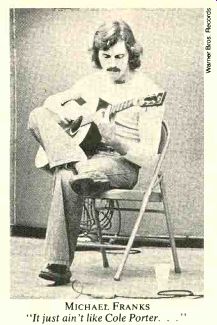
MICHAEL FRANKS--"It just ain't like Cole Porter.
Performance: Very good
Recording: Very good
Michael Franks is a jazz singer, and, like most current jazz singers, he continually flirts with atonality and seems to sing with only one lung. I was somewhat taken aback by his voice, too; it reminded me of Astrud Gilberto, famous for her vocals on The Girl from Ipanema. But the more I listened to this album, the more I grew accustomed to his voice and his tonal flapdoodles-and the more I liked his songs.
Good lyrics are hard, mighty hard, to come by these days, and Franks has supplied some tasty ones. For instance, from I Really Hope It's You: "It's the Prince of Cynics they call me/It's three hundred shades of blue./It's multiple `nope'/But I really hope it's you." Or this, from In the Eye of the Storm: "I hear from my ex-/On the backs of my checks/. . It just ain't like Cole Porter/It's just all too short-order." Franks has excellent instrumental support, especially from the versatile saxophonist Michael Brecker (brother of trumpeter Randy) and the Brazilian composer Joao Donato, who appears on piano in both B 'wana--He No Home and Down in Brazil.
The arrangements by Klaus Ogerman, the engineering by Al Schmitt (who for many years worked with the Jefferson Airplane), and the production by Tommy LiPuma are all first rate,. The album becomes better the more it is played, and I'm already looking forward to Franks' next outing. J. V.
DON HARRISON BAND: Red Hot. Don Harrison Band (vocals and instrumentals). Red Hot; Jaime; This 01' Guitar; Rock 'n' Roll Lady; My Heart; In the Rain; and four others. ATLANTIC SD 18208 $6.98, 0 TP-18208 $7.97, CS-18208 $7.97.
Performance: Big smoke, no fire
Recording: Okay
The first album by the Don Harrison Band contained their hit version of the old Tennes-
--------------------
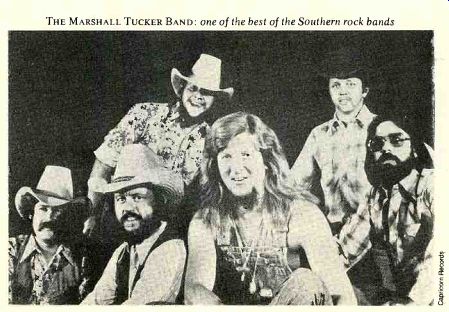
THE MARSHALL TUCKER BAND: one of the best of the Southern rock bands; see Ernie Ford success, Sixteen Tons. That cut (and the others- on the album) was a solid example of slugging, no-frills rock by a combo with a strong lead singer (Harrison), a capable lead guitarist (Russel DaShiell), and a tight bass-drum back-up (Stu Cook and Doug Clifford, both formerly of Creedence Clear water Revival).
But the present effort never makes it more than a few feet off the ground. Although it is still muscular rock-and-roll, one gets the impression that the band is flexing its muscles in stead of using them. The trouble, as it so of ten is, is that the material doesn't match the combo's capabilities. It is almost mandatory for groups to write their own songs these days (and, indeed, it has been for nearly a decade) for reasons of prestige and distinction, not to mention mechanical royalties. But what is the point of writing your own stuff if the stuff you write is substandard? What the Harrison band ought to do--what hundreds of bands ought to do--is give up the false notion that self-penned material is essential to its glory and start drawing on the tremendous catalog of solid, proven tunes that are both fun to play and can reveal the band's talents. The Harrison group is a combo with a good one-two punch when it aims at the right material, but this album is mere shadow-boxing
- J. V .
LAVENDER HILL MOB. Lavender Hill Mob (vocals and instrumentals). Magic Lady; Head over Heels; Loneliest Man on the Moon; Warning; The Party Song; and three others. UNITED ARTISTS UA-LA719-G $6.98, C) EA719-H $7.98.
Performance: Fair
Recording: Good
This Lavender Hill Mob is from Montreal. Now, Canadian pop/rock is often interesting (witness the Guess Who) and sometimes out standing (Motherlode), but there is also a great deal of it that, like its American counter part, is less than inspiring. The Mob plays in an expedient, amorphous manner--some Crosby-Stills-Nash-Young vocal setups here, some Carpenters lushness there, and so on and the banality of the lyrics is sometimes too much, to bear ("Stars are falling down from the sky" indeed). My guess is that this band is a local favorite that packs 'em in at clubs and concerts, basically a floor-show group. On the evidence of this album, they certainly don't do anything that needs to be recorded.
-J. V.
LIVE AT THE RAT (see The Pop Beat )
RECORDING OF SPECIAL MERIT
ANDY FAIRWEATHER LOW: Be Bop 'n' Holla. Andy Fairweather Low (vocals, guitar); vocal and instrumental accompaniment. Shimmie-Doo-Wah-Sae; Ain't No Fun Any more; Hot Poop; Travelin' Light; Lighten Up; and six others. A&M SP-4602 $6.98.
Performance: Excellent
Recording: Excellent
This delightful album is blessed with relaxed performances, a variety of material, and a knowledgeable sequencing of cuts that makes each new track a pleasant surprise. Low glee fully- glides through several styles--Latin, jazz, reggae, rock, country--with accompanying lyrics that are alternately zany and straightforward. All the while he seems to be having great fun and not taking anything too seriously. Ain't No Fun Anymore and Lighten Up are fine examples of what rock can be if you don't complicate it. Da Doo Rendezvous is jazz-oriented, with Low's guitar set against a string section. Hot Poop is a silly and funny countryish tune whose lyrics simply call its chord changes. I Can't Take Much More, Be Bop 'n' Holla, and Shimmie-Doo-Wah-Sae use Latin and reggae rhythms, while Rocky Raccoon, by Paul McCartney, is included be cause it is such precious nonsense. If you put this charming and infectiously satisfying al bum on your turntable you will probably not be able to take it off. Try it. J. V.
RECORDING. OF SPECIAL MERIT
THE MARSHALL TUCKER BAND: Carolina Dreams. Marshall Tucker Band (vocals and instrumentals). Fly Like an Eagle; Heard It in a Love Song; Life in a Song; Desert Skies; and three others. CAPRICORN CPK 0180 $7.98, M80180 $7.97, M50180 $7.97.
Performance. Impressive
Recording: Very good
This is one of the best of the Southern rock bands. A couple of their songs, Willin' and Can't You See, have caught the fancy of all manner of songwriters and singers as well as a huge audience. There's nothing here of that caliber, although two (out of three) long ones on side two are worth getting to know. The hit, Heard It in a Love Song, was damaged for me by overexposure, but most of the rest is pretty good stuff. The band plays what you'd swear was Sixties music yet manages to sound fairly in tune with the times; it may be Jerry Eubanks' reeds that give them the edge on that. He takes one really fine break on the sax, but generally the band sounds more sure of itself when he's playing the flute. Doug Gray's vocals may take a little getting used to, unless Can't You See was the first thing you heard him sing-that one was a natural for him. A lot of little things done right contribute to the good feelings I have about this album; the acoustic guitars, for example, are beautifully recorded and are used sort of like accent devices in the generally electrified sound. It must have been well planned, but it sounds spontaneous, and how it sounds is what counts.
- N.C.
ROGER McGUINN: Thunderbyrd. Roger McGuinn (vocals, guitar); Rick Vito (guitars, vocals); Charlie Harrison (bass, vocals); Greg Thomas (drums); others. All Night Long; It's Gone; Dixie Highway; American Girl; Why Baby Why; and four others. COLUMBIA PC-34656 $6.98, PCA-34656 $6.98, PCT- 34656 $6.98.
Performance: Offhand
Recording: Excellent
First of all, this is not the Thunderbyrd of your dreams, the band Roger McGuinn was supposed to have put together at the close of Dylan's Rolling Thunder tour. That Thunderbyrd would have featured the rhythm section of Rob Stoner and Howie Wyeth (for my money, the most exciting bass and drum combination to emerge in rock in almost a decade) as well as Mick Ronson, whose heavy-metal Jeff Beckisms would have made for a fascinating contrast with McGuinn's inimitable twelve-string pyrotechnics. By the same to ken, it is not, mercifully, the Thunderbyrd McGuinn dragged around earlier this year (those Commander Cody dropouts), which was one of the most God-awful outfits ever to tread a stage. What it is, simply, is McGuinn and some unknown younger musicians who can best be described as serviceable.
As for the album ... well, it's pretty weak. Roger continues to let his lead guitarist hog the show, and this one is a particularly uninteresting Clarence White disciple. No one in the group is much of a harmony singer, and since McGuinn has never been a strong enough vocalist to front a band (it was no accident that the Byrds were famous for their ensemble vocals), we're left with what sounds like an average bar band cranking out Eagles imitations. The material is interesting enough-a few good originals, two fine numbers from Tom Petty and Peter Frampton, and a really rousing Why Baby Why, an ancient George Jones hit that cooks like some of the better mid-period Burrito Brothers stuff but there's very little here that merits repeated listening.
This album should once and for all put an end to the Roger McGuinn-as-auteur theories of certain rock critics. McGuinn was no more the Byrds than, say, John Lennon was the Beatles. He's a talented guy, of course, but in the end he's no better than the musicians he surrounds himself with. I wish he'd start surrounding himself with better ones. A lot better ones.
-S.S.
BILL QUATEMAN: Night After Night. Bill Quateman (vocals, electric rhythm guitar); vocal and instrumental accompaniment. Dance Baby Dance; Doncha Wonder; Down to the Bone; Mama Won't You Roll Me; You're the One; and five others. RCA APLI-2027 $6.98, APS1-2027 $7.98, APK 1-2027 $7.98.
Performance: Pseudo-streetwise schmaltz
Recording: Very sharp
I believe we have encountered a Document Symptomatic of Our Era, worthy of preservation in a time capsule, in the following hype from RCA's ad for Bill Quateman's debut al bum: "If you've had it with mister macho and superstar punks, this man has a very intri guing proposition for you. Meet Bill Quateman. He's not just another one-dimensional, ego-tripping ladies' man with hair on his chest and lust in his jeans. Bill Quateman is more interested in what kind of music he's making with his band than what kind of girl he's making backstage. And . . . he's articulate enough to express the frustrated intensity we all feel living life in the Seventies." Now, if there's one thing I hate, it's naked honesty. It's so embarrassing. Why didn't they just lie and say he wants to be the Elton John of the burnt-out swingles-set, or some thing? These are tough times, and such mortifying truthfulness doesn't help things any.
When I'm sitting here under my headphones I want entertainment, not devastating revela tions of the sordid truth about the way we live today. Quateman's insights into promiscuity and the human condition are just too cruel. In fact, this record has slammed so many un pleasant truths about myself into my face that I'm going to commit suicide. A gruesomely real death it'll be, too-I'll hang myself on one of Quateman's hooks. He's got one screwed into every song on this record, which is why Bill Quateman may well become very popular among those who can take him at all.
Then everyone else who hears his pseudo-streetwise schmaltz can commit suicide too, providing the perfect setting for the solo al bum to end 'em all! It will be really lonely at the top then, but that's life, Bill baby-only the strong survive. Lester Bangs.
KENNY RANKIN: The Kenny Rankin Album. Kenny Rankin (vocals and guitar); orchestra, Don Costa arr. and cond. Groovin'; I Love You; On and On; Make Believe; A House of Gold; and five others. LITTLE DAVID 1013, $6.98, TP-1013 $7.97, CS-1013 $7.97.
Performance: Smooth
Recording: Even smoother
Here's Kenny Rankin in his guise of the Smoothest Singer in the World (Who Isn't Married to Eydie Gorme). There's more than a touch of Steve Lawrence's high-gloss style here, but perhaps that's because Don Costa, who has worked so often with Lawrence, is apparently the dominant force in the recording. His conducting and arranging create an almost flawless setting (if you like lucite) for Rankin, who comes through with some very pretty but hardly individual sounds. Rankin's been around since the early Sixties, never making it really big but always surviving respectably enough commercially to be able to keep on recording. His work here is characterized by the expected flexibility and professionalism of a survivor and his own consistently excellent musicianship. His voice is a bit squeezed at the top for this kind of straight out singing, but he still does well, particularly in such things as Stephen Bishop's semi-calypso On and On and his own I Love You.
Mildly entertaining.
-P.R.
CHARLIE RICH: Take Me. Charlie Rich (vocals, piano); vocal and instrumental accompaniment. On My Knees; Easy Look Even a Fool Would Let Go; Mood Indigo; Where Do We Go from Here?; Spanish Eyes; and four others. EPIC KE 34444 $5.98, EA 34444, $6.98.
Performance: Peter Pan smooth
Recording: Very good
Charlie Rich is a jazz singer in the same way Peggy Lee is a jazz singer: in a mass-market, by-the-numbers sort of way that the big, sluggish pop market can track fairly easily, with him coming out of country just as she comes from easy-listening pre-rock-and-roll pop. I don't say this is a bad thing; good for Charlie and Peggy, I say, for tricking people into listening to quality singing. If you want to know how smoothly Charlie sings in this one, imagine rubbing your fingers together after dipping them in cornstarch. That's how easily he's going these days, and I find myself admiring his craftsmanship and being dismayed with his penchant for slickness at the same time. The album seems to put you on notice that this is stylized, this is acting--these are songs, just songs, and this is what's known as putting songs across. But Charlie is a pretty convincing actor sometimes, and then I wonder if he isn't actually feeling something for the song. I'd rather my relationship with the album on this point weren't so ambivalent.
-N.C.
DIANA ROSS: An Evening with Diana Ross (see Best of the Month ) SEA LEVEL. Sea Level (vocals and instrumentals). Rain in Spain; Shake a Leg; Tidal Wave; Country Fool; Nothing Matters but the Fever; Grand Larceny; and two others. CAPRICORN CP 0178 $6.98, M80178 $7.97, M50178 $7.97.
Performance: Disparate, desperate
Recording: Good
There's a difference between a band that is versatile and one that will play anything in the hope of making a hit. Sea Level is of the latter type. When they are not playing California steak-house-lounge jazz, they are trying to be condescendingly funky or hesitantly pop. The result is an album of skillful blithering. The band never comes to a decision; they don't know what to play for, so they play at. Bands of this type don't last long unless they get lucky. No one can predict what Sea Level's luck will be, but the kind of slapdash music they play here mortgages fortune.
It is likely that Sea Level is just a halfway house for its three Allman Brothers Band graduates (Jai Johanny Johanson, Chuck Leaveil, and Lamar Williams), who were floundering after the disintegration of that super group. I predict these guys will soon move on to other groups. And I can just hear the inter view with one of them a couple of years from now: "I was with the Allmans for some time and . . . oh, yeah, I played in a band called Sea Level, but it didn't last too long." End of story.
-J.V.
SON SEALS: Midnight Son. Son Seals (vocals, guitar); instrumental accompaniment. I Believe (You're Tryin' to Make a Fool Out of Me); No, No Baby; Four Full Seasons of Love; Telephone Angel; Don't Bother Me; and four others. ALLIGATOR AL 4708 $6.98.
Performance: Good
Recording: Good
Son Seals is a solid blues singer and guitarist in the manner of Albert King (with whom he used to play), and this is a perfectly respectable blues album featuring well-executed, if pedestrian, horn arrangements behind Seals' singing and playing. I might have liked it better if it hadn't been for the fervid liner notes pleading the case of the poor, down trodden blues singer, who has to suffer through a torturing work schedule and never gets to stay in fancy hotels like them no-good sell-outs, the rock-and-roll stars. The proselytizers so overstate their claims for both blues in general and their particular idols that no performer could possibly live up to them.
The blues has not been a living and growing musical form for several years now. Most of the original practitioners (Bessie Smith, Ma Rainey, Elmore James, Howlin' Wolf, Little Walter, Magic Sam, and others) have gone to heaven, and the conditions that formed their sensibilities have largely disappeared. The number of middle-aged black musicians now actively engaged in singing urban blues (post-World War II, Chicago-style) is small. As far as I can see, young blacks today do not take much of an interest in blues, do not know much about it, and perhaps do not care to learn; the same is true for jazz in the styles of 1917 through 1955. Black pop, a.k.a. "soul," replaced the blues quite a few years ago. I am glad that people like Son Seals are still alive, working, and delivering the real goods, but I wish the proselytizers would face facts and shut up. J.V.
SKYHOOKS: Living in the Seventies. Sky-hooks (vocals and instrumentals). Million Dollar Riff; Mumbo Jumbo; Blue Jeans; Is This America; Crazy Heart; and five others.
MERCURY SRM-1-1124 $6.98, 81-1124 $7.95, 41-1124 $7.95.
Performance: Beside the point
Recording: Good
Poor Australia has been suffering from the greatest national inferiority complex in rock and-roll almost since the music's inception, and with good reason. Quick, name three important (or even internationally known) Australian rock acts. If you're really hip, you might remember the Easybeats, and if you're one of those lunatics who'll listen to anything, you might recall two entertaining albums from a strange Aussie band called Daddy Cool (cir ca 1971). Other than those, the closest thing to a successful rocker from Down Under is . . . egads, Helen Reddy.
Poor Skyhooks. This, their second American release, is actually several years old, and from what I've been able to learn, they may already be living back in the Seventies equivalent of the carwash (traditional haven for out-of-work rockers). It seems that a gang of Australian kids decided that if Alice Cooper could wear funny clothes and make-up, so could they. They followed suit, conquered Australia's teenagers, and then decided to take on the world. They didn't make it, and if you're wondering why, all you have to do is wait 'til "Living in the Seventies" hits the bargain bins. You'll be treated to the usual heavy met al riffs, silly, sexually ambivalent lyrics, and, in general, the kind of music that almost makes you want to listen to Helen Reddy. I hope Skyhooks got a huge advance from Mercury Records.
S.S.
SPLIT ENZ: Mental Notes. Split Enz (vocals and instrumentals). Late Last Night; Walking Down a Road; Titus; Lovey Dovey; Sweet Dreams; Mental Notes; and four others. CHRYSALIS CHR 1131 $6.98.
Performance: Snide
Recording: Good
Split Enz is an English group playing what may be termed British Gothic rock. The material, arrangements, and performances are murky, smell slightly of madness and evil, and are intended to make the hair on the back of one's neck rise rather than set the foot to tapping.
It is difficult to tell when this group-or any English Gothic group-is kidding or when the emotional unbalance described in the music does in fact reflect the state of mind of the musicians. The album cover is not much help.
It depicts Split Enz in various stages of mental peril; the photo on the inside cover shows them dressed in weird costumes, their faces painted.
There is, and has always been, a fascination with madness, else why do people go to horror movies? But while madness can attract the curious and those who like a good scare, it can also repel. In this case, it's more the latter than the former.
J. V.
THE STATLER BROTHERS: The Country America Loves. Statler Brothers (vocals); instrumental accompaniment. The Movies; Let It Show; All I Can Do; You Could Be Coming to Me; Hat and Boots; I Was There; and five others. MERCURY SRM-1-1125 $6.98.
Performance: One-dimensional
Recording: Average
The Statler Brothers are capable enough they've got fine individual voices and come up with dandy harmonies when they work at them-but here's another of their albums sounding like country music's answer to junk food. The boys can't seem to get over how cute it all is, although their parody of the Ink Spots (or tribute to them, or whatever it is) does stand surprisingly well on its own. Mostly the deliveries sound as if they're being read off a teleprompter, unless there is some fun to be had with a song, in which case its meager humor gets beaten to a pulp. The Statlers made it clear long ago they aren't guilty of the sin of taking themselves too seriously. Now if only they would get on with something.
N.C.
( Continued on page 105)
DISCO
GLORIA GAYNOR: Glorious. Gloria Gaynor (vocals); instrumental accompaniment. Sweet, Sweet Melody; Life Ain't Worth Living; So Much Love; Why Should I Pay; and five others. POLYDOR PD-1-6095 $6.98, 8T-1-6095, $7.98, CT-1-6095 $7.98.
Performance: Strong
Recording: Good
Gloria Gaynor really deserves a lot better than she gets in this release. How very good she is can be measured and confirmed by her treatment of As Time Goes By (in tandem with The Hands of Time), which is so vivid and forceful that you know you are in the presence of a real talent. Aside from her smoky, pleasantly affected lyric attack and her rhythmic urgency, she has the gift of pacing that particular old warhorse so dynamically that you really couldn't give a damn whether or not Sam ever played it again. Elsewhere, though, she's led up the garden path of pop solemnity with a nine-minute Most of All, the mealy-mouthed mush of So Much Love, and others of their ilk. Gaynor might profitably consider doing an album composed solely of standards. Profitable or not, I have a feeling that I'd love it.
-P.R.
OTHER RECOMMENDED DISCO HITS
C. J. & COMPANY. WESTBOUND WB-301, $6.98
KRAFTTWERK: Trans- Europe Express. CAPITOL SW 11603 $7.98
IDRIS MUHAMMAD: Turn This Mutha Out. KUDL KU 34 $7.98.
DEXTER WANSEL: What the World Is Coming To.
PHILADELPHIA INTERNATIONAL PZ 34487 $6.98.
(List compiled by David Mancuso, owner of the Loft. one of New York City's top discos.)
-------------------
Lofgren Gets Lucky
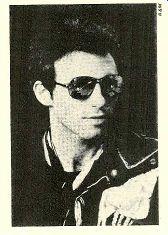
A FEW years ago, I was firmly convinced that A&M Records was missing a great bet. They had two relatively unsuccessful solo artists on their roster who I was sure would make an unbeatable team. They struck me as perfectly matched front men for a band. Both were short, both were hot guitarists and inconsistent songwriters capable of occasional brilliant tunes, one was a pretty boy and the other a believable rock-and-roll tough kid; in other words, they could conceivably have complemented each other as well as Lennon and McCartney. I tried unsuccessfully to get rumors started about this fantasy partnership of mine, but then half of the duo got lucky, became an overnight superstar, and ruined the whole project. The successful one was Peter Frampton; but I don't really mind, since his music of late is so determinedly bland that obviously I was wrong about the whole business to begin with.
But Nils Lofgren . . . ahhh. Though he has yet to achieve anywhere near the kind of commercial success that Frampton has, he's continued to grow and mature as an artist, and I'd like to take this opportunity to apologize publicly for never having said anything nice about him in print before. A lot of outrageous claims have been made for the kid, and most of them are absolutely true. He's a natural-rocker in the classic mold, which means that-unlike most Seventies stars-he plays the music because he loves it and it's in his blood. His best songs are melodically charming, neatly constructed, and imbued with a teen romanticism that never rings false. Bruce Springsteen excepted, he may be the last real innocent in rock.
"I Came to Dance" is not his best solo effort (the first one, titled simply "Nils Lofgren," strikes me as a wee bit more consistent, and if you ever chance across a copy of the limited-edition "authorized bootleg" A&M issued of one of his live shows, grab it immediately), but it is marvelous nonetheless.
The title song, despite a token bow to disco, is still a flat-out rocker and a neat summary of Lofgren's thinking these days. "I'm not Bob Dylan, but I never miss a beat," he sings, without a hint of rancor (this boy respects the rock tradition far too much to take any cheap shots), and concludes, "I ain't no philosopher, I dance in the street." Then he proves it with a graceful guitar solo and-a melodic hook that will probably have you dancing too.
The whole album is like that. It has an endearing sense of humor, a punk attitude leavened with real intelligence, and, best of all, that increasingly rare quality we used to call soul. All that and a marvelous cover version of the Stones' Happy, with Nils cheerfully botching his heroes' lyrics. What more do you want? There will probably be better albums released this year, but not many, and certainly few that are as much fun.
-Steve Simels
NILS LOFGREN: I Came to Dance. Nils Lofgren (guitar and vocals); Tom Lofgren (guitar); Wornell Jones (bass); Andy New mark (drums); other musicians. I Came to Dance; Rock Me at Home; Home Is Where the Hurt Is; Code of the Road; Happy Ending Kids; Goin' South; To Be a Dreamer; Jealous Gun; Happy. A&M SP-4628 $6.98, 8T-4628 $7.98, CS-4628 $7.98.
------------------
Southside Johnny and the Asbury Jukes
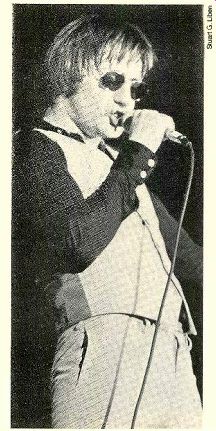
To begin with, the cover of "This Time It's for Real" is absolutely perfect. The Jokes are posed somewhere in South Jersey (in an area that practically defines the phrase "urban blight") wearing their scuzziest street duds and looking tough enough to be one of the gangs from West Side Story. The whole thing is lighted (or retouched) to create the kind of atmosphere Guy Peelaert conjured up in his series of illustrations for his book Rock Dreams. Well, let me assure you folks that the Jukes aren't fooling around, and that the title is the album's best review. Good as their de but effort was, this one is an unqualified masterpiece. No sophomore jinx for these guys.
The format is basically the same as before: there are a bunch of great r-&-b guest stars, a few cover versions of obscure oldies, and a whole lot of originals contributed by producer Miami Steve Van Zandt and the Jukes' pal Bruce Springsteen. The big difference, however, is in the production. The first album had enormous energy and enthusiasm, but the band was pretty green in the studio and their inexperience resulted in a somewhat thin sound. They learned quickly, though. "This Time" has a dense, rich, almost Spectorish quality to it that the volume control. The strings and the Juke's brilliant horn section come off especially well.
This is a cruising-in-your-car record if there ever was one.
Most of the tracks are just incredible. With out Love, an Aretha Franklin tune that has been part of the band's stage show recently, is as moving a soul ballad as you can imagine, and guitarist Willy Rush embellishes the al ready lush arrangement with some shimmering lines that recall Mick Taylor's best work on the later Stones albums. Springsteen and Van Zandt's Little Girl So Fine, recalling New York street-corner chestnuts like Spanish Harlem and Up on the Roof, appropriately features gorgeous backing vocals by the Drifters. Drummer Kenny Pentifallo, that remarkable basso profundo, gets to work on an old novelty tune, Check Mr. Popeye, with the Coasters contributing their best naughty-boy back-ups a la their own Charlie Brown. And as for Johnny himself, his singing has matured tremendously; he's so natural and unforced in his approach to this stuff that it's almost spooky.
They are the best band working in America at the moment. . .
5 But it is the concluding track, When You Dance, that best demonstrates the real break through of this album. Beginning with a collage of jungle noises (which I'd like to think was meant as a parody of Patti Smith's Radio Ethiopia), it is a stupendous production number that sounds like Sam and Dave running amuck through the Motown studios of 1966.
The Jukes have now, in only two tries, reached the stage where they have transcended their original influences. They may have begun as Sixties soul purists, faithfully copying all the oldies in their collections much as the J. Geils Band did, but unlike that crew they are now resolutely making a unique and personal kind of music, a music that owes a debt to the past but is stamped with an instantly identifiable character of its own.
Let us not mince words. The Asbury Jukes are the first white band since the Rolling Stones to manage that kind of quantum leap.
They are the best band working in America at the moment, and this is a great, great album.
Play it loud. Really loud.
-Steve Simels
SOUTHSIDE JOHNNY & THE ASBURY JUKES: This Time It's for Real. Southside Johnny and the Asbury Jukes (vocals and instrumentals); the Miami Horns; other musicians. This Time It's for Real; Without Love;
Check Mr. Popeye; First Night; She Got Me Where She Wants Me; Some Things Just Don't Change; Little Girl So Fine; I Ain't Got the Fever No More; Love on the Wrong Side of Town; When You Dance. EPIC PE 34668, $6.98, PEA-34668 $6.98, PET-34668, $6.98.
-------------
Helen Schneider: New Girl

In Town THERE'S a new girl in town and she's made quite a spash with her debut Windsong al bum, "So Close." On the cover, Helen Schneider looks like she just stepped out of a shower; on the disc inside she sounds terrific.
Ms. Schneider is young, self-confident, and talented. While she takes no particular pains to exploit it, her youth is important in that she so perfectly and unaffectedly represents the new breed of pop singer. Unselfconsciously, naturally, and expertly, her style of singing and way with words reflect the experience of growing up with rock.
In the twenty or so years it's been with us, rock has metamorphosed from teenager's jalopy to something very like the family car. It is now the mainstream of American popular music, with everything else reduced to a tributary status. Things haven't yet gone that far everywhere, of course, as I learned in a brief conversation recently with a Frenchwoman.
On hearing that I reviewed records, she asked what kind-la vrai musique or la cacaphonie?--and I suddenly realized that, some where along the line, what she considered cacaphony had become, to me, the real thing (sorry, ma petite).
And so it is to Helen Schneider too. She doesn't have to try to be a new kind of pop singer; by circumstances of time and place she just is one. Take, for instance, her opening song, So Close. This is a semi-rhapsodic rip-off of Jimmy Webb's Didn't We, a song veteran pop singers invariably hold up as proof that "they're still writing good songs"-and then proceed to murder with a time-capsule performance. Schneider handles it with the easy self-confidence of one to the rock manor born. She instinctively searches out the ballad's throbbing rock under-beat and brings it up front, and she does this-no sweat, no stretch-without sacrificing one iota of clarity or listener comprehension. Her diction, in fact, is a marvel. It's so good that I never once regretted the absence of a lyric sheet in the album-something that's been a necessity lately with even some of the best performers (too many of today's really good, really talented rock stars apparently feel that the less we can understand them the more likely we are to take them seriously). Schneider is no belter, no stripling Ethel Merman. She just wants to communicate, and she does so, using today's idiom coupled with an old-fashioned respect for the sense of the words she sings.
When her material gets broad and loose and raucous-as it does in Sad Eyes, for in stance-Schneider rolls along with it in an offhandedly funky way that is totally engaging. One appreciates her light touch in a song like Yakkin' (Your Mind Is on Vacation), in which she glides over the humor of the situation instead of poking you in the ribs to be sure you get the point of the joke. And yes, she's sophisticated, not in the sense popularized by left-over Sixties hippies-phony, that is-but in its real-world, real-life meaning: not likely to be surprised by anything. But you are probably in for a surprise, and a great deal more, when you first hear Helen Schneider.
She's what pop music has grown up to as the Seventies draw to a close: a performer who uses "rock" as an action verb in her musical sentences; one who can actually sing and thus doesn't have to fake it and try to cloak that . rock is now the mainstream of American pop music 4141stimmosemstmm, fakery with "meaningfulness"; and, most of all, a performer who wants to get close to her audiences, not dazzle or berate them.
The album's production, by Ron Dante, is careful without being cautious, though too many of the songs are, for my taste, a bit bland. Nonetheless, "So Close" brings a fresh breeze of hope that rock can get over its recent pomposity. Helen Schneider doesn't need rock so much as rock needs Helen Schneider.
-Peter Reilly
HELEN SCHNEIDER: So Close. Helen Schneider (vocals); orchestra. So Close; Tryin' to Say Goodbye; All the Time; Sad Eyes; Cuddle Up; Why Don't We Live Together; Darlin' ; Yakkin' (Your Mind Is on Vacation); How I Miss You; I Never Meant to Hurt You. WINDSONG BHL1-2037 $6.98, BHS1-2037 $7.98, BHKI-2037 $7.98.
============
THE TOSHIKO AKIYOSHI/LEW TABACKIN BIG BAND "... everything you ever wanted to hear from a big band", CHRIS ALBERTSON
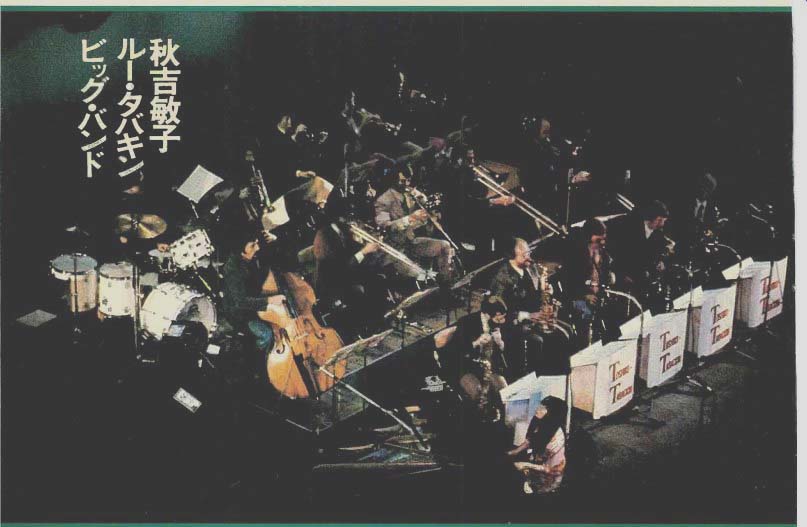
IN the early Forties a frenzied period of screaming brass, stomping saxophones, hot solos, and gravity-defying ballroom acrobatics came to an end. There would always be big bands, but never again would they precipitate the nationwide fervor of the Swing Era, which had been sparked by Benny Goodman in a California ballroom one summer night in 1935.
Americans are as fickle about music as they are about clothes, and by the mid-Forties both swing and bobby socks were suffering the same fate, but changing tastes alone did not do in the big bands. Among the other factors were gasoline rationing, which made travel difficult for players and patrons alike; the infamous Petrillo recording ban, which for more than two years robbed the big-band business of one of its most effective promotional tools; a 20 percent amusement tax that made some employers of big bands simply throw in the towel; and the World War II draft, which deprived many band leaders of their star soloists and inspired blues man Brownie McGhee to comment in song "Uncle Sam ain't no woman, but he sure can take your man." Some musicians who weren't drafted took advantage of the scarcity of players by demanding outrageous salaries that few bandleaders could afford to pay. But even if none of the above had happened, TV-and the change in lifestyle that came with it would eventually have struck the fatal blow.
Today there is still a Basie band, Mercer Ellington continues the struggle to keep what's left of his late father's orchestra afloat, Woody Herman valiantly maintains a youthful reincarnation of his ofd Herds, and even Benny Goodman is known to assemble an orchestra from time to time. But, as Duke Ellington himself put it in 1941, when he saw the handwriting on the wall, "Things Ain't What They Used to Be." Until recently, the only successful new band with any kind of longevity has been one led jointly by trumpeter Thad Jones and drummer Mel Lewis.
Consisting of top New York studio musicians, it has survived virtually un challenged, and against tremendous odds, for the past twelve years. There are, of course, other new big bands, such as those led by David Matthews and Clark Terry, but the most powerful new voice to hit the big-band scene of late is the steeped-in-tradition-but-au-courant roar of the West Coast-based Toshiko Akiyoshi/Lew Tabackin Big Band. It is a dynamic orchestra that has been delighting audiences in Japan and California for the past three years and is fast winning a world-wide following by way of some extraordinary record albums.
Toshiko Akiyoshi was growing up when the big bands began their reign, but for her there wasn't a riff to be heard for miles around. If you think your home town was jazz-forsaken, just imagine what it was like in Dairen, a Manchurian port at the tip of the Liaotung Peninsula roughly midway between Peking and Seoul. When she was seven, Toshiko began studying classical piano. "Because my parents weren't exactly poor, we had the piano, and it was just the thing to do," she says, but she had no thought of making a career out of music, a turn of events which she jokingly attributes to "the gods watching me seriously." Jazz would probably not have entered Toshiko's life if her parents hadn't moved to Japan in 1946. "I had been playing the piano ten years by then," she explains, "and I loved it as an instrument, but my parents had lost everything during the war, and they couldn't afford to buy me a piano. So, one day as I was walking down a street in Fukuoka, I saw a sign that read 'Pianist wanted for dance hall,' and I went in and got the job-that's how it all started.
"I didn't consult my parents, but they found out a few days later because I was coming home very late. My father really got upset, because it was un thinkable for a girl to be working in a dance hall in those days and because I was supposed to start medical school." Toshiko's mother finally convinced Mr. Akiyoshi that there would be no harm in the girl's taking the job for the eight months that remained before the start of medical school the following April, and by that time Toshiko had managed to talk her parents out of further schooling altogether. That first job, however, wasn't exactly a dream come true. Flanked by violin, accordion, alto sax, and drums, she spent a year and a half playing some pretty dreary fare. "It was quite bad," she re calls. "I didn't understand anything in those days, I mean those chord symbols and things, but I got a little better as time went on."
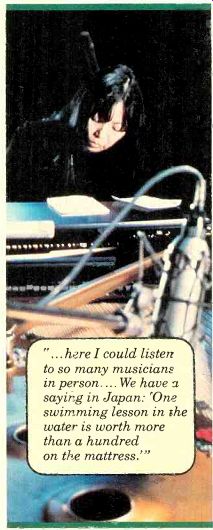
" ...here I
could listen to so many musicians in person ... We have a saying in Japan:
'One swimming lesson in the water is worth more than a hundred on the mattress."
In 1947 she was good enough to join Yamada's big band-not a giant step, but one in the right direction. "We played a lot for the American officers' club, and one day a Japanese man came to me there and told me he thought I had a lot of potential. I still hadn't heard jazz, but this man had a large collection of 78's, and the first one he played for me was Teddy Wilson's Sweet Lorraine. That was my introduction to jazz. I became interested immediately and started listening to any thing I could get my hands on-I had no particular preferences, I just listened to anything." Toshiko began spending her days in the club's office, listening to V-Discs (records made for distribution to G.I.'s overseas) by such Swing-Era stars as Harry James and Gene Krupa. The Bop Era had already been ushered in, but it would be another three years before this newest jazz idiom came to her attention.
"I was living in Tokyo then," she re calls, "and I used to listen to AFRS (Armed Forces Radio Service) broad casts a lot. One day I heard a piano solo, and it sounded so beautiful that I called up the station to find out who was playing. That's how I became interested in Bud Powell." The influence was considerable, and Toshiko's subsequent mastering of Powell's style gained her more rewarding employment with various bop-oriented groups and bands, including the Blue Coats, the Six Lemons, and-of all things the Gay Stars (who, she assures us, re ally were neither). By 1952, having earned a good reputation as player and arranger, Toshiko formed her first group, which was heard by pianist Os car Peterson in November of the following year when he visited Japan with Jazz at the Philharmonic. "It was a lucky break for me," says Toshiko, "because Oscar recommended me to Norman Granz, who then gave me the chance to make my first recordings." Eight selections were made with an illustrious rhythm section consisting of Herb Ellis, Ray Brown, and J. C. Heard, and around the time of their re lease (on two Norgran EP's) Granz wrote a lengthy article on Toshiko for Metronome magazine. The combination of records and article brought the offer of a scholarship from the Berklee College of Music in Boston.
BY 1956, when she arrived in this country, Toshiko had become Japan's highest-paid free-lance arranger, but she admits that she still had a lot to learn and recalls her first year here as a real eye-opener. "I was still playing very much in the Bud Powell style," she says, "but I soon began to develop a much broader attitude, and I guess I became more of an individual. In Japan, in those days, it was very difficult to get records. We had to pay about ten dollars for a ten-inch LP, and so we used to go to jazz clubs to listen to records on earphones. We listened diligently and tried to pick up the changes-that's how we got our material and developed a repertoire. But here I could listen to so many musicians in person, and although I had heard them on records, it just wasn't the same as actually being in the room with them. We have a saying in Japan: One swimming lesson in the water is worth more than a hundred on the mat tress.' That was the difference. I was in the water over here." Soon after her arrival in Boston, Toshiko began appearing four nights a week at George Wein' s Storyville Club and recording for his Storyville label (with such musicians as Roy Haynes, Ed Thigpen, Paul Chambers, and Oscar Pettiford). Wein, obviously an admirer of her forceful, Powellesque playing, also began presenting Toshiko at his Newport festivals beginning in 1956, when she made her debut assisted by Percy Heath and Ed Thigpen. Toshiko Akiyoshi had, as they say, arrived.
DURING her three years at Berklee she made more recordings (for Verve and Metrojazz, MGM's jazz label) and personal appearances. In November of 1959 she married alto saxophonist Charlie Mariano, with whom she formed a group and toured extensively.
By the end of 1966 the marriage had broken up, and though she could look back on ten years that, by most people's standards, had been successful, Toshiko felt a lack of accomplishment.
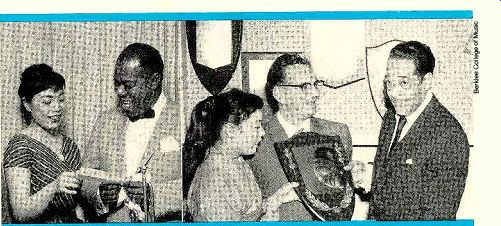
above: School days: a young and exuberant Toshiko Akiyoshi shares some moments
with jazz all-stars at Boston's Berklee College of Music. Near right, with
Louis Armstrong; far right, with Duke Ellington and Berklee president Lawrence
Berk.
"Japanese people do a lot of reflecting around New Year's," she says, "and on New Year's Eve in 1966 I sat down and thought, 'Well, I've been in this country for ten years, and what have I accomplished?' I was in pretty pathetic shape. I just didn't think I'd done any thing-I hadn't had any really glorious moments, and I didn't have any prospects. So I felt I had to do something for my own sake, and I decided to have a concert." When she had saved up enough money to rent New York's Town Hall and pay for the musicians, Toshiko asked trumpeter Bill Berry to be her contractor. "I told him I wanted Joe Farrell on tenor," she recalls, "and I panicked when Bill told me that Joe would be on the West Coast with Thad and Mel's band. 'Don't panic,' he said, 'I know a tenor player who is just as good, maybe even better. His name is Lew Tabackin.' I had been living in New York for quite a long time by then, and I had never heard of Lew Ta backin, so I was convinced that he couldn't be any good. A few days later I was substituting for Don Friedman in the Clark Terry band at the old Half Note. I couldn't see the horns from the piano, but we had started playing an E-flat blues when I suddenly heard this tenor coming out of nowhere. It was such a glorious sound-a tone like Lucky Thompson or Don Byas, but much more modern playing-and it just knocked me out. During the intermission, I called Bill Berry and said 'I found a tenor player, and I want you to get this guy.' He asked me what he looked like, and when I described him Bill said 'That's Lew Tabackin, the guy I've been telling you about!' That's how we met." Lew Tabackin comes from Philadelphia, where he grew up "with a generation of white Coltrane imitators." He had been in New York two years when he met Toshiko that night at the Half Note, and he had already de-Coltranized his style. "I heard a lot of other white tenor players imitating Coltrane," he recalls, "and it irritated me when I realized that I was probably doing the same thing, so I decided to investigate some of the older players. I listened to Lester Young, Don Byas, and Coleman Hawkins, and found that I was more in agreement with their style." As it turned out, Tabackin wasn't able to make Toshiko's Town Hall concert, but they were married in 1969. In 1970 and 1971 they toured Japan together, settling down in Los Angeles the following year. "Nothing really happens in Los Angeles," Taback in observes. "It's not like New York, where everybody seems to have some kind of project and there's electricity in the air. In Los Angeles, if you just sit around and become a part of the inertia, you can just die. So we decided to start a band." As Toshiko had done five years earlier in New York, they saved up money (Tabackin was working in the Doc Severinsen Tonight Show band, a "boring experience" he recently left behind him) and rented a Hollywood theater for their first big concert. It worked. The Japanese Victor company decided to fund an album, "Kogun" (RCA-6246), which has yet to be re leased in this country, but with 30,000 copies sold, it has become Japan's biggest jazz hit of all time. Three more al bums followed; "Road Time" (Japanese RCA 9115-16), a two-record set just now released in the States, "Long Yellow Road" (RCA JPL1-1350), and "Tales of a Courtesan" (RCA JPL1-0723). The last two are American releases, both of which got rave re views in this country; "Long Yellow Road" received a STEREO REVIEW Record of the Year Award for 1976.
The albums, all of them outstanding, will surely create a demand for the Toshiko Akiyoshi/Lew Tabackin Big Band outside of Japan and beyond the West Coast, for it is the most exciting big band to come along in many years.
There is, of course, still room for the Thad Jones/Mel Lewis Orchestra, but for my money the Tabackins are in the lead, and much of the credit goes to the wonderfully imaginative compositions and arrangements of Toshiko. If she sits down this New Year's and be moans a lack of accomplishment, she had better have her head examined.
-------------------------
The Akiyoshi/Tabackin Big Band: A Musical Dynamo
IT is a sad indication of the lack of sup port for and interest in jazz shown by Americans these days that promoters and bookers continue to regard bringing the Toshiko Akiyoshi/Lew Tabackin Big Band to the East Coast as an economically unfeasible proposition, while in Japan a tour by the group reaps sufficient profits to warrant repetition. But perhaps it is only to be expected from an audience that seems to encourage retaining on the tube a Bob by Vinton or a Sammy Davis, Jr. both of whom have weekly shows of their own-while the likes of Sarah Vaughan and Ella Fitzgerald are reduced to occasional guest shots and the Betty Carters and Ornette Colemans are simply ignored altogether. Maybe the television networks-and, in turn, the public-might open their doors and ears to such internationally revered artists as Teddy Wilson and Charles Mingus if discrimination against jazz were not also rampant in the record industry. Sure, there are lots of jazz records, but look who's putting them out: mostly small, independent labels. Ironically, it is the major labels-giants breast-fed in their infancy by jazz that are most guilty of either ignoring jazz artists or treating them as of secondary importance.
Toshiko Akiyoshi and her husband, Lew Tabackin, do have the advantage of having their music committed to vinyl on a label that is likely to be carried even by stores in Oshkosh and Peoria, but they have still been victimized by the aforementioned prejudicial attitudes. They lead an American band, based in the U.S., but they had to look to Japan for a recording contract (they are signed to Japanese RCA). This absurdity is hardly justified by the Japanese origins of the band's co-leader, and it is only partly redeemed by American RCA's rather arbitrary re lease of their albums here.
The latest of these releases is "Road Time," a two-record set of lively, imaginative performances recorded by the band at concerts in Tokyo and Osaka during a tour of Japan in the early part of last year. Underlining its lack of confidence (or is it lack of interest?) in jazz, American RCA has packaged its version of "Road Time" in a sleeve de signed for a single disc, doing away with the double spread plus an additional page of photos and notes offered Japanese consumers. But they have not managed to water down the music itself. This group has everything you ever wanted to hear from a big band:
the heat and bounce of Basie at his best, imaginative Gil Evansesque voicings, and as fine a battery of soloists as your ears are likely to encounter.
Akiyoshi, who composed and arranged all but one selection, paints her orchestral pictures with strokes that are modern, yet unmistakably rooted in the lanche--and an avalanche of Akiyoshi/ Tabackin music is not a bad thing to be hit by.
"Road Time" is a live recording, so there are the unavoidable rough spots, but they are amazingly few and far between. From Tuning Up, which starts off as if the band were, but quickly develops into an infectiously funky affair, to Kogun, which draws some of past. The result is glorious, and I can think of no other big band today that can match the Toshiko Akiyoshi/Lew Tabackin Big Band for sheer vivacity and excitement.
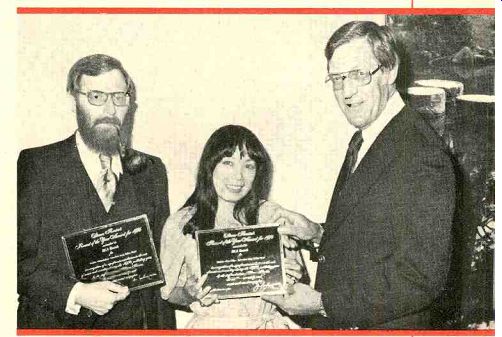
------------- Lew Tabackin and Toshiko Akiyoshi accept STEREO REVIEW'S Record of the Year Award for their RCA Album "Long Yellow Road." Presenting the award is Bud Dean of STEREO REVIEW'S Los Angeles office.
If it can generate this much electricity on records, it must be one hell of a band to experience in person. The more I hear of this musical dynamo, the more I am convinced that its bursting forth on the national scene is inevitable. The band's first album, "Kogun," and three individual albums (one by Akiyoshi, two by Tabackin) have yet to be released in this country, but one big hit (a high sales figure, that is) is usually the rock that starts the ava its sounds from Akiyoshi's own cultural heritage, and Road Time Shuffle, the album's rousing, ever-so-bluesy finale, "Road Time" is the band's best so far-and that's saying a great deal.
-Chris Albertson
TOSHIKO AKIYOSHI/LEW TA BACKIN BIG BAND: Road Time. Toshiko Akiyoshi/Lew Tabackin Big Band (instrumentals). Tuning Up; Warning: Success May Be Hazardous to Your Health; Henpecked Old Man; Soliloquy; Kogun; Since Perry/Yet Another Tear; Road Time Shuffle. RCA CPL2-2242 two discs $9.98, CPS2 2242 $9.98.
-------------------
============
Also see:
BEST RECORDINGS of the MONTH--Jazz: Miles Davis' "Water Babies" ... Vocal: "An Evening with Diana Ross" ... Orchestral: Josef Krips' Mozart Symphonies ... Opera: Rimsky-Korsakov's May Night.