Reviewed by: RICHARD FREED; DAVID HALL; GEORGE JELLINEK; PAUL KRESH ; STODDARD LINCOLN; ERIC SALZMAN
RECORDING OF SPECIAL MERIT
BEETHOVEN: Piano Concerto No. 4, in G Major, Op. 58. Maurizio Pollini (piano); Vienna Philharmonic Orchestra, Karl Bohm cond.
DEUTSCHE GRAMMOPHON 2530 791 $7.98; 3300 791 $7.98.
Performance: A joy!
Recording: Excellent
BEETHOVEN: Piano Concerto No. 4, in G Major, Op. 58; Leonore Overture No. 3, Op. 72a; Symphony No. 5, in C Minor, Op. 67. Claudio Arrau (piano); Bavarian Radio symphony Orchestra, Leonard Bernstein cond. DEUTSCHE GRAMMOPHON 2721 153 two discs $15.96.
Performance: Dramatic
Recording: Good
------------------
Explanation of symbols:
= reel-to-reel stereo tape
= eight-track stereo cartridge
= stereo cassette
= quadraphonic disc
= reel-to-reel quadraphonic tape
= eight-track quadraphonic tape
Monophonic recordings are indicated by the symbol
The first listing is the one reviewed; other formats, if available, follow it.
-------------
--------------
Tastes in performance style can differ radically when it comes to the Beethoven G Major.
The reading by the immensely gifted Maurizio Pollini with Karl Bohm matches my own preferences as none other since the early and late Schnabel collaborations with Sargent and Dobrowen, respectively. Some of Schnabel's ruggedness may be missing here, but all too many of the recorded performances I have heard in the recent past have been lacking in the special type of seamless lyrical flow that marked Schnabel's versions and most certainly characterizes this one. As in Pollini's readings of the late Beethoven sonatas, which I reviewed in these pages some months ago, the command here of "floating legato" is simply awesome and the finger-work in running pas sages is wholly effortless-"like oil," to use Mozart's description of one of his own performances. The slow movement is, as it should be, the high point, altogether moving in its flawless blend of tonal beauty and grip ping drama. The finale ripples along its joyous way in the most satisfying manner imaginable. It sheds a rather special light on Pollini's concept of this music when we realize that in the first movement he uses the almost-never heard shorter of the two cadenzas written by Beethoven, a choice that tends to keep one's mind and heart more involved with the music itself than with the digital dexterity of the soloist. Perhaps here is the key to both the merit of this particular recorded performance and what it has in common with Schnabel's: it's the music that matters.
Bohm is the ideal partner, and the Viennese players are with him all the way in terms of responsiveness and lovely sound. I do wish that the DG engineers had given them just a mite more presence relative to the piano, but aside from this minor cavil the sonics, especially of the piano, are first-rate. I think I'm going to be living with this recording of the Fourth Concerto for a long, long, time.
Extra-musical considerations area factor in the Arrau-Bernstein set since the album documents a special benefit concert given in Munich on October 17, 1976, for Amnesty Inter national. In light of the present human-rights situation in Claudio Arrau's own homeland of Chile and the forthright stand being taken on worldwide human-rights issues by President Carter, there is a rather special potency to the gestures of these performers in donating their services and of DG in donating profits from the album's sales to Amnesty International.
DG has done a good live-concert recording job; as might be expected, the overall sound is somewhat less brilliant than that normally achieved in an empty hall or a large studio, but it is well balanced and full bodied, with easy audibility of the conductorial foot-stamping. The piano-orchestra balance in the concerto strikes me as somewhat more just than in the Pollini-Bohm disc. Bernstein delivers himself of an immensely dramatic reading of the Leonore No. 3, and I find Arrau in better pianistic form and less mannered than in most of his other recent interpretations of the Classical concerto literature-though his fingers, at age seventy-three, may not be quite as limber as those of the youthful Pollini. The realization of the great piano-vs.-orchestra slow-movement dialogue is particularly telling in this performance.
It is in the Beethoven Fifth that my critical faculties become ascendant over my sympathy for a good cause. As in his 1963 Columbia recording with the New York Philharmonic, Bernstein here takes all exposition repeats, including that in the finale, and he achieves a splendidly majestic reading of the slow movement. The opening movement is another matter, however. Whereas in the 1963 recording a workable, even convincing, compromise was achieved between a weighty treatment of the famous "Fate" figure and the main tempo of the movement, in the Bavarian concert the two elements are distractingly at odds with one another. Also, the main body of the scherzo is a bit too freewheeling for my taste.
But the finale is wholly satisfying and truly cumulative in its impact.
D.H.
BRITTEN: Variations on a Theme of Frank Bridge (see BUTTERWORTH) RECORDING OF SPECIAL MERIT BRUCKNER: Symphony No. 4, in E-flat Major ("Romantic"). Berlin Philharmonic Orchestra, Herbert von Karajan cond. DEUT SCHE. GRAMMOPHON 2530 674 $7.98, 3300 674 $7.98.
Performance: Top-drawer
Recording: Excellent
Karajan has tightened up his reading of this most accessible of the mature Bruckner symphonies considerably since his 1971 Angel re cording, and I must say that I prefer it this way, for the music gains in sinew and sense of momentum. The quasi allegretto marking for the slow movement gets special attention, so that these pages take on the character of a Schubert walking-tune (as in the slow movement of the E-flat Trio or Der Wanderer an den Mond) instead of sounding like a funeral cortege. I'm inclined to support this approach relative to the musical context of the symphony as a whole, which takes a somber turn only in the stormy outbursts of the finale, though Bruckner purists won't like Karajan's use of cymbals in the climax to herald the recall of the opening horn motive. If you don't mind that one bit of lily-gilding, however, this is the Bruckner Fourth to have on the shelf. The craggy, yet clean, recorded sound is a great improvement over the churchy acoustics of the earlier Angel issue. D. H.
RECORDING OF SPECIAL MERIT BUTTERWORTH: Six Songs from "A Shropshire Lad"; Bredon Hill and Other Songs. FIN ZI: Earth and Air and Rain. Benjamin Luxon (baritone); David Willison (piano). ARGO ZRG-838 $7.98.
Performance: Expert and communicative
Recording: Very good
BUTTERWORTH: A Shropshire Lad; The Banks of Green Willow; Two English Idylls.
BRITTEN: Variations on a Theme of Frank Bridge, Op. 10. Academy of St. Martin-in-the-Fields, Neville Marriner cond. ARGO ZRG-860 $7.98.
Performance: First-rate but second-best
Recording: Excellent
I don't think George Butterworth's name has been listed in Schwann since 1962, when Boult's London mono of A Shropshire Lad and The Banks of Green Willow and Barbirolli Mercury stereo of A Shropshire Lad were both deleted. This more than promising English composer, killed in World War I at the age of thirty-one, was a fastidious craftsman who destroyed many of his manuscripts be fore he left for the front; fortunately, the works recorded on these two Argo discs survived. I can't pretend to know enough about Butterworth's output to say these pieces rep resent him at his best, but I suspect they do, and they are fine enough to stand beside al most anything of Vaughan Williams or Holst or Bax in the same vein-that vein being a consummately English one, rich in the spirit of folk music and actual citations from it. The five Bredon Hill songs as well as the Shrop shire Lad cycle are settings of poems by A.E.
Housman, and in every case the music fits the text so perfectly as to suggest a Housman-Butterworth collaboration from the outset.
The cycle by Gerald Finzi (1901-1956) is a similarly apt series of ten songs to poems of Thomas Hardy, in which the vocal writing suggests now and then a bit of Butterworth, a bit of Britten-but only bits amid much more that is distinctively Finzi. Here the piano comes more into its own, seeming to be not so much an accompanying instrument as a full partner;
the keyboard writing in such songs as When I Set Out for Lyonnesse and The Phantom is quite fascinating. Benjamin Luxon is the ideal interpreter of both composers' songs; he sings them all as if he truly loved both the verses and the music, projecting them with unselfconscious skill and exceptional communicative ness, and David Willison is a most knowing and effective partner. Even though Luxon's enunciation is clarity itself, it is most disappointing that Argo did not include printed texts.
There is nothing really disappointing about the Marriner disc, which is, as one expects from the Academy, first-rate in every way (sonically as well as musically). Still, it is not mere sentiment that dictates a preference for Britten's own recording of his Bridge Variations (London CS-6671), and, good as Marriner's Butterworth is in its own right, it is no re placement for Boult's incomparably persuasive performances. Sir Adrian's London mono is long gone, but Lyrita, in England, has issued his new recording of all three of these titles, which is now available here as an HNH import.
R.F.
BYRD: Music for Viols and Virginals. Prelude and Ground; Four Fantasias; In Nomine a 4; In Nomine a 5; Browning; Will Yaw Walke the Woods Soe Wylde; Lord Willobies Welcome Home; The Third Pavan and Gailiarde; Pavan a 5; The Barelye Breake. Edward Smith (harpsichord); New York Consort of Viols. Musical HERITAGE SOCIETY MHS 3460 $3.50, 0 MHC 5460 $4.95 (plus 95¢ handling charge, from Musical Heritage Society Inc., Oakhurst, N. J. 07755).
Performance: Refined
Recording: Clear
William Byrd was certainly one of the greatest instrumental composers of the Renaissance, and this record beautifully demonstrates his power and ingenuity when it came to writing for viols and solo harpsichord. But viol music seems to have been conceived mainly for the joy of the performers. It is in ward-looking, incredibly subtle, and all but impossible to project in a concert situation.
Realizing this, the New York Consort of Viols plays for itself and its own wonder. It is this very quality, so admirably captured here, that makes this album so special. Although we cannot partake of the actual performance, we can listen to the recording as many times as we wish and gradually be drawn into this meticulously ordered world of serene beauty and contemplation.
As for the performance itself, the Consort begins rather tentatively. There are some problems of intonation and a few scruffy moments, but soon they settle down and one can enjoy the unearthly sound of the viols without any worry about technique. Edward Smith is essentially a fine harpsichordist. His technique is flawless and brilliant, and the sound of his instrument perfect for this difficult music. I would like more rhythmic vitality in such robust pieces as Lord Willobies Welcome Home and the rustic theme of The Barelye Breake. But once the divisions begin ...
----------------
A Master clarinetist
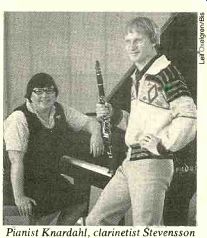
--- Pianist Knardahl, clarinetist Stevensson
KJELL-INGE STEVENSSON was all of twenty six last year when he made this record, and he had already identified himself as an outstanding master of his instrument in the re cording of the clarinet concerto in EMI's set of Nielsen's orchestral works. Here he earns further admiration for bringing these all but unknown works to our attention. Only the Stravinsky is at all familiar; the Mendelssohn sonata is one of that composer's recently resurrected bits of juvenilia, and the very names of Edison Denisov, Einojuhani Rautavaara, Ingvar Lidholm, and Bernhard Henrik Crusell will be new even to many seasoned listeners. All of these (and of course Penderecki and Shchedrin) are contemporaries except Crusell (1775-1835), whose five-minute rondo-actually a delicious set of mini-variations with a brilliant little cadenza by Stevensson--is the sort of lovable gem by which many a composer's name has been preserved.
I especially liked, too, the Shchedrin Basso Ostinato, essentially a rhythmic workout for the piano with some high-flying elaborations for the clarinet. But all of these works are provocative, and there is enough contrast between them to make the array thoroughly fascinating. I have put off saying anything about the playing because, really, the old superlatives seem a bit shopworn when trotted out to describe something so spectacularly alive and involved and secure as these performances.
Perhaps none of this music is "important," but anything that provokes music-making on this level is certainly worthwhile. Stevensson and his associates are having a hell of a good time, and nobody with ears is likely to feel like an outsider at their party. This recording is simply glorious in every respect-including the splendidly natural sonics.
-Richard Freed
KJELL-INGE STEVENSSON: Clarinet Recital. Mendelssohn: Sonata for Clarinet and Piano. Lidholm: Invention for Clarinet and Bass Clarinet. Crusell: Rondo for Two Clarinets and Piano. Shchedrin: Basso Ostinato for Clarinet and Piano. Stravinsky: Three Pieces for Solo Clarinet. Penderecki: Three Miniatures for Clarinet and Piano. Denisov: Sonata for Solo Clarinet. Rautavaara: Sonetto for Clarinet and Piano, Op. 53. Kjell-Inge Stevensson (clarinet, A-clarinet, bass clarinet); Kjell Fageus (clarinet in Lidholm, A-clarinet in Crusell); Eva Knardahl (piano). BB LP-62 $7.98 (from HNH Distributors Ltd., P.O. Box 222, Evanston, Ill. 60204).
-------------
... taking over from the themes, we are treated to a fine technical show that covers up the rhythmic weakness, and the disc ends in a rousing blaze of glory.
- S.L.
RECORDING OF SPECIAL MERIT
CLERAMBAULT: Gloria in Excelsis; Motet de Saint Michel; Antienne de la Sainte Vierge; Suite for Organ in the First Mode; Suite for Organ in the Second Mode. Mady Mesple (soprano); Gaston Litaize (organ). CONNOISSEUR SOCIETY CSQ 2126 $7.98.
Performance: Excellent
Recording: Good
I am always a bit apprehensive when con fronted by a wall-known opera singer tackling Baroque music, especially when that opera singer is a high coloratura and a fine Lakme.
On hearing this recording of Clerambault motets, however, my apprehension was assuaged, and I enjoyed some fine music and excellent singing. Miss Mesple's voice is typically French-hard and nasal-but it is well focused, with a cutting edge that gives it a thrilling sound. At first one wonders how she will manage to articulate the minute French ornamentation with her rapid vibrato; some how she manages, though, and comes through with delightful, authentic, and precise readings. Mesple has an excellent coloratura, of course, and she has the rhythmic control so often lacking when opera singers attempt Baroque measured fioratura. In short, her performance is a fine one in which the music is brought to life precisely because she is an op era singer and approaches it dramatically.
Clerambaules organ music is also a delight.
Written in the spirited tradition of Couperin, it is full of contagious melodies and jaunty rhythms. Gaston Litaize brings out its natural charms by making full use of the snarling French reed stops and a dialogue of registration appropriate to the music.
- S.L.
DOHNANYI: Sonata in C-sharp Minor for Violin and Piano, Op. 21. SIBELIUS: Sonatina in E Major for Violin and Piano, Op. 80; Devotion, Op. 77, No. 2; Souvenir, Op. 79, No. 1; Berceuse, Op. 79, No. 6. Diana Steiner (violin); David Berfield (piano). ORION ORS 76244 $7.98.
Performance: Good
Recording: Good
Give this one an "A" for enterprise: I don't recall seeing any of these titles on a domestic label before, and nearly all these pieces-the two big ones, especially-are worth hearing.
The Dohnanyi sonata becomes more intriguing from one of its three movements to the next, as additional Hungarianisms creep in but always Hungarian a la Brahms! All of the Sibelius items date from 1915, more than a decade after the masterly concerto. The sonatina, as meaty as it is concise, is a romantic bravura piece that any violinist should love to play and any audience should love to hear, and yet it is utterly neglected in our recital halls and record catalogs. Devotion, originally titled Ab imo pectore, is the second of the Two Solemn Melodies Sibelius wrote for violin or cello with orchestra; although it is more animated than the title might suggest, the neglect in this case is easier to understand, for it is simply not a very distinguished piece.
The first and last of the Six Pieces, Op. 79, on the other hand, are unpretentious and exquisitely fashioned-fine little encores. The performances strike me as a good deal more than competent and the sound is quite good, though the violin is perhaps just a shade too forward.
R. F.
DONIZETTI: Gemma di Vergy. Montserrat Caballe (soprano), Gemma di Vergy; Paul Plishka (bass), Guido; Luis Lima (tenor), Tamas; Louis Quilico (baritone), Count di Vergy; Natalya Chudy (mezzo-soprano), Ida; Mark Munkittrick (bass), Rolando. Schola Cantorum; Opera Orchestra of New York, Eve Queler cond. COLUMBIA 34575 three discs $20.98.
Performance: Enthusiastic
Recording: Good
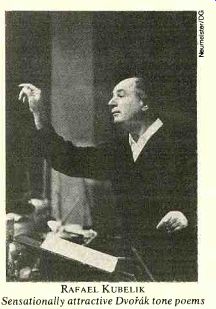
RAFAEL KUBELIK---Sensationally attractive Dvorak tone poems.
Donizetti stood at the zenith of his creativity when he wrote Gemma di Vergy in 1834, the same year that also produced his Rosmonda d 'Inghilterra and Maria Stuarda. (Marino Fa Hero and Lucia di Lammermoor followed in quick succession in 1835.) Felice Romani, Donizetti's chosen librettist, was otherwise en gaged, and the book eventually provided by the less gifted Emanuele Bidera leaves a lot to be desired, even by the not too exalted con temporary standards. And yet, weak libretto notwithstanding, and even allowing for some musical scenes that were put together with obvious haste, Gemma di Vergy turned out to be an effective opera. It is extraordinarily tuneful and could easily rival Lucia di Lam mermoor in popularity if it were on display with similar frequency.
This recorded performance, taped at a Carnegie Hall concert on March 14, 1976, captures much of the opera's vibrancy and melodic attractions. Without quite taking seriously Montserrat Caballe's reference to one Gemma being as difficult to sing as three Normas (as quoted in the notes), I go along with the observation that the role is both demanding and very rewarding for an artist of her caliber. It is indeed a special vehicle for Madame Caballe, whose warm-toned, virtuosic, and expressive singing justifies the production.
Her colleagues perform on a less exalted but still noteworthy level. In the role of the Count (whose abandonment of Gemma for not providing him with an heir precipitates the tragic sequence of events) Louis Quilico sails through his high-lying part with firmness and confidence. Paul Plishka delivers the music of Guido, the Count's confidant, with fine sonority. It is hard to work up much sympathy in this opera for Tamas, the tenor non-hero, an impetuous hothead. Louis Lima sounds convincing in his youthful ardor but vocally not quite equal to his task.
Eve Queler leads a vigorous, idiomatic-sounding account of the opera. Neither the orchestra nor the chorus functions with ultimate precision, but the results are not bad at all for a "live" and obviously not rigorously rehearsed undertaking. The sound is good, and, evidently through the judicious use of some rehearsal "takes," all applause but the final well-deserved round has been eliminated. An attractive and well-annotated book let completes the laudable presentation.
-G.J.
DUBOIS: Concerto for Flute and Orchestra (see IBERT)
RECORDING OF SPECIAL MERIT
DVORAK: The Golden Spinning-Wheel, Op. 109; The Wood Dove, Op. 110. Bavarian Radio Symphony Orchestra, Rafael Kubelik cond. DEUTSCHE GRAMMOPHON 2530 713 $7.98.
Performance: Marvelous
Recording: Finely detailed
These are the last two-and surely the best of Dvorak's four tone poems after Erben's ballads, his penultimate works for orchestra.
They are still far from well-known, and any one hearing the opening of The Golden Spinning-Wheel, with its percussion-ornamented horn calls, must wonder why this is so; the work conjures up and sustains a fairy-tale atmosphere (in this case a rather grisly tale, but one whose happy ending is never in doubt) through imaginative orchestral coloring that might suggest Dvorak was out to beat Rimsky-Korsakov at his own game. The Wood Dove is more concise and more sober, but no less enticing. Both of these marvelous works draw marvelous performances from Kubelik and his orchestra, and DG's finely detailed recording insures that none of Dvorak's effects, so splendidly realized here, are lost to the ear. A slightly greater spring in Kubelik rhythms and greater clarity in the sound give this version of The Golden Spinning-Wheel a slim edge over Kertesz's (Lon don CS-6721), while Vaclav Neumann's Wood Dove (in Telefunken set 36.35075) may have a similar edge over Kubelik's by virtue of a still more opulent sonic frame. But all these differences amount to little: this is a sensationally attractive release, just the sort of thing to give both works a boost toward the so-called standard repertoire.
R.F.
DVORAK: Serenade in E Major for Strings, Op. 22 (see TCHAIKOVSKY).
FINZI: Earth and Air and Rain (see BUTTERWORTH)
RECORDINGS OF SPECIAL MERIT
HAYDN: Piano Trios in E-flat Major, G Mi nor, and C Major (Hob. XV: 29, 19, 27). Amade Trio. TITANIC Ti-12 $7.00.
Performance: Exquisite
Recording: Alive
HAYDN: Piano Trios in C Minor, D Major, and F Major (Hob. XV: 13, 16, 17). Beaux Arts Trio. PHILIPS 9500.035 $7.98.
Performance: Excellent
Recording: Excellent
Although Haydn's piano trios embody some of the Viennese master's most exalted inspirations and greatest piano writing, they are all too frequently misunderstood or neglected.
Not only are string players reluctant to take a secondary role to the piano, but until recently there has been no reliable performing edition of the music. Now, however, we have the Diletto Musicale series, magnificently edited by H. C. Robbins Landon, and the string players' objection will perhaps be overcome as they gain a greater knowledge of the history of the genre and realize that their parts in these pieces are much more important than they might seem to be on a first reading and with a modern piano.
Haydn's piano trios are closer to the "accompanied sonata," a kind of piano sonata virtually unknown today, than they are to the trios of Mozart and Beethoven, which put the strings on a far more equal footing with the keyboard. Thus, when playing them with the overpowering modern concert grand, a violinist may feel expendable, since he is rarely assigned any material of structural or melodic importance. The cellist is even more frustrated, since just about every note he has is doubled, continuo fashion, by the keyboard player's left hand. But with the fortepiano (the Viennese instrument of the Classical period) the situation is quite different. Admittedly, the violin does not share in the principal melodic exposition, but its part is frequently the expressive heart of the composition; it offers a sensitive comment on the music and gives it its soul. The cello part, too, becomes essential, as it supplies the very foundation of the music-which the fortepiano cannot do be cause of its relatively weak bass. This is all beautifully demonstrated by the new Amade Trio recording, not only because they use original instruments (or copies of them) but also because they are superb musicians.
The members of the Amade Trio are by no means historians who play well. They are soloists of the highest caliber whose instinct for musical perfection has led them to study authentic performance practice. As members of the Cornell music faculty, they are an established ensemble; thus they are sensitive to each other's playing and perform as a beautifully balanced unit. Malcolm Bilson under stands the fortepiano and is capable of bringing it to fullest expression. His articulation is subtly detailed, each phrase clear and exact.
Sonya Monosoff's violin playing is a perfect match. When doubling a melody, she adds a dimension that only a singer could duplicate.
Her accompanying figures are exquisitely molded and offer an intimate commentary that gives the music breadth. Although John Hsu's cello is unobtrusive, as it should be, it offers just the right support needed by his colleagues. The Titanic recording engineer also deserves some credit, for he has caught the balance of a live performance without once artificially emphasizing a line that is naturally submerged. This is a very special disc, and I hope it will lead to more Haydn recordings from the Amade.
Although the Beaux Arts Trio covers the entire trio repertoire, they seem to have a special fondness for Haydn. Few people realize that Haydn wrote more trios than any other composer, and the present album is the seventh in the Beaux Arts' project to record the whole miraculous set. Like the Amade, the Beaux Arts Trio understands the delicate problem of balance in these works, a problem that often escapes even the finest musicians using modern instruments. Here a fine balance is achieved purely through sensitive playing; each instrument falls naturally into its assigned role. This plus excellent ensemble work and fine recording affords a rewarding representation of musically stimulating works that are just now beginning to find their proper place in the concert hall.
- S.L.
RECORDING OF SPECIAL MERIT
IBERT: Concerto for Flute and Orchestra.
DUBOIS: Concerto for Flute and Orchestra.
MARTIN: Ballade for Flute, String Orchestra, and Piano. Louise di Tullio (flute); English Chamber Orchestra, Elgar Howarth cond. CRYSTAL S503 $6.98.
Performance: Very good
Recording: Good
Ibert's flute concerto, one of his most successful works, has not been available on records for a decade or more; Frank Martin's Ballade has been recorded heretofore only in its original version for flute and piano alone; and the concerto of Pierre-Max Dubois (born 1930), whose four movements run just a bit over twelve minutes, is a delicious little discovery, rather in the vein of Prokofiev's Classical Symphony. These all add up to an intriguing package of lightweight but superbly crafted material, all reflecting, to a greater or lesser degree, the influence of jazz (or, at least, an awareness of it), and all admirable as much for their succinctness as for their imaginative coloring. Louise di Tullio plays all three works with great flair, Elgar Howarth is a suave partner, the sound itself is quite good, and the surfaces are excellent. The focus on the Dubois/Martin side has the soloist a little too far forward, perhaps, but that is just about the only imperfection to be noted in this most attractive release.
- R. F.
MARTIN: Ballade for Flute, String Orchestra, and Piano (see IBERT) MENDELSSOHN: String Quartet in D Major, Op. 44, No. 1. SCHUMANN: String Quartet in A Minor, Op. 41, No. 1. Budapest String Quartet. ODYSSEY O 34603 $3.98.
Performance: Dated
Recording: Live mono
Mendelssohn was a wonderful chamber music composer, and it is a pity that such works as the D Major Quartet are not better known.
Unfortunately, though, this is difficult music to play; not only does it require the utmost in skill, care, delicacy, and poetic feeling, but it must sound effortless. I don't think this old Budapest Quartet recording, taped at the quartet's famous Library of Congress Concerts more than a decade and a half ago, really lives up to the requirements. Part of the problem is the slip-and-slide style of playing, which produces a great deal of out-of-tune ness that is hard to take in this music. The Schumann, also an attractive, not-too-well known piece of chamber music, fares better.
Instead of Mendelssohn's elegant figurations and sparkling inventions, Schumann wrote warm, harmonic counterpoint alternating with a vigorous rhythmic style, both of which suit the Budapest's big-vibrato style much better.
The recording is not overwhelming but provides a serviceable mono sound.
-E.S.
MOUSSORGSKY: Pictures at an Exhibition.
PROKOFIEV: Visions Fugitives, Op. 22. Tedd Joselson (piano). RCA ARLI-2158 $7.98.
Performance: Imaginative Prokofiev, pallid Moussorgsky
Recording: Good
It is in the poetic and sometimes capricious fancies of the Prokofiev Visions Fugitives that Joselson is heard to best advantage here, equaling in sensitive musicianship and fleet pianism his impressive accomplishments in the Prokofiev sonatas issued by RCA some months ago. Pictures at an Exhibition, however, does not fare so well-and it is not just a matter of having one's memory cluttered with the resplendent sonorities of the Ravel orchestral transcription. Horowitz, in his edited version, has shown how well the music can work on the piano with his special touch, while in a fine Melodiya/Angel disc Soviet pianist Viktor Yeresko has shown what a commanding sense of style can do for the work.
I'm sorry to say that for me Joselson misses on both counts. The RCA sound is good, but it lacks the richness of the Melodiya/Angel recording.
- D.H.
MOZART: Symphonies Nos. 22, 24-27, 29, 39, and 40 (see Best of the Month )
PROKOFIEV: Visions Fugitives, Op. 22 (see MOUSSORGSKY)
PUCCINI: Arias (see Collections-Sylvia Sass)
PUCCINI: Suor Angelica. Renata Scotto (soprano), Sister Angelica; Marilyn Horne (mezzo-soprano), Princess; Ileana Cotrubas (soprano), Sister Genevieve; Patricia Payne (mezzo-soprano), Abbess; Gillian Knight (mezzo-soprano), Sister Monitor; others. Ambrosian Opera Chorus; New Philharmonia Orchestra, Lorin Maazel cond. COLUMBIA M-34505 $6.98.
Performance: Uneven
Recording: Good with reservations
Suor Angelica has been criticized for a kind of excessive sentimentality Puccini exhibited in no other opera. And yet, for all the canny manipulations of his theatrical genius, which is as observable here as it is in Tosca, I have never doubted his sincere and compassionate involvement in Angelica's pathetic fate. Lorin Maazel's properly affectionate account of the music is rather expansive in the opening scenes, but it builds to an effective climax.
Renata Scotto is an intense and thoroughly convincing Angelica. Her smoldering emotions are revealed in the early "I desiderisono i fiori del vivi" passage, and, as may be expected, her "Senza mamma " is heartrending.
Ileana Cotrubas shines in the brief role of Sister Genevieve, but Marilyn Horne is disappointing as Angelica's stern, unforgiving aunt. The character's cruelty is commandingly projected, but the aristocratic bearing is missing, the lines do not flow convincingly, and the tone is burdened by a heavy vibrato.
There are other problems, too. The chorus is good, as are the voices of the individual nuns, but their Italian accents are not convincing. And the side break is placed not at the appearance of the Countess (a logical procedure observed in all previous recordings), but literally in the middle of her first sentence. This kind of misjudgment is inexplicable unless it was dictated by the length of the music (sixty-nine minutes altogether) and the necessity to avoid overloading side two which may also explain the overall low sound level. In any case, I prefer the earlier London version with Tebaldi and Simionato, Gardelli conducting.
- G.J.
RECORDING OF SPECIAL MERIT
RACHMANINOFF: Songs. In the silent night; So many hours, so many fancies; The Soldier's Wife; A Dream; I wait for thee; The Little Island; Midsummer Nights; The world would see thee smile; Believe it not; Spring Waters; Fate; Day to night; Arlon; The Raising of Lazarus; So dread a fate; Music. Elisabeth Soderstrom (soprano); Vladimir Ashkenazy (piano). LONDON OS 26453 $7.98.
Performance: Very good
Recording: Excellent
This disc is a sequel to a volume of Rachmaninoff songs by these two artists released last year (London OS 26428), and, like its companion, it combines earlier songs (1893-1896) with some of later origin, in this instance dating from 1912. This makes for a well-contrasted sequence. Written under Tchaikovsky's influence, the early songs stress passionate melody. Later, as Rachmaninoff's idiom turned harmonically more adventurous, he became more conscious of color and expression at the expense of long spun melodic writing.
Elisabeth Soderstrom is a remarkably alert and communicative singer for all these demanding songs, though two of them (Fate and The Raising of Lazarus), written with Chaliapin in mind, clearly call for his type of voice.
Despite occasional vocal blemishes, Soderstrom projects the essence of each song with clarity and total involvement.
Some of these songs (Spring Waters and Anion) require virtuosic pianism on Rachmaninoff's own level. Vladimir Ashkenazy is such a pianist, yet his bravura playing is perfectly blended with the vocal line.
The engineers deserve special praise for maintaining perfect balance between vocalist and piano.
- G.J.
RIMSKY-KORSAKOV: May Night ( see Best of the Month )
RECORDING OF SPECIAL MERIT
ROUSSEL: Psalm 80, Op. 37; Bacchus et Ariane, Suite No. 2, Op. 43. John Mitchinson (tenor); Stephen Caillat Chorus; Orchestre de Paris, Serge Baudo cond. CONNOISSEUR SoCIETY CS 2124 $7.98.
Performance: Resplendent
Recording: Very fine
Albert Roussel's powerful setting of Psalm 80 ("Give ear, O Shepherd of Israel") was re corded by Pattie Marconi in Paris in the Fifties under Georges Tzipine but never issued by Angel over here. Thanks to Connoisseur Society, we now have a later stereo Palle Marconi taping, done under Serge Baudo's direction about eight years ago as part of a disc celebrating the centenary of this fine but still under-appreciated French master. Roussel's setting, strange as it may seem, was originally of the King James text, and he only reluctantly acceded to use of the French version re corded here. In any event, the language by no means detracts from the elemental power of the music, which enhances and intensifies the spirit of the Israelites' appeal for relief from the anger of the Lord. The massive opening is worthy of anything by Bloch or Walton, while the later pages, which follow a lyrical episode with tenor solo, display Roussel's polyphonic dynamism in its most compelling vein. The concluding chorale is a stroke of genius and stunningly beautiful.
Far better known is the Bacchus et Ariane ballet music on the other side of the disc-the second suite drawn from the last two-thirds of the full score. The music is a far cry in spirit from the sensuousness of, say, Ravel's Daphnis et Chloe, stressing as it does sharp contrasts between tender lyricism (the sleep music at the beginning of Suite No. 2) and fiercely athletic polyphony (the opening pages of Suite No. 1 and the last half of Suite No. 2).
Serge Baudo, who has given us a notable Honegger series issued by Supraphon, displays an equal affinity for Roussel in both of the works at hand. The recording is altogether splendid, and I strongly recommend it, along with the Boulez reading of the Third Symphony, as an ideal entrée to Roussel's musical universe: D.H.
SCHUMANN: String Quartet in A Minor, Op. 41, No. 1 (see MENDELSSOHN) RAVI SHANKAR: Improvisations-West Meets East, Album 3. Tenderness; Twilight Mood; The Enchanted Dawn; Morning Love.
Ravi Shankar (sitar); Yehudi Menuhin (violin); Alla Rakha (tabla); Jean-Pierre Rampal (flute); Martine Geliot (harp); Nodu Mullick, Amiya Dasgupta, Kamala (tanpura). ANGEL SFO-37200 $7.98.
Performance: Eastern slopes
Recording: Nice
The charm of this record, as with its predecessors, lies in the contrast between Menuhin's gypsy fiddling and the "off" sound of the sitar with its own kinds of slides, twangs, and shakes. The novelty here is the induction of Jean-Pierre Rampal and Martine Geliot into the growing circle of Shankar adepts with, I think, somewhat less successful results. The fiddle was originally an Indian instrument. Invented in that part of the world, it traveled west and then, transformed, it was brought by the English back to India, where it was successfully re-domesticated as one of the principal instruments of Indian music. Unless I'm mistaken, the violin is played in India in somewhat the same way it is played in the American mountains-that is, "sidesaddle," held more like one holds a guitar. Of course, the sound is quite different from that produced by a Western virtuoso. Nevertheless, Menuhin knows, loves, and understands this music, and he gets better and better at integrating himself into its soul. Rampal and Geliot, on the other hand, although excellent musicians in the Western tradition, simply do not swing. The contrast is particularly noticeable in the "light-classical" Morning Love, where Rampal's solos sound formal next to Shankar's. This piece and Enchanted Dawn for flute and harp are really "compositions" in the Western sense-I would guess that much
----------
ALBERT Roussel (1869-1937)
A Psalm of elemental power of the flute and harp music is written out. The result is curiously thin, like a pale imitation of the real thing (Shankar's scoring in his previously recorded Concerto for Sitar and [Western] Orchestra has a similar effect). Menuhin understands that the richness in Indian music lies in the melodic and rhythmic inflection, not in the set patterns per se. My only com plaint about the other two pieces, in which the violin is the only Western instrument, is that they are too short. Now that it has been well established that there is a real public for this sort of thing, how about some pieces big enough to convey a bit of the real scope of this music? E. S.
RECORDING OF SPECIAL MERIT
SHOSTAKOVICH: Symphony No. 14, Op. 135. Galina Vishnevskaya (soprano); Mark Reshetin (bass); Ensemble of Soloists of the Moscow Philharmonic, Mstislav Rostropovich cond. COLUMBIA/MELODIYA M-34507 $6.98.
Performance: Intensely moving
Recording: Excellent
I have written at length about this death-haunted song-symphony to poems of Lorca, Apollinaire, Kuchelbecker, and Rilke (see STEREO REVIEW, August 1971), and it re mains for me a work of the most piercing and painful eloquence. Some months ago I picked up a copy of the Melodiya/Eurodisc pressing of this 1973 recording conducted by Rostropovich with the soloists who participated in the 1969 world premiere under Rudolf Barshai. Thus I have had a good deal of time to compare it in detail with the two previous recordings-by Barshai with Margarita Miroshnikova and Yevgeny Vladimirov and by Eugene Ormandy with Phyllis Curtin and Simon Estes.
Rostropovich takes a slightly broader approach to the music than does Barshai. With Barshai and his singers, it is the raw bitterness of the work that comes across, together with the grim drama. With Rostropovich and his collaborators, it is, rather, the most deeply tragic compassion that is communicated.
These qualities are present in the Ormandy performance, but the intensity of experience conveyed by both Russians is by no means equaled there. Two particular high spots in the magnificent Rostropovich reading stand out for me: the gorgeously spooky coloration he achieves in the pizzicatto collegno interlude of Apollinaire's At the Sante Jail and the absolutely desolating eloquence of Vishnevskaya in delineating Rilke's The Death of the Poet, which opens with the high-string Dies Irae theme from the symphony's first pages.
Reshetin's bass has a fine black coloration, better controlled in delivery and impact than his counterparts' on the other recordings.
Vishnevskaya has never been more eloquent than she is here, and her delivery is under far better control than in many of her other recordings. The Moscow players respond magnificently to the music and to Rostropovich's direction. The recorded sound is altogether superb, using a somewhat closer microphone setup than Barshai had and there by achieving a more effective projection of timbre and linear detail. I don't know how often I will want to listen to this harrowing music, but when I do, this remarkable realization of it will have to be my choice. A great re cording of a unique masterpiece. D. H.
SIBELIUS: Sonatina in E Major for Violin and Piano, Op. 80; Devotion, Op. 77, No. 2; Souvenir, Op. 79, No. 1; Berceuse, Op. 79, No. 6 (see DOHNANYI) RECORDING OF SPECIAL MERIT SIBELIUS: Symphony No. 1, in E Minor, Op. 39; Finlandia, Op. 26. Boston Symphony Orchestra, Colin Davis cond. PHILIPS 9500 140
$7.98, 7300 517 $7.95.
Performance: Superb
Recording: Lucid
It was the last year of the nineteenth century when Sibelius conducted the premiere of his First Symphony in Helsinki, and it was hailed at once as an expression of nationalist fervor.
Today it seems to have one foot in the Russia of Tchaikovsky and the other in the austere world of twentieth-century design-Finnish modern glass displayed in an ornately carved antique cabinet. When this soaring symphony, with its abundant Slavic melodies, propulsive rhythms, and rich orchestration is played in too Romantic a style, the sound is fleshy and conceals the sinews; when severity is stressed too much and the climaxes are muted, the color drains out and the work sounds empty. Only a few conductors seem to have successfully straddled the two approaches on discs, and, though there are spectacularly played, heart-on-sleeve versions of the piece by Bernstein and Ormandy and a hectic one by Maazel, there really is no competition for this new reading by Colin Davis. The line is serene and noble; the themes are allowed to germinate like things of nature. The orchestral texture is as transparent as the ice through which Sibelian fires glow; the scherzo for once explodes and surges as it should; and the finale expands into an anthem of ever-growing ardor.
Davis and the BSO accord equally superb handling to the almost too-well-known Finlandia, that impassioned nationalistic tone poem dating from the same year as the symphony, which it well complements. The re cording is an exceptionally lucid one, if a bit heavy on the bass, and the Philips surfaces are almost uncannily flawless. P.K.
RECORDINGS OF SPECIAL MERIT
TCHAIKOVSKY: Serenade in C Major for String Orchestra, Op. 48. DVOrAK: Serenade in E Major for Strings, Op. 22. Academy of St. Martin-in-the-Fields, Neville Marriner cond. ARGO ZRG-848 $7.98, KZRC-848 $7.95.
TCHAIKOVSKY: Serenade in C Major for String Orchestra, Op. 48.
Dvorak: Serenade in E Major for Strings, Op. 22. English Chamber Orchestra, Raymond Leppard cond. PHILIPS 9500 105 $7.98, 7300 532 $7.95.
Performance: Leppard more robust, Marriner more refined
Recording: Philips richer, Argo more detailed
This combination of works is so sensible and attractive that Argo has re-coupled Marriner's recordings of them from other discs issued seven or eight years ago and still current (the Tchaikovsky with a cut version of the Souvenir de Florence on ZRG-584, the Dvorak with Grieg's Holberg Suite on ZRG-670), while Leppard's is the third such coupling by the English Chamber Orchestra in the last three years (preceded by one under Barenboim on Angel S-37045 and one under Enrique Garcia Asencio on Musical Heritage Society 1623).
The two new discs are by all odds the most satisfying of all such packages and probably represent the finest current versions of the respective works individually, too, except per haps Karajan's aristocratic one of the Tchaikovsky (Deutsche Grammophon 139 040) and Stokowski's radiant treatment of that work (Philips 6500 921).
Tchaikovsky said, "The larger the string orchestra . . the better" for his serenade; neither the Academy nor the ECO is as large a body as a full orchestral string section, but neither seems at any disadvantage on that ac count, and the refinement of the Academy's playing is, as always, a great source of pleasure in itself. Because of that extraordinary refinement, and because Marriner's reading ...
======================
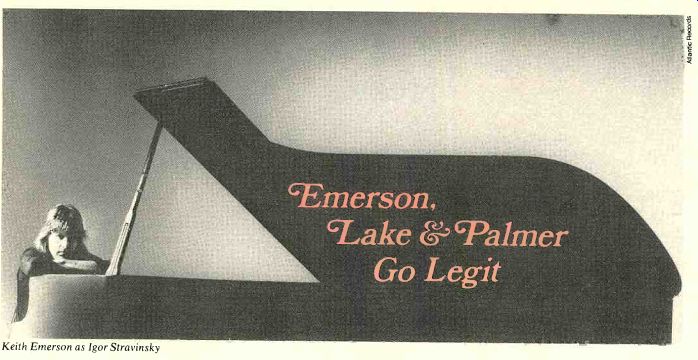
Emerson Lake and Palmer go Legit
Keith Emerson as Igor Stravinsky AN odd thing happened on the way to the Royal Festival Hall. Keith Emerson, musician par excellence, put on his concert drag and promptly forgot almost everything of value that he had learned in jazz/rock. Except for one Gershwinesque cadenza and a bit of British upper lip, his Piano Concerto No. 1, which can be heard in a new release ("Works, Volume 1") from Atlantic, is a straight, light weight piece of busy neo-Classicism of the kind that used to win foundation grants a quarter of a century back.
The truth is that deep in many a jazzer's or rock-and-roller's soul is a desire to go legit, to "do" classical music, to climb up the social ladder on the musical scale. Ironically enough, this often corresponds to a parallel desire by classical composers to incorporate the vernacular (Ives-Joplin, Copland-Gershwin, etc.), and we're quite clearly slouching into one of those synthesis periods right now.
I recently wrote a book on popular or "vernacular" harmony with Michael Sahl [see review on -Ed.] and we discovered (or rediscovered) the tremendous areas of over lap between the languages of popular and modern classical music; this helped give a couple of old-time avant-gardists a new freedom to use the popular speech in new con texts. How odd, therefore, to find as skilled and original a rock-head as Keith Emerson trying to earn the right to write old-fashioned modern music! First of all, let us admit that this double al bum, with its pretentious get-up, pompous title, formal black cover, concerto and all, is mainly a frame for Keith Emerson's "serious" ambitions: Piano Concerto No. 1 (is there a No. 2?) in the Russo-French manner of Prokofiev and Poulenc, with a touch of Stravinsky and Gershwin-et voila. Make no mistake, Keith Emerson, the most musical head in the rock business, has the musical powers and the pianistic dexterity to carry this off. Questions of style or fashion aside, this concerto is almost gauche enough to be camp, but there is not a false move or hint of awkwardness in it. And, in spite of its loose ness, I would say that it at least hangs together better than, say, the comparable Gershwin pieces do. Emerson's powers of invention are not remotely equal to Gershwin's, but his ideas are amusing and engaging. What Gershwin could deliver that this piece does not are (1) a true ability to synthesize elements from apparently disparate sources and (2) schmaltz. This is said not to make odious comparisons, but to try to get some perspective on what's going on here. I find this concerto wistful and appealing-"Like me," "Accept me," "I'm classical," it seems to say. But it is pops without the pop and obviously someone will now have to hire EL&P to do the rock version! I don't have much to say about EL&P's version of Copland's Fanfare for the Common Man; it never had much musical content to start with, and it is stretched awfully thin in this arrangement. Pirates, a long instrumental ... this concerto is almost gauche enough to be camp, but ... fi with orchestra and a Zap comics lyric by Peter Sinfield, is really closer to that synthesis idea than anything else on the record, al though, interestingly enough, it has none of the far-out qualities sometimes associated with EL&P.
Greg Lake's side is a set of simple songs de signed to set off his sexy singing. His style is--ahem !--ecstatic eclecticism (does that sound musicological enough?), right on the edge of Alfred Newman (the film composer, that is) and the Hollywood Bowl. The attention-grabber in the bag is Hallowed Be Thy Name, one of those weirdo Black Mass pieces left over from Lake's days with King Crimson. Besides the plushy singing, the key to the other songs is the lush orchestral arranging; elegant as it is, it cannot alone provide the classical-masterpiece aura that, I gather, is supposed to hover over everything in this set.
Carl Palmer's involvement in this wildly eclectic montage is even more peripheral.
Versions of Prokofiev and Bach (having been caught out before, EL&P now carefully label their classical sources) and a re-release of Tank from the group's first album are accompanied by three heavily written, musically thin tunes authored or co-authored by Palmer (probably mostly studio-made riff improvs).
There is nothing wrong with EL&P's musicality and eclecticism, but the very title "Works" implies a serious synthesis that is nowhere even attempted, let alone achieved.
We await Volume 2.
-Eric Salzman
EMERSON, LAKE & PALMER: Works, Volume 1. Emerson: Piano Concerto No. 1; Fan fare for the Common Man (arr. from Cop land); Pirates. Lake: Lend Your Love to Me Tonight; C'est la Vie; Hallowed Be Thy Name; Nobody Loves You Like I Do; Closer to Believing. Palmer: New Orleans. Palmer/ Emerson: L.A. Nights; Tank. Palmer/South: Food for Your Soul. Prokofiev: The Enemy God Dances with the Black Spirit (arr. from "Scythian Suite"). Bach: Two Part Invention in D Minor (BWV 775). Keith Emerson (piano, synthesizer); Greg Lake (guitar); Carl Palmer (drums); London Philharmonic Orchestra, John Mayer cond. (in concerto). Greg Lake (vocals); orchestra and choir, Godfrey Salmon cond. (in Lake songs). Orchestra of the Paris Opera, Godfrey Salmon cond. (in Pirates). ATLANTIC SD 2-7000 two discs. $13.98 TP 2-7000 $13.97, CS 2-7000. $13.97.
=========================
All Out for Uplift
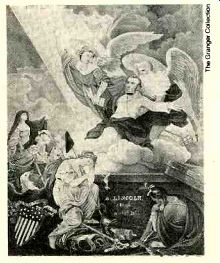
LISTENING to "Angels' Visits," a stunning if somber new album from New World Records, is like walking through a well preserved Victorian cemetery. As Richard Jackson explains in his notes, our forebears in Victorian America were rather preoccupied with death and their chances in the life here after-and no wonder, since the death rate was certainly very high. There were 630,000 casualties in the Civil War, infant mortality took a heavy toll, and a man who died in his fifties was considered to have attained a ripe old age. Death was much on the popular mind, and the songs of the period inevitably reflect concern with the subject.
Some of the songs in this collection are as ornate as the elaborate hearses, coffins, and tombstones of the funeral business that flourished at the time. From Sweet By and By, with its promise of a mass reunion on heavenly shores, to Put My Little Shoes Away, a lachrymose little item in which a dying child demands a drop of water on his burning cheek and the preservation of his shoes for his baby brother while he himself goes off to wear golden wings in a better realm, the songs in "Angels' Visits" go all out for uplift. The composers had such names as Joseph Philbrick Webster, Augustus Montague Toplady, and Mary Stanley Bruce Dana, and when it came to setting a sentimental topic to a plaintive tune there was no melancholy musical stop they didn't know how to pull. In these songs there is no separation between church and state-or, for that matter, journalism-so that what starts out to be a ballad mourning some disaster like the sinking of a ship ends evangelically with lines about the safe landing of the passengers on shores under benign celestial rule.
All is piety, and yet there is a good deal of musical substance in this collection. High praise must be accorded the soloists, the Harmoneion Singers under Neely Bruce, and Lawrence Skrobacs, whose nimble fingers can coax mournful chords from piano and harmonium with equal adroitness. And the re corded sound is excellent. You don't have to be in love with easeful death to savor "Angels' Visits."
-Paul Kresh
ANGELS’ VISITS. Webster: Sweet By and By; Willie's Grave. Woodbury: We Are Happy Now, Dear Mother. Lowry: Shall We Know Each Other There? White: Trusting. Buck: Rock of Ages. Melnotte: Angels' Visits. Pratt: Put My Little Shoes Away. Fischer: I Love to Tell the Story. Hicks: The Last Hymn. Dadmun: The Babe of Bethlehem. Anon.: Oh, You Must Be a Lover of the Lord; Flee as a Bird. Kathleen Battle (soprano); Raymond Murcell (baritone); Rose Taylor (mezzo-soprano); Lawrence Skrobacs (piano and harmonium); Harmoneion Singers, Neely Bruce cond. NEW WORLD NW 220 $8.98.
=============================
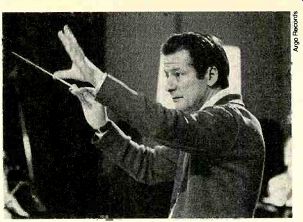
NEVILLE MARRINER: a cohesive, refined Tchaikovsky serenade.
... has a more cohesive flow, I find his the more interesting of the two discs, even though Leppard's well-chosen tempos and general straight-forwardness tend to make Marriner seem rather fussy by comparison. By way of oversimplifying: Leppard is more outgoing and robust, Marriner more reflective and expressive; Philips' close-up recording has a richer character, while Argo's has a crisp refinement of detail to match that of the Academy's playing. Those who might feel Marriner veers too near the world of Verklarte Nacht in his handling of Tchaikovsky's Elegie (the third movement) or lacks buoyancy in the second theme of the adorable finale will prefer Leppard's greater heartiness, but they will also have to accept a bit of gear-shifting, which never obtrudes in Marriner's subtly shaped reading, and far less clarity in the inner voices. Differences are less marked in the two Dvorak performances, but Marriner, no less animated than Leppard in this case, still has the edge in refinement. While my own preference is clear, I can't imagine anyone's being unhappy with either disc.
- R.F.
TCHAIKOVSKY: Symphony No. 4, in F Mi nor, Op. 36. Vienna Philharmonic Orchestra, Claudio Abbado cond. DEUTSCHE GRAMMOPHON 2530 651 $7.98, 3300 651 $7.98.
Performance: Brilliant
Recording: Rather thin in spots
TCHAIKOVSKY: Symphony No. 4, in F Minor, Op. 36. London Symphony Orchestra, George Szell cond. LONDON CS 6987 $6.98.
Performance: Vintage Szell
Recording: Good 1962 stereo
If you find Leonard Bernstein's treatment of the Tchaikovsky Fourth a little too wild and woolly, here are two excellent alternatives, both equally convincing and exciting in their respective fashions. Abbadomaintains the same classical dramatic "Verdian" manner in the Fourth Symphony that he employed with such brilliant success in his Vienna DG disc of the Pathetique. His reading of the Fourth is especially noteworthy for the wealth of de tailed nuance he brings, without fussiness, to the slow movement, which more often than not is passed over as comparatively lacking in interest. I'm a bit bothered by the sound, which seems to lack bass presence. A com parison of the opening of the last movement of the Fourth with the reprise of the scherzo of the Sixth will illustrate what I mean.
The Szell recording dates from 1962, but it was not allowed release during Szell's lifetime because of minor performance imperfections (far worse ones are allowed to pass nowadays). The reading and the playing are marvelously disciplined and solid, and, if Szell's opening movement is not as viscerally exciting as some, he builds up to a finale that is a real gut-buster. The orchestra is fairly close miked, but the overall sound is quite decent by any standards. Incidentally, the 1972 British release of this recording (on Decca SPA 206) was and is priced at £1.89, which at the present exchange rate is considerably below the price of this London issue.
VERDI: Arias (see Collections-Sylvia Sass)
COLLECTIONS
THE CLASSICAL MANDOLIN. Hasse: Concerto in G Major for Mandolin and Orchestra.
Gianneo: Suite Argentine for Mandolin and Orchestra. Beethoven: Four Pieces for Mandolin and Cembalo. Jacob Thomas (mandolin); Gunter Krieger (harpsichord); Heidelberg Chamber Orchestra. CMS/Ouvx EXP 40 $6.98.
Performance: Fun
Recording: Prickly
The mandolin has a surprisingly rich repertoire for such a humble little instrument and can draw from music by such composers as Mozart, Schubert, and Hummel as well as the works listed above. None of this music is great, but the wiry sound of the instrument is fresh, and it is amusing to hear the "greats" handle it. And so it is with this record: the music is nicely performed, the repertoire light and easy, and the sound will cheer the heart, It also makes a chic conversation piece.
-S.L.
COMPOSERS STRING QUARTET. Schuller: String Quartet No. 1. Cowell: Quartet Etil phometric. Stravinsky: Double Canon. Swift: String Quartet IV. Carter: Elegy for String Quartet. Composers String Quartet. GOLDEN CREST/NEW ENGLAND CONSERVATORY NEC-115 $6.98.
Performance: The best
Recording: On the dull side
The Composers String Quartet is, as its name suggests, an organization devoted to new music. The principal works represented here are two very modern-music-type quartets: one is an early, strong, severe work of Gunther Schuller, president of the New England Conservatory (and sometime conductor of Scott Joplin!); the other is by Richard Swift, the winner of a competition jointly sponsored by the quartet and the conservatory. Although found it difficult to sit still through Swift's quartet, I must admit that it is a very impressive piece of its kind and very impressively performed.
The album includes some short works of special interest. The Henry Cowell Quartet Euphometric is a rather early experiment (1916-1919!) that derives rhythm from the vibrations of the harmonies. This might sound as if it were a mathematical process, but the results are actually very rich and full of expression. The Elliott Carter Elegy, the com poser's own arrangement of an early duet for cello and piano, is a warmly tonal piece that preceded his First String Quartet, a work that took his music on quite another tack. And the Stravinsky Double Canon, written in 1959 in memory of Raoul Dufy, is an odd little twelve-tone exercise in a dry, Baroque tradition. Everything is exceedingly well played, but the recording quality is a bit on the dull-room side.
-E.S.
RECORDING OF SPECIAL MERIT
ILEANA COTRUBAS: Arias. Donizetti: Don Pasquale: So anch'io la viral magica. Mozart:
Le Nozze di Figaro: Deh vieni, non tardar. The Magic Flute: Ach, ich Phi's. Die Entfuhrung aus dem Serail: Ach, ich liebte. Puccini: Turandot: Tu, the di gel sei cinta. La Rondine: Chi it bel sogno di Doretta. La Boheme: Michiamano Mimi. Verdi: Rigolet to: Caro nome. La Forza del Destino: Pace., pace, mio Dio. Ileana Cotrubas (soprano); New Philharmonia Orchestra, John Pritchard cond. COLUMBIA M-34519 $6.98.
Performance: Exquisite singing
Recording: Excellent
The recording industry has been rather tardy in according suitable representation on discs to Roumanian soprano Ileana Cotrubas, who has been receiving enthusiastic notices in European centers for the past several years. But now, with Charpentier's Louise ( Columbia) already released and new recordings of La Traviata (DG) and L'Elisir d'Amore ( Columbia) soon to follow, matters seem to be moving in the right direction at last.
Meanwhile, we can enjoy Cotrubas' delightful singing in an almost entirely congenial repertoire in her first aria recital. Miss Cotrubas is a lyric soprano with impeccable schooling, whose tones are freely produced, pure, and perfectly placed, reminiscent of the young Hilde Gueden and Lisa della Casa. Her firm intonation and solid musicianship make for exquisite Mozart singing, further enriched by a relatively easy command of the florid writing in the aria "Ach, ich liebte." She is an engaging vocal actress, too, one who knows how to impart a mock-serious tone to Norina's reading of the letter, thereby making the transition into the playful "So anch'io la virtu magica" more effective.
The Puccini-Verdi side is equally pleasing in terms of vocalism, and, surely, her Mimi and Magda (La Rondine) cannot be faulted. I prefer more emotional stops pulled for the death of Liu, however, and, though it is interesting to hear an intimately scaled "Pace, pace" as an experiment, this is not a role for Ileana Cotrubas and the aria's inclusion seems puzzling.
In the Donizetti and Mozart arias conductor Pritchard gets beautiful orchestral playing and neat details in the woodwind writing. The orchestra sounds no less beautiful in Verdi and Puccini, but the pacing for the Rigoletto and La Boheme arias is too slow.
- G.J.
RECORDING OF SPECIAL MERIT
SYLVIA SASS: Puccini and Verdi Arias. Puccini: Turandot: Inquesta Reggia. Tosca: Vissi d'arte. Manon Lescaut: In quelle trine mor bide; Sola, perduta, abbandonata. Madama Butterfly: Un bel di vedremo. Verdi: Aida: Ri torna vincitor. Macbeth: Sleepwalking Scene. I Lombardi: O madre, dal cielo ... Se vano, se vano ... No! No! Giusta causa. Sylvia Sass (soprano); London Symphony Orchestra, Lamberto Gardelli cond. LONDON OS 26524 $7.98.
Performance: Individual
Recording: Very good
Still short of her twenty-seventh year, Sylvia Sass finds herself at the top of her profession, solidly booked for years ahead in the world's most prominent theaters. She is, without a doubt, an extraordinarily gifted artist, but the danger of "too much, too soon" definitely threatens. The storm signals were evident in the three Toscas she sang at the Metropolitan last March, though assuming that demanding role without the benefit of a single orchestral rehearsal (a fact never revealed in the press) did not make things any easier for her. She does seem to take on extraordinary challenges with some regularity, and this recorded recital is one of them. But the challenges are not forced on an unwilling victim. "The difficulties of Turandot are exaggerated," she told me in New York between Toscas. "There is no acting to speak of, just standing still and getting the notes out. Now Butterfly-that's a difficult, indeed a searing part. I may wait for ten more years before doing it on stage." On record Miss Sass gets the notes out commendably in Turandot; those in mid range are sensitively phrased, but the top ones show some strain. Butterfly's "Un bel di," on the other hand, gets a beautiful performance, thoughtfully phrased, with exquisitely colored tones, particularly lovely in soft dynamics. This is pretty much characteristic of her singing throughout the recital. She is a very musical artist and an intensely dramatic one in the Callas mold-an influence she readily acknowledges. She is no carbon copy, however, but quite an individual interpreter, and this individuality is, at this time, perhaps her most striking characteristic. Everything here commands interest, but not everything is sung with consistent smoothness or tonal beauty. At forte levels, the top register is pre carious, which is a troublesome development in such a young singer. Time will tell if we are now in the presence of another Callas-or another Suliotis.
Gardelli provides exceptionally fine accompaniments. The recorded sound is opulent, but reverberation detracts from the clarity of the singer's enunciation.
-G.J.
-------------
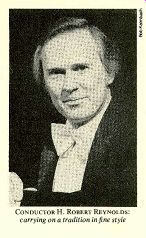
CONDUCTOR H. ROBERT REYNOLDS: carrying on a tradition in fine style "Terrific" Modern Music For Wind Band IN spite of the long history of the band as a popular medium and the tremendous diffusion and high quality of wind playing in this country, band music is a relatively neglected medium today. Notwithstanding the efforts of the famous Goldman Band and the many excellent university ensembles, the "low-brow" band only occasionally sneaks through the back door in the more respectable, high-class-sounding guise of "wind ensemble." Case in point: neither of two excellent recently re leased wind-music recordings comes to us out of the mainstream of the recording industry, but from somewhat out-of-the-way places.
One of the great pioneers of modern wind music was Paul Hindemith. Although his own instrument was the viola, Hindemith could play at least a scale on most of the winds.
Much of his best music for these instruments dates from the Twenties, when he first made a conscious attempt to extend his "music for use" (Gebrauchsmusik) outside of the standard classical ensembles. Although his is "art" music for winds, it remains in touch with popular traditions. The Concert Music for Wind Orchestra, for instance, has a nice "band" sound and employs an Austrian folk song as a subject for some genial variations. The Geschwindmarsch paraphrases a wind march by Beethoven that-is itself in a "popular" vein. The Symphony for Band, although writ ten for a real band (it was commissioned in 1951 by the U.S. Army Band), is more serious and uncompromising in manner. But all three pieces, the heavier and the lighter, have the composer's characteristic fingerprints every where, and since Hindemith's four-square German-modern style is so well suited to the wind band, they come out sounding terrific in the excellent recorded performances by the University of Michigan Band.
With the possible exception of the professional Goldman Band, the University of Michigan has probably the most famous band in the country, and conductor H. Robert Reynolds is carrying on its tradition in fine style.
And it isn't just a matter of the band's sheer power and sonority--for an example of real finesse, try the slow movement of the Hindemith symphony.
American symphony orchestras are among the principal beneficiaries of the excellence in wind playing fostered by the activities of schools such as Michigan. The Louisville Orchestra, for instance, long known for its performances and recordings of specially commissioned new music, has always been strongest in its wind department. The Louisville woodwind and brass sections get a chance to shine (along with the percussion section) in a new record of music by Ernst Kienek and Peter Maxwell Davies.
Kienek's Three Merry Marches and Kleine Blasmusik date from 1929 and 1931, respectively-that is, after his sensational 1927 op era, Jonny Spielt Auf, but before he turned to twelve-tone composition. The "Little Wind Music" is a quiet piece in the Hindemithian "music for use" genre (it was in fact arranged from a four-hand piano work written for Kitnek and a friend). The marches are hilarious parodies of German and Austrian beer-barrel marches. There was a streak of wit and an attunement to popular idiom in Krenek's music in those days, which, alas, he abandoned in his later work.
THE alternation of popular idioms and severely abstract modes is a major feature of twentieth-century music that applies equally to younger composers like Peter Maxwell Davies. The Saint Michael Sonata, written in 1957, long predates Maxwell Davies' recent interest in pop elements, instead combining serialism with Renaissance brass music traditions in a skillful post-Webern manner, Ktenek went from Jonny Spielt Auf and the Merry Marches to super-serialism; Maxwell Davies has gone in the other direction, from the elegant neo-Renaissance pointillism heard here to pop collages and theatrical works. The wind band--a more "modern"-sounding ensemble than the orchestra with strings serves well either way.-Eric Salzman HINDEMITH: Concert Music for Wind Orchestra, Op. 41; Geschwindmarsch; Symphony in B-flat Major for Band. University of Michigan School of Music Wind Ensemble and Symphony Band, H. Robert Reynolds cond.
UNIVERSITY OF MICHIGAN, SM 0003 $7.95 (from the University of Michigan School of Music, Ann Arbor, Mich. 48109).
KRENEK: Kleine Blasmusik, Op. 70a; Three Merry Marches, Op. 44. DAVIES: Saint Michael Sonata. Louisville Orchestra (wind, brass, and percussion sections), Jorge Mester cond.
LOUISVILLE FIRST EDITION LS 756 $6.98 (from Louisville Orchestra First Edition Records, 333 West Broadway, Louisville, Ky. 40402).
--------
Also see:
BEST RECORDINGS of the MONTH--Jazz: Miles Davis' "Water Babies" . .. Vocal: "An Evening with Diana Ross" ... Orchestral: Josef Krips' Mozart Symphonies ... Opera: Rimsky-Korsakov's May Night